

From the USGS:
In a new publication, the 2022-2024 Climate Adaptation Postdoctoral Fellows cohort explores how climate-driven low-flows in rivers alter water quality, how those water quality changes influence ecosystem health, and how instream flow management has been used across the U.S. to address these challenges.
Across the country, rivers and streams are experiencing declining water quality as low-flow extremes become more common. These low-flow events, or periods when rivers have reduced water levels, are strongly influenced by increasing temperatures, rainfall extremes, and a growing demand for fresh water.
Low-flows were the focus of a national synthesis project led by the CASC Climate Adaptation Postdoctoral (CAP) Fellows ‘Future of Aquatic Flows’ cohort. The team, comprised of post-docs located in each CASC region, conducted a review of the current literature and expert knowledge to better understand the influence of low-flows on water quality and aquatic ecosystems across the U.S., and its implications for future management.
Their research found that although the drivers of low-flows vary across the country, certain water quality patterns are consistent. For example, low-flows are frequently connected to higher stream temperatures, particularly in urbanized areas and the western U.S. When river temperature is warmer, dissolved oxygen levels drop and salinity increases, creating challenges for ecological, municipal, and agricultural water usage. Degraded water quality has detrimental impacts on aquatic ecosystems, including disrupting food webs, reducing habitat connectivity, and increasing macroinvertebrate mortality.
While several river management frameworks have been developed to address these challenges, they differ in their geographic scale and in how they integrate water quality measures. Since ecological impacts vary by river and location, the team suggests that local case studies could be used to highlight successful management approaches and help regions across the U.S. collaborate on similar low-flow issues. To better inform the long-term resilience of river ecosystems, they recommend that scientists seeking to understand river management priorities collaborate more closely with managers to develop and use frameworks that emphasize water quality measures.
As changes in temperature and precipitation patterns exacerbate challenges for managers and ecosystem health, incorporating water quality into place-based management approaches can help keep river flows in balance.
This national synthesis was completed as part of the Future of Aquatic Flows cohort (2022-24) of the Climate Adaptation Postdoctoral (CAP) Fellows Program. Hosted by the CASCs, the CAP Fellows Program brings together postdoctoral scholars from around the country to conduct independent and collaborative research directly applicable to regional management priorities.
RESEARCH ARTICLE: What goes with the flow: exploring climate impacts on low-flows, their influence on water quality, and instream flow management responses across the United States
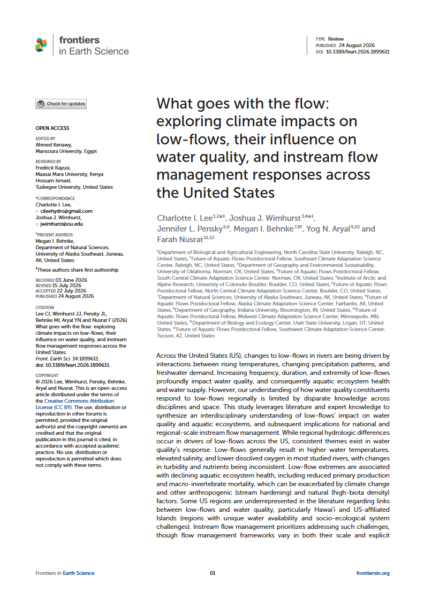 By Charlotte I. Lee, Joshua J. Wimhurst, Jennifer L. Pensky, Megan I. Behnke, Yog N. Aryal, Farah Nusrat
Across the United States (US), changes to low-flows in rivers are being driven by interactions between rising temperatures, changing precipitation patterns, and freshwater demand. Increasing frequency, duration, and extremity of low-flows profoundly impact water quality, and consequently aquatic ecosystem health and water supply.
However, our understanding of how water quality constituents respond to low-flows regionally is limited by disparate knowledge across disciplines and space. This study leverages literature and expert knowledge to synthesize an interdisciplinary understanding of low-flows’ impact on water quality and aquatic ecosystems, and subsequent implications for national and regional-scale instream flow management.
While regional hydrologic differences occur in drivers of low-flows across the US, consistent themes exist in water quality’s response. Low-flows generally result in higher water temperatures, elevated salinity, and lower dissolved oxygen in most studied rivers, with changes in turbidity and nutrients being inconsistent. Low-flow extremes are associated with declining aquatic ecosystem health, including reduced primary production and macro-invertebrate mortality, which can be exacerbated by climate change and other anthropogenic (stream hardening) and natural (high-biota density) factors.
Some US regions are underrepresented in the literature regarding links between low-flows and water quality, particularly Hawai’i and US-affiliated Islands (regions with unique water availability and socio-ecological system challenges). Instream flow management prioritizes addressing such challenges, though flow management frameworks vary in both their scale and explicit representation of water quality constituents. Our review provides context about the US’ instream flow management challenges and the importance of water quality’s consideration in managing low-flow regimes.

