
Several news sources featured in the Daily Digest may limit the number of articles you can access without a subscription. However, gift articles and open-access links are provided when available. For more open access California water news articles, explore the main page at MavensNotebook.com.
In California water news this weekend …
The Pacific off California set a 177-year record for June warmth. And a historic El Niño is still building
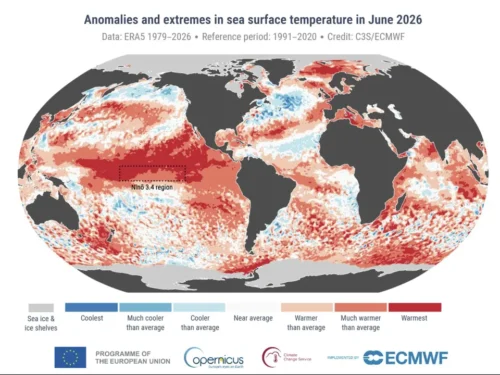 “The stretch of Pacific Ocean off California and the West Coast has never been this warm in June. Last month, water temperatures in the region ran more than 3 degrees Fahrenheit above the 20th century average, the highest June departure in 177 years of records, according to data from the National Oceanic and Atmospheric Administration published Thursday. The record is part of a remarkable buildup of ocean heat across the eastern North Pacific. The region has been running unusually warm for months amid a persistent marine heat wave, and the January-through-June period was also the warmest on record. Globally, ocean temperatures were also the warmest ever recorded in June. The extraordinary warmth is unfolding as a historically strong El Niño continues to develop in the tropical Pacific, adding another source of ocean heat and atmospheric disruption heading into the second half of the year. … ” Read more from the San Francisco Chronicle.
Exceptionally broad and persistent west-central U.S. ridging to bring periods of elevated heat and monsoon moisture to CA and the SW, with record heat across Intermountain West
Dr. Daniel Swain writes, “June was a relatively warm month across much of the western U.S. compared to long-term averages, though record warmth was limited to the Four Corners region. Much of the California coast, despite some warm and sunny days, was relatively cool under a persistent marine layer–though, notably, temperatures even here were *much* warmer than during recent “June Gloom” events between 2023-2025 despite the fog and stratus as near-shore ocean temperatures warmed. Early July has actually been cooler than much of June in some parts of the West, though that trend will reverse (quite dramatically in some places) in the coming days. … ” Continue reading from Weather West.
Climate change may boost California’s hurricane flood risk: study
“Hurricanes are exceptionally rare in California. Records hold only a handful of strikes since the middle of the 1800s, and even those were just glancing blows. The trend may not hold as the climate changes. A recent study revealed that southern California may endure more frequent heavy rain and landslide events in the future as tropical cyclones push closer to the region. The eastern Pacific Ocean is a hotbed of tropical activity every year, producing around 15 tropical storms in an average season, with eight of those storms growing into hurricanes. Most of that activity remains off the western shores of Mexico where favourable atmospheric conditions and very warm sea surface temperatures can support development. Storms tracking north typically fall apart in a hurry due to cold sea surface temperatures. Only a handful of tropical systems have ever made it to California intact, including a hurricane that grazed San Diego in 1858, followed by a tropical storm landfall in 1939. … ” Continue reading from the Weather Network.
Increased fire risk expected in Northern California for next few months
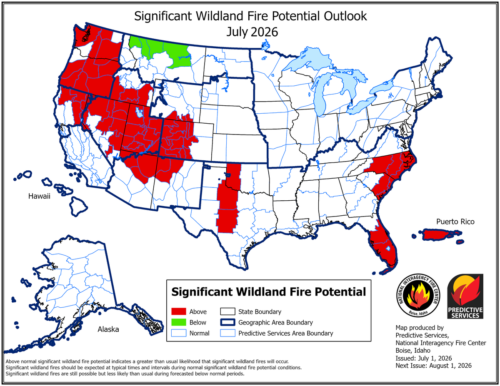 “As the peak of California’s fire season nears, federal forecasters say the mountains and inland valleys of Northern California face a riskier stretch than usual over the next three months. The National Interagency Fire Center’s July outlook projects above-normal significant fire potential from July through September across northeastern California and the Northern Sierra — a swath that includes communities from the Shasta-Trinity region through the northern portions of the Sacramento Valley and down to South Lake Tahoe. … ” Continue reading from the Sacramento Bee.
Environmental DNA monitoring protects fish hatchery from invasive species
“USGS NOROCK scientists, in collaboration with the U.S. Fish and Wildlife Service, used environmental DNA monitoring in the early detection of invasive New Zealand mudsnails in a fish hatchery, enabling a rapid and successful eradication response. This effort prevented a mudsnail infestation that could have led to long-term operational disruption or permanent facility closure. … To our knowledge, this represents the first published case documenting the use of eDNA monitoring for early detection followed by and successful rapid response eradication of an invasive species in a hatchery setting. … ” Read more from the USGS.
UC Santa Cruz team helps California Air Resources Board better understand how wetlands sequester carbon and improve air quality
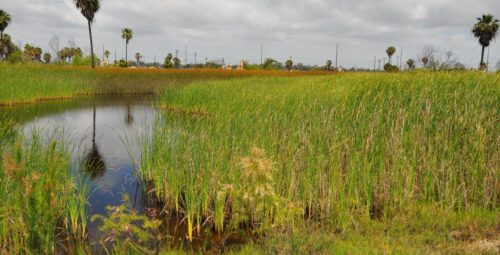
“To support the state’s climate change mitigation efforts, as well as its goals for clean air and sustainable environments, researchers from the University of California, Santa Cruz, have recently started monitoring the atmosphere at two very different wetlands to measure how much carbon they store and emit. Earth and planetary sciences professor Adina Paytan and members of her lab are partnering with the California Air Resources Board (CARB) and AmeriFlux to study two wetlands in Southern California. One is the Los Cerritos Wetlands, an estuary in Long Beach that is highly degraded from industrial use. The other is neighboring Seal Beach National Wildlife Refuge, one of the largest and most pristine wetlands in Southern California. … ” Read more from UC Santa Cruz.
State Water Contractors responds to Court’s denial of request for a temporary restraining order
“On Thursday, July 9, the U.S. District Court denied a request for a temporary restraining order that would have restricted the U.S. Bureau of Reclamation’s planned operations of Shasta Dam and reduced releases for the remainder of summer and early fall. The Court found the Bureau’s operational plans represented a reasonable interpretation of the 2024 Endangered Species Act biological opinion, clearing a path toward more real-time, responsive releases from Shasta. “The State Water Contractors support measures that maximize water flows for our farms and communities while complying with the Endangered Species Act,” said Jennifer Pierre, General Manager of the State Water Contractors. … ” Continue reading from the State Water Contractors.
Western United Dairies responds to State Water Board’s revised draft Dairy Order
 “Western United Dairies (WUD) today responded to the State Water Resources Control Board’s (State Water Board) release of a revised draft order regarding waste discharge requirements for dairies in the Central Valley. The order is currently scheduled for consideration for adoption by the State Water Board on September 15. Throughout this process, WUD has been actively engaged with the Central Valley Water Board and State Water Board, participating in meetings, reviewing proposed language, and providing comments grounded in the firsthand experience of dairy farmers across the region. Underscoring their meaningful involvement in this process, WUD most recently participated in a July 8th State Water Board Workshop around the draft order. At the workshop, Paul Sousa, WUD’s Director of Environmental Services and Regulatory Affairs, was part of an industry panel that highlighted the dairy community’s ongoing work to protect drinking water and improve nutrient management. The panel also voiced concerns about the unachievable aspects of the revised draft order, including the proposed approach to new and existing dairies. … ” Read more from Western United Dairies.
California lawmakers seek ‘forever chemicals’ protections despite EPA rollbacks
“As the Trump administration delays regulations on “forever chemicals” that pollute reservoirs, rivers and aquifers nationwide, California officials say they are unsure what the consequences will be for an estimated 1.5 million Californians served by utilities with contaminated sources of drinking water. With uncertainty over when regulations on some of the most common of these cancer-causing pollutants, called per- and polyfluoroalkyl substances or PFAS, will take effect in California, lawmakers are floating alternative plans to remove them from the state’s tap water. Among several forever chemical-related bills in Congress is one that would tax PFAS manufacturers to help utilities pay for expensive treatment technologies. State legislation that could have led to the ban of pesticides containing PFAS has been watered down by lawmakers, but environmental advocates still see the bill as an important first step. … ” Read more from Capitol & Main.
In commentary this weekend …
Waste and unreasonable use: The overriding doctrine for California water law
Max Gomberg, C-WIN Senior Policy Advisor, writes, “If there is a single overriding principle that defines the consumption of water in California, it is the legal definition of “waste and unreasonable use.” This concept is foundational to the entire body of laws, rules and policies that determine the use of water in California; and even though it is honored in the breach more than the observance, it remains a central means for safeguarding equitable distribution of water in the state. Avoiding waste and unreasonable use, in fact, is mandated by the California Constitution. Article X, Section 2 of the Constitution declares water rights are privileges granted by the state to use water—not property rights. They come with the caveat that such use can only be applied to “reasonable and beneficial” uses. This means that the reasonable and beneficial metric serves as an overarching constraint to all uses and diversions. … ” Read more from C-WIN.
Podcasts …
CALIFORNIA SUN: Mark Arax on California’s extraction ethos
The author and journalist Mark Arax joins us to discuss his recent sweeping essay in the Guardian, published under the headline “California: Land of Plunder and Hypocrisy.” From the Gold Rush to the artificial intelligence boom, Arax explores how California’s myths, ambitions, and repeated reinventions have often concealed a far more complicated history of extraction, contradiction, and self-deception.
VOICES OF THE VALLEY: Regenerative Roots: Farming for the next 100 years
In this episode of Voices of the Valley, we explore the future of regenerative agriculture through the lens of stewardship, conservation and long-term resilience. Hosted by Western Growers’ Jeana Cadby, the conversation features Craig McNamara, founder of Sierra Orchards, who shares his decades-long journey in farming and his vision for farming for the next 100 years. From integrating sheep into orchard systems and restoring Chinook salmon habitat to investing in farmworker well-being and the next generation of farmers, McNamara shares how regenerative agriculture can support both the land and the people who depend on it. The conversation also explores water conservation, biodiversity and the importance of long-term stewardship in California agriculture.
GREEN ROOT: Poisoning California’s most famous lake?
On episode 131 of the Green Root Podcast (the official podcast of Eco-Integrity Alliance), Melissa Soderston, president of Tahoe Forest Matters, exposes California “land management” agencies’ scheme to log, burn, and poison public lands surrounding Lake Tahoe. Host Josh Schlossberg talks with Melissa about how the U.S. Forest Service and other agencies spray toxic herbicides after destroying forest ecosystems with ineffective “wildfire fuel reduction” logging; how glyphosate/Roundup threatens the waters of California’s iconic Lake Tahoe; How the region’s forests are growing back beautifully after the so-called “devastating” Caldor fire of 2021; The myth that California’s public lands are “unmanaged” as they are subjected to some of the largest, most destructive logging schemes in the U.S.; and Melissa’s take on a root cause of the ecological crisis.
WATER IS A MANY SPLENDOR’ED THING: Blue Green Algae
 Scott Springer grew up in Chicago and decided to pursue his personal growth in the 1960s by traveling clear across the country to Mt. Shasta, California. It was there that he learned of the benefits of blue green algae that grew from the waters of Klamath Lake, Oregon. Water is a Many Splendor’ed Thing brings you another water relationship that has a personally significant impact to your life. Produced by Stephen Baker, Bringing People Together to Solve Water Problems, water@operationunite.co 530-205-6388
ECO NEWS: The remarkable history and uncertain future of abalone with Author Ann Vileisis
Explore the exciting world of abalone! Author, naturalist, and environmental historian Ann Vileisis talks to the Gang Green about the sad, strange and sometimes hopeful history of California’s abalone.
RIPPLE EFFECT: The climate condition and 2026 El Nino
Our very own Dr. Joe Casola, Climatologist at C.K. Blueshift, joins us to discuss the current climate, how it got here, and what the future holds. We dive deep into warming trends and what the rising heat means for society as a whole. We explore what El Niño could mean for our water, both in the monsoonal season and upcoming winter. Taking advantage of these climate trends, we can make smarter decisions for the future.
In regional water news this weekend …
NORTH COAST
Ukiah has plenty of water — the Ukiah Valley doesn’t
“Drill a well in Redwood Valley, and a gallon a minute can pass for good news. Twenty gallons a minute, by local standards, is a gusher. Drill one a few miles south, inside the city of Ukiah, and some wells pump more than 1,000. Same valley, same rain. The difference is what’s under the ground. Sean White has run the Ukiah Valley’s water from both ends of the pipe. He managed the Russian River Flood Control district, the agency that sells the valley its river water. Then he ran the City of Ukiah’s water utility until he retired in December. The city keeps him on as a “retired annuitant” — pension-system speak for a retiree hired back part-time — and he works a few hours a week. … ” Read more from the Mendocino Voice.
SACRAMENTO VALLEY
Invasive mussel found in Sacramento area, Lake Oroville remains free
“Months after the California Department of Water Resources halted its boat inspection program locally, Butte County waterways overseen by the department remain free of golden mussels. The invasive species was found in the Sacramento River near West Sacramento in June, specifically in the river’s deep water ship channel in two locations. According to a map provided by the California Department of Fish and Wildlife, these are the closest sightings to Butte County as of Friday. A notice by DWR in April said the decision to end the inspection program was based on new analysis that showed a “lower risk of golden mussel establishment than was originally anticipated.” … ” Read more from the Chico Enterprise-Record.
Projected Folsom Lake levels put salmon, recreation and water planning in focus
“During his winter drives up Interstate 80 toward Lake Tahoe, Sean Bigley keeps his eyes peeled. He isn’t just watching traffic — he’s also scanning the highway shoulders to see exactly how much snow has fallen. To Bigley, the city of Roseville’s environmental utilities director, a bare roadside is an early warning sign. “You may see snow in the upper reaches of the mountain tops, but you may not necessarily see that (along) Interstate 80,” he said. “And so that may indicate it may not be a good year coming.” A “good year” is tied to water levels at Folsom Lake. Fed largely by melting Sierra snowpack, the reservoir supplies water to the Sacramento region and much of California through the U.S. Bureau of Reclamation — a federal water management agency. … ” Read more from the Sacramento Bee.
BAY AREA
Sports salmon season reopens in CA, bringing big catches and new hope to North Bay fishermen
“After nearly a three-year closure, Bay Area sport salmon fishing is back, and North Bay fishermen are celebrating a season already producing impressive catches. At Bodega Bay on Friday, the charter boat Surf Scooter returned to the dock with coolers full of king salmon, giving anglers and fishing operators a long-awaited boost after years of restrictions tied to declining salmon populations. “We’re greeting this with open arms,” said Captain Rick Powers of Bodega Bay Sport Fishing. “Things have been tough the last few years to say the least.” Powers said fishing conditions have been exceptional since the season reopened. … ” Read more from ABC 7.
Suisun City Council gets update on eastward expansion plan
“Suisun City’s ambitious expansion plan moved another step closer to public scrutiny Tuesday as officials announced the Environmental Impact Report is nearing completion, clearing the way for the first public look at how the proposed growth could affect traffic, the environment and city services. Deputy City Manager Jim Bermudez said the Environmental Impact Report on the Suisun Expansion Specific Plan is nearly complete. “Over the next month, the team is zeroing in on a set of key topics,“ he said. “Kind of the key sticking points, and we are working through those topics, which will allow us to close out all of the remaining sections.” … ” Read more from the Santa Rosa Press Democrat.
Demolition of cement plant begins at historic Cupertino quarry
“Construction crews this week begin work to demolish and remove a sprawling cement plant at a historic quarry in the hills west of Cupertino that has provided building materials for dams, highways, bridges and other projects across California since the 1930s, but in recent years encountered growing environmental violations and opposition from neighbors. Workers will remove roughly 40 structures across 123 acres at the Permanente Quarry, a job that will take two years, according to officials at Heidelberg Materials North America, a German company with U.S. headquarters in Irving, Texas, that owns the site. Planned for demolition are massive conveyor belts, silos, mills, warehouses, offices and even the huge cement kiln that heated rock to 2,700 degrees. “It’s essentially the entire plant,” said Gregory Ronczka, vice president of environmental projects for Heidelberg Materials North America. … ” Read more from the San Jose Mercury News.
CENTRAL COAST
New study says Fort Ord water posed no public health hazard
“According to a study by the Agency for Toxic Substances and Disease Registry, the drinking water in the Fort Ord area from 1985 to 1994 did not pose a health risk to soldiers and residents. The agency only had access to complete data from 1985 to 1994, ending when the base closed, a period of time when many spoke out, linking their own cancer to the time spent at the base as reported in an Associated Press story in 2022. Although some contaminants were detected and many were flagged as areas of future study, the ultimate conclusion was that “Residents and soldiers-in-training who drank, showered, washed, and cooked with water from former Fort Ord and Marina Coast Water District (MCWD) drinking-water well from 1985 to 1994 were not at risk for health effects due to contaminant exposures.” … ” Read more from the Monterey Herald.
Greenfield wins $111 million for new wastewater plant as city races to stop spills
“Greenfield’s new development has pushed its aging sewage treatment plant to the brink, leading to sewage spills, leaks and, most recently, a building moratorium on new housing and commercial development, forcing the city to pursue an upgrade. “If we don’t, we’re at risk of having further spills, and we don’t want any more risk for the city,” Greenfield Mayor Bob White said. The solution is $111 million in state grant funding and low-interest loans to build a new wastewater treatment plant that will nearly double the city’s sewage capacity to 2 million gallons a day, up from 1.2 million gallons. … ” Read more from KSBY.
Paso Robles: Vernal connection
“Idyllic, ain’t it? Charles Salas led me down into a recently restored ephemeral creek on his 1700-acre Estrellita Ranch tucked away in the rolling green hills of Paso Robles in Central CA. The creek was lush with fragrant arroyo lupine, purple sage thistle, and vibrant California poppies, and low-growing goldfields, a far cry from what it was when Salas began breathing life back into the array of sensitive habitats surrounding his ranch. He purchased his ranch in June 2025 but began restoring critical habitat on the property in January 2025. One of those projects involved removing an absurd number of beat-up tires from what is now a pristine watercourse. The five tons of tires were removed by hand, a slow, laborious project, but one of many projects that has brought a smile to Salas’ face. “As a guy who worked in finance his whole life,” said Salas, who retired from his finance job in San Diego two years ago, “it’s been a fun ride, a fun education.” … ” Read more from the Montecito Journal.
SAN JOAQUIN VALLEY
Why will 450 sheep be near this river in Fresno County?
“A plan to restore up to 180 acres of land along the San Joaquin River is in the works with the help of 450 sheep, officials announced on Friday. The 450 sheep will be grazing at the San Joaquin River Conservancy’s Jensen River Ranch and Lanes properties, with the sheep grazing in the area over the next four to eight weeks to prepare the landscape for native habitat restoration. The plan was put together by the Sierra Resource Conservation District (Sierra RCD), in partnership with the San Joaquin River Conservancy and the City of Fresno. … ” Read more from Your Central Valley.
Bakersfield: Going with the flow…while it lasts
“The City of Bakersfield pledged to run some of its Kern River water down the normally dry river bed through town at least until July 30th this year. While it lasts, the Kern River Parkway Foundation and Bring Back the Kern are hoping to draw attention to the difference a little water makes in the river bed by holding “Sunsets on the River” events at Yokuts Park each Thursday through the rest of the month. The events, which start at 6:30 p.m. and run until sunset, are low-key with no need to register and no cost to families. Volunteers host rubber duck races, provide fly fishing demonstrations, talk about the natural flora and fauna in and around the river, and more. Water fights are encouraged. … ” Read more from SJV Water.
EASTERN SIERRA
Judge in groundwater adjudication case sharply questions experts for the large pumpers and will appoint a ‘special master’
“After taking evidence and hearing several days of testimony from expert hydrogeologists and groundwater modelers, the Indian Wells Valley Groundwater Basin Adjudication Court has concluded that it will appoint an independent groundwater expert, called a Special Master, to assist the Court in the review of the complex scientific evidence. Initially, the Court sided with the Indian Wells Valley Water District, Searles Valley Mineral, and Meadowbrook Dairies (Large Pumpers) opposition to the appointment of an independent expert to assist the Court. However, after some pointed questioning of experts for the Large Pumpers and expert testimony showing fatal flaws in the Larger Pumpers analysis, the Court concluded that an independent expert review assistant was necessary to ensure the Court’s decision is based on a thorough evaluation of the scientific evidence. … ” Continue reading from the Indian Wells Valley Groundwater Authority.
SOUTHERN CALIFORNIA
BLM approves right-of-way for Cadiz northern pipeline
“Cadiz, Inc. (NASDAQ: CDZI/CDZIP, the “Company”) is pleased to announce today that the U.S. Bureau of Land Management (“BLM”) issued a final decision approving the right-of-way (“ROW”) grant that allows the Company to begin construction on conversion of the Cadiz Northern Pipeline from natural gas to water conveyance. BLM’s approval of the ROW, when fully executed by the Company, authorizes the conversion and operation of the Northern Pipeline for the conveyance of water on BLM-managed lands under the authority of Title V of the Federal Land Policy and Management Act (“FLPMA”). “We’re excited to achieve this pivotal milestone,” said Susan Kennedy, Chair and CEO of Cadiz. “After many years of planning and environmental review, the project is now ready to begin the construction stage.” … ” Read more from PR Newswire.
Cadiz pipeline permit threatens Mojave Desert groundwater
“Today, the leaders of California Tribes, community, and environmental organizations are highlighting their opposition to a Cadiz-Trump administration plan to extract and export groundwater from the California desert, including selling it to other states. This outcry from Californians comes as the Bureau of Land Management issued a pipeline permit for Cadiz, Inc. without conducting its legally required review of the significant groundwater depletion that the project would cause. Cadiz, Inc., a foreign investor-backed company, has for decades attempted to gain approval for various schemes to extract and sell groundwater from underneath California’s desert. That groundwater supports California’s prized public lands in Mojave Trails National Monument and Mojave National Preserve—lands, landscapes, and waters that are sacred to Native American Tribes including the Chemehuevi Indian Tribe and the Fort Mojave Indian Tribe. … ” Read more from the National Parks Conservation Organization.
SAN DIEGO
Go inside this hidden Corona del Mar marine lab – and its 100 years of ocean science
“Hiding out among the luxury beachfront condos in the Newport Beach neighborhood of Corona Del Mar is an outpost where scientists have been conducting important marine research for nearly a century. And you can go check the place out for yourself. With its Spanish style architecture that includes a central tower and red-tiled roof, Caltech’s Kerckhoff Marine Laboratory looks like it’s been teleported in from another time and place. Originally built as a boat and club house, it was purchased by Caltech in 1929 for use as a beachfront science outpost. Victoria Orphan, James Irvine Professor of Environmental Science at Caltech and director of the Kerckhoff Marine Lab, said the place is one of the oldest running marine labs on the West Coast. … ” Read more from the LAist.
California starts statewide marine biodiversity documentation in San Diego
“Marine scientists spent the past two weeks at San Diego County tide pools documenting the diversity of life found along the California coast, kicking off a statewide project in San Diego. The project is a multi-year statewide initiative to document and catalog invertebrates and algae found in California’s intertidal zones — coastal areas where the ocean meets the land between the tides. Tide pools are isolated pockets of seawater that are found in intertidal zones. Researchers, students and volunteers from UC San Diego’s Scripps Institution of Oceanography and other organizations led the way in San Diego this summer as they documented the first intertidal sites of the California Intertidal Biodiversity DNA Barcode Library Project. … ” Read more from Fox News.
Along the Colorado River …
Dry winter leaves farmers along Colorado River facing greater water shortages
“This past winter was an extraordinarily dry one in the western U.S. A lack of snowpack that normally feeds the Colorado River has only deepened the impact of a drought affecting tens of millions in seven states and Mexico. Accelerated by climate change, the drought is taking a bite out of farmers’ plans in Colorado. Science correspondent Miles O’Brien reports for our series, Tipping Point.” Read transcript at PBS News Hour or watch video below.
SEE ALSO: Report: Colorado River Basin bakes under relentless drought, from Western Water
Taxpayers on the hook? Developers seek billions over failed Southern Nevada city
“California developers Albert and Thomas Seeno sat in a Las Vegas courtroom this week as their attorney argued why taxpayers should be on the hook for what has become the worst business deal of their careers. To attorney and former Nevada Lt. Gov. Mark Hutchison, a decision by state regulators to block the development of Coyote Springs — a proposed mini-city near the springs that feed the Muddy River — is blatant, unjust government overreach. “Judge, what happened here is just wrong. It hits you in the gut,” Hutchison said. “At the end of this evidence, we’re going to ask the court to right this wrong.” … Experts say the first-of-its-kind case could rewire the state’s water law, opening the door for any water user to sue the government if they believe their property has been rendered unusable — or “taken” in legal terms — due to an unfavorable water rights decision. It could have ripple effects for the Nevada state engineer, the top water regulator in the nation’s driest state. … ” Read more from the Las Vegas Review-Journal.
SEE ALSO: Podcast: Lawsuit could determine Nevada regulators’ ability to curtail water rights, from Nevada Public Radio
In national water news this weekend …
How redefining one word strips the Endangered Species Act’s ability to protect vital habitat

“It wouldn’t make much sense to prohibit people from shooting a threatened woodpecker while allowing its forest to be cut down, or to bar killing endangered salmon while allowing a dam to dry out their habitat. But that’s what the Trump administration is doing by changing how one word in the Endangered Species Act is interpreted: harm. For 50 years, the U.S. government has interpreted the Endangered Species Act as protecting threatened and endangered species from actions that either directly kill them or eliminate their habitat. A new federal rule change, announced July 10, 2026, keeps the first part – protecting against the direct killing of the species – but removes habitat destruction. That matters, because most species on the brink of extinction are on the Endangered Species list because there is almost no place left for them to live. Their habitats have been paved over, burned or transformed. Habitat protection is essential for their survival. … ” Read more from The Conversation.
Trump, ending decades of protection, opens wild habitats to drilling and mining
“The Trump administration on Friday moved to open the habitats of imperiled animals to farming, drilling, mining, real estate development and other activities in what environmentalists characterized as the most severe erosion of protections for wildlife in half a century. It did so by recasting a single word, “harm.” For more than 50 years, the federal government has used a broader definition of harm to animals under the Endangered Species Act, a bedrock environmental law. It included any significant “modification or degradation” of habitat that kills or injures animals by impairing their ability to eat, shelter or breed. The Supreme Court upheld this interpretation in 1995, ruling against property owners who argued that harm should only mean directly killing or injuring an endangered animal. But on Friday, the Interior Department and the Commerce Department announced a final rule that rescinded this longstanding interpretation. Under the rule, destroying an endangered species’ nest or habitat would no longer be considered illegal. … ” Read more from the New York Times.
SEE ALSO: Trump admin narrows Endangered Species Act protections, from E&E News
[spacer]
