
By the USGS
USGS NOROCK scientists, in collaboration with the U.S. Fish and Wildlife Service, used environmental DNA monitoring in the early detection of invasive New Zealand mudsnails in a fish hatchery, enabling a rapid and successful eradication response. This effort prevented a mudsnail infestation that could have led to long-term operational disruption or permanent facility closure.
Background
The Hatchery
The Alchesay National Fish Hatchery is part of the U.S. Fish and Wildlife Service’s National Fish Hatchery system and is located on the Fort Apache Reservation in Whiteriver, Arizona.
- The hatchery supports recreational angling by rearing brown and rainbow trout for Tribal reservoirs, lakes, and rivers across the Southwest, including Apache reservations, the Navajo Nation, and the Hopi reservation.
- The hatchery relies on the North Fork White River to supply cool water. The invasive New Zealand mudsnail is present in the region and has been detected at the confluence of the hatchery’s outflow with the North Fork White River.
New Zealand Mudsnail
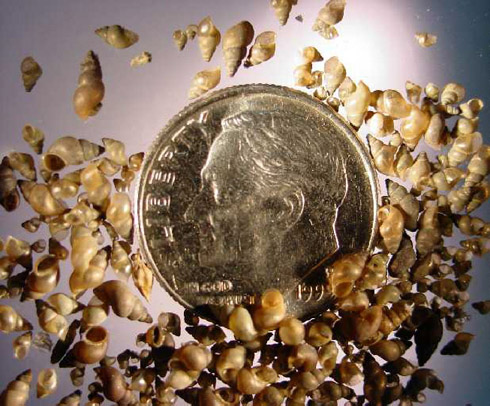
The New Zealand was first detected in Arizona in 1995 and the American West is one of the global hotspots for the invasive species.
- The invasive New Zealand mudsnail grows to about 0.2” in length in the U.S., making it difficult to detect using visual methods, particularly during the initial stages of invasion.
- The invasive snails can be ecologically disruptive by competing with native aquatic invertebrates and have the potential to alter aquatic foodwebs.
- They are parthenogenic (females can bear live young without males), meaning a single snail can initiate an invasion of new habitat or an infestation within a fish hatchery.
- Infestations at hatcheries increase the risk of spreading this invasive species to other locations during fish stocking operations.
Early Detection, Rapid Response at the Hatchery
Early Detection Monitoring at the Hatchery
USGS Northern Rocky Mountain Science Center scientists, in collaboration with the FWS and the White Mountain Apache Tribe Game and Fish Department, developed a proactive early detection monitoring program for New Zealand mudsnails at the Alchesay National Fish Hatchery.
- The monitoring program uses environmental DNA (eDNA)—genetic material shed by organisms in the environment and collected by researchers.
- Given their small size and rapid reproduction, eDNA sampling was selected as an effective method to quickly detect New Zealand mudsnails if they began to invade the hatchery. Monitoring with NOROCK began in 2021.
Snail Detection and Rapid Response
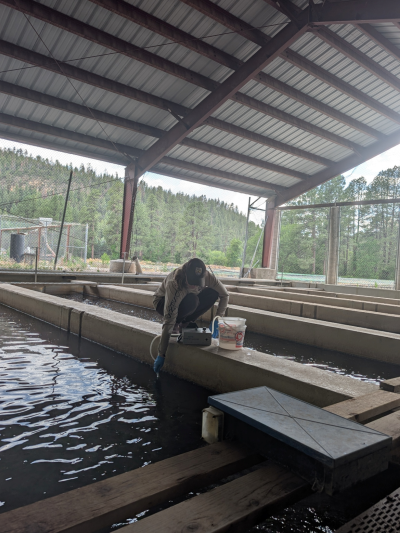
In July 2024, eDNA monitoring detected New Zealand mudsnails in a localized area of the hatchery, triggering a successful rapid response eradication effort by the FWS and White Mountain Apache Tribe Game and Fish Department.
- The affected section of the hatchery was isolated from the rest of the facility, thoroughly searched, and four snails were located.
- The impacted area was treated to eliminate any remaining snails and following multiple post-treatment eDNA sampling events through December 2024, the hatchery was confirmed to be free of New Zealand mudsnails.
eDNA Monitoring was Effective and Costly Consequences Avoided
Although only four New Zealand mudsnail individuals were located, it only takes one to initiate an infestation because of their ability to reproduce parthenogenically. Relying solely on visual detection in fish hatcheries is challenging, as many areas (e.g., pipes and water distribution boxes) are inaccessible for inspection. In fact, the snails in this case were found within a water distribution box.
- eDNA monitoring proved to be an efficient and cost-effective approach for early detection of New Zealand mudsnails at the Alchesay National Fish Hatchery.
- By detecting the snails at a very low abundance, eDNA enabled the FWS and partners to initiate a timely and successful rapid response eradication effort.
- In contrast, a previous New Zealand snail infestation resulted in the permanent closure of a Utah fish hatchery in 2014 resulting in the loss of local jobs and ~$57 million to construct another facility. The Alchesay National Fish Hatchery avoided a similar fate due to the eDNA early detection monitoring and the subsequent rapid response to eradicate the snails.
- To our knowledge, this represents the first published case documenting the use of eDNA monitoring for early detection followed by and successful rapid response eradication of an invasive species in a hatchery setting.
RESEARCH PAPER: Bright spot in eDNA monitoring: Early detection of invasive New Zealand mudsnails (Potamopyrgus antipodarum) prompted effective rapid response for fish hatchery
By: Devin Slobodian, Patrick R. Hutchins, Jennifer Graves, and Adam Sepulveda
 The New Zealand mudsnail (NZMS; Potamopyrgus antipodarum) is a widespread aquatic invasive species that is parthenogenic, requiring only a single individual to initiate an infestation.
Fish hatcheries–which are critical infrastructure that raise fish to support conservation, recreation, and subsistence fisheries–frequently use local water sources to provide cool water and are especially vulnerable to NZMS invasion from the contamination of water supplies. If an invasion proceeds undetected, hatcheries pose a risk for compounding the spread of NZMS because their operations transfer live organisms and associated water between hatchery facilities and, when stocking, to rivers and lakes.
The U.S. Fish and Wildlife Service’s Alchesay National Fish Hatchery, located on the Fort Apache Indian Reservation in Whiteriver, Arizona, produces trout to stock in Tribal reservoirs, lakes, and rivers across the southwestern U.S. New Zealand mudsnails were first documented in Arizona in 1995, are now widespread in this region, and occur at the confluence of the hatchery’s outflow with the North Fork White River. Contamination of water supplies is the principal pathway for NZMS invasion into the hatchery.
Here, we describe early detection environmental DNA (eDNA) surveillance efforts for NZMS at Alchesay National Fish Hatchery. Positive eDNA detections initiated a chain of events that ultimately led to four NZMS individuals being discovered and a rapid response eradication effort. Follow-up eDNA sampling and visual observation efforts after the eradication effort have yielded no detections of NZMS eDNA. We credit the success of this case with four key elements: rapid turnaround times, a robust quality assurance scheme, a proactive eDNA sampling design, and established partnerships.
To our knowledge, this is the first published case of eDNA monitoring being used for early detection and successful rapid response for complete removal of an invasive species in a fish hatchery.

