
Several news sources featured in the Daily Digest may limit the number of articles you can access without a subscription. However, gift articles and open-access links are provided when available. For more open access California water news articles, explore the main page at MavensNotebook.com.
In California water news this weekend …
Environmental groups sue California State Parks over plan they say endangers protected wildlife
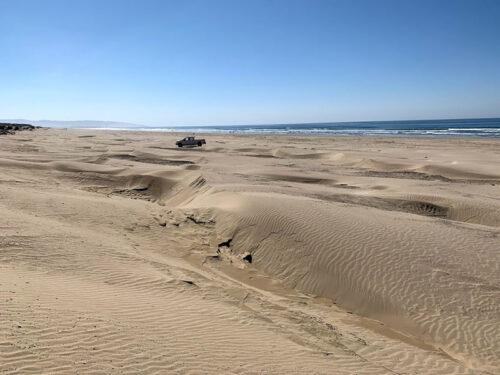 “An environmental group and Native American tribe have challenged California’s approval of the Oceano Dunes habitat conservation plan, saying it will allow for the killing of federally protected wildlife. The Center for Biological Diversity and the Northern Chumash Tribal Council argue that a habitat conservation plan and a final environmental impact report certified in May underpin State Parks’ application for an Endangered Species Act incidental take permit. Such permits authorize the harming, pursuit or killing of protected species within a project area. Such take can stem from motor vehicle use. In their lawsuit, filed Thursday, they ask a Sacramento County Superior Court judge to vacate the environmental report’s certification and block further project approvals until the state complies with the California Environmental Quality Act. … ” Read more from the Courthouse News Service.
Newsom’s stance on controversial data centers about to be tested. Again.
“Gov. Gavin Newsom vetoed legislation to require proposed data centers to provide estimates of their water usage last year, saying he was “reluctant to impose rigid reporting requirements” without understanding the impact on businesses and consumers. Opposition to the mammoth tech hubs and their massive thirst of water, power and land has only escalated throughout the state and nation ever since. In just a matter of months, Newsom again could find himself in the political crosshairs. Several bills to regulate the facilities and increase public transparency on their impacts are progressing in the California Legislature, which could create a conundrum for a governor who has long aligned with the tech industry but also paints himself as an environmental and social justice advocate. … ” Read more from the LA Times. | Read via AOL News.
SEE ALSO: When Data Scarcity, Water Scarcity, and Data Center Development Meet, from Santa Clara University
Testing before taking: California court confirms DWR may enter land before project funding is secured
“In Department of Water Resources Cases, the Third District Court of Appeal addressed whether the California Department of Water Resources (DWR) may obtain court-authorized entry onto private property to conduct environmental, cultural, and geotechnical investigations before a water project is fully authorized and funded. The dispute arose from DWR’s ongoing effort to evaluate property for the Delta Conveyance Project and related water conveyance planning in the Sacramento-San Joaquin Delta. The court affirmed the trial court’s entry order and rejected landowners’ argument that Water Code sections 250 and 11580 bar any such pre-condemnation activity until formal project approval and funding are in place. … ” Read more from Mondaq.
Suisun City budget highlights importance of California Forever plan
“The Suisun City Council will consider adopting the city’s fiscal year 2026-27 budget Tuesday, a spending plan that not only outlines the city’s finances for the coming year but also highlights the importance of the proposed Suisun City Expansion Plan and ongoing negotiations with California Forever to the city’s long-term future. Council members are scheduled to review and potentially approve four resolutions covering the city’s annual budget, the Housing Authority budget, the Successor Agency budget and the city’s annual appropriations limit required under state law. According to the staff report, the proposed budget represents the third year of a five-year “resilience bridge strategy” designed to guide Suisun City toward long-term fiscal sustainability. City officials say the plan rests on three key pillars: revenue generated by Measure S, a voter-approved sales tax; a pipeline of 17 infill development projects; and a future decision regarding the Suisun City Expansion Plan and related development opportunities tied to California Forever. … ” Read more from the Daily Reporter.
Efforts to save kelp forests from ocean warming are ramping up
“In the coastal waters off British Columbia, tribal volunteers from the Haida Nation dive for purple sea urchins amid a dense forest of rippling golden-brown kelp fronds. Sunlight filters through the canopy, creating a mesmerizing dance of light and shadow, as rays and sea lions wend through the kelp maze, sharks glide past, and bright orange garibaldis dash between the swaying fronds. Kelp forests are biodiversity hot spots teeming with a colorful variety of seaweeds, sponges, crustaceans, and other small ocean animals, many of them found nowhere else. At one time, vast kelp beds grew in nutrient-rich shallow waters along roughly a third of the world’s coastlines, where they helped to reduce the strength of waves, minimized coastal erosion, and provided shelter to fish, invertebrates, and marine mammals. Today, however, many kelp forests are on life support, victims of water pollution from terrestrial agriculture and coastal development, bottom trawling for fish, and an explosion of kelp-devouring urchins, like those the Haida volunteers are collecting as part of an eradication program. But perhaps the most important driver of kelp decline is the rapid warming of the ocean. … ” Read more from Grist.
In people news this weekend …
Promotions, passings, profiles – submit people news items to maven@mavensnotebook.com.
Alyson Piguee—Building trust through leadership & connection
 “At Santa Margarita Water District, strong public service depends on strong leadership—and Alyson Piguee brings both experience and purpose to the work of serving the community. As Director of Government & Public Affairs, Alyson leads the team responsible for communications, community outreach, public education, advocacy, marketing, media relations, and grants strategy. Her team helps connect customers, residents, elected officials, and community partners with the important work happening across the District every day. With more than 15 years of leadership experience across city, county, special district, nonprofit, and private sector organizations, Alyson brings a thoughtful, strategic perspective to her role. Before joining SMWD, she served in leadership positions with the Inland Empire Utilities Agency and the County of Orange, where she guided public policy initiatives, organizational transformation efforts, emergency response coordination, and large-scale operational projects. … ” Read more from the Santa Margarita Water District.
Podcasts …
WE GROW CALIFORNIA: Water’s movers & shakers with Meena Westford, San Diego County Water Authority
This week’s guest, Meena Westford, Director of Imported Water for the San Diego County Water Authority (The Authority) shares the inside scoop on new water transfer agreements with other Metropolitan Member Agencies, a groundbreaking Memorandum of Understanding that will allow interstate water transfers, and how customer messaging matters now more than ever. These new-ways-of-doing-business deals didn’t happen overnight; timing is everything. The right people are in the right places – smart, seasoned, and thinking differently to solve today’s problems without yesterday’s baggage; Meena is one of those people. Darcy & Darcy discuss litigation history, the Colorado River, and why these issues matter to all Californians, as well as those who benefit from what California produces.
ONCE UPON A BAY: The last place like this
Hidden behind Chevron’s tank farm and built on the bones of condemned ships, Point San Pablo Harbor feels like a place that shouldn’t exist. In this episode, we explore the history, characters, and unlikely revival of one of the last truly eccentric waterfront communities on San Francisco Bay. From its haunted breakwater to John Wayne, fishermen, resourceful holdouts, and occasional outlaws, this is the story of a place that survived by refusing to give up its soul.
GOLDEN STATE NATURALIST: Forgotten lands with Josh Jackson
California is home to 15 million acres of a kind of land most people have never heard of. These lands span deserts, grasslands, oak woodlands, and coastal rainforests. They’re free or very inexpensive to visit, and they’re almost never crowded. But what are these mythical wonderlands? These are the largely overlooked lands managed by the Bureau of Land Management, or BLM, and you can go and see them. Josh Jackson, author of The Enduring Wild: A Journey Into California’s Public Lands, took me to see one of these places he refers to as Forgotten Lands. While we were there, we discussed the history of BLM lands, nature behind a velvet rope and not behind a velvet rope, current threats to the land, how we can find and access BLM lands, and how connecting with these places can change not only how we look at nature far from home, but also how we see the living world in our own backyards.
WATERLOOP: The water cost of the cloud: Amazon discusses data centers
The impact of data centers is currently one of the most discussed issues in water. In this episode, Will Hewes, Water Sustainability Lead for Amazon, shares how one of the world’s largest data center operators is managing water use, responding to growing public scrutiny, and working to reduce its impact on local water resources.
SCIENCE YOU CAN USE: Restore ponderosa forests – and reduce fire risk? Study shows the path forward
Forest managers are increasingly looking to restore ponderosa pine forests to more ecologically diverse conditions—forests with clusters of trees, openings, and multiple age classes instead of the evenly spaced, uniform stands produced by traditional forest management.
WATER IS A MANY SPLENDOR’ED THING: Alaska’s Tlingit People
 Alaska’s native communities have lived in the coastal regions of the Alaskan Panhandle for many generations. Water has shaped their lives in every way. Stories heard and totem poles seen each describe the history and life of the Tlingit People. Water is a Many Splendor’ed Thing brings you another water relationship that has a personally significant impact to your life. Produced by Stephen Baker, Bringing People Together to Solve Water Problems, water@operationunite.co 530-205-6388
Sunday read …
BOOK REVIEW: Safe Drinking Water Act: The Next Fifty Years
 “When Manny Teodoro joined Adam Tank and me as an early guest on our podcast Water We Talking About?, it was immediately clear that he sees water as more than treatment trains and test results. He understands that water is governance. It is finance. It is accountability. This compendium, Safe Drinking Water Act: The Next Fifty Years (Palgrave Macmillan, 2026), written explicitly “for the men and women of the American water sector,” reflects that broader lens. Manny brings together respected leaders like Alan Roberson and Chad Seidel, along with many other accomplished water professionals, to create a practical, experience-driven examination of American drinking water. This is not theory for the ivory tower. It is guidance for operators, managers, regulators, and policymakers navigating real-world constraints. … ” Read more from the Water Shelf.
In regional water news this weekend …
NORTH COAST
Understanding juvenile salmon mortality in the Klamath River

“CDFW is working closely with our scientific colleagues at the U.S. Fish and Wildlife Service, Cal Poly Humboldt and Oregon State University to monitor Klamath River salmon and the impacts of the naturally occurring, microscopic C. Shasta parasite (short for Ceratonova shasta). This parasite is common in the Klamath and other Pacific Northwest rivers and its impact ebbs and flows with environmental conditions. Hot weather, warm water and low flows – conditions the Klamath is currently experiencing – can increase its prevalence. On the evening of May 14, CDFW’s Fall Creek Fish Hatchery released 675,000 certified pathogen-free Chinook salmon smolts into the Fall Creek tributary of the Klamath River about 7 miles upstream of the former Iron Gate Dam location. … ” Read more from the Department of Fish and Wildlife.
SEE ALSO: A parasite is infecting nearly half the young salmon in the Klamath River, from Active NorCal
Coalition expresses support for dam removal ahead of federal Potter Valley meetings
“This week, the Round Valley Indian Tribes, “Two-Basin Solution” partners and environmental groups released statements affirming their support for PG&E’s license surrender and decommissioning plan for the Potter Valley Project and the subsequent plans for dam removal and the construction of a new Eel-Russian facility along the upper Eel River watershed. Those statements of support come in advance of Federal Energy Regulatory Commission scoping meetings next week, the first hearings in what will be a protracted multi-year process to flesh out the future of the Potter Valley Project, the Eel River watershed and the Russian River watershed that has historically relied on water diversion from the Potter Valley Project. … ” Read more from the Eureka Times-Standard.
SIERRA NEVADA
California’s next great trail system is taking shape — and it could transform these forgotten towns
“Jack Menard hiked 1,000 tough vertical feet — bushwhacking through a dense pine forest, hopping over deadfalls and scrambling over loose scree — on a beeline for the top of Crystal Peak, a remote summit in the mountains north of Truckee. “We’re almost at our starting point,” he said. There’s no trail up the 8,075-foot mountain, and Menard, trails program coordinator with the Sierra Buttes Trail Stewardship, was scouting one. For a couple of hours, he and another trail worker, Simon Becwar Berry, ground-truthed a route that had been roughed out in mapping software — verifying every step of it. They graded each leg using a clinometer, a handheld device used to measure the angle of a slope, then marked their progress by tying bits of neon-orange flagging tape to tree branches and saplings. … ” Read more from the San Francisco Chronicle.
‘Gold fever’ still draws prospectors to a historic Amador County mining camp
“More than 150 years after author Bret Harte immortalized Roaring Camp in his 1868 story “The Luck of Roaring Camp,” people are still searching for gold in the hills along the Mokelumne River in Amador County. “There’s been tens of thousands of ounces pulled right out of this mountainside here, not only up and down the canyon, but just right here in this whole mountainside,” Roaring Camp Mining Company owner and general manager Ricky Lague said. Roaring Camp Mining Company operates as a recreational gold mining destination where visitors can stay in cabins or campsites and learn how to prospect for gold. Guests can also swim, fish, hike, collect rocks and use metal detectors on the property. Lague, a third-generation owner, said the area was heavily mined from the Gold Rush through World War II before his grandfather, Elton Rodman, purchased the property. … ” Read more from Channel 10.
SACRAMENTO VALLEY
Not your typical tow: Sacramento County Sheriff’s Office dive team recovers car from Sacramento River
“On June 7, the Sacramento County Sheriff’s Office deputies and their Marine Enforcement Detail recovered a sunken car after it took an unexpected dive into the Sacramento River. Sgt. Edward Igoe is a member of the office’s dive team and helped with this recovery mission. “We made this social media post just to try to give a little bit of a glimpse into what the dive team goes through,” Igoe said. He said dispatchers received a call from a distressed woman. She reported that her vehicle had “entered the water” near the intersection of Twin Cities and River roads. She was able to safely exit the car, but the real rescue mission was just getting started. … ” Read more from Fox 40.
BAY AREA
Alameda Co.: Water provider asks Tri-Valley residents to reduce outdoor usage during planned maintenance
“Water suppliers of Livermore, Dublin, and Pleasanton asked the public on Thursday to voluntarily limit outdoor water usage from June 27 to July 2 to coincide with planned maintenance to California State Water Project facilities that supply 70% of water to the region. Zone 7, the primary county water supplier for the Tri-Valley region, said that no restrictions are being placed in the lead-up to June 27 and ensured residents that this temporary measure is not a reflection of the overall water supply. “[This conservation period] it is a proactive safety measure to help ensure adequate supplies remain available for essential indoor use, emergency response, and fire protection during (the state Department of Water Resources’) planned maintenance,” Zone 7 said in a statement. … ” Read more from SF Gate.
CENTRAL COAST
NOTICE of hearing to consider modification of California American Water Company Cease and Desist order (State Water Board Orders WR 2016-0016 and WR 2009-0060)
“The State Water Board or Board, Division of Water Rights (Division) in coordination with the Administrative Hearings Office (AHO), will conduct a hearing on the written record, with an opportunity for public comment and oral presentation of policy statements, to inform the State Water Board’s consideration of Monterey Peninsula Water Management District’s application to modify Orders WR 2009-0060 and WR 2016-0016. … ” Continue reading from the State Water Board.
Urban water use examined in Oxnard
“The City Council approved a resolution on Tuesday, June 16, aftfter reviewing its Urban Water Management Plan, and Water Shortage Contingency Plan. The City’s Staff will file the plans with the State of California. Mayor Pro Tem Gabe Teran asked for an overview of the plan, since the presentation was live. Council Member Bert Perello noted that he recently brought up Artesian Wells at a Fox Canyon Groundwater Meeting and he spoke to a farmer about the amount of water flowing out of the ground. … ” Read more from the Tri-County Sentinel.
Camarillo: Supremes shoot down city’s mid-case water-rights gambit ruling
“The California Supreme Court has dealt a significant blow to the City of Camarillo’s immediate legal strategy in a multi-year battle over regional water rights. On May 27, the state’s highest court officially declined to review a lower court regarding how local groundwater is calculated and managed, closing off a swift appellate avenue for the city. The decision marks the latest chapter in a bitter legal feud that city officials previously described in the Camarillo Acorn as a “water crisis of others’ making.” Despite the setback, city leaders emphasize that the underlying litigation is far from over and vow to continue fighting to protect local utility ratepayers. … ” Read more from the Camarillo Acorn.
SAN JOAQUIN VALLEY
Fresno Irrigation District completes new groundwater recharge basin
“The Fresno Irrigation District is marking the completion of the Carter Bybee Basin, a new project aimed at boosting groundwater supplies in the region. The 35-acre groundwater recharge basin is designed to replenish the aquifer by about an additional 840 acre-feet each year. … ” Read more from ABC 30.
Newman Environmental Wetland System project to finish by Spring 2027
“After much anticipation and waiting, the Newman Environmental Wetland System (NEWS) project could finish by Spring 2027, according to Public Works Director Thomas Spankowski. Located southeast corner of Canal School Road and Inyo Avenue on an undeveloped 78-acre parcel of city-owned land, the 21-acre constructed treatment wetland that will treat Newman’s untreated stormwater before its discharge to the Newman Wasteway and delivery to the San Joaquin River. Additionally, it will also help increase groundwater supply to the Delta-Mendota Subbasin and reduce urban and agricultural pollutant loads. … ” Read more from Westside Connect.
Water districts look at kill rates, ponder golden mussel emergency declaration
“Golden mussels again dominated board discussions at several water district meetings. In particular, board members wanted to know how Kern County’s emergency declaration regarding the mussels will affect funding. Eric McDaris, water resources manager for Wheeler Ridge-Maricopa Water Storage District told his board that the first step is for costs to hit $5 million. At that point the county would send a letter to the state Office of Emergency Services that would potentially result in some reimbursements to districts. The county had gathered information indicating districs had spent $4.6 million at the time of its meeting on June 8. McDaris noted that there would not be reimbursements for private costs taken on by growers themselves. … ” Read more from SJV Water.
SOUTHERN CALIFORNIA
After public outcry, PUSD Board votes to save some trees slated for removal
“Pasadena residents fighting a school district plan to remove nearly 200 trees scored a win Thursday night. Pasadena Unified School District officials had said 193 trees across 11 campuses need to be cut down to clean up soil contaminated by the Eaton Fire. But on Thursday, the district’s board voted unanimously to attempt to save up to 57 of those trees. The adopted motion is no guarantee trees will be saved, but directs staff to evaluate other ways to remediate soil around certain mature, protected trees. The vote came after major public outcry from local residents, including a Pasadena teen who spent more than eight hours in the branches of an oak tree slated for removal at the district’s headquarters. … ” Read more from the LAist.
Congressman urges federal review of controversial Mojave Desert groundwater project
“U.S. Rep. Raul Ruiz called on the federal government Wednesday to launch a rigorous environmental and historic review of a controversial proposal to pump billions of gallons of groundwater from the Mojave Desert, framing the project as a threat to local communities, tribal sovereignty, and iconic national parks. In a formal letter to Interior Secretary Doug Burgum, Ruiz, D-Calif., urged the Bureau of Land Management to conduct a comprehensive assessment under federal environmental and historic preservation laws before deciding on a crucial pipeline right-of-way application for Cadiz Inc. The proposal by Los Angeles-based Cadiz, which is backed by foreign investors, seeks to extract 16 billion gallons of water annually for 50 years from an ancient desert aquifer. The company intends to export the water to distant, growing urban markets. “The California desert is a national treasure,” Ruiz said in a statement. “The Cadiz proposal is dangerously inconsistent with efforts to develop reliable and sustainable water supplies for communities.” … ” Read more from the Imperial Valley Press.
Along the Colorado River …
The Colorado River water supply crisis in a few graphs: Part 1
“In 2026 and for only the third time in the 21st century, there was no accumulation, and no recovery, of total Basin live storage6 during the snowmelt season. Nor was there any accumulation or recovery of total live storage in Lake Powell and Lake Mead during the 2026 snowmelt season. Total Basin live storage (hereafter, total Basin storage) is all the water available in the Colorado River Basin’s reservoir “savings account” and stored in reservoirs within the watershed.7 On June 1, total Basin storage was 22.94 million acre feet (maf), only 1.62 maf above the previous minimum of March 20238 and less than 2 years supply at the current rate at which water is consumptively used or lost in the Basin. Total Basin storage will almost certainly drop to less than the previous record minimum by March 2027. … ” Continue reading from the University of Colorado.

