Visit the Water Shelf main page
 First published on the To Know Water Is To Love Water blog February 24, 2026
By Jim Lauria
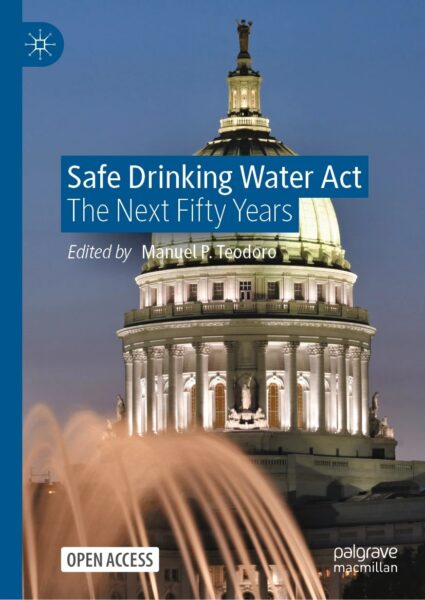
When Manny Teodoro joined Adam Tank and me as an early guest on our podcast Water We Talking About?, it was immediately clear that he sees water as more than treatment trains and test results. He understands that water is governance. It is finance. It is accountability. This compendium, Safe Drinking Water Act: The Next Fifty Years (Palgrave Macmillan, 2026), written explicitly “for the men and women of the American water sector,” reflects that broader lens.
Manny brings together respected leaders like Alan Roberson and Chad Seidel, along with many other accomplished water professionals, to create a practical, experience-driven examination of American drinking water. This is not theory for the ivory tower. It is guidance for operators, managers, regulators, and policymakers navigating real-world constraints.
One of the book’s most powerful distinctions is between contaminant removal and governance capacity. We in the industry are increasingly capable of measuring contaminants at parts per billion — and now parts per trillion. But measurement is not removal. And removal is not free. Ppm can mean millions, ppb billions, ppt trillions. Risk assessment therefore becomes more than a laboratory exercise; it becomes a societal decision about priorities, affordability, and public health protection.
The historical framing of the Safe Drinking Water Act reminds us that reform in our sector is often reactive. High-profile failures in Milwaukee, Flint, and Jackson were not failures of chemistry alone. They were failures of oversight, communication, funding, and governance. Compliance on paper does not guarantee resilience in practice.
Aging infrastructure compounds the challenge. Much of our buried capital is well beyond its intended lifecycle. At the same time, the workforce that built and maintained these systems is aging as well. The book rightly emphasizes that system performance ultimately depends on dedicated professionals — trained operators, engineers, and utility leaders — whose expertise cannot simply be replaced by regulation or technology.
Fragmentation is another central theme. The United States has tens of thousands of water systems, many too small to achieve technical, managerial, and financial capacity. Consolidation and regionalization are presented as partial solutions…ways to gain scale, professionalize management, and improve compliance. Yet scale must be balanced with local accountability. In the end, we are bound to our watersheds, and no governance structure changes that hydrologic reality.
The multi-barrier approach is treated not just as a treatment philosophy but as a governance model: protect the source, optimize treatment, maintain distribution integrity, enforce standards, and communicate transparently. Risk is best managed in layers. So is trust.
The financial gap looms large throughout the book. Federal and state funding help, but sustainable systems ultimately require pricing that reflects the true cost of service. The reluctance to align rates with reality leaves utilities dependent on crisis-driven infusions rather than long-term planning. Measurement technology may advance rapidly; pricing reform moves far more slowly.
The authors also stress the importance of professional alignment through organizations such as the American Water Works Association, Water Environment Federation, and National Rural Water Association (NRWA). In a highly fragmented sector, these associations provide standards, training, research, and a unified voice.
Perhaps most importantly, the book makes a compelling case that we must do a better job educating the general public about the value of water services. Most Americans only think about water when something goes wrong. Yet delivering safe, reliable water 24/7 is one of the most complex public services in modern society. Without public understanding, there will be no political support for sustainable funding or thoughtful risk management.
The book is neither a cynical critique nor a simplistic defense of the status quo. It honors the professionals who keep our water safe while challenging leaders to close the gaps between science and policy, funding and pricing, compliance and enforcement.
Clean water is not simply the product of good chemistry. It is the outcome of sound governance, disciplined risk assessment, professional dedication, and an informed public. For anyone who cares about the future of American drinking water, this book belongs in the conversation.