
Several news sources featured in the Daily Digest may limit the number of articles you can access without a subscription. However, gift articles and open-access links are provided when available. For more open access California water news articles, explore the main page at MavensNotebook.com.
In California water news this weekend …
Delta Conveyance Project receives critical federal clearance to advance construction
“Governor Newsom’s Delta Conveyance Project achieved another major milestone this week as it continues to advance towards construction. The California Department of Water Resources (DWR) has received Biological Opinions from the U.S. Fish and Wildlife Service (USFWS) and National Marine Fisheries Service (NMFS) for Delta Conveyance Project construction and construction-related maintenance activities. This important milestone marks the completion of the Endangered Species Act process for construction. California is now one critical step closer to completing the complex state and federal planning and permitting processes needed to begin project implementation. “The science is clear: California must quickly complete the Delta Conveyance Project to meet our water needs in the future,” said Governor Gavin Newsom. “I thank the federal government for their partnership in moving this project forward. By meeting this important milestone, we are closer than ever to seeing this vital piece of infrastructure completed and benefiting all Californians. Let’s get this built.” … ” Read more from Governor Newsom.
Federal agencies green-light Delta tunnel, but just construction
“The construction, though not the long-term operation, of a proposed 45-mile extension to the State Water Project, backed by Democratic Gov. Gavin Newsom, has received permission from two key federal wildlife agencies. On Friday, the California Department of Water Resources received permits known as biological opinions from the U.S. Fish and Wildlife Service and the National Marine Fisheries Service concluding that construction can proceed under conditions designed to protect endangered species and sensitive habitat. … The opinion of the Fish and Wildlife Service orders builders to take measures to avoid harming endangered or threatened species. The list includes two fish — the delta smelt and longfin smelt — a small migratory bird known as the least Bell’s vireo, San Joaquin kit fox, giant garter snake, California red-legged frog, California tiger salamander, valley elderberry longhorn beetle, two species that live in seasonal pools — the vernal pool fairy shrimp and vernal pool tadpole shrimp — western yellow-billed cuckoo, monarch butterfly, northwestern pond turtle and western spadefoot toad. … ” Read the full article at SF Gate.
SEE ALSO:
- Here are the biological opinions, posted at the Delta Conveyance Project website
- Delta Conveyance Project gets federal clearance to advance construction, from KTVU
Temporary barriers go up in the Delta
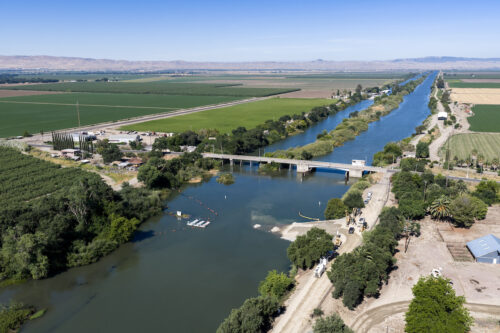
“Construction work at three channels in the southern end of the Sacramento-San Joaquin River Delta wrapped up Friday as part of the annual California Department of Water Resources South Delta Temporary Barriers Project, according to the department. Three temporary rock barriers have been constructed across South Delta channels to maintain water levels for agricultural activities in the South Delta. The project, undertaken in coordination with the South Delta Water Agency, was intended to offset impacts from water exports by the Central Valley Project and State Water Project pumping plants. … ” Read more from the Sacramento Bee. | Read via Yahoo News.
CA groups push $44B water plan over $60B Delta Tunnel
“A coalition of conservation groups and Tribes has released a proposal for California’s water future, calling for greater investment in local water supplies and less reliance on imported water sources. The Water Renaissance Plan for California outlines strategies to secure between 1.8 million and 2 million acre-feet of drought-proof water annually in Southern California by 2045 through stormwater capture, wastewater recycling, conservation, and groundwater cleanup projects. The coalition estimates the cost at approximately $44 billion. Supporters say those investments would produce significantly more water than the proposed Delta Conveyance Project, or Delta Tunnel, which is projected to yield about 400,000 acre-feet annually and could cost more than $60 billion. … ” Read more from Action News Now.
Unusually active June jet stream energizes late season low pressure before giving rise to broad and strong ridge by mid-June, with significant PacNW/NorCal heatwave possible
Dr. Daniel Swain writes, “The May and early June weather pattern across the West Coast has been–and remains–a changeable one. Repeated late season trough and low pressure sequences, bringing both unusually late-season showers as well as periods of fire weather-elevating dry north winds–have been the rule for some time. Much of this has been facilitated by an unusually strong late-season Pacific jet stream, particularly the subtropical branch over central and southern CA and points east. This unusually late-season showing of the subtropical jet is likely a product of the extreme warm ocean water to the southwest of California and the subsequently increased thermal differential between the subtropics and midlatitudes–something that is not uncommon during the developing stages of a strong El Niño event and amid the positive phase of the Pacific meridional mode (both of which are conditions currently in place). This general pattern makes it hard to mid-tropospheric ridges to build directly over California, though it does tend to favor the Pacific Northwest and western Canada as a location for strong and/or persistent ridging as a more active lower-latitude wind pattern “undercuts” the blockier pattern up north. And, indeed, over the coming week we are likely to see a progression from an anomalous West Coast trough to and anomalous West Coast ridge–both facilitated, in different ways, by an unusually strong and eastward-extended jet stream. … ” Read more at Weather West.
Kings County judge considering whether to advance groundwater lawsuit
“A Kings County Judge may decide next week whether to allow a lawsuit by the Kings County Farm Bureau to move to the next phase in its quest to prove the state Water Resources Control Board overstepped its authority when it placed the region on probation in 2024 for lacking an adequate groundwater plan. The Farm Bureau is also disputing what it says was an improper blanket denial by the Water Board of exemptions for some local agencies from those probationary measures, which require farmers to meter and register wells at $300 each, report extractions and pay the state $20 per acre foot pumped. At a June 3 hearing, Kings County Superior Court Judge Robert Burns said he may rule by June 11 on whether to start the discovery process, where both sides seek documents. If he does not issue a ruling, the parties will meet July 2 to determine next steps. … ” Read more from SJV Water.
Report: Refining farmland appraisals for SGMA and subsidence rules in California
“Groundwater is changing the ground rules of farmland appraisal in California. Traditional methods of appraising California farmland are growing increasingly obsolete as the state’s new subsidence best management practices (BMPs) drafted under the Sustainable Groundwater Management Act (SGMA) complicate the process via groundwater cutbacks tied to critical head thresholds with the power to suddenly reduce the economic lifespan of orchards. Cody Dahl, PhD, Vice President of Acquisitions and Strategy, AgIS Capital, LLC, and JoAnn Wall, ARA, CEO, Above and Beyond Real Estate Services, Inc., have collaborated to author an in-depth paper examining how this new consideration affects the application of cost, sales comparison, and income approaches when valuing farmland, and to offer guidance on how integrating hydrological indicators can result in reliable price valuation. … ” Read more from the Agriculture Investment Marketplace.
California Farm Bureau President Shannon Douglass discusses federal support, water challenges, and the future of agriculture
“California agriculture continues to face a complex mix of challenges, from labor shortages and water uncertainty to trade concerns and wildlife management. During a recent visit by U.S. Secretary of Agriculture Brooke Rollins to Bakersfield, California Farm Bureau President Shannon Douglass sat down with AgNet West’s Nick Papagni, host of The Ag Meter, to discuss the issues affecting farmers across the state and the importance of strong advocacy at both the state and federal levels. Douglass expressed appreciation for Secretary Rollins making her second trip to California, emphasizing the importance of federal officials hearing directly from the state’s farmers and ranchers. According to Douglass, one of the key goals of the visit was to ensure that the voices of California’s specialty crop producers are being heard in Washington, D.C. California agriculture is unique compared to many other states, particularly those in the Midwest, and growers often face different challenges when accessing federal programs and assistance. … ” Read more from AgNet West.
Comment period opens for Sites Project draft contracts for the administration of public benefits
“Draft contracts for the administration of public benefits (CAPBs) for the Sites Project, part of the Water Storage Investment Program, are now available online. The California Water Commission will receive public comments at the June 17, 2026, Commission meeting. The CAPBs document the public benefits in which the State is investing and ensure the delivery of these benefits called for by voters of Proposition 1 (2014). The CAPBS must be completed before final funding is awarded. … ” Read more from the California Water Commission.
Bill that would make state agencies consider Tribes during water policy decisions passes State Assembly
“An Assembly Bill sponsored by the Karuk Tribe, which seeks to expand consultation between state water agencies and tribes during water policy decisions, passed through the California Assembly last week. The Karuk Tribe says the bill could help address historic inequities by giving tribes a seat at the table. The vote was 57 in support and 23 members refusing to vote, including every Republican in the Assembly and three Democrats. If signed into law, Assembly Bill 2218 would declare, as statewide policy, recognition of “the inequities regarding access to, and control over, water caused by state-sanctioned acts of termination, removal, and assimilation inflicted upon all California Native American tribes.” … ” Read more from the Lost Coast Outpost.
Can California boost wildfire prevention with less cash? A new plan proposes to do just that
“State and federal wildfire officials have spent the past five years rapidly expanding efforts to thin out hundreds of thousands of acres of dense fire-prone forests, reduce the number of human-caused ignitions and fortify millions of homes against flames, heat and embers. On Friday, those officials unveiled a draft plan to ramp up the work and turn a flurry of projects and funding into a long-term strategy — even as the state expects to lose hundreds of millions of dollars from its annual wildfire prevention budget in the coming years. The new plan “is going to enable us to go bigger, smarter, and faster,” said Patrick Wright, director of the California Wildfire and Forest Resilience Task Force, a joint effort between the state and federal government that created the draft plan. “We’ve built that capacity, we’ve built that science, we’ve built that network. … Now, we’re ready to take everything to the next level.” … ” Read more from the LA Times.
In commentary this weekend …
Trump is pushing to erase this Northern California national monument’s protected status
Heather Bourbeau, a poet and fiction writer, writes, “I visited the newly designated Sáttítla Highlands National Monument this June as part of a series of trips I was making to national lands at risk of losing federal protection. Over the course of 10 months, I traveled to 40 national forests, monuments, parks, and other designated public lands across the Western U.S. I set out to document these lands before they were lost or irrevocably altered. What I learned was just how devastating these losses would be to all Americans. Sáttítla Highlands encompasses 224,676 acres in Northern California’s Modoc, Shasta-Trinity, and Klamath national forests. Sáttítla — which means “obsidian place” in the Ajumawi language — includes part of the ancestral homelands of the Pit River (Ajumawi–Atsugewi) and Modoc Peoples (Mo Wat Knii–Mo Docknii) and is central to their spiritual beliefs and cultural practices, as well as that of a number of other local tribes, including the Karuk, Klamath, Shasta, Siletz, Wintu and Yana. … ” Read more from the San Francisco Chronicle.
In people news this weekend …
Promotions, passings, profiles – submit people news items to maven@mavensnotebook.com.
Kaveh Madani, UC Davis Ph.D. alum, named 2026 Stockholm Water Prize Recipient
 “Kaveh Madani, Ph.D. ’09, noted the irony of the day he found out he had won the 2026 Stockholm Water Prize, the world’s highest water research honor. “It was a big surprise,” he told UC Davis Magazine. “And then I said, ‘How ironic, because eight years ago at this time, I was under arrest.’” Based in Toronto, Madani is now director of the United Nations University Institute for Water, Environment and Health and research professor at City College of New York CREST Institute. His path to get here has been wide-ranging. He is a leader in water science, and has taught at universities around the world. While working for the government in Iran, eight years ago, he was accused of espionage and labeled a “water terrorist.”He is recognized for integrating game theory and decision analysis into conventional water resources management models and coining the term “water bankruptcy.” …, ” Read more from UC Davis.
Podcasts …
TERRA VERDE: Toxic legacies on the San Francisco Bay shoreline
Across the San Francisco Bay shoreline, communities are living alongside the legacy of more than a century of industrial activity. From former chemical manufacturing facilities to hazardous waste sites, contaminated lands and waterways continue to shape the environment and public health of waterfront neighborhoods. As climate change drives sea level rise and raises groundwater tables, new questions are emerging about what happens when these contaminated sites meet a changing shoreline. In this episode of Terra Verde, host and producer Hannah Wilton speaks with Kevin G. Ruano Hernandez of Richmond Shoreline Alliance and Makayla Marquez of San Francisco Baykeeper about environmental justice, shoreline contamination, and efforts to build more resilient waterfront communities in the face of climate change. The conversation explores Richmond’s industrial history and the ongoing challenges posed by contaminated sites such as the United Heckathorn Superfund site and the former Zeneca chemical facility.
THE JEFFERSON EXCHANGE: Why Dunsmuir, California, claims to have the best water on earth
A small city along the upper Sacramento River is leaning into its natural assets — from spring-fed drinking water to fly fishing — as it works to balance tourism with long-term sustainability. Dunsmuir, in northern California’s Siskiyou County, has about 2,800 residents and sits along Interstate 5 and the Union Pacific Railroad. Situated in a canyon, it draws visitors for its scenery and access to outdoor recreation. Dunsmuir boasts the “best water on earth,” sourced from underground volcanic flows. “Our water comes from a volcanic tube that never sees the light of day until you turn the tap water on,” Mayor Juliana Luchessi said.
AgNET NEWS HOUR: California agriculture, water, and regulations take center stage in AgNet News Hour discussion
The focused heavily on California politics, agriculture policy, water management, labor concerns, and the future of farming during a wide-ranging June 1 broadcast featuring political analyst David Collenberg and discussions surrounding the upcoming gubernatorial race. Hosts Nick Papagni and Josh McGill opened the program by discussing frustration among farmers and ranchers who feel agriculture is being overlooked in statewide political debates despite California producing much of the nation’s food supply. “We need leadership that understands agriculture,” Papagni said during the broadcast as the conversation shifted toward regulation, water storage, energy costs, and food production.
CAPITOL WEEKLY: How California can get ahead of wildfires, with Steve Frisch
Our guest today is Steve Frisch, President and CEO of the Sierra Business Council (SBC) and a founding member of the Wildfire Solutions Coalition. With the devastating impacts of wildfire becoming more evident with each fire season, the Coalition advocates for funding and implementation of wildfire resilience strategies. While acknowledging California’s budget woes, he argues that preventing fires will save the state money, and that “this is not the year we should be reducing wildfire funding.”
WATER IS A MANY SPLENDOR’ED THING: The Crown of the Continent
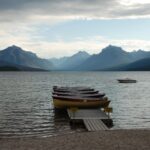 Glacier National Park is rich in water. It’s where you find a triple continental divide. Hudson Bay, the Atlantic and the Pacific are the ultimate destinations for Glacial National Park source water. Wild, beautiful and alive. Water is a Many Splendor’ed Thing brings you another water relationship that has a personally significant impact to your life. Produced by Stephen Baker, Bringing People Together to Solve Water Problems, water@operationunite.co 530-205-6388
In regional water news this weekend …
NORTH COAST
Drilling slurry believed source of white plume in Redwood Creek; agencies investigating
“The mysterious white plume that turned Redwood Creek milky and reached the South Fork Eel River this week is believed to have come from nearby drilling activity, according to information provided to Redheaded Blackbelt by the California Department of Fish & Wildlife. Lab results that could confirm the substance are not yet in. A Cal OES Hazardous Materials Spill Report filed Tuesday evening, June 2, first documented the opaque, bluish-white substance in Redwood Creek between Seely Creek and the Eel River along Briceland Thorn Road west of Redway. The substance covered the water shore to shore. Community members reported it had appeared the previous Saturday before clearing, then returned. … ” Read more from the Redheaded Blackbelt.
SIERRA NEVADA
The Sierra Nevada Conservancy awards new wildfire resilience and recreation grants; starts two new grant programs
“The Sierra Nevada Conservancy (SNC), a California state agency focused on improving the environmental, economic, and social well-being of the Sierra-Cascade, approved nearly $1.5 million to new early action wildfire-resilience projects and just over $3 million to new projects to help boost recreation and tourism in the Sierra-Cascade. The Board also approved new guidelines for another Wildfire and Forest Resilience program and guidelines for a new Landscape Grant Program that will increase the pace and scale of forest health and community protection. “Since the governor approved the early action wildfire resilience funds from the Climate Bond in April of last year our staff has worked diligently to get investments out to our regional partners for high priority projects that protect communities and the landscape from damaging wildfires,” said Angela Avery, executive officer of the SNC. “Due to the action of our Board, that vital work continues, as well as new upgrades and improvements to a variety of recreation and outdoor opportunities throughout the Sierra-Cascade.” … ” Read more from the Sierra Nevada Conservancy.
TRPA discusses aquatic invasive species, parking and water clarity during tour
“The Tahoe Regional Planning Agency (TRPA) conducted a two-day media tour on the Environmental Improvement Program and projects around the lake. The second day highlighted projects to combat aquatic invasive species and SR28 improvement projects. Day two of the tour started with a look at the fight against aquatic invasive species that have already made it into Lake Tahoe. Leaving from Tahoe Keys on one of TRPA’s enforcement vessels, Jeff Cowen, Public Information Officer, pointed out the turbidity curtains that line the marina’s entrance. The curtain uses bubbles to help dislodge aquatic invasive plants from boats to prevent them from leaving the Keys. … ” Read more from the Tahoe Daily Tribune.
SACRAMENTO VALLEY
California’s forbidden waterfall may finally get a legal trail
“The couple from Chico had driven their station wagon up to Dunsmuir in search of one of California’s most spectacular waterfalls — knowing they’d have to trespass to get to it. “I’m mostly a rule-follower but I’m breaking the rules today,” said the driver, stepping out of his Subaru in cargo shorts and sunglasses. It was a playful acknowledgement of the strange conundrum at Mossbrae Falls. Set deep within a narrow canyon on the Upper Sacramento River, it’s a top attraction in California’s mountainous north state — drawing an estimated 40,000 sightseers per year — and yet visitors must traipse through private property to get to it. There’s an element of danger as well: Much of the main, 3-mile path to the falls traces a stretch of active railway carved into the canyon wall above the river. Hikers pad warily along train tracks, ears perked for the telltale rumble of rolling steel, sometimes having to duck off to the side when a locomotive roars through. At least two people in recent memory have been hit by passing trains, and a hiker drowned in the river last year en route to the falls. … ” Read more from the San Francisco Chronicle.
Video: Salmon return to Lincoln stream after decades of blockage
“Salmon are making a comeback in a Lincoln stream after decades of decline, thanks to the removal of a dam that had blocked their migration. The Nevada Irrigation District owned the previous dam and has been a major partner in the success of removing the dam while also maintaining the flow of water to farmers and others. Some say this dam removal could prove a model for others to follow.” Watch video from KCRA.
Is a massive AI data center coming to Roseville? City officials answer online rumors
“After rumors spread on social media, Roseville city officials this week pushed back on claims that a hyperscale AI data center would be built in the city’s west tier anytime soon. A user on Reddit raised concerns about a draft environmental impact report, claiming project plans included a hyperscale data center at the corner of Blue Oaks Boulevard and Westbrook Boulevard near 6392 Phillip Road. City officials said the project documents did not describe the development as a data center. Instead, the proposed development was identified as an innovation center. The project remains in the early stages of review. It is currently undergoing environmental analysis and would still need several city approvals before any development could move forward. Helen Dyda, a spokesperson for the city of Roseville, said the city could not speculate about the source of online discussions but encouraged residents to review a frequently asked questions page about the project. … ” Read more from the Sacramento Bee.
Celebrating 10 years of the Reclamation District 2035 and Woodland-Davis Clean Water Agency Joint Intake and Fish Screen Facility
“Ten years ago, a bold vision became reality along the banks of the Sacramento River. The completion of the new intake facility serving Reclamation District 2035 (RD 2035) and the Woodland-Davis Clean Water Agency (Woodland-Davis) marked more than the construction of critical infrastructure — it represented a transformative investment in water reliability, environmental stewardship and public health for the communities of Woodland and Davis and for UC-Davis. Today, as we celebrate the facility’s 10th anniversary, we recognize the collaboration and long-term vision that made this achievement possible. This milestone is not simply about pipes, pumps and concrete. It is about creating a modern water system that works in harmony with California’s rivers, protects drinking water quality, and demonstrates how collaborative water management can support communities for generations to come. … ” Read more from the Daily Democrat.
NAPA/SONOMA
Napa County supervisors vote to forgive $5 million in loans to Berryessa Highlands for water, sewer systems
“The Napa County Board of Supervisors voted this week to forgive $5 million in loans the county previously made to support the Berryessa Highlands water and sewer systems after area voters agreed to tax themselves to improve those systems. The county supported operation of the Napa Berryessa Resort Improvement District — which manages the water and sewer systems — over roughly the past two decades with a series of loans. Those loans were needed because the district lost a large chunk of its customer base as the Berryessa Highlands, currently about 250 households, has shrunk over time. The customer base was particularly diminished by the closure of the Steele Park Resort in 2008 — which caused the loss of 228 housing units — and the destruction of over 100 homes in the 2020 LNU Lightning Complex Fire. … ” Read more from the Santa Rosa Press Democrat.
BAY AREA
Navy finds radiological material in ‘unauthorized’ storage in SF
“Community groups near Hunters Point issued a “call to action” Friday after the U.S. Navy disclosed “radiological material” was found in a cabinet at the former naval shipyard back in April. In a statement released in May, Navy officials said a contractor discovered “radiological material in a cabinet in a secure building” at the infamous Superfund site. They described the material as being found in “unauthorized” storage. “The material was believed to be placed in the building by a former subcontractor at the site, and may have violated Radiological Material License requirements,” Navy officials said of the finding on April 8. They clarified the suspected subcontractor “was not authorized” to store the material in the building they were occupying at the time. Additionally they said “there are no public or contractor health and safety issues related to this incident” and the material was “unrelated to project work being done at any time over the course of cleanup operations.” … ” Read more from SF Gate.
Pacifica pier cracks, another coastal casualty as seas continue to rise
“The Pacifica Municipal Pier was shut down and taped off Thursday after city workers noticed cracks running through the landmark structure and concrete chunks falling into the ocean. It’s just one of many coastal California structures that have recently crumbled under pressure from a rising and relentless ocean. Officials from the small, beach city south of San Francisco said the pier was closed due to “cracking, separation, and displacement of the concrete walkway and structural elements.” … ” Read more from the LA Times.
CENTRAL COAST
Watsonville city staff prepare for possible algal bloom at Pinto Lake
“Watsonville city staff are preparing for a harmful algal bloom at Pinto Lake this summer. Using a combination of native vegetation, sediment catch basins, aluminum sulfate and the occasional fishing contest, the city is hoping to reduce the chance that a toxic algal bloom will occur mid-July, when the water is just warm enough. Harmful algal blooms occur when nutrients like phosphorus, nitrogen and carbon funnel from sources — like farms and lawns— and into warm bodies of water, giving algae and cyanobacteria the right environment to multiply and produce toxins harmful to the kidneys and liver. In Pinto Lake, scientists monitor potentially harmful microcystin algae year-round and close the lake when the concentration of microcystin exceeds 8 parts per billion, or if fatal chemical compounds like anatoxin or cylindrospermopsin are detected, per Environmental Protection Agency recommendations. … ” Read more from the Santa Cruz Sentinel.
SAN JOAQUIN VALLEY
More than $131 million secured for Valley water upgrades
“Rep. Jim Costa, D-Fresno, has announced that more than $131 million in federal funding is coming for major San Joaquin Valley water infrastructure improvements. The targeted projects include two key cogs in the federal water delivery system, the Friant-Kern Canal and the O’Neill Pumping Plant. “The Central Valley depends on a reliable water supply to support our farms, local economy, and growing communities,” Costa said in a statement. “These investments will help strengthen water delivery systems that families, farmers, and communities across the Valley rely on every day.” … ” Read more from GV Wire.
State Supreme Court may hear Kern River arguments in September
“A notice from the California State Supreme Court went out to attorneys on Friday to be ready to present oral arguments on the Kern River possibly as early as this September. If that happens, it will have been just four years from the time the case was initially filed to a hearing before the state’s highest court. That could be considered “breakneck speed” compared to the last time a Kern River case was decided by the Supreme Court 138 years ago after slogging it out for nearly a decade. A lot can happen to delay the hearing, which doesn’t have an absolute date yet, including scheduling conflicts for the phalanx of attorneys involved on all sides. But if the justices review the case any time between September and even into early November, the February 2027 trial date for the underlying lawsuit likely would not be changed. … ” Read more from SJV Water.
EASTERN SIERRA
When the well runs dry …
“It’s been a few months since consultants presented the results of a draft groundwater modeling project to the Tri-Valley Groundwater Management District, beginning what many hope will be a broader conversation about how the region responds to declining groundwater supplies. Funded through a state grant secured by Mono County and administered by the Owens Valley Groundwater Authority, the roughly $200,000 model was designed to simulate groundwater conditions across the Tri-Valley basin under a range of management scenarios. One takeaway from the presentation, voiced primarily by chairperson Carol Ann Mitchell and echoed by several audience members during the board’s meeting Wednesday, was the model’s projection that groundwater could be depleted within roughly 30 years. … ” Read more from The Sheet.
‘We don’t want it:’ Ridgecrest residents continue to push back against proposed data center, labor groups say not so fast
“Kern County residents in Ridgecrest and Inyokern are continuing to push back against the proposed data center coming to their community, which could use millions of gallons of water every year. Residents from around the area gathered at Ridgecrest City Hall on Wednesday evening urging city leaders to squash the project. Many of the residents who spoke to the council noted concerns over environmental issues, both water quality and quantity concerns, aesthetics, noises and odors, along with concerns that a possible data center would lower property and home values. “One of the overall concerns that I think needs to be said, is that most people when you hear data center you are concerned, because if it’s paying attention to national news, it is a national conversation,” said Ridgecrest City Councilmember Kyle Blades in a city council meeting on Wednesday. “You’ve seen where data centers have rolled into rural areas, and they end up forcing the community to socialize the infrastructure cost. That’s a concern. That’s the problem.” … ” Read more from KGET.
SOUTHERN CALIFORNIA
50 gallons of water spill into storm drain at site of O.C. chemical crisis, testing underway
“About 50 gallons of water spilled into a storm drain at GKN Aerospace in Garden Grove, and testing is underway to see if the water contained any toxic chemicals, Orange County health officials said Friday. Specifically, officials are searching for any trace of methyl methacrylate, or MMA. Approximately 7,000 gallons of that same chemical were in a tank at the facility that went into crisis in late May, creating a risk of explosion that forced the evacuation of 50,000 people in portions of Garden Grove, Stanton, Anaheim, Buena Park, Cypress and Westminster. The threat subsided on May 26 after officials confirmed that the tank had cracked and was no longer pressurized. … ” Read more from the LA Times. | Read via AOL News.
Orange County agency postpones toxic chemical cleanup in Garden Grove
“Cleanup of a toxic chemical from storage tanks in Garden Grove has been postponed because “some needed resources” were unavailable. The Orange County Health Care Agency did not say when the cleanup would start. Last month, a chemical leak in a storage tank owned by GKN Aerospace forced about 50,000 nearby residents to evacuate. Officials had originally scheduled to remove the neutralized methyl methacrylate, a chemical used in plastics manufacturing, to begin Thursday, June 4. The postponement comes as Garden Grove leaders are demanding more answers from GKN Aerospace, the company that owns the storage tanks. During a special meeting Thursday, City Council members and Mayor Stephanie Klopfenstein called on the company to address the public at their meeting next week. … ” Read more from the LAist.
IMPERIAL/COACHELLA VALLEYS
Climate change is threatening the Coachella Valley’s Illusion of Abundance
“The problem isn’t just that Southern California’s Coachella Valley has approximately 100 large commercial farms, 120 golf courses, dozens of world-class resorts, and one of the nation’s highest rates of per capita water use. It’s that 90% of the 330,000 acre feet of Colorado River water that the Coachella Valley Water District receives every year is sold to farmers (who have access to the Coachella Canal) for just $40.14 per acre foot1. Cheap water encourages farmers to produce water-intensive crops like alfalfa instead of drought-tolerant crops and seasonal produce. Another problem is that this water is being imported from the Colorado River which is an increasingly unreliable source. And the final problem is that instead of the Valley’s water consumption falling, (as with other Southwestern municipalities), the Coachella Valley’s municipal water use continues to increase due to a rising population and an increase in the irrigation of crops and landscaping due to climate change. … ” Read more from Coyote Gulch.
Along the Colorado River …
Colorado River compact negotiators see rocky road toward mediation
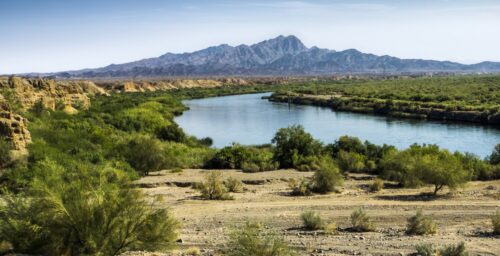
“Four months past the deadline to produce a new agreement, two Colorado River compact commissioners from different basins can agree on three things. The University of Colorado Boulder campus has a shocking abundance of lush grass in light of the governor’s Stage 3 drought declaration. The best path forward is a still through an agreement between states. Getting there might require mediators. Addressing attendees Friday at the 46th Annual Colorado Law Conference on Natural Resources at the Wolf Law School at University of Colorado Boulder, John Entsminger, Nevada’s Colorado River compact commissioner, said he was open to anything that offered to “reinvigorate negotiations.” “In terms of reaching a longterm, durable, multidecadal plan, we’re not close,” Entsminger said. “So, if a mediator will help, let’s do it.” … ” Read more from the Courthouse News Service.
Feds will soon impose new framework on Colorado River if states can’t agree how to manage it
“The federal government will impose a 10-year operating framework for managing water use in the Colorado River Basin by the end of this summer if the seven states that rely on the river cannot come to an agreement before then, said Scott Cameron, acting commissioner for the Bureau of Reclamation, at a water conference Thursday. The announcement comes in the midst of the worst water year ever recorded on the Colorado River and after years of tense and largely fruitless negotiations between water managers in the states that rely on the declining waterway. The states have missed November and February deadlines to reach an agreement, and the current guidelines outlining drought mitigation efforts for the Colorado River Basin expire at the end of September, so new guidelines must be in place by Oct. 1. State and tribal leaders, however, said the federal government’s proposal, which would be reevaluated every two years, will only lead to more uncertainty as it will require constant negotiations between the states over how to share the river, and could go against what some see as the guiding laws regulating the river. … ” Read more from Inside Climate News.
Colorado and Nevada negotiators throw cold water on parts of federal plan to manage Colorado River
“When Scott J. Cameron, the acting commissioner of the Bureau of Reclamation, strode to a lectern on Thursday, he riffed off an old Ronald Reagan joke and insisted that the federal government would help manage dwindling water on the Colorado River. “I’m at least trying to help you, as is the entire administration,” he told a group of officials, tribal representatives and experts at a University of Colorado Law School water conference in Boulder. Cameron expects to finalize a new river plan in the next two months to guide water management in the fall. It seems he has more work to do. At the conference on Friday, Colorado and Nevada’s top river negotiators said aspects of Reclamation’s plan to release water from massive, federally-owned reservoirs like Lake Powell and Lake Mead would likely need to be revised. … ” Read more from the Colorado Public Radio.
Feds say new Colorado River plan will be short-term
“Federal officials announced on Thursday that they plan on using a shorter-term framework for future Colorado River management so they can be more responsive to changing conditions and reservoir levels. Acting Commissioner of the U.S. Bureau of Reclamation Scott Cameron said at an annual conference on water policy that the agency will be using a 10-year framework, issuing new operational guidelines every two years. In the absence of a seven-state deal for sharing shortages and managing reservoirs, river management now falls to the federal government — an outcome nearly everyone had hoped to avoid. “We would love to have a 20-year deal or a 30-year deal but, frankly, we haven’t even been able to get the seven states to agree on what a two-year deal would look like,” Cameron said. “Given the highly unusual hydrological situation in the basin … we think it makes sense to take a second look at decision making every couple of years.” … ” Read more from Aspen Journalism.
EXPLORE MORE COVERAGE:
- Latest Colorado River proposal is disappointing, some officials say. Here’s why, from the Colorado Sun
- Colorado River states suggest mediation as water supplies near, from Arizona Central
- ‘We’ve been called failures’: Colorado River negotiators address stalled talks, from KJZZ
- The Colorado River’s largest reservoirs are heading toward a ‘system crash,’ experts warn, from the Salt Lake Tribune
- Lake Mead is barreling faster than ever toward ‘system crash,’ top experts say, from the Las Vegas Review-Journal
- Stabilizing the Colorado River basin now so we can thrive into the future, from Audubon
Turf war: Water scarcity pits Las Vegas residents against water managers
“Like many communities in the American Southwest, Las Vegas is facing a prolonged drought that is forcing policy leaders to make tough decisions about how best to mitigate the declining water supply. In 2021, state lawmakers passed a measure that ostensibly banned all irrigation of so-called “non-functional turf.” The law officially goes into effect next January, but the Southern Nevada Water Authority has already begun working to replace that grass with more drought-tolerant landscaping, mostly through rebates for customers who choose to re-landscape. A lawsuit is now challenging the Southern Nevada Water Authority’s grass removal program in federal court. The suit claims that the program’s enforcement is overzealous and is potentially causing environmental harm. … ” Read more from Nevada Public Radio.
Popular eastern Arizona lake closes after all the fish die
“A popular lake southeast of Globe is closed after all the fish died. Officials said Friday that San Carlos Lake, one of the largest lakes in Arizona, is closed until further notice. The San Carlos Recreation and Wildlife Department said drought conditions and water released from the dam led to the deaths of all the fish. The fish carcasses pose health and safety risks to people who enter the water or try to fish. … ” Read more from KTAR.
In national water news this weekend …
Satellite maps of sinking coastlines come under scrutiny
“Along many coasts, sinking ground is amplifying the impact of rising seas. But satellite radar, a popular tool for identifying fast-sinking, vulnerable shorelines, may be leading scientists astray, according to a comparison of two influential studies of subsidence along the U.S. Gulf Coast. The studies reached strikingly different conclusions about which areas are sinking, according to the analysis, published today in Earth Observation. The discrepancies raise questions about recent reports of alarmingly fast subsidence in deltas and near coastal cities around the world. The problems are especially acute in vegetated areas, where current radar satellites struggle to accurately measure the ground beneath plants, says Torbjörn Törnqvist, a geologist at Tulane University and co-author of the new study. “Do we really know exactly what we are doing here?” The work also highlights the need for journal referees to ask hard questions about how subsidence data are produced, says Mahdi Motagh, a radar sensing specialist at the GFZ Helmholtz Centre for Geosciences. “It raises questions about the robustness of the peer-review process.” … ” Read more from Science Magazine.

