
By Robin Meadows
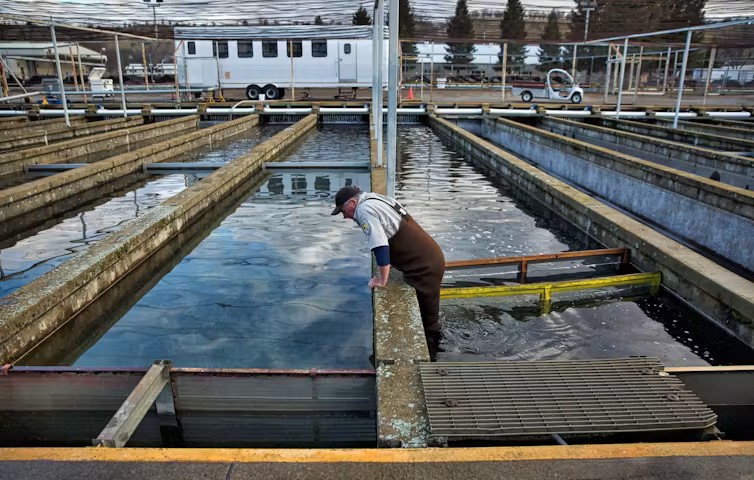
Rivers in the Central Valley are so degraded by dams and water diversions that the tens of millions of Chinook salmon raised in hatcheries each year are essential to shoring up California’s salmon fisheries. But hatcheries can also have downsides. Artificially-produced fish can harm those born in the wild, both by introducing traits better suited to concrete raceways than rivers and by outcompeting them for food and the best spawning grounds and nurseries for young fish.
“Hatchery fish are really contentious,” says Emily Chen, an ecologist at California Trout, a nonprofit dedicated to restoring the state’s freshwater ecosystems. “It’s a hot-button issue.”
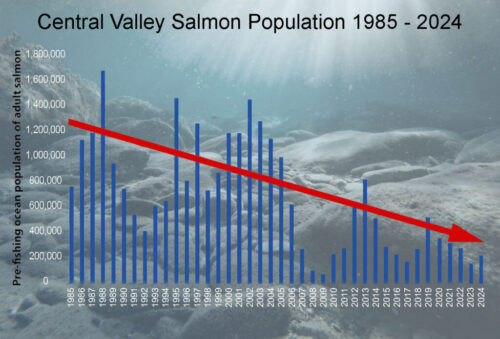
Another complication is that these days, even hatcheries can’t always safeguard the state’s salmon catches. Regulators recently shut the state’s commercial salmon fishery for three years in a row―2023 through 2025―citing low stocks due to drought and rivers that were too slow and warm. Historically, as many as one or two million Chinook salmon returned from the Pacific Ocean to spawn in Central Valley rivers each year but during the fishery closure, as few as 80,000 returned.
In the works are new practices that could lessen differences between hatchery and wild-born salmon and upgrades to make hatcheries more resilient to climate change. California has also increased production of young salmon bound for the ocean over the last few years, from about 20 to 33 million. But environmental conditions for fish are already bad and will likely get worse as the world warms. To flourish, salmon need restoration of the river systems where they begin and end their lives.
THE NEED FOR SALMON
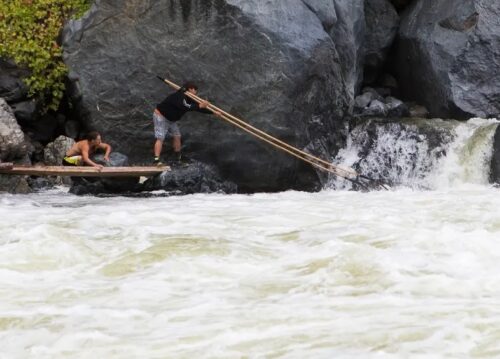
In a good year, the California salmon industry is valued at $1.4 billion and creates 23,000 jobs, according to a 2012 analysis commissioned by the Golden Gate Salmon Association, a nonprofit dedicated to restoring California salmon and the rivers they depend on.
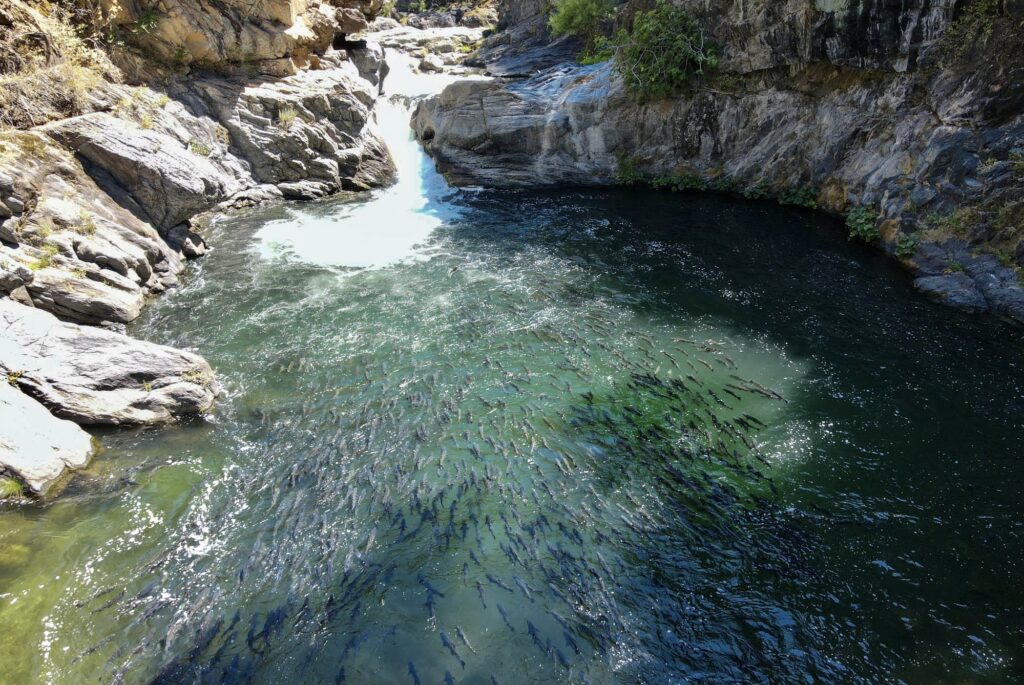
Chinook salmon are also central to the lifeways and wellbeing of Indigenous peoples as well as the waterways that are intrinsic to Tribal identities. These fish begin life in rivers and streams and migrate as finger-sized young to the Pacific Ocean, where they spend several years and typically grow to three feet long and 30 pounds. Next they return to freshwater to spawn and then die. Completing this life cycle requires a wide range of flourishing ecosystems from cold, rushing streams and rivers to food-rich floodplain nurseries and marine waters.
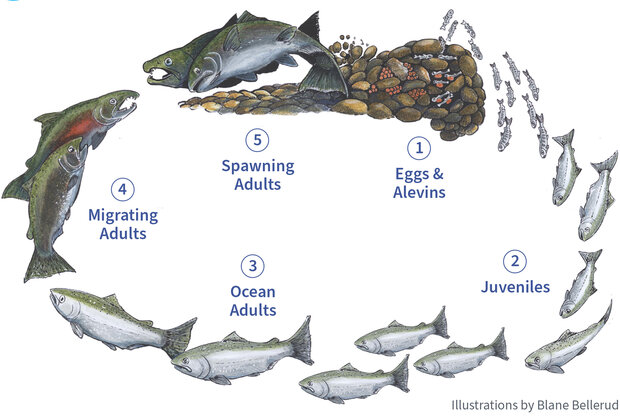
Salmon are a vital link between the sea and land. Packed with nutrients from the ocean, their hefty bodies feed a tremendous diversity of wildlife inland, including river otters, bears and eagles. Salmon carcasses also feed forests, bringing marine nitrogen and phosphorus hundreds of miles upstream from the ocean.
Hatcheries need salmon that go through their entire life cycle in the wild too. “They reflect what’s happening in rivers and we incorporate that into hatchery stock,” says Jay Rowan, a biologist who is Fisheries Branch Chief at the California Department of Fish and Wildlife (CDFW). “But it can be super challenging during drought―few natural-origin spawners return.”
THE NEED FOR HATCHERIES
California’s first hatchery was established in 1872, and the Central Valley now has five facilities that produce Chinook salmon in part to boost commercial and recreational catches as required by state law. Intended to compensate for the gigantic dams constructed to form reservoirs, these hatcheries also block salmon from most of their historical spawning grounds.
“The dams were too large to build fishways around them,” Rowan says. Shasta Dam on the Sacramento River is 602 feet high and Oroville Dam on the Feather River is even higher at a whopping 770 feet, making it the tallest nationwide.
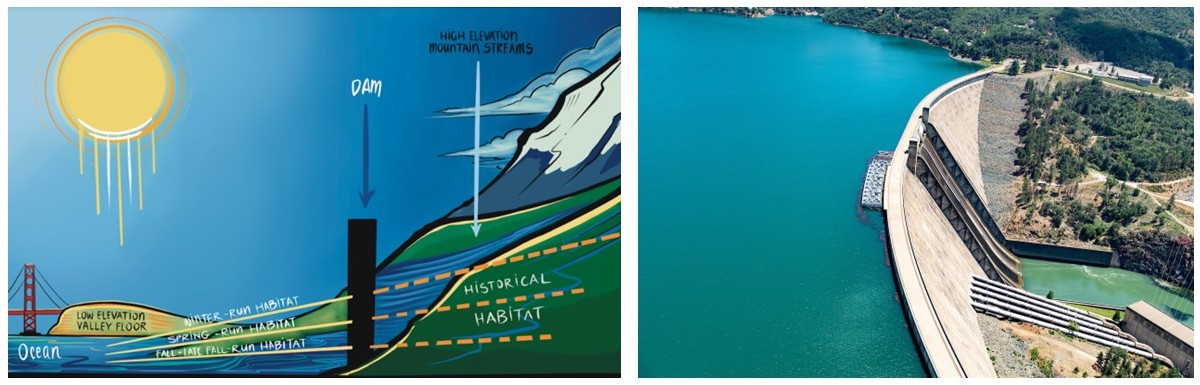
Hatcheries are also key to conserving salmon listed under the federal Endangered Species Act. California has four runs of Chinook salmon named for the season when adults return to spawn and two of them―spring-run and winter-run―are listed. “The only reason winter-run still exist is the Livingstone Stone National Fish Hatchery,” Rowan says. “Without it, they’d be gone.”
The Livingston hatchery is near Redding at the base of Shasta Dam, which cut winter-run Chinook off from their historical summer spawning grounds in the McCloud River. These high-elevation waters remain cold even during the summer but today winter-run Chinook are restricted to spawning in the Sacramento River on the valley floor, where summer temperatures are increasingly too hot for their eggs to survive.
California’s salmon would be in even more trouble without hatcheries, says commercial fisherwoman Sarah Bates, speaking from Fishermen’s Wharf in San Francisco where her boat The Bounty is docked. “A lot of people think wild fish are good and hatchery fish are bad―but if we’re stuck in the mindset that only wild fish are good then we won’t have any.”
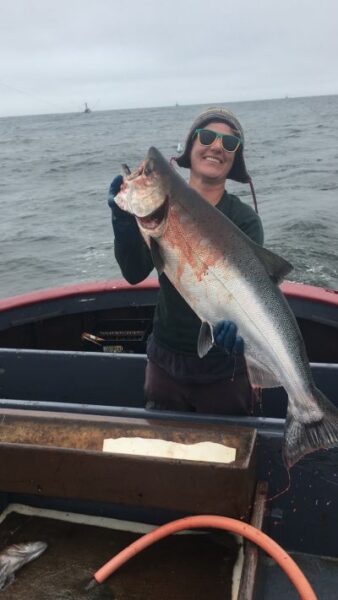
“At this point we need hatcheries because the ecosystem has changed so much over the last 200 years,” continues Bates, who has a background in genetics and infectious disease research and is president of the Institute for Fisheries Resources, a nonprofit dedicated to protecting fish and restoring their habitats. “We have altered everything we touch.” Besides building dams and taking water out of rivers, people have diminished the once-extensive floodplain and marsh nurseries for baby salmon by channelizing waterways for flood control and by draining marshes in the Sacramento-San Joaquin Delta for agriculture.
UNINTENDED CONSEQUENCES OF HATCHERIES
But hatcheries can change the genetics and behavior of salmon. Fish in hatcheries are crowded together in simple concrete environments, don’t have to hunt for food, and don’t have to escape predators. These factors can contribute to domestication and salmon from hatcheries are less likely to survive in the wild.
Release practices can also make hatchery salmon less fit. Wild-born Chinook salmon swim to the ocean at a wide range of sizes and times and from a variety of places. This strategy helps the species survive adverse environmental conditions such as drought, heatwaves, and food shortages―rather than all migrating during a bad period, at least some of the young will head out when conditions are good or at least better.
“It’s important to spread the risk in space and time,” says Rachel Johnson, a fish ecologist based at UC Davis who leads the National Oceanic and Atmospheric Administration’s (NOAA) Central Valley Team. “But hatcheries rarely mimic that natural diversity―they release cookie-cutter fish of similar size at the same time, essentially putting all their eggs in a few baskets.”
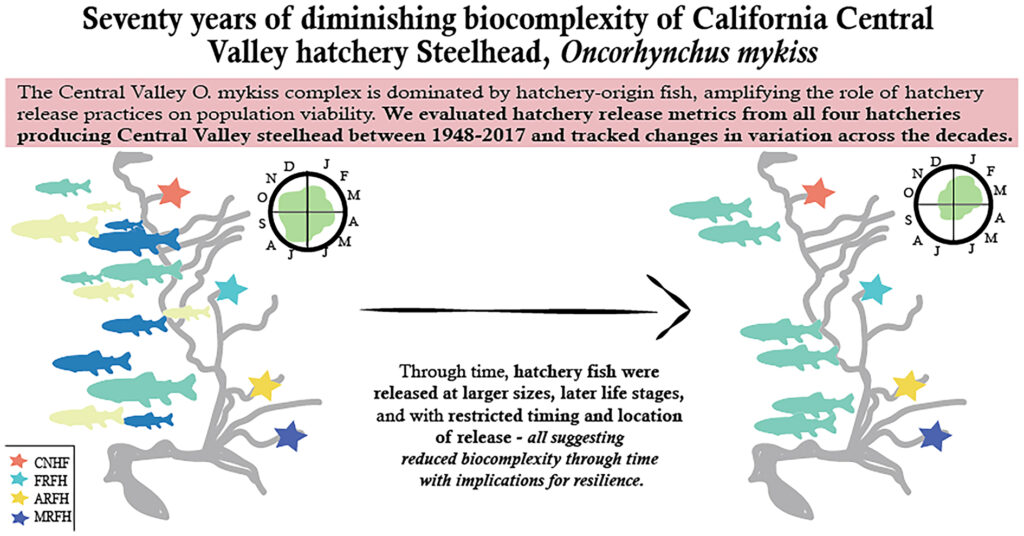
In a 2024 study, Johnson and colleagues found that steelhead from Central Valley hatcheries are released at a similar size, during a relatively narrow time window, and at relatively few locations. Steelhead are close relatives of Chinook salmon that likewise are born in freshwater, migrate as young to the ocean, and return inland to spawn. Studies in 2015 and 2019 indicated that hatchery Chinook salmon releases have likewise been simplified.
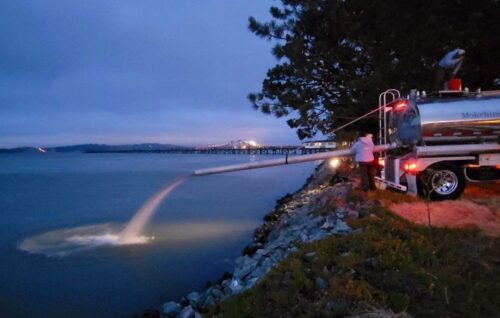
Another common hatchery release practice―trucking―can also be detrimental. When rivers are too low and warm for young salmon to migrate downstream on their own, hatcheries bypass these hazardous conditions by trucking the fish for release at sites like the San Francisco Bay. While this greatly increases their chances of survival, trucking also increases their likelihood of straying when they return to freshwater as adults.
Salmon imprint on the waters where they are born as well as along their migration route, based on factors including the smell of local minerals and minute variations in the Earth’s magnetic field. Then they typically use these environmental cues to navigate the reverse trip to their natal streams to spawn. For hatchery fish, this means returning to the place they were produced. But trucked fish are not exposed to these cues because they skip all the waterways between the hatchery and their release site, and don’t know how to get back to where they started out.
Besides recognizing and returning to their natal waters, wild salmon are uniquely suited to them. “Salmon that spawn in their home rivers have a home-field advantage having benefited from generations of ancestors passing down traits that are adapted to that place,” Johnson says.
Hatchery strays that spawn in rivers lack these local traits so their young are less suited for success in the wild. “The primary concern is that when hatchery fish interbreed with wild fish, it will make them weaker than if they were completely wild,” California Trout’s Chen says.
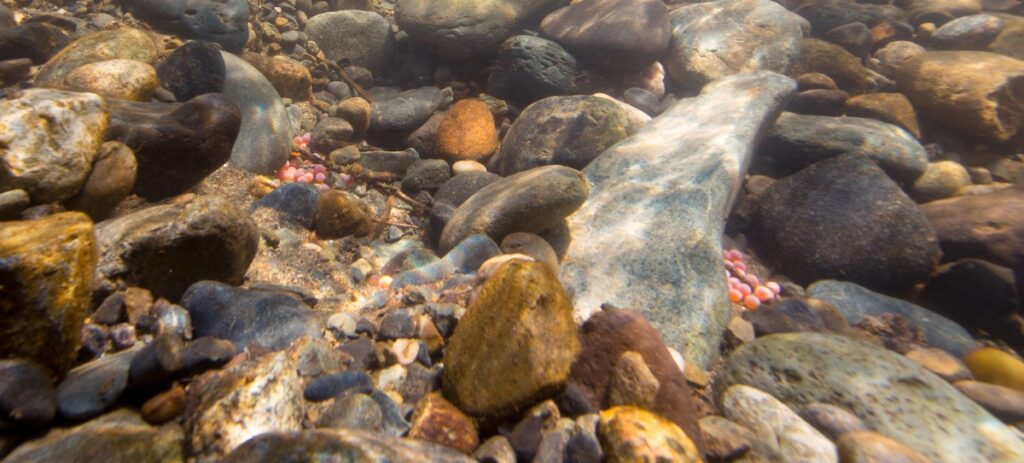
WHAT IS A WILD SALMON, ANYWAY?
Fall-run Chinook salmon, the type fished commercially, have been mass-produced for decades and today wild fish are intermixed with hatchery fish. “Probably every natural-born fish has a hatchery parent or grandparent,” Chen says. A 2024 study found that it only takes a few generations for hatchery salmon to become genetically distinct from wild ones.
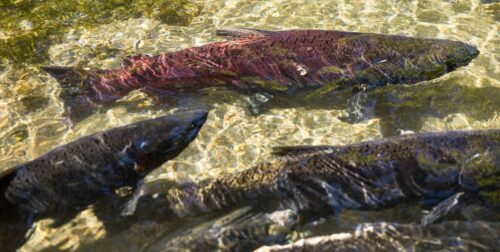
That said, Chen also thinks that even a fish with hatchery ancestry still counts as wild if that artificial influence is a few generations back. “In my eyes, it’s gone through the test of nature,” she says.
In support of this view, another 2024 study compared the fitness of wild-born salmon with hatchery parents to that of wild-born salmon with wild parents. Fitness was measured by the number of young surviving to adulthood. The study showed that wild-born salmon with hatchery parents were nearly as fit as wild-born salmon with wild parents and twice as fit as salmon born in hatcheries, suggesting that being born in a river helps preserve wildness.
MAKING HATCHERY SALMON MORE WILD
Most hatchery salmon are released as smolts, which are about six months old and four inches long and are physiologically ready to transition to life in salt water. Decades ago, hatcheries also released salmon fry, which are about three months old and about 1.5 inches long, but stopped partly because they were too small to tag.
By law, one-quarter of hatchery salmon must be tagged to differentiate them from those born in the wild. This process has long entailed clipping small fins on their backs and inserting small wires etched with tiny numbers into their snouts.
But fry releases have compelling potential advantages and in 2023 state hatcheries began trying them again, thanks to new tagging technology that identifies fish genetically. Called parentage-based tagging, this approach entails taking tissue samples from hatchery parents and matching those with samples taken from adults that return to spawn.
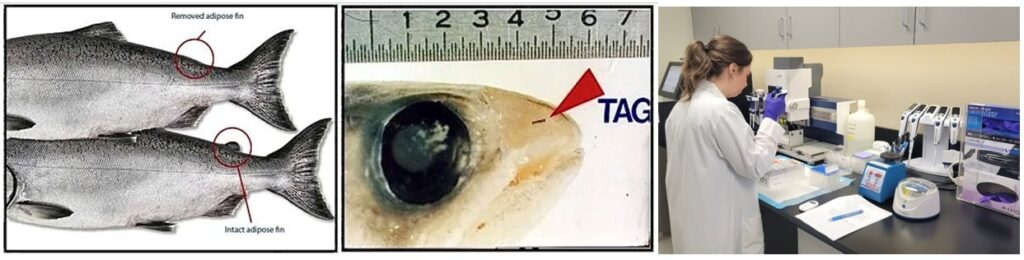
“Parentage-based tagging is a game-changing technology,” CDFW’s Rowan says. “You can’t release smolts at the ideal time, when big, cold flows after winter storms expose them to restored floodplains and tidal marshes where they rear naturally.”
“Exposure to natural processes in the wild is very important because they drive adaptation,” he continues. “It’s important not to short-circuit evolution.”
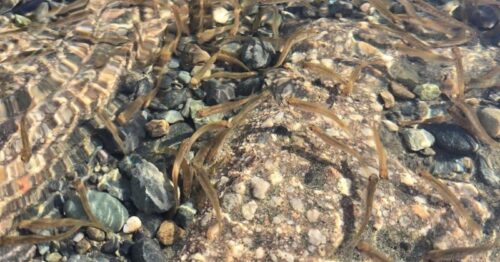
Besides letting hatcheries take advantage of higher river flows during cooler winter months, releasing salmon as fry shortens the hatchery portion of their lives. “They’ll learn to be wild earlier―they’ll find their own food and avoid predators,” NOAA’s Johnson says. Hatchery fry are released soon after emerging from eggs, which is when wild-born salmon hatchlings swim out of their gravel nests on river bottoms.
Fry releases could also help more hatchery salmon survive in the face of climate change. In a 2019 study Johnson and colleagues found that, particularly during wet years, fry contributed as many as one fourth of the adults returning to spawn. “There are a lot of potential wins for these little fry,” she says. “They might be climate heroes of the future.”
10-YEAR RELEASE EXPERIMENT
Coleman National Fish Hatchery, which is near Redding and is operated by the U.S. Fish and Wildlife Service, recently launched a 10-year test of new release strategies. The goals are to reduce straying and increase adult returns. The project is in collaboration with the Bridge Group, a coalition of rice farmers, fishermen―including salmon fisherwoman Bates―water suppliers, researchers and conservationists dedicated to restoring salmon in the Sacramento Valley, which is the northern part of the Central Valley.
When smolts from Coleman hatchery are trucked, nearly all of those that return as adults stray. “Trucking is great for getting fish to the ocean but not for returnees to the hatchery,” says Brett Galyean, project leader at the hatchery.
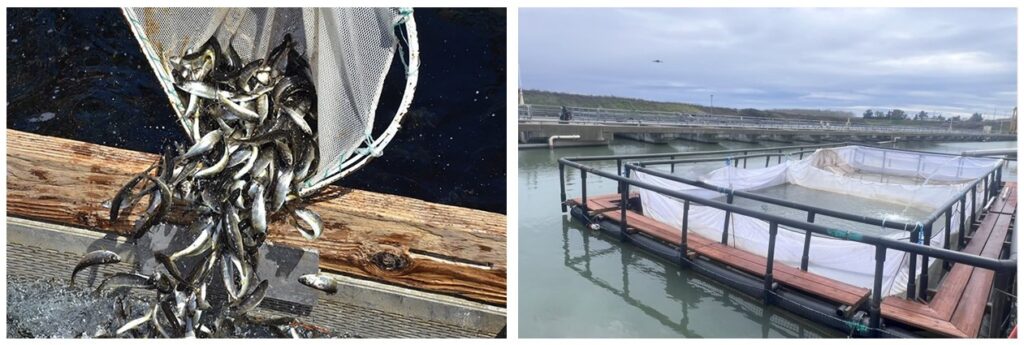
Coleman hatchery is on Battle Creek, a tributary of the Sacramento River, and in 2025 the team began an effort to imprint smolts on Sacramento River water. About 450,000 smolts were tagged and clipped and then split into two net pens in the Tehama-Colusa Canal forebay, which is near Red Bluff and receives water from the Sacramento River. After several weeks, one group was released on-site and the other was trucked to the San Francisco Bay. This year the team repeated the process with about 500,000 smolts.
“Will returnees swim straight to the Sacramento River or will they stray?” Galyean asks. The team expects preliminary results from this ongoing release experiment in 2027, when the first batch of adults starts coming back from the ocean.
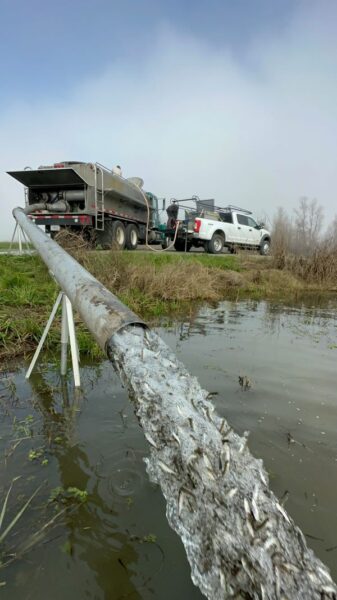
Coleman hatchery also began testing fry releases this year. The team released nearly 8 million fry that were of known parents and so can be tracked genetically via parentage-based tagging.
About 6 million fry were released over several months in late winter at a variety of sites near the hatchery. Variables will be built in naturally as environmental conditions change over the duration of the release experiment, including wet and dry years as well as warm winters. As the resulting adults come back from the ocean over the duration of this experiment, the team hopes to learn “when and where it’s a good idea to release fry,” Galyean says.
Bates supports this approach. “The fishing industry wants increased production but it can’t be just that,” she says. “It’s a dangerous place out there for fish and if the population faces different threats, that increases the odds of success.”
The rest of the Coleman fry released this year―nearly 2 million―went into winter-flooded rice fields in the Yolo Bypass, a 59,000-acre leveed flood control structure built on a former floodplain near Sacramento. The idea of raising baby salmon in rice fields, which mimic floodplain nurseries, was inspired by programs that flood fields for shorebirds. A 2017 study showed that fry grow big and fat in rice fields.
The fry were divided between two rice farms, Knaggs and Conaway ranches, and spent about a month in the flooded fields. As with the other releases in this decade-long experiment, parentage-based tagging will show whether raising fry in rice fields increases adult returns.
Knaggs Ranch rice farmer John Brennan has raised baby salmon in his fields for about 15 years and was among the originators of the concept. “If you’re in the rice business you have to be in the water business, and if you’re in the water business you have to be in the fish business,” he explains.
Brennan notes that efforts to conserve salmon are driven by their endangered species listing status. “All the mitigation is for winter-run and spring-run,” he says. “But fall-run―the fish we eat―could use some help too.”
CLIMATE-RESILIENT HATCHERIES
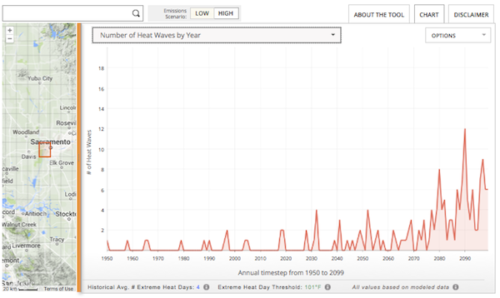
Most California hatcheries are along rivers and creeks on the Central Valley floor, where climate change is making water hotter and scarcer. “Climate conditions are getting worse and the last few droughts really took a toll,” CDFW’s Rowan says. On top of this, many state hatcheries are more than 80 years old and contend with aging equipment.
To help hatcheries withstand future climate extremes, the state commissioned individualized climate-resilience assessments for 21 state trout and salmon hatcheries. Key recommendations include installing recirculation systems to cut water use and chilling expenses as well as installing filtering systems so the water can be treated with UV light to decrease pathogens.
“Water is going to become more scarce and warmer, and warmer water has more pathogens and lowers fish immune systems,” Rowan says. “It’s a perfect storm.”
THE NEED FOR HEALTHY RIVERS
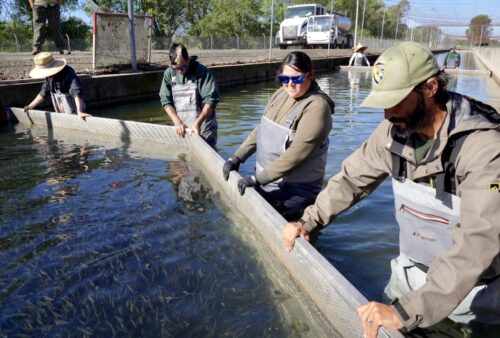
But hatchery upgrades, increased production, and new release strategies can only do so much for California’s troubled salmon. In severe drought years, even fry are unlikely to do well. “That’s the reality we’re facing right now, until we can do more restoration and improve water management strategies,” Rowan says, adding that at inter-agency meetings he tries to get as much water as possible for fish.
Habitat restoration is critical but not enough on its own, says John McManus, policy director at the Golden State Salmon Association. “There’s so much investment into floodplain restoration to increase food for juvenile salmon but too often during droughts, flows are too slow and warm,” he says. “What good is access to floodplains if we don’t have water to flood them?”
Salmon fisherwoman Bates agrees. “If we dump a bunch of healthy juvenile fish into poor river conditions, we’re just wasting time,” she says. “Salmon overall are in trouble―we’re not doing a great job managing this species.”

