
Several news sources featured in the Daily Digest may limit the number of articles you can access without a subscription. However, gift articles and open-access links are provided when available. For more open access California water news articles, explore the main page at MavensNotebook.com.
California prepares for El Nino …
California’s El Niño emergency begins now as beaches erode
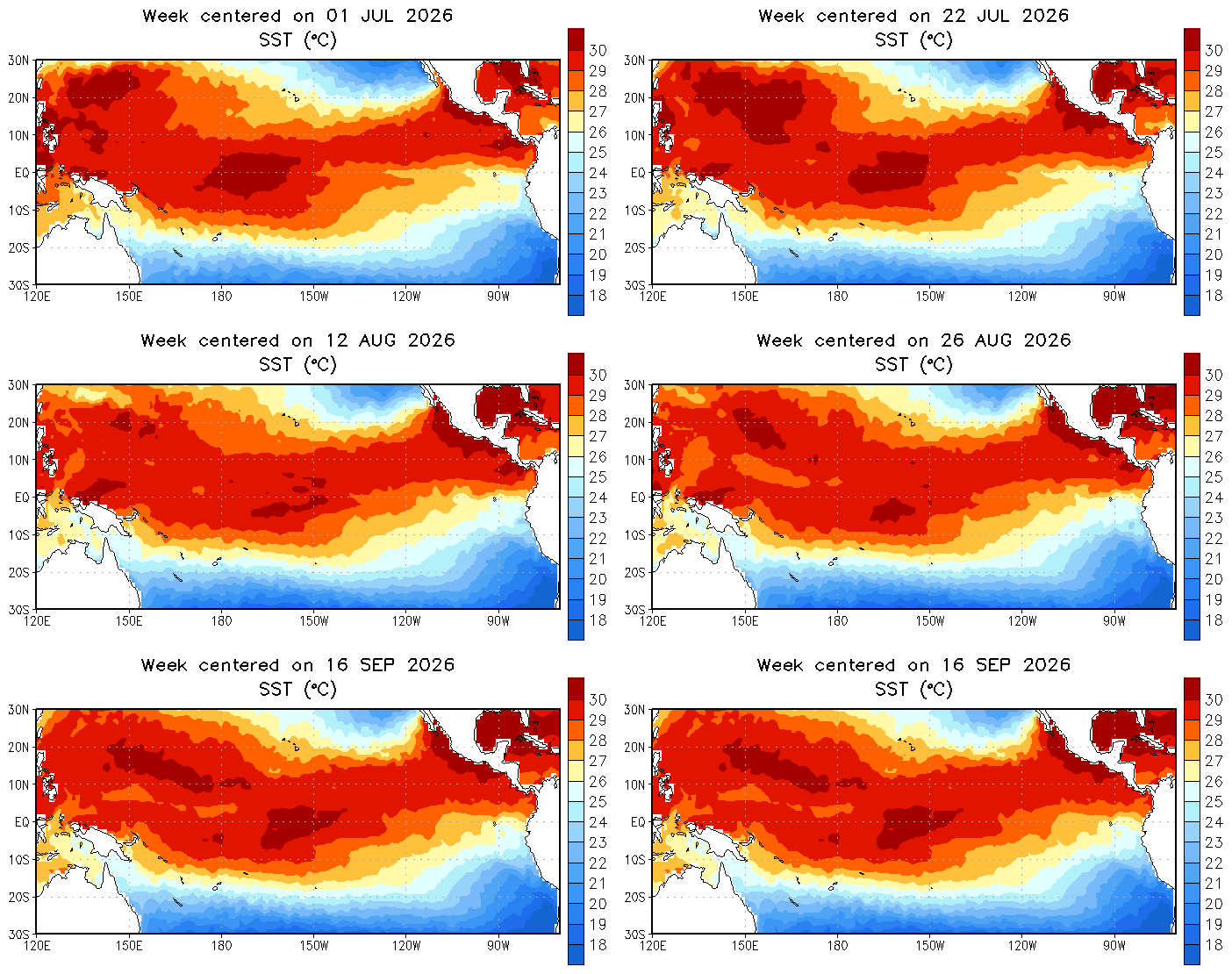 “California is facing a potentially multi-billion-dollar flood threat as El Niño gathers strength in the Pacific Ocean. The warming El Niño phenomenon tends to unleash powerful storms in the Pacific, including atmospheric rivers, some of which are named the “Pineapple Express” if they originate near Hawaii. The heaviest rains tend to come during the winter months. But El Niño is already wreaking havoc on some California beaches, with flood risks expected to rise in the weeks ahead. Disaster modelers at Climate X, a risk analytics firm backed by Google Ventures, estimate that El Niño could cause $2 billion to $3 billion in losses from flooding and mudslides statewide through the winter, based on damage inflicted during past events. On average, California tends to see about $500 million a year in flood damages, according to estimates from the nonprofit Climate Central. … ” Read more from Bloomberg.
California needs water. El Niño might bring too much.
“El Niño threatens to dump torrential rains on California this winter. With a megadrought in the American West since 2000, that water should be welcome. But there’s such a thing as too much water. All that rainfall can outpace the state’s ability to capture and store it for when the dry years return, gushing into the Pacific Ocean but not before causing floods and mudslides. “We all hope that it’s wet,” said Stephanie Anagnoson, the director of water and natural resources in Madera County in the state’s agriculture-dominated Central Valley. “But maybe not too wet.” El Niño, a phenomenon that naturally occurs every few years, tends to bring wetter-than-average weather to California and the Southwest. It can send streams of moisture known as atmospheric rivers into the West Coast, pummeling communities with days of rain and snow that can account for most of the region’s annual precipitation. The current “super” El Niño, which is still gathering strength and will continue into 2027, is expected to be one of the most powerful on record. … ” Read more from the New York Times.
SEE ALSO:
- El Niño Amplifies Compound Coastal Flood Risk, from The Confluence
- Will El Niño have an upside? California tries to capitalize on big storms, from the LA Times
- With storms on two sides of the U.S., El Niño shows its might, from the New York Times
In other California water news this weekend …
Where rivers meet the sea: How estuaries protect our water
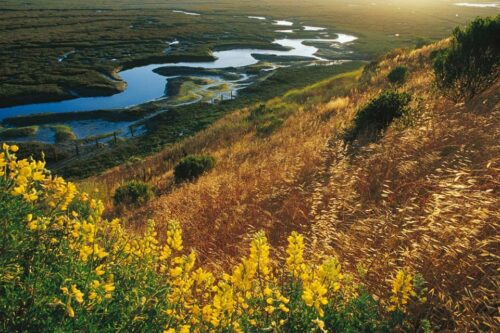
“From Humboldt Bay south to San Diego Bay, California is home to about 1.3 million acres of bays and estuaries, including three of national significance: Morro Bay, Santa Monica Bay and the San Francisco Bay/Sacramento-San Joaquin Delta. Often referred to as “nurseries of the sea,” estuaries provide nutrient-rich habitat for native plants and animals. They are also vital to California’s economy, protecting the quality of water needed for drinking, agriculture and commercial and recreational fishing. Managing estuary health requires a delicate balance. The California Water Boards help protect estuaries by setting limits on contaminants such as bacteria or metals; reducing stormwater and wastewater pollution; defining how much water may be diverted from waterways; and funding habitat restoration projects. … ” Continue reading from the State Water Board.
International group tours San Joaquin Delta to see golden mussel threat
“A flotilla of boats cruising the San Joaquin River Friday gave nearly 90 scientists, water management officials and leaders from 19 U.S. states and four Canadian provinces a closer look at the threat posed by golden mussels. The Western Regional Panel on Aquatic Nuisance Species ended its annual meeting with the tour embarking from Stockton. The group got a firsthand look at the mussels’ impacts in San Joaquin County, including how the species clings to boats, water pumps, pipes and other infrastructure. “We were able to see and show Western states and others in the state of California golden mussels within the infested San Joaquin County,” Martha Volkoff with California Fish and Wildlife said. A diver went underwater to show how the mussels have attached to a flood gate designed to protect thousands of Stockton homes. Rhodesia Ransom, a Stockton Democrat, said the flood gate is particularly important as officials prepare for a historically strong El Niño. … ” Read more from Channel 10.
A megadrought has been plaguing the U.S. for 27 years—and scientists say it may never end
“On September 10, 2026, satellite images from the NASA-USGS Landsat 8 captured the stunning consequences of the 25-year-long megadrought that has gripped the southwestern United States. Lake Powell, the serpentine reservoir formed by Glen Canyon dam that stretches across the border of Utah and Arizona, appears like a small trickle compared to its previous stature as one of the country’s largest man-made lakes. Today, the water’s surface stands at a record low 3,517.24 feet, only 30 feet from “minimum power pool” (when the dam no longer produces hydropower). It seems almost impossible that a little more than 40 years ago, Lake Powell overflowed with too much water. … ” Read more from Popular Mechanics.
Rep. Jared Huffman leads charge against data centers on public lands
“North Coast Rep. Jared Huffman, the chair of the House Natural Resources Committee, and several of his colleagues are demanding answers about proposals to build data centers on public lands. The Bureau of Land Management is reportedly reviewing at least a dozen data center proposals, covering at least 17,600 acres across Arizona, Idaho, Nevada, Oregon, Utah, and Wyoming. Interior Secretary Doug Burgum has met with dozens of technology and energy executives about data center buildout since the 2025 executive order on data center permitting, and BLM officials have reportedly compiled lists of public land to target for development. “Our public lands must not be managed by secret deals and industry-led schemes,” the lawmakers wrote in a letter to Burgum. “… Bureau of Land Management officials have reportedly compiled lists of public land for data center development. The administration is moving quickly to permit data centers and has shown a concerning proclivity to skirt environmental reviews and cut the public out of the process. Local officials only learned of several projects from reporters, and the public, including local communities near project proposals, have been left in the dark.” … ” Read more from the Eureka Times-Standard.
California, Texas put data centers to infrastructure test
“Data centers have spent years competing for sites based on tax incentives, land, fiber access and proximity to customers. A different set of questions is increasingly determining whether projects can move forward. Is enough electricity actually available? Who pays for the generation, transmission and distribution infrastructure needed to serve the facility? Where will the water come from? And what happens if a developer reserves enormous amounts of grid capacity but never builds the project? California and Texas took major steps this week toward making those questions part of the development process. Their approaches are different, but both point toward a broader change in the U.S. data center market. Infrastructure capacity is becoming a condition of growth rather than a problem to solve after a project is announced. … ” Read more from Energy & Environment Leader.
In people news this weekend …
Promotions, passings, profiles – submit people news items to maven@mavensnotebook.com.
Byron Sher, early environmental warrior in California, dies at 98
“Byron D. Sher, a California lawmaker who wrote landmark environmental laws in the 1980s and was the first to use the phrase “global warming” in the state’s legislation, died on Sept. 12 at his ranch near Placerville, Calif. He was 98. His family confirmed the death. Mr. Sher taught at Stanford Law School for three decades, and in the State Legislature he projected a slightly rumpled, professorial air, earning a reputation as the state’s most effective environmental advocate — one who achieved his goals through congeniality rather than pugilism. Endorsing his election to the State Senate in 1996, after he had served 16 years in the State Assembly, The San Francisco Chronicle said that Mr. Sher was “no shoot-from-the-hip liberal.” He was a lawmaker, the paper went on, who “does his homework, seeks consensus and typically argues — and wins — on the merits, without unnecessary and all-too-familiar legislative histrionics.” … ” Read more from the New York Times.
Ventura County water leader, fourth-generation farmer dies
“Lynn Maulhardt, a local groundwater leader whose family farmed on the Oxnard Plain since the late 1860s, has died. He was 78. The fourth-generation Ventura County farmer was a descendant of the Maulhardt and Borchard families. He grew up on his family’s Oxnard farm that remained his home for most of his life, his obituary said. He and his wife of 56 years raised their own children at the spot. He died Sept. 10. Maulhardt served on the United Water Conservation District board for four decades and represented northeast Oxnard. In 1987, he was named board chair of the Fox Canyon Groundwater Management Agency, a position he remained in for the next 30 years. He then returned to Fox Canyon in 2022. Shortly after his death, the board adopted a resolution in his honor. Board chair Eugene West described Maulhardt’s death as unexpected, a great loss to the agency and a greater loss for the community that he served. “I can’t even imagine the weight of the loss on his family and loved ones,” West said, during the Sept. 23 meeting. … ” Read more from the Ventura County Star.
Podcasts …
(Re)TURNING TO THE RIVER: Delta reflections
When a river “ends,” where does it go? In this episode, we’ll reflect on our San Joaquin River Valley experiences and look forward to a future of reconnection between watersheds, landscapes, and communities.
AgNET NEWS HOUR: California water, farming, and ag technology in focus
California agriculture takes center stage in the latest AgNet News Hour, as Nick Papagni, the Ag Meter, talks with fourth-generation Bakersfield farmer Jason Giannelli and Patrick Williams of SkySense about some of the biggest issues facing farmers across the state. Giannelli, director of farming for Old River Farming and R.& G. Fanucci and president of the California Water Alliance, gives listeners an inside look at the challenges facing Kern and Kings County agriculture. His operation farms roughly 10,000 acres, much of it dedicated to dairy feed crops including corn silage, milo, Sudan grass and triticale. He says the current dairy market remains difficult, while increasing water-quality regulations are adding additional challenges for farmers working with manure, nitrogen and irrigation water.
WATERLOOP: Governing for gallons in Colorado
Policy is becoming a water-supply tool in Colorado, as local governments use development codes, financing rules, and workforce requirements to reduce demand. The second episode of Resilience in the Rockies examines how Broomfield, Denver Water, and Aspen are using governance to move conservation projects forward. In Broomfield, where landscape irrigation accounted for an estimated 60 to 70 percent of annual water demand, a 2023 ordinance limits turf to 30 percent of new landscapes and caps outdoor use at 12 gallons per square foot annually. The city developed the code after a WaterNow workshop and consultation with residents, elected officials, landscape architects, and homeowners associations.
WATER IS A MANY SPLENDOR’ED THING: The Perspective from an Eye in the Sky
What started out as research of gravity fields using satellites turned into the discovery of satellite data noise that was a signal that was coming from water. Water is a Many Splendor’ed Thing brings you another water relationship that has a personally significant impact to your life. Produced by Stephen Baker, Bringing People Together to Solve Water Problems, water@operationunite.co 530-205-6388
In regional water news this weekend …
SIERRA NEVADA
State-funded stormwater project will help protect Lake Tahoe clarity
“Expanding regional efforts to protect Lake Tahoe’s famed water clarity, the city of South Lake Tahoe today celebrated the completion of the Tahoe Valley Stormwater and Greenbelt Improvement Project, which will reduce flood risk and increase recreational opportunities across a new greenbelt area spanning 320 acres. The city received a $7 million grant from the State Water Resources Control Board’s Stormwater Grant Program. The city estimates that the project will prevent nearly 34,000 pounds of tiny particles from roads, stormwater runoff and erosion from reaching the lake each year. In doing so, the project will contribute to California and Nevada’s cornerstone anti-pollution efforts aimed at restoring the lake’s water clarity to depths of 100 feet, which has kept almost 740,000 pounds of sediment out of the lake last year. “We are grateful for South Lake Tahoe’s strong partnership with the Lahontan Regional Water Quality Control Board to protect the lake’s health and dazzling blue waters,” said Dan Newton, deputy director for the State Water Board’s Division of Financial Assistance. “The State Water Board is proud to support projects like these that reinforce regional water quality efforts, and bring flood control and recreational benefits for residents.” …, ” Read more from the State Water Resources Control Board.
Lake Tahoe recreation sites may soon charge new fees under Forest Service proposal
“Some popular recreation sites around Lake Tahoe could soon come with new fees as the U.S. Forest Service looks to address rising visitation and the cost of maintaining public lands. The proposed changes would affect several sites managed by the Lake Tahoe Basin Management Unit, including beaches, trailheads and campgrounds. At Kiva Beach on the South Shore, parking is currently free. Under the proposal, visitors would pay $10 per vehicle per day. For South Lake Tahoe resident Raul Martinez, the beach is a place where his family, including their dog, comes to enjoy the outdoors. “Lake Tahoe is the paradise. Not just for us, but for our puppies to play around and feel like it’s at home as well as for them,” Martinez said. … ” Read more from CBS Sacramento.
SACRAMENTO VALLEY
The barrier is gone:: Iron Canyon Fish Passage Project complete on Ótakim Séwi (Big Chico Creek)
“For nearly 70 years, a concrete fish ladder built into a bedrock gorge deep in Upper Bidwell Park did what it could to help steelhead and spring-run Chinook salmon move through Iron Canyon on Ótakim Séwi (Big Chico Creek). Built in 1956 with the technology and understanding available at the time, the concrete fish ladder was always going to be difficult to maintain in this remote and rugged site — and, over the decades, it stopped functioning, leaving salmon and steelhead stuck downstream in water too warm for them to survive and nowhere to spawn. Today, that barrier is gone and fish once again have an open migration corridor to move upstream. After four years of planning, permitting, designing, outreach, and construction, the instream work for the Iron Canyon Fish Passage Project is complete, restoring access to 8.5 miles of critical cold-water habitat and reconnecting a stretch of watershed that has sustained fish, wildlife, and people for thousands of years. The project is a partnership between CalTrout, the Mechoopda Indian Tribe, the City of Chico, the Big Chico Creek Ecological Reserve (BCCER), and a series of specialists in permitting, fish biology, engineering, and construction. … ” Read more from Cal Trout.
Huge numbers of birds are migrating over Sacramento each night. How to track them
“Far in the night skies over Sacramento, hundreds of thousands of birds are on the move. It’s autumn, and that means it’s migration season for millions of birds. “Tonight, more than 330,000 birds are predicted to fly over Sacramento as they make their seasonal journeys south,” posted the Wildlife Care Association of Sacramento on Sept. 23. “From songbirds to raptors and everything in between, fall migration is one of the most incredible wildlife spectacles happening right over our heads.” … ” Read more from the Sacramento Bee.
NAPA/SONOMA
A broken Russian River dam drained beloved summer swimming holes. No one knows when it will be fixed
“About a mile downstream from Guerneville, Sarah Dale’s Russian River dock is marooned on a silty, bone-dry riverbed. She called out to her teenage sons carrying kayaks down the dusty bed to find the water’s edge, and reminded them to check the depth at a favorite jumping spot. Normally, a branch of the Russian River would be coursing past their dock in their Neeley Road hamlet and teeming with otters, herons, kayakers and swimmers. But for the past two summers, this part of the river has run dry. In August 2024, an I-beam failed on a seasonal dam downstream in a community called Vacation Beach, and repairs have lagged. So, for the past two summers, instead of slowing into a broad, calm summertime pool along the cabins and homes lining its banks, roughly 2 miles of the river west of Guerneville have been faster and narrower, leaving entire waterside hamlets high and dry. … ” Read more from the San Francisco Chronicle. | Read via Yahoo News.
BAY AREA
From ‘Big Stench’ to cleaner waters: EBMUD marks 75 years of wastewater treatment
“The East Bay Municipal Utility District is celebrating its 75th anniversary with an open house event in Oakland on Saturday. The East Bay’s wastewater bulwark, EBMUD began treating raw sewage in 1951 following a voter-approved mandate in 1944. The vote also included the approval of a $23 million bond to build a regional wastewater system, which involved laying pipelines through Albany, Berkeley, Emeryville and Oakland. Prior to that system, raw sewage flowed directly into San Francisco Bay, “creating an environmental and public health crisis so notorious it became known as the ‘Big Stench,’” EBMUD officials said in a news release Friday. … ” Read more from Local News Matters.
CENTRAL COAST
Hundreds of San Luis Obispo County residents win quiet title lawsuit
“A judge ruled Thursday that the more than 800 residents involved in a quiet title lawsuit to protect their rights to use water from the Paso Robles Groundwater Basin without charge have won their case. Moving forward, water districts can not force the plaintiffs to pay fees or taxes for using the groundwater under their land. Despite the absence of a legal finding of overdraft, in 2013, the San Luis Cbispo County Board of Supervisors enacted an “emergency ordinance” limiting landowner’s pumping to a fixed, rather than flexible, amount. However, groundwater use can be lawfully restricted by the government only in the event of severe depletion of the basin’s water supply — an overdraft. More than 800 property owners then formed Protect Our Water Rights. The group of overlying landowners who, by virtue of owning their property, asserted they have the right to pump and reasonably use water on their land. … ” Read more from Cal Coast News.
SAN JOAQUIN VALLEY
Supervisors advocate in DC for federal help with Delta, golden mussels, and more
“The San Joaquin County Board of Supervisors traveled to Washington, D.C., to meet with federal officials and advocate for issues critical to the County. They discussed efforts to combat invasive golden mussels in the Delta, alternatives to the Delta Conveyance Project, expand access to behavioral health services, improve transportation infrastructure, and secure federal support for local priorities. “Our goal is to make sure San Joaquin County has a strong voice in Washington,” said Chair and Third District Supervisor Sonny Dhaliwal. “We are bringing the needs of our residents directly to our federal representatives and asking them to help us address the challenges facing our community.” … ” Read more from the Manteca Bulletin.
A deeper look at Stockton’s invasive golden mussels problem: “We cannot wait.”
“State and local officials are getting a firsthand look at the growing challenges posed by golden mussels in San Joaquin County, as the invasive species begins attaching itself to critical water infrastructure. Divers entered Stockton’s Smith Canal on Friday to remove golden mussels from a flood-control gate, demonstrating the work now required to keep the system operating. “We cannot wait and respond later. We have to be as proactive as we possibly can,” Assemblymember Rhodesia Ransom (D-Stockton) said. California Department of Fish and Wildlife officials say the mussels can form dense clusters on underwater surfaces, a process known as biofouling. … ” Read more from CBS Sacramento.
SOUTHERN CALIFORNIA
Lithium-ion batteries heat up again at La Verne water facility, prolonging evacuations
“Lithium-ion batteries damaged in a fire at a Southern California water treatment facility began heating up again Wednesday morning, forcing firefighters to resume cooling efforts as hundreds of residents remained under evacuation orders. The latest temperature spike occurred at a second battery storage system at the Metropolitan Water District facility in La Verne, where a fire and explosion Tuesday prompted a massive hazardous materials response. During a Wednesday morning news conference, La Verne Fire Chief Brandon Coney said crews had stopped spraying water on the damaged batteries shortly before 6 a.m. after temperatures appeared to stabilize overnight. However, temperatures subsequently rose from approximately 70 degrees to 90 degrees, triggering renewed cooling efforts. … ” Read more from KTLA.
New report looks at metals in LA River after warehouse fire started in Boyle Heights
“A new report sheds light to the heavy metals that researchers say were carried from the burning Lineage Logistics cold food storage warehouse in Boyle Heights into the Los Angeles River. Researchers from UCLA’s Department of Environmental Sciences said at the peak of the fire, which started June 17 and flared up for days, firefighters were spraying 12,000 gallons of water per minute on the nearly 500,000 square-foot warehouse east of downtown Los Angeles. Some of that runoff water containing potentially toxic metals entered drains that lead to the Los Angeles River and, eventually, the ocean, researchers said. … ” Read more from KNBC.
Bicycle advocates want to see LA River bike path project accelerated ahead of LA28 Olympics
“Plans are in the works to link the LA River bike path gap in downtown LA, and bicycle advocates say getting it done before the LA28 Olympics would ease traffic in the downtown area. There is currently about an eight-mile gap in the LA River Trail, and Metro has a plan in the works to link it, creating a 32-mile continuous path. Once complete, the path would extend from Griffith Park through downtown L.A. to the city of Vernon and connect to Long Beach along the LA River. Peter Abraham, with the nonprofit People for Bikes, is pushing the city to accelerate several bike projects before 2028, including closing the eight-mile gap through the heart of Los Angeles. … ” Read more from CBS News.
Hurricanes Polo, Odalys to send powerful waves to already battered Southern California coast
“Two hurricanes raging off the coast of Baja California are expected to send another round of destructive waves to the Southern California coast. The National Weather Service forecast shows that Hurricane Polo (located 1,100 nautical miles southeast of Los Angeles) and Hurricane Odalys (located 900 nautical miles southwest of Los Angeles) will bring more coastal flooding, strong rip currents and beach erosion to Southern California between Monday and Tuesday of next week. “The biggest concern in the short-term is the southerly swells produced by Hurricane Odalys and Polo,” the NWS forecast reads. “… Most hazardous conditions are expected Monday and Tuesday when high tides overlap with the continuing southerly swells.” … ” Read more from KTLA.
Beaches are disappearing in Southern California as El Niño bears down
“Southern Californians have long viewed the disappearance of their prized beaches as an abstract problem for future generations to solve. Not anymore. Giant swells have pounded the coast in recent weeks, laying bare the immediate vulnerability of the state’s oceanfront. In Long Beach, residents were forced to flee as the Pacific battered their homes this month. Up the coast, a gaping sinkhole prompted evacuations in Malibu outside of the actor Nicolas Cage’s mansion. In Orange County, the relentless waves cut off a key rail line and left a section of a popular beach parking lot crumbled like a smashed pack of Oreos. Multimillion-dollar houses washed into the sea. … ” Read more from the New York Times.
California beachgoer says ocean water is ‘hot now’ as locals point to ‘off-the-charts’ El Niño
“For many Southern Californians, cool ocean water comes with the territory. That is why one Orange County beachgoer’s observation that the surf felt unusually warm struck a nerve online and quickly sparked a conversation about changing ocean conditions. In a Reddit thread posted to the site’s r/OrangeCounty community, the original poster wrote: “I am very confused why the beach water is hot now. In my whole life living here, it’s never been hot! This will only bring more sharks, like in Florida, and so many other things, we can’t even imagine!” … ” Read more from The Cool Down.
First-ever olive ridley sea turtle nested in California
“An olive ridley sea turtle was observed digging a nest and laying eggs on the beach near Seal Beach, in Orange County, California on September 16, 2026. This is the first-ever recorded nest for any sea turtle species on the U.S. West Coast. The nesting female was discovered about 3 p.m. by a beachgoer who alerted the Huntington Beach life guards. Three days later and about 8 miles away, a second turtle was observed around 7 p.m. nesting near the Huntington Beach Pier. Due to forecasted high surf resulting from tropical storms off Mexico, a team of scientists from federal and state agencies collected the eggs and transferred them to the Aquarium of the Pacific in Long Beach on September 25. The eggs will be under the care of Aquarium staff during their incubation period. If they successfully hatch, the young turtles will be released on the beaches where the eggs were laid to make their journey across the sand to the ocean. … ” Read more from NOAA.
After Marie’s destruction, Long Beach faces new test from Hurricane Polo
“Just weeks after Hurricane Marie brought massive waves, flooding and destruction to the Long Beach peninsula, another tempest threatens the coastal enclave. Hurricane Polo, slated to make landfall in Mexico over the weekend, is expected to send big waves north. These waves, combined with bimonthly high tides, could cause flooding, the National Weather Service in San Diego told The Times. Weather reports reviewed by The Times predict waves as large as 9 feet in the ocean waters off Southern California, with the biggest impact expected Monday and Tuesday. Long Beach will augment its normal emergency preparedness actions for the storm and continuous impacts from a potentially historic El Niño, city spokesperson Laath Martin wrote in a statement to the Times. … ” Read more from the LA Times.
Along the Colorado River …
New Colorado River rules buy time. They don’t solve the crisis
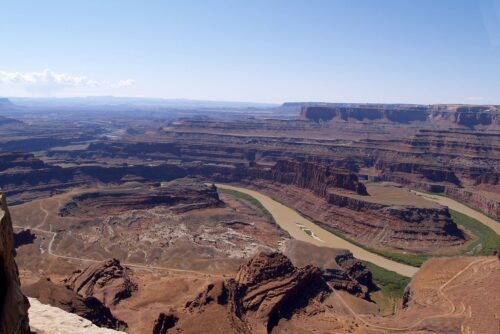 Jennifer Pitt, Audubon’s Colorado River Program Director, writes, “The Colorado River has been telling us something for more than half a century, and this year the message got harder to ignore. In the 1960s, the river stopped flowing regularly into its delta, once a thriving 2-million-acre wetland where the river met the Gulf of California. Today, Lake Powell and Lake Mead—the two largest reservoirs that buffer the system against drought—are at their lowest combined levels since Lake Powell began filling. Water Year 2026 was among the driest of the last century. The message is clear: we are using more Colorado River water than the river can reliably provide. As warming continues to reduce its flows, using less water is not preparation for some future crisis. It is a requirement of the basin we have now. … ” Read more from Audubon.
How we hold on to water in the Colorado River Basin
“The Colorado River Basin is facing one of the driest summers on record. Snow that came too little, too late—or not at all—has depleted water supplies heading into the dry season. Throughout the West, communities are grappling with water shortages, wildfire risk and the growing impacts of a hotter, drier climate. In a summer like this, the work doesn’t change—but the urgency does. Many of the solutions are already in motion, shaped by years of collaboration across the basin. Across the Western U.S., TNC staff and partners are stepping up efforts to protect our forests, conserve water and help balance water needs for the communities, businesses and wildlife that need it most. … ” Read more from The Nature Conservancy.
Peaches put this town on the map. The Colorado River drought could wipe it all away.
“Ask almost anyone in this tiny desert town, and they will tell you providence has endowed their valley with three attributes that produce the world’s most perfect peach. The first is a warm wind that blows out of neighboring De Beque Canyon in springtime, dispelling frosts that could damage delicate blossoms. Next are the sunny days and cool nights of high-altitude summers, which encourage production of sugars and other compounds that make the fruits teasingly tangy and blissfully sweet. And then there is the Colorado River, the greatest of nature’s gifts. Born in the breathless heights of the Rockies and channeled through irrigation canals, the river is Palisade’s lifeblood. For more than 100 years, its waters have coaxed orchards from dusty desert soil, nurturing peaches so succulent they have made small fortunes, impressed presidents and turned a remote corner of western Colorado into a produce powerhouse. … ” Read more from the Washington Post.

