
Building a coordinated approach to monitor, forecast, and address Delta blooms
By late summer, harmful algal blooms are a familiar sight in parts of the Sacramento–San Joaquin Delta—but understanding when they will form, whether they are toxic, and how to reduce their impacts remains a complex challenge. Cyanobacterial harmful algal blooms can threaten people, pets, wildlife, aquatic ecosystems, and water operations, yet monitoring across the region remains fragmented.
The Delta Stewardship Council’s examination of harmful algal blooms began at its July 23 meeting, when Delta Lead Scientist Dr. Lisamarie Windham-Myers provided a “HABs 101” overview during the Delta Lead Scientist Report. The discussion continued at the Council’s August 27 meeting in Stockton, where a panel of scientists and agency experts described efforts to build a coordinated, Delta-wide monitoring program. The panel examined what drives blooms, how biological data could improve forecasts, progress on the 2024 Delta CHAB Monitoring Strategy, and new tools—including a standardized visual index and potential phone app—that could help managers identify risks earlier and respond more effectively.
Understanding Harmful Algal Blooms
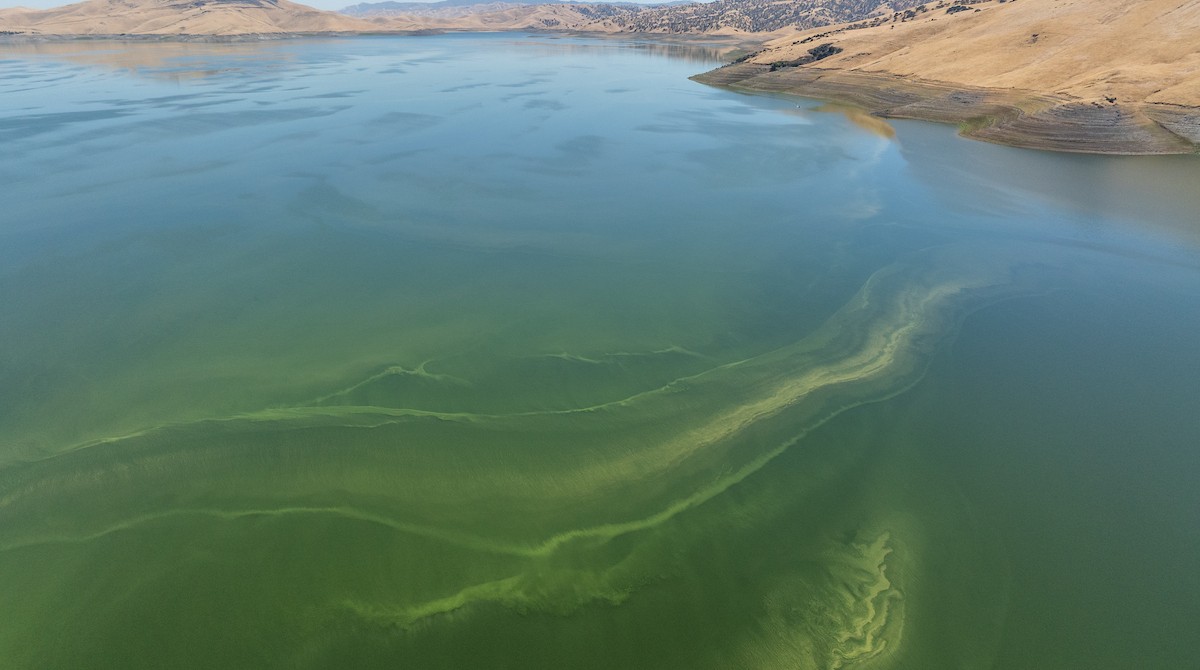
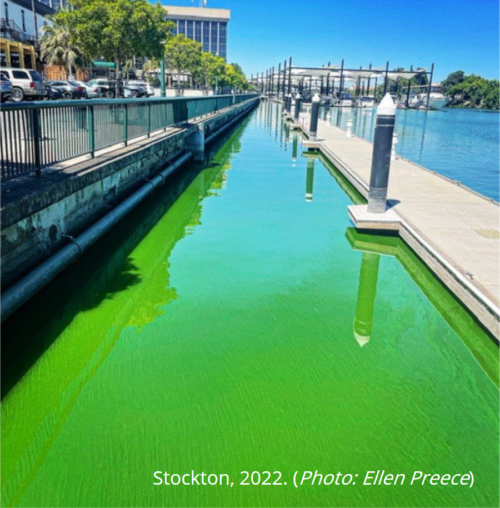 Algae and cyanobacteria are single-celled, photosynthetic organisms that form the base of the aquatic food web for many fish and other organisms. Under certain conditions, they can reproduce rapidly and reach unusually high concentrations in the water, creating an algal bloom. Blooms may turn the water bright green, deep red, or opaque brown; however, color alone does not indicate whether a bloom is harmful.
Algal blooms generally fall into three categories, based on the organisms involved and the bloom’s characteristics:
- Beneficial algal blooms (BABs): These naturally occurring blooms provide substantial food for aquatic organisms before dispersing. Water managers may manage tides and pulse flows to support BAB production and improve food availability for fish.
- Harmful algal blooms (HABs): These blooms persist or become concentrated enough to create physical, chemical, or biological conditions that can threaten human health and the environment.
- Cyanobacterial harmful algal blooms (CHABs): These are HABs caused specifically by cyanobacteria, often including Microcystis.
Harmful algal blooms can produce toxins that affect people, pets, and wildlife. They may also reduce dissolved oxygen, disrupt aquatic food webs by outcompeting other algae, and affect the zooplankton and fish that depend on those organisms. Dense colonies or surface scums can limit water mixing and clog filters and fish gills.
What Drives Harmful Algal Blooms?
 Algal blooms are not limited to drought years. CHAB formation, frequency, duration, and intensity are influenced by complex interactions among environmental conditions, including water flow, mixing, and turbulence. When these processes are limited, the water can become stratified, allowing blooms to persist longer and become more intense.
Water temperature and light availability also influence bloom formation. Because the Delta is nutrient-rich, increasing water clarity and decreasing turbidity may allow light to penetrate more deeply, creating more favorable conditions for HABs.
CHABs generally favor fresh water and require sufficient nitrogen and phosphorus to develop and persist. However, high nutrient concentrations alone do not always produce a bloom. High temperatures and low-flow or drought-like conditions can promote CHAB formation, but blooms do not occur every time these conditions are present.
“It’s hard to conclusively say how HAB intensity and frequency in the Delta have changed in the last few decades because more intensive monitoring has improved our detection rate,” said Dr. Lisamarie Windham-Myers. “But we do know that, in the future, in the absence of smart management strategies, climate change is expected to cause more frequent, more severe, and longer-lasting CHABs, especially where our waters are fresh, not mixed, and slow-moving.”
Why Microcystis Is a Delta Concern
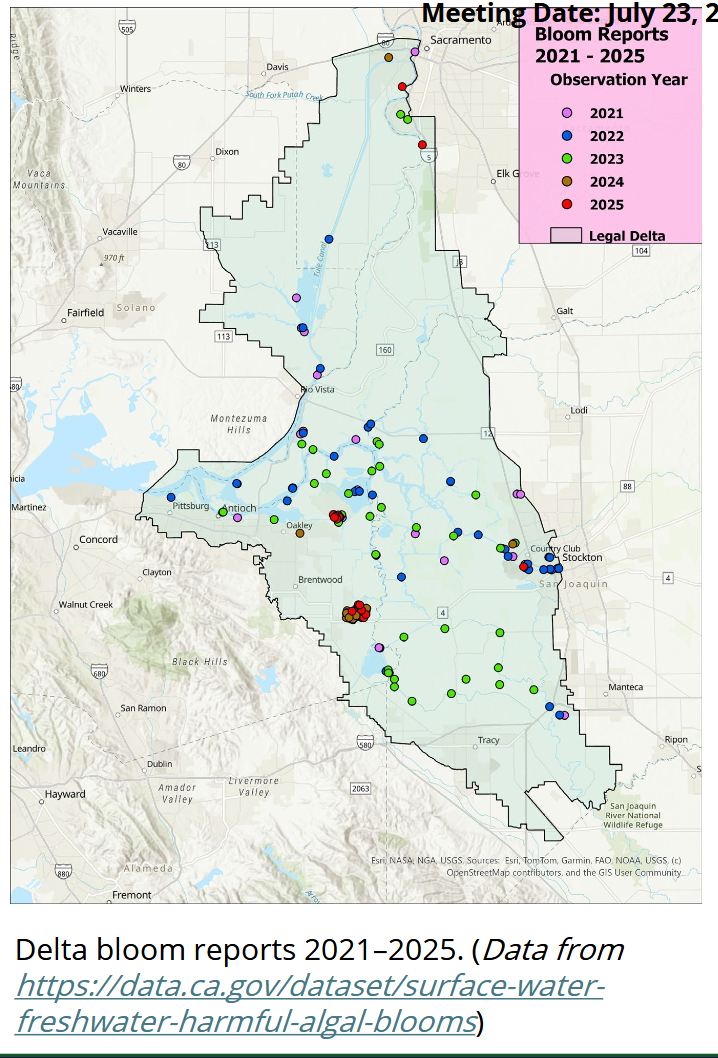 In the fresher portions of the Delta, most harmful algal blooms are CHABs, and Microcystis is the most common bloom-forming cyanobacterium. It is also widespread across the United States. Microcystis blooms were first documented in the Delta in 1999 and now occur during most summers. Dead-end waterways and other low-energy environments, including areas around Stockton and Discovery Bay, are particularly susceptible to CHABs.
Microcystis is a particular concern because it can produce microcystins, a group of toxins that primarily affect the liver and can harm people, pets, livestock, and wildlife. Exposure may occur through drinking water, irrigation water, fish consumption, or direct contact during recreational activities. Airborne droplets may also provide a potential route of exposure.
Not all blooms produce toxins, and toxin concentrations can vary widely. A bloom’s appearance alone cannot reveal whether it is toxic or indicate the level of exposure associated with different activities. Public advisories therefore identify locations where blooms are present or likely to occur and alert people to potential risks.
Closing the Gaps in HAB Monitoring
Improving the prediction and mitigation of algal blooms requires reliable information about where and when they occur in the Delta. Researchers also need data to identify the conditions that drive bloom formation, along with experiments to develop tools that can prevent blooms or reduce risks to people and ecosystems.
The Delta currently lacks a unified monitoring program focused specifically on CHABs, making it difficult to fully assess their location, intensity, and frequency. Existing monitoring relies on several uncoordinated methods, including public reports of visible blooms, direct sampling for cyanobacteria and toxins by the State Water Board, and continuous water-quality sensors that track conditions such as temperature and flow, which can help indicate the potential for water-column stratification.
The Delta Plan, Delta Adapts, and the Science Action Agenda each identify the need to monitor and understand CHABs, improve response efforts, and reduce the risks they pose.
The Delta Stewardship Council is helping develop a comprehensive Delta CHAB monitoring strategy to coordinate the region’s scientific and monitoring efforts. The strategy is intended to support bloom prediction, consistent reporting, and effective mitigation. By bringing these components together, agencies and partners can move beyond public alerts toward more proactive management of CHAB risks.
Looking Beyond Water Quality to Forecast Blooms
Alerts help people avoid exposure when a bloom is present, but earlier forecasts could provide advance notice of where and when a CHAB may develop. Prediction is difficult because no single factor triggers a bloom, and conditions that appear favorable do not always lead to one. Blooms are not solely physical or chemical events; they are also ecological events, suggesting that biological indicators may improve forecasting.
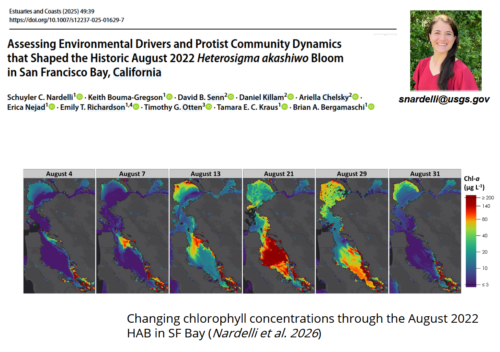 For example, the most severe harmful algal bloom recorded in San Francisco Bay occurred in summer 2022 and caused tens of thousands of fish deaths, including endangered sturgeon. A recent U.S. Geological Survey study found that the large Heterosigma bloom was not preceded by the environmental conditions typically associated with HABs. Instead, it followed a sequence of changes in plankton communities, nutrients, and tidal dynamics.
Researchers were able to identify the factors preceding the event because the U.S. Geological Survey had collected long-term DNA data on plankton community structure in the water column. The study found that plankton community structure was a better predictor of the bloom than water-quality conditions alone, indicating that biological monitoring could support earlier notification of bloom formation.
“Despite being a very different kind of bloom in a very different part of the estuary, these findings still can help CHAB prediction because they could allow us to broaden what we monitor—not just temperature, flow, and nutrients, but also biological communities—so we can see what bloomed before, what nutrients were depleted or regenerated, and how the community is shifting,” said Dr. Windham-Myers.
The Council’s Role in Advancing HAB Science
 The Delta Stewardship Council supports several efforts to address CHAB research and monitoring gaps. Its work includes helping coordinate implementation of the 2024 Delta CHAB Monitoring Strategy, convening an annual workshop, and identifying studies to fill priority data gaps.
Strategy implementation is supported by a five-year, $3 million NOAA Monitoring and Environmental Response to Harmful Algal Blooms grant awarded in 2023, along with State Water Board funding and Department of Water Resources staff participation.
“Most of the work happening here is very underfunded,” said Dr. Windham-Myers. “It’s remarkable we’re making any progress because directed funds really aren’t available.”
The Council also funded the the Microcystis Visual Index Optimization Project through a 2025 Delta Research Award to standardize citizen-science CHAB reporting. In parallel, it is facilitating modeling work through the Delta Modeling Collaboratory and supporting a synthesis working group with the National Center for Ecological Analysis and Synthesis to align Delta CHAB and toxicity data and examine predictive relationships. The Independent Science Board is also planning a review of potential mitigation options for different Delta settings.
According to Dr. Windham-Myers, HABs affect public use, ecosystem health, and water operations, while fragmented monitoring makes them difficult to predict. Coordinated monitoring, integrated data, and improved models could help managers identify bloom-prone conditions earlier and reduce risks before significant exposure occurs.
A Coordinated Strategy for Delta CHAB Monitoring
U.S. Geological Survey research biologist Dr. Keith Bouma Gregson provided an overview of the Delta CHAB Monitoring Strategy.
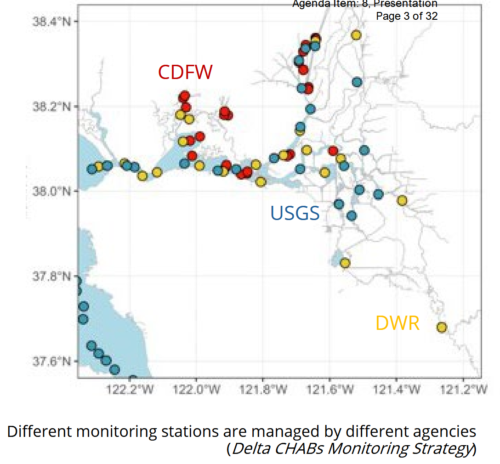 Although several special studies have performed HAB monitoring since CHABs were first documented in the Delta in 1999, significant data gaps remain. The Delta’s core monitoring programs are administered by different entities and were designed to address other needs, such as salinity and fisheries. As a result, their locations and measured parameters are not always well suited to understanding CHAB dynamics.
The Delta also lacks sustained, long-term CHAB monitoring. Over the past 25 years, monitoring has been assembled through a series of special studies. Greater coordination could direct available resources toward priority management needs and help establish a sustained CHAB monitoring program that generates the data needed to forecast, manage, and mitigate blooms.
Recognizing the need for a strategy to guide CHAB monitoring and data collection, representatives of the Central Valley Regional Water Quality Control Board and the California Department of Fish and Wildlife asked the Delta Science Program to help develop one.
“The Delta Science Program proved instrumental to developing the strategy because of its extensive experience in facilitating conversations and soliciting engagement from a wide variety of stakeholders in the Delta,” said Dr. Keith Bouma Gregson.
The effort began with a 2022 workshop that gathered community input, identified priorities, and clarified CHAB monitoring needs. Released in 2024, the strategy was written for a broad audience so that organizations representing different sectors and interests in the Delta could identify ways to contribute to its goals.
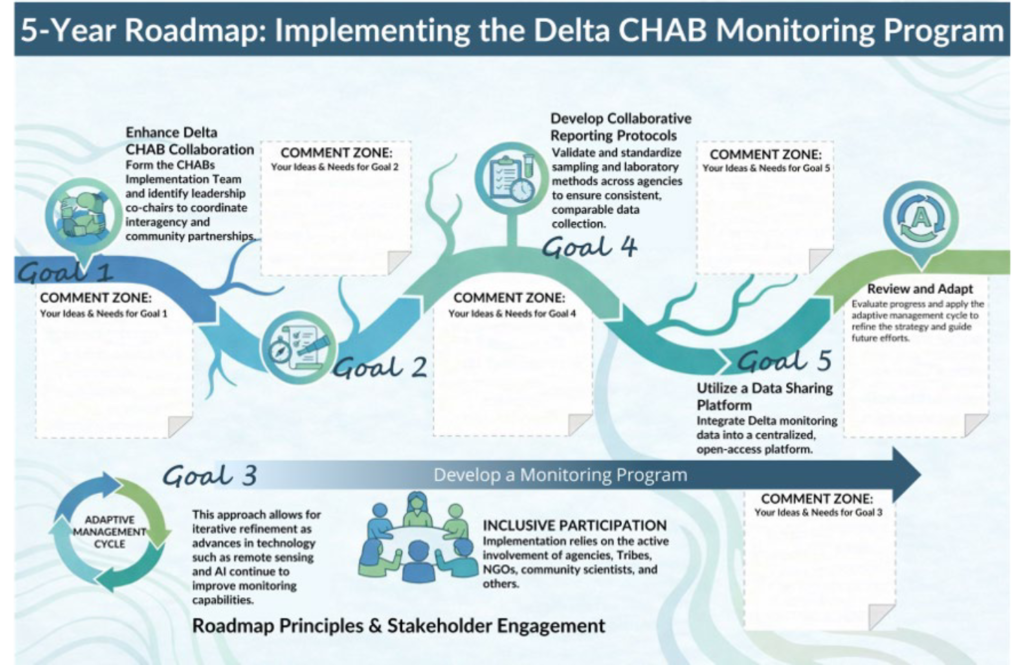
The strategy is organized around five goals:
- Enhance Delta CHAB collaboration;
- Identify monitoring questions, goals, and objectives;
- Develop a CHAB monitoring program;
- Develop collaborative reporting protocols; and
- Use a shared data platform.
Together, these goals are intended to strengthen coordination, establish CHAB monitoring comparable to other Interagency Ecological Program efforts, and make data broadly accessible to scientists and the public.
The strategy includes 26 actionable recommendations and identifies 20 special studies designed to address knowledge and data gaps.
Putting the CHAB Monitoring Strategy into Action
Dr. Laura Twadochleb, an environmental program manager with the State Water Board, discussed implementation of the strategy.
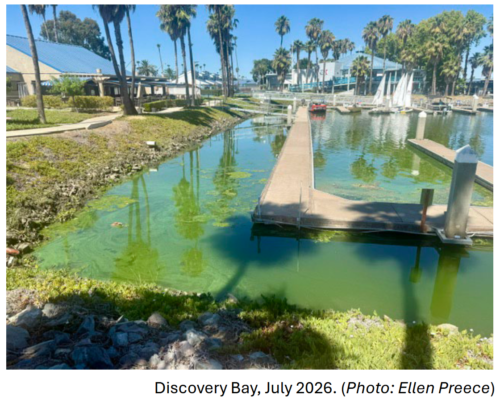 Since the strategy was finalized, the effort has shifted to implementation, with the goal of establishing a coordinated, Delta-wide CHAB monitoring program. Because the implementation team has no dedicated funding, much of the work is voluntary. Its success therefore depends on sustained coordination and collaboration across the Delta science community.
The CHAB Implementation Team meets quarterly. Its first priorities included developing a roadmap built around an adaptive management process. The team will operate on a five-year cycle, reviewing its approach in the fifth year and making adjustments to strengthen implementation and address remaining gaps.
Subcommittees address specific components of the strategy. One is developing annual CHAB workshops to strengthen coordination around monitoring and science. In 2025, another subcommittee began finalizing management questions covering status and trends, environmental drivers, public health, modeling, mitigation and prevention, management actions, and environmental impacts. The team is preparing a public report that will describe the questions and establish metrics for tracking how science and monitoring activities address them. Progress will be evaluated periodically.
Keith Bouma Gregson and the U.S. Geological Survey led development of a CHAB monitoring designs report that recommends options agencies can tailor to their priorities. One option focuses on public-health monitoring, an area of particular interest to the State Water Board. Using the report as a guide, Dr. Twadochleb developed proposed HAB monitoring requirements for the Bay-Delta Water Quality Control Plan. The requirements would establish a network of Delta locations monitored regularly during each annual bloom season.
The implementation team has also made substantial progress on the 20 special studies recommended in the strategy to address scientific knowledge gaps.
Over the coming year, the team plans to finalize the management questions report and organize an annual workshop for spring 2027. It will also form two subcommittees: one to further develop the implementation roadmap and adaptive management process, and another to begin integrating data. Additional priorities include securing funding for special studies and advancing implementation of the strategy.
Optimizing the Microcystis Visual Index
Dr. Ellen Preece, environmental program manager at the Department of Water Resources, then discussed the Microcystis Visual Index Optimization Project, which seeks to expand use of the Microcystis Visual Index (MVI), a common field method for assessing algal bloom severity. The Delta Science Program funded the project through the 2025 Delta Research Awards.
Developed by the Department of Water Resources’ Environmental Monitoring Program, the MVI rates bloom severity on a scale from one to five based on visual characteristics such as water color and surface scum. Field crews assign a score during routine monitoring visits. The method can provide broader spatial coverage than quantitative CHAB sampling alone.
“This is great because it’s rapid and low cost. It just relies on having a person out in the field recording the data,” said Dr. Preece. “It’s actually the longest CHAB data set that we have for the Delta, extending back to 2007.”
MVI data can support early warnings by helping the state Freshwater Harmful Algal Bloom Program determine when advisories or signs may be needed. The index complements rather than replaces quantitative measurements.
The scale ranges from 1, indicating no visible Microcystis, to 5, indicating a thick, oily surface scum. Scores of 2 through 4 represent increasing amounts of visible cells and scum formation.
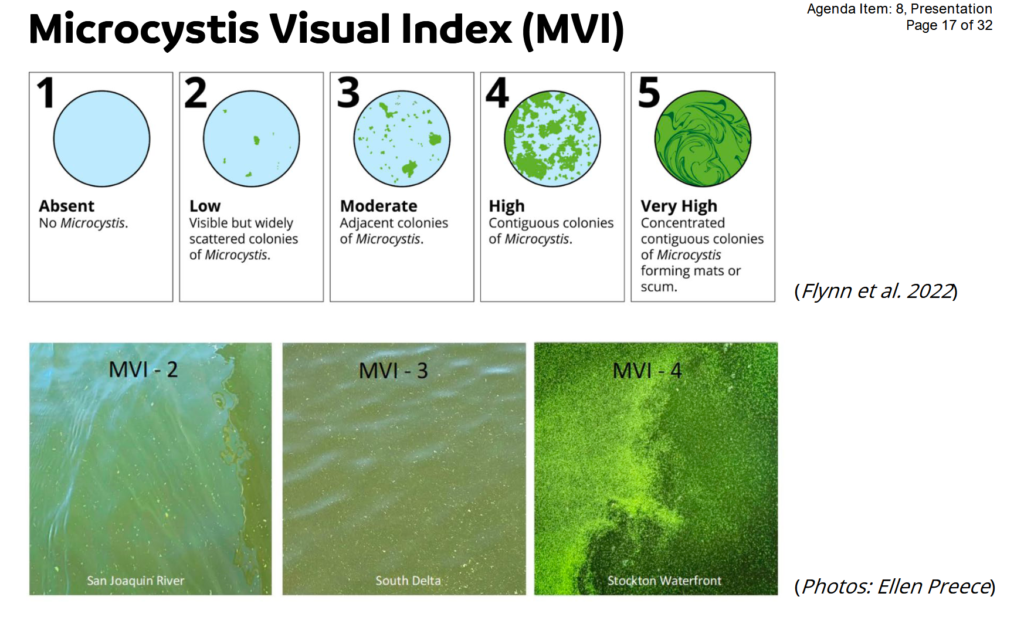
Dr. Preece noted that MVI scoring is subjective because observer experience, sunlight, wind, and time of day can affect ratings; the same bloom may therefore receive different scores across observers or sampling times.
She also emphasized that an MVI score does not indicate whether a bloom is toxic. Visual severity does not reliably predict microcystin concentrations: a dense-looking bloom may contain little or no toxin, while a less visible bloom may still be toxic.
The project has two aims: standardize MVI scoring and determine how well scores reflect Microcystis biomass and toxicity.
To reduce observer bias, researchers are training an image-classification model with thousands of labeled Delta bloom photographs to assign consistent MVI scores.
The second aim compares MVI scores with measured Microcystis biomass and microcystin concentrations. The project involves state agencies, private consultants, the Shingle Springs Band of Miwok Indians, and the Delta Stewardship Council. 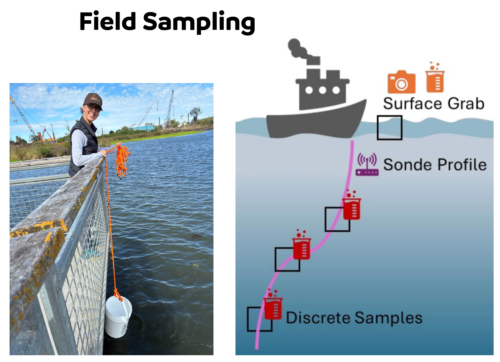 Researchers will pair visual scores with water-quality measurements and laboratory analyses collected through the water column. A related study will compare MVI scores from boat and shore observations, bucket samples, and a gridded white tray to identify the most consistent method. The team will also use a portable imaging system to identify and measure Microcystis colonies rapidly without conventional microscope processing.
“Because we are collecting these samples at the same place and time as the MVI scores, we can directly compare what the bloom looked like to what it actually was,” said Dr. Preece.
The project is expected to produce a phone app, developed with the San Francisco Estuary Institute, that assigns MVI scores from photographs and maps results across the Delta. The tool could support faster, more consistent bloom alerts and inform public-health and management decisions.
The Path Forward for Delta CHAB Management
Many organizations contribute to CHAB research and monitoring, and the strategy provides a framework for coordinating their efforts. Although implementation is not yet fully funded and work to date has relied on multiple funding sources, the strategy establishes priorities and a structure that will allow the Delta HAB community to use future resources efficiently and effectively.
Continued leadership from the Council will also be important to advancing the strategy. “This whole thing lives and dies by the collaboration and coordination of multiple different groups: state and federal agencies, water contractors, tribes, nonprofits, for-profits, community groups, and academia,” said Nick Rowlands, TITLE. “The Council is in a great position to help draw these different groups together and make sure that we’re all rowing in the same direction.”
Councilmember Diane Burgis observed that the strategy emphasizes monitoring but gives less attention to mitigation and direct treatment of blooms.
“That is considered in the strategy as a pathway we want to move forward on, but we need more data as we move toward it to help us understand what tools will be effective and where they will be effective in the Delta,” said Dr. Preece. “The Central Valley Water Board had planned to study which mitigation options might be feasible for the Delta, but when we had state budget cuts a couple of years ago, they had to pause that study. That is something we are still hoping to find a way to move forward because it is not even clear what would be feasible given all the permitting and regulatory requirements.”

