
Several news sources featured in the Daily Digest may limit the number of articles you can access without a subscription. However, gift articles and open-access links are provided when available. For more open access California water news articles, explore the main page at MavensNotebook.com.
On the calendar today …
- MEETING: State Water Resources Control Board beginning at 9am. Agenda items include Consideration of proposed resolution amending water right fee schedules, Drinking Water Fee Schedules, Environmental Laboratory Accreditation Program fee regulations, and Core Water Quality Regulatory Fee Schedules. The Board will also consider Waste Discharge Requirements for Dairies in the Central Valley Region. Click here for the full agenda.
- WEBINAR: Room to Grow: Building California and Conserving its Future from 12pm to 1pm. All Californians deserve to live in healthy, affordable communities surrounded by the natural lands that make California unique. This means building more homes near jobs, schools, and parks, to preventing traffic and pollution, to expanding housing options and preserving natural and agricultural lands. At the same time, our state needs to build more clean energy and climate resilience infrastructure. Join Secretary Wade Crowfoot and other leaders to explore how California can build much-needed housing and infrastructure while protecting the environment. The discussion will highlight promising new approaches that advance growth, prosperity, and environmental sustainability all together. Click here to register.
- FERC PUBLIC SCOPING SESSION: Eel River Dams removal (Eureka) from 6pm to 8pm. FERC will hold two additional public scoping sessions to collect comments on the scope of the environmental issues that should be analyzed in the NEPA document. All interested individuals, resource agencies, Native American Tribes, and non-governmental organizations (NGOs) are invited to attend one or both of the sessions. These additional sessions will follow the format of the June 23 and 24, 2026 sessions. There will be no formal presentations at either session. Numbered tickets will be handed out on a first-come, first-serve basis; individuals will be called in order by ticket number to provide oral comments to be transcribed by a stenographer for the formal record. For more information, click here.
In California water news today …
California is finally addressing groundwater overdraft. How is it going?
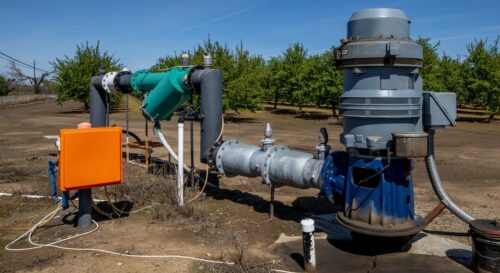 “Groundwater is essential to California’s water supply, making up about 40% of water use in most years. Yet groundwater use has outpaced what’s sustainable, resulting in a variety of issues such as land subsidence, ecosystem damage, and saline intrusion. To address these concerns, the Sustainable Groundwater Management Act (SGMA) was passed in 2014. The act requires basins to rebalance their pumping and resolve these issues by the early 2040s. In this blog post, we look at SGMA’s progress thus far and describe what’s to come. While over a decade has passed since SGMA went into effect, most of this time was spent establishing governance frameworks. Between 2014 and 2017, basins created groundwater sustainability agencies (GSAs), charged with implementing SGMA. These agencies were required to submit groundwater sustainability plans (GSPs) to the Department of Water Resources (DWR) by 2020–22. In most basins, implementation of these plans didn’t get fully underway until 2020 at the earliest. … ” Read more from the PPIC.
Knives are out for nascent groundwater agency struggling to govern its own “dead men walking” in Tulare County
“The Tule East Groundwater Sustainability Agency in southern Tulare County just can’t seem to put a foot right. The state is bearing down, demanding an end to overpumping that has sunk huge swaths of land – taking the critical Friant-Kern Canal with it. Surrounding farmers and water managers want action and they want it now. Tule East directors and staff are still dotting the “i”s to create a legitimate governing agency. Meanwhile, Tule East farmers have apparently abandoned all restraint and are “pumping like it’s the wild west.” The situation is a mess, according to someone familiar with the process and the players who agreed to talk with SJV Water. “What is left of Tule East is now just white area landowners,” they said, referring to land that isn’t covered by a water district, so is totally groundwater dependent. “I mean they’re dead men walking. Why should they walk any faster?” … ” Read more from SJV Water.
DWR explains how Article 21 water could supply WSIP pulse-flow projects
California Department of Water Resources
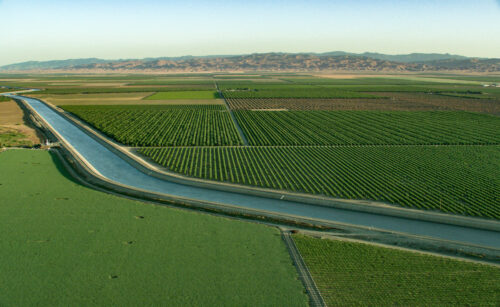
“Proposition 1, approved by California voters in 2014, allocated $2.7 billion for water-storage investments administered by the California Water Commission through the Water Storage Investment Program (WSIP). Projects approved under the Water Storage Investment Program receive funding based on the public benefits they provide. One of those benefits is the delivery of pulse flows to the Feather River to support salmon. Three groundwater-storage projects in the South San Joaquin Valley and Southern California have committed to provide those flows as public benefits in exchange for WSIP funding. When the California Department of Fish and Wildlife requests a pulse flow, the Department of Water Resources releases water from Lake Oroville into the Feather River’s low-flow channel, where the Feather River Fish Hatchery is located. Pulse flows can provide several ecological benefits, including moderating water temperatures, diluting pathogens, helping spring-run salmon migrate out of the low-flow channel, and attracting returning adult salmon to the hatchery for broodstock collection and tagging. Water released into the low-flow channel later rejoins the Feather River’s high-flow channel downstream. … ” Read more from Maven’s Notebook.
In Brief: A Unified Water Plan for the Valley
 “The eight-county San Joaquin Valley includes seven of the nation’s top 10 agricultural producing counties and grows more than 250 crops with an annual value of about $24 billion, with almost $10 billion more in annual dairy and beef revenues. More than 300 disadvantaged communities in the study area draw on the same groundwater that supplies those acres. The Valley is also an important link in the Pacific Flyway and provides habitat for salmon and other anadromous fish. The plan treats water supply, flood management, and ecosystem condition as one regional system. The plan’s central finding is a water supply-demand gap of about 2.4 million acre-feet per year by 2040. It is built from overdraft reported in the Groundwater Sustainability Plans that local agencies wrote under the Sustainable Groundwater Management Act, a provision for replenishing groundwater beyond the elimination of overdraft, contributions from the San Joaquin River Restoration Program and the Healthy Rivers and Landscapes Program, and projected reductions in Delta imports. Increased demand under a hotter and drier climate is included. The figure excludes supply reductions that have already occurred under existing regulatory requirements, and it does not assume future constraints that are not yet known. … ” Read more from the Water Blueprint for the San Joaquin Valley.
Public hearing set on revised Delta Conveyance Project certification
Ken James / DWR
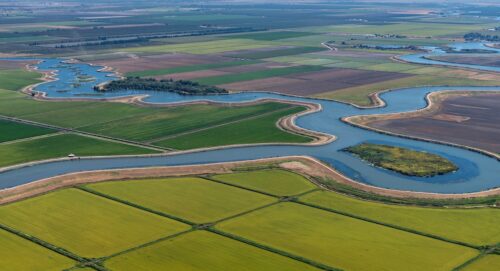
“The Delta Stewardship Council will hold a public hearing on October 15, 2026, beginning at 9:30 a.m., to consider appeals concerning the California Department of Water Resources’ revised Certification of Consistency with the Delta Plan for items remanded in connection with the Delta Conveyance Project (C20262). The Delta Conveyance Project is proposed by the California Department of Water Resources and would involve the construction, operation, and maintenance of new State Water Project water-diversion and conveyance facilities in the Delta. Because the project is a covered action under the California Water Code, the Department must prepare and submit to the Delta Stewardship Council a written certification containing detailed findings on the project’s consistency with Delta Plan regulations. … ” Read more from Maven’s Notebook.
Iran and US: Two countries and the pistachio between them
“Hand-width cracks crisscross Armin’s pistachio orchard in southeastern Iran, damaging irrigation pipes and swallowing precious water as the ground beneath him sinks. “You look, and the earth has opened its mouth, and the water just pours in,” Armin says. He has seen the cracks spread rapidly over the past five years, and worries that his children may not be able to work the land as his father and grandfather did before him. Armin, whose real name DW has chosen not to reveal for security reasons, lives in the arid region of Rafsanjan. For generations, farmers there have cultivated the pistachio tree for its small green edible seed used in everything from ice cream to the viral Dubai chocolate. The region has long covered much of the world’s demand for pistachios, but a combination of drought and groundwater extraction for irrigation has made Rafsanjan one of the fastest-sinking areas in Iran. One study found parts of the ground are dropping by up to 37 centimeters (14 inches) annually. And that is impacting production. It’s a similar picture in California, where some pistachio farmers are also seeing their ground sink. Joe Coelho’s family has cultivated the crop since 2000, and he says while his farm in Fresno is not directly affected, “growers are very aware of the risk.” … ” Read more from DW.
California agriculture under pressure: Manuel Cunha on labor, water and regulation
“California agriculture is facing a growing list of challenges, and on the latest AgNet NewsHour, “The Ag Meter” Nick Papagni takes a hard look at those issues in a wide-ranging conversation with Manuel Cunha, president of the Nisei Farmers League. The two-part interview examines the pressures confronting farmers and farm workers, from labor and water to regulations, rising costs, farmland losses and the political decisions shaping the future of California agriculture. Papagni also continues his call for California political leaders to provide real answers about what they intend to do to keep farming viable in the state. … ” Read more from AgNet West.
Less grass, more bark coming to city parks across California
“People visiting parks in San Jose and other cities across California will soon see less grass and more bark as part of an effort to save water. Cities are making the move to the more brown look in order to comply with Assembly Bill 1572, which goes into effect January 1, 2027. “Basically it says cities generally cannot use potable or drinking water to irrigate grass that does not serve a recreational, community or public use function,” said Ed Bautista with San Jose Parks, Recreation and Neighborhood Services. In San Jose, sections of non-functional turf at about 50 city parks will be replaced with tanbark or mulch. … ” Read more from NBC Bay Area.
USGS: Understanding the 2026 El Niño: Regional insights for managers
“El Niño is the naturally occurring warm phase of the El Niño-Southern Oscillation (ENSO), a climate pattern in the Pacific Ocean. During El Niño events, sea surface temperatures in the central and eastern Pacific Ocean near the equator become warmer than average. NOAA and other scientific agencies are forecasting the current El Niño to become very strong over the next 2–9 months—perhaps the strongest in over 150 years. The 2026 El Niño is raising important questions for resource management across the country. To support planning and decision‑making, the Climate Adaptation Science Centers have developed a series of webpages that outline the forecasted regional impacts of the 2026 El Niño and discuss what these changes may mean for resource management in each CASC region. The webpages offer a high level overview of El Niño, followed by a closer look at potential shifts in temperature, precipitation, storms, and more in each region of the U.S., along with what those changes could mean for resource management.” Explore the USGS El Niño webpages.
California engineers trace how UV light destroys ‘forever chemicals’ in water
“Water systems have struggled for years with how to remove “forever chemicals” from water. Researchers at the University of California, Riverside, have found a set of chemical reactions that clarify the role ultraviolet light can play in taking those pollutants apart. UC Riverside said the work, published in the journal Nature Water and detailed by Phys.org, traces the chemistry behind UV-driven treatment of PFAS — short for per- and polyfluoroalkyl substances. By spelling out those reactions, the study gives researchers a clearer basis for improving cleanup methods. … ” Read more from The Cool Down.
Millions in bond money going to CA Water Project if this bill becomes law
“Approximately $158.2 million of bond money approved in 2024 will pay for projects in the State Water Project and Sacramento-San Joaquin Delta levees, according to an announcement from state Sen. Jerry McNerney, D-Stockton. The money was approved as part of the budget bill Assembly Bill 113, which passed the legislature in August and is on the governor’s desk. According to McNerney’s office, the funding comes from Proposition 4, which California voters passed in 2024. Voters approved the $10 billion bond measure, which lifted the state’s ban on using public funds for election campaigns, allowing cities, counties and the state to create publicly-funded campaign finance systems in the future, according to the Legislative Analyst’s Office. … ” Read more from The Center Square.
What are some of the California environmental bills the Legislature sent to Gavin Newsom?
“California legislators passed a bill last month that pushed back against changes to a state law Gov. Gavin Newsom had previously jammed through the Legislature, as part of an array of environmental measures that headlined this year’s legislative session. That measure joined bills regulating data centers, home energy use and other measures affecting the state’s natural resources that are now awaiting action by Newsom. Here are some of them … ” Read more from the Sacramento Bee.
In commentary today …
Water, energy and climate resilience must go hand in hand
Westlands General Manager Allison Febbo writes, “California often speaks in ambitious terms about climate resilience, clean energy, and sustainable water management. Turning those goals into workable solutions is proving more difficult, particularly in regions where water supply has become increasingly uncertain. On the west side of the San Joaquin Valley, Westlands Water District is going beyond simply navigating these challenges. We are developing solutions for our communities, farmers, and economy. It turns out, these are the integrated solutions California needs. “Weather whiplash” – rapid swings from drought to flood – combined with rigid regulatory constraints make it harder for farmers to plan from season to season. In the last decade, federal water allocations have averaged only a fraction of what was promised, forcing difficult decisions, including fallowing land that once produced food for the nation. … ” Read more from the SJV Sun.
In regional water news and commentary today …
NORTH COAST
Klamath River adult salmon fishing closes after quota met
“Adult Chinook salmon fishing on the lower Klamath River closed late Sunday after anglers reached the 2026 fall-run quota, state wildlife officials said. The closure covers the main stem of the Klamath River from the Highway 96 Bridge near Weitchpec to the Pacific Ocean, according to the California Department of Fish and Wildlife (CDFW). Anglers may still fish below the Highway 96 Bridge for jack Chinook salmon, which are two-year-old fish measuring 23 inches or less. Any adult Chinook salmon caught in that stretch must be released immediately. … ” Read more from KRCR.
Guided tour reveals why Anderson Marsh is so vital
“One of the most vital water ways of Lake County is also one of the most enjoyable recreation spots, Seigler Canyon Creek – part of the Lower Lake Basin hydrology, draining into Cache Creek. This is known as a riparian area, which features native trees and shrubs adapted to flood prone conditions, noted Joe Lundengreen, a volunteer State Parks docent and a Certified California Naturalist. It includes Cottonwoods and Willows, which stabilize banks and with their roots, provide shade and a complex habitat for wildlife, nesting that also filters sediment from runoff with deep roots to hold soil in place during flooding and slows flood waters, according to the California Department of Water Resources. … ” Read more from the Lake Record-Bee.
SIERRA NEVADA
Powerful El Niño could bring wetter season to Mother Lode
“Oceanographers and other forecasters say potential for a strong El Niño or super El Niño this winter is growing, and that could mean a wetter-than-average winter for the Central Sierra Nevada and the Mother Lode, as well increased risks of flooding and erosion due to high-elevation snow mixed with rain during warmer storms. In spite of the chances for more storms and more precipitation, it could also mean below-average snowpack if warmer storms outnumber colder ones. … ” Read more from the Union Democrat.
SACRAMENTO VALLEY
DWR warns of Algal Bloom in Lake Oroville
“Swimmers at the middle fork of Lake Oroville beware as an algal bloom has been spotted in the area. The California Department of Water Resources issued an advisory Friday, saying samples collected between the inlet at Bald Rock Canyon and Bean Creek Bar to be tested in order to determine whether the bloom is dangerous. There are, however, some visual indicators for those in the area to keep an eye out for. These include green, blue-green, brown or white particles in the water as well as streaks in the water that “look like spilled paint,” according to the notice from DWR. … ” Read more from the Chico Enterprise-Record.
Company eyes ‘large load’ data center in Sacramento that could be region’s biggest
“One of the largest developers of data centers in the nation is eyeing an industrial area in the city of Sacramento for a new data center. Employees from Link Logistics have been in talks with the Sacramento Municipal Utility District since February this year, according to emails acquired by Abridged by PBS KVIE. Link Logistics is a warehouse real estate company and is a subsidiary of Blackstone Inc. Blackstone describes itself as the world’s largest owner of commercial real estate and data centers. The data center is estimated to be a “large load” project over 50 megawatts, according to SMUD, which declined to state the exact size the company is considering building in Sacramento. … ” Read more from PBS Abridged.
New preserves held by land trust protect open space in Sacramento County
“Sacramento Valley Conservancy (SVC) added two new open space preserves to the system of protected lands in Sacramento County this summer, one protecting blue oak woodlands and the other open grasslands for Swainson’s Hawk foraging. Hardwood forests and grasslands are among the least-protected landscapes in California, and these new preserves are a small step toward addressing this gap as the state seeks to reach 30X30 biodiversity goals. Westervelt Ecological Services established the preserves as habitat mitigation for a development project in the City of Folsom. The Crevis Creek Oak Woodland Preserve connects to the 4,600-acre Deer Creek Hills Preserve and adds 125 acres of protected oak woodland in Eastern Sacramento County, where SVC has a goal of protecting 10,000 acres of blue oak woodlands south of Folsom. … ” Read more from the Carmichael Times.
BAY AREA
‘Exceptionally rare’ Bay Area island property listed for sale
“A 100-year-old duck-hunting club on an island in the eastern Bay Area is up for sale. The historic Concord Farms Duck Club includes 400 acres of open space on the minimally developed Van Sickle Island in Solano County. Much of the marshy isle, in the middle of Suisun Bay, is occupied by private clubs where dues-paying hunters shoot waterfowl during the fall season. The property was listed this month for $1.5 million. A buyer could continue running the hunting club or use the property as a personal wildlife watching retreat, according to listing agent John Ward. “Normally you’d see a place like this get bought by a group of duck hunters but there’s so much money in the Bay Area, you never know,” he said. “Maybe someone in AI wants some elbow room and buys it as their own little place to enjoy.” … ” Read more from the San Francisco Chronicle.
More than 100 data centers already dot Silicon Valley landscape, more on the way
“As the cities of San Jose and Gilroy and the California Legislature are tackling ways to regulate the dramatic expansion of data centers, data center growth in California and nationwide shows no signs of slowing. In fact, an analysis of national and state data shows that hundreds of data centers are already solid fixtures in major tech centers like Silicon Valley, Austin and Northern Virginia. “The race to build AI infrastructures is unfolding town by town across America,” legendary environmental activist Erin Brockovich wrote in May. “In some places, data centers are welcomed. In others, they are delayed, contested or abandoned altogether.” The tracking website Data Center Map reports that San Jose already has 47 data centers, and city officials have said that as many as 34 new projects are under review. … ” Read more from the San Jose Spotlight.
Gilroy approves temporary freeze on new data centers
“The Gilroy City Council on Monday night backed a temporary freeze on new data centers in the city while more comprehensive rules are developed for such projects. The unanimous vote follows community uproar over a massive Amazon data center taking shape on the city’s northeastern edge. Elected officials did not vote on that project because the 56-acre parcel had already been zoned for heavy industrial use. The moratorium took effect immediately and will remain in place for at least 45 days, the city said in a statement. While the freeze is in place, the city cannot accept, process or approve applications and entitlements for new data centers. The moratorium will not affect the current Amazon project, but it would halt a second data center the company is said to be considering. … ” Read more from the San Jose Mercury News.
SEE ALSO: Gilroy City Council approves temporary moratorium on new data centers, from NBC Bay Area
SOUTHERN CALIFORNIA
Santa Ynez drinking water reservoir cover construction on track as planned for completion by December 2026
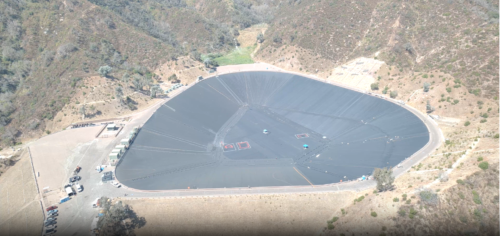 “The Los Angeles Department of Water and Power (LADWP) continues making significant progress on the Santa Ynez Drinking Water Reservoir Floating Cover Replacement Project, a major infrastructure upgrade designed to improve long‑term water system resiliency, protect drinking water quality, and ensure compliance with state and federal drinking water regulations. The reservoir remains temporarily out of service while construction advances, including installation of the new reinforced liner and floating cover system-both required to safeguard potable storage under the EPA’s Long‑Term 2 Enhanced Surface Water Treatment Rule. As of today, the liner and cover installations are complete, and the project is on schedule to begin refilling later this month, with a full return to service expected by December 2026. … ” Read more from LA DWP.
This little-known ocean phenomenon has California forecasters concerned
“As if concerns about El Niño leading to more coastal flooding and erosion in Southern California weren’t enough, experts are now warning of another looming threat. Kelvin waves, described by climatologists as slow-moving “humps” of elevated ocean water that become trapped along the coast, are developing along Mexico’s west coast and moving northward. “During El Niño, winds that typically blow westward along the Equator weaken and periodically reverse in ‘westerly wind bursts,’” the National Oceanic and Atmospheric Administration explains. “These wind bursts set off oceanic Kelvin waves that travel east along the Equator.” These waves are not particularly large, only about 6 to 18 inches tall, according to Dr. Daniel Swain, a climatologist with the University of California system. But the timing of their arrival could be problematic. … ” Read more from KTLA.
SAN DIEGO
Del Mar readies for flooding, erosion as El Niño builds
“Del Mar is preparing its beaches, streets and emergency response operations for a potentially powerful El Niño that city officials say could heighten the risk of flooding, erosion and debris flows this fall and winter. A Sept. 8 City Council staff report cited a 95% probability of a very strong El Niño for October through December. The National Weather Service’s Climate Prediction Center subsequently said Sept. 10 that there is a greater than 90% chance of a very strong El Niño this fall and winter and a 75% chance that the October-December event will exceed the strength of previous El Niños dating to 1950. Southern California is favored for above-normal winter precipitation during a strong El Niño, although the timing and intensity of individual storms cannot be predicted months in advance, according to the report. … ” Read more from the North Coast Current.
Crews begin making berms on S.D.’s beaches to prepare for El Niño
“City crews are installing sand berms on city beaches and the Mission Bay shoreline to prepare for heavy swells anticipated with the upcoming El Niño weather pattern in the forecast this fall and winter. The building of the berms began last week. The work is expected to take several weeks — starting on the bay and then moving along the beach shoreline to be completed by early November. The berms are intended to protect against flooding caused by high tides and surf. “These berms help absorb and dissipate the energy of waves and high tides, providing an added layer of protection,” said Assistant Fire Chief Rob Rezende, who oversees the city’s Office of Emergency Services. “By breaking the force of the incoming waves, they reduce the risk of erosion and coastal damage. With the potential for a wetter winter and stronger storms associated with El Niño, we’re taking steps now to prepare our beaches and shoreline before severe weather arrives.” … ” Read more from the San Diego Union-Tribune.
Report: Tijuana River is chronically polluted with sewage, chemicals
“E. coli levels in the Tijuana River watershed are often 30,000 times higher than the federal standard for freshwater bodies, according to a new report San Diego Coastkeeper released last week. And chemicals researchers said they can’t find thresholds for because they’re not expected to be found in water are also being detected in the binational river. “Our monitoring documents the unprecedented levels of sewage and industrial pollution in the Tijuana River that are causing severe impacts to public health, the Tijuana River Estuary and our coastal ocean waters,” Phillip Musegaas, Coastkeeper’s executive director, said in a statement. … ” Read more from KPBS.
Along the Colorado River …
Colorado River officials support more emergency releases from Wyoming reservoir to prop up Lake Powell
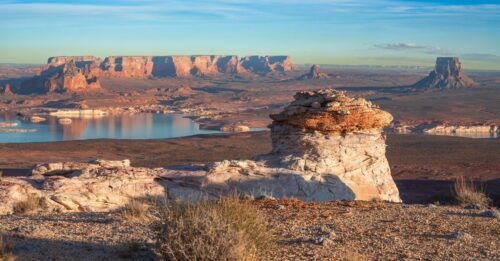
“Officials in the Upper Colorado River Basin plan to continue draining Flaming Gorge in Wyoming to protect Lake Powell, one of the basin’s largest reservoirs. The Colorado River Basin, which extends from Colorado to California and northern Mexico, uses a network of reservoirs to store vital water supplies for cities, farms, recreation, the environment and millions of people. But the basin’s overall storage has dropped to a third of its capacity, officials said during an Upper Colorado River Basin meeting Monday. Lake Powell holds about 22% of its total capacity. Since April, the Bureau of Reclamation has released about 450,000 acre-feet of water to help boost storage in Lake Powell. Colorado and other Upper Basin state officials agreed Monday that those releases should continue through April. “I know none of us like to be in the hydrologic conditions that we’re seeing,” said New Mexico’s representative Commissioner Tanya Trujillo. “But (we) appreciate Reclamation’s work and the good job that you do in communicating these results not only to us as commissioners but also to the public.” … ” Read more from the Colorado Sun.
Wyoming, Upper Basin States: Water taken from Flaming Gorge should be replaced
“Lake Powell probably won’t hit “dead pool” this year, but a drawdown on Flaming Gorge Reservoir that helped make that possible should be made up for, water commissioners decided Monday. The four-member Upper Colorado River Commission voted to send a letter to U.S. Interior Secretary Doug Burgum stating the Drought Response Operation Agreement (DROA) water released appears to have been effective in averting a crisis. However, recovery of those releases from Flaming Gorge, on the Wyoming-Colorado state line, “is a priority when hydrologic conditions improve,” the commission decided during an online meeting. … ” Read more from Cowboy State Daily.
Colorado River states face tough choices as water supplies shrink
“The Colorado River is running low, and states that rely on it are facing a difficult question: How do you divide water you don’t have? The results of a study were discussed Monday during a special meeting of the Upper Colorado River Commission, which includes representatives from Utah, Colorado, Wyoming and New Mexico. Gene Shawcroft, chair of the Colorado River Authority of Utah, said the challenges are becoming increasingly difficult to manage as water demand grows while supplies remain limited. “When you expect 100, and you get 10, you can’t give them 50. It just isn’t there,” Shawcroft said. “And that’s a difficult concept to those who’ve historically been able to pull whatever they needed from a reservoir.” … ” Read more from Fox 13.
The Colorado River is becoming an industrial location risk
“Lake Powell sat at just 25% of capacity as of late April 2026, and the Bureau of Reclamation (BLM) now expects the reservoir to drop to a record low sometime in the next twelve months, according to tracking by Circle of Blue. Lake Mead has not fared much better, holding around 32% of capacity. Reclamation’s own April study put water year 2026 inflows into Lake Powell at 3.87 million acre-feet, roughly 40% of the long-term average. Those figures used to be a farming and municipal supply story. It is increasingly an industrial one. Arizona has spent the past several years courting exactly the kind of facilities that need the most water and the most certainty about getting it. Semiconductor fabs run cooling and ultrapure water systems around the clock, and hyperscale data centers can draw millions of gallons a day depending on design. Both industries are betting on a river system that is shrinking; at the same time, the rules for sharing it are about to be rewritten. … ” Read more from E&E Leader.
Arizona chip boom faces water cuts from 2027, raising alarm for TSMC, Intel expansions
“Arizona is expected to have to sharply cut the amount of water it draws from the Colorado River, a shift likely to add to the burden of semiconductor factory expansions by TSMC and Intel. Water demand is surging as AI chip production and data centre construction rise at the same time, bringing the U.S. “semiconductor revival” into conflict with water shortages. On Sept. 11, IT outlet The Verge reported that under a new U.S. government water allocation plan, Arizona must cut at least 760,000 acre-feet of water each year from 2027. That amounts to more than a quarter of the water it currently receives from the Colorado River, leaving Arizona with the biggest burden among the regions subject to cuts. … ” Read more from the Digital Times.
What is Scottsdale’s wastewater swap plan, and will it work?
“Scottsdale has proposed sending its treated wastewater into the Central Arizona Project (CAP) canal in exchange for a share of another community’s CAP water, as Arizona faces major cuts to Colorado River supplies. Sarah Porter, director of the Kyle Center for Water Policy at Arizona State University’s Morrison Institute, said the proposal surprised her. “This one, I hadn’t seen coming,” Porter said. Under the plan, Scottsdale would take some of its advanced purified water, which is recycled wastewater treated at a city plant, and trade it to another community for a share of that community’s Central Arizona Project water. The city would pump the treated water directly into the canal system to complete the swap. … ” Read more from Arizona Family.
‘We’re out of water’: Utah communities live with steep water cuts amid brutal Colorado River drought
“In a normal year, Ferron farmer Brooks Behling can fill his barns with hay two or three times. This year, they were never full. Brooks Behling was only able to irrigate about half of his farm this year. The fields that did get water only received half of what they would ideally get. He estimated his total harvest this year will likely be 30% of normal. “We’re done,” he told the Tribune in August. “We’re out of water.” Blistering drought across the West has forced some communities in Utah to live with a fraction of their normal water. The canal company in Ferron, a small city in Emery County, had to cut water shares to farmers, the city and Hunter Power Plant by 75%. The company has senior water rights but this year, Ferron Creek was a trickle compared to its usual flow. “We’ve had some lean years, but this is by far the worst,” said Tracy Behling, Brooks Behling’s father and 42-year president of the Ferron Canal and Reservoir Company. … ” Read more from the Salt Lake Tribune.
Colorado town fears losing water supply after river runs dry in second-worst drought year
“La Veta, Colorado, is confronting a growing fear: running out of water after its local river dried up. According to The Denver Gazette, the small town’s water troubles came into focus when the Cucharas River went dry. In Huerfano County, where La Veta has about 850 residents, drought conditions have worsened into the extreme-to-exceptional range. This is the county’s second-most severe drought year in 132 years, and neighboring counties — especially those west in the San Luis Valley — are seeing similar conditions. After tightening restrictions, La Veta moved to stage four rules, which ban all outdoor water use. … ” Read more from The Cool Down.
In national water news today …
EPA eliminates rule that limits planet-warming greenhouse gas emissions from power plants
“The Environmental Protection Agency said Monday it is repealing rules that limit planet-warming greenhouse gas emissions from power plants fueled by coal and natural gas and announced it is taking a separate but related step to prevent future administrations from regulating climate pollution from power plants. The rule change, first proposed last year, represents a fundamental shift from efforts by Democratic Presidents Joe Biden and Barack Obama to address climate change and regulate carbon dioxide and other greenhouse gases that trap the sun’s heat. Environmental groups decried the change, saying it would come at a cost to Americans’ health and further degrade the environment. … ” Read more from the Associated Press.
SEE ALSO: EPA Finalizes Repeal of 2024 Power Plant Regulations, Delivering $300+ Billion in Savings, Proposes Repeal of All Remaining Greenhouse Gas Emissions Standards for Power Plants, press release from the EPA

