
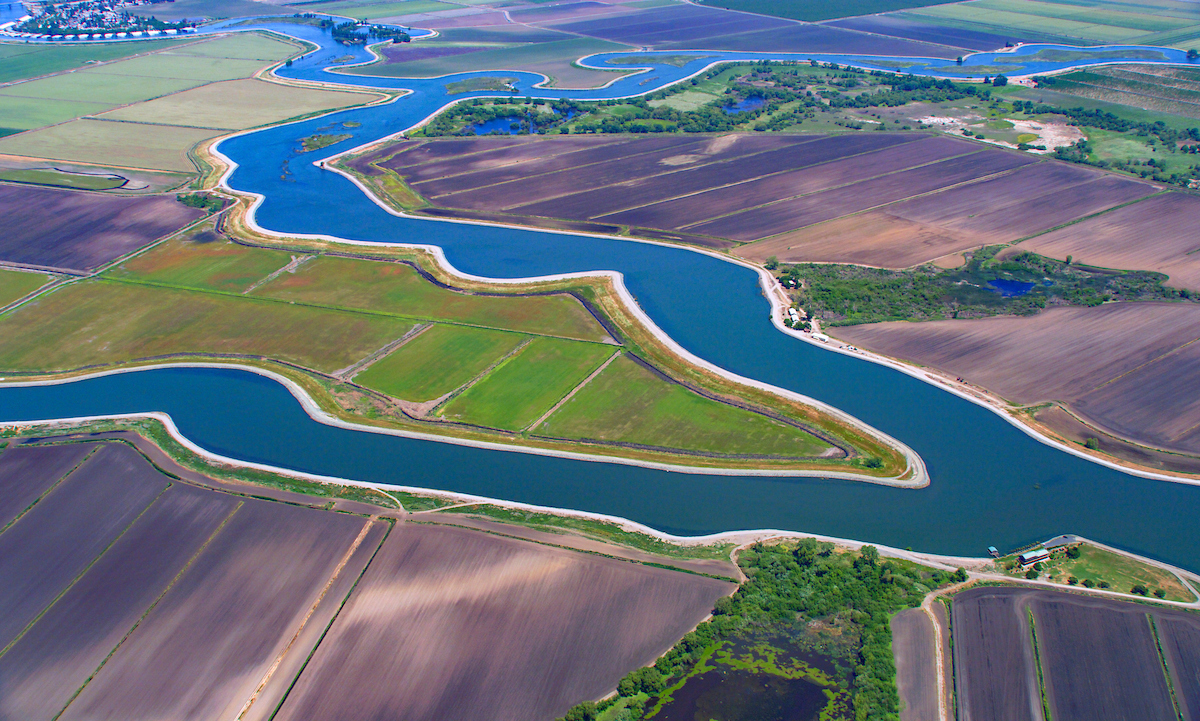
The UC Berkeley-led COEQWAL project is helping communities explore how shifting the state’s water priorities could impact agriculture, cities and ecosystems.
By Kara Manke, UC Berkeley
Water has always been one of California’s most contested resources. For more than a century, battles have raged over how much of the state’s water should be diverted to farmland, pumped into cities or used to conserve aquatic ecosystems — and at times, these clashes have even led to violence. The state’s water system consists of a dizzying array of reservoirs, rivers, dams and aqueducts, making it challenging even for experts to understand the trade-offs of different management decisions.
To top it off, climate change is intensifying California’s already dramatic dry and wet cycles. After surviving more than a decade of severe drought, the state is now bracing for the impact of this year’s super El Nino, which is likely to bring above average rainfall this winter.
A UC Berkeley-led project aims to make it easier for all Californians to understand the state’s complex water system and have a say in how this critical resource is used. With the support of a California Climate Action Grant, the Collaboratory for Equity in Water Allocation (COEQWAL) team has spent the past three years working with stakeholders from around the state. They are creating tools that help illustrate where California’s water is going, the impacts of different water priorities, and how climate change will shift the water landscape.
At an event in Sacramento on Sept. 3, the collaboration unveiled the new COEQWAL website, which includes educational modules and reference guides explaining California’s water system. It also visualizes the outcomes of more than 100 water management scenarios modeled using the California Department of Water Resource’s CalSim 3 planning tool. These scenarios give the public the ability to explore how specific water policy decisions — such as limiting groundwater pumping in the Central Valley or increasing river flows to protect salmon — might impact water users and ecosystems around the state.

“CalSim is a very complex model in part because it’s a very complex system, but the way it was designed makes it almost impossible for anyone other than a highly specialized engineer to interact with the data,” said project lead Ted Grantham, an associate professor of cooperative extension in Berkeley’s Department of Environmental Science, Policy and Management. “A big part of what we wanted to do with this project is explore a much broader range of scenarios [than have been published by the Department of Water Resources] to help people understand not only how water is managed today, but what’s possible in the future.”
In designing the scenarios, the team partnered with nearly 100 organizations around the state, running workshops to understand their water priorities and interests. The scenarios explore a variety of different water management approaches, including increasing river flows to benefit fish and aquatic ecosystems; improving access to drinking water; and the impacts of state regulations on sustainable groundwater use and protecting the Sacramento-San Joaquin River Delta.

“It’s really, really unique to be asked, ‘What if we managed water for entirely different priorities than we do today?’” said Jonathan Rosenfield, science director at San Francisco Baykeeper, who participated in a number of the workshops. “Usually, when you get access to the CalSim model, you’re creating alternative management scenarios that differ really around the margins. It’s not, ‘What if we reoriented our water management to a different kind of future?’ This is a real example of the university helping the public and decision-makers understand their options.”
The findings are all available on the public COEQWAL website, where users can access, filter and investigate scenario outcomes and tradeoffs with the help of advanced data visualization tools.
“Being able to have access to some of this modeling and understand the complex elements that currently interact and influence the Delta watershed is going to be very, very powerful for tiny organizations like ours,” said Morgen Snyder, director of policy and programs at Restore the Delta. “I am really impressed with the way the COEQWAL team has brought together a myriad of different stakeholders — water contractors, water districts, environmental justice groups and tribal organizations — and using science to find a common path forward.”
Grantham hopes the tool will enable more informed discussions about the future of California’s water and debunk some of the simplified arguments and misconceptions that people have about what could happen if priorities were to shift.
In fact, he was surprised to find that the system was often more resilient than might be expected, perhaps due to the deep interconnectedness of the state’s many waterways.
“We found that a lot of these strategies don’t have as big of an impact as you might expect,” Grantham said. “It shows that we’re not risking putting the entire system at collapse by sustainably managing groundwater, or protecting the environment or ensuring that everyone has access to clean drinking water. We can actually do these things. They may come with trade-offs, but they are trade-offs that we can manage.”

Moving forward, the COEQWAL project team has secured a grant from the Delta Science Program to continue the work, now with a focus on tribal engagement and better modeling Indigenous relationships with water. In hearing from Indigenous representatives at COEQWAL workshops, the team was struck by how models like CalSIM — which break down complex systems into smaller, quantitative pieces — are unable to reflect how Indigenous nations experience water as part of interconnected ecological and cultural systems.
“We want to explore how we can better integrate or weave these values and relationships to water into how we represent them in these models,” Grantham said. “We’d like to try to draw attention to the fact that these systems are much more than just a volume of acre feet being delivered from point A to point B.”
COEQWAL is a multi-institutional research effort with collaborators from Berkeley, UC Agriculture and Natural Resources, UC Davis, UC Merced, UC Santa Cruz, UC San Diego, UCLA, California State University and many others.

