
A wrap-up of posts published on Maven’s Notebook this week …
Note to readers: Sign up for weekly email service and you will receive notification of this post on Friday mornings. Readers on daily email service can add weekly email service by updating their subscription preferences. Click here to sign up!
In California water news this week …
California’s biggest reservoir in decades is facing a crucial moment. Will there be enough water?
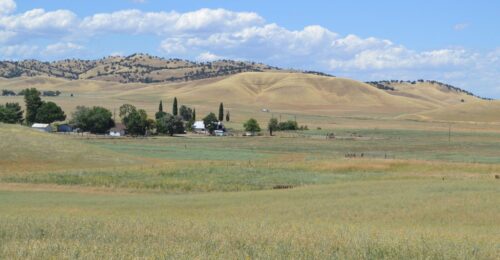
“A major reservoir planned in Northern California is facing a pivotal question: whether enough water will be available to move forward. On Thursday, state water regulators released a draft permit for the highly anticipated Sites Reservoir, outlining how much water the proposed $6 billion facility in rural Glenn and Colusa counties can draw from the Sacramento River and, importantly, when those draws can be made. The project’s backers, who include Gov. Gavin Newsom, criticized an earlier draft of the permit as overly restrictive, saying it offered as little as half the water needed and left the viability of what would be California’s eighth largest reservoir in question. Cities and farms across the state stand to benefit from the new water supply, including in the Bay Area’s South Bay and Tri-Valley, though opponents of the project say it will dangerously deplete the Sacramento River. … ” Read more from the San Francisco Chronicle.
State Water Board revises draft water right decision for proposed Sites Reservoir; The Sites Project Authority responds
“The State Water Resources Control Board today released for public comment a revised draft water right decision and draft permit for the proposed Sites Reservoir in Northern California that will balance the project’s water supply benefits with the protection of senior right holders, water quality and flows for fisheries. The proposed 1.5 million-acre-foot reservoir, which would be the largest built in California in more than 50 years, would increase the state’s supplies by diverting water from the Sacramento River when flows are relatively high and storing it for farms, cities and the environment. If approved by the State Water Board, the revised drafts allow the project to divert up to 986,000 acre-feet of water per year — enough to supply about 8.4 million people annually. … ” Read more from the State Water Board, and the response from the Sites Project Authority.
New rules for pumping water from Delta include restoration incentive
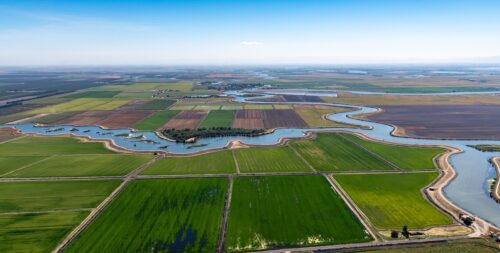
“After years of debate over how much freshwater should be allowed to flow to the sea through the Sacramento-San Joaquin Delta, the State Water Resources Control Board has released a final draft of its regulatory plan. The board is accepting public comments through Sept. 18 before it considers adopting the draft Water Quality Control Plan on Oct. 28. In the draft plan, water right holders can choose from two pathways to compliance. They can provide a minimum rate of water flow from Sacramento River tributaries, or they can voluntarily invest in habitat restoration projects with specific flow volumes in lieu of sustaining a minimum flow rate. Some stakeholders say that part of the plan hands regulatory authority over to the very groups the board is supposed to regulate. The Delta, where water flows from the Sierra Nevada through San Francisco Bay, provides water for nearly 30 million Californians and 4 million acres of farmland. It spans more than 1,000 square miles. Streams and tributaries flow around cities and farms into lakes and wetlands that sustain some of the state’s most threatened and endangered wildlife. Those watery landscapes also help replenish groundwater storage. … ” Read more from Local News Matters.
Fong, Valadao throw cold water on state plan to rework flows from Delta
“Two locally elected congressmen jumped Thursday into one of the Central Valley’s most contentious water issues, saying a proposal released by the state last month “moved the goalposts” set up four years ago in an agreement governing water flows south from the Sacramento-San Joaquin Delta. Reps. Vince Fong and David Valadao issued a news release accusing the State Water Resources Control Board of walking away from the agreement they said was based on science and struck in good faith. “Central Valley families are the ones who will pay the price for this bait and switch,” their joint statement read. A spokeswoman for the agency said the board had not seen Thursday afternoon’s statement and declined to comment. She noted the proposal at issue is undergoing public review and that the board expects to vote on it next month. … ” Read more from Bakersfield.com.
Butte County aims for DWR accountability regarding dam
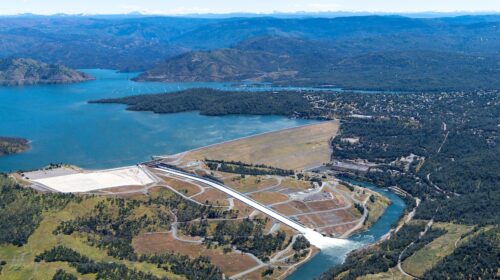
“In its latest efforts to hold the California Department of Water Resources accountable regarding Lake Oroville, Butte County representatives met with Federal Energy Regulatory Commission officials last month to discuss the Oroville Dam relicensing process. The county issued a statement Monday regarding both the process and the lack of benefits faced by local residents regarding the Lake Oroville reservoir. “Since Oroville Dam was completed in 1968, local taxpayers have absorbed the financial and public-safety burdens of hosting the State Water Project’s primary storage reservoir, from the devastating 2017 Spillway Failure and ongoing road and public-safety costs to the loss of approximately 41,000 acres from the County’s property tax base,” the statement said. “Meanwhile, the water captured and stored in our community has generated enormous economic value for the State and its water contractors hundreds of miles away.” … ” Read more from the Chico Enterprise-Record.
Study: Reservoir management system could save California $150 Million every year
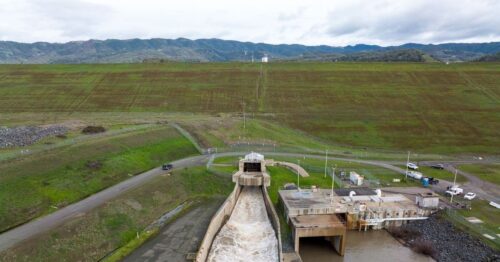 “A new study from the Center for Western Weather and Water Extremes (CW3E) at Scripps Institution of Oceanography at UC San Diego finds that improved weather and water forecasts could help California gain more value from existing reservoirs and help meet a new water supply target. The study, led by Scripps economist Tom Corringham and staff researcher Denali Pinto, estimates that a reservoir operation system co-led by Scripps, state, federal and local water authorities could save the state between $100 million and $200 million per year in the form of added water available to meet agricultural, urban and household needs. Corringham said that ripple effects ranging from recreation enhancements to recreation, power generation, enriched fishery stocks, and improved flood risk management make that a conservative estimate. “California’s water challenge will require many different solutions,” said Corringham. “Our research shows that smarter operation of existing reservoirs could make a meaningful contribution.” … ” Read more from Scripps Institution of Oceanography.
Super El Niño is looming. Here’s what new data means for snow season across the West
“As El Niño continues to strengthen, data is increasingly points to a clear pattern this upcoming snow season: a wet winter for California, and a warm winter for the Pacific Northwest. We took the data behind our upcoming winter season and applied it to snow using three independent climate models. The results give us a rough picture of a winter that features above-average snowfall for the Sierra and Northern California — especially in January. With models projecting an inch or three or extra snowfall for the first month of 2027, a below-average snow year is looking increasingly unlikely. The variables that inform these projections are already informing other winter outlooks as everyone from governments to ski resorts moves to prepare for the winter on its way. … ” Read more from the Sacramento Bee.
This “supersized” El Niño is only just beginning to wreak its havoc
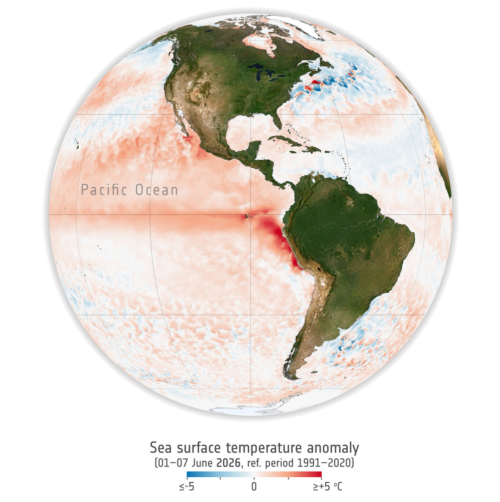 “The world’s leading weather organization is sounding the alarm about this year’s super El Niño, issuing its most certain forecast in the history of the organization. In an update issued early Thursday, the World Meteorological Organization predicted a “nearly 100% likelihood” that the El Niño will last through February. The strong language from the WMO—the UN’s weather and climate agency—underlies just how historic this El Niño is shaping up to be. “This is the first time that a WMO El Niño/La Niña Update has been so unequivocal,” the agency says, noting that certainty reflects “the strong agreement within WMO’s extensive network.” El Niño is a naturally occurring weather phenomenon defined by warmer-than-normal ocean temperatures in the eastern tropical Pacific, a pattern that disrupts weather patterns around the world. Scientists have been warning since the start of the year that a particularly strong El Niño was set to develop. The latest forecasts indicate it will be the strongest on record by a wide margin, and impacts are already being felt throughout the world—and they’re likely to intensify in the coming months. … ” Read more from Mother Jones.
“Over our dead bodies” likely response to Arizona proposal to harvest California rivers to fill its water gap
“A nascent proposal by Arizona to fill the water gap from its dwindling Colorado River and groundwater supplies by reaching into California’s rivers likely won’t go over well in the Golden State. “Over our dead bodies,” was the response envisioned by the leader of one of the southern San Joaquin Valley’s most powerful water boards. The proposal is one of two ambitious projects involving California that are being explored in a private-public partnership between Arizona’s Water Infrastructure Finance Authority (WIFA) and Canadian company EPCOR. EPCOR has proposed capturing excess water from the San Joaquin and Sacramento rivers in flood years, banking it somewhere in the southern San Joaquin Valley and delivering 100,000 acre feet a year to southern California water agencies for urban use. In exchange, Arizona would take a like amount of Colorado River water before it runs to California. “I may be completely wrong, but I see the political maelstrom of ‘Oh wait a sec, you’re going to take water off the Sacramento or San Joaquin that is critically needed in the Central Valley for Sustainable Groundwater Management Act, and move it to Arizona?’” said Eric Averett, general manager of the Kern County Water Agency, the second largest contractor in the state for water from the Sacramento-San Joaquin Delta. … ” Read more from SJV Water.
People started building artificial beaver dams in California. Now something “mind blowing” is happening
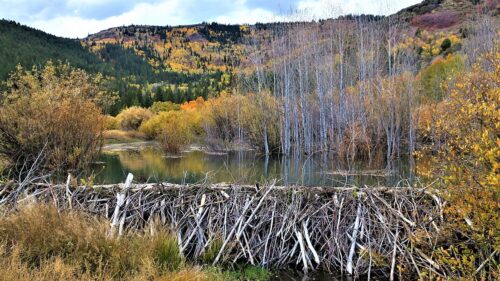
“It’s well known that beaver dams transform landscapes. In their absence, artificial versions were built in northern California to recreate lost wetlands – boosting the survival of threatened coho salmon. The findings are published in Frontiers in Ecology and Evolution. Fish biologist Michael Pollock of NOAA’s Northwest Fisheries Science Center called the results “mind blowing”. The Scott River valley in northern California was once home to so many beavers it was known as Beaver Valley. Their dams created an enormous riverine wetland, providing habitat for juvenile coho salmon and a host of other wildlife. Then European fur trappers arrived in the 1830s. Thousands of beavers were trapped and killed, and much of the habitat created by their dams and wetlands was lost – taking with it the cold, slow-moving habitat favoured by coho salmon. With the beavers all but gone, in 2015 the nonprofit Scott River Watershed Council built two artificial dams on a tributary called Sugar Creek. Wooden posts were hammered into the streambed, interwoven with willow and conifer branches, then the gaps were plugged with gravel, straw and mud. … ” Read more from BBC Wildlife.
Tidal restoration round-up: Insights from two studies in Suisun Marsh and the Delta
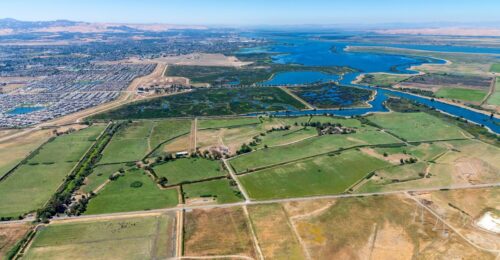
“On an unseasonably warm day in February of 2022, after being acquainted for approximately eight hours, we found ourselves canoeing across Big Break near Antioch, California. As we paddled against the wind we were busily dodging bass boats and floating logs. We watched a Peregrine Falcon dive at the water in front of us and fly off holding an American Coot who never saw the assault coming. With our canoe full of nets, water quality equipment, and zooplankton supplies, we were taking the long way around from one tidal slough mouth to another. Although it functioned as intense workplace bonding – and the beginning of a long friendship – we were out there to catch thousands of nearshore fish at the brand-new tidal restoration at Dutch Slough. … ” Read more from the California Water Blog.
FACT CHECK: Is Sam Altman right that almonds use more water than ChatGPT queries?
 “As Gov. Gavin Newsom weighs whether to require data centers to disclose how much water they use, OpenAI CEO Sam Altman says concerns over AI’s water use don’t hold “up to any scrutiny.” On the Sources Podcast with Alex Heath released Tuesday, Altman said that it takes 38,000 ChatGPT queries to use as much water as producing a single almond in California. “If you look at a modern very large data center, it uses the equivalent amount of water as an office building in terms of, you know, people like running the sinks and the toilets and whatever,” Altman told Heath. The problem, experts say, is that it’s impossible to verify those numbers given what’s public about the secretive industry. “The information we have is so limited,” said Shaolei Ren, a professor of electrical and computer engineering at UC Riverside. … ” Read more from Cal Matters.
Unified Water Plan for the San Joaquin Valley released: Congressionally authorized report gives decision-makers a roadmap for Valley water investment
“ The Water Blueprint for the San Joaquin Valley and the California Water Institute at Fresno State today released the Unified Water Plan for the San Joaquin Valley, a congressionally authorized, federally funded report that gives local, state, and federal decision-makers a single roadmap for water investment across the eight-county region. The California Water Institute at Fresno State prepared the plan with the Water Blueprint for the San Joaquin Valley and Stantec, and its results will be reported to the Senate Committee on Energy and Natural Resources and the House Committee on Natural Resources. The plan integrates the adopted Groundwater Sustainability Plans of all sixteen Valley subbasins into one regional strategy covering Fresno, Kern, Kings, Madera, Merced, San Joaquin, Stanislaus, and Tulare counties. Congress directed the study in Public Law 111-11, the 2009 San Joaquin River Restoration Settlement, and the U.S. Bureau of Reclamation funded it. … ” Read more from the Water Blueprint for the San Joaquin Valley.
Evaluating the economics of ‘SGMA-ready’ crops
“According to the Public Policy Institute of California, 10% to 20% — or 500,000-acres to 900,000-acres — of farmland is likely to come out of active production in the San Joaquin Valley primarily due to the impacts of the Sustainable Groundwater Management Act of 2014. PPIC, which has studied agriculture in the San Joaquin Valley for over eight years, recently released a report on the potential of “SGMA-ready” crops for farmers in areas where significant cuts to water use are required. According to the report, “SGMA-Ready Crops as a Low-Water Alternative to Fallowing,” these crops may help reduce widespread and uncoordinated fallowing. Bradley Franklin, a research fellow at the PPIC Water Policy Center and author of the report’s companion policy piece, explained that a SGMA-ready crop requires minimal water use. Specifically, Franklin discussed the viability of small grain winter crops such as wheat, barley, rye, and triticale for both forage and grain, as an alternative to fallowing. “Growing wheat and small grain crops is nothing new to the Valley, but this is a different way of thinking about it and using different management practices,” Franklin said. … ” Read more from Valley Ag Voice.
Funding for state drinking water program gutted, revamped, now waiting to be signed after harrowing ride through the Legislature
“A proposal to fund a state drinking water program that has been a lifeline for communities in the San Joaquin Valley at $171 million passed by the Legislature Tuesday after a harrowing few days and now awaits Gov. Gavin Newsom’s signature. The proposal is supported by a broad coalition of organizations, some of which typically find themselves on opposite sides of most issues. But they came together to protect the Safe and Affordable Fund for Equity and Resilience (SAFER), which pays for emergency supplies when homes, and even whole towns, go dry and funds efforts to find long-term water solutions. Just a few months ago, SAFER was all but gutted, left with $68 million. That’s less than half of its previous annual funding of $130 million. Tom Collishaw, CEO of Visalia nonprofit Self-Help Enterprises, credited the coalition with helping turn SAFER’s fortunes. “It’s an incredible group of stakeholders that you do not normally see on a letter together and I’d like to believe this made a difference,” he said. Valley legislators, including Sen. Melissa Hurtado, deserved credit as well, he added. … ” Read more from SJV Water.
Delta Caucus secures $158.2 million for Delta levees
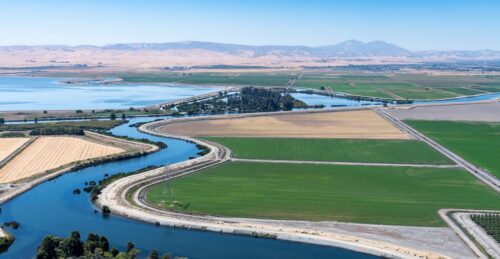
“The California Legislature Wednesday approved $90.2 million to protect the Delta and fortify its aging levees, along with up to $68 million to safeguard the State Water Project’s California Aqueduct and canals. The funding for the levees — which are being undermined by the over-drafting of groundwater — was secured by the California Legislative Delta Caucus. “Today’s vote was truly historic. California’s water wars may finally be over,” said State Sen. Jerry McNerney, who serves as co-chair of the caucus. “Today we joined together, North and South, environmental groups and State Water Contractors, to support vital projects that will protect California’s water and the Delta, while also benefitting the entire state.” “But we’re not done. This historic investment is just a downpayment. In the years to come, we need to continue to protect California’s primary supply of freshwater.” … ” Read more from the Manteca Bulletin.
SEE ALSO: State budget to include $158 million for Delta, SWP levees, canals, from the Daily Republic
Tribal water rights bill heads to Newsom’s desk
 “A bill that tribal leaders say would finally move California from “apology to action” on Indigenous water rights is now in Gov. Gavin Newsom’s hands, following a unanimous Senate vote and weeks of direct tribal advocacy in the Capitol. Assembly Bill 2218, authored by Assemblymember Ash Kalra, would require state agencies to formally consult with tribes when making decisions about water policy, permitting and investigations. The bill would be a shift tribal governments have sought for decades as they continue to confront the legacy of dispossession and exclusion from water‑management systems. “I am proud to author AB 2218, a measure that will support California’s efforts to respectfully and effectively address the historic water inequities that continue to affect tribal communities,” Assemblymember Ash Kalra said in a news release. “Despite being the original stewards of this land, tribes have been systemically dispossessed of the water resources they have depended on for millennia. I hope Gov. Newsom will recognize this bill as an essential component in the state’s ongoing work to address this injustice.” … ” Read more from the Eureka Times-Standard.
Wildfire liability: California legislature clarifies the role of public water systems
“California water providers are one step closer to receiving important statutory protection against inverse condemnation claims arising from catastrophic wildfires. Senate Bill 1153 has passed both houses of the California Legislature and is headed to Governor Newsom. If signed, the legislation would provide important guidance regarding what public water systems can—and cannot—reasonably be expected to do during a wildfire. For those following California inverse condemnation law, the bill is particularly significant because it builds upon both prior legislation addressing fire hydrants and the California Supreme Court’s framework for inverse condemnation liability in City of Oroville v. Superior Court (2019) 7 Cal.5th 1091. Taken together, these developments reinforce an important principle: inverse condemnation liability should turn on the inherent risks associated with the actual design, construction, and intended operation of a public improvement—not on functions the improvement was never designed to perform. … ” Read more from JD Supra.
In commentary this week …
Is there an emerging consensus on how to fix California water problems?
Geoff Vanden Huevel, Director of Regulatory and Economic Affairs for the Milk Producers Council, writes, “Over the past couple of months, I have attended and participated in a number of water conferences and broader meetings where common themes have emerged. There is a universal belief that California’s water situation is not good and there are two things we need to do to change that. One is euphemistically named “regulatory reform” and the other is “funding.” Let me unpack that a bit. By regulatory reform, folks mean a couple of things. First, current regulations governing the operations of our many and varied water delivery systems are layered with many constraints creating bottlenecks and barriers to using water when it is available. For example, the regulations governing the movement of water through the delta during the winter and spring when wet year water is most prevalent are very restrictive. Many of these regulations were put in place decades ago to protect endangered species with very dubious benefits, and yet they remain in place, costing in some cases millions of acre-feet of water over time to run to the ocean. … ” Read more from the Milk Producers Council.
Which state government agency has jurisdiction and the political will to enforce instream flows?
Angelina Cook writes, “California is world-renowned as an environmental leader. Yet agencies are reluctant to enforce laws that ensure people and fish have clean water. Those who advocate for salmon recovery and track agency performance on reversing damage to aquatic ecosystems can attest: the enactment of environmental regulations does not guarantee that those laws will get enforced. Enforcement requires adequate manpower and financial resources. Sometimes it requires collaboration with the right partners. The Scott and Shasta rivers have been oversubscribed for more than half a century. State courts ruled on the water rights for these rivers over 50 years ago. The U.S. Environmental Protection Agency added these rivers to its Clean Water Act list of impaired waterways over 20 years ago. Yet more than two decades of having restricted Total Maximum Daily Loads (TMDLs) have not sufficiently protected water supplies for non-irrigation beneficial uses. … ” Read more from the California Sportfishing Protection Alliance.
Solano County Water Agency: Healthy Rivers and Landscapes builds on a proven approach
“For Solano County Water Agency (SCWA), supporting Healthy Rivers and Landscapes (HRL) comes from decades of firsthand experience managing water for farms, cities and the environment, and seeing what it takes to support healthy fish populations. In a new video, Alex Rabidoux and Max Stevenson of SCWA share lessons from Putah Creek, where the agency began releasing additional water for salmon 25 years ago. While those flows were important, salmon did not immediately return. It took another 14 years and $20 million in habitat restoration before salmon returned to the creek. Those efforts included improving fish passage, restoring spawning gravels, reconnecting floodplains to provide food for juvenile salmon, and creating better rearing habitat along the creek. … ” Read more from the Northern California Water Association.
Incomplete science misinforms management actions for Delta smelt
Scott Hamilton, President, Hamilton Resource Economics, writes, “In the controversial world of California water, executive orders at both the state and federal levels demand better use be made of available water, but efforts to capture surplus water meets with zealous resistance from special interest groups and their proxies in the legislature and resource agencies. The conflicts undermine the purposes of California’s Delta Reform Act of 2009, which established two “coequal goals” – securing a reliable water supply for California and protecting, restoring, and enhancing the Sacramento-San Joaquin Delta ecosystem. Achieving the co-equal goals necessarily requires a balancing between competing beneficial uses of available water resources. Conflicts arise in the continuing case of management actions employed to help the delta smelt, a species reliant now on hatchery propagation for survival. In 2008 when the Fish and Wildlife Service was evaluating the effects of Central Valley Project and State Water Project operations on delta smelt, the agency concluded that those operations could jeopardize its continued existence and proposed a “reasonable and prudent alternative” that increased Delta outflow in the fall of wetter than normal years to benefit the species, primarily to increase the extent and quality of delta smelt habitat. That requirement was based on flawed studies. … ” Read more from Valley Ag Voice.
Without sediment removal in the Delta, California risks winter flooding
Edward Ring, director of water and energy policy for the California Policy Center, writes, “In the cities and farms immediately south of the Sacramento-San Joaquin Delta, the worst flooding of the 20th century happened in 1997. Several days of unrelenting rain pummeled the slopes of the Sierras, and with the snow line unusually high at 10,000 feet, nearly all of it poured into the San Joaquin River and other tributaries. Reservoirs filled to capacity, sending torrents of water into spillways at a rate far beyond the flow capacity of downstream channels. Levees were overwhelmed. The response to this disaster has been to strengthen levees and construct bypasses. Those projects, along with habitat restoration, have been the priority for state and federal agencies. But nowhere in these project descriptions, including in the State Water Resources Control Board’s August 2026 draft of the “Water Quality Control Plan for the San Francisco Bay/Sacramento-San Joaquin Delta Watershed,” is there any mention of channel restoration through sediment removal. It’s not enough. Strengthening levees without restoring channel depth is to ignore one of the biggest variables affecting how much water can safely make it downstream. The federal, state, and regional agencies, water districts, irrigation districts, contractors, engineering firms, environmental consultancies, NGOs, pressure groups, and countless additional “stakeholders” involved with the fate of the delta must answer just one urgent question: How much stormwater is the forecast “super El Nino” going to dump onto the Central Sierras in 2027 compared to 1997? … ” Continue reading from Edward Ring.
A super El Niño will take a toll on California’s coast. Building seawalls will make it worse
“A powerful El Niño is forming in the Pacific. The real threat to California’s beaches isn’t the waves — it’s the concrete we pour after they hit. Some forecasters are already calling the coming El Niño “Godzilla.” The National Oceanic and Atmospheric Administration’s Climate Prediction Center now puts the odds at greater than 90% that this will be a “very strong” event this fall and winter — and a 69% chance it exceeds the strength of every El Niño on record since 1950. The subsurface ocean heat that drives it is already measurable. We can see it coming. For California’s coast, where up to 75% of our beaches are at risk of disappearing by 2100, each El Niño presents another moment of reckoning. When warm water masses shift across the equatorial Pacific, the resulting atmospheric changes bring larger waves, elevated sea levels and powerful storms in rapid succession — each hitting a shoreline already battered by the last. Wave energy along California’s shore can run 50% above average. Sea levels climb half a foot to a full foot, pushing the ocean inland and flooding coastal homes, roads and infrastructure. … ” Read more from the San Francisco Chronicle.
California needs a clear path for safeguarding its outstanding waters
“California has spent billions of dollars restoring rivers, lakes, and streams after they have been damaged by pollution, development, altered landscapes, and other pressures. This restoration is essential work, but there is another, often overlooked, part of protecting clean water: making sure our outstanding waters don’t become degraded in the first place. California already has a powerful tool for doing just that. It simply hasn’t made much use of it. Under the Clean Water Act’s antidegradation framework, states can designate exceptional waters as Outstanding National Resource Waters, or ONRWs. ONRW designation can be the highest level of water quality protection available under the Clean Water Act, establishing a legal standard that prohibits any permanent degradation of a water body’s existing quality. The objective is straightforward: when a river, stream, or lake possesses exceptional water quality or ecological or recreational significance, we should maintain that quality rather than allowing it to slowly decline with allowable pollution. … ” Read more from the South Yuba River Citizens League.
Absurdity of the Colorado River crisis
Daniel M. Frey writes, “Forty million people depend on the Colorado River. Some of its largest cities are facing real shortages. Yet nearly half of the water put to human use in the basin goes to growing feed crops such as alfalfa, hay and silage for cattle, with a meaningful share exported overseas. This is not a hydrology problem. It is a political one. Growing alfalfa and hay to feed livestock consumes roughly 46% of all the water put to human use in the basin—more than every city and industry combined, and more than any other single use of the river. In the Imperial Valley, a material portion of alfalfa is exported. Foreign agribusinesses, including Saudi Arabia’s Fondomonte and the UAE’s Al Dahra, have leased Southwestern land to grow water-intensive feed and ship it home to countries that have banned the same crop domestically to protect their own water. Arizona’s governor already canceled state land leases with one of these companies over exactly this issue. We are draining a river that 40 million Americans depend on to grow low-value cattle feed. This is not even a true market outcome. … ” Read more from Big Pivots.
For a thirsty American West, it’s either cows or humans
Columnist Mark Gongloff writes, “Sustaining communities of millions of thirsty people in a desert is challenging enough. Adding millions more cows, or at least growing the water-intensive food those cows eat, ramps up the difficulty level exponentially. America’s arid Southwest is learning it can’t comfortably have both. The toxic combination of a 25-year drought and chronic overuse has caused the Colorado River to lose 20% of its flow, major reservoirs Lake Mead and Lake Powell to fall to record-low levels and a Lake Mead’s worth of groundwater to evacuate. The seven states that share the Colorado’s water with several Native American tribes and Mexico have haggled unsuccessfully for years over divvying up this dwindling resource, so the federal government recently offered its own suggestions. … But the bulk of the Colorado River isn’t piped to houses. It’s claimed, in the form of food, by those cows. … ” Continue reading at Bloomberg.
How California can do data centers differently and win back community trust
Allison Agsten, director of the USC Annenberg Center for Climate Journalism and Communication, writes, “Americans finally found something to agree on: concern about the rapid proliferation of data centers. A recent Reuters/Ipsos poll found that only 1 in 3 Americans approves of the current pace of data center construction, and most would oppose a facility being built in their own community. That skepticism comes at a time when confidence in Big Tech is at an all-time low, according to Gallup. These concerns deserve attention, not because the data center boom can be stopped, but because it can’t. More than 800 data centers are under construction across the United States, with the largest technology companies collectively spending hundreds of billions of dollars each year to expand AI infrastructure. McKinsey & Company estimates that the cumulative global investment in data centers could reach nearly $7 trillion by 2030. … ” Read more from Cal Matters.
Data centers are blowing the PR game. Here’s how to fix that.
Taylor Budowich, founder and president of Innovation Council, writes, “When many teachers in Richland Parish, Louisiana, opened this year’s annual bonus checks, they found them 400 percent larger than last year — reaching up to $50,000, nearly a full year’s pay in one of the poorest corners of one of America’s poorest states. The bulk of the money came from the tax revenue of a single source: the five-gigawatt data center that Meta is building in Richland Parish. The company’s first sales-tax payment, more than $22 million, exceeded the parish’s entire annual tax collection the year prior. For the first time in his 30-year career, the schools superintendent says, every teacher the district interviewed was fully certified. Most Americans haven’t heard that story. What they have heard instead is that data centers will guzzle their water and spike their power bills — and our politics now reflect that. New York imposed a one-year moratorium on new data center construction, and Democrats in Congress introduced a national moratorium bill. Republican Texas Gov. Greg Abbott — up for reelection — is bragging that he’s paused projects across his state. … AI supporters are losing the argument not because the facts aren’t on their side, but because they keep reaching for the wrong facts — gigawatts, capital expenditure, the race with China — in making their case. … ” Read the full commentary at the Washington Post.
The Fix Our Forest Act: Benefit or bypass?
“Aerin Monroe writes, “The Fix Our Forests Act, although it has not yet been enacted into law, aims to address wildfires and make forest management more efficient. However, because it avoids critical environmental laws that safeguard ecosystems and limit scientific input and public involvement, the Act may have serious repercussions for the environment and endangered species. These concerns make the bill’s effects on forest health especially important to examine. In a 2025 letter to The Honorable John Boozman Chairman, Senate Committee on Agriculture, Nutrition, and Forestry United States Senate, advocates from across the nation rallied against the bill, united in support of protecting the environment. “On behalf of our millions of members and supporters, our organizations write to express our strong opposition to S. 1462, the “Fix Our Forests Act” (FOFA), as introduced by Senators Curtis, Hickenlooper, Padilla, and Sheehy, and urge you to vote no at the October 21st, 2025 Committee Markup.” They noted that at the local level, the consequences could be especially dire: neighborhoods near forested areas could face greater wildfire threats, local wildlife could lose their habitats, and nearby recreational areas and drinking water sources could be put at increased risk. At best, this bill would do little to reduce wildfire threats, and at worst, it could increase wildfire risk. … ” Read more from the Northcoast Environmental Center.
While Colorado and the West burn, Washington rearranges org charts
Scott Fitzwilliams, who resigned from the U.S. Forest Service in February 2025 after 34 years with the agency, writes, “As millions of acres burn across Colorado and the American West, thousands of families flee their homes, entire communities are blanketed in smoke and firefighters continue to risk — and in too many cases lose — their lives, one would expect the federal government to be singularly focused on confronting one of the greatest natural resource crises of our time. Instead, the Trump administration is reorganizing federal agencies, eliminating experienced public servants and insisting it has wildfire under control. It doesn’t. The devastating wildfire season unfolding across the West is not an isolated event or simply another bad fire year. It is the predictable consequence of a warming climate that is producing record-breaking heat, prolonged drought and increasingly volatile fire behavior. … ” Read more from the Colorado Sun.
In regional water news this week …
How a Klamath Basin bird crisis brings old water rivals together
“When Teresa Wicks surveyed the wetlands at the Lower Klamath National Wildlife Refuge in Siskiyou County, California, early this summer, they were alive with birds. She saw black-necked stilts, avocets, and thousands of white-faced ibises. A single colony of eared grebes had about 1,500 nests. Birds and ducklings seemed to be everywhere. “l don’t think I’ve ever seen that many ducklings in one spot as I did at Lower Klamath [that day],” said Wicks, Eastern Oregon biologist and program manager at the Bird Alliance of Oregon. The abundance made what happened next especially painful. As drought tightened its grip on the Klamath basin, wetlands at Lower Klamath and the neighboring Tule Lake National Wildlife Refuge began drying rapidly. Many grebe nests were abandoned. Then avian botulism began killing waterbirds and hatchlings. “Some of the birds that were sick and dying were ducklings and one- or two-day-old grebelings,” Wicks said. “That was particularly heart-wrenching.” … ” Read more from Jefferson Public Radio.
Raft of resilience initiatives keeps Tahoe blue
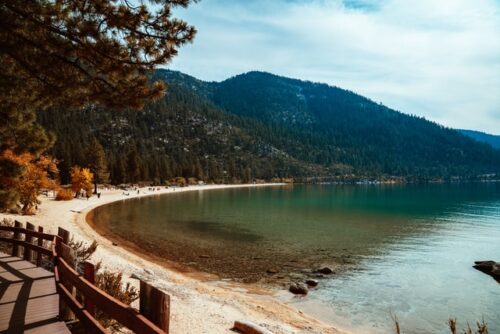 “It’s not a national park or a major city, but Lake Tahoe can feel like both: a place of breathtaking natural beauty but also crushing crowds. More than a million Northern Californians visit annually, including thousands of Bay Area families who have had cabins on the lake for generations. Many may be aware of ongoing pressures on the lake’s health from tourism, development, fire, and invasive species — pressures now amplified by climate change. Most visitors, however, are probably unaware of just how much critical conservation and restoration work is underway to protect this unique body of water and the watersheds and forests that surround it. While many regions lack the capacity to rise to the increasing environmental and climate challenges of the 21st century, Tahoe is ready. The region has had the necessary institutional infrastructure in place for decades in the form of Team Tahoe, the unofficial name for a collaborative of more than 80 different entities ranging from fire and water districts to federal agencies, cities, nonprofits, and local business interests. To meet today’s challenges, Team Tahoe has pursued both innovation, such as portable boat-cleaning stations and beach-cleaning robots, and tried-and-true tactics like forest thinning and meadow and wetlands restoration projects. Across those efforts, Tahoe serves as a model for lake regions nationwide. … ” Read more from Knee Deep Times.
The century-old Sacramento Weir is expanding. When will the flood gates be ready?
“More than a century and a half ago, in Sacramento’s nascent years as a city, torrential winter rains exposed one of its major vulnerabilities. Through December 1861 and January 1862, storm after storm passed over the region, swelling its rivers and breaching newly constructed levees. Water inundated the state capital, reaching the second floor of some buildings in town. The destruction wrought by the Great Flood laid bare the risks of Sacramento’s location at the confluence of two mighty and unpredictable rivers. “The Sacramento region has one of the highest flood risks of any metropolitan region in the country,” said Lt. Col. Kara Greene of the U.S. Army Corps of Engineers. “We follow right behind New Orleans.” … ” Read more from PBS Abridged.
Sacramento River bike trail hits new hurdle as state approves private fences
“Plans for a long-awaited bike and pedestrian trail along the Sacramento River are facing another hurdle after state flood officials approved two new private fences along a section of the riverfront. The proposed trail would run through Sacramento’s Pocket and Greenhaven neighborhoods, south of downtown and west of Interstate 5. Trail advocates have been working for more than five decades to create a continuous paved path along the Sacramento and American rivers. They say the completed route could eventually allow people to travel more than 40 miles between Freeport and Folsom Lake. But a roughly four-mile gap in the Pocket neighborhood remains privately owned by residents whose properties extend down to the waterline. … ” Read more from CBS Sacramento.
An unexpected threat to aquatic life in San Francisco Bay? Our pets.
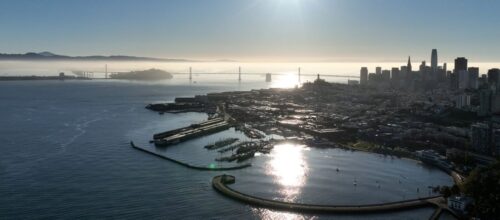 “Walk into any pet store and you’re likely to see shelves of topical products aimed at killing and repelling fleas and ticks on dogs and cats from brands such as Frontline, Advantage, and Seresto. Almost all of them contain the pesticides fipronil or imidacloprid. They are, as you might expect, toxic to invertebrates. But they don’t stay on your furry companions. When you wash your dog or its bedding, or pet your cat and wash your hands, the chemicals go down the drain, where they head to a wastewater treatment plant—a facility that was not designed to remove pesticides. Studies show that fipronil and imidacloprid are ubiquitous in Bay Area wastewater effluent at levels that the EPA has deemed may be harmful to aquatic life. That means they end up in the Bay, where, scientists say, they may pose risks to invertebrates such as shrimp, amphipods, and isopods—bottom-dwelling creatures that provide important food for fish, birds, and marine mammals. … ” Read more from Bay Nature.
Even Cal Am gets on board with asking for relief on the cease-and-desist.
“The iceberg that is the cease-and-desist order on the Monterey Peninsula’s water supply may finally be melting. A bit of background: Private utility California American Water delivers water to thousands of local taps. For decades, the company obtained most of that water by sticking a straw into the Carmel River – something that officials at the State Water Resources Control Board determined in 1995 was a violation of Cal Am’s legal limit to pump from the river. Years of stop-and-start efforts began to get water some other way. By 2009, the state deemed Cal Am to still be in violation, and it issued a new cease-and-desist order, this one with teeth. New water meters are prohibited, a significant obstacle to building housing. … ” Read more from Monterey Now.
Forget Florida. L.A. humidity is off the charts this summer. What’s going on?
“Southern California’s swampy summer is setting new records, with humidity levels creating conditions that feel more like Florida than the West Coast. Forecasters attributed the punishing humidity to the remnants of Tropical Storm Iselle moving over the state, as well as unusually warm ocean temperatures due to a combination of a months-long marine heat wave, a powerful El Niño and climate change. It’s made an intense summer of heat particularly miserable. This week saw new heat records set in some areas, but it’s the humidity that has many at their wit’s end. … ” Read more from the LA Times.
LADWP: In the trenches: Inside the multi-front Sunset Blvd. incident response
“In the quiet pre‑dawn at around 4:00 AM, at the intersection of Holloway Drive and Sunset Boulevard, the street gave a subtle shudder before a sudden blast of water punched through the asphalt. Within minutes, those spurts turned into a heavy, surging rupture as a section of a century-old, 36-inch riveted steel trunk line gave way. LADWP water crews immediately rolled out to the scene, triggering a rapid chain reaction of emergency calls across executive leadership: Interim General Manager David W. Hanson and Chief Resiliency and Emergency Officer Zoraya Oliver-Griffin activated the Department Emergency Operations Center (DEOC), Chief Customer Officer Joseph Ramallo initiated crisis communications protocols and customer support resources, and operational heads, including Chief Operating Officer and Senior Assistant General Manager of the Water System Anselmo Collins, mobilized their respective teams. Before sunrise, a massive, multi-divisional choreography was underway. … ” Continue reading from LADWP.
Forecast Informed Reservoir Operations assists in record capture of more than 18 billion gallons of water at Prado Dam
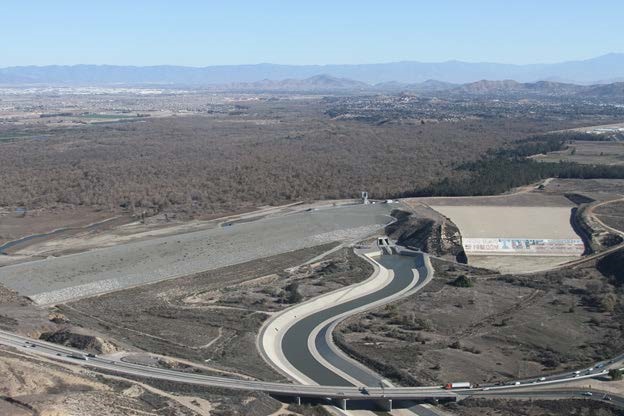 “The Orange County Water District (OCWD) and U.S. Army Corps of Engineers (USACE) captured a historic 18.1 billion gallons of water at Prado Dam between July 2025 and June 2026, marking the highest stormwater capture total since the 1940s. The amount is enough to supply more than 110,000 households for one year and is valued at more than $55 million. The record reflects the benefits of Forecast Informed Reservoir Operations (FIRO), which uses advanced weather forecasting to better track atmospheric rivers and allows more water to be stored behind Prado Dam while maintaining flood protection. Close coordination between USACE and OCWD on the timing of releases helped create room for additional incoming storms and maximize every opportunity to capture stormwater for groundwater recharge. “This all-time high for stormwater capture is a major win for Orange County’s water supply and demonstrates what can be achieved through innovation and strong partnerships,” said OCWD President Denis R. Bilodeau, P.E. “FIRO is helping us store more local stormwater using the infrastructure already in place, without having to build new facilities, to strengthen water reliability for the communities we serve.” … ” Read more from the Orange County Water District.
Metropolitan reviews new Colorado River guidelines and forecast implications
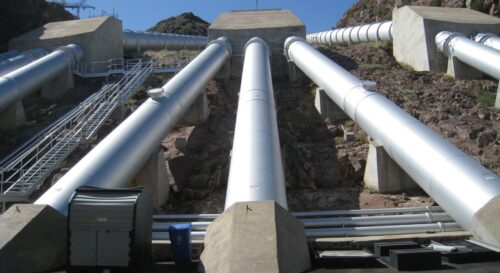
“The Colorado River’s next operating era is beginning under unusually difficult conditions. On August 21, the Department of the Interior issued the final agency actions for the post-2026 Record of Decision and the operating guidelines for 2027 and 2028. Rather than establishing a fixed operating regime for the next decade, the Record of Decision creates a framework for shorter-term decisions. The two-year guidelines set the rules that will govern operations at Lake Powell and Lake Mead. They arrive as the basin faces some of the most severe conditions in the modern operating record: 26 years of drought, combined storage in Powell and Mead at its lowest level since Powell’s initial filling, and a winter that produced record-low snowpack. At the August meeting of Metropolitan’s Imported Water Subcommittee, Colorado River Policy Manager Shanti Rosset briefed committee members on the new federal documents and their implications for Metropolitan’s water supplies. “This is not a planning exercise for distant risk,” Ms. Rosset said. “The new rules are beginning with both reservoirs already under substantial stress.” … ” Read more from Maven’s Notebook.
‘Like driving off a cliff at 2 mph’: A water expert’s take on what’s coming for the Colorado River
“The Colorado River is on the brink of collapse because of climate change and overuse of water. Reservoirs supplying water to tens of millions of people in the southwest reached record lows this summer. The nation is racing to refill them with conservation measures so they can still generate hydropower and reliably deliver water to users downstream. Fish are struggling. Rafters are having trouble navigating low water. Despite all this, the seven states sharing the water supply remain at a yearslong impasse over how to conserve the river. “The Colorado River is in as bad a shape as it’s ever been,” said Doug Kenney, chairman of the Colorado River Research Group at CU Boulder’s Getches-Wilkinson Center. The Interior Department announced Aug. 21 it will significantly cut back the amount of water that will flow to the lower basin states of California, Nevada and Arizona for at least the next two years. “To the people who really study this river, everything that’s happening this year has been expected for decades,” Kenney said. “This is a classic, slow-moving crisis. I’ve equated it to driving a car off a cliff at 2 miles an hour. You can look out the windshield and see that cliff coming. And we’re now right at the edge.” Kenney spoke to CU Boulder Today about the latest efforts to conserve the river and what he thinks is coming next. … ” Read more from the University of Colorado at Boulder.

