
Several news sources featured in the Daily Digest may limit the number of articles you can access without a subscription. However, gift articles and open-access links are provided when available. For more open access California water news articles, explore the main page at MavensNotebook.com.
On the calendar today …
- MEETING: Central Valley Regional Water Board beginning at 9am. Agenda items include several NPDES permits, WDRs, and Rescissions. Click here for the agenda.
- MEETING: California Water Quality Monitoring Council beginning at 9:30am. Agenda items include advanced stormwater monitoring, Initiative to streamline water agency reporting, Quantifying and reporting benefits of municipal stormwater projects, Safe to Drink website, and estuary regional monitoring programs. Click here for the agenda and remote access instructions.
- MEETING: Delta Stewardship Council in Stockton beginning at 10am. Agenda items include Delta Plan Interagency Implementation Committee (DPIIC) Meeting Preview, Delta Watermaster Update, Delta Cyanobacteria Harmful Algal Blooms Monitoring Strategy, and a Report on the 2026 Interweaving Traditional Knowledge Series. Click here for the full agenda and remote access instructions.
- WEBINAR SERIES: Expanding Recharge and Preparing for Wet Weather from 11am to 12pm. While California water managers gear up for a “Super El Niño” and a potentially active water year, partners across the State have brought a variety of new advances to topi s that Managed Aquifer Recharge (MAR) practitioners will find familiar. This recharge readiness webinar series will share information about recently completed guidance, projects, and case studies to help recharge project planners and implementers (growers and local agencies, in particular) prepare for the wet season ahead. Click here to register. Click here for a flyer.
- VIRTUAL WORKSHOP: Keeping Water in Our Streams from 12pm to 2pm. We manage our water resources to balance human diversions and uses with instream needs and uses that include Tribal cultural uses, commercial fishing, recreation, and fishery/ecosystem health. Because California has a “use it or lose it” approach to water rights, a water rights holder who wishes to leave their water instream to benefit instream uses risks losing their rights or having that water diverted by someone downstream before the instream flow serves it purpose. Section 1707 was amended into the water code in 1999 to enable an instream flow dedication that preserves the water right. Since the law took effect in 2000 around 30 applications have been made to dedicate instream flow. The process to achieve an instream flow dedication can be costly and time consuming. It can also be challenging to monitor and assure that the water stays in the stream and isn’t diverted by another user downstream. Register today to learn about the potential and the opportunities available to improve access and effectiveness of 1707 instream flow dedications. All are welcome.
- MEETING: SB 1157 Benefits and Impacts Working Group Meeting #4 from 1pm to 4pm. This group supports DWR in quantifying the benefits and impacts of the 2030 indoor residential water use standard on water, wastewater, and recycled water systems. Zoom Registration
- WEBINAR: Developing an Outreach & Equity Strategy to Increase Program Participation from 2pm to 3pm. Engaging communities in an equitable way is about more than sharing information. It’s about removing barriers, building trust, and ensuring programs reach the people who can benefit most. In this interactive workshop, participants will learn how to develop an outreach and equity strategy that connects program goals with audience needs. Through practical examples and hands-on activities, attendees will explore how to identify target audiences, understand participation barriers, work with trusted community partners, craft audience-focused messages, select effective outreach channels, and measure success. Participants will leave with tools, frameworks, and a draft outreach plan they can apply immediately to improve program participation, access, and community impact. Click here to register.
In California water news today …
Data centers use little water, so where does it all go?
 “One of the top reasons Americans cite for opposing data centers is their excessive water use. Yet the notion that data centers are guzzling the nation’s reservoirs is, to put it softly, a fiction. Based on the most recent figures, data centers consume 17.4 billion gallons of water each year. That sounds like an enormous amount, until you realize the nation consumes tens of trillions of gallons. Even including data centers’ indirect water consumption via the electricity generation needed to power them, they account for less than 1 percent of the country’s total water consumption. Data centers use less water than the nation’s golf courses or California’s almond industry. Yes, data centers’ water demands are expected to grow dramatically over the coming years, but it will remain a tiny percentage of overall use, and they are becoming more water-efficient through recycling techniques. More importantly, data centers must go through the same process of acquiring water as any other business or development, either by buying water rights from existing holders or by applying for a new withdrawal permit, depending on the location. … ” Read more from the National Review.
SEE ALSO:
- CRS REPORT: Data Centers and Water: Frequently Asked Questions, from the Congressional Research Service
- Map Shows States Using the Most Water for Data Centers, from Newsweek
Tons of planet-warming gases are bubbling up from reservoirs. California is going to keep track
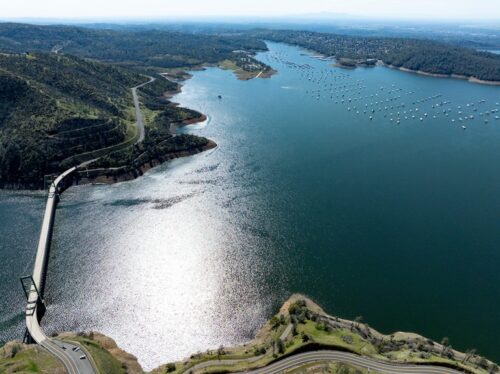 “California air regulators will start tracking estimates of the gases that bubble up from the state’s artificial reservoirs and contribute to climate change. The California Air Resources Board says it will begin reporting how much of the planet-warming gases methane and carbon dioxide are released from dams and reservoirs. The Air Resources Board adopted the new policy last week in response to a petition by environmental groups. It turned down the groups’ request that it require reports on emissions from managers of dams and reservoirs but said it will start collecting estimated data using methods recommended by the U.N. Intergovernmental Panel on Climate Change. Steven Cliff, CARB’s executive officer, said in a 29-page response to the environmental groups that the agency is committed to “further study of emissions from dams and reservoirs.” … ” Read more from the LA Times. | Read via Yahoo News.
Big oil and gas companies are partly responsible for California’s water woes, study finds
“In the last few years, multiple studies have shown that global warming is intensifying drought and worsening water scarcity in California and the Western United States. Now, scientists have found that a group of polluters is responsible for a large share of this drying. In their study, published this week in the journal Communications Earth & Environment, the researchers estimated that climate change shrank the peak annual snowpack in 11 Western states by 36% between 2014 and 2024, and reduced the flow of rivers and streams in spring and summer by 13% compared to a world without human-caused warming. … ” Read more from the LA Times. | Read via Yahoo News.
Final monitoring special study report advances scientific understanding of Delta hydrodynamics and water quality
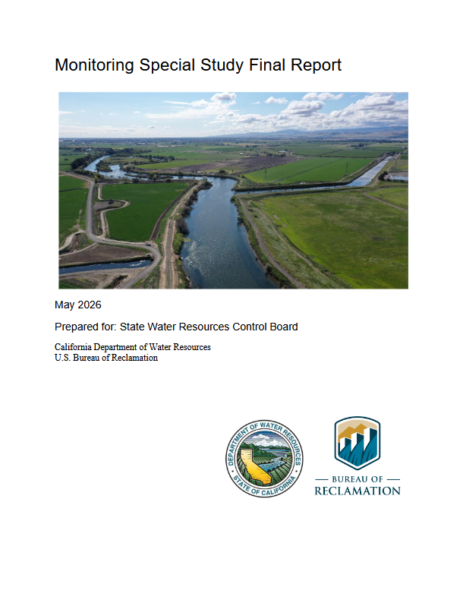 “The Bureau of Reclamation and the California Department of Water Resources have released the Final Monitoring Special Study Report, marking an important milestone in advancing the scientific understanding of hydrodynamic and water quality conditions in the Sacramento–San Joaquin Delta. Because the Delta supplies water to millions of Californians and supports vital agricultural, environmental, and economic uses, improving the scientific foundation behind management decisions is crucial. The report provides state-of-the-art scientific analyses that improve understanding of the complex physical processes influencing flow and salinity in the Delta. By reducing scientific uncertainty and strengthening the technical foundation for future evaluations, the study supports more informed water management decisions, contributes to greater regulatory certainty, and helps advance reliable water supplies while protecting environmental resources. “The Monitoring Special Study Report reflects years of scientific analysis and technical collaboration to improve our understanding of the complex processes that influence the Delta,” said Reclamation’s Central Valley Operations Manager Levi Johnson. “Better science leads to better understanding and decisions. These enhanced monitoring and modeling tools provide a stronger foundation for evaluating water management strategies, supporting informed regulatory decisions, and helping improve long-term water supply reliability for the many stakeholders who rely on the Delta.” … ” Read more from the Bureau of Reclamation.
The Pacific is a ‘hot spot’ for storms right now. Here’s why — and how long it will last
“The Pacific Ocean has become a storm-spinning machine. On Tuesday, short-lived Tropical Storm Julio marked the 10th named east Pacific storm so far this year — about 10 days earlier than normal. Three or four more storms are possible by the second week of September. That would put the basin just shy of its yearly norm of 15, with three months still remaining in hurricane season, which lasts through Nov. 30. Cyclones in the central Pacific waters near Hawaii — between 140 degrees west longitude and the international date line — have been more energetic this year than storms in the entire Atlantic Ocean. A big reason is El Niño. … ” Read more from the San Francisco Chronicle.
Cannon Michael: California farming at a crossroads
“California agriculture is under pressure from nearly every direction, but sixth-generation farmer Cannon Michael says farmers are not ready to give up. Michael, president and CEO of Bowles Farming Company in Los Banos, joined Nick Papagni on The Ag Meter for a candid discussion about what it takes to keep farming in California amid extreme heat, limited water, rising costs, labor challenges, regulations and an uncertain future. Bowles Farming Company manages approximately 11,000 acres and has built a highly diversified operation producing carrots, sweet corn, garlic, onions, watermelons, cantaloupes, honeydew, tomatoes, almonds, pistachios and other crops. The full interview offers a revealing look at the realities facing farmers on the West Side of the San Joaquin Valley—and why Michael remains optimistic about California agriculture. … ” Read more from Ag Net West.
SEE ALSO: Bowles Farming Company Part 2: Labor, Technology and the Fight to Keep Farming, from Ag Net West
California dairy farmers work together to innovate and advance manure management
“Dairy farmers have long paid careful attention to manure management, as it is central to operational efficiency and to supplying nutrients for feed crop production. As science evolves, so has the sector’s understanding of how to better manage manure, in part due to the development of new technologies and pathways for adopting advanced manure management practices. There is much to consider today as California dairy farmers plan for better long-term manure management. They are looking for solutions that meet the needs of their unique operations, shrink their environmental footprint, and help them stay ahead of increasingly strict regulations. Adoption of advanced manure management solutions can often constitute multi-million-dollar capital investments. The Dairy Plus program has been a critical opportunity for California dairy farms to secure cost-share funding for projects that both reduce methane and improve water quality protection. … ” Read more from Dairy Cares.
Ninth Circuit affirms Reclamation’s Central Valley Project contract conversions under the Water Infrastructure Investment for the Nation Act
“On August 17, 2026, a unanimous panel of the Ninth Circuit Court of Appeals rejected a years-long challenge to the United States Bureau of Reclamation’s (“Reclamation”) conversion of certain federal water service contracts, granting a significant win to the municipal and irrigation contractors relying on those agreements to provide water to cities and farms across California. Center for Biological Diversity et al. v. United States Bureau of Reclamation et al. (Case No. 25-5137) (“CBD v. Reclamation”). In denying Plaintiffs’ appeal, the panel held that Reclamation was not required to conduct separate environmental review before allowing its eligible Central Valley Project (“CVP”) contractors to prepay the capital cost of their contracts under the Water Infrastructure Improvements for the Nation Act of 2016 (“WIIN Act”). The Act directed the prepaid funds to water storage infrastructure and converted the contracts into a repayment contracts without requiring future renewals or otherwise altering the terms of water delivery. Recognizing that Reclamation already conducts systemwide environmental review of ongoing CVP operations, the Court held that the WIIN Act imparted a mandatory duty to convert contracts upon request that “does not allow Reclamation to consider environmental effects or take actions that could benefit protected species as part of the contract conversion process.” … ” Read more from Downey Brand.
White House to unveil program to protect water systems against hackers
“The Trump administration will soon announce a program to provide free cybersecurity services to vulnerable U.S. water facilities, following a cascade of cyberattacks across at least a dozen states that many experts suspect are linked to Iran. The initiative is being led by the Office of the National Cyber Director and has gained momentum over the last several months, according to two people with knowledge of the program. A third person with knowledge of the program said it will begin with facilities in Texas and described it as a “proof of concept” that could expand to other states. All three people were granted anonymity to discuss plans not yet made public. The program will offer water utility providers in the state access to free services, such as tools for scanning their networks for security vulnerabilities, to help them better protect against future attacks, according to the three people. Water facilities have long been attractive targets for hackers because they often lack robust funding or staffing to prioritize their cyber defenses. … ” Read more from Politico.
Landmark California bill that would track and disclose PFAS pesticide use heads to Newsom’s desk
“Groundbreaking legislation that would address the widespread use of toxic PFAS “forever chemicals” pesticides on California produce today passed the state Legislature. It now heads to Gov. Gavin Newsom’s desk for his signature. If enacted, Assembly Bill 1603, by Assemblymember Nick Schultz (D-Burbank), would require the state to monitor and disclose PFAS pesticide use. State agencies were not tracking the concerning use of toxic PFAS on crops until the Environmental Working Group raised concerns. More than 2.5 million pounds of PFAS pesticides are applied to Golden State crops each year, contaminating produce sold in the state and throughout the U.S., in addition to soil and water. … ” Read more from the Environmental Working Group.
Will scrapping forest road rules help fight wildfires? The science is complicated
“The Trump administration plans to eliminate the Roadless Rule in national forests, with public comment available until Sept. 21. The federal policy prohibits the construction of roads inside national forests except under certain conditions. Agriculture Secretary Brooke Rollins said the decision would help with wildfire response as the U.S. currently grapples with nearly 100 large wildfires, according to the National Interagency Fire Center. “Our forests can’t afford another decade of inaction,” Rollins said in a statement earlier this month. “Across the country, we’ve watched preventable conditions – overgrown stands, insect outbreaks and disease – turn healthy landscapes into tinderboxes.” … ” Read more from Straight Arrow News.
‘Yes, no, maybe’: Gov. Newsom could still pursue California Forever plan despite local vote against shipyard development
“Gov. Gavin Newsom signaled Wednesday he’s not ready yet to scrap his administration’s plan that could make it easier for a major business to set up shop in a plot of land bought by billionaires known as California Forever. Hours after the Solano County Board of Supervisors voted to avoid taking a position on the governor’s proposal that would help the developers of California Forever, the governor would not commit to halting the effort as the end of California’s lawmaking session draws near. “This just happened last night, I haven’t even had a chance to process it with the team,” Newsom told reporters at an economic development-related press conference in Vallejo. “There’s yes, no and maybe because we have to see.” … ” Read more from KCRA.
Newsom responds after Solano County supervisors stall talks on Collinsville shipbuilding
“Gov. Gavin Newsom expressed dissatisfaction on Wednesday morning following a late Tuesday night vote by Solano County’s Board of Supervisors to not immediately throw their support behind draft legislation to fast-track shipbuilding in Collinsville, as CBS News Sacramento first reported. “Continue to do what you’ve done, you’ll get what you got,” Newsom told reporters. “It’s easy to punt something, but there’s going to be some reckoning.” The governor’s comments came after a press event at Mare Island in Vallejo, where the Governor announced $48.5 million in funding to support 20,000 new jobs across 19 projects statewide. Part of that includes $8.2 million to revitalize Mare Island shipbuilding and Cal Poly Maritime. … ” Read more from CBS Sacramento.
SEE ALSO:
- California Forever’s new city plan hits local resistance — but lawmakers could forge ahead, from the San Francisco Standard
- STATEMENT: Restore the Delta calls on legislators to stop Newsom’s attempt to fast-track California Forever
- Gov. Gavin Newsom laments Solano County shipyard vote, pushes future projects, from the Sacramento Bee
In regional water news and commentary today …
NORTH COAST
The salmon came back: new published study confirms rapid chinook return in the Klamath River after the world’s largest dam removal
“Less than two years ago, four dams on the Klamath River were removed. This week, the first peer-reviewed science is out — published in Scientific Reports, part of the renowned Nature portfolio of journals — confirming that Chinook salmon reoccupied 88% of their historical range within just two migratory seasons. Chinook salmon didn’t just trickle back into reconnected habitat in the upper Klamath Basin. They surged. The study, led by CalTrout’s Shasta Cascade Regional Director Damon Goodman alongside partners from the Karuk Tribe, Klamath Tribes, Yurok Tribe, Oregon Department of Fish and Wildlife, California Department of Fish and Wildlife, NOAA, USGS, CalPoly Humboldt, and independent researchers, is the first published quantitative assessment of how salmon have responded to the removal of J.C. Boyle, Copco 1, Copco 2, and Iron Gate dams — the largest dam removal project ever completed. Using high-resolution imaging SONAR stationed near the former Iron Gate Dam site, the team counted salmon swimming upstream into water they hadn’t been able to reach in over a century. In fall 2024, the first salmon migration season after the dams came out, an estimated 7,742 Chinook salmon passed the site — about 18% of all the Chinook that returned to the entire Klamath Basin that year. The following year, fall 2025, that number nearly doubled to 13,310, or roughly 19% of the basin-wide return. … ” Read more from Cal Trout.
Water Quality Control Board warns of harmful algal blooms detected in North Coast Rivers
“The North Coast Regional Water Quality Control Board is advising visitors to use caution around several North Coast rivers where toxic algal mats have been found. The mats produce toxins that can make people and animals sick and pose a particular risk to children and dogs. The North Coast Water Board is working with tribes and counties to monitor rivers for harmful algal blooms and mats, including the Klamath, Trinity, Salmon, Scott, Mad, Eel, South Fork Eel, Van Duzen, Navarro, Russian and East Fork Russian rivers. Visual assessments and testing have confirmed potentially toxic algal mats in some of these waterways. The mats grow on the bottom of rivers but can break loose and float at the surface or wash up along the shoreline, where children and dogs can come into contact with or ingest them. … ” Read more from the Redheaded Blackbelt.
SIERRA NEVADA
Tahoe locals are fuming over a plan to add fees at dozens of recreation sites
“That free beach day at Tahoe might soon come with a price tag. The U.S. Forest Service is proposing new or increased recreation fees at roughly 40 sites around the Lake Tahoe Basin, and the plan is not going over well with the people who live there. The NY Post reported that Tahoe locals are vehemently opposed to the proposal, which lands as the basin absorbs record crowds, rising parking fines and a summer of tension between residents and visitors. Long-free favorites like Kiva Beach and Taylor Creek are among the spots that would start charging for the first time. … ” Read more from Active NorCal.
SACRAMENTO VALLEY
Concow Reservoir seeks state funds for $50 million dredging after Camp Fire sediment loss
“Nearly eight years after the Camp Fire, sediment continues to reduce storage capacity at Concow Reservoir, prompting the Thermalito Water and Sewer District to seek state funding for a major dredging project estimated to cost $50 million to $55 million. The reservoir is the primary drinking water source for about 12,200 residents in the Thermalito community. “As a lot of people know, after the Camp Fire, about eighty-five percent of Concow Reservoir’s watershed burned, and we’ve seen significant sediment coming into our reservoir, erosion during rainstorms and things like that,” said Chris Heindel, district engineer for the Thermalito Water and Sewer District. … ” Read more from KRCR.
Glenn County Resource Conservation District (RCD) announces upcoming Colusa Subbasin SGMA 201 event
“Glenn County Resource Conservation District (RCD), in partnership with Community Alliance with Family Farmers (CAFF), is pleased to announce the upcoming Colusa Subbasin SGMA 201 event, a free educational workshop designed to help local growers, landowners, and community members better understand the Sustainable Groundwater Management Act (SGMA) and what local groundwater management means for them. SGMA 201 will build on the basics of the Sustainable Groundwater Management Act and provide attendees with information about how the Colusa Groundwater Authority and Glenn Groundwater Authority are working to achieve groundwater sustainability within the Colusa Subbasin. … ” Read more from the Colusa Sun-Herald.
What happened after Sacramento sued over “forever chemicals” found in groundwater
“Forever chemicals went unchecked for decades and now water regulators and chemical companies across the country are grappling with the fallout. One chemical manufacturing company, 3M, was ordered to pay out between $10.5 to $12.5 billion to roughly 12,000 public water utilities across the country. The utilities filed a class action lawsuit over groundwater contamination, which 3M will be paying through 2037. In 2022, the city of Sacramento filed their part in the lawsuit against the chemical manufacturer for the contamination of Sacramento’s groundwater. In 2023, they secured a $10.4 million settlement. “[Sacramento’s] Water Resources have been contaminated by PFAS compounds approaching and exceeding California’s notification and/or response levels,” the lawsuit reads. That legal complaint was filed on November 1, 2022 in federal court, alongside a class of other water suppliers throughout the country that have been affected by PFAS. … ” Read more from Capital Public Radio.
BAY AREA
Tiburon approves $468K contract for Greenwood Beach restoration
“Tiburon will move forward with the final phase of its state-funded shoreline restoration project at Greenwood Beach. The Town Council voted 3-0 on Aug. 19 to approve a $468,983 contract with Livermore-based Goodfellow Bros. LLC to finish restoration work at the site. Vice Mayor Isaac Nikfar was absent and Councilmember Holli Thier recused, citing a potential conflict involving her business working with the contractor. The money will be fully reimbursed from a $1.5 million project grant the town received from the California State Coastal Conservancy in 2024. The project at Greenwood Beach and Brunini Beach at Blackie’s Pasture is intended to address erosion and habitat loss, and improve sea-level rise resiliency by implementing a living shoreline. … ” Read more from the Marin Independent Journal.
Llagas Creek flood control construction in final phase in Morgan Hill
“The Upper Llagas Creek Flood Protection Project, a $176.2 million effort led by Valley Water in partnership with the City of Morgan Hill, is entering the home stretch of its final phase, with one of the summer’s most disruptive closures lifting this month. Wright Avenue has reopened as of Aug. 18, offering some relief from the road closures that have snarled traffic around Morgan Hill this summer. Hale Avenue and Spring Avenue remain closed and are scheduled to reopen in October. The closures were expected to cause heavy delays during the first week of the school year for families near Britton Middle School, P.A. Walsh Elementary and St. Catherine School—all of which sit close to the Phase 2B work zone. The project aims to bring relief to a city that has long suffered from flooding in its downtown core. Streets including Watsonville Road, Main Avenue and Wright Avenue have flooded repeatedly during heavy rain events. … ” Read more from the Morgan Hill Times.
CENTRAL COAST
A levee project focuses on reducing Pajaro’s flood risk. Researchers say the benefits are bigger.
“The Pajaro River and its tributaries are, for the most part, hidden… Despite traversing a few dozen miles throughout Monterey and Santa Cruz counties, the general public typically notices it when they cross a bridge here and there – or when it floods, as it is all too prone to do. The vegetation that grows in and around the river is so thick that it conceals the trickle of water from within, left mostly undisturbed since the levee system was built in 1949. And in areas such as Corralitos Creek in Watsonville, the tributary was essentially shaped by farmers over the decades. When dignitaries gathered along Corralitos Creek in October 2024, the area was unrecognizable. The land around the creek had been cleared, exposing a section of the waterway that for years has been hidden in plain sight. Beyond the wildlife – and the unhoused people – who live in the creekbed, this was the first time many had seen it with their own eyes. … ” Read more from Monterey Now.
Eight new gas and oil wells have been approved for San Ardo
“In the same oil field that experienced a 4,000-gallon spill less than a year ago, eight new oil and gas wells have been approved for Aera Energy in San Ardo. These are the first approvals for oil and gas wells in California outside of Kern County since 2025. The approvals are for six cyclic steam wells and two steamflood wells. These differ from a traditional well in that they are used to assist with oil recovery and means of production by injecting steam into the reservoir to make the oil less thick and more mobile. “These enhanced oil recovery methods come with all the risks of traditional production,” says Cooper Kass, an attorney with the Center for Biological Diversity, a watchdog organization which has filed multiple lawsuits regarding California’s oil and gas industry. “They also bring a number of additional risks, including the potential for the high-pressure injection to damage the wellbore and/or crack the surrounding rock, which could lead to migration and groundwater contamination.” … ” Read more from Monterey County Now.
SAN JOAQUIN VALLEY
Some Kings County farmers can expect state groundwater invoices by end of year, at the latest
“Some Kings County farmers may see invoices for groundwater pumping fees from the state by the end of this year, or as soon as October. The state Water Board Resources Control Board is preparing to bill landowners in the Tulare Lake subbasin, which cover most of Kings County, as part of probationary measures it imposed in 2024 after the region failed to produce a plan to protect groundwater as required by the Sustainable Groundwater Management Act (SGMA). Fees had been held in limbo pending a legal question in an ongoing lawsuit. But a Kings County Superior Court Judge ruled in mid-August that the Water Board could begin billing most Tulare Lake farmers, except those in two groundwater agencies. The Tri-County Water Authority and Southwest King Groundwater Sustainability Agency were exempted. Exactly when invoices will hit mailboxes is a little squishy. … ” Read more from SJV Water.
Powerful Kern water agency bulking up its Sacramento presence and focus
“The new general manager of the Kern County Water Agency adheres to a deceptively simple mantra: More water, less cost. Contained in that sentiment are whole worlds of political, regulatory and legal complexities. Which is why the agency recently hired a second person to represent Kern’s interests in Sacramento. Taryn Ravazzini, was officially hired as an Assistant General Manager with an annual salary of $350,000 during the agency’s August meeting. She will join Craig Wallace as part of the agency’s Sacramento team. … ” Read more from the New York Times.
SOUTHERN CALIFORNIA
Summer weather in LA was perfect. Then came humidity and mosquitoes.
“Across Los Angeles, at festivals, botanical gardens and even the beach, the heat is the hottest topic. Residents lament astronomical electricity bills or lack of air conditioning. Memes about the swelter multiply. Neck fans abound. Weather is often the easiest small talk in a region whose normal summers offer pleasing aridity and cool nights. But this year, there’s a disquieting debate: Is humidity making things worse? Meteorologists don’t track humidity as closely as temperature, but trends point to stickier air than usual in Southern California, from San Diego to Santa Barbara. That’s in part because the rapidly warming Pacific Ocean off the coast feels like a bath tub. …” Read more from the New York Times.
Two new groundwater treatment facilities commissioned in North Hollywood
“Just days after federal officials announced drastic water cuts from the drought-stricken Colorado River for California, Nevada and Arizona, Los Angeles Mayor Karen Bass and LA City Councilmember Adrin Nazarian joined other officials and community leaders to mark the completion of two groundwater treatment plants in North Hollywood. The new facilities – North Hollywood Central (NHC) and North Hollywood West (NHW) – will treat up to 43 million gallons of water daily from the San Fernando Groundwater Basin to help supply safe drinking water for LA and San Fernando Valley residents. A third water treatment plant – the Tujunga Well Field Facility in Sun Valley – is currently slated for completion in 2027. … ” Read more from the San Fernando Sun.
Rare bird draws flocks of Southern California birders to this Irvine marsh to get a glimpse
“For the last two weeks, a little bird with big feet has turned a 320-acre marsh in Irvine into one of the hottest birding destinations in Southern California. Hundreds of birdwatchers have flocked to the Irvine Ranch Water District’s San Joaquin Marsh, hoping to catch a glimpse of a juvenile purple gallinule. It’s the first documented sighting of the rare bird in Orange County and the eighth in California since 1961. The sighting still needs to be accepted by the California Bird Records Committee, which reviews and confirms rare bird sightings in the state. The swamp hen, known by its scientific name, Porphyrio martinica, is mostly found along the Gulf of Mexico and Caribbean as well as parts of South America. The bird, however, is known to wander past its range and has been spotted as far as Iceland, according to the Cornell Lab of Ornithology, a research and conservation institute. … ” Read more from the LA Times.
Calimesa weighs return to groundwater agency
“Calimesa’s place in the region’s groundwater future came under scrutiny Monday, Aug. 17, as the city council considered whether to rejoin the agency responsible for managing the Yucaipa Subbasin — a move that could give the city a formal vote on groundwater policy but cost roughly $10,000 to $12,000 a year. The council ultimately took no action on the proposal, tabling the discussion after weighing the potential value of returning to the Yucaipa Sustainable Groundwater Management Agency against the financial and staffing demands that would come with membership. … ” Read more from the News-Mirror.
IMPERIAL/COACHELLA VALLEYS
Column: Stage Four begins for the IID to protect its rights to Colorado River water
“We can divide the Imperial Valley’s relationship with the Colorado River into four stages. Stage four is accelerating, and it may be our toughest challenge yet. Water from the Colorado River first arrived via a canal through Baja California June 1, 1901. That started a forty year period of agricultural expansion, floods, shortages, and an accumulation of huge amounts of debt. It was a time of constant uncertainty. In 1935 Hoover Dam eliminated the danger of floods. The All-American Canal in 1940 finally gave the IID independence from Mexico. The stage of uncertainty was over. The age of prosperity had begun. From 1940 to 1980, the IID and the valley expanded and refined the system that the pioneers had so sublimely designed. By gravity alone, a network of canals irrigated half a million acres of farmland. The Colorado River supplied all the water we could use. … ” Read more from the Desert Review.
SAN DIEGO
San Diego region in ‘good shape’ despite Colorado River water cuts
“The San Diego region appears well-positioned to weather sharp cuts to California’s share of Colorado River water. The U.S. Department of Interior on Friday announced California, Arizona and Nevada need to reduce their water usage by 1.25 million acre-feet annually between 2027-2028, as climate change and overuse push the Colorado River watershed further into crisis. California is absorbing the second-largest cut, at 440,000 acre-feet of water. But Felicia Marcus, former chair of the California State Water Resources Control Board, said in an interview that local leaders have spent “smart money” bolstering the water supply here. … ” Read more from KPBS.
Along the Colorado River …
The Colorado River basin is running out of water. Not everyone is happy with the government’s suggested solution.
 The Colorado River and its reservoirs, which supply water for about 40 million people and 30 tribes across seven states and two countries, is drying up. Lake Mead on the Arizona-Nevada border, which has the largest storage capacity of any reservoir in the United States, hit its lowest recorded levels on 7 August. Water levels in Lake Powell, located on the Utah-Arizona border, reached their own record low about a week later. Though overallocation is one reason the river is shrinking, reduced snowpack and increased evaporation caused by climate change are also contributing factors.“The Colorado River crisis is one of the clearest examples of climate change in the U.S.,” Douglas Kenney, the director of the Western Water Policy Program and a hydroscientist at the University of Colorado Boulder, said in an email to Eos. “The basin has warmed dramatically, especially over the last 30 years, changing virtually every aspect of the water cycle in ways that result in lower streamflows. Flows so far in the 21st century are 20 percent lower than the 20th century. In an already arid region with very few water sources, that is a huge issue.” … ” Read more from EOS.
New website delivers key data and information on the Colorado River crisis
“As some 2,000 experts gather for World Water Week to address global water challenges and solutions, Circle of Blue and True Elements today launch a new, live data, information and context platform for the Colorado River basin, which faces unprecedented stress as the river and its reservoirs set record lows that are forcing a dramatic reset of water use across the American West. The river supports approximately $1.4 trillion in annual economic activity and 16 million jobs across seven basin states, 30 Tribal Nations, and northwestern Mexico. Situation: Colorado River begins with real-time and historical data collected into a strategic, user-friendly dashboard. In the face of increasing stress on the basin, the team, which includes reporters from Circle of Blue, will add on-the-ground context to deliver critical insights for policymakers, negotiators, journalists, businesses, and the public. … ” Read more from Circle of Blue.
Arizona is moving forward with ideas to import more water. They won’t be cheap
“As Arizona prepares to get less water from the Colorado River under recently announced plans from the federal government, the state is moving forward on plans to bring in more water from elsewhere. The Water Infrastructure Finance Authority of Arizona, or WIFA, has approved what are called scopes of work for two water augmentation projects. There are a handful more that will follow. One of the initial projects involves recovering excess runoff in California. The other deals with treating wastewater — again, out of state. Chelsea McGuire is WIFA’s director. She joined The Show to talk more about these projects and what might come next. … ” Read more from KJZZ.
The Gila River Indian Community “walks the walk” on water conservation
“The Gila River Indian Community, a federally recognized tribe in Arizona, has been at the negotiating table with the federal government during talks about the future of the Colorado River basin’s water. They’ve also been working to stabilize the water system using their 600,000 yearly acre-feet of water. In the past ten years, the tribe has contributed over a million acre-feet of conservation water to Lake Mead. “That’s not just talking the talk, that’s walking the walk,” said Stephen Roe Lewis, governor of the Gila River Indian Community. “That’s over 15 feet in elevation, which is the difference today between crisis and disaster.” “Marketplace” host Amy Scott spoke with Governor Lewis about making sure the Gila River Indian Community is not subjected to further compulsory cuts to its water use, as climate change continues to threaten the Colorado River and the people who rely on its water. … ” Read more from Marketplace.
Tucson: Colorado River cuts could drive up your water bill
“Arizona will take the biggest hit among three states affected by a finalized federal plan to cut Colorado River water use through 2028. … Flessa said Tucson has prepared for the cuts and can handle them for the next two years. “Tucson Water has stored at least six years of supplies, so I think we have some buffer,” Flessa said. Flessa said the average Tucson resident should not see major impacts in the short term. … ” Read more from KOLD.
A costly invasive species appears to have made it to Utah’s Colorado River segment
“DNA fragments from zebra mussels have been detected in Utah’s section of the Colorado River for the first time, raising new concerns for the river because of the challenges that the species is associated with. The DNA fragments were found within four of 22 samples collected in June and July near the Potash Boat Ramp, nearly 15 miles downstream of Moab, Utah Division of Wildlife Resources officials said in a statement on Tuesday. It follows an infestation that was found last year near Loma, Colorado, just upstream of the Utah-Colorado border. Zebra mussels, much like quagga mussels, which have been an issue at Lake Powell, are invasive and clog pipes and infrastructure, while also creating new hazards on rocks and beaches, potentially causing millions in damage. Combined, the two cost billions of dollars in water infrastructure damages every year, the U.S. Geological Survey noted in 2010. … ” Read more from KSL.
Denver Water approves Oct. 1 ban on lawn watering, threatening fines
“Denver Water for the first time made Oct. 1 the hard cutoff for lawn watering for its 1.5 million customers, under threat of fines, saying 2026 so far is the hottest year ever recorded in the metro area and calling for drastic measures to preserve dwindling reservoirs. Customers may still irrigate on their designated two days a week through Sept. 30, the agency’s board ruled Wednesday, but will face warnings and fines for any use of irrigation sprinklers beyond that date. Limited hand watering will still be allowed. With no end to the drought in sight, the agency also warned the lawn watering cutoff is indefinite and will last at least through next spring, with summer 2027 rules depending on the coming snowpack. … ” Read more from the Colorado Sun.

