
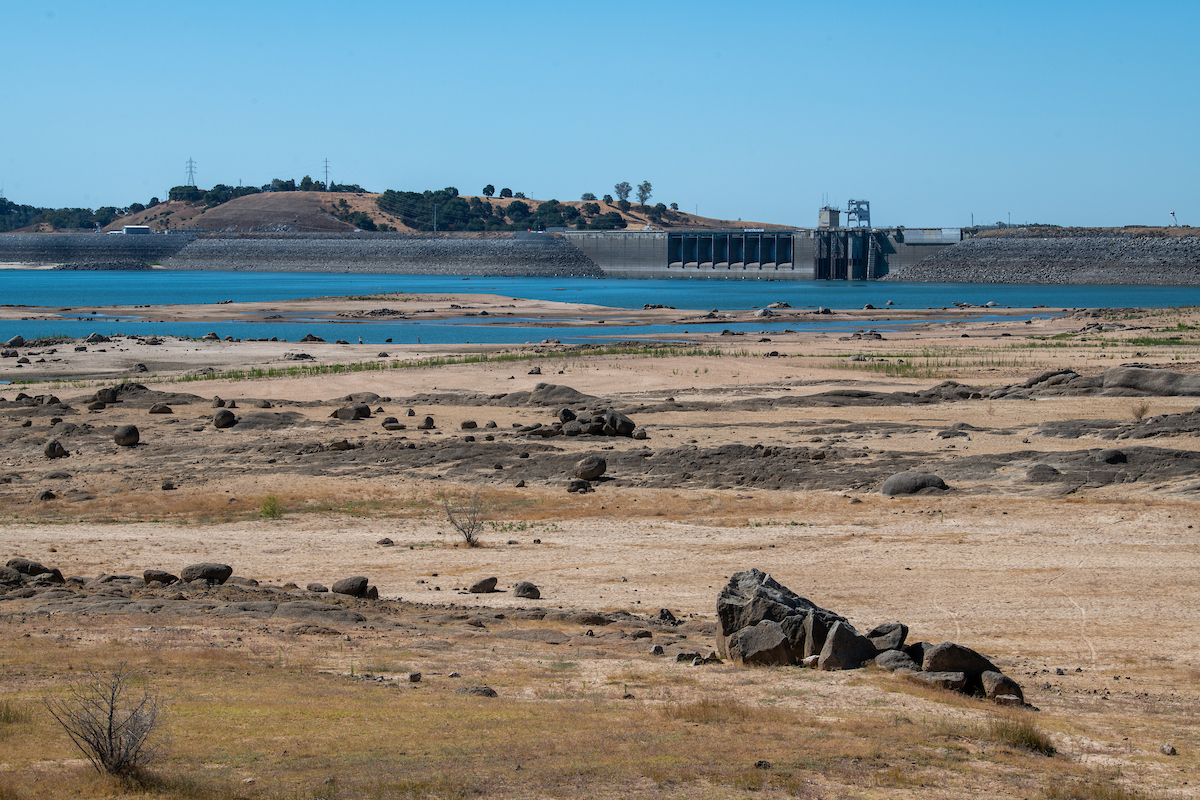
Some of the most impactful changes have come in the stressed Colorado River basin.
By Jake Bolster, Inside Climate News
This article originally appeared on Inside Climate News, a nonprofit, non-partisan news organization that covers climate, energy and the environment. Sign up for their newsletter here.
Some of the largest fossil fuel companies on Earth are disproportionately responsible for the water crisis in the American West, according to a first-of-its-kind study published Tuesday.
From 2014 to 2024, climate change sapped over a third of the region’s typical annual snowpack and decreased streamflows by about 13 percent, the authors found in the paper, which appeared in Nature’s Communications Earth and Environment journal. About half of those losses are attributable to emissions from “carbon majors,” 122 fossil fuel companies and cement producers, the study concluded.
That carbon-major pollution has drained the West of trillions of gallons of water, about the full capacity of Lake Mead, the largest reservoir in the U.S., the study found.
“There are millions of people that rely on these water resources,” said Carly Phillips, a senior research scientist at the Union of Concerned Scientists and one of the study’s co-authors. “The consequences of these changes are really evident for people on the ground.”
As humanity continues to burn fossil fuels and trap heat in Earth’s atmosphere, the West descends further into a decades-long, climate change-fueled drought, where higher temperatures sap more water from the region. Western river basins are experiencing an excruciatingly dry summer, which followed a historically low-snowpack winter and record peak runoff after a heatwave in March.
Now, complex, sprawling wildfires—driven in part by the historic lack of moisture—blanket the region, and some areas have reached a breaking point. On Monday, Nevada sued the federal government over its plan for managing the Colorado River, which supplies 40 million people with water for cities, farms and businesses.
To quantify emissions from the world’s biggest fossil fuel companies and cement producers, Phillips and her co-authors used data from a peer-reviewed paper and a database compiled by Carbon Majors, a project from the independent think tank InfluenceMap that tracks global fossil fuel emissions. Carbon Majors estimates 178 entities have emitted the equivalent of 1.44 trillion tons of carbon dioxide since the start of the Industrial Revolution.
By subtracting the carbon majors’ emissions from the total emissions between 2014 to 2024, and modeling each scenario against a hypothetical Earth without climate change, Phillips and her co-authors determined the role of carbon majors’ emissions in regional snowpack and riverflow declines.
This practice, known as attribution science, represents a growing body of work that links extreme weather events and rapid environmental changes to the greenhouse gas effect, about three-quarters of which comes from burning fossil fuels. In the West, as temperatures rise, more precipitation may fall as rain instead of snow, which can melt earlier, scrambling water forecasts. Less snow also means less reflectivity, and more heat at the earth’s surface, which increases evaporation of soil and plant moisture, snowpack and groundwater and leaves less water to run into rivers, dams and irrigation canals.
From 2014 to 2024, the Pacific Northwest and California’s Central Valley saw the largest drops in snow water equivalent, which estimates how much water lies in snowpack, and peak streamflow by volume. Though the lower basin of the Colorado River, by comparison, lost a smaller amount of moisture, that loss has proven more extreme: Snow water equivalent in the basin fell by 76 percent that decade, with the region’s streamflow declining by 21 percent.
As snow and water levels declined, water needs have risen, the authors found. Irrigation demand across the West rose by over 4 percent from 2014 to 2024, with just over half that demand driven by Carbon Majors’ emissions, 97 percent of which occurred, according to Phillips, since the 1950s.
That was a pivotal decade, Phillips said. “Some fossil fuel producers began to understand the risks of their products” at that time, “but instead of taking action to warn the public and inform policymakers, they engaged in a campaign of delay and denial and deception to cast doubt on the science,” she said.
Graham Fogg, a professor emeritus of hydrogeology at the University of California, Davis, who was not involved in the research, said doing an attribution study linking carbon majors is extremely difficult, and praised the authors of the paper for their approach.
“It’s a groundbreaking paper,” he said. “I think it should lead to many follow-up studies that attempt to improve upon and refine these kinds of estimates.”
Dozens of states and cities across the U.S. have sued large oil and gas companies for environmental damages associated with emissions from their products. Phillips said this study supports plaintiffs’ position in those cases as they seek to put a price tag on climate change for fossil fuel companies.
“It didn’t have to be this way,” Phillips said. Fossil fuel companies made choices “that have led to us being in this situation.”

