
Several news sources featured in the Daily Digest may limit the number of articles you can access without a subscription. However, gift articles and open-access links are provided when available. For more open access California water news articles, explore the main page at MavensNotebook.com.
On the calendar today …
- MEETING: State Water Resources Control Board beginning at 9am. Agenda items include consideration of a proposed Resolution approving an amendment to the Water Quality Control Plan for the San Diego Region to incorporate a water quality objective for Biological Condition, Consideration of a proposed Resolution to adopt the State Fiscal Year 2026-27 Drinking Water State Revolving Fund Intended Use Plan including Guidelines for Complementary Funding from the Budget Act of 2024 and Propositions 1, 68, and 4; and Public Hearing on the proposed Staff Report and Work Plan for the Review of State Water Quality Control Plans and Policies. Click here for the full agenda.
- PUBLIC HEARING: Department of Fish and Wildlife rulemaking: Invasive Mussels from 1pm to 2pm. The Department proposes to amend sections 650, 672, 672.1, and 672.2 to Title 14 of the California Code of Regulations. Amendments include management measures for watercraft removed from invasive mussel infested waters, such as mandating the inspection of watercraft that have been launched in infested water for four or more consecutive nights. Additionally, the proposed changes establish a departmental list of conveyance service providers that adhere to industry standards for inspection and decontamination. This is necessary to expand the scope of the existing regulations to encompass all invasive mussel species, thereby ensuring consistency with the revised Fish and Game Code (FGC) established by Assembly Bill 149. The proposed amendments are intended to align regulations with current conditions and to incorporate a proactive component that addresses potential invasive mussel threats not presently identified within the California or the United States. Click here for the Zoom link. Access documents here.
In California water news today …
New heat dome to build in western US, further exacerbating drought this week
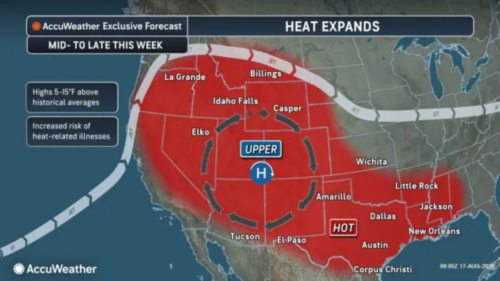 “Intense heat is in store for much of the interior West during the middle and latter part of this week. The heat dome will suppress thunderstorm activity, while ongoing drought and high evaporation rates contribute to falling river and reservoir levels. Temperatures will climb 5-10 degrees Fahrenheit above historical averages, although the heat is unlikely to be as extreme as heat waves earlier this summer. A few locations may set record-high minimum temperatures, particularly in the Southwest, where lingering monsoonal moisture can limit nighttime cooling. Downtown Los Angeles is projected to have multiple days with highs near 90, while temperatures soar well above 100 across inland areas. … ” Read more from AccuWeather.
Super El Niño is projected to douse California. Here’s how much extra rain to expect
“Strong El Niño events are commonly associated with wet winters for the Golden State. As the jet stream and atmospheric rivers that dowse the Pacific Northwest in normal winters get pulled south into California by El Niño, they also become supercharged thanks to warmer ocean temperatures. And as the ongoing “Super El Niño” continues to strengthen, long-range climate models are already studying this scenario and projecting what it could mean for California as winter nears. To understand the wet picture that is emerging, it is important to understand what climate models are. Weather models, such as the ones that feed the weather app you use on your phone, calculate specific conditions throughout the time of day. This includes any specific clouds or storms or fronts, and when and where any of those features might arise. Most of these models forecast out several days to a week or two. … ” Read more from the Sacramento Bee.
Ninth Circuit sides with Reclamation in fight over California water contract conversions
“A Ninth Circuit panel granted a win to the U.S. Bureau of Reclamation Monday, confirming a lower court’s finding the conversion of water service contracts from the California Central Valley Project doesn’t require a new environmental review. A three-judge panel unanimously held the Water Infrastructure Improvements for the Nation Act required the bureau to change a contract if requested by a water user, and does not necessitate the agency undertake environmental review under the National Environmental Policy Act or Endangered Species Act before converting each water service contract. “Reclamation was not required to conduct contract-specific environmental review or initiate consultation before converting those contracts because § 4011(a) creates a mandatory duty to convert water service contracts upon request and prohibits Reclamation from considering the environmental effects of the contract conversion or exercising discretion to benefit protected species when converting contracts,” U.S. Circuit Judge Gabriel Sanchez, a Joe Biden appointee, wrote for the court. … ” Read more from the Courthouse News Service.
Major data center bills advance in California despite industry pushback
“California, with its sky-high electricity prices, isn’t facing the same influx of data centers that many other states are. But the massive facilities are still being built and proposed in California — and legislators are racing to stop them from pushing up utility rates and pollution. Two major data center bills passed a key committee last week as California’s legislative session nears its close at the end of this month. Senate Bill 886 aims to prevent data centers from raising utility costs for other consumers, while SB 887 would incentivize developers to invest in clean energy and nearby communities. Data centers have lawmakers nationwide walking a fine line. Voters are increasingly worried about the facilities’ impacts on energy affordability and the environment, but the industry also promises jobs and economic benefits. State Sen. Steve Padilla, the Democrat who penned both California bills, says his proposals would rein in the sector without stifling it completely. … ” Read more from Canary Media.
SEE ALSO: Sidebar: The data center gold rush, from the Courthouse News Service
Following California’s steelhead through the seasons
“Steelhead are among California’s most remarkable fish. Born in freshwater streams, these ocean-going rainbow trout can migrate hundreds of miles to the Pacific Ocean before returning to the very streams where they hatched to spawn. Understanding where steelhead live, how they use habitat, and how many adults return each year is critical to conserving these iconic fish. “The best way to understand and support this unique species is to monitor steelhead throughout the year using a variety of scientific techniques tailored to each season,” according to Deena Hansen, the California Department of Fish and Wildlife (CDFW) senior environmental scientist supervisor who oversees steelhead monitoring across the South Coast Region for the Department in southern California. As weather conditions dry out and stream flows recede during the summer and fall, biologists conduct electrofishing and snorkel surveys to assess juvenile steelhead and resident rainbow trout populations. Occasionally, adult steelhead may spend their summers in freshwater, though it is less common. … ” Read more from the Department of Fish and Wildlife.
Tag, track, simulate: Rethinking salmon survival studies
“California’s Central Valley (CV) salmonids face many problems, and their decline can be attributed to “death by a thousand cuts.” Some of those cuts are exhibited in the high levels of mortality that juveniles face when they migrate from CV rivers to the ocean where they would ideally mature before returning to spawn. Predation, starvation, disease, and poor habitat are just some challenges these juveniles face. Unfortunately, it can be hard to identify what exactly causes these high mortality numbers at finer scales, making it difficult to apply targeted management strategies. For imperiled populations, even small improvements in juvenile survival can matter, so identifying the most important sources of mortality is key for effective recovery actions. … ” Read more from FishBio.
Young salmon in Prairie creek are growing twice as fast
“Give a creek room to act like a creek, and the fish notice within a single season. That is the early verdict from Prairie Creek in Humboldt County, where NOAA Fisheries and a coalition of partners spent more than a decade converting a former lumber mill site into wetlands, side channels, and off-channel ponds. NOAA Fisheries reported that juvenile coho in the restored habitat are putting on size far faster than fish holding in the main channel. In certain spots and years, according to a Pacific States Marine Fisheries Commission biologist who studied growth there, they grew up to twice as fast. … ” Read more from Active NorCal.
UC Santa Cruz researchers to study Southern California wetlands
“A research group out of UC Santa Cruz is taking their wetland monitoring work down to Southern California. The new data will strengthen our understanding of how restored wetlands keep carbon out of the atmosphere, and could even inform state policy. “There’s more carbon sequestered per area in wetlands than in tropical Amazon forests,” said Adina Paytan, a professor of earth and planetary sciences at UCSC. Paytan is leading the monitoring project at the Seal Beach National Wildlife Refuge and the Los Cerritos Wetlands in Southern California. Paytan’s lab studies biogeochemistry and chemical oceanography, including atmospheric microplastics and the impacts of climate change on coral reefs. The lab members also study wetland dynamics and how vegetation in these environments absorbs greenhouse gases such as carbon dioxide and methane from the atmosphere and keeps them buried for hundreds or thousands of years. … ” Read more from the Santa Cruz Sentinel.
Research article: Drought extremes are intensifying more rapidly than in the past
“Droughts are becoming an increasing global concern as their impacts intensify. Understanding how climate change affects drought frequency and severity is essential for projecting future drought risk. In this context, the question raised by Helpap et al. [2026]—”are modern droughts unprecedented?”—has a high scientific relevance. Here, 20 ensemble members from a 600-year climate simulation and reanalysis data from the period 1950-2024 are analyzed to place recent droughts in a multi-century context. It is concluded that drought extremes are intensifying more rapidly beyond the range experienced in the past than moderate droughts. Therefore, an increasing likelihood of droughts reaching unprecedented magnitudes is expected in the near future, thus highlighting the urgency for adaptation measures in water resources and environmental management. … ” Read the research article.
New council gives young adults a say in California’s environmental policy
“California is inviting teenagers and young adults to help shape state environmental policy. The state Environmental Protection Agency is taking applications for its first Environmental Youth Advisory Council. It’s open to Californians ages 14 to 20. Members will meet with state officials and weigh in on environmental issues. CalEPA Secretary Yana Garcia says the next generation has a valuable perspective on the world they’ll inherit. … ” Read more from KALW.
In regional water news and commentary today …
NORTH COAST
Sprague River – Restoring water and habitat in the Klamath headwaters
“After over two decades of advocacy, negotiation and engineering, the four dams blocking the Klamath River came down over the course of 2023 – 2024. With the final barrier breached in September 2024, within weeks Chinook salmon were found in tributaries above the former dam sites. Since then, the fish have astounded biologists by quickly migrating through Keno Dam, the Link River Dam and Upper Klamath Lake to reach headwater streams like the Sprague, Wood and Williamson Rivers. Monitoring by the Klamath Tribes and Oregon Department of Fish and Wildlife (ODFW) has confirmed that juvenile salmon are migrating out of these tributaries, profound evidence that salmon are successfully spawning in these portions of the watershed for the first time in over a century. While fall Chinook have had the most dramatic return to the basin since dam removal, coho salmon and steelhead have been documented above the former dams, too, and reintroduced spring Chinook smolts have been found moving downstream through the system on their way to the Pacific Ocean. Astoundingly, a spring Chinook adult was recently documented above Upper Klamath Lake as well. … ” Read more from Trout Unlimited.
The Yurok Tribe is back in court over who gets Klamath water first
“Two years after the last of the Klamath dams came down, the fight over the river has shifted from concrete to paperwork. The Yurok Tribe and its co-plaintiffs went before a San Francisco federal judge on Friday, asking him to step into a long-running dispute over how much water the Bureau of Reclamation sends downstream from the Klamath Irrigation Project. The challenge follows a federal decision last year placing irrigation ahead of threatened salmon. An Earthjustice attorney representing the tribe argued the bureau flipped its obligations and pushed ahead without the consultations the Endangered Species Act requires from the U.S. Fish and Wildlife Service and NOAA Fisheries. … ” Read more from Active NorCal.
City of Ukiah may nearly triple financial support for PVP activities
“At its next meeting Wednesday, the Ukiah City Council is scheduled to consider nearly tripling the amount of financial support the city provides toward activities related to the pending decommissioning of the Potter Valley Project, a hydroelectric plant in Mendocino County that the Pacific Gas and Electric Company is seeking to dismantle. According to the agenda staff report prepared for the Aug. 19 meeting, the board is being asked to consider approving a contribution of “up to $215,000 to the Mendocino County Inland Water and Power Commission for Fiscal Year 2026–27 …for activities related to the Potter Valley Project.” … ” Read more from the Ukiah Daily Journal.
SIERRA NEVADA
OpenSnow winter forecast: El Niño shows above-normal temps, precipitation for Tahoe, northern Nevada
“In the wake of one of the worst snow seasons on record for the West as a whole in 2025-2026 (but a good snow season for the East), it’s time to shift gears and take a look at the upcoming 2026-2027 winter forecast for the major ski regions of the Northern Hemisphere. A well-advertised and potentially historic super El Niño emerging this season played a big role in putting together this season’s outlook. We most strongly considered past strong to super El Niño winters with a similar distribution of sea surface temperatures to this one in the Equatorial Pacific Ocean, while also examining other oceanic and atmospheric signals, as well as seasonal model data, in producing this outlook. As a reminder, winter outlooks contain an inherent degree of uncertainty since so many factors in the atmosphere are not predictable months or even weeks in advance. … ” Read more from Carson Now.
Lawmakers to convene Tahoe Summit with a focus on progress and funding
“With its crystal-clear waters and soaring pine forests, Lake Tahoe is a beloved destination for Californians, Nevadans, and tourists from around the world. It’s also a fragile ecosystem that faces threats from climate change, invasive species and changes in weather patterns, according to Jeff Cowen, a spokesperson for the agency responsible for regional planning and environmental protection in the Tahoe area. Restoration and conservation efforts have been achieved through careful coordination by federal, state and local officials who recognized the need for environmental improvements — and the money to fund them, Cowen said. The event comes as President Donald Trump’s administration is poised to roll back federal environmental policies that protect national lands around the country, including Tahoe. … ” Read more from the Sacramento Bee. | Read via Yahoo News.
SEE ALSO: Sand Harbor to close Wednesday for 30th annual Lake Tahoe Summit, from Carson Now
Calaveras County moves to pause AI data centers. What will Tuolumne County do?
“Calaveras County is moving to temporarily prohibit the development of large-scale data centers while it studies their potential impacts, which raises questions about whether Tuolumne County will take a similar approach as the rapid growth of artificial intelligence increases demand for such facilities across the United States. At a public meeting Tuesday, the Calaveras County Board of Supervisors directed county staff to develop an urgency ordinance that would impose a temporary moratorium on data centers as a land use to allow more time for the county to look into how they should be regulated. Tuolumne County has no such moratorium under consideration, according to County Administrator Roger Root, though he said the issue of data centers has been discussed with the Board of Supervisors and briefly among county staff. … ” Read more from the Union-Democrat.
SACRAMENTO VALLEY
Shasta County: Man in Cal Fire lawsuit over ‘illegal’ water use vows to keep fighting
“A Shasta County man accused by the state of illegally swiping water from the Pit River and diverting it to a storage pond on his property in rural Montgomery Creek says a showdown is coming. In its lawsuit filed in Shasta County Superior court last year, the California Department of Forestry and Fire Protection alleged that landowner Guiliano Borgna “is improperly diverting water” from the river and sending it across Cal Fire’s property to a storage pond about 275 feet away on his land. In the lawsuit filed in October 2025, Cal Fire called it an “unpermitted channel.” Borgna denies the charge. He said he possesses historical water rights and that he didn’t build the ditch, since the tributary has existed on the property for 115 years. He said the stream carries water from the river to a storage pond on his nearly 18-acre property, which he bought in 2003. … ” Read more from the Redding Record Searchlight.
Podcast: Sacramento Valley groundwater damage
“California’s water system is complicated, ranging from reservoirs to the snowpack, to a significant amount of groundwater. Those underground aquifers are critical for the Golden State’s agricultural communities to tap into when conditions get dry, but overpumping is causing communities to significantly sink over the years. A new study shows that irreparable sinking is now happening in parts of the northern Sacramento Valley, from Woodland up to Redding, caused by major droughts from 2020-2022. J.T. Reager heads the Water and Ecosystems group at NASA’s Jet Propulsion Laboratory in Pasadena, and spoke with Insight about the study’s findings and what can be done to prevent future damage.: Listen at CapRadio.
BAY AREA
One of the Bay Area’s favorite beaches may lose some parking. Here’s why
“One of the Bay Area’s most popular beaches is moving into a future with less parking but a better chance of surviving storms. The National Park Service cleared a key hurdle this month to redesign Stinson Beach’s three main parking lots increasingly threatened by flooding from storms and rising seas. The plan calls for giving up about 10% of the town’s free beach parking spots in order to restore wetlands and other natural habitats capable of absorbing floodwaters. The tradeoff could be significant for a small town wedged between a mountain and the sea where most visitors arrive by car. Parking would fall from about 750 spaces to 680, according to a California Coastal Commission report. The north lot along Stinson’s crescent-shaped beach would take the biggest hit, dropping from 170 spaces to 90, while the central lot would gain 25 spaces and the south lot would lose 15. … ” Read more from the San Francisco Chronicle.
Why S.F. neighborhoods are up in arms over new environmental rankings that could cost them money
“California recently updated the system it uses to decide which communities get top priority for state environmental cleanup funding, and dozens of groups in the Bay Area aren’t happy with it. In July, the Office of Environmental Health Hazard Assessment released its fifth version of CalEnviroScreen, a data tool that maps environmentally burdened communities in California. The tool added two new indicators – diabetes prevalence and small air toxic sites, such as gas stations – and incorporated updated metrics, such as levels of lead detected in children. But Bay Area community advocates say the new data in the final version dilutes the ranking of some neighborhoods, making them seem less polluted than they were before despite a lack of environmental improvements. The change means those communities could lose out on state funding. That’s because the California Environmental Protection Agency uses CalEnviroScreen to define what communities are “disadvantaged.” Under Assembly Bill 1550, the agency must direct 25% of so – called cap-and-invest funds — money paid by polluting companies and deposited into the state’s Greenhouse Gas Reduction Fund – to be set aside for disadvantaged communities. … ” Read more from Cal Matters.
SAN JOAQUIN VALLEY
Visalia and Tulare County move to block data centers — but not the city of Tulare
“Tulare County and the city of Visalia will both consider temporary bans on data center development this week, while the city of Tulare has declined to take up the issue — a split response to a wave of proposals that have raised concerns over water and power in the South Valley. The Tulare County Board of Supervisors on Tuesday will take up a proposed 45-day moratorium on data center development in any unincorporated part of the county. The same week, the Visalia City Council will hear a plan to pursue a moratorium within city limits. Tulare, meanwhile, opted not to discuss the matter at its last meeting. … ” Read more from The Business Journal.
Kings County groundwater agency to host workshops ahead of land assessment fee election
“Hanford-area landowners are invited to two workshops to learn about proposed new land-based and groundwater pumping fees. The Mid-Kings River Groundwater Sustainability Agency (GSA) will host two workshops explaining the fees and election process. One fee is proposed under Proposition 218 election and would charge landowners $26.84 per acre of land. The other is a Proposition 26 proposed fee that would charge well owners up to $19.24 per-acre-foot pumped. While the Prop. 218 fee will need to be passed by landowners, the Prop. 26 fee will need approval by the Mid-Kings GSA board. The first workshop will be held August 24 at 1 p.m. The second workshop will be held August 25 at 5:30 p.m. Both events will be held at the Hanford Civic Auditorium, 400 N. Douty Street and will include an online option. … ” Read more from SJV Water.
SOUTHERN CALIFORNIA
Month after water main break, some West Hollywood homes remain unlivable
“Although the water main break that shut down one of West Hollywood’s busiest streets was repaired last month, some homes that were affected by the incident remain unlivable. A massive water main break ushered residents along Sunset Boulevard out of their homes last month as it flooded nearby roads with 17 million gallons of water. The disaster created a sinkhole in the immediate area and floodwaters damaged sidewalks, underground parking garages and businesses. After about a week of nonstop work, crews were able to fix the water line and reopen streets on July 24. Nearly a month later, however, some residents are still unable to return home. … ” Read more from KNBC.
Stripped of sand, decades-old infrastructure ‘relics’ pop up at the Wedge in Newport Beach
“A series of powerful hurricane-driven swells have surfaced forgotten remnants of Newport Beach’s infrastructure that lay buried beneath sand and water for many decades. Videos and photos circulating on social media show piles of rocks, chunks of concrete and rusted metal rods after waves removed layers of sand along the shoreline. Much of the erosion has occurred near the west jetty where the popular surfing spot the Wedge is located. “We’re aware of the sand erosion and the different relics getting exposed down there,” said Newport Beach Lifeguard Battalion Chief Adam Yacenda. … ” Read more from the LA Times.
SAN DIEGO
De Anza Cove plan could dramatically expand Mission Bay wetlands
“A long-discussed transformation of De Anza Cove in Mission Bay has cleared a key hurdle, giving the City of San Diego a path toward dramatically expanding wetlands while maintaining space for recreation and camping. The California Coastal Commission approved the city’s plan for De Anza Cove, according to San Diego Coastkeeper Executive Director Phillip Musegaas. The proposal could eventually expand wetlands in the area from about 70 acres to 260 acres, although Musegaas said the full transformation could take at least 20 years. “We’re very supportive of it,” Musegaas said. … ” Read more from NBC 7.
Along the Colorado River …
Nation’s largest reservoirs are drying up, threatening life in the Southwest
“Lakes Powell and Mead, the nation’s largest reservoirs, are drying up, sending a Colorado River system that provides water and electricity for millions of people into a state of crisis with no end in sight. Water levels in Lake Powell, along the Utah-Arizona border, fell to a record low on Saturday. Lake Mead, the larger of the two and farthest downstream on the Colorado River, dropped to its lowest recorded point a week earlier. The combined reservoir system, an essential water source for cities and farms across Arizona, Nevada and Southern California, has not held so little water since 1957, before Lake Powell was filled. That was long before climate change brought three decades of drought, the worst dry spell for the Southwest in at least 1,200 years, scientists said. Federal and state officials and communities across the region have taken emergency steps to try to head off catastrophe. They shifted water from a smaller reservoir to try to save Powell and have called for water conservation, though those requests are mostly voluntary so far. … ” Read more from the New York Times.
SEE ALSO:
- Lake Powell sinks to record low as Colorado River crisis deepens, from AccuWeather
- Lake Powell is just 30 feet away from its worst disaster, from SF Gate
- Lake Powell’s water level hits new low, fueling West’s water crisis, from the Washington Post
Hageman: California ‘failed all of us’ and made Colorado River water crisis worse
“California isn’t doing its part to avert the Colorado River crisis by upgrading its aging water infrastructure and is instead spending billions on pet projects, Wyoming Republican Rep. Harriet Hageman said Monday. “It’s because they do stupid things like spending money on high-speed rail and don’t meet the basic needs of their citizens,” Hageman told Cowboy State Daily. She added that California Gov. Gavin Newsom is one of the “top five worst governors in the United States.” “How many billions have been wasted on healthcare for illegal aliens (in California)?” she asked. During a recent appearance on News Nation, Hageman said California, with a population of 40 million, still relies on water infrastructure dating to the 1960s, when about 16 million lived in the state. … ” Read more from Cowboy State Daily.
As Colorado River reservoirs shrink, Arizona warns of a legal fight
“The Trump administration’s plan for dealing with worsening water shortages along the Colorado River is encountering strong opposition from Arizona’s leaders, who are warning they could sue to challenge mandatory water cutbacks that they say would harm their state. A legal fight could end up before the U.S. Supreme Court and further complicate efforts by seven Western states to agree on how to share water from the shrinking river and its reservoirs, which have fallen to record low levels. Arizona laid out its objections in a sharply worded letter to the federal government last week. It said the Trump administration’s 10-year plan doesn’t adhere to the Colorado River Compact, the 1922 agreement that originally divided the water among the states. … ” Read more from the LA Times. | Read via AOL News.
Colorado River crisis threatens crops, not Wyoming’s dam plans, experts say
“A federal drought plan for the Colorado River and its tributaries in Wyoming shouldn’t stop Wyoming from building a new dam and reservoir in Carbon County, two Western water experts say. The Bureau of Reclamation plan for the sweeping basin focuses on maintaining enough water in Lake Powell and Lake Mead to generate electricity and prevent degradation of critical infrastructure, professors from Utah and Arizona said last week. The 10-year framework to manage water storage and releases in the complex seven-state, two-nation system seeks to balance predictability and flexibility in two-year increments. It also acknowledges that the government has little to no authority over water use in headwater states Wyoming, Utah, Colorado and New Mexico, said Sarah Porter, the director of the Kyl Center for Water Policy at Arizona State University’s Morrison Institute. … ” Read more from the WyoFile.
Rafting a river in flux through the Grand Canyon
Heather Hansman writes, “They call it the horizon line, the point on a river where the water disappears over the drop of a rapid and you can’t see what’s coming next. Once you pass it, you’re committed to the force of the water. I felt that force above Badger Creek Rapid, the first major white water on the Colorado River in the Grand Canyon. The walls of the canyon pinched in and the river sped up, pulling us toward the horizon line. Our boat tipped over the edge, rushing into the waves and then we crashed through the rapids, immersed in the canyon. I’d been chasing that feeling since I was 18, when I started working as a river guide on cold, clear rivers in Maine, far from the desert depths of the Grand Canyon. For over two decades, I’d held up the Grand Canyon as the ultimate river trip: the longest, the biggest rapids, the most stunning canyon, the start of so many river stories. And now, I was finally getting my chance. … ” Read more from the New York Times.
Colorado River cuts to drive up Arizona water prices as cities invest in infrastructure
“Water experts state that no matter what happens with cuts along the Colorado River, water will start getting more expensive. There are many reasons for that, with much on the line as federal officials announce Colorado River water cuts. Big picture view: In Apache Junction, local officials rely entirely on the river for their water supply. While residents will still have water, many water solutions require infrastructure, which requires funding. Inside a city office building, a team of people, including Apache Junction Deputy Water Director Brian Draper, is working on finding water. Securing water is a necessity for Draper because Apache Junction is entirely dependent on Colorado River water. … ” Read more from Channel 10.
UCLA study says Nevada leads on wastewater recycling as Colorado River shortage grows
“A new UCLA study identifies Nevada as a leading example of wastewater recycling among Colorado River Basin states, while saying most other states in the basin are behind on reuse efforts. The Colorado River has been affected by more than a quarter-century of drought. Southern Nevada receives the smallest share of the river’s water among basin states. Noah Garrison, a water researcher with the UCLA Institute of the Environment & Sustainability, said Nevada recycles its wastewater effectively because Las Vegas can treat wastewater from the city and discharge it into the Las Vegas Wash, where it flows back into Lake Mead and can be reused. “So it turns out that Nevada is actually doing an incredible job of recycling its wastewater, largely because the city of Las Vegas can treat wastewater that comes out of the city, place that water or discharge that water into the Las Vegas wash, it goes back into Lake Mead, and then it can be reused,” Garrison said. … ” Read more from Channel 5.
Utah State Ag-DRIP program helps farmers conserve water in Colorado River Basin
“The sound of sprinklers spraying water throughout a Uintah County farm might seem far removed from the larger debate over the future of the Colorado River. However, researchers at Utah State University said the two are very much connected. At the Bar Lazy TL Ranch just outside of Vernal, wheel lines stretch across several fields. The irrigation systems are common on farms throughout Utah, but the technology behind them has not changed all that much through the years. The USU researchers are now looking at ways to change that. “This is called an R-33,” said Matt Yost, an agroclimate scientist with Utah State University Extension, while demonstrating one of several sprinkler designs being tested. “It’s got a big spray pattern, but then every so often it disrupts that and makes a shorter throw.” … ” Read more from KSL.
Colorado got a rain dump. Did it help?
“Beleaguered Front Range residents weary of crackling-dry lawns and long-term drought anxiety were hoping the past week of heavy clouds and thunderous cloudbursts would fill reservoirs and turn precipitation maps from red to green. So the question from many minds was, did it help? The answer is: Not really. The key word, unfortunately, is “localized.” Yes there were downpours strong enough to green up lawns and flood some creek beds. Yes, a swath from Denver International Airport southwest to Conifer got 1 to 2 inches of much-needed rain, and a good number of Eastern Plains farmers saw their crops catch up to normal. But Colorado’s professional weather watchers must deal in data. And the statewide numbers tell a different story than the Instagram reel of your neighbor’s gutters overflowing. … ” Read more from the Colorado Sun.
In national water news today …
EPA tool helps states spot water problems early
“The U.S. Environmental Protection Agency introduced a new checklist on August 13, 2026, meant to help states find weak spots in drinking water systems before those weak spots cause real trouble. The agency said the goal is to spot small problems during routine checkups and fix them early, so homes, schools, and hospitals keep getting clean water without a break in service. The checklist is voluntary. States do not have to use it. The agency designed it to slide into inspections that state agencies already perform, so it adds a tool rather than a new stack of paperwork. EPA tied the release to its Powering the Great American Comeback Initiative and to states’ role as co-regulators under the Safe Drinking Water Act. … ” Read more from Western Water.

