
A wrap-up of posts published on Maven’s Notebook this week …
Note to readers: Sign up for weekly email service and you will receive notification of this post on Friday mornings. Readers on daily email service can add weekly email service by updating their subscription preferences. Click here to sign up!
In California water news this week …
El Niño continues to strengthen. What does that mean for flood risk this winter?
“The already strong El Niño conditions in the Pacific Ocean continue to grow stronger, federal scientists said Thursday, with a 69% chance that this year’s event will be the strongest since modern records began in 1950. Scientists at the National Oceanic and Atmospheric Administration in College Park, Maryland announced there is a 90% chance of a very strong El Niño through this fall and winter as water temperatures along the equator off South America continue to rise. But while El Niño increases the odds of wet winters in California, it doesn’t mean what many people assume: That flooding is imminent later in the year for residents who live along rivers and creeks. Of the 10 worst flooding years in California since 1950, ranked by dollar damage compiled by the California Office of Emergency Services, only three came during El Niño years. … ” Read more from the San Jose Mercury News.
A ‘super’ El Niño is now super likely, leaving California bracing for impact
“A “super” El Niño now has a 95% chance of developing this year as the climate pattern gains dramatic strength in the Pacific Ocean — leaving officials across California and beyond bracing for a wet and potentially destructive winter. The National Oceanic and Atmospheric Administration’s Climate Prediction Center said Thursday that the El Niño has strengthened in the last month, and there’s a roughly 7 in 10 chance it will be the strongest such pattern since 1950. Of the three other powerful El Niños on record during that span — in 1982-83, 1997-98 and 2015-16 — two brought above-average rain to Southern California. The 2015-16 El Niño, while very strong in the ocean, did not, though the pattern was blamed for record beach erosion along the California coast. … ” Read more from the LA Times. | Read via Yahoo News.
A possible ‘super’ El Niño could pose the latest threat to North Bay fishing fleets
“North Coast commercial fishermen have spent the past several years weathering one crisis after another: a three-year salmon shutdown, repeated delays to the Dungeness crab season and millions of dollars in lost revenue. Now, a strengthening El Niño could prove to be the industry’s latest challenge. Scientists say the climate pattern, including warming waters in the eastern Pacific, has the potential to shift where marine species are found and contribute to harmful algal blooms that could disrupt California fisheries. While forecasters say it is too early to know exactly how Northern California will be affected, local fishers say they have already observed unusual conditions on the water. “Fishermen are scientists,” said commercial fisherman Dick Ogg. “We are always monitoring current, water temperature, color and where we see changes. We look for change and variation as fishermen and we go fish on the edges of this change.” … ” Read more from the Santa Rosa Press Democrat.
California at risk of ARkStorm, a 1,000-year megastorm caused by a 30-day lashing
“Scientists have issued a warning about a storm in California that could inundate residential areas with floodwaters as high as 20 feet and submerge everything between San Francisco and Los Angeles. This scenario has been named ARkStorm 2.0 and involves a chain of storms hitting the state one after the other, leading to a scene similar to the biblical flood, not only in name (ARkStorm – a direct play on Noah’s Ark from the biblical Genesis flood narrative) but also in the scale of devastation. ARkStorm stands for “Atmospheric River 1,000-year Storm” and was developed by the US Geological Survey (USGS) and federal, state and academic experts in 2010. The purpose was to help prepare for an extreme weather disaster driven by atmospheric rivers. These long and narrow corridors flowing in the sky carry water vapour from the tropics towards higher latitudes. When they reach California, ARs slam into coastal mountains or the Sierra Nevada, with condensation leading to heavy rain or snow. They are integral to the state’s water supply and weather, but a glitch can cause them to sometimes arrive in quick succession. This would trigger a deluge, floods of astronomical levels, and landslides. In the ARkStorm 2.0 scenario, multiple atmospheric rivers will slam into the West Coast over nearly 30 days, dumping huge amounts of rain and snow, the Daily Mail reported. … ” Continue reading at WION.
Reclamation nudges CVP allocations up for south-of-Delta contractors; Westlands responds
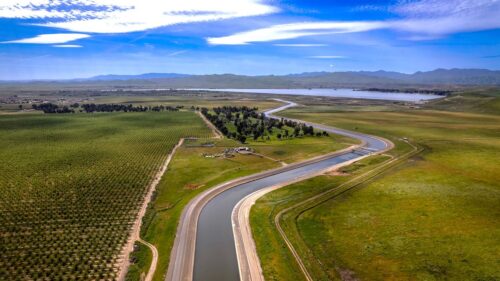 “The Bureau of Reclamation is increasing Central Valley Project 2026 water supply allocations for south-of-Delta contractors reflecting improved water supply conditions and operational flexibility. “Increasing water allocations means more reliable water for California’s farmers, families and communities, supporting food production, local economies and greater affordability,” said Assistant Secretary for Water and Science Andrea Travnicek. “Under President Trump’s leadership, we are making the most of available water supplies and improving delivery certainty so the Central Valley Project can better serve the people and communities that depend on it.” This action underscores the ongoing commitment of the Trump administration to improve water supply reliability, enhance system resilience, and reduce regulatory delays, consistent with the directives outlined in Executive Order 14181. Efforts under this Executive Order are supporting food production, strengthening economic stability, and fostering community resilience throughout California. … ” Read more from the Bureau of Reclamation.
SEE ALSO: Central Valley water supply jumps to 28% for irrigation contractors, from Action News Now
California law aimed at saving groundwater risks crushing state’s small farmers, according to report
“Small farmers in the San Joaquin Valley are struggling with groundwater regulations to the point that 85% of 170 farmers surveyed for a recently released report said they were concerned they would have to shut down. Others said they are “cutting their farms in half, or more,” said Alyssa DeVincentis, one of the report’s authors, with the California Alliance with Family Farmers, during a webinar held August 3 to discuss the “Managing Groundwater With Small Farms in Mind” report. “They’re actually reducing the amount of food that they’re producing,” DeVincentis said. That’s a very real and substantial impact of how the Sustainable Groundwater Management Act (SGMA) is affecting small farmers, she added. … ” Read more from SJV Water.
Charting a path for the San Joaquin Valley
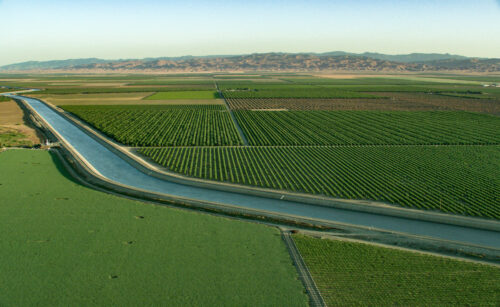
“California’s San Joaquin Valley is one of the most productive agricultural regions in the world. The valley accounts for about 60% of the state’s farm economy and produces an astonishing share of the nation’s fruits, nuts, and vegetables. But all this productivity depends on water, and most groundwater basins in the valley are critically overdrafted, which creates a host of problems. In a recent event examining new PPIC research on SGMA-ready crops, Geoffrey Vanden Heuvel of the Milk Producers Council explained. “We developed this huge agriculture palate that is the San Joaquin Valley over 100-plus years without any regulation of groundwater…That led to an unsustainable situation.” In his opening presentation, PPIC Water Policy Center research fellow Brad Franklin outlined how the 2014 Sustainable Groundwater Management Act (SGMA) seeks to rectify that by mandating that groundwater sustainability agencies bring basins into balance by the early 2040s. To comply with the law, as much as 900,000 acres of land may need to come out of irrigated production by 2040. … ” Read more from the PPIC.
Valley water managers pushback on proposed new $50,000-$250,000 state fee
“The state says it needs more money to police overpumped regions in the San Joaquin Valley and is considering a new fee that could cost water agencies between $50,000 to $250,000. That fee would be charged to groundwater sustainability agencies seeking exemptions from state enforcement measures. It would apply to new exemption requests as well as to agencies seeking to extend exemptions that have already been granted. Southern Tulare County water managers challenged the proposed fee during a July 30 workshop, saying the Water Resources Control Board hasn’t given updated details on its costs and how that money, and other fees, would be spent. “We’ve been invited to participate in this process, but there’s nothing for us to participate in if you don’t give us any budgets or any projections of fees,” Lower Tule and Pixley general manager Alex Peltzer said during the workshop. “If there’s an old budget, where is that? And what are the details of that?” … ” Read more from SJV Water.
Appellate court clarifies groundwater well permitting responsibilities
“In an August 4, 2026, decision (Russian Riverkeeper v. County of Sonoma), the California Court of Appeal determined that a county well-permitting ordinance satisfied the county’s public trust responsibilities, but that the ordinance was not exempt from California Environmental Quality Act (CEQA) review. … Sonoma County relies on more than 45,000 groundwater wells and issues roughly 320 well permits annually. Following the 2018 decision in Environmental Law Foundation v. State Water Resources Control Board — which held that counties share the state’s public trust duties when permitting wells that affect navigable waters — Sonoma amended its well-permitting ordinance (Chapter 25B) in April 2023. The amendment created a science-based Public Trust Review Area (PTRA) covering approximately 19% of the county, introduced discretionary review for wells within the PTRA, and established water conservation and metering requirements. Sonoma claimed the amendments were categorically exempt from CEQA under Class 7, Class 8, and the common sense exemption. Petitioners challenged both the public trust adequacy of the amendments and the CEQA exemption claims. … ” Read more from Hanson Bridgett.
Now available: New guide: Designing recharge projects for multiple benefits
“Managed aquifer recharge can do more than replenish groundwater. This new brochure explores how thoughtfully designed recharge projects can also support flood risk reduction, ecosystem enhancement, water quality, climate resilience, working lands, and drought preparedness. It highlights practical planning considerations, real-world examples, and strategies for maximizing the multiple benefits of recharge projects across California.” Read the new guide from DWR.
Now available: 2025 Groundwater Recharge Roundup
“Curious how groundwater recharge efforts are progressing across California? This new Annual Groundwater Recharge Round-Up provides a statewide snapshot of Water Year 2025, including recharge volumes, hydrologic conditions, permitting pathways, policy updates, and emerging tools. The resource also spotlights successful implementation in Yolo County, offering insights and lessons for agencies looking to expand recharge efforts.” Read the roundup from DWR.
California drew the line on regenerative agriculture. Farmers are making sense of it
“California has long been at the forefront of climate and environmental policy. Last year, the state became the first to officially adopt a statewide definition of regenerative agriculture. The move reinforces the state’s climate goals, which identify natural and working lands as a key part of reaching carbon neutrality. “This was about aligning state policy and programs, especially our grant programs, around a shared definition throughout our state government,” said California Department of Food and Agriculture Secretary Karen Ross. California’s resulting outcome-based framework focuses on eight key areas that aim to improve and restore soil health. Environmental leaders say healthier soils can store more carbon, improve water retention during drought and make farms more resilient to climate change. While the definition outlines the results, it does not prescribe the specific practices to achieve them, leaving farmers, researchers and policymakers to navigate what regenerative agriculture looks like across California’s diverse farming ecosystem. … ” Read more from Capital Public Radio.
Scientists define a new category of heat wave: ‘Snow eaters’
“Matthew LaPlante doesn’t have to go to a lab to see his research in action. On some mornings, he can just look out his own window in the mountains high above Salt Lake City. After a warm night when the temperature stays above freezing, he’ll wake up and see that the snow level has dropped by inches, revealing more of the aspens he taps for syrup. “It feels like a monster came and just in the middle of the night, took a bite out of a snowpack,” said LaPlante, a journalist and climate scientist at Utah State University. So it’s fitting that scientists have started calling these kinds of heat waves, marked by unusually high temperatures in the spring and early summer, “snow eaters.” … ” Read more from Grist.
Where did the birds go? Once-abundant wetlands are drying up after federal staff cutbacks
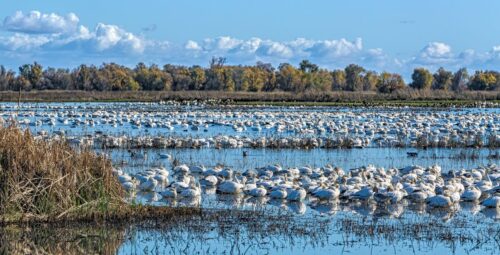
“Even on chilly January days in years past, it was possible to see and hear more than 100 kinds of birds at the Vierra Wetlands in the San Joaquin River National Wildlife Refuge. But last winter, dozens of species like the snowy egret, northern shoveler and the strikingly colorful wood duck did not appear. The seasonal wetlands, which are part of a larger pit stop for migratory birds on the Pacific Flyway, were nearly bone dry — and not because of a drought. The U.S. Fish and Wildlife Service simply didn’t have enough employees dedicated to opening the levees that flood the wetlands. It’s a reality playing across many of the national wildlife refuges in the country, including the 35 in California. Labor shortages at the federal government’s various land management agencies — which have intensified in President Donald Trump’s second term — have left departments with less capacity to manage the refuges. … ” Read more from Cal Matters.
What are nature-based solutions and why are they needed now?
“Even if you have never been to L.A., you probably have seen the L.A. River. It is that wide concrete trench that Hollywood loves to film: drag races, chase scenes, countless commercials shot on the bare slab… But it’s strange. This river doesn’t look like a river. After catastrophic floods about one century ago, the river started to be lined with concrete for most of its 51 miles. The river became a single-purpose concrete channel to flush stormwater from the mountains to the sea as fast as possible. But in three stretches, the river couldn’t be lined with concrete. And in those stretches, something happened that no one had planned. Cottonwoods and willows came back. Herons, egrets, and the Santa Ana sucker (an endangered fish species) came back. And people came back too to enjoy the river that had become their neighborhood park, to ride their bikes or to use their kayaks. Same river, two realities. Gray concrete infrastructure does one job at a very steep price. … Luckily for our L.A. friends, the L.A. River is undergoing a restoration that will bring back many of the multiple benefits of the river such as habitat, cleaner air, and green areas in the city while improving water quality, reducing erosion, and of course, maintaining (or even improving) the much-needed flood risk control.This restoration project in the L.A. River is an example of a nature-based solution. … ” Read more from the Union of Concerned Scientists.
Forecasting data centers’ demand
 “How do you decide where to put a data center that will consume as much power as a small city? Data centers have existed to support early computers and the internet for decades. Every data center in the U.S. draws power from a regional electrical grid and water from a local watershed—costs that are usually calculated after they’re built, if at all. But in the last five years, the boom of artificial intelligence has driven up the energy demand. Hyperscale data centers, designed to handle AI and cloud computing, consume three to five times more power per square foot than traditional data centers, with large facilities drawing as much power as nearly 100,000 homes and millions of gallons of water daily. But as technology companies scour the country for their next site, cities have often been resistant to data center expansion for two reasons: strain on the local power grid and negative health effects of pollution on nearby residents. Now, a Harvard biostatistician and an electrical engineer have combined their expertise to build a framework for helping policymakers decide where data centers should go. … ” Read more from Harvard Magazine.
In commentary this week …
Assessing the effectiveness of California’s Delta Reform Act
Paul S. Weiland writes, “Recently, three state agencies – the Delta Stewardship Council, the Sacramento-San Joaquin Delta Conservancy, and the Delta Protection Commission – released a report on their achievements in realizing the goals of the Delta Reform Act of 2009. … More than 15 years after its enactment the Delta Reform Act presents at best a mixed record. While the Act undoubtedly expanded planning and oversight mechanisms and established an additional formal governance structure for Delta-related decision-making overlaid on numerous already existing regulatory programs, there is substantial reason to question whether it has achieved any of its central objectives. The evidence suggests that those objectives — creating a more coherent management framework, improving ecosystem conditions, and enhancing long-term water supply reliability — have yet to be realized. … ” Read more from the California Water Resources Policy and Management.
Alternative crops on California farms offer options beyond fallowing land
Caitlin Peterson, an agroecologist, associate director and a research fellow at the Public Policy Institute of California (PPIC) Water Policy Center, and Bradley Franklin, an agricultural and environmental economist and research fellow at the PPIC Water Policy Center, write, “Growers in the San Joaquin Valley know they have to reduce groundwater pumping — and not just because it’s the law. The 2014 Sustainable Groundwater Management Act (SGMA) mandates that overdrafted areas bring their groundwater basins into balance by the early 2040s. Local water agencies — which are in charge of ensuring that pumping levels are brought down to sustainable levels — are turning to fallowing cropland to reduce groundwater use. But fallowing can create more issues, including economic losses to farmers and related businesses, the spread of weeds to neighboring farms and poor air quality due to increased dust. Many growers may wonder about other options. Is fallowing the only way to reduce their water footprint? Or are there alternative crops or business models that could help them adapt to this new water reality? We may have found one. … ” Read more from the Fresno Bee.
Is covering California’s aqueducts and canals with solar panels economical?
Edward Ring, the Director of Water and Energy Policy at the California Policy Center, writes, “Earlier this week, a respected YouTube channel covering the future of technology and energy released a video exploring the viability of solar panels covering California’s canals and aqueducts. The videos are hosted by Ricky Roy, a California-based mechanical engineer whose channel is called “Two Bit Da Vinci.” Reviewing his findings is an opportunity to offer some updates and perspective on the potential of photovoltaic energy in California. Roy claims solar and battery storage capacity has exploded in recent years. He’s right. It’s grown so fast that even its proponents have seen their expectations surpassed. Worldwide photovoltaic capacity has increased by more than ten times in the last ten years, and the last decade has seen worldwide battery storage capacity increase by more than 150 times. One of the leaders in this gallop into the electric age is California. The California ISO (Independent System Operator) website is a good place to get a visual impression of just how much growth we’re seeing in solar and battery capacity. On August 9, 2026, utility solar output exceeded 20 gigawatts from 9:30 a.m. till 3:30 p.m., six full hours, and later that same day, batteries discharged over 10 gigawatts into the grid from 6:45 p.m. until 8:30 p.m. It’s summer. Lot’s of sun. Of course! But consider the trend. … ” Continue reading from Edward Ring at Maven’s Notebook.
How the Trump administration could limit California’s power over its own coastline
Stephanie Altman, a senior energy and biodiversity specialist at Defenders of Wildlife, writes, “California’s coastline is one of the nation’s greatest conservation success stories. From recovering sea otters and nesting snowy plovers to migrating gray whales and the vibrant national marine sanctuaries that many species call home, generations of Californians have fought to protect the wildlife and places that make this coastline extraordinary. Few may realize these conservation successes are made possible, in part, by a little-known but critically important federal law: the Coastal Zone Management Act. For more than 50 years, the act has given California and other coastal states a meaningful voice in federal decisions affecting their shorelines. Through the law’s federal consistency program, California works with federal agencies and project proponents to ensure that offshore drilling proposals, pipelines, ports and other federally authorized activities are consistent with the state’s coastal policies. … ” Read more from the San Francisco Chronicle.
The looming emergency that should make us build more water infrastructure
Joe Pollak, opinion editor at the California Post, writes, “California faces potential water shortages if the states that use the Colorado River can’t make a deal. Seven states depend on the river, which winds from the Rocky Mountains through the Grand Canyon to the Gulf of California. The states take so much water from the river that it rarely reaches the sea. The Colorado River provides about one-third of Southern California’s total water supply. The past 25 years have been particularly dry. And two major dams on the river — Lake Powell and Lake Mead — are dropping to dangerously low levels. That means the states need to come up with a new water-sharing agreement. The federal government says it will impose cuts if there’s no deal. … But if conditions don’t improve, bigger water cuts are coming for California. And that could affect everyone, especially if there’s another drought. California is not short of water. But it is short of good water management. … ” Read more from the California Post.
California ‘has failed its people’ with desalination efforts: Rep. Hageman
“Wyoming Congresswoman Harriet Hageman has had enough of California’s lack of large-scale seawater desalinization. Lake Mead, the Colorado River Reservoir, has dropped to its lowest level since it was filled in the 1930s, with the reservoir is currently sitting at only 27% capacity. California has blocked and underdeveloped large-scale seawater desalinization for years and the state, which borders an ocean, takes a large share of Colorado River water. According to the Department of Energy, desalination is the “process of removing salts and other minerals from water, making it suitable for human consumption, irrigation, or industrial uses.” Republican Congresswoman Hageman, a member of the committee on natural resources, sat down with “Katie Pavlich Tonight” to discuss what she believes needs to be done. … ” Read more from News Nation.
Wildfires will only get worse until the US stops ignoring the climate crisis
Felix Horne, senior expert with Climate Rights International based in Ottawa, writes, “”President Donald Trump argued last month that Canada should pay damages — or face additional tariffs — for the wildfire smoke recently “poisoning” American air, and claimed that he strong-armed Canadian Prime Minister Mark Carney during the World Cup final in New Jersey, telling Carney he needed to stop the fires. To Trump and the Michigan members of Congress who recently declared in a letter that their “patience has run out” with Canada over the wildfire smoke: I get where you’re coming from. As a Canadian, I’d love nothing more than to stop the haze drifting over the border. The air is thick, the sunsets are unsettling and your constituents — just like ours — are coughing through summers that are no longer what they used to be. But here’s the thing: Demanding compensation while gutting climate policy is asking Canada to put out the fires while Washington keeps adding more fuel. … ” Read more from the Santa Rosa Press Democrat.
Peter Gleick: Drought, water rationing and dry rivers: our water crisis is here
“Disturbing news about our water resources is now constant and unrelenting. In just the past few weeks, media have reported that Puerto Rico is suffering a deep water crisis as severe drought has cut water supplies to thousands. The Rhine and Po rivers in Europe are at record low levels. The seven states sharing the Colorado River in the US are fighting over unprecedented shortages, while its major reservoirs have shrunk to their lowest levels since they were built. Hungary’s only nuclear power plant is on the verge of shutting down because there isn’t enough water in the Danube River to cool it. Toxic chemicals have been found in all English water bodies. … At any given moment, there are always places around the world suffering from droughts or floods or experiencing water scarcity – a normal consequence of the natural variability of our climate and weather. But what we’re experiencing now is not normal; it is the direct consequence of accelerating human-caused climate changes, on top of decades of neglect and underinvestment in our water institutions and infrastructure. … ” Read more from the Guardian.
In regional water news this week …
State water board passes restrictions on Smith River lily growers
“Last week, the California North Coast Regional Water Quality Control Board adopted an order establishing discharge requirements for commercial lily bulb growers in the Smith River Plain. The order marks a culmination of more than 30 years of struggle to prevent large agricultural interests along the Smith River Plain from polluting the waterway and surrounding area, environmental groups say. It also represents an important path forward for the restoration of a crucial and eminently curable portion of the state’s anadromous fish habitat, they say, while also allowing a way for Del Norte County’s three major lily bulb growers, which combined produce roughly 90% of the nation’s Easter lily bulbs, to continue to operate. “Water board … staff did commit to being very involved and helpful for these three growers, and that’s one of the reasons I say I think the Smith River lily bulb issue is probably one of the most solvable water quality issues on the West Coast — because it is just three people, and it is just certain fields that are the issues,” Regina Chichizola from Communities United for Water Protection told the Times-Standard on Tuesday morning. … ” Read more from the Eureka Times-Standard.
Water board votes to elevate Little River pollution case to state AG’s office
“The North Coast Regional Water Quality Control Board on Thursday authorized a referral to the California Attorney General’s Office for judicial civil enforcement against the Vern C. McGaughey Trust, citing more than a decade of unaddressed waste dumping, wetland degradation and missed cleanup deadlines along Little River. The decision followed a two‑hour hearing in which board staff detailed years of failed cleanup deadlines, repeated violation notices, and worsening conditions along Little River, a waterway already listed as impaired under Section 303(d) of the Clean Water Act for elevated fecal bacteria levels. Assistant Executive Officer John Curtis told the board that the referral is intended to prioritize cleanup and restoration. He said administrative civil liability, the board’s usual enforcement tool, had not produced compliance and could further delay remediation. …” Read more from the Eureka Times-Standard.
Potter Valley: Local officials report “stunning” results from water diversion models
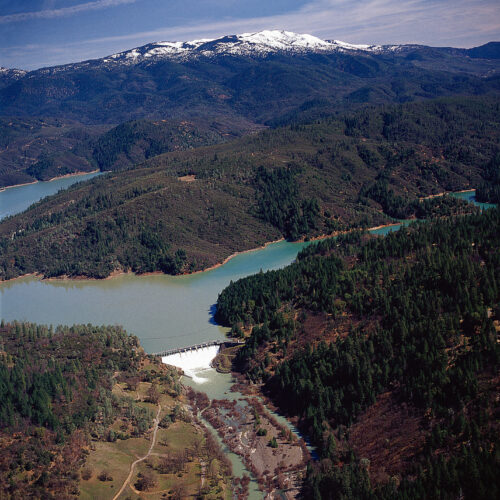
“Mendocino County water officials are reporting promising results from models predicting the amount of water that the proposed New Eel-Russian Diversion Facility would make available if and when the dams serving Potter Valley Project are removed. “Sonoma County Water Agency conducted some very in-depth modeling on how much water would have come through the project if the NERF, the pump that would pump water from the Eel River into the Russian River, were in the place,” Mari Rodin, the city of Ukiah’s representative on the Mendocino County Inland Water and Power Commission, told her fellow Ukiah City Council members at the board’s most recent meeting last month. “And the news was really stunning, in terms of the amount of water we would get, even in drought years,” Rodin continued, pointing out that “the key, though, is that we need to store the water. So we’re continuing to look at storing water in Potter Valley, but also, most importantly, raising Coyote Valley Dam,” which would allow more water to be stored in Lake Mendocino. … ” Read more from the Ukiah Daily Journal.
Mendocino’s tribes, farmers, environmentalists agree: Take down Eel River’s dams
“During the throes of the COVID-19 pandemic, PG&E was conducting a routine inspection of a hydroelectric dam on Northern Mendocino’s Eel River — when it discovered a problem. A key component in their power generation system needed a pricey fix — one that could cost the utility up to $15 million. The power company already knew that the Potter Valley Project, which included two dams on the Eel River, didn’t balance economically. It barely powered 750 homes and was expensive to operate. So when no buyers came forward to offload the 100-year-old hydroelectric system, PG&E submitted an application to the federal government to decommission the project — in other words, take down the dams for good. “ PG&E likes dams, right? I mean, we are a hydro generating company,” said Janet Walther, director of hydro licensing and compliance for the company. “However, there are times, as Potter Valley is one of those, where a dam may no longer make sense.” … ” Read more from KQED.
FERC will hold public scoping sessions in Eureka next month on the proposed decommissioning of PG&E’s dams on the Upper Eel River
“Humboldt County residents will have a pair of chances next month to weigh in on the future of the Potter Valley Project, with federal regulators holding public meetings at Eureka’s Wharfinger Building as part of their environmental review of PG&E’s plans to decommission the project. The Federal Energy Regulatory Commission (FERC) will hold an evening session Sept. 15 and a daytime session Sept. 16, giving members of the public a couple of chances to say their piece and have their comments entered into the formal record. PG&E’s plans to surrender and decommission the Potter Valley Project — a defunct hydroelectric system that diverts water from the Upper Eel River to the headwaters of the Russian River — have become something of a political football in recent months. U.S. Secretary of Agriculture Brooke Rollins seems determined to blow up the “Two-Basin Solution” developed under U.S. Congressman Jared Huffman. … ” Read more from the Lost Coast Outpost.
Arden Water Project wraps after 10 years, ending California’s last flat-rate zone
“Sacramento County has finished the largest construction project in the history of its water agency, wrapping up a $160 million overhaul of the Arden area’s water system after 10 years of work. The Arden Service Area Pipe and Meter Installation Project installed roughly 38 miles of new water distribution pipelines and more than 3,000 new water meters, closing out flat-rate billing in what county officials say was the last unmetered pocket of unincorporated Sacramento County left in the state. According to Sacramento County, the Arden neighborhood represented the final section of California still operating without water meters, a distinction that had persisted long after most communities converted decades earlier. … ” Read more from Hoodline.
Learning from the river: How science guides habitat enhancement on the Lower American River
“The Lower American River is constantly changing. Each year brings different flows, temperatures, and conditions that influence how Chinook salmon and steelhead use the river. As climate change creates more extreme swings between wet and dry years, developing a deeper understanding of the river has become increasingly important for protecting the ecosystem, supporting regional water supply reliability, and adapting to future conditions. For more than 20 years, the Water Forum and its partners have invested in science, monitoring, and habitat enhancement to understand how the river functions and how salmon and steelhead respond to changing conditions. Today, scientists map spawning areas, count redds, monitor juvenile fish, analyze genetics, study fish ear bones (otoliths), and more, all to track how habitat evolves over time and better understand the needs of the fish. … ” Read more from the Water Forum.
San Francisco’s $17.8 billion plan to save its waterfront hits new hurdles
“Raising the Ferry Building. Levees along Mission Creek. “Living” seawalls that integrate with marine life. San Francisco has a sprawling $17.8 billion plan to protect its waterfront against rising seas and earthquakes over the coming decades. But it will cost more and take longer than previously estimated, and it could be years before the megaproject gets federal approval. The U.S. Army Corps of Engineers and the Port of San Francisco in late July released a final study and recommended plan for adapting a 7.5-mile stretch of waterfront — from Fisherman’s Wharf to south of Islais Creek — to coastal flooding and sea level rise of up to roughly 9 feet by 2140. Without taking any action, sea level rise could cause roughly $23 billion in damage in San Francisco in about the next century, impacting 23,000 people and 3,400 jobs, according to the Port. The federal government may ultimately pay up to 65% of the project cost if approved, according to the Port. … ” Read more from the San Francisco Chronicle.
A new type of levee is taking root in Northern California
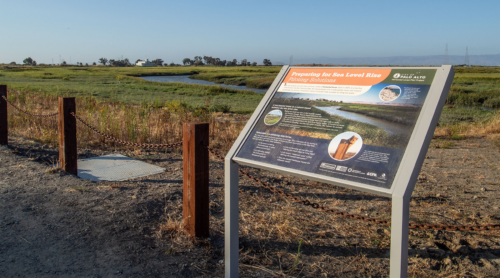
“Visitors to the Palo Alto Baylands Nature Preserve, captivated by gliding birds overhead and golden hills across the Bay waters, could be forgiven for failing to notice that the preserve is also home to the Bay’s newest levee. Most levees look like steep, barren embankments or riprap-clad seawalls, designed to prevent flooding by adding extra feet of height. But this project, though it shares a name, is a different type of infrastructure altogether. Seeded with over 35 species of native plants, the site is a pilot for what’s known as a horizontal levee, or living levee, blending into the estuary’s natural scenery as it spreads its feet of added height over a longer area. In stark contrast to a traditional levee, the Palo Alto Horizontal Levee Pilot Project’s natural appearance and gradual slope are designed to interact with Bay waters the same way natural estuaries do. “When you look at levees that are along the bay front, a lot of times they’ve got really steep faces and big, huge rocks in front of them to protect them from wind waves,” explained Mark Lindley, lead engineer on the Palo Alto living levee. “By having this flat, gradual slope with really dense vegetation on it instead of having rock, the waves break on that slope like they do on a beach.” … ” Read more from Grist.
Kings County groundwater agencies closer to coordination as last entity signs on for region-wide efforts
“The fifth of five groundwater agencies in Kings County officially committed to a region-wide planning effort that water managers hope will fend off the potential of state regulators mandating how much farmers can pump. Over the summer four of the five GSAs in the Tulare Lake subbasin, which covers most of Kings County, agreed to work on a single groundwater management plan and hired two engineering firms to get the job done. The Southwest Kings Groundwater Sustainability Agency (GSA) was the final GSA to agree. At its August 7 meeting, Southwest agreed to join the region-wide effort, rather than writing its own plan. The board agreed unanimously and without comment. … ” Read more from SJV Water.
Streaming Service: A model of the Los Angeles River scales down the waterway and scales up solutions for a reimagined riverbank.
“A few blocks from the bends in the Los Angeles River that snake past Taylor Yard, a former railyard being reimagined as a riparian park, Alexander Robinson, ASLA, prepares to unleash a 100-year flood across the urban river’s empty channels. Robinson, an associate professor and landscape architect at the University of Southern California (USC), derives this power not from divine intervention but from mimicry. He’s controlling a detailed, 1:120-scale, 60-foot-long hydraulic model of the river, set on plywood and construction jacks. Located in the Frogtown neighborhood that borders the river, it’s a project of the Los Angeles River Integrated Infrastructure Design Lab, led by Robinson, other USC faculty, and a cadre of collaborators. The expertly measured and sculpted simulation, complete with flora and mock power towers, can be altered to test new designs for the riverfront. The value of Robinson’s model, which has been in operation for two years, lies in its fidelity and functionality; despite our AI-obsessed era, mathematical models simply can’t fully simulate the water flow of a physical riverbed. … ” Read more from Landscape Architecture.
Could Super El Niño bring venomous sea snakes and hammerheads to California?
“As the Pacific Ocean continues to simmer, Southern California’s waters could get considerably stranger before this season’s Super El Niño runs its course. Oceanographers are anticipating a major reshuffling of marine life as exceptionally warm Pacific waters push northward, potentially bringing tropical and subtropical species into California waters where they are rarely seen. Among the more bizarre possibilities is the yellow-bellied sea snake, a highly venomous species that normally inhabits tropical waters throughout the Pacific and Indian oceans. “Some of these kinds of interesting oddities that are never a part of California will become part of this temporarily tropical El Niño-heated California,” said Douglas McCauley, director of the Benioff Ocean Initiative at UC Santa Barbara, in an interview with USA Today. … ” Read more from Surfer Magazine.
Tribes sue Interior department over controversial groundwater pumping project
“A plan to pump billions of gallons of groundwater from under the Mojave National National Monument is back in court – this time led by two tribes. The plan was blocked by a federal court in 2022 but last month the Bureau of Land Management approved a new right-of-way grant for Cadiz Inc. to begin converting a natural gas pipeline to transport the water from an aquifer system located within the monument. Now the Fort Mojave and Chemehuevi Indian Tribes have taken the plan back to the court. “This is the Mojave Desert, and we are the Mojave people, the caretakers of this land, water and wildlife since time immemorial. Our Tribe has a solemn, sacred relationship with these resources that Cadiz, Inc., … is targeting for exploitation and profit,” said Fort Mojave Chairman Timothy Williams in a statement. “Their plan to pump and sell 25 times more groundwater each year than the aquifer can replenish would desecrate our traditional territories and any community sold this water would be left with an unreliable, unsustainable supply. The federal government’s permitting of Cadiz is not only negligent, but dangerous to the American Desert Southwest.” … ” Read more from Indian Country Today.
‘Lithium Valley’ sounded like the next California gold rush. Why hasn’t it panned out?
“Corban Dillon found the dream job he trained for — only it’s two hours away from his home in El Centro, in the middle of the desert. He has to leave his daughter with his mother five days a week. That wasn’t his plan. Dillon was a part of the inaugural class of Imperial Valley College students training for jobs in what was projected to be a booming lithium industry drawing on vast reserves of the critical mineral deep below the Salton Sea. But the dream of “Lithium Valley” transforming this corner of California has yet to materialize. “If it’s not for Lithium Valley, I probably will never go back to the valley, which is sad because they’ll lose somebody like myself that could be an asset to any team in so many ways,” Dillon said. … ” Read more from iNewsSource.
What should become of the Lake Hodges Dam? As San Diego studies its options, local leaders worry about lake
“A growing coalition of civic groups is lobbying San Diego to accelerate efforts to rebuild Lake Hodges Dam and to raise the dam’s existing water level — but city officials are limited by state regulations and cost concerns. The lobbying effort comes as city officials finalize two complex studies: one analyzing whether a new dam should be built, another analyzing how to handle the existing 108-year-old dam until there’s a long-term answer. The civic groups say a new dam is crucial to keeping downstream communities like Rancho Santa Fe safe from flooding, securing a reliable local water supply, supporting existing wildlife and limiting risks to homes in the wildfire-prone area. The groups, which include the Rancho Bernardo Community Council and the Friends of Lake Hodges, also want the water level raised from 280 feet to 295 feet during the roughly 10 years it will take to build a new dam. … ” Read more from the San Diego Union-Tribune.
Colorado River negotiations continue as states await fed decision
“Nevada’s top Colorado River negotiator said lower-basin states are still pressing for adjustments and attempting to forge consensus-based alternatives before federally mandated water cuts are finalized. Last month, the Bureau of Reclamation released its long-awaited 10-year plan to manage worsening water shortages along the Colorado River, including deep cuts to Nevada’s allocation of the drought-stricken river. Arizona and Nevada criticized the framework for placing a disproportionate burden on the lower basin while sparing upper-basin states — Colorado, Utah, Wyoming, and New Mexico — from mandatory water cuts. John Entsminger, Southern Nevada Water Authority General Manager and Nevada’s lead negotiator on the Colorado River, provided limited details on the status of negotiations Wednesday during Nevada Democratic U.S. Rep. Susie Lee’s fourth annual Southern Nevada Water Summit. … ” Read more from the Nevada Current.

