
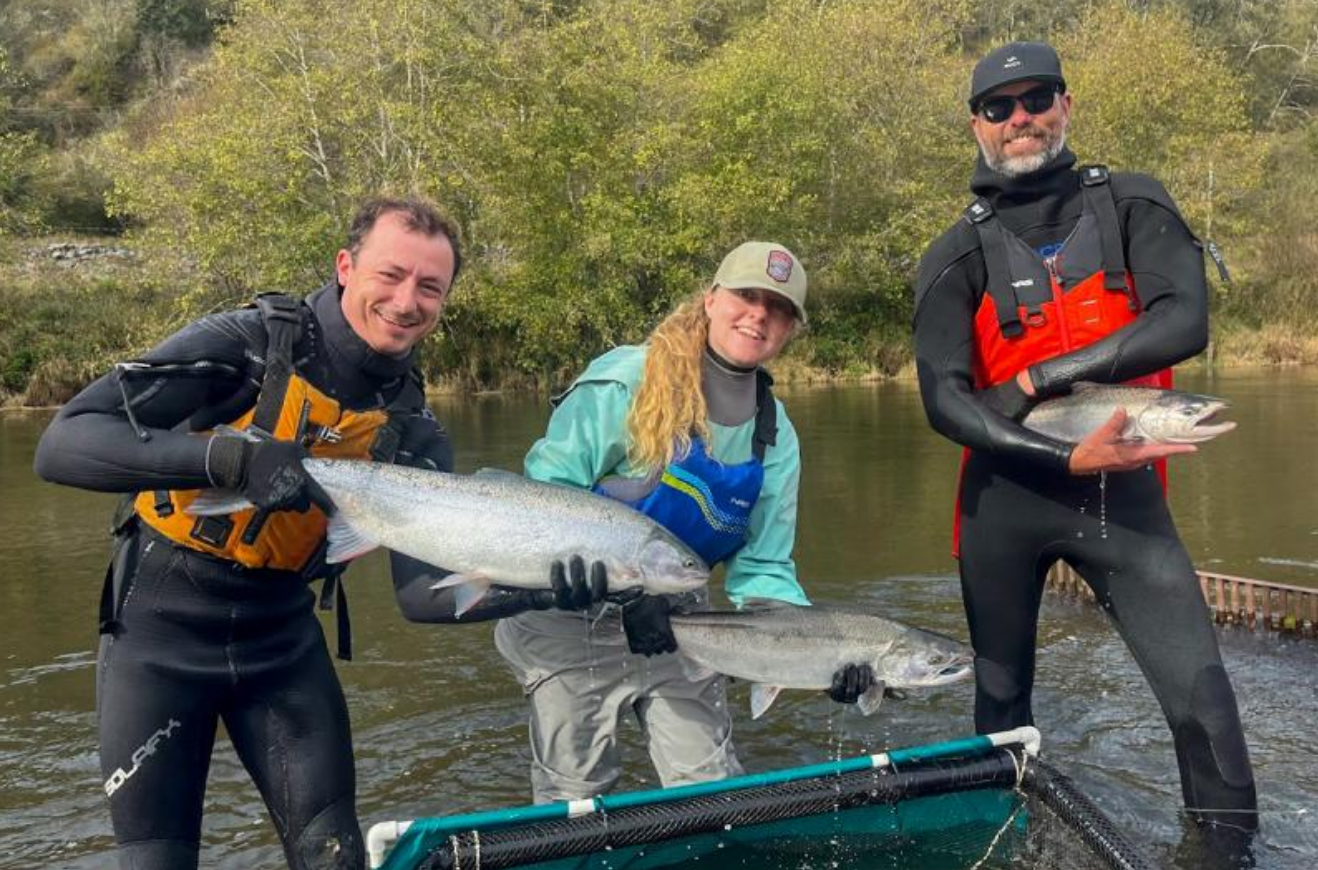
Researchers tracked salmon before, during, and after restoration to understand how restored channel and floodplain habitat influences growth, survival, and recovery of threatened coho salmon.
By NOAA Fisheries
This story is part 2 of a 2-part series. Read part 1.
When any habitat restoration project finishes, a critical question remains: Will the project help threatened fish and other species recover? Answering that question requires rigorous long-term monitoring.
At the Prairie Creek salmon habitat restoration project in Northern California, researchers from NOAA Fisheries’ Office of Habitat Conservation, Cal Poly Humboldt, and other partners have conducted monitoring before, during, and after construction to determine whether the project would improve the survival prospects of threatened Southern Oregon/Northern California Coast coho salmon.
The project transformed a former lumber mill site into wetlands, side channels, and off-channel ponds where juvenile salmon can rest, feed, and grow before migrating to the Pacific Ocean. Juvenile salmon that grow big and strong in freshwater have a better chance of surviving their time in the ocean and returning as adults to spawn.
Early findings suggest that juvenile coho salmon using the restored habitat are growing faster and experiencing higher ocean survival than prior generations from the same watershed. Preexisting monitoring data going back to 2011 gave the team an unusually long baseline against which to measure change. Their findings are also changing what scientists understand about how juvenile salmon use coastal watersheds.

Monitoring: Early Signs of Success
Researchers from Cal Poly Humboldt set up a salmon life-cycle monitoring station to determine how coho salmon and other species were responding to the project.
Each fall, team members wade into Prairie Creek, catch a sample of juvenile coho salmon, measure them to assess growth rates, and implant them with Passive Integrated Transponders, or PIT tags. These rice-grain-sized microchips last for the fish’s lifetime and are detected by antenna arrays placed at strategic locations throughout the watershed, automatically logging each fish’s location and timing. The team also counts redds, or salmon nests, during the winter spawning season and counts smolts, juvenile fish heading to the ocean, each spring.
It will take years of monitoring to fully understand the impact of the Prairie Creek project, but early results suggest that the restored habitats are benefiting fish.
“The winter of 2024, we had our second-highest redd estimate ever,” said Katherine Stonecypher, who leads the monitoring program. “That corresponds with spring 2023’s smolt abundance estimate, which was the highest ever—the first cohort to have had the opportunity to use the restoration site as juveniles. This past winter, we saw a robust return as well.”

Using PIT tag data, the team calculated that 2.6 percent of the 2023 juvenile coho cohort survived the ocean and returned to spawn as adults. Previous estimates had put marine survival at around 1 percent. This suggests the out-migrating juveniles were healthier and better able to survive ocean conditions.
Stonecypher warns that it’s hard to attribute the higher marine survival to a specific restoration project because they have only a few years of data, and ocean conditions can vary dramatically from year to year.
“Monitoring for just one 3-year life cycle is not enough to tell you what the population is doing,” said Stonecypher. “But if you show an increase over time, you can say: This is when we restored this section of lower Prairie Creek, and we’re showing that a sizable proportion of the population is using it.”
Research also found that juvenile fish using the restored off-channel habitat grow faster than fish staying in the main creek channel.

Better Habitat, Bigger Fish
“In certain sites and certain years, the fish using restoration sites grew up to twice as fast,” said Carter Adamson, a fish biologist with the Pacific States Marine Fisheries Commission who completed his master’s thesis on fish growth at the Prairie Creek restoration site. “Individuals that grow faster are more likely to survive to outmigration, more likely to survive at sea, and more likely to return to the stream to spawn as adults.”
Adamson noted that some restored areas provided variable growth rates from year to year, while others stayed consistent.

“This shows the importance of having multiple restoration sites,” said Adamson. “If, for whatever reason, one site isn’t providing the benefits we want in a given year, another site can make up for it.”
The team’s research also led to an unanticipated discovery. Some juvenile coho salmon leave their home streams and explore other watersheds on the coast before migrating to the ocean. Tagged juvenile coho salmon from Prairie Creek began showing up at monitoring stations on the Klamath River— 23 miles north by ocean—and as far as 50 miles south in Humboldt Bay.
NOAA Marine Habitat Resource Specialist Bob Pagliuco started the recent monitoring effort at Prairie Creek and is a co-author on the marine migration study. “You never read this stuff in your textbooks,” said Pagliuco. “Just understanding this new life-history strategy makes you want to protect all the tiny marine coastal tributaries. When you’re driving over the highway, and you see these little streams, you realize how important it is to make sure they are open for fish passage.”
Monitoring at Prairie Creek will continue through at least 2028.

