
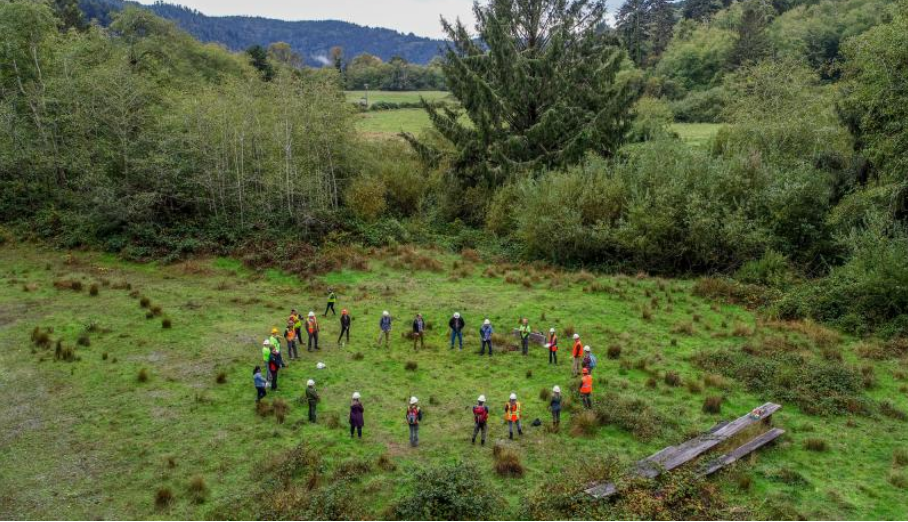
NOAA Fisheries and partners rebuilt floodplain habitat in the heart of redwood country, benefiting salmon, restoring tribal stewardship, and creating new opportunities for recreation and jobs.
By NOAA Fisheries
 For more than a decade, NOAA Fisheries and a broad coalition of partners worked to transform degraded fish habitat on California’s Prairie Creek into a thriving floodplain ecosystem for juvenile salmon and steelhead.
Located in California’s redwood country, Prairie Creek is part of the Redwood Creek watershed and one of the last refuges for three threatened species: Southern Oregon/Northern California Coast coho salmon, California Coastal Chinook, and Northern California steelhead. Coho salmon populations along the California coast have declined by an estimated 90 to 95 percent over the last century.
Nearly 98 percent of Prairie Creek flows through Redwood National and State Parks, but its unprotected lower portion bears the scars of a century of livestock grazing, highway construction, and industrial logging. A Yurok Tribe elder described the site, which is part of the Tribe’s ancestral land, as a “festering cut.”
In December 2014, NOAA Fisheries and partner staff gathered at the site just off Highway 101 in Orick, California. They found an expanse of asphalt behind a chain-link fence, the remnants of a 125-acre lumber mill that had operated for nearly 50 years before closing in 2009. Prairie Creek flowed in a deeply entrenched channel with 10- to 12-foot vertical banks. Virtually no salmon habitat remained at the site, and there was very little downstream on Redwood Creek, which is lined with flood-control levees all the way to the Pacific Ocean.

“Prairie Creek was the first best place and the last best place for fish using the Redwood Creek watershed,” said Mary Burke, North Coast Program Manager for California Trout, the project’s technical lead. “Here we had the opportunity to create rich wetland habitat, off-channel ponds, and places for juvenile fish to grow big before migrating to the ocean.”
Construction wrapped up in November 2025. Together, the project partners:
- Removed more than 20 acres of asphalt and concrete from the mill site
- Restored about a mile of Prairie Creek and 50 acres of floodplain and upland habitat
- Created a network of off-channel ponds and side channels for juvenile salmon rearing
- Planted more than 420,000 native plants to support long-term recovery
- Established long-term monitoring to evaluate how restoration influences fish survival and recovery
- Improved public access with new trails and visitor amenities
- Provided jobs and income to local businesses and Yurok Tribal members who led the construction effort
The project also set in motion something bigger than anyone had anticipated. The Prairie Creek site sits on the ancestral land of the Yurok Tribe, who call it ‘O Rew, or “where the trails come together.” On August 1, the land was transferred back to Yurok stewardship.
“It’s a holistic restoration,” said Barry McCovey, Director of the Yurok Tribe Fisheries Department. “It’s not just restoring the landscape—it’s also helping to restore the people.”

Helping a Species Recover
When they are young, salmon and steelhead need access to slower-moving parts of the streams, such as floodplains and wetlands, where they can safely feed, rest, and grow before migrating to the ocean. This is especially important for coho salmon, which spend up to 2 years in freshwater.
Both the lower Prairie and Redwood creeks were disconnected from their floodplains. Water velocity increased in their narrow, constrained stream channels, especially during heavy winter storms. The fast flows left juvenile fish that ventured into the lower Creek starved and exhausted.
NOAA Marine Habitat Resource Specialist Bob Pagliuco explained: “Imagine you’re at your desk right now and you’re on a treadmill. You’re just going and going and going. And then your office mate over there is sitting in a chair all day and eating. Who’s going to be bigger at the end of a month? And the bigger you are when you enter the ocean, the higher your success rate.”

Despite the damaged lower reach, Prairie Creek supports about 80 percent of all coho salmon spawning in the Redwood Creek watershed, making it vital to the recovery of Southern Oregon/Northern California Coast coho salmon.
NOAA Fisheries Biologist Justin Ly explained that these coho salmon—a genetically distinct segment of coho salmon extending from Punta Gorda, California, to Cape Blanco, Oregon—are in serious trouble.
“Some populations are doing better than others, but overall, most of them are at high risk of extinction,” said Ly. “With Prairie Creek undergoing restoration, we’re hoping to see improvements in the years moving forward.”

Designing Salmon-Friendly Habitat
Principal Engineer Jeff Anderson designed a network of side channels, backwater ponds, and wetlands to reconnect a realigned and restored Prairie Creek channel with its floodplain and recreate the diverse habitats that once existed naturally. Because the project stretched over 5 years, Anderson adapted the design as he saw the ecosystem respond to new habitat features.
As it turns out, designing an ideal nursery for salmon is somewhat of an art form—especially when you let the fish have a say. Researchers at Prairie Creek have been conducting rigorous fish monitoring at the project site and other locations in the watershed, collecting data from before, during, and after construction. Their findings on salmon numbers and behavior helped tell the design team what benefited fish the most
“What I was learning about these fish, I’d bring back to the design team,” said Pagliuco, who initiated the monitoring program. “Every year, we could tweak the designs based on what we learned through the monitoring efforts.”

In one instance, Anderson made design changes based on coho salmon behavior that altered the design surface and reran the project hydraulic model to demonstrate improved habitat conditions.
“Bob and the monitoring team found that juvenile coho really like low-velocity habitat areas,” said Anderson. “That’s why we have these little ponds and backwater features all over. The design originally had some split flow around an island, but we removed it to accommodate more backwater channel habitat. We had to go back and make sure the changes didn’t raise water levels and cause flooding. But it was all doable, and I think it made a better project in the end.”
The restored habitat is already showing early signs of success. A long-term monitoring program run by researchers at Cal Poly Humboldt has documented record coho salmon returns, faster fish growth in restored ponds, and even an unexpected discovery about juvenile salmon behavior that is reshaping how scientists think about habitat management on the Pacific Coast.
Engineering a Fish-Friendly Ecosystem with Plants
The project also restored native vegetation that supports healthy salmon habitat. The team planted more than 420,000 native trees, shrubs, and other plants throughout the site, carefully selecting species that would reduce erosion, shade waterways, and support aquatic food webs.
Riparian Ecologist John Bair planted what he called “little green furries” along the stream channel to jump-start the food chain for juvenile fish. Plants like sedges and bulrushes grow algae on their stems, which feed the insects and macroinvertebrates that juvenile fish like to eat.

“We’re basically feeding the fish that we’re inviting into this habitat,” said Bair. “Without a revegetation effort, the food production engine would be much slower during the winter months when juvenile fish need to gain weight to increase their survival for spring migration.”
Another design strategy included planting slough sedge by the restored habitat to stymie the growth of invasive reed canary grass, whose dense growth can prevent juvenile salmon from moving through the floodplain. “Slough sedge is kind of my plant warrior,” said Bair. “It fills the spaces up very quickly but grows in clumps so fish can get through it.”
While some plantings will benefit salmon right away, others will take time. Bair carefully chose locations to plant different tree species so that as the forest matures, it creates a patchwork of shade and open canopy. Shade will keep the stream cool in the summer, and the open canopy will let sunshine warm parts of the creek in the winter, supporting the growth of plants at the base of the food web.
“In 25 years, I really hope this site looks nothing like what it does today,” said Bair. “I hope the project has changed, that the stream has moved, and that the vegetation has adjusted and evolved along with it.”

A Return to ‘O Rew and Creating Opportunities for People
For the Yurok Tribe, the restoration was never just about fish. An all-Yurok construction crew built every phase of the project over 5 years, working on land their ancestors had stewarded since time immemorial.
“Doing the work was kind of a catharsis,” said McCovey. “The people out there on the landscape doing the work, getting their hands dirty, took it very seriously. They weren’t just out there for the money. They did it because they want to restore these landscapes for themselves and for future generations.”
Soon, ‘O Rew will be transferred back to the Yurok Tribe for permanent stewardship.
Save the Redwoods League purchased the Prairie Creek project site in 2013 and originally planned to hand the land over to the National Park Service. However, as the project evolved and the league built a relationship with the Tribe, a different idea emerged.
“Our growing partnership with the Yurok Tribe allowed us to have new conversations,” said Jessica Carter, director of parks and public engagement for Save the Redwoods League. “Reckoning with the past, gaining clarity around the Tribe’s interests, it became very clear what needed to happen.”

“For the land to heal, the people have to heal, and for the people to heal, the land has to heal,” said Rosie Clayburn, the historic preservation officer for the Yurok Tribe. “Nobody is better at taking care of this land than the Yurok people.”
The project also delivered economic benefits to the local community. The 2009 closure of the Orick lumber mill ended long-term employment for many residents. Over five construction seasons, the Prairie Creek project generated an estimated $33 million in local economic activity, creating jobs and sustaining the Yurok Construction Crew.
“The Yurok people, having these construction jobs, this work for 5 plus years, has changed their lives and made it possible for some of them to own homes,” said Su Corbaley, the retired former project manager for the California State Coastal Conservancy. “The hope is that this project, now that it’s completed, will bring more economy and help the community flourish.”
The Yurok Fisheries Department will continue monitoring the project and managing restoration actions for 3 years thanks to a Coastal Conservancy grant.

The transformed project site opened to the public August 1. The new ‘O Rew Redwoods Gateway will serve as the primary southern access point to the Redwood National and State Parks, which see more than a million visitors a year.
There will be:
- More than a mile of trails, including connections to the 1,200-mile California Coastal Trail and the Lady Bird Johnson Redwood Grove
- Interpretive exhibits built around Yurok culture, language, and storytelling
- Regular cultural programming and events
- Parking, restrooms, and picnic areas
A traditional Yurok village with plank houses, a sweat house, and a cultural center is also in the works.
“We really want people to understand Yurok history and culture and the continuation through time that we have,” said Clayburn. “We’re still contemporary people who are here living and working and bringing balance to the world.”

Collaboration Made This Project Happen
This project would not have been possible without the collaboration of numerous government agencies, nonprofits, design firms, tribal organizations, Cal Poly Humboldt University, and community groups. NOAA provided more than $8 million in funding over 12 years, giving the project credibility that helped unlock an additional $25 million from state, federal, and private sources.
Partners interviewed for this story repeatedly credited genuine trust between organizations as the key to managing unexpected challenges while building something that benefited both fish and people.
“I’ve been doing this for almost 30 years, and this was one of the smoother projects, start to finish, I’ve ever been involved with,” said Anderson. “Even with all the ups and downs, everybody just hung together.”
Several described the project as a career highlight.
“This project changed my life,” said Su Corbaley. “It changed the way I looked at my work. It humbled me to put my opinions and thoughts and nearly 40 years of experience aside and let two things happen—let the land speak to us and listen to the Yurok people about what they knew needed to be done.”

