

Several news sources featured in the Daily Digest may limit the number of articles you can access without a subscription. However, gift articles and open-access links are provided when available. For more open access California water news articles, explore the main page at MavensNotebook.com.
In California water news today …
Powerful El Niño puts California in the bull’s-eye for soaking winter, models show
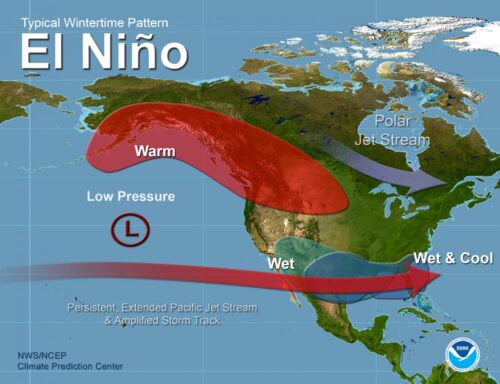 “One of the world’s top climate models puts a bull’s-eye on the California coast as El Niño strengthens, with a greater than 90% chance of above-normal precipitation from December through February. There’s at least a 70% chance of well-above-normal precipitation. That outlook is from the European Center for Medium-Range Forecasts, which on Wednesday released its first full supercomputer forecast that includes 51 model simulations of winter. The California coast could receive 40% to 70% more precipitation than normal from December through February, according to the model. That would put San Francisco at more than 20 inches of rain in that time, which historically happens about once every five years. … ” Read more from the San Francisco Chronicle.
SEE ALSO: Experts warn strong El Niño could bring record sea levels to California coast with flooding concerns, from ABC 7
San Joaquin Valley Watershed Studies: Modeling the future of groundwater recharge
“Following the methodology developed for the Merced Watershed Reconnaissance Study, the California Department of Water Resources (DWR) has expanded its efforts to model the potential benefits of groundwater recharge in the San Joaquin Basin. The resulting San Joaquin Basin Flood-MAR Watershed Studies—spanning the Calaveras, Stanislaus, Tuolumne, Merced, and Upper San Joaquin watersheds—mark a major step forward in regional water planning. These studies evaluate how managed aquifer recharge using floodwaters (Flood-MAR) can mitigate the interconnected threats of groundwater depletion, flood risks, climate change, and habitat loss. The studies evaluated and compared two distinct management strategies for capturing high-flow storm waters: MAR 90/20 and I-FIRM. … ” Continue reading at Sustainable Conservation.
5 trends shaping agricultural water use in California
“California is one of the world’s most productive agricultural regions, supplying U.S. and international markets with more than 350 different farm products. Water plays a critical role in California agriculture. Agriculture typically uses about 80% of California’s developed water supply. Understanding how agricultural water use has changed over time can help inform policy and strengthen agricultural resilience in the face of a changing climate. Pacific Institute’s issue brief, “Water for Food and Farms: Trends in California, 1960–2022,” examines water use in California agriculture, changes over time and across crops, and the state’s agricultural economics using statewide data and publicly available information. The analysis highlights five key trends … ” Read more from the Pacific Institute.
Advancing water equity in California requires continued commitment
“Water equity in California is grounded in the principle that all people have the right to safe, clean, affordable, and accessible water for human consumption, cooking and sanitary purposes regardless of income, race, geography, or other factors. The human right to water extends to all Californians, including disadvantaged individuals and groups and communities in rural and urban areas. In fact, California was the first state in the nation to legislatively recognize a “human right to water” when in 2012 it passed Assembly Bill (AB) 685. This was followed in 2016 by a State Board Resolution pledging that it would work to “preserve, enhance, and restore the quality of California’s water resources and drinking water for the protection of the environment, public health, and all beneficial uses.” To understand the significance of California’s water equity policy, imagine turning on your tap and NO water comes out – or worse, it is brown and stinks – but you still have to pay your monthly water bill even if your water is undrinkable, unusable, and unsafe. … ” Continue reading from the League of Women Voters.
State o’fish: Rebuilding California’s still-struggling salmon fishery and another ‘unpredictable’ year for dungeness crab
“Obstacles facing California’s Dungeness crab and salmon fisheries were the focus of Tuesday’s annual fisheries meeting in Sacramento. The Zeke Grader Fisheries Forum, named after the renowned sustainability advocate and longtime leader of the Pacific Coast Federation of Fishermen’s Association, gives industry experts, tribal leaders and scientists an opportunity to discuss issues facing California’s commercial fisheries with state lawmakers and explore potential legislative action. Over the last decade, elevated levels of the neurotoxin domoic acid, mandatory gear reductions, whale entanglements and price negotiations with seafood suppliers have led to unprecedented delays for commercial crabbers. Similarly, historic drought and poor habitat conditions have devastated California’s salmon population in recent years, forcing the closure of the commercial fishery from 2023 to 2025. … ” Read more from the Lost Coast Outpost.
In commentary today …
Debunking the allegedly prohibitive cost of desalination
Edward Ring, Director of Water and Energy Policy at the California Policy Center, writes, “Earlier this summer a guest op-ed appeared in the Orange County Register, “Learning the right lesson from San Diego’s desal water surplus.” But the “lesson” presented was only partly accurate. What the authors, both affiliated with the Property and Environment Research Center (PERC), got right was the need to change regulations that restrict the ability for farmers to sell their water allocations to cities. This is consistent with PERC’s mission, which is to promote “free market environmentalism,” property rights, and market based solutions to environmental challenges. But when it comes to the economics of desalination, these critics of the technology were way off. It does not cost too much to make economic sense. The high costs are the result of policy choices. The “lesson” we should be taking from desalination projects and proposals so far in California is that current policies have grossly inflated the cost of desalinated seawater here for two reasons: the construction cost is inflated thanks to California’s regulatory and legal environment, and the operating cost is inflated because California has the highest electricity rates in the nation. … ” Continue reading from Edward Ring.
Data centers are inevitable. California must regulate them.
“Recently, while working on a writing project, my computer froze. My immediate response was panic. Then I realized that I had moved most of my apps to the cloud. Almost everything was available to me on any of my devices. I’m not alone. Cloud computing is the default for most users, business and personal. The cloud is actually a collection of data centers. These are the humongous facilities using huge amounts of land, electricity and water, that contain data storage units that host all the commercial and public cloud-based digital content. These are not new, but the need to host all of the artificial intelligence content has created an urgent surge in new, large data center construction. … ” Read more from the San Diego Union-Tribune.
In regional water news and commentary today …
NORTH COAST
Super El Niño could bring ‘highest sea levels ever recorded on the California coast’
“On Tuesday evening, State Senator and Congressional candidate Mike McGuire hosted a Super El Niño Town Hall. The online gathering boasted more than 5,700 attendees and featured scientists and emergency response specialists from throughout the state. McGuire said that the meeting was intended to “separate hype from reality, … fact from fiction and give you the straight scoop … about what you can expect this fall and winter and how challenging conditions may be.” “Let’s get into it and exactly why climate scientists are raising the alarm bell around this weather event,” McGuire said during introductory remarks. “It’s because the Super El Niño has a real potential for larger and more destructive winter storms, significant flooding events, ocean-based heat waves, which we’re already starting to see off the Pacific, and enhanced summertime monsoonal moisture. That moisture that’s coming up from the Pacific … could bring lightning to fire-prone regions across the state and right here in Northern California.” … ” Read more from the Eureka Times-Standard.
SEE ALSO:
- El Niño Town Hall Warns of ‘An Event We haven’t Seen Before In Living Memory’, from the Redheaded Blackbelt
- McGuire town hall explores fallout of approaching ‘Super El Niño’, from the Santa Rosa Press Democrat
The Klamath Dams are down: A closer look at juvenile salmon migration
“It has been almost two years since the largest dam removal project in U.S. history took place at the border of Oregon and California. The Klamath dam removal, beginning in 2022 and ending in 2024, removed four hydroelectric dams from the Klamath River: J.C. Boyle Dam, Copco No. 1 Dam, Copco No. 2 Dam, and the Iron Gate Dam. While the dam removal is complete, work to restore the 2,200 acres of formerly submerged lands continues. As the reservoirs drained, native seed mix was applied to the reservoir footprints to stabilize sediments and improve soil composition. Additionally, these dams, built between 1918 and 1962, blocked salmon migration and altered water quality for over a century. Now, with the dams out, USGS Western Fisheries Research Center (WFRC) scientists are monitoring and analyzing the effects of dam removal on migration rates and survival of juvenile salmon in the Klamath River. These fish have been granted access to more than 400 stream miles, including cold-water tributary creeks and streams in the upper Klamath Basin important to Chinook salmon, coho salmon, and steelhead. … ” Read more from the USGS.
Restoring California’s Prairie Creek supports salmon recovery and local community
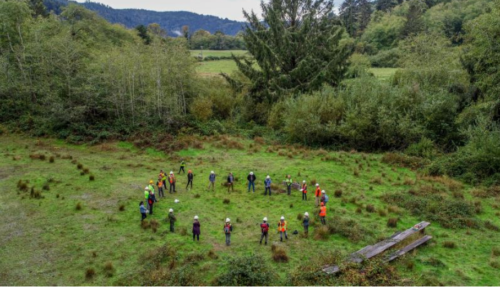
“For more than a decade, NOAA Fisheries and a broad coalition of partners worked to transform degraded fish habitat on California’s Prairie Creek into a thriving floodplain ecosystem for juvenile salmon and steelhead. Located in California’s redwood country, Prairie Creek is part of the Redwood Creek watershed and one of the last refuges for three threatened species: Southern Oregon/Northern California Coast coho salmon, California Coastal Chinook, and Northern California steelhead. Coho salmon populations along the California coast have declined by an estimated 90 to 95 percent over the last century. Nearly 98 percent of Prairie Creek flows through Redwood National and State Parks, but its unprotected lower portion bears the scars of a century of livestock grazing, highway construction, and industrial logging. A Yurok Tribe elder described the site, which is part of the Tribe’s ancestral land, as a “festering cut.” In December 2014, NOAA Fisheries and partner staff gathered at the site just off Highway 101 in Orick, California. They found an expanse of asphalt behind a chain-link fence, the remnants of a 125-acre lumber mill that had operated for nearly 50 years before closing in 2009. Prairie Creek flowed in a deeply entrenched channel with 10- to 12-foot vertical banks. Virtually no salmon habitat remained at the site, and there was very little downstream on Redwood Creek, which is lined with flood-control levees all the way to the Pacific Ocean. … ” Read more from NOAA Fisheries.
Cannabis farming is changing streams in California, experts warn
“New research suggests groundwater pumping for cannabis irrigation in Northern California’s Emerald Triangle could reduce streamflow in some headwater creeks, particularly during dry years, potentially affecting salmon habitat and downstream water supplies. The study, conducted by researchers from Simon Fraser University, the University of California, Berkeley, and the U.S. Department of Agriculture, modeled hundreds of irrigation scenarios to examine how groundwater withdrawals interact with mountain watersheds. While the findings are based on simulations rather than direct measurements, the researchers say they point to possible impacts even when cannabis cultivation makes up a relatively small portion of a watershed. … ” Read more from Ag Daily.
Northern California anglers can win cash for catching an invasive fish in the Eel River
“Northern California anglers have a summertime incentive to head to the Eel River: the Eel River Pikeminnow Fishing Derby is back for its third year, and catching one of the watershed’s most harmful invasive fish can earn prize money. The Eel River Pikeminnow Fishing Derby uses cash rewards to encourage the removal of a species that threatens native fish. From July 1 through August 31, the Eel River Pikeminnow Fishing Derby will award $5,000 in cash and prizes to anglers who catch Sacramento pikeminnow in the Eel River watershed, Active NorCal reported. Participants can win up to $800, and anyone with a valid California fishing license may join at no cost. Children younger than 16 are exempt from the license requirement. … ” Read more from The Cool Down.
SIERRA NEVADA
The DWR, SNC, and Blue Forest host Upper Feather River watershed tour for state contractors
“On July 7 and 8, the Sierra Nevada Conservancy (SNC), the California Department of Water Resources (DWR), and Blue Forest, held an Upper Feather River Tour for State Water Project contractors. The tour highlighted the importance of protecting and enhancing forest health and mountain meadows within the Feather River headwaters and showcased important work the State Water Project is doing to improve water quality, water supply, flow timing, public safety, and ecosystem health. The health of California’s water supply is tied to the health of the headwaters, and the State Water Project depends on the short- and long-term resilience of the Upper Feather River in the Sierra Nevada. The State Water Project supplies water to 27 million Californians and 750,000 acres of farmland. Managed by DWR, the project moves water from the Sacramento-San Joaquin Delta down through the Central Valley, the San Francisco Bay Area, the Central Coast, and into Southern California. … ” Read more from the Sierra Nevada Conservancy.
Proposed Nevada Irrigation District deferred rate increase results in $8.6 million in lost revenue – hydro to subsidize water rates
“During a special meeting tomorrow NID directors are slated to vote on a reduced rate increase for treated and raw water customers. Staff recommends a nine percent increase, which is three and a half percent below the Prop. 218 maximum annual increase. The hydro division will subsidize the 2027 rates with a $1,277,966 transfer. Over the 2027-2031 period, the district will have to backfill a $8,640,055 loss in revenue. After multiple public workshops, and a Prop. 218 vote that failed to garner enough protest votes, directors decided to to forego any rate increases for 2026. Under Prop. 218, a majority plus one (12,537) protest votes would have been needed to stop any increase. NID received 3,105 protest votes. … ” Read more from YubaNet.
Someone is poisoning trees near Lake Tahoe
“Along the Nevada shores of Lake Tahoe, Burnt Cedar Beach is known for its lakeside outdoor pool, picnic areas beneath alpine forests and its protected swimming cove of crystal blue waters. And now, for its mysteriously poisoned trees. Starting in 2022, someone has repeatedly harmed trees at the beach by pouring a strong-smelling substance around their bases or placing it into holes drilled near their roots, according to the Washoe County Sheriff’s Office. Sixteen poisoned trees have been discovered this year, following 12 in previous years, according to law enforcement officials. All but one of the trees that were previously poisoned died within months and had to be chopped down. … ” Read more from the New York Times.
SACRAMENTO VALLEY
Tehama County to revisit groundwater fees at Red Bluff meeting
“The Tehama County Flood Control and Water Conservation District will discuss new groundwater fees during a special meeting on Wednesday morning. Last month, the board voted 4 to 1 to postpone moving forward with the fees until they looked into some of the concerns brought up during the public hearing. The board will discuss the fees and modifications before once again considering the ordinances. … ” Read more from Action News Now.
DWR wraps up repaving project around Afterbay
“Where there once was gravel, a freshly paved trail now wraps around the crest of the Thermalito Afterbay, allowing for easier recreational access. The California Department of Water Resources launched a series of maintenance projects in August 2025 in an effort to upgrade the various trailways in and around Oroville including the one that runs along the edge of the Afterbay, which was completed in July. Other sections on the docket included portions of the Brad Freeman Trail, the Feather River Fish Hatchery, access roads around the Thermalito Powerplant, the Thermalito Power Canal access road, Canyon Drive and more. DWR spokesperson Raquel Borrayo said the project in total came out to roughly $6 million, of which the Afterbay Dam Crest Road project cost about $1.9 million. … ” Read more from the Chico Enterprise-Record.
Butte County residents voice concerns over data centers
“The threat of a large scale data center being built without public oversight in unincorporated Butte County was quelled Wednesday after an informational meeting with the Butte County Water Commission. At least 130 people filled the Butte County Board of Supervisors Chambers — up to standing room continuing outside the door — to voice concerns about data centers possibly building in Butte County and consuming natural resources. The discussion item was requested by commissioners to preemptively understand what would happen if a data center planned to build here. Commission Chair Matthew Tennis began the meeting stating that, so far, there is no indication or knowledge of any data center currently being proposed in the unincorporated area of the county. … ” Read more from the Chico Enterprise-Record.
New Dry Creek Conservancy mural in Roseville celebrates returning Chinook salmon
“A new community mural at Royer Park is drawing attention to one of Roseville’s most remarkable natural events: the annual return of Chinook salmon to Dry Creek. More than 100 volunteers spent 20 days transforming a blank retaining wall beneath the Downtown Bridge into a colorful mural depicting the salmon’s 125-mile journey from the Pacific Ocean back to the streams where they were born, according to the Dry Creek Conservancy. The mural follows the Chinook salmon’s entire life cycle, showing the fish traveling downstream beneath the Golden Gate Bridge, into the Pacific Ocean, and eventually returning to the Dry Creek watershed to spawn. Along the way, the artwork features familiar local landmarks, including Roseville’s iconic Cosmos sculpture, connecting the salmon’s story to the community where they have lived for centuries. … ” Read more from the Sacramento Bee.
NAPA/SONOMA
Court rules Sonoma County must study water wells impact on fish, Russian River
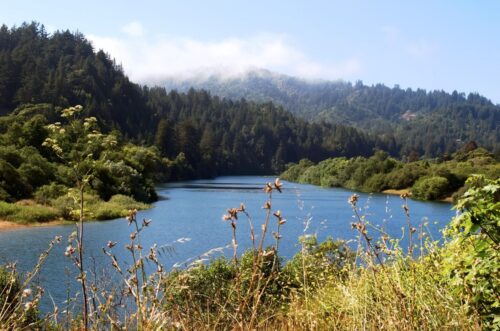 “In a challenge by environmental groups to the pumping of groundwater from rivers to fill wells for farmers, homes and businesses in Sonoma County, a state appeals court says counties must consider the impact of their water wells on fish and the environment. Tuesday’s ruling by the 1st District Court of Appeal in San Francisco said Sonoma County had not properly considered the effects of new rules it issued in 2023 for increased pumping from the Russian River and other waterways, but might be able to meet legal standards with an environmental review. On the central legal issue in the case, however, the court rejected the county’s argument that such reviews of water wells are required only for the state, and not for local governments. “Sonoma’s regulation of well permits ‘carries with it an ‘affirmative duty to take the public trust into account,’” Justice Tara Desautels wrote in the 3-0 ruling, quoting language from another appellate decision. … ” Read more from the San Francisco Chronicle.
Sonoma County wins appeal to keep well-permitting ordinance amendments
“The county of Sonoma did not violate the public trust doctrine when it amended an ordinance related to groundwater well permits, a California Court of Appeal said Tuesday, reversing a lower court’s ruling. In Sonoma, part of the Russian River is considered a navigable waterway, protected by the public trust doctrine — a legal principle that holds the government responsible for protecting certain natural resources available for public use. After a 2018 decision in the Third District Court of Appeal, it was determined that counties, as subdivisions of the state, must share the state’s “responsibility for administering the public trust.” A three-judge panel in the First Appellate District determined that, while Sonoma didn’t violate the public trust doctrine by amending the well ordinance, it also upheld the lower court’s ruling that substantial evidence did not support Sonoma’s claimed exemptions from a California Environmental Quality Act review. “We are continuing to analyze the decision, but Sonoma County appreciates the Court of Appeal’s confirmation that the county’s extensive process in developing the well ordinance complied with all requirements of the public trust doctrine.” Genevieve Bertone, a Sonoma County program manager, said in an email to Courthouse News. … ” Read more from the Courthouse News Service.
Appellate court confirms groundwater pumping ruling, orders Sonoma County to conduct environmental review of its well ordinance
“Yesterday, the California Court of Appeal issued a decision in Russian Riverkeeper and California Coastkeeper Alliance’s long-running lawsuit over Sonoma County’s groundwater well ordinance, delivering two significant wins for California’s rivers and the communities that depend on them. First, the Court squarely rejected the County’s attempt to escape the Public Trust Doctrine altogether, reaffirming that counties across California share the state’s responsibility to protect rivers, streams, and the fish and wildlife that depend on them when permitting groundwater wells. Second, the Court affirmed that Sonoma County violated the California Environmental Quality Act (CEQA) by adopting its Well Ordinance without required environmental review and upheld the lower court’s order rescinding the County’s claimed CEQA exemptions. On appeal, Sonoma County asked the Court to “decline to follow” Environmental Law Foundation v. State Water Resources Control Board, the landmark 2018 decision holding that counties have a fiduciary duty to consider impacts to public trust resources—like salmon and steelhead—when issuing well permits. Had the County succeeded, counties statewide could have washed their hands of any responsibility for the harm groundwater pumping causes to interconnected rivers and streams. The Court of Appeal refused, holding that counties share responsibility for administering the public trust when authorizing groundwater pumping that impacts public trust resources. … ” Read more from the California Coastkeeper Alliance.
This California creek was reshaped for flood control decades ago. Today, a $5.8 million project is bringing back wildlife and natural habitat
“Lower Colgan Creek in Santa Rosa used to bear little resemblance to a natural waterway. Now, after a restoration effort by the city that spanned over two decades, the creek has been transformed from a flood channel into a natural creek. The California Department of Water Resources invested more than $5.8 million across three phases of the Lower Colgan Creek Restoration Project through its Urban Streams Restoration Program. The project aimed to restore the creek’s ecosystem and reduce flood risk, giving surrounding communities better access to the waterway. … ” Read more from edhat.
Walt Ranch renamed Osos Ridge Preserve after yearslong land controversy
“The Land Trust of Napa has renamed the 2,300-acre Walt Ranch to the Osos Ridge Preserve, the agency announced Monday. The wildlife corridor filled with biodiversity, rare species and unique microclimates was acquired three years ago and is slated to open to the public in spring 2027, according to the Land Trust of Napa. This news release comes after years of legal and political wrangling, controversy involving a county supervisor and extensive efforts to secure the funding to purchase the land. “After a decade of contention over this land’s future, I’m glad the outcome is publicly accessible open space, which is exactly what our district exists to help deliver,” said Chris Cahill, the Napa County Regional Park and Open Space District general manager, in a statement. … ” Read more from NorCal Public Media.
BAY AREA
A ‘super’ El Niño is here. What does it mean for the Bay Area?
“El Niño is here, already bringing a storm surge of superlatives: Super. Strongest ever. Gob-smacking. Godzilla. The potential images are dire: storms, big rains, floods, warm winter, stranded seabirds. Yet Godzilla (Gojira, for purists) has been invoked before. Eleven years ago, that’s exactly what people were predicting for the 2015–2016 El Niño. And that year, the Bay Area actually experienced a drier winter than average. So maybe this will be no big deal? Sorry, no. It is a big deal, according to climate scientists. “This is really going to profoundly affect California for the next six to 12 months,” says Daniel Swain, a climate scientist who writes the Weather West blog and has been on a tireless climate-communications spree warning people about El Niño. Swain’s doing it because he’s worried. “There’s a lot of misleading stuff out there floating around right now,” he says. … ” Read more from Bay Nature.
SEE ALSO: Climate experts predict high flood risk in Bay Area for super El Niño, from Local News Matters
Editorial: Marin Municipal Water District focus needs to be on dam repairs
The Marin Independent Journal writes, “A warning order from the state that Nicasio Reservoir’s Seeger Dam is in need of repair is not welcome news for the Marin Municipal Water District. The district already faces a lengthy “to do” list, including projects designed to build greater resiliency in the face of droughts. The state Division of Safety of Dams has ordered MMWD to come up with a repair plan for the earthen dam that secures the district’s largest and most important reservoir. The district faces a Dec. 1 deadline to submit a plan after the Seeger Dam was downgraded by the state from a “fair” rating to “satisfactory” because it falls short of modern standards. An earthquake or “extreme hydrological” event could compromise the 65-year-old, 115-foot-tall dam, according to the district’s interpretation of the state’s order. No estimated costs for a repair are being kicked around, but it’s not likely to be cheap. … ” Continue reading at the Marin Independent Journal.
CENTRAL COAST
Housing project near Carpinteria salt marsh moves forward
“A Santa Barbara County judge ruled in favor of developers last week, allowing a large single-family home to move a step closer to construction near the environmentally sensitive Carpinteria Salt Marsh. After the California Coastal Commission greenlit the project in May of last year, advocacy group Friends of the Carpinteria Salt Marsh retained attorneys to fight the approval in court. Their concerns largely focused on its location at 501 Sandspit Road: a vulnerable spot surrounded by ocean, marsh, and estuary with sensitive animal and plant resources. The proposal encompasses a nine-acre parcel of land that has been vacant since the 1950s and extends into the ocean. It proposes a 4,843-square-foot house with 3,550 square feet of raised single-story space (on stilts) and a 771-square-foot screened-in carport. … ” Read more from the Santa Barbara Independent.
SAN JOAQUIN VALLEY
How Bakersfield turns river water and groundwater into safe drinking water for residents
“Bakersfield residents rely on two main sources for their water: groundwater and the Kern River. Before either reaches a tap, it goes through an extensive treatment process designed to meet safety standards year-round. Communities like Arvin have previously dealt with contaminated groundwater. Raul Barraza, the Arvin Community Service District general manager, said new wells have made a significant difference. “Being able to drink out of the tap that provide clean drinking water to the community is you know God sent,” Barraza said. At the Northwest Bakersfield Water Treatment Plant, Kern River water is processed before it reaches residents. Donald Fowler, a manager at the plant, said the treatment begins with pre-treatment barriers that remove iron and manganese, followed by filters that clear out organisms and particles. … ” Read more from Channel 23.
Kern County groups host forum on growing threat of invasive golden mussels
“Golden mussels and the threat they pose to Kern County’s water systems drew farmers, water districts and other community stakeholders to a forum Wednesday aimed at coordinating a response and pushing for broader state action. The Kern County Farm Bureau and the Water Association of Kern County co-hosted the Golden Mussels Forum, which featured a panel of five experts discussing the growing threat of the invasive species. Rachel Nettleton, executive director of the Kern County Farm Bureau, said the event brought together people working on multiple fronts, including treatment and government response. … ” Read more from Bakersfield Now.
Kern’s golden mussel fight expected to cost $36 million annually
“No silver bullets to eradicate golden mussels were revealed at a symposium on the invasive species held Wednesday by the Water Association of Kern County and Kern County Farm Bureau. But participants got a solid overview of what water districts have learned so far – what’s worked, what to look out for and how big the bill is expected to be. Agricultural water districts in Kern have spent about $9 million combined trying to keep the rapidly reproducing, pipe clogging little mollusks at bay, according to Stacy Kuwahara, Assistant County Administrative Officer. She said she expects those costs to balloon to $36 million a year – conservatively. … ” Read more from SJV Water.
SOUTHERN CALIFORNIA
Free, festive, and brimming with beauty: Celebrate the LA River at ‘RiverFest’
“Rivers are eternally changeable, full of drama and flair, and each new bend can offer a river’s admirer a fresh view, experience, observation, or deeply felt emotion. This all applies, very much so, to the Los Angeles River, a waterway that brims with moxie, flavor, and history. Cement stretches and manmade structures rule some of the urban feature, while birds, trees, and fishes are found in other areas. It’s a big river with a big personality, in short, meaning a big annual party thrown in its honor feels right. Friends of the Los Angeles River (FoLAR), the river-championing nonprofit, has spent the last few years helming a happening at Los Angeles State Historic Park, a location not far from the river. Fans gather at the celebration to revel in their shared river love, learn about the river’s past and future, and enjoy a few themed activities. … ” Read more from Channel 4.
Less than 10 minutes from Downtown LA, a hidden 4.4-mile trail is unlocking the city’s forgotten 1900s secret stairs, part of a $19 billion plan to revitalize the 51-mile LA River
“Most people who live in LA have driven past the river a thousand times without ever actually seeing it. It sits behind fences, under freeway overpasses, mostly written off as the concrete channel where Terminator 2 staged its most famous chase scene. But less than 10 minutes from Downtown, a completely different version of that river is hiding in plain sight, and there’s a hike built entirely around proving it. The LA River Eco Tour and Secret Stair Hike is a 4.4-mile, three-hour walking tour that stitches together forgotten hillside staircases, an reclaimed trolley route, and a stretch of the LA River that still looks the way nature intended, no concrete required. It’s run by See LA in a Day, a local outfit that specializes in the kind of off-the-radar experiences most visitors, and plenty of locals, never stumble into on their own. … ” Read more from Secret LA.
Transforming schoolyards into climate solutions
“Implementing living schooluyards in Los Angeles County has proven difficult. While we often focus on the difficulties of transitioning to living schoolyards, challenges still exist once the work is completed as well. Living schoolyard projects represent a long-term solution that school districts have developed to increase climate resilience while providing a nourishing environment that benefits students across the region. In November, Council for Watershed Health, Heal the Bay, Los Angeles Waterkeeper, and Randolph Consulting Group began these efforts by presenting on the nexus of living schoolyards and stormwater harvesting on school campuses for the California Green Schools and Higher Education conference. We continued these efforts this past May, by hosting the From Runoff to Resilience Symposium to discuss stormwater harvesting and living schoolyard projects across the region. The event had high interest and sold out nearly two months in advance. The audience included teachers, school district representatives, facilities staff, agencies, funders, watershed coordinators, and community members. … ” Read more from Heal the Bay.
SAN DIEGO
Escondido are residents concerned a former toxic dump site could affect this housing project. Here’s how
“Environmentalists and residents in Escondido are raising concerns about a neighborhood project to build homes near the Chatham Brothers Barrel Yard, a notorious hazardous waste cleanup site. Ahead of a Wednesday evening vote, they hope the Escondido City Council will consider their concerns, including a report by a hydrogeologist residents hired that suggests the city and property owner conduct more thorough testing. The project would turn a long-vacant six-acre lot on the southeast corner of Hamilton Lane and Bernardo Avenue into five single-family homes and a stormwater basin. Lee Duran, who serves on various boards and commissions in San Diego County, including San Diego Coastkeeper, is the property owner pursuing the project. … ” Read more from KPBS.
County addresses brown water at Coronado Beach
“After murky brown water at Coronado Beach raised concerns among beachgoers last week, San Diego County health officials are giving the public a closer look at how they determine whether it’s safe to enter the ocean. The San Diego County Department of Environmental Health and Quality invited ABC 10News to observe its daily water sampling process at Silver Strand, one of more than a dozen beaches monitored each morning before sunrise. Supervising Environmental Health Specialist Romina Schiess said county crews collect samples from beaches spanning the U.S.-Mexico border to the northern edge of San Diego County. The samples are analyzed at the county’s laboratory for enterococcus, a bacteria found in fecal matter that is used to assess potential sewage contamination. … ” Read more from Channel 10.
Binational wastewater project in Tijuana reaches major construction milestone
“A long-running binational effort to improve wastewater infrastructure in the Tijuana-San Diego region has reached a new milestone, with authorities reporting significant progress on projects designed to reduce cross-border sewage pollution and improve water treatment. According to Baja California’s Secretariat for Water Management, Sanitation and Protection (SEPROA), the initiative represents a joint investment of more than 15.6 billion pesos (around $900,000) by Mexico and the United States. SEPROA Secretary Víctor Daniel Amador Barragán said authorities are overseeing 20 infrastructure projects grouped under 16 initiatives established through Minute 328, a binational agreement focused on modernizing wastewater infrastructure in the Tijuana River watershed. … ” Read more from San Diego Red.
Along the Colorado River …
Dwindling Colorado River creates water, power challenges for the western US
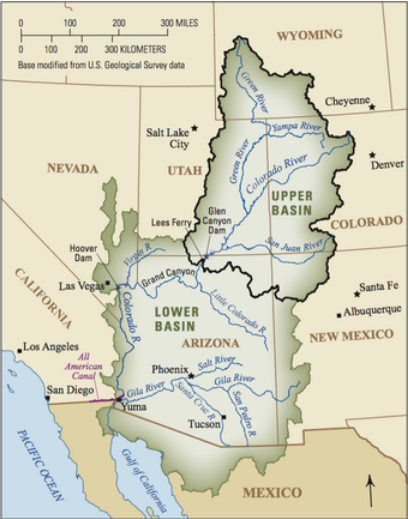
“As the Colorado River dwindles, it threatens to reduce the availability of both water and electricity in the western U.S. Last week, the federal government came up with a plan to manage the river water, but critics on both sides of the aisle warn that deep cuts to water use could be harmful in the states that depend on it. The river has been in a drought for more than 25 years, and its levels have fallen over time. A recent study from NASA found that since 2002, Colorado River reservoirs and aquifers have lost a total of 52 cubic kilometers of water. That drought, intensified by climate change, is one factor constraining the water supply. Another is heavy usage, especially for agriculture, including crops such as hay, which are particularly water-intensive. … ” Read more from The Hill.
Lake Mead water levels just inches from record low
“Lake Mead has fallen to within inches of its lowest-ever recorded level, highlighting ongoing concerns about drought, extreme heat and long-term strain on the Colorado River, one of the Southwest’s most important water sources. As of August 5, the reservoir stood at 1,040.74 feet above sea level, just 0.16 feet (1.9 inches) above its record low of 1,040.58 feet, which was set in July 2022. The lake’s elevation has dropped dramatically over the past two decades, leaving the distinctive white “bathtub ring” visible around much of the shoreline. … ” Read more from Newsweek.
Colorado River hits “bleak” new low in Palisade, straining water supplies for fish and farms
“The Colorado River near Palisade briefly dipped to its lowest point in at least 10 years Wednesday morning as officials struggled to balance water deliveries and demands with shrinking rivers and streams. The river’s flow dropped to 42.9 cubic feet per second in the early morning hours before rebounding to around 88 cfs by the afternoon. Typically, when water managers mention flows that small, they’re talking about creeks and streams, not the mighty Colorado River that serves as the lifeblood and economic engine of the West. The low flows are straining supplies for farmers, reservoir operators and endangered fish from the mountains to the Utah-Colorado border. “My key word has been dire. Bleak. It’s record-setting. We’ve never seen anything like this,” said Dan Crabtree, superintendent of the Palisade Irrigation District. … ” Read more from the Colorado Sun.
Are there winners and losers in the battle over the Colorado River?
“The battle over water in the West has gone on for over a hundred years. Now, the federal government is stepping in to mediate state infighting. The two-year stalemate over how to make cuts to the amount of water used from the Colorado River was partially put to bed last week after the Interior Department released a preferred Colorado River management plan that will set new guidelines for states after several drought-stricken years. Upper Basin states — Utah, Colorado, New Mexico and Wyoming — are celebrating the proposal. But Lower Basin states — Arizona, California and Nevada — are fuming. The current low-water guidelines expire on Oct. 1 and the involved states have been unable to come to an agreement about how much they will scale back. If the states are still deadlocked when that deadline arrives, the Interior Department will impose the proposed guidelines. … ” Read more from the Deseret News.
Arizona pushes for smaller Colorado River cuts as feds finalize plan
“Arizona continues pressing its case for manageable Colorado River water supply cuts over the next two years even as it protests that a new federal framework for protecting the river unfairly targets the state for unacceptable losses in the longer term. U.S. Rep. Greg Stanton, D-Arizona, called the U.S. Bureau of Reclamation’s new 10-year river framework — one that allows for taking a large majority of the state’s river allocation if drought conditions worsen over the coming decade — “a total failure of leadership.” State officials remain hopeful that the agency will accept their offer of giving up a more modest 27% for at least the first two years plus voluntary conservation measures, but negotiations are ongoing. … ” Read more from Arizona Central.
Hobbs calls GOP frustration over her handling of river negotiations ‘political gamesmanship’
“Democratic Gov. Katie Hobbs said Tuesday that Republican criticism directed at her over federally proposed Colorado River cuts doesn’t reflect the reality of negotiations. Late last week, the federal government released water sharing guidelines, which outline potentially massive cuts to Arizona’s water supply. Hobbs’ gubernatorial opponent, Andy Biggs, and other Republicans have since bashed her for failing to secure a better deal for the state. Biggs also accused Hobbs of waiting too long to engage in river talks and failing to work with the Trump administration. “That is absolutely invalid criticism and quite frankly nothing more than political gamesmanship from people who have not been involved in the process at all,” Hobbs said. … ” Read more from KJZZ.
SEE ALSO: One Month After Hobbs Touted Her Colorado River Success, Feds Hit Arizona With The Largest Water Cuts, from Arizona Free News
Homeowners sue Las Vegas Valley Water District over excess use charges
“A group of homeowners has filed a class-action lawsuit against the Las Vegas Valley Water District, alleging the agency has imposed excessive water use charges without due process while residents watch their yards, trees, and plants die. The lawsuit came into focus this week at a Las Vegas Valley Water District Board of Directors meeting, where residents raised concerns about how water is being used and how the district is billing for it. Carol Reynolds, a resident who spoke at the meeting, said she received a water bill totaling $685.95, adding that despite the cost, the tree in her front courtyard is dead. “I could take you on a tour of all the other nearly dead plants and trees that I have gardened for 36 years, but you obviously could care less,” Reynolds said. … ” Read more from Channel 5.
Facing “devastatingly low” reservoir levels, Colorado River communities get creative
“Kremmling town manager Jen MacPherson was already spending hours hunched over stacks of 1940s-era water documents by late winter. A giant map of the town’s water supply covered her office window. It was as if water now dominated her literal view of the world. Kremmling, a small town of 1,600 nestled in the Rockies, is close to water — it hugs the Colorado River and is near man-made lakes normally filled with kayaks and pontoons. But this year, much of that water never came. Substantial snow never arrived. Much of the limited snow that did fall vanished due to record-breaking heat in March. The ditches and streams that typically feed into the town’s two reservoirs were parched. … In order to preserve the town’s water, officials embarked on a saga of last-ditch efforts throughout the spring and summer. And that mirrored what dozens of towns across the West have faced this year: how to keep taps flowing during an unprecedented drought. … ” Read more from Colorado Public Radio.
More Utah forests are burning than ever before. Here’s why that matters
“New research shows Utah, though it’s only halfway through its wildfire season, is seeing unprecedented burns in woodland and forest areas — and that trend poses “concerning” economic and ecological threats. That’s according to Phil Dennison, a professor in the University of Utah’s School of Environment, Society and Sustainability, who detailed his ongoing research in a virtual news conference Wednesday. This year, Utah has already broken its record for wooded and forested areas burned in a single year. So far in 2026, wildfires have engulfed a record 285,000 acres of woodland and forest areas, according to an analysis by University of Utah geographers. The Widemouth 2 Fire, sparked by lightning last week near Kanosh in Millard County, spread to nearly 85,000 acres as of Tuesday, according to the Western Fire Chief’s Association’s website. … ” Read more from the Utah News Dispatch.
‘Super El Niño’ is coming. What does that mean for Utah ski resorts?
“With temperatures hitting triple digits in Utah, skiing and snowboarding might be the last thing on people’s minds. But it’s never too early to pray for snow or do a snow dance. At the very least, it would bring cool thoughts amid the scorching heat. Weather forecasters, though, are already looking ahead as the odds of a strong to historic El Niño are growing. Some are already dubbing it a “Super El Niño.” Some meteorologists use “very strong” and “super” interchangeably. “Are there breathless news headlines and dubious social media posts floating around that may be exaggerating the severity or definitiveness of outcomes with respect to El Niño in 2026? Sure; there’s no question,” per Weather West. … ” Read more from KSL.

