
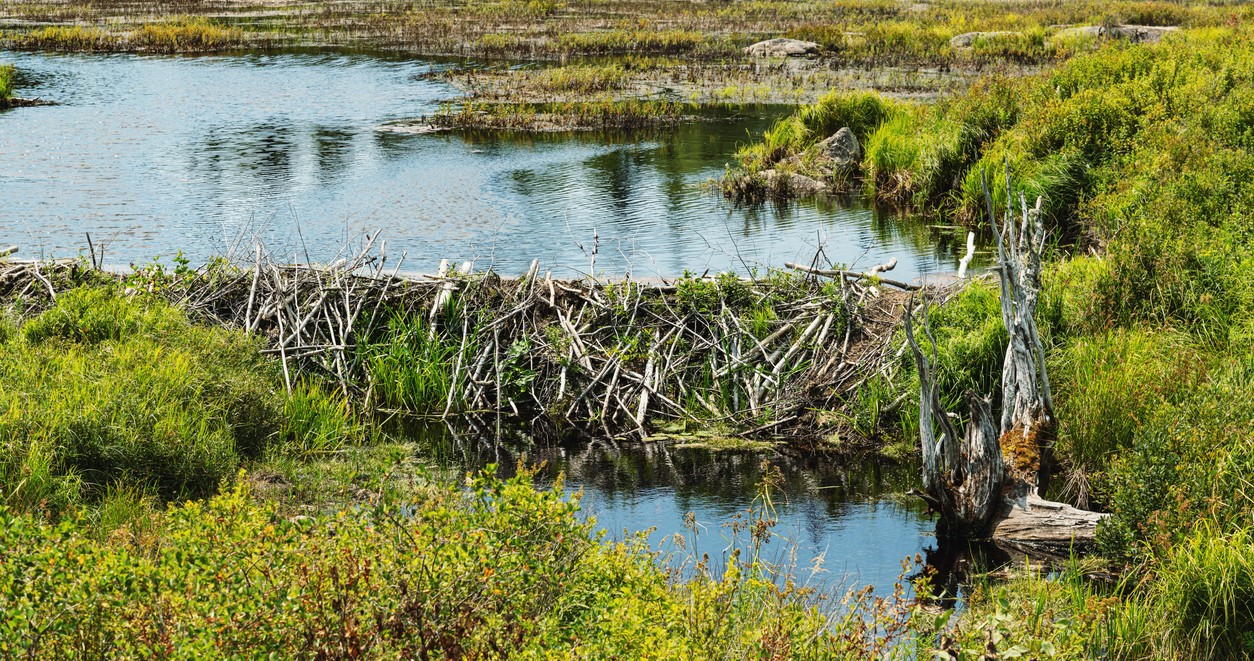
At the State Water Contractors science conference in June 2026, Dr. Katie Holzer, watershed scientist for the City of Gresham, Oregon, opened her presentation on how beavers improve water quality by explaining that her interest in the animals began early. As a child, she said, her father often took her into nature and shared the wonders of the natural world, with beavers among their favorite topics. A zookeeper by profession, he also studied Native American tribes and the journals of European settlers as they moved across the West—histories that helped shape Dr. Holzer’s understanding of the role beavers once played in western landscapes.
“One thing that’s found from looking at those histories is that the West was managed by two species,” said Dr. Holzer. “The land was managed by humans with fire and the movement of the herds that they hunted, and the water was managed by beavers with their dams and channels. So, there wasn’t this pristine wilderness; it was actually a very managed landscape for 1000s of years by the people and the beavers, and they’re both really important to the functioning of those native systems.”
European settlement brought drastic reductions in beaver populations across the continent. Estimates place the pre-European settlement beaver population at about 150 million. By around 1900, the population had fallen to about 1 million to 2 million, or roughly 1% of previous levels. Current estimates range from about 15 million to 20 million; although beavers may seem abundant in some places, the population remains at about 10% of historic levels in the United States.
As beavers return to the landscape, coexistence with humans can create challenges. During western city development after the decline of beaver populations, former beaver wetlands were reduced to small channels, and development occurred close to those channels. Recolonization can create conflicts where limited space remains for natural beaver activity. In some areas of Oregon, houses have been built up against creeks, leaving little room for beaver dams and wetlands. Beaver recolonization in those areas can cause flooding, blocked culverts, and other problems because the landscape no longer provides enough space for beavers to perform natural ecosystem functions.
New development in Gresham now includes at least a 200-foot buffer on either side of streams, giving channels room to move when beavers return.
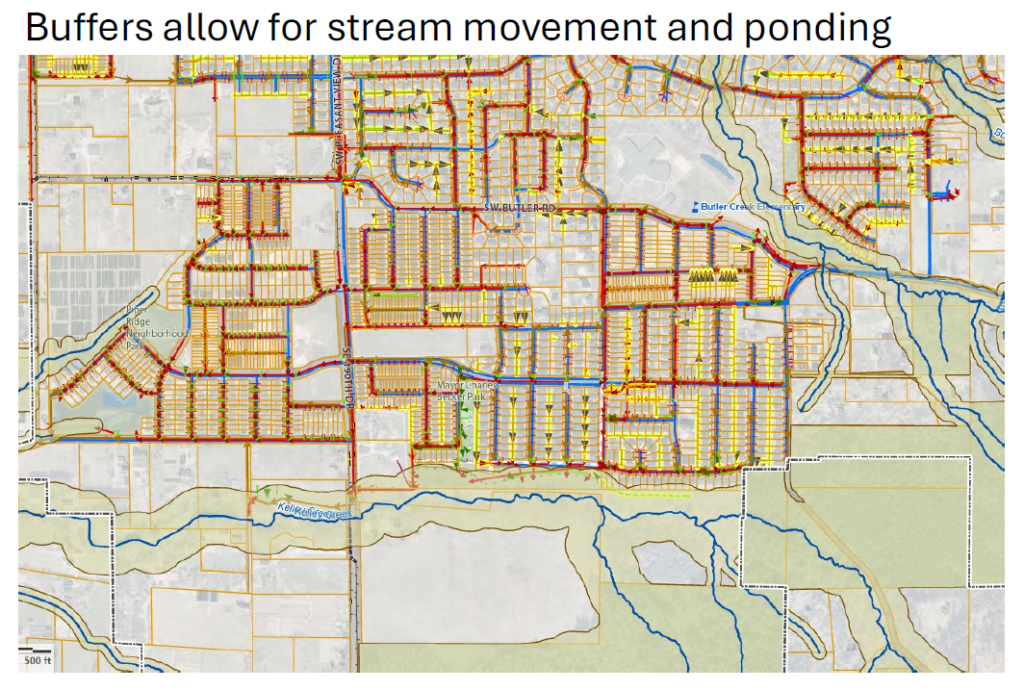
“All of this was built in the last 10 years,” said Dr. Holzer. “This section has been restored as this is being built from agriculture. There are now a series of 10 beaver dams along this section, and we don’t have to trap the beavers out, we don’t have to take down the dams, because there’s plenty of room for that wetland; even if it gets to be 400 feet wide, it’s not running into houses or roads or infrastructure.”
Dr. Holzer noted that beavers have been observed in many areas of the Delta. There are likely a lot of conflicts with beavers and levees, so places with levees are probably not a good spot for beavers. In the upper watersheds, there may be fewer conflicts.
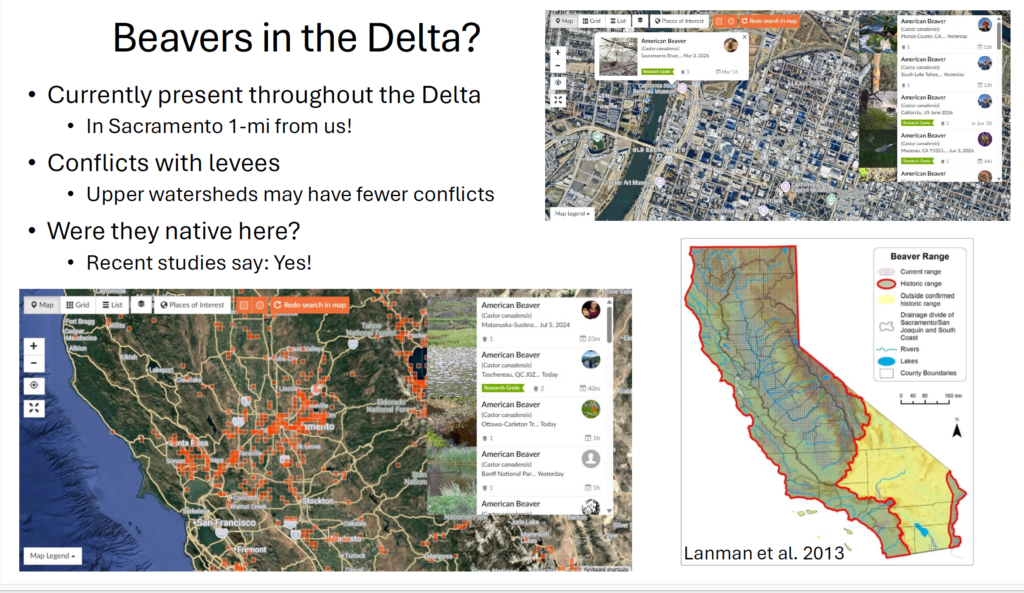
Beavers are native to the area, Dr. Holzer said. A beaver range publication from the 1940s did not include Southern California, but that assessment was based on museum specimens. More recent research has drawn on histories, place names, journals, and Native American petroglyphs documenting where beavers once lived. The updated range map now includes nearly all of California, including the Bay-Delta.
BEAVERS AND WATER QUALITY
Research on beavers and water quality is strongest for sediment, dissolved oxygen, and nutrients. Beaver dams generally reduce sediment by slowing water, allowing particles to settle, and filtering flow through the dam. Results for dissolved oxygen and nutrients are more mixed. Far less research has examined urban pollutants, pesticides, herbicides, heavy metals, or 6PPD-Q.
Gresham provided an opportunity to study those questions when beavers colonized a constructed stormwater treatment wetland. The facility drains about 1,000 acres of mostly industrial land that previously sent untreated stormwater directly to a stream. The 15-acre wetland was built to clean that runoff through green infrastructure, but beavers significantly altered the original design.
The facility was designed for a long, slow flow path, with water ponding before gradual discharge. After beavers arrived, a 10-foot dam and extensions along the berms changed the system. Instead of following the designed route, water ponded at two levels and moved through the dam.
The site produced a natural before-and-after comparison. Data were collected before beavers arrived, after beavers built dams, after the beavers were trapped and the dams removed, and again after another family moved into the habitat.
The study, Beaver activity improves pollutant reduction in a constructed stormwater wetland, analyzed 14 storm events by comparing pollutant levels at the inlet and outlet—seven storms with beaver dams and seven without. Researchers sampled heavy metals, nutrients, sediment, pesticides, herbicides, and, in a few storms, 6PPD-Q; the study began in 2008, before 6PPD-Q was widely recognized.
Dr. Holzer said the dam material was light and loosely packed. “You could just kind of dig in there with your hands and move it all out,” she said. “There were tons of snakes basking on the top of it. We found a bunch of frogs and salamanders hanging out in the dam itself, because it was nice and moist and cool during a hot, dry August day.”
STUDY RESULTS
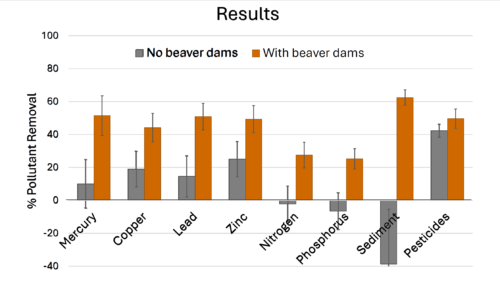 The bar graph shows pollutant removal at the outlet. Zero indicates no removal, meaning concentrations were the same at the inlet and outlet. Gray bars represent periods without beaver dams, when metals removal averaged only about 20% to 30% and nitrogen, phosphorus, and sediment were sometimes exported.
Sediment export likely reflected the sampling focus on large storms: sediment accumulated during smaller storms, then resuspended during the larger storms studied.
“In general, this was probably underperforming because this was a retrofit,” Dr. Holzer said. “We fit in what we could, but it was only about 1% of the drainage area, whereas we’d rather a facility in a new development would be 6% of a drainage area. So it was somewhat undersized, so it’s what we expected.”
Orange bars represent periods with beavers present. Removal improved for every pollutant measured, indicating that beaver activity helped improve water quality.
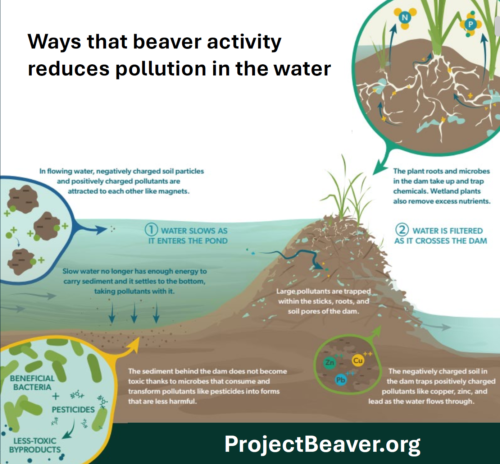 The graphic illustrates how beaver dams remove pollutants. Instead of flowing over the dam, water moves through a matrix of soil, roots, leaves, and sticks, filtering as it passes. Chemical sorption also plays a role: heavy metals can bind to soil particles, and 6PPD-Q is thought to bind to organic matter. Stormwater treatment research has long shown that moving polluted runoff through soil can help clean it.
Water also slows behind the dam, allowing pollutants to settle. Beaver ponds support a greater variety of microbes than moving water, which can help break down pollutants.
High flows can breach beaver dams, but beavers typically return to repair them. “So it’s sort of like a perfect self-maintaining filter that the beavers are able to create for us,” said Dr. Holzer.
OTHER BEAVER STUDIES
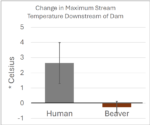 One study of the impact on beavers found that on 22 in-stream ponds, some made by beavers and some by humans, the ponds tended to increase the surface water temperature. They compared upstream and downstream temperatures from the ponds. However, if the ponds are at least 2 feet deep, a lot of them start to stratify, and they will have a pocket of cold water in the bottom, which can be important for cold water for fish. The larger and older the ponds, the more cold water habitat that was available.
Human-made ponds tended to increase the downstream water temperature by 2 to 3 degrees Celsius. Beaver ponds, on the other hand, did not change the downstream temperatures on average; some actually cooled water downstream. Dr. Holzer said the difference had something to do with how the water moves through the entire beaver dam. Water tends to percolate through beaver dams, acting as a pervious filter, maintaining that temperature profile. The larger, deeper, and older the beaver ponds are, the more cold water is sent downstream.
Beavers create habitat. Studies have shown use by raccoons, mallards, great blue herons, barred owls, muskrats, river otters, and native fish, especially salmonids using beaver ponds as rearing habitat.
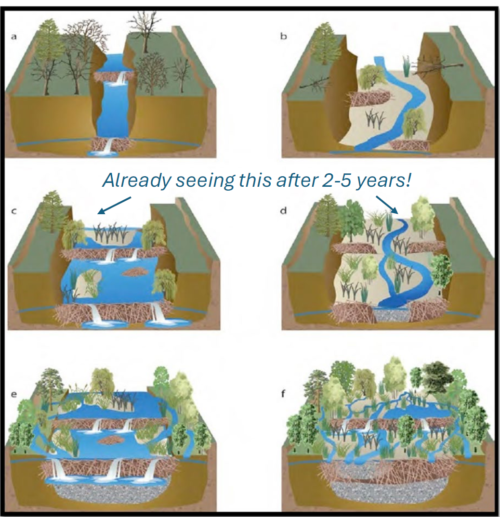
Beavers can also impact channel complexity. A lot of urban streams are made into straight channels with vertical steep edges and very little complexity. Dr. Holzer studied as beavers returned to the landscape, the rocks bars that were created, the grass bars that were created, and the braids that were created in the channel. “I thought it would take like 50 to 100 years, but we saw some of these changes happening two to five years after beavers moved back in,” said Dr. Holzer. “Three years later, there’s a 200-foot-long dam, eight different braids of this channel going around, a lot of differences in depth, and tons of wildlife, including salmonids, using it. That really blew my mind.”
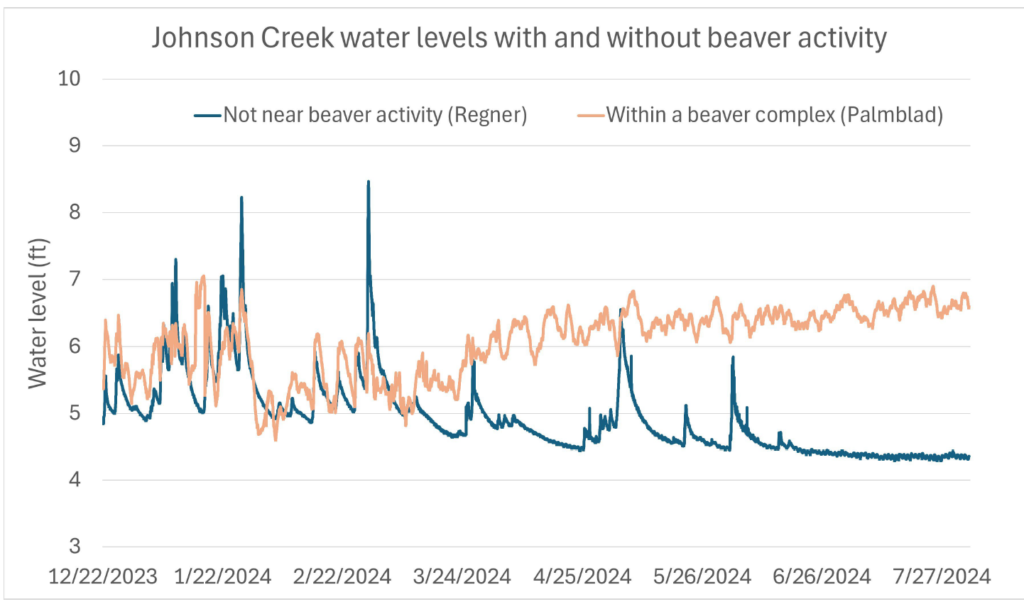
New research shows how beaver dams can reduce flooding and improve drought. Beaver dams keep more water on the landscape so they can help mitigate flood and drought by reconnecting to the floodplains, recharge groundwater, increase base flows, and increase the complexity. Dr. Holzer gave an example for Johnson Creek, which is located downstream of a beaver wetland complex. The main USGS gage for Johnson Creek shows peaks in the winter and very low flows in the summer. At a gage about one mile upstream near a beaver wetland complex, the storm events were much less intense and base flows in the summer were much higher.
CONFLICTS
As beavers recolonize urban and managed landscapes, conflicts with human infrastructure can still occur. Beaver dams and activity can block intake pipes and culverts, flood access roads, and create problems around stormwater systems. In some cases, beavers may also move through or occupy manholes, outfalls, and other built structures.
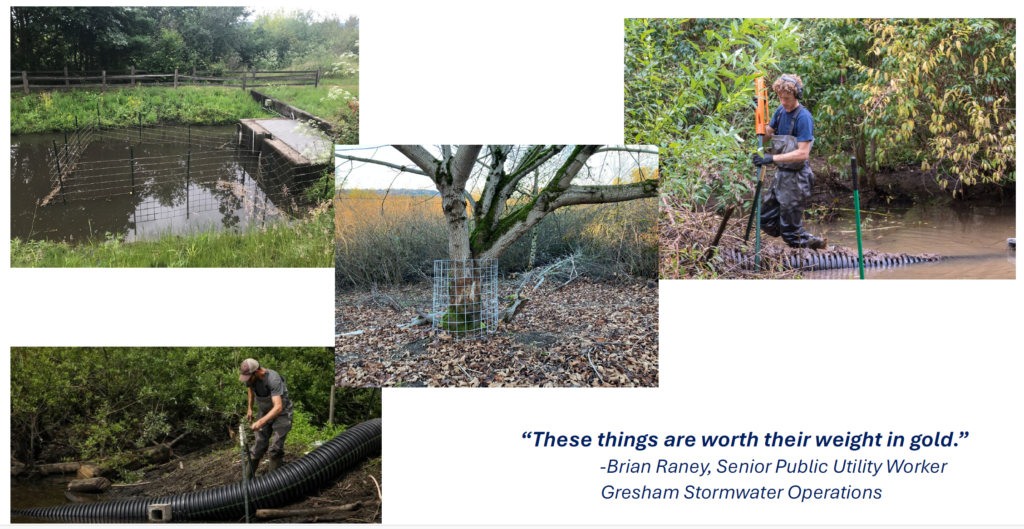
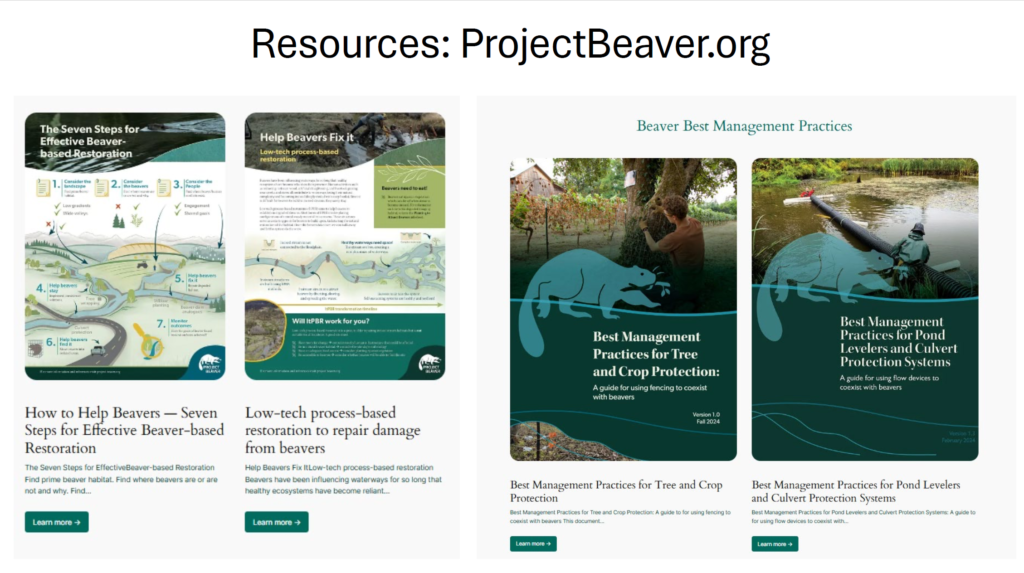
Coexistence devices can help reduce those conflicts without removing beavers from the landscape. Flow devices, culvert protection, and other site-specific tools can keep water moving while allowing beaver wetlands to remain in place. Dr. Holzer noted that ProjectBeaver.org offers practical resources, including printable one-page guides that can be shared with land managers and maintenance crews.
PERMEABLE PAVEMENT
Runoff from roadways carries pollutants into waterways, including contaminants that are especially harmful to fish. A new study suggests that porous pavement can reduce those pollutants at the source while providing additional benefits. The publication, Reduction of Runoff Pollutants from Major Arterial Roads Using Porous Pavement, documented pollutant reductions of up to 80% to 90%, including reductions in 6PPD-quinone.
 “So, if we can cut that down by 80% or 90% right at the source before it even enters a stormwater pipe, and we finish it off with some more green infrastructure, we could be taking care of this whole problem,” said Dr. Holzer.
Porous pavement also offers co-benefits, including less road noise, reduced maintenance, and lower treatment costs because it fits within the existing road footprint. The slide showed a roadway in Texas with porous pavement on the left side and conventional pavement on the right. The porous pavement reduced road spray, which can improve visibility and safety. Dr. Holzer noted that Caltrans is already using similar open-graded friction courses in California, and a recent Caltrans study found that the porous surface layer reduced 6PPD-Q by about 80%.
“If we could move that from just highways and freeways for safety to also doing that in our cities on our major roads, then we could cut down the 6PPD-Q right at the source before it even gets anywhere else,” said Dr. Holzer.
IN SUMMARY …
In summary, Dr. Holzer said the research points to a practical opportunity: beavers can improve water quality, expand habitat, increase channel complexity, and help reduce flooding, drought, and fire damage. But those benefits depend on planning for coexistence in human-dominated landscapes.
Porous pavement offers a complementary strategy by treating polluted runoff at the source, even when only the surface layer is porous and infiltration into the ground below is limited. Broader use on major urban roads could reduce 6PPD-Q and other roadway pollutants while also lowering noise, reducing maintenance, and improving safety.
“So, if we can work synergistically with nature and engineers, we can clean the water and improve human comfort and safety at the same time,” said Dr. Holzer.

