

Several news sources featured in the Daily Digest may limit the number of articles you can access without a subscription. However, gift articles and open-access links are provided when available. For more open access California water news articles, explore the main page at MavensNotebook.com.
In California water news today …
Heat dome to deliver extreme temperatures, high wildfire risk to West
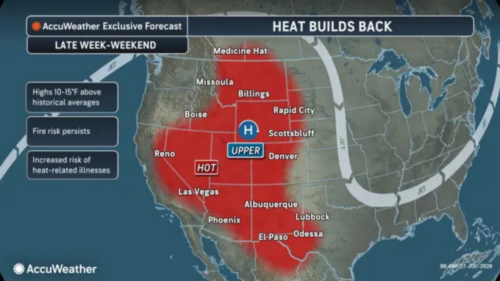 “The large dome of high pressure bringing dangerous temperatures to central portions of the Plains this week will shift west by late week. As this occurs, temperatures are expected to climb well above the historical average across much of the Southwest and interior California, with many locations forecast to experience their highest temperatures of the year so far. By Friday, the heat dome is expected to be centered over Utah, allowing excessive heat to expand across much of the Southwest and interior California. The heat dome could center even farther southwest for a time in early August. “Given the forecast position of the high pressure area associated with the expansive heat dome in the West, there could be enough easterly breezes to bring intense heat to the Los Angeles basin next weekend with highs well into the 90s F possible,” AccuWeather Senior Meteorologist Alex Sosnowski said. … ” Read more from AccuWeather.
As El Niño cooks Pacific, California scientists warn ocean is losing oxygen
“As the brewing El Niño cooks the Pacific Ocean this summer, California scientists warn that the global seas are losing a vital resource due to climate change: oxygen. In a recent study published in the journal Limnology and Oceanography, scientists from UC San Diego’s Scripps Institution of Oceanography and several partners argue that the rate of oxygen loss in the ocean and freshwater is approaching an “unsafe space” with irreversible impacts. “The loss of dissolved oxygen could impact nearly every aspect of aquatic ecosystems, from the food they provide us to the sense of place and meaning that we draw from them,” paper co-author Erica Ferrer, a Scripps Oceanography alumna and postdoctoral scholar at UC Santa Barbara’s National Center for Ecological Analysis and Synthesis, told SFGATE by phone Thursday. “It also seems likely that widespread changes in dissolved oxygen could impact our climate, including driving the additional production of greenhouse gasses.” … ” Read more from SF Gate.
Hurricane Genevieve suddenly explodes into Category 5 hurricane in Pacific, stunning forecasters
“Major Hurricane Genevieve intensified into a Category 5 storm on Monday morning, going well beyond forecasters’ expectations to become the strongest hurricane so far this year in the Western Hemisphere. The storm was hundreds of miles southwest of the Mexico coastline Monday morning and had sustained winds of near 160 mph near its center. That was a 90-mph increase from Saturday afternoon. Genevieve was already the strongest hurricane so far this year in either the east Pacific or Atlantic. Steady weakening is forecast beginning Tuesday, though Genevieve will probably still be borderline hurricane strength Friday morning. … ” Read more from the San Francisco Chronicle.
Kern water districts officially pledge just 1/3 of state ask for Delta tunnel costs
“The official tally shows Kern County water districts are only willing to chip in $11.7 million of $33 million requested by the state toward the planning phase of the so-called delta tunnel, according to figures presented at the July 23 Kern County Water Agency meeting. The agency, which administers the State Water Contract on behalf of 13 local water districts, called “member units,” voted Thursday to approve a funding agreement with the Department of Water Resources that included the reduced amount for planning and pre-construction costs of the 36-foot diameter Delta Conveyance Project. That leaves DWR with a 20% funding gap in the $300 million it needs for this phase, according to agency General Manager Eric Averett. The state has told SJV Water previously that if Kern’s contribution came in lower than expected it would “… adjust the workload and prioritization accordingly.” … ” Read more from SJV Water.
DWR submits the Delta Conveyance Project revised Certification of Consistency on remanded items
“DWR submitted the Delta Conveyance Project Revised Certification of Consistency with the Delta Plan on Remanded Items on July 24, 2026. The Council’s determination on April 23, 2026, dismissed or denied the vast majority of appeals. For two policy areas, the Council directed a limited remand to DWR. Remands are a standard part of the Delta Reform Act’s Certification of Consistency and appeals process and provide an opportunity to supplement or clarify portions of the record to address the findings in the remand. … ” Continue reading this press release.
SJSU-led study finds household water insecurity persists across California despite human right to water policies
 “A new San José State University-led study finds that many California households continue to experience water insecurity despite the state’s Human Right to Water policies and major investments in drinking water infrastructure. The open-access article, “Safe, Secure, and Affordable? The State of Household Water Insecurity in California,” was published in the Journal of the American Water Resources Association. The study offers the first representative statewide look at household water insecurity in California, using data from the 2021 CalSpeaks survey. The research was led by Melissa Beresford, associate professor of anthropology at San José State University, who developed the household water insecurity survey module with a multi-institutional research team. The study was funded by the CSU Social Science Research and Instructional Council CalSpeaks Fellowship, which supports CSU researchers in using the CalSpeaks statewide survey panel. … ” Read more from SJSU News Center.
Just as the salmon return to the Sacramento River, a federal water plan threatens them again
“Just as California’s salmon are staging a comeback, a federal water plan has put this year’s run in jeopardy. Despite a wet winter and healthy reservoir levels, the Bureau of Reclamation’s approach to Lake Shasta has state officials and conservation groups warning of a fall die-off on the Sacramento River. At issue is Reclamation’s 2026 temperature management plan, finalized in late May, which aims to end the irrigation season with about 2.2 million acre-feet in Shasta while sending water south to farms and cities served by the Central Valley Project. Critics say draining the reservoir that aggressively will leave too little cold water behind the dam when endangered winter-run Chinook need it most. An analysis by the State Water Resources Control Board warned the plan could recreate the conditions of 2015, a drought year when nearly all winter-run salmon born in summer and fall perished in warm water below Shasta and Keswick dams. … ” Read more from Active NorCal.
California pistachio crop expected to shrink sharply following challenging growing season
“California pistachio growers could be facing one of the smallest crops in years after an unusually warm spring disrupted pollination across much of the Central Valley. The outlook was the focus of a recent episode of the AgNet News Hour, where crop advisor and pistachio industry leader Rich Kreps discussed the challenges shaping the 2026 crop and what growers can expect moving forward. Kreps said the extreme heat experienced during bloom created significant pollination issues, particularly in the southern San Joaquin Valley. Because pistachio pollen becomes less viable when temperatures climb above approximately 85 degrees during bloom, many orchards are now showing unexpectedly high percentages of blank nuts. “We went from over 1.5 billion pounds last year,” Kreps said. “I’ve heard estimates ranging from around 900 million pounds down to as low as 600 million pounds. We’ve almost dropped to a third of the market from last year.” … ” Read more from AgNet West.
Wine grape growers consider agave as industry searches for a way forward
“It was a Tuesday morning on Clear Lake. People congregated outside as the temperature remained mild. There were muffins and danishes, coffee and water. There were also alcoholic spirits for anyone who wanted an alternative morning boost featuring California-grown agave. Multigenerational farmers and Californians interested in pursuing the agriculture business gathered to learn about growing agave from the University of California Cooperative Extension and its partners. The Lake County event was billed as an agave and grape field day, with many wine grape growers in attendance. … ” Read more from the Sacramento Bee.
California marine sanctuaries face threats of new Trump-backed offshore oil leases
“After years trying to realize her father’s dream of designating a 4,543-square-mile expanse of California’s coast and ocean waters as the Chumash Heritage National Marine Sanctuary, Violet Sage Walker said she is disappointed with the direction the sanctuary’s leaders are taking amid the Trump administration’s threats to open areas for new offshore oil and gas leases. “It’s unfortunate that the federal partners and NOAA … are considering prohibited items within the marine sanctuary and protected areas, but it’s not surprising considering what they’ve just recently done, opening up commercial fishing in the Hawaii sanctuaries and protected areas,” Walker, the chairwoman of the Northern Chumash Tribal Council, told Inside Climate News. She nominated the designation of the Chumash Heritage National Marine Sanctuary in 2015. … ” Read more from Inside Climate News.
The best way to save giant sequoias may be more fire
“Two devastating wildfires that swept through California’s Sierra Nevada in 2020 and 2021 killed thousands of giant sequoias. A new University of California, Davis study suggests the losses would have been far worse without prescribed burns. Published in Nature Communications, the research found that giant sequoias exposed to prescribed fire during the previous 10 years were nearly four times more likely to survive the 2020 Castle Fire and the 2021 KNP Complex Fire than nearby untreated trees. “Prescribed burns are effective at reducing giant sequoia mortality, even for today’s extreme wildfires,” said lead author Dan Dixon, who was a UC Davis postdoctoral researcher in Professor Yufang Jin’s lab when the study was conducted. “If the goal is protecting giant sequoias, prescribed fire is an essential tool available to managers.” … ” Read more from Science Daily.
California is cutting trees to prevent wildfires. But it has nowhere to put them
Matt Dias, a registered professional forester and president and CEO of the California Forestry Association, and Tracy Hernandez, the co-founder and CEO of the New California Coalition, write, “Walk onto almost any forest wildfire prevention or post-fire restoration project in California right now and you will find the same thing: piles of low-value wood, cut and stacked, waiting for somewhere to go. The crews did their job. They thinned the overgrown stands and pulled out the dead material. They removed the low-value kindling that turns a manageable fire into a catastrophe. Then the wood sits there. It’s not because the state lacks ambition. California has committed to treating around 1 million forest acres annually to reduce wildfire risk and restore forest health. Reaching that goal entails removing more than 5 million bone-dry tons of woody material annually, and that’s a conservative estimate. Since 2018, California has accumulated 11 at least 1 million bone-dry tons of forest biomass in piles awaiting disposal, with much more likely remaining undocumented. … ” Read more from the San Francisco Chronicle.
FireSat satellites promise faster wildfire detection for California firefighters
“As California’s firefighters race to detect wildfires before they grow into destructive blazes, a new tool soon will join their arsenal: FireSat satellites, a constellation designed to detect wildfires. Pioneered by the Earth Fire Alliance, or EFA — a global nonprofit organization developing technology to detect, monitor and research wildfires — and built by Muon Space, the state began to support the FireSat program in 2022. In 2026, California is one of 15 early adopters of the technology, alongside Oregon, Colorado, Texas, Portugal, Australia, Morocco and Brazil. “This is the future of early detection and ongoing assessment,” Cal Fire Intelligence Program Staff Chief Phillip SeLegue said in an interview. “Having that persistent coverage — that’s something that we have never experienced before.” … ” Read more from the Sacramento Bee.
In regional water news and commentary today …
NORTH COAST
With Water Board funding, tribe to regain nearly 40,000 acres of ancestral lands in Klamath River Basin
“The State Water Resources Control Board adopted a resolution to fund the second largest tribal “land back” deal in California’s history, providing the Quartz Valley Indian Reservation with the means to acquire ancestral lands, restore critical salmon habitat and protect water quality across nearly 40,000 acres within the Klamath River Basin. “The return of the Scott River Headwaters Project lands to the Quartz Valley Indian Reservation marks a truly historic moment for our people, our neighbors, and the entire Scott River watershed,” said Quartz Valley Chairman Leonard Lincoln. “There is immense work ahead to heal these lands, and we are excited, determined, and ready to begin.” Quartz Valley’s planned land purchase is the second largest in the state in terms of acreage and is the largest land back deal in the country to occur in a single transaction. … ” Read more from the State Water Resources Control Board.
SEE ALSO: California Just Funded the Second Largest Tribal Land Return in State History, and It’s in Siskiyou County, from Active NorCal
Op-ed: Restoring salmon does same to Klamath ecosystem
Kenneth Brink, vice chairman of the Karuk Tribe, writes, “This year’s historically low snowpack is forcing Klamath Basin communities to endure another difficult water year. Upper Klamath Lake, the Klamath River, farms, wildlife refuges, and communities are all under pressure to conserve water. There is simply not enough water to meet every need, and every decision carries consequences for someone. While river flows are at the bare minimum and water allocations to farmers are well below demand, the ducks of the Klamath Wildlife Refuges face an immediate risk of catastrophic disease outbreak in coming weeks. As many as 500,000 birds are at risk. The Klamath Water Users Association’s proposal to use project infrastructure to provide flows to the refuges might allow us to avert such a disaster. … ” Read more from the Herald & News.
Federal regulators extend Potter Valley comment deadline to September
“The public gets nearly two more months to weigh in on the plan to pull two dams out of the Eel River. Federal regulators moved the deadline Friday, the day the old one was set to run out. Comments came in all day. At least 212 landed Friday, July 24 — more than on any other day of the review. The Federal Energy Regulatory Commission explained itself in one sentence. “Staff have considered the comments and have decided to extend the comment period for scoping to 5:00 p.m. Eastern Time on September 18, 2026,” wrote Secretary Debbie-Anne A. Reese. That was all it said. … ” Read more from the Mendocino Voice.
SIERRA NEVADA
Mechanical forest thinning projects underway in South Lake Tahoe
“When forest service crews work on forest thinning projects, many times the work is not visible along main streets, but this year has been different on Pioneer Trail. The USDA Forest Service Lake Tahoe Basin Management Unit (LTBMU) began mechanical forest thinning in 2024 on approximately 687 acres along the Pioneer Trail corridor from Ski Run Blvd. south to Meyers. That project moved south from Ski Run over the last two years, and this year crews have been in the Al Tahoe/Pioneer Trail area. The Al Tahoe Mechanical Contract is part of the South Tahoe Fuels Treatment Project and is intended to reduce the risk of severe wildfire near neighborhoods and create healthier forests in the Lake Tahoe Basin. … ” Read more from South Tahoe Now.
SACRAMENTO VALLEY
Federal committee approves Chico, Palermo, Stirling City water projects
“Three critical infrastructure improvements projects in Butte County have advanced through the House Transportation and Infrastructure Committee, helping flood control for the Chico Five-Mile Basin Project, flood control in Palermo and sewer replacement in Stirling City. The office of Rep. James Gallagher (R-Yuba City) announced Friday that the Chico Five-Mile Basin Project was added to the U.S. Army Crops of Engineers’ Continuing Authorities Program through a provision in the Water Resources Development Act, which the committee approved June 26. The act also includes a provision adding the Palermo Tributary project to the continuing authorities program, and a provision that provides $1 million to rehabilitate sewers in Stirling City. … ” Read more from the Chico Enterprise-Record.
Ground broken on Oroville Wildlife Area recreation upgrades to expand public access
“Construction is underway on recreation improvements at the Oroville Wildlife Area that officials say will expand public access while supporting flood control and habitat restoration along the Feather River. Local, state and federal leaders gathered Friday at the Feather River Boat Launch for a groundbreaking ceremony marking the start of the Oroville Wildlife Area Recreation Improvement Project. The work is the final phase of the Sutter Butte Flood Control Agency’s broader $25 million wildlife area project. … ” Read more from KRCR.
Wildfire Ready: How bigger fires and shrinking snowpack could change NorCal’s water future
“Any wildfire can become a threat to life and property. But in Northern California, the most destructive fires can also change the forests and snowpack that help feed the region’s rivers and reservoirs. That connection is a growing concern in the American River watershed, which helps supply water for approximately 2 million people. A new watershed resilience plan funded by California’s Department of Water Resources looks at how climate change could affect the American, Bear and Cosumnes watersheds in the decades ahead. The impacts include hotter summers, more extreme precipitation, longer droughts, shrinking snowpack, more frequent wildfire and earlier runoff into reservoirs. … ” Read more from KCRA.
E. coli levels improve in Lake Natoma but rise in Folsom Lake, water samples indicate
“Water samples recently collected at Lake Natoma show E. coli levels have dropped, but elevated levels were detected in one area of Folsom Lake. Samples collected Tuesday show levels at the Willow Creek Day Use Area, Nimbus Flat North Beach and Black Miners Bar Swim Area are now below the threshold that the U.S. Environmental Protection Agency (EPA) considers safe in recreational waters. The threshold, which is a measurement of the concentration of bacteria in the water, is 320 MPN/100mL. MPN or most probable number is the laboratory estimate of how many bacteria are present in 100 milliliters of water. … ” Read more from KCRA.
City line separates Clark Pacific from Woodland water. Should voters bridge the gap?
“Woodland voters will decide in November whether to let the city extend water and sewer service beyond its borders, a policy shift that could pave the way for industrial expansion outside the growing Yolo County city. The measure stems from requests by Clark Pacific and Bayer U.S. Crop Science, which asked the city in February 2025 to provide potable water, wastewater and recycled water service to facilities outside the city limits. The proposal would amend Woodland’s voter-approved Measure A, which generally prohibits the city from extending utilities beyond its Urban Limit Line. If approved, the city could consider utility service for existing commercial businesses within one mile of the city limits. Any utility extensions would still require City Council approval on a case-by-case basis. An environmental impact report approved in May found the city’s water infrastructure can handle additional demand from Bayer and Clark Pacific. No other businesses have applied for service. … ” Read more from the Sacramento Bee.
BAY AREA
Marin water suppliers adapt to population forecasts
“The Marin Municipal Water District has adopted an urban water management plan that reflects an expected population growth of nearly 60,000 in its service area by 2050. The district board adopted the plan on Tuesday. In June, it asked staff to update the document with projected water savings attributable to the planned installation of wireless meters, also known as “smart” meters. Lucy Croy, water resources manager, clarified that the plan, which is a state requirement, is not used for the district’s rate setting, infrastructure planning or water supply planning. “We do use it for our water shortage contingency planning, so thinking about droughts and how we would act at different emergency levels in the lake and coming up with those action responses,” Croy said. … ” Read more from the Marin Independent Journal.
Marin beaches get mixed grades in water quality report
“A majority of Marin beaches received top marks for water quality in an annual assessment, but a few freshwater sites have brought down the county’s average. The “report card” by the nonprofit organization Heal the Bay gave an F grade to two sites along Lagunitas Creek: the Inkwells near Lagunitas and a spot near Whitehouse Pool outside Inverness. Also, a site near the Green Bridge just south of Point Reyes Station scored a D during dry summer weather. The organization grades California beaches and some freshwater recreational sites based on fecal bacteria levels in the water. Marin only collects data for the report from April through October. Overall, 78% of Marin sites received an A grade for dry summer weather, a drastic drop from the five-year average of 97%. … ” Read more from the Marin Independent Journal.
Can tech keep whales safe from deadly vessel strikes?
 “San Francisco Bay is one of the busiest marine superhighways in the United States. Massive container ships cruise alongside crude oil tankers under the Golden Gate Bridge as high-speed ferries zip near the infamous Alcatraz Island and sailboats catch gusts close by. The world’s longest-haul ocean travelers are now in the fray too—with deadly consequences. Eastern North Pacific gray whales take a more than 10,000-mile marine road trip annually, gorging themselves on tiny, shrimp-like crustaceans off northern Alaska before traveling to the balmy waters off Baja California in Mexico to breed. But a climate-change-induced decline in high-quality food supplies during the first leg of the journey is forcing whales to seek sustenance in new places along the way, research suggests. … ” Read more from Inside Climate News.
Oakley leaders hint at possible permanent ban on data centers
“Oakley officials are considering a permanent ban on data centers as the city works on updating zoning ordinances and tightening regulations to prevent development of the controversial facilities. With a temporary moratorium already in place, several councilmembers expressed support for pursuing a more permanent solution and asked staff to include more details on the potential impacts from data centers. Councilmembers Anissa Williams and Shannon Shaw said they would like to see ordinances that would describe and define the uses of data center operations to prevent loopholes.“I don’t want there to be a way for it to come under any other name,” Williams said during a joint City Council and Planning Commission work session on Tuesday. “So I just have some concerns if there’s any tight language that we could do. Who knows in two years what they’re going to decide these things are called, especially with all the negative things that are happening.” … ” Read more from the San Jose Mercury News.
CENTRAL COAST
With deadline near, who bears the cost of Monterey County seawater intrusion still unclear
“From some parts of Highway 101, the Salinas Valley can look like one long, uniform stretch of agricultural fields. But the groundwater basins that lie beneath the surface tell a different story, one of interconnectivity, fragmentation and different interests depending what end of the valley you’re on. Groundwater is the source for roughly 96% of all water used in the Salinas Valley. For more than a century, it has been the foundation for Monterey County’s agricultural industry. But as generation after generation has sipped from thousands of straws up and down the valley, groundwater levels have dropped and the salty waters of Monterey Bay have seeped in to fill its place. The saltwater has moved steadily inland, compromising agricultural wells and nearly reaching Salinas city limits. In 2015, California’s Sustainable Groundwater Management Act mandated officials across the Salinas Valley to get a handle on seawater intrusion and now a critical deadline approaches. … ” Read more from the Monterey Herald.
This picturesque California town is overwhelmed by tourists — but can’t afford to lose them
“On a recent afternoon in this wealthy beach community, dozens of cars crawled along Ocean Avenue in search of curbside parking. Horns blared. A parking-enforcement officer ticketed vehicles that had overstayed a two-hour limit. Carmel-by-the-Sea has long been accustomed to such commotion on sun-drenched weekends, but this was an overcast Wednesday. With the iconic span of Highway 1 connecting San Francisco to Los Angeles fully reopened after years of repairs, droves of tourists have descended upon this Monterey Peninsula enclave for its Instagram-worthy beach, storybook cottages, elegant restaurants and boutique storefronts. The result is more trash on the streets, near-perpetual gridlock along Carmel’s quaint retail corridor, residential neighborhoods overrun with parked cars — and increasingly frustrated residents. “They’re angry about it, frankly,” council member Hans Buder said at a recent public meeting. “They feel like there’s too much tourism, there’s overtourism.” … ” Read more from the San Francisco Chronicle.
Santa Barbara County pays $4 million in settlement for 2023 Orcutt debris flow
“Santa Barbara County paid $4 million and a farming firm provided $525,000 as settlements to the plaintiffs in a lawsuit related to the January 2023 rainstorm that sent a deluge of water and debris into an Orcutt neighborhood. The 15 plaintiffs lived on or owned eight properties on Parkland Drive, Hibiscus Court and Country Hill Road on Jan. 9, 2023, when a stormwater retention basin at the southeast corner of Bradley Road and Union Valley Parkway failed. Santa Barbara County paid $4 million and a farming firm provided $525,000 as settlements to the plaintiffs in a lawsuit related to the January 2023 rainstorm that sent a deluge of water and debris into an Orcutt neighborhood. The 15 plaintiffs lived on or owned eight properties on Parkland Drive, Hibiscus Court and Country Hill Road on Jan. 9, 2023, when a stormwater retention basin at the southeast corner of Bradley Road and Union Valley Parkway failed. …. ” Read more from Noozhawk.
SAN JOAQUIN VALLEY
Column: Notes from home: That sinking feeling
Trudy Wischemann writes, ““Buckle up,” a friend wrote when he sent an article on El Niño from the Sacramento Bee (“Super El Niño charging ‘full steam ahead,’” 7-19-26). After watching the amazing graphics, I understood why meteorologists are trying to get our attention. But as I started to imagine what that could mean, I got this sinking feeling. Nothing has really changed in the power dynamics of our closed, precious, endangered Basin since the 2023 floods. For the entirety of that event, J.G. Boswell, the biggest landowner in the Tulare Lake Basin Water Storage District, diked off half of the old lakebed, keeping it dry while flooding out orchards and dairies on “the lake’s margins,” destroying many people’s livelihoods. Had the Sierran snow melted all at once, it would have been a much bigger disaster. … ” Read more from the Porterville Recorder.
California has a water storage problem. A Los Banos project hopes to change that.
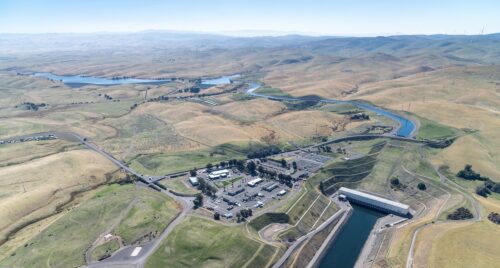
“More than 60 years after President John F. Kennedy dedicated the San Luis Reservoir, California is rewriting the playbook on water storage. In 1962, Kennedy stood in the San Joaquin Valley and celebrated what was then one of the state’s largest water investments. Since then, California’s population has more than doubled, while many argue investments in water storage have not kept up. Now, officials say the newly completed first phase of the Los Banos Creek Detention Dam project is an example of how existing infrastructure can help capture more water during wet years and make it available when drought returns. … ” Read more from KMPH.
Kern water district inks deal to keep water flowing to homes hear Patterson
“Homeowners in a development near Patterson no longer have to worry that a water agency 200 miles away could cut off their taps. A contract was signed late this week between the Kern County Water Agency and Western Hills Water District that will keep water water flowing to the 600-home Diablo Grande development in the western foothills of Stanislaus County. The agency agreed to deliver up to 1,500 acre feet a year to Western Hills, which serves Diablo Grande exclusively, and forgive $14 million in debt the agency said it was owed. The agency signed off on the contract Thursday and Western Hills agreed to it on Friday. The agency will charge Western Hills $37,500 per year, with an escalation clause, as an “administration fee,” according to the contract. … ” Read more from SJV Water.
SOUTHERN CALIFORNIA
L.A.’s dangerous game of triage as aging water system hits breaking point
“The Los Angeles water system is so old — and money for replacements is exceedingly scarce — that officials are left playing a dangerous game of triage. They know huge swaths of the system are in desperate need of replacement. But with limited time and money, the Los Angeles Department of Water and Power has no choice but to focus on the lines it believes are most likely to blow. Sometimes, it can get there before a massive leak. But as West Hollywood discovered this month, sometimes the pipes rupture well before help can arrive. The Westside has experienced the highest number of leaks across the city’s water distribution system over the past 10 years, according to the utility. Experts say the age of pipes, the corrosive soil they’re buried in and pressure changes in pipes that send water to hillside neighborhoods all contribute to breaks across the aging system. … ” Read more from the LA Times. | Read via Yahoo News.
Sunset Boulevard reopens after repairs on 36-inch water main — but it’s not over yet
“The stretch of Sunset Boulevard closed since the rupture of a large water main sent 17 million gallons of water cascading through West Hollywood has reopened after more than a week of repair work by Los Angeles Department of Water and Power crews. The heavily traveled stretch of Sunset reopened about 11 p.m. Friday. It had been closed between Sherbourne Drive and San Vicente Boulevard since about 3 a.m. July 16, when the rupture occurred beneath Sunset Boulevard at Holloway Drive. “From the start, LADWP has prioritized safety, recognizing that the reopening of the street depended on our ability to safely fill and repressure the pipe,” the department said in a statement Friday night. “However, due to recurring leaks following attempted repairs, LADWP crews shifted to an alternate plan that allows us to safely move forward with street restoration and isolate a section of the water pipe, while maintaining reliable and safe water service.” … ” Read more from the LA Daily News.
Why a plan to filter bacteria from the Arroyo Seco is facing fierce opposition
“Between South Pasadena and Highland Park is a tiny wilderness of Mexican fan palms and even some oak trees. Some locals say they love it the way it is, graffiti, fire hazard and all. But the city of Pasadena says it needs the place to filter out E. coli bacteria and zinc pollution that ruin water quality in the Arroyo Seco, which then flows into the L.A. River. The Arroyo Seco is born in the Angeles National Forest and winds through through La Cañada Flintridge, Altadena, Pasadena and South Pasadena and finally Los Angeles. The water-cleaning project has been drawing protests from several community groups and some elected representatives for the area. Neighbors have organized a lawsuit against the city and there’s a growing social media campaign to bring the project to a halt. … ” Read more from the LA Times.
In Boyle Heights, LA County Public Health fines Lineage over pest problems
“Los Angeles County health officials issued an administrative citation against Lineage Logistics for creating unsanitary and nuisance conditions at their burned-out cold-storage warehouse in Boyle Heights, it was announced today. Investigators with the L.A. County Department of Public Health assessed and inspected the warehouse after the June fire that left tons of rotting food that has attracted rats and bugs. County officials issued the citation Thursday, fining Lineage the maximum $500 per day until the violations are corrected. Additional citation may be issued if compliance is not obtained as identified on subsequent inspections. DPH investigators reviewed the warehouse on July 15. The official inspection report identified violations that remained outstanding after a re-inspection earlier this week. … ” Read more from the LA Daily News.
SEE ALSO: Lineage says it’s cleaned ‘nearly half’ of food waste in Boyle Heights warehouse, from the LAist
Inland, OC agencies push back on plan to reduce pollution in stormwater in the Santa Ana River Basin
“The Santa Ana Regional Water Quality Control Board, part of the state’s environmental protection agency, is proposing comprehensive new regulations to reduce pollution in water from storm drains and flood control channels in the Santa Ana River Basin covering large parts of Orange, Riverside and San Bernardino counties. Local governments in Orange, Riverside and San Bernardino counties have pushed back on the proposed order, though, sending the board letters objecting to the plan. Many of the municipalities’ complaints remain centered on the new regulations’ projected costs. An environmental group, however, said stricter stormwater runoff regulations are needed. … ” Read more from the OC Register.
Earthquake pressure in Cajon Pass is new reason to stress
“The Cajon Pass is under historic levels of stress — and not from commuters fuming on the 15 Freeway. The Pass is the juncture of the San Andreas and San Jacinto earthquake faults, which have been quiet. Too quiet, in horror movie terms. “Tectonic stress has continued to build along these faults, increasing the likelihood of a large future rupture. One key area of concern is Cajon Pass, where the two fault systems meet and could potentially rupture together,” according to a study that’s in the news. Scientists in Hawaii, Pasadena and La Jolla, taking a break from enjoying life in their respective paradises, used computer simulations of the past 1,000 years of seismic activity to learn how fault stress builds. In other words, they looked at the region since the year 1100. The last major earthquakes at this juncture were the Wrightwood quake in 1812 and the Fort Tejon quake in 1857. The lack of a major quake since then suggests that “the system is critically stressed,” the study concludes. … ” Read more from the LA Daily News.
SEE ALSO: California earthquake expert gives staggering cost estimate for Big One: $1 trillion, from the San Francisco Chronicle
IMPERIAL/COACHELLA VALLEYS
California’s chromium-6 crackdown could raise water bills across Coachella Valley
“A new California drinking water rule targeting chromium-6 may carry a heavy price tag for Coachella Valley residents. According to the Coachella Valley Independent, meeting the requirement could cost five of the region’s six water providers more than $525 million combined, with at least some of that expense potentially ending up in customer bills. An April 2024 rule from California’s State Water Resources Control Board set a 10-particles-per-billion cap for chromium-6 in delivered drinking water. To comply, most Coachella Valley agencies said they need to quickly expand infrastructure by adding treatment systems, wells, and pipelines. The Coachella Valley Water District, the area’s largest provider, says 34 of its 96 drinking water wells are affected. … ” Read more from The Cool Down.
SAN DIEGO
What the Tijuana River cleanup reveals about San Diego’s bigger challenge
“Amid 18 months of federal retreat and punctuated hostility to local priorities, one San Diego problem has managed to draw Washington in. Since his first visit in April 2025, Environmental Protection Agency Administrator Lee Zeldin has returned to the region repeatedly to press what he calls a “100% solution” to the Tijuana River sewage crisis. In July 2025, Zeldin signed a memorandum of understanding with Mexico’s environment secretary. Last December the two governments enacted a binational agreement known as Minute 333, and work is now underway to expand the South Bay treatment plant and install river gates meant to keep millions of gallons of sewage out of the valley. … ” Read more from the Voice of San Diego.
SEE ALSO: Congressional delegation pushes to make Tijuana River cleanup a permanent EPA project, from the Border Report
Along the Colorado River …
Federal proposal could reshape Colorado River management after 2026
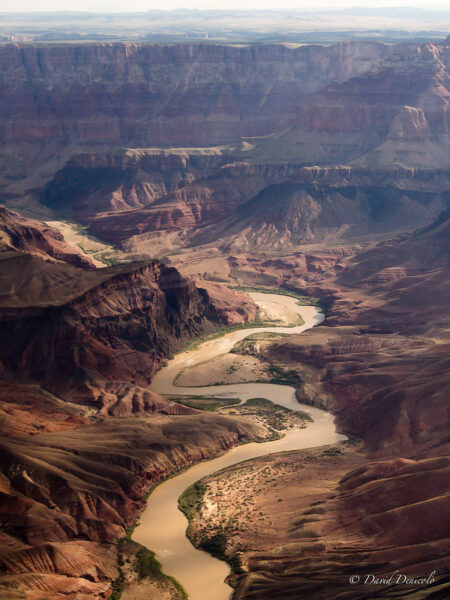 “The federal government is preparing to unveil a long-awaited proposal that will help determine how the Colorado River will be managed after current operating rules expire at the end of 2026. The decision is expected to have significant implications for the seven Colorado River Basin states, tribal nations, Mexico, and communities throughout the Southwest that rely on the river for drinking water, agriculture, and power generation. For Imperial County, where the Colorado River is the region’s only source of water, the stakes are especially high. More than 470,000 acres of farmland depend on Colorado River water, supporting an agricultural industry that supplies much of the nation’s winter vegetables and contributes billions of dollars to the economy. Local leaders have closely monitored the negotiations, warning that changes to water allocation rules could affect both agriculture and the Imperial Irrigation District’s long-held senior water rights. … ” Read more from the Desert Review.
Feds to share first Colorado River plan this week
“After more than three years of negotiations among the seven Colorado River Basin states, the federal government is preparing to release its plan for managing the shrinking river. The U.S. Department of the Interior and Bureau of Reclamation say they expect to release the Final Environmental Impact Statement for post-2026 Colorado River operations this week. The document is expected to identify the federal government’s preferred approach for operating Lake Mead and Lake Powell after the current guidelines expire. “We’ve been waiting on this for essentially three-plus years,” said Kyle Roerink, a senior advisor with the Great Basin Water Network. “It’s been a long time coming.” Arizona, California, Colorado, Nevada, New Mexico, Utah and Wyoming have been unable to agree on how future shortages should be divided. That has left the federal government to move forward with its own framework. … ” Read more from Channel 15.
SEE ALSO:
- Trump administration to announce rules for how states will share the Colorado River, from NPR’s All Things Considered
- Feds set to unveil Colorado River plan. How it could hit Arizona, from Arizona Central
- Arizona expected to take a 31% cut in Colorado River supplies, from the Arizona Daily Star
- Colorado River’s two big lakes drop to lowest water levels on record, from the Arizona Daily Star
- ‘We are deeply concerned’: Arizona leaders ask Congress for emergency funding to protect Colorado River, from Channel 12
- Heat and water concerns challenge Arizona farmers as Colorado River allocation decisions near, from Channel 15
Las Vegas can keep drawing water past Lake Mead’s dead pool, thanks to the Third Straw
“Lake Mead is one of the country’s most closely watched reservoirs, and Las Vegas relies on it heavily — but the city also has added protection built deep below the waterline. A recent explainer from Armchair Engineer (@armchairengineer) on TikTok breaks down why Las Vegas can continue drawing water even if the reservoir falls below Hoover Dam’s “dead pool” level. The video presents Las Vegas as more prepared for water shortages than many people may assume. “Las Vegas may be huge and sprawling, but they actually know what they’re doing when it comes to conserving water,” they said, describing it as potentially “the most water-efficient big city in North America.” … ” Read more from The Cool Down.
Humpback chub rebound: USGS science uncovers population increase and range expansion for threatened fish
“Scientists attribute the population increase primarily to warmer water temperatures, a consequence of low reservoir levels in Lake Powell, paired with a current scarcity of warmwater invasive predators in this stretch of river. Pearce Ferry Rapid, an evolving Class VI rapid that formed in 2007, acts as a partial barrier to non-native fishes moving upstream from Lake Mead, likely reducing predation pressure. A companion genetic analysis found negligible differences between humpback chub populations found in western Grand Canyon and Little Colorado River, and recaptures show very little movement between the two areas. These patterns are consistent with a once-continuous distribution that fragmented during the cold-water decades. … ” Read more from the USGS.
A desert town may run out of water. Others could face the same fate.
“Mayor Curtis Stacy starts every morning checking two websites that tell him how much he needs to worry about water. One site tells him about the reservoir that supplies his tiny desert town — it’s effectively empty. The other site tells him if the town gets additional water that other communities with more senior rights aren’t using; right now, the answer is yes. But Stacy tries to remind Kearny’s roughly 2,000 residents that they could easily tip back into crisis mode, just like this spring. In newsletters, he underscores that fragility with no less than 20 exclamation points. If other communities call for more water, they will have to cut back again. … ” Read more from the Washington Post.
Drought Task Force makes formal recommendations to Gov. Jared Polis to reduce water use
“Despite recent rains, most of Colorado remains in deep drought and a governor’s task force has now put forward four recommendations to help deal with the problem. State climatologist Russ Schumacher said the monsoon rains were welcome, and certainly bringing some relief — increasing stream flows on the Western Slope and helping control widespread wildfires — but it’s unclear that the rain will continue in the fall or reduce the risk of another snow drought next winter. “El Niño is in place and getting stronger, which tilts the odds towards wetter-than-average conditions in the fall and possibly hopefully beyond,” he said. But he added, “The connection between El Niño and mountain snowpack is not as strong, making it difficult to say much with confidence.” … ” Read more from Colorado Public Radio.
‘Rain makers’ say they can boost Wyoming’s water supply, Wyo lawmakers want proof
“The founders of a Colorado company said they’ve found a way to boost rainfall by at least 10% in certain locations, using technology that could help mitigate the persistent Colorado River water crisis. However, an abiding distaste for “cloud seeding” in Wyoming has hampered efforts here so far, representatives of Rain Enhancement Technologies say. Randy Seidl, the company’s CEO, and chief meteorologist Jeff Chagnon told Cowboy State Daily their system relies solely on solar-generated electricity, not cloud-seeding chemicals. They’ve built rain-making facilities in Utah and Colorado, but when they’ve approached Wyoming officials their message has been conflated with the “cloud-seeding umbrella,” Seidl said. … ” Read more from Cowboy State Daily.

