
by Alastair Bland
Biologists studying the San Francisco Estuary’s endangered fishes are trying to unpack a puzzling but encouraging uptick of endangered longfin smelt in a small North Bay watershed. With the fish declining in most of the estuary, time is running out to stabilize the population. Now, scientists hope that understanding why longfin are aggregating in this small stream system could guide efforts to protect critical habitat and save the species from extinction.
In the last quarter century, the longfin smelt population has collapsed, following the path of most fishes native to the estuary. Loss of wetland habitat, depleted river flows, and climate change are the probable culprits.
However, in the past three years, the fish’s numbers have shown a modest bump—likely from the ecosystem benefits of three consecutive wet winters beginning in 2023. History has shown that winters of high precipitation prompt increases in longfin numbers; this pattern is accentuated when wet years occur consecutively.
“You get a compounding effect from these back-to-back wet water years,” says Colin Brennan, who supervises the California Department of Fish and Wildlife’s Interagency Ecological Program.
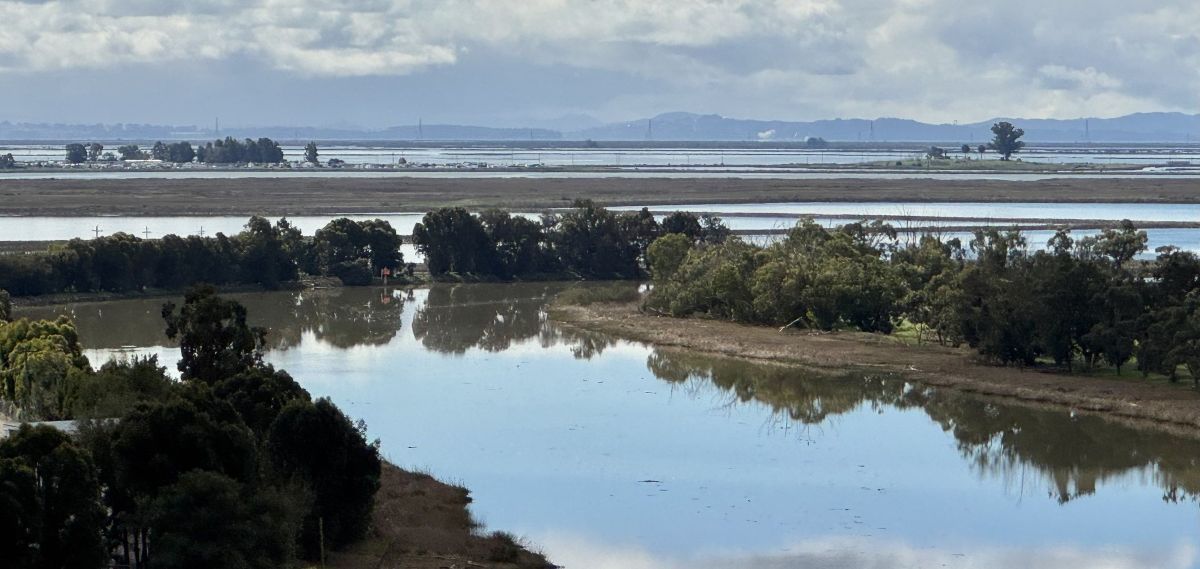
What has particularly caught scientists’ eyes, though, is the outsized concentration of longfin smelt in the marshy lower reaches of the Napa River.
“What’s going on here?” asks Brennan. “This location may be a really good breeding, rearing, and recruitment location for this fish.”
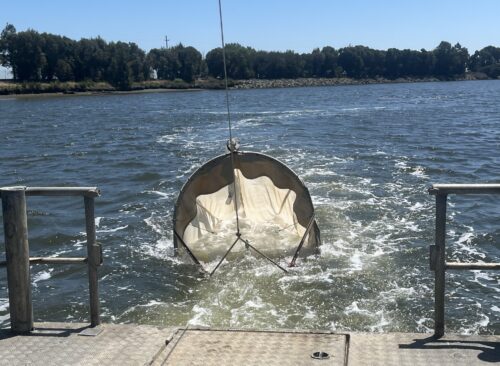
Each year, the department’s scientists sample dozens of sites around the San Francisco Estuary using fine-meshed nets to capture juvenile longfin smelt and other fish. The number of longfin captured through this sampling program abruptly spiked in 2025, following a modest rise the previous two years. Most of the fish are appearing in nets towed through the estuary of the Napa River.
Brennan says part of the trend is easily explained: the winters of 2023, 2024, and 2025 produced hydrologic conditions ideal for longfin smelt and their reproduction. What’s less obvious about the department’s sampling results is why longfin have been so concentrated around the Napa River mouth compared to other sampled sites throughout the estuary.
Brennan and his research team, including environmental scientist Vanessa Mora, have proposed a “Goldilocks effect,” whereby multiple conditions aligned to create a smelt-friendly environment. Salinity, by this hypothesis, would have been just right. The estuary’s water also would have been suitably cool, filled with nourishing zooplankton, and murky with rain-induced sediment suspension—a water condition that hides small fish from predators.
A synthesis of the sampling data by Mora shows that through the spring of 2025 the program caught longfin of progressively larger size, suggesting that when hydrology and climate cooperate, the Napa can offer habitat for all life stages of longfin smelt. This makes it a potential refuge for future longfin persistence. According to Brennan, the Napa River Salt Marsh Restoration Project, which restored 10,000 acres of wetlands from 2009 to 2019, likely magnified the benefits of the recent wet years.
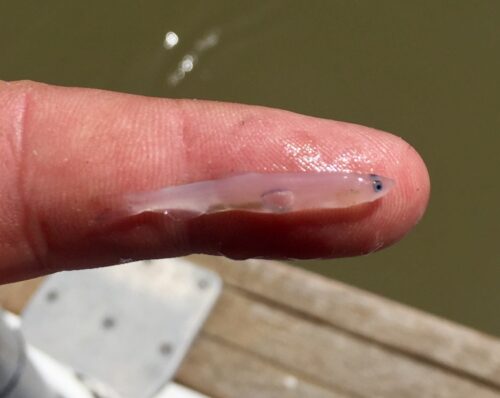
On the other hand, capturing fish in the Napa system doesn’t prove they were born there, meaning that the Napa basin does not necessarily support the entire longfin smelt life cycle. Levi Lewis, a research scientist at U.C. Davis, who directs the Otolith Geochemistry and Fish Ecology Laboratory, says even geographic concentrations of larvae only days old don’t tell biologists where their parents spawned.
“We’ve sampled the Napa River for many years, and we’ve just never seen a lot of spawners in that system,” says Lewis. “It is possible there is spawning going on in the Napa, but we know there’s a lot of spawning going on in the Delta.” The mouth of the Napa is situated such that fish born in the Delta could easily enter the smaller waterway as they move downstream.
“These systems are highly tidal, so the fish are moving back and forth with the tides, they’re getting advected in and out,” he says. “There is a certain time of their life where they do seem to be highly concentrated in that Napa basin area, but they move through there—they don’t all start there, and they don’t all end there.”
Lewis said local researchers, including Wim Kimmerer at San Francisco State University, are developing particle tracking models that incorporate the age of a captured fish based on patterns in its earbone, or otolith, the location of capture, and the known patterns of water movement within the estuary “to back-calculate where that fish likely came from.”
These models are powerful, Lewis says, but they cannot accurately account for where a fish may have moved under its own swimming power. Simply by transiting several vertical feet in the water column, longfin smelt may hitch rides for miles on strong currents defined and separated by sharp salinity gradients.
Unfortunately for smelt and other species, Central Valley flows reduced by human water use, drought, and warming are all diminishing the ecological functions of the Bay and the Sacramento-San Joaquin Delta. Even wet winters may not override the impact of elevated water temperatures on longfin smelt.
“If it warms up too fast, it really does a number on the recruitment [of longfin],” Brennan says, suggesting a likely barrier to smelt survival in coming decades.
Unsurprisingly, smelt counts were down this year following a remarkably warm spring. But the Napa River, preliminary data shows, remains a substantial longfin source. Brennan says this invites further research to identify the Napa’s strengths as a refuge for this endangered species and, maybe, replicate them through management actions in other watersheds.
Looking ahead, Brennan wonders, “What can water managers learn from the Napa River to manipulate other waterways and keep this trend moving?”
This article was produced by Estuary News Group

