
Several news sources featured in the Daily Digest may limit the number of articles you can access without a subscription. However, gift articles and open-access links are provided when available. For more open access California water news articles, explore the main page at MavensNotebook.com.
On the calendar today …
- PUBLIC HEARING: Delta Conveyance Project water right hearing beginning at 9am. The State Water Resources Control Board Administrative Hearings Office is holding a Public Hearing on the pending Petitions for Change of Water Right Permits for the Delta Conveyance Project. Interested members of the public who would like to watch this hearing without participating may do so through the Administrative Hearings Office YouTube channel at: bit.ly/aho-youtube. Click here for the meeting notice.
- FERC Scoping Sessions for Eel River Dam Removal beginning at 10am at the Ukiah Valley Conference Center, Chenin Blanc Room, 200 S School St, Ukiah, CA 95482. The sessions are an opportunity for the public to weigh in on the surrender and decommissioning of the Eel River Dams.
- WEBINAR: Natural Capital as Infrastructure from 12pm to 1pm. As California faces mounting threats from extreme heat, flooding, drought, wildfire, and sea-level rise, its natural capital—resources such as forests, wetlands, watersheds, and coastlines—play an essential role in the State’s climate resilience. This expert briefing will explore the role of natural capital in policy, planning, and public investment decisions as infrastructure alongside traditional gray infrastructure. Drawing on the framework of Natural Capital Assessment and Accounting (NCAA), the event will equip California policymakers and staff with practical tools for understanding how ecosystem health translates into measurable economic value, risk reduction, and long-term fiscal resilience. Click here to register.
- SoCAL WATER DIALOG: Should Stormwater Permits be Mandated for Commercial Businesses from 12pm to 1:30pm. To better control polluted stormwater runoff, the California Coastkeeper Alliance is petitioning regional boards to require commercial businesses such as shopping centers and warehouses to obtain stormwater permits. Cities and counties are currently responsible for treating stormwater runoff. Groups representing businesses in LA County point out that they already pay to capture and treat their stormwater runoff through Measure W that placed a special parcel tax on property owners. These groups urge an analysis of benefits and costs before moving forward. Click here to register.
- VIRTUAL WORKSHOP: Beyond Silos: Building a Shared Natural Resource Vision for California’s Next Governor from 12pmnm to 2pm. California’s next governor will inherit natural systems changing faster than our institutions are currently designed to respond. Across water, forests, agriculture, conservation, fire, flood, biodiversity, infrastructure, and community resilience, the challenge is beyond having good programs or committed people. The challenge is whether we can align decision-making, funding, relationships, and day-to-day management across the fragmented agencies, jurisdictions, and managers that actually shape the health of our watersheds and communities. Join our conversation with participants from across sectors and geographies to help identify the values, priorities, and practices that should guide California’s next gubernatorial administration. We will focus the discussion on how the administration can build trust and accelerate opportunities for innovation and alignment. Register here.
In California water news today …
Why El Niño is driving this unusual ocean phenomenon in California
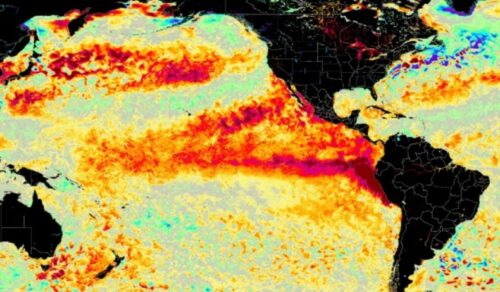 “A satellite that measures ocean levels across the globe seemed to pick up a massive glitch in June. Along the equator, the Pacific Ocean appeared taller than normal. The phenomenon is a sign of El Niño, the seasonal climate pattern that the National Weather Service reported had emerged earlier this month. Daniel Swain, a climate scientist for the University of California’s Agriculture and Natural Resources, expects an average 6 inches to 2 feet of temporary sea-level rise to hit California’s shores this year. King tides, which inundated parts of the Bay Area last winter, and storm surges could bring it higher. “We kind of get to the point where 2 to 3-plus feet of temporary sea-level elevation is possible near California later this year during a major storm event,” Swain said during an online briefing. He added: “We could see major coastal flooding this year. In fact, we may see all-time, record-high water levels during storm events or king tides this year.” … ” Read more from SF Gate.
‘Very anomalous situation’ expected to create extreme fire danger in much of the West
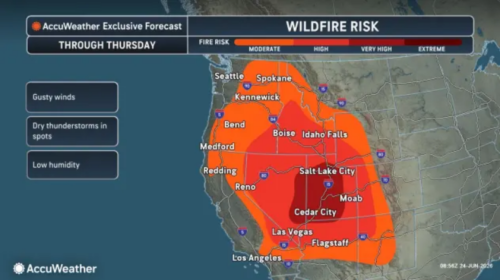 “Extreme fire danger is expected across much of the Southwest and Great Basin this week as weather quickly shifts from heat to lightning to wind. “This very anomalous situation, should it verify, would create very high to extreme fire danger for the Southwest that is uncharacteristic of late June,” the National Interagency Fire Center said. Dry lightning associated with the North American monsoon is first expected to develop across parts of Southern California on Tuesday afternoon and could spark fires. San Diego, Orange, Imperial, Riverside and San Bernardino counties are most likely to be hit by lightning, though there’s a chance thunderstorm energy doesn’t fully develop and these areas see no more than increased high-level clouds. … ” Read more from the San Francisco Chronicle.
SEE ALSO: ‘Extreme’ weather conditions could fuel erratic wildfires in western US, from AccuWeather
How farmers can help fight wildfires
“In 2017, as dozens of wildfires ravaged California’s wine country, University of California, Davis, researcher Natalia Pinzón witnessed the devastation firsthand. The fires underscored a critical gap: Farmers and ranchers needed to be more actively included in the state’s wildfire preparedness and mitigation efforts. Pinzón spoke with Ag Alert® about her research on wildfire impacts to agriculture and the role farmers and ranchers can play in fighting them. This interview has been edited for length and clarity.What risks do wildfires pose for people in agriculture? We’re talking about lost fencing—thousands and thousands of miles of lost fencing, which is so expensive. We’re talking about losses to irrigation systems, whether it’s drip irrigation or sprinkler systems, but also pipes like underground irrigation. … ” Continue reading at Ag Alert.
Tribes, environmentalists blast AB 2215 for clearing path to build Delta Tunnel
“Tribes and environmental groups have registered their strong opposition to a California water bill, AB 2215, that they say would clear the path for controversial water projects, including the embattled Delta Tunnel, without proper regulatory and public oversight. AB 2215 would extend the Department of Water Resources’ (DWR) water rights permit for the State Water Project until 2046. Bill proponents claim that it is a “critical response to climate change and ensuring reliable water supplies,” but opponents say the very opposite is true. … ” Read more from the Daily Kos.
NOAA to allocate $21.3 million in support of California’s beleaguered commercial salmon fishery
“California’s troubled commercial salmon fleet, fishing this year for the first time since 2022, is in store for some federal disaster aid after the Trump administration announced it would allocate $21.3 million to support the state’s beleaguered fishery. The June 17 announcement by the National Oceanic and Atmospheric Administration, or NOAA, follows years of requests for help from a West Coast industry still reeling after a historic closure that banned all California salmon fishing in 2023, 2024 and 2025 due to low ocean forecasts of returning fish. California lawmakers first requested assistance from the Biden administration in April 2023, eventually securing $20.6 million in February 2024 to offset losses. California officials and industry representatives stressed it was not enough. … ” Read more from the Santa Rosa Press Democrat.
In commentary today …
Why operating a desalination plant in California is a high-stakes gamble
Attorney Keith R. Solar writes, “California’s acceptance of desalination has ebbed and flowed over the years as the state grapples with shoring up water security in the face of constant drought conditions. Recent discussions over “water swaps” have generated excitement over the possibilities. While regional water-sharing arrangements between neighboring states and California could result in new desalination facilities, the process of converting seawater into drinking water comes with a host of regulatory hurdles that make planning, permitting and operating reverse osmosis plants extremely challenging in California. … ” Read more from the Voice of San Diego.
Data centers are stewing in their own pollution
Columnist Mark Gongloff writes, “When “data centers” and “climate change” are in the same sentence, it’s usually about how the former are fueling the latter with their thirst for energy. But the latter can also make life expensively miserable for the former. Maybe it’s not a great idea to pollute a planet if you have to share its atmosphere. About 6% of nearly 3,000 data centers planned around the world are in places that will immediately put them at high risk of damage because of extreme weather, according to a new study by the risk-analytics firm XDI Pty Ltd. “High risk,” in this case, means these data centers could essentially be uninsurable without hardening themselves against fires, floods or whatever else their local environment will throw at them. This is XDI’s follow-up to its report last year estimating that about 7% of nearly 9,000 built and planned data centers will be at high risk of climate damage by 2050. An additional 20% will be at “moderate” risk, meaning they’ll be able to get insurance, but it will be costly. … ” Read more at the San Jose Mercury News.
A super El Niño threatens disaster. Trump is handling it recklessly
Terry Garcia, former deputy administrator of the National Oceanic and Atmospheric Administration, writes, “This month, Noaa confirmed the formation of El Niño in the tropical Pacific and issued an official advisory. Forecasters expect it to strengthen through the winter of 2026–27, with a 63% chance it will reach the “very strong” threshold, placing it among the strongest events in the modern record dating back to 1950. … In the face of this evolving threat, the Trump administration has sought to cripple our forecasting capabilities. This spring, the National Science Foundation (NSF) began “descoping” the Ocean Observatories Initiative, a network that delivers real-time ocean data from more than 900 sensors. “Descoping” is bureaucratic language for dismantling the program. The agency announced plans to pull all sensors, buoys and other equipment from four of the program’s five sites. These arrays span from the Gulf of Alaska to the Irminger Sea between Greenland and Iceland, and down to the waters off North Carolina. Built over a decade at a cost of approximately $386m, the system is among the most advanced ocean-observing networks in the world. Make no mistake. Pulling these arrays was not a budgetary exercise. Rather, the NSF’s actions are more properly viewed as an extension of the Trump administration’s broader assault on federal climate science. The objective is apparently to weaken the programs that measure climate change and then claim the problem is “uncertain”. But turning off the alarm does not put out the fire. … ” Read the full commentary at The Guardian.
In regional water news and commentary today …
NORTH COAST
Klamath River salmon wins Endangered Species Act protection in court ruling
“The Ninth Circuit Court of Appeals ruled in favor of the Yurok Tribe, Pacific Coast Federation of Fishermen’s Associations and the Institute for Fisheries Resources in a case determining that a large federal irrigation project near the Klamath River’s headwaters must follow Endangered Species Act protections for at-risk salmon and suckers. The court’s decision confirms that the Bureau of Reclamation’s operation of the 240,000-acre Klamath Irrigation Project must follow the Endangered Species Act and ensure the survival of Southern Oregon/Northern California Coast Coho salmon and Chinook salmon. The ruling reaffirms that the operation and management of the Klamath Project must be conducted in a way that does not directly contribute to the extinction of ESA-listed species. … ” Read more from KDRV.
SEE ALSO: US Appeals Court Protects Klamath River’s Recovering Salmon Runs, from the Redheaded Blackbelt
Eel River dam removal hearings begin in Ukiah
“Federal regulators are taking public comment on a proposal to remove two Eel River dams and build a new water diversion system for the Russian River. Federal regulators will hold two public hearings this week in Ukiah on a proposal to remove two dams from the Eel River, a plan that has drawn broad regional support but recently faced new political opposition. The hearings are part of the Federal Energy Regulatory Commission’s environmental review of Pacific Gas & Electric’s plan to decommission the Potter Valley Project. The project diverts water from the Eel River to the Russian River for irrigation and generates hydroelectric power. PG&E says the aging dams are no longer economically viable. A coalition of tribes, environmental organizations and public agencies has developed an alternative water diversion system to the Russian River while restoring fish habitat in the Eel River. … ” Read more from Jefferson Public Radio.
The State just threatened $5,000-a-day fines over clay discharge into a Humboldt County salmon stream
“The state issued abatement orders over bentonite clay discharge into Redwood Creek, one of the most important salmon and steelhead streams on the North Coast, claiming that Briceland Road property owner Mykal Coelho and three companies involved in California’s Broadband for All fiber project are the perpetrators. The Water Board documented clay deposits in roadside ditches along Briceland Road that are funneling sediment directly into the creek. Fines of up to $5,000 per day are being threatened if the discharge is not stopped. … ” Read more from Active NorCal.
SIERRA NEVADA
Fire and ice: ‘Snow drought’ could impact water, wildfire
“In January, the U.S. Drought Monitor declared California drought-free for the first time in 25 years. The state has received 97% of average precipitation since the water year began Oct. 1 2025. So why is everyone so concerned about water? It comes down to snowpack. The University of California, Berkeley’s Central Sierra Snow Laboratory recorded a cumulative 294 inches of snow for the winter season, about 40 inches below average and 87% of the annual median. The problem is, it didn’t stick around. The West saw its warmest winter on record, according to NOAA’s National Centers for Environmental Information, causing the Sierra snowpack to melt fast and early — a phenomenon known as a snow drought. Snow melt recorded March 1 had reached levels usually expected by May, according to California’s Department of Water Resources. By April 1, snowpack across the state was just 18 percent of average, data showed. The National Integrated Drought Information System called this winter’s snowpack the second lowest on record for California since 1981. … ” Read more from the Plumas Sun.
Golden mussels could invade Lake Tahoe, cloud its famed waters, and unravel its food web
“An invasive species warning is hanging over Lake Tahoe’s clear water. Conservation advocates told the San Francisco Chronicle that golden mussels could speed the lake’s shift toward greener, murkier conditions and make the “Jewel of the Sierra” much harder to protect. On May 31, inspectors stopped a boat bound for Tahoe after finding four golden mussels attached underneath it. The vessel had recently been in waterways near Sacramento. Golden mussels can spread easily because they are able to survive for days out of the water, reproduce quickly, and cling to boats, trailers, paddles, and fishing gear. … ” Read more from The Cool Down.
Yuba Water awards design contract for New Colgate penstock rebuild
“Yuba Water Agency has awarded a contract to GFT Inc. for engineering and design services related to rebuilding the penstock that ruptured above the New Colgate Powerhouse in February. The initial contract, valued at nearly $2m, covers a condition assessment of the penstock and analysis of repair and replacement options. The work is intended to support detailed engineering design and future construction planning. “While this contract does not cover the actual construction of the repaired penstock, it does position us to move quickly once we have the results from the forensic investigation,” said Ryan Perrin, Yuba Water’s project manager overseeing the work. “Our goal is to take what we learn from the investigation, develop engineering design plans and award a future construction contract to rebuild the penstock and get us back in business.” … ” Read more from International Water & Power.
Above the Tuolumne, a forest gets ready for fire
“A recent fuel-reduction treatment near Long Barn shows how strategic forest management can protect wildlife, waterways, and neighboring communities before wildfire strikes. At first glance, the difference between these two forest scenes may seem simple: fewer shrubs, fewer small trees, and more open space between the larger trunks. But the change represents something much bigger—a forest that is better prepared for fire. These before-and-after photographs were taken in a treatment unit just east of Long Barn, near the North Fork Tuolumne River. The work is part of the SERAL 2.0 Excelsior Fuels project, a broader effort to improve forest resilience and reduce the risk of severe wildfire across the Stanislaus National Forest. … ” Read more from the Yosemite Rivers Alliance.
What is the quality of Tuolumne Utilities District water?
“Tuolumne Utilities District (TUD) customers can find out the quality of water coming from their taps, as the district has released its Annual Water Quality Report. Also known as “The Consumer Confidence Report,” it summarizes water quality monitoring and testing for the 2025 calendar year and is required under state regulations to provide customers with an overview of the water quality. The report addresses the district’s 11 treated water service regions, comprised of nine surface water treatment plants and nine operational wells. TUD’s surface water is supplied from the South Fork of the Stanislaus River at Lyons Reservoir via the Tuolumne Main Canal under a contract with Pacific Gas and Electric Company (PG&E). … ” Read more from My Mother Lode.
NAPA/SONOMA
Prescribed burn at Foothill Regional Park in Windsor reintroduces flames near neighborhood menaced by 2019 Kincade Fire
“White wisps of smoke drifted across Foothill Regional Park on Tuesday afternoon, June 23, as firefighters carrying drip torches filled with diesel and gasoline, methodically ignited dry grasses across a hillside on Windsor’s eastern flanks, part of a prescribed fire designed to reduce wildfire fuels and restore fire-adapted habitats. The 12-acre burn, conducted by Sonoma County Regional Parks in partnership with Cal Fire and the Sonoma County Fire District, began around 11 a.m. near the park’s three small ponds. Ignitions concluded around 2 p.m., though crews remained on site for several hours afterwards to monitor the area and extinguish any remaining hot spots. The project targeted grasslands and other brush along strategic park boundaries as wildfire season ramps up. But organizers said the operation was about more than reducing fuels. … ” Read more from the Santa Rosa Press Democrat.
Commentary: Regulatory costs put Napa County wine future at risk
Johnnie White writes, “Our family has farmed in Napa County for six generations. Through droughts, recessions, changing markets and evolving technologies, we have adapted time and again to keep our land productive and business viable. We have never expected farming to be easy. But we have always believed it would remain possible. Today, that assumption is no longer safe. The mounting weight of regulations continues to push many of us to a breaking point, threatening not just individual farms but the future of agriculture in California. … ” Read more from Ag Alert.
BAY AREA
Divided panel backs restoring ‘parkland’ status to Baylands site
“The ribbon of land stretching along the southeast edge of Palo Alto’s wastewater plant has little to offer at first glance, but plenty on the second or third. It stretches between two critical environmental habitats, the Baylands Harbor Marsh on its northern end and the Emly Renzel Wetlands on the south. When Palo Alto voters agreed to remove “parkland” status from a 10-acre area around this corridor, proponents noted that the flat strip of land currently doesn’t have any attractive features or amenities. “Many times, it was presented as if there’s nothing there, it just stinks, nobody uses that we don’t need it,” Shani Kleinhaus, a member of the Parks and Recreation Commission recalled during a June 23 discussion of the site’s future. … ” Read more from Palo Alto Online.
CENTRAL COAST
Pajaro Regional Flood Management Agency to host community forum
“As projects continue to take shape to reduce flood risks along the Pajaro River — and to prevent a repeat of the 2023 levee breach that left the town of Pajaro flooded — the Pajaro Regional Flood Management Agency will host a community forum June 30 to provide updates on four local projects. The Pajaro River Levee was constructed in 1949 and has experienced multiple floods, most recently in March 2023 when heavy rains resulted in a breach of the levee that flooded Pajaro, resulting in residents being evacuated or displaced, structures receiving water damage and agricultural fields being soaked. That same year, the Pajaro Regional Flood Management Agency entered into a Project Partnership Agreement with the U.S. Army Corps of Engineers and the neighboring city of Watsonville to expedite upgrades to the levee system. … ” Read more from the Santa Cruz Sentinel.
California State Lands Commission approves slant well lease application for Monterey Peninsula Water Supply Project
“Today, the California State Lands Commission (SLC) voted to approve California American Water’s application for the lease of state lands that comprise a part of its Monterey Peninsula desalination project. The SLC evaluated California American Water’s lease application for the construction and use of four new subsurface slant wells and the conversion and use of one existing subsurface slant well for the proposed desalination plant on the Monterey Peninsula. During the three-year application review process, SLC staff gathered extensive community input through environmental justice outreach, outreach to the Monterey community and through tribal consultation. “We thank the State Lands Commission for their thorough review of the facts and the approval of California American Water’s lease application,” said Sarah Leeper, President of California American Water. “This decision is integral to bringing reliable, drought-proof water to the Monterey peninsula to provide opportunities for sustainable growth while reducing dependence on the Carmel River.” … ” Read more from PR Newswire.
Arroyo Grande voters to decide on their water supply
“For more than three decades, Arroyo Grande has given its residents the ability to choose where the city gets its water from. Now, the choice is in their hands once again. Arroyo Grande relies entirely on local water sources. The largest of those is Lopez Lake, which supplies 60% to 65% of the city’s water. With the city so dependent on a single source that can fluctuate year to year, some residents say it’s hard not to worry. … Voters this November will decide on measure D-26. “I’m happy that we’re doing something about the dire straits that we’re going to wind up in otherwise,” said Arroyo Grande resident Will Reichart. If passed, the city could buy water from the state without being in an emergency or needing voter approval. … ” Read more from KSBY.
SAN JOAQUIN VALLEY
Modesto Irrigation District president seeks state investigation into director’s alleged water theft
“The Modesto Irrigation District board president has requested that the state Attorney General’s office open an investigation into Director Larry Byrd’s alleged water theft. The request comes after the MID board hit a stalemate in February about continuing an investigation into Byrd’s use of district water from 2021 to 2024. Board President Robert Frobose sent a letter to Attorney General Rob Bonta on Tuesday asking state officials to step in to look into the claims. “I just want the truth to be known, whatever that truth is,” Frobose told The Modesto Focus. “If the allegations are to be found true, then I want the financial recovery from Larry Byrd, so that the ratepayers are made whole. When somebody steals something from MID…the rest of the ratepayers are picking up that tab.” … ” Read more from SJV Water.
Kings County groundwater agencies move closer toward reconciliation
“Fractures are rapidly mending in the Kings County region after groundwater agencies split apart two years ago when the state placed the region on probation. In the latest show of unity, the Mid-Kings Groundwater Sustainability Agency (GSA) voted June 9 to join a region-wide effort to write a single groundwater management plan, rather than each of the five GSAs writing its own. At the same meeting, a representative of the Kings County Water District, which abandoned the GSA in 2024, asked to reconcile. After the district left, Mid-Kings had to be re-formed with Kings County as its lead agency and Chuck Kinney, the county’s redevelopment director, as its general manager. “I think Kings County Water District, we’ve all agreed, all the board, has agreed that we would like to have some type of involvement back with the GSA because we feel like Chuck and you guys need help,” Mello said during the June 9 meeting. “Whether it’s financial, staffing, whatever.” … ” Read more from SJV Water.
‘We’re very conscious of the notion that data centers are in the public eye’: CRC proposes data center outside of Taft
“A dusty oil field in Elk Hills may soon be the home of data center led by the California Resource Corporation. “We’re very conscious of the notion that data centers are in the public eye now nationally. We know that, we understand that. That is why we’re committed to preemptively designing the data center in a way that doesn’t even bring to bear issues that the community would be concerned about,” said CRC’s Chief Sustainability Officer, Chris Gould. The CRC officially filed to create a 600,000 square foot data center facility Monday. But what do residents say about the potential new project and what steps are in place to prevent potential contamination? “I was kind of surprised that they were looking at out here in the oilfields. I started to do some research. I don’t know much about the data centers,” said Taft resident, Patti Bench. … ” Read more from KGET.
SOUTHERN CALIFORNIA
Heat and a chance of thunderstorms: A look at LA’s elevated fire risk this week
“A chance of dry lightning and thunderstorms could increase fire risk across the region as this week’s heat lingers, according to the National Weather Service. The Antelope and Cuyama valleys could see temperatures as high as 106 degrees. Tuesday and Wednesday will be the hottest period for most of Southern California. The L.A. County Department of Public Health also issued a Heat Advisory through Thursday for valleys and mountain communities. The advisory is issued when hot weather may cause heat-related illness for some people. To top it off, meteorologists say there will also be increased humidity. … ” Read more from the LAist.
Boyle Heights fire: LA County declares emergency; reports of LA River pollutants studied
“The Los Angeles County Board of Supervisors ratified a local emergency and streamlined county resources on Tuesday, June 23, for residents in unincorporated East Los Angeles and nearby cities affected by breathing thick smoke from the warehouse fire in Boyle Heights burning for a seventh day, as reports of possible environmental damage surfaced along the area’s waterways. Smoke rose anew from the smoldering Lineage cold-storage facility on Tuesday, again darkening the skies in the area. Fire crews continued to pour water on the fire inside the badly damaged hulk; they still hope to fully douse the frustrating week-old blaze by Friday. First District Supervisor and Board Chair Hilda Solis said at the board meeting she’d heard runoff from firefighting efforts had reached the Los Angeles River, killing fish downstream. However, killing of fish could not be verified by officials at the Los Angeles City Fire Department, who were still checking on the situation Tuesday afternoon. … ” Read more from the LA Daily News.
SAN DIEGO
San Diego County Water Authority proposes 3% water rate hike for 2027
“The San Diego County Water Authority Monday proposed a 3% rate increase for 2027, with similar adjustments tentatively planned through 2032. SDCWA leaders said while the rate hike was painful, it was actually below the national rate of inflation and a significant decrease from earlier projections — at least partly due to two water-sharing agreements with other agencies signed this spring. “We’re keeping our promise to working families across the region by using new revenues to minimize water rate impacts,” SDCWA General Manager Dan Denham said. “At a time when costs are rising across the board, the water authority is focused on making a real difference for San Diegans.” … ” Read more from ABC 10.
City hall approves Tijuana River channel cleanup proposal
“The Tijuana City Hill has approved a formal measure urging the National Water Commission (Conagua) to carry out immediate cleaning and maintenance efforts along the Tijuana River channel and the Alamar River bed. The initiative, introduced by councilmember Miguel Loza, responds to mounting complaints from local residents, business owners, and commuters who navigate the areas surrounding both waterways on a daily basis. Beyond the request for federal intervention, the agreement also seeks to strengthen coordination among municipal, state, and federal authorities is to restore the safety, functionality, and overall condition of these critical infrastructure corridors for the benefit of the surrounding communities. … ” Read more from San Diego Red.
Along the Colorado River …
Will El Niño ride to the Colorado River’s rescue?
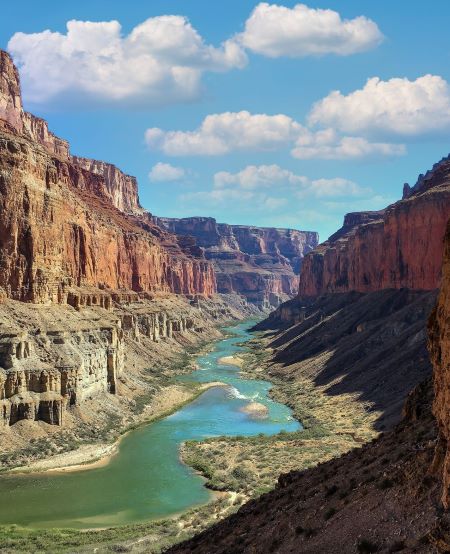 “Twenty years ago, some might have hoped that drought in the Colorado River Basin would diminish or disappear altogether. Hope remains but of a distinctly diminished variety. Will the arriving El Niño will bring a rare deluge, bringing the water levels of Lake Powell from the brink of deadpool, too low to release water downstream? Two books have been written in the last few years with “deadpool” in their titles, indicating how close to the edge we have been. If not for a very big snow year in 2022-2023, we might well have been there in 2023. Now, we’re in the same place or worse. It’s very possible that Lake Powell will have too little water by September to generate electricity. That is called minimum power pool. Deadpool lies just a few steps below. … ” Read more from KUNC.
As Colorado River states struggle to reach agreement, New Mexico brings on a fresh voice
“The Upper Colorado River Commission welcomed a new representative from New Mexico at a meeting in downtown Denver on Tuesday, where it discussed ongoing negotiations over how to share America’s most over-allocated river. Tanya Trujillo, deputy state engineer and senior water policy advisor to New Mexico Gov. Michelle Grisham, replaced Estevan López as the state’s top negotiator on the Colorado River, which supplies water to 40 million people across seven Western states, 30 tribes and Mexico. Trujillo served as the Interior Department’s assistant secretary for water and science under President Joe Biden. She said she had not previously been part of negotiations, but she carries decades of familiarity with the basin and its challenges. “This, for me, is not a congratulations moment,” Trujillo said during her opening remarks, noting that she had not asked to be appointed to the role but was given it after Grisham became discouraged by the lack of progress in negotiations. “We are in a crisis.” … ” Read more from Inside Climate News.
Can Yuma soften the blow of Colorado River cuts?
“The federal government is considering a framework to cut Colorado River water use in Arizona, California and Nevada by as much as 3 million acre-feet a year. Though the move is supposed to protect Lake Mead — which is on a swift and perilous path downward — it also could dry up taps and idle prime farmland across Arizona, devastating communities across the state. A diverse swath of cities and irrigation districts, to their credit, are working overtime to blunt the impact of these potential cuts. But there could be roadblocks. Let’s start with Yuma. Five irrigation districts serve the area. They primarily serve farmers and rely on third-priority water, which is later in line for cuts than many users in central Arizona and Mohave County. The separate Yuma County Water Users Association delivers water to farmers, cities and tribes that hold some of the most senior water rights in the state. There has long been fear that powerful central Arizona interests would use political force to take this water. But — at least for now — the focus is on finding mutually beneficial deals to keep taps flowing in central Arizona without decimating critical agriculture production in Yuma. … ” Read more from the Arizona Farm Bureau.
Arizona: Buckeye discusses water future amid shortages
“Buckeye city leaders received a sobering update on Colorado River conditions and reviewed a series of proposed water policies designed to guide the city’s long-term water management and sustainability efforts. The presentation, delivered by Central Arizona Water Conservation District Board President Terry Goddard and Water Resources Director Terry Lowe, focused on ongoing negotiations surrounding the future management of the Colorado River system and the city’s approach to water planning, conservation and resource management. Goddard told council members that prolonged drought conditions and ongoing interstate negotiations are creating uncertainty for communities that rely on Colorado River water. … ” Read more from West Valley View.
Arizona: Scottsdale braces for Colorado River water cuts by looking for new sources
“The city of Scottsdale is looking to acquire new water sources as it braces for Colorado River water cuts. Scottsdale gets about 70% of its water supply from Colorado River water delivered through the Central Arizona Project, or CAP. CAP is a wholesaler of Colorado River water that provides water to roughly 80% of the state’s population. As the federal government creates a new operating agreement for the river, it’s still unclear how much of CAP’s allotment will be cut. The current agreement expires this year, and the seven Colorado River basin states failed to agree on a new plan. … ” Read more from KTAR..
Arizona: Cave Creek leaders to vote on crucial water-sharing partnership with Peoria
“Cave Creek town leaders are scheduled to vote Tuesday night on a crucial water-sharing partnership with the City of Peoria. It’s designed to protect the community from Colorado River shortages. The proposed agreement would serve as a short-term safety net to keep Cave Creek’s water flowing through 2033 while the town develops more permanent, long-term water supplies. The Cave Creek Town Council meeting and vote will take place on Tuesday at 5 p.m., following the Peoria City Council’s unanimous approval of the plan last week. Cave Creek officials state that a partnership of this nature is desperately needed due to the increasing unpredictability of their current water supply. … ” Read more from Channel 12.
Arizona: Why did all the fish die at San Carlos Lake? Drought…and water law, experts say
“San Carlos Lake has been closed for nearly three weeks, the entire fish population has died off, and experts say it may happen again. The reservoir, about 160 miles from the Phoenix metro area, has lost so much water that it has caused a massive fish die-off. Rhett Larson, a professor of water law at Arizona State University, says this winter was the worst he has seen in two decades. “This last winter was catastrophically horrible. I mean, we’ve had some bad winters in the last 20 years, but this past winter was the worst we’d ever seen,” Larson said. The snow drought lowered water levels, Larson said, but Arizona’s water laws also contributed to the die-off. “It’s been a really bad winter; there’s a lot less runoff, so it’s a bad drought year. But there’s also a legal component of it, which is there’s required legal releases from Coolidge Dam that have to go to downstream farmers who have water rights,” Larson said. … ” Read more from Channel 12.
Utah officials warn of ‘totally unprecedented’ water shortages as towns run dry
“Utah’s top official overseeing the Colorado River gave a serious warning alongside his counterparts from other states Tuesday: Utah’s farmers and ranchers, as well as some rural towns, are grappling with drastic water shortages from the ongoing drought. “I want you all to recognize the significance and severity of the things we’re dealing with — totally unprecedented,” said Gene Shawcroft, Utah’s Colorado River commissioner, during Tuesday’s meeting of the Upper Colorado River Commission. “The real question is, what happens if next year looks like this? And I hope we don’t have to answer that question.” Utah’s state engineer has already cut back “some of the most senior rights in Utah on the Colorado River system,” Shawcroft said. Those include water rights that date back to 1886 on Ashley Creek and 1906 on the Duchesne River, both tributaries to the Green River in eastern Utah. … ” Read more from the Salt Lake Tribune.
Upper Colorado River states convene in Denver amid ‘dire’ drought crisis and looming deadline
“Representatives from Colorado, New Mexico, Wyoming and Utah gathered in Denver on Wednesday for the 317th regular meeting of the Upper Colorado River Commission, confronting what officials described as one of the worst water years on record as a critical October deadline for new operating rules for the river draws closer. Colorado River Commissioner Rebecca Mitchell opened the meeting with a stark assessment of conditions across the four-state upper basin. “The facts on the river in Colorado are dire this year,” Mitchell said. “The reason you all are in this room is because it is dire. The pain is felt in every corner of every state in the upper basin.” … ” Read more from Channel 9.
Colorado streamflows projected to be a quarter of normal this summer
“Colorado’s rivers and streams are expected to flow at only a quarter of normal levels during June and July, following what the Natural Resources Conservation Service referred to as an “unusual volatile winter” in its June water supply outlook. On the Western Slope, the outlook is even more grim, with the Colorado River headwaters basin expected to see streamflows 21% of normal and the Yampa-White-Little Snake basin 19% of normal during these two months. This year, Colorado’s snowpack accumulation was the lowest on record, affirmed Nagam Bell, a hydrologist for the Natural Resources Conservation Service in the state, at the June 16 Colorado Water Conservation Board’s water conditions monitoring meeting. … ” Read more from the Craig Daily Press.
SEE ALSO:
- Colorado River’s Dire Water Picture Expected To Hit Green River Ranchers Hard, from the Cowboy State Daily.
- In Wyoming, will ranchers opt in to conserve Colorado River water?, from the WyoFile
In national water news today …
Majority of datacenters are vulnerable to climate threats like floods and fires, study finds
“Amid rising concern that the artificial intelligence boom is fueling the climate crisis, a new report has found that nearly 80% of datacenters are also exposed to extreme climate hazards, including flooding, extreme winds and wildfires. Those impacts are leaving the infrastructure vulnerable to disrupted operations, increased time offline, and inflated insurance and repair costs, the research from climate risk analytics firm First Street shows. “Where you build a data center determines a large share of what it will cost to run for the next 20 or 30 years,” said Jeremy Porter, chief economist at First Street, in a press release. “Climate is a big part of that: cooling, water and reliability all depend on location. But most valuations still focus on growth and treat climate as a secondary concern.” … ” Read more from The Guardian.
War‑induced fertilizer shortage may be reducing US soil and water pollution
“American farmers are expected to plant several million fewer acres of corn in 2026 than they did in 2025, as the closure of the Strait of Hormuz throttles a key fertilizer trading corridor, along with the energy and raw materials needed to produce and transport fertilizer. The closure is disrupting deliveries of about one-third of the world’s traded agricultural fertilizers. Fertilizer prices are rising, and farmers worldwide are cutting back on fertilizer use or shifting to less fertilizer-intensive crops. Corn is one of the most fertilizer-intensive and widely grown crops in the United States, but the disruption extends far beyond a single crop or a single nation. These changes are often discussed as a threat to global food supplies – and they are. But as researchers who study agricultural nutrient cycles and nutrient pollution of our waterways, we suspect that the picture is more complicated, and in some ways more hopeful, than the headlines suggest. … ” Read more from The Conversation.

