
A wrap-up of posts published on Maven’s Notebook this week …
Note to readers: Sign up for weekly email service and you will receive notification of this post on Friday mornings. Readers on daily email service can add weekly email service by updating their subscription preferences. Click here to sign up!
In California water news this week …
Is climate change supercharging El Niño? Scientists don’t agree.
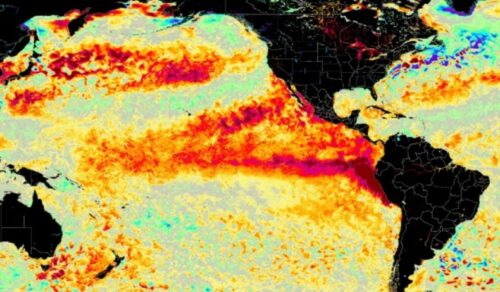 “It’s a vigorous debate taking place right now among scientists around the world, with far-reaching implications for extreme weather and costly disasters: Is climate change making El Niño more intense? El Niño, the natural phenomenon that occurs every few years and pushes up global temperatures, has just begun and is expected to continue through 2027. Scientists say this latest version is likely to be especially potent and could smash records. As greenhouse gasses heat the planet, El Niño events over the past few decades have been comparatively strong. The run of powerful El Niños since the 1980s stands out when measured against the past 600 years. That’s led some scientists to suggest that climate change is supercharging El Niño. Others say there is no clear evidence to support that theory. … ” Read more from the New York Times.
7 ways El Niño and large marine heatwave could affect West Coast marine species
 “A large marine heatwave has bathed parts of the West Coast in very warm ocean waters over the past year, breaking temperature records in the Pacific. NOAA has also announced that El Niño has developed in the tropical Pacific and is predicted to intensify to a moderate or strong level this fall. El Niño represents another form of marine warming , though with different drivers and influences. The prolonged period of high temperatures could affect fisheries and marine life in the California Current that have already been buffeted by shifting ocean conditions over the last decade. One factor may help dampen the impacts, though: The same strong upwelling of cool water along the coast that fuels the West Coast ecosystem with nutrients could help keep some warmer waters at bay, as happened in 2025. … Here are some of the ways warming water can impact marine life, coastal communities, and economies. … ” Read more from NOAA Fisheries.
California’s shifting snowpack and the growing water gap
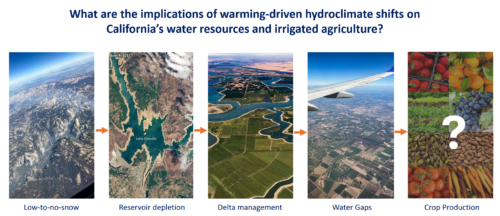 “Even by California’s standards of extreme variability, water year 2025–26 has been a strikingly poor snow year, especially in the mountains that feed the Delta watershed. A dry fall and January limited snow buildup even after a few early storms, and by late February snowpack had peaked at just 55% of the historical average. A subsequent heat wave then triggered an extraordinary melt event, and the snowpack never recovered. This year’s losses raise a larger question: Is 2025–26 an outlier, or does it reflect the increasingly unstable snowpack conditions California must now plan for as warming reshapes when and how water is stored and released? “Recent work such as the extreme events edition of the State of Bay-Delta Science, the Independent Science Board’s Emerging Climate Science Symposium, and the forthcoming 2026 update to the Delta Science Plan highlights why forward-looking science is vital to long-term planning and resilience in a water future that no longer resembles the past,” said Delta Lead Scientist Lisamarie Windham-Myers. … ” Continue reading from Maven’s Notebook.
Iranian hacker group alleges it breached Bakersfield, Visalia, Chico water systems
“An alleged breach of several California water systems by an Iranian-linked hacker group did not compromise any water production or delivery systems, according California Water Service Company. “We have conducted a preliminary scan of our internal IT and OT networks and have no signs of any compromise within our IT, water production, and delivery systems at this time,” an email Friday from Yvonne Kingman, director of communications for CalWater, states. Kingman said the investigation is continuing and she didn’t have further information in response to a follow up question about whether the hacker group, called Handala, had accessed other systems, such as CalWater’s billing system. Handala stated Thursday that it had gained access to several systems, including in Bakersfield, Visalia and Chico and showed screenshots of what it said were residents’ bills, according to several news sites. It claimed to have five gigabytes of data from the alleged breach on its website, according to Iranian news network Press TV. … ” Read more from SJV Water.
Water Commission increases potential funding for Sites Project
“The California Water Commission on Wednesday committed $268.9 million in conditional supplemental funding to the Sites Project to offset inflation and for additional public benefits. These funds, administered through the Commission’s Water Storage Investment Program (WSIP), were made available from Proposition 1 (2014) and Proposition 4 (2024) and are an investment in the public benefits offered by the Sites Project. … With this additional funding, the Sites Project is eligible for a total of $1.363 billion in WSIP funding. To receive funding from the Commission, the project must first meet certain voter-mandated requirements, including securing financing, obtaining permits, completing environmental review, and contracting with the State agencies that are overseeing the administration of the public benefits. … ” Read more from the California Water Commission.
California’s waterways could get clogged by a problem that didn’t exist two years ago
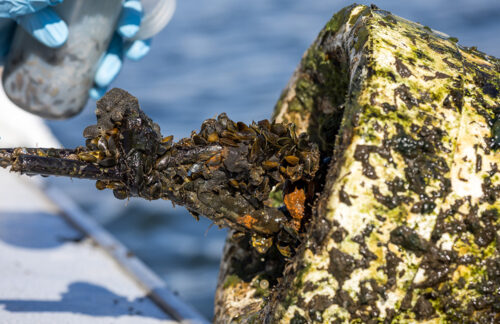
Xavier Mascareñas / DWR
“When golden mussels were found in an international shipping channel in Stockton nearly two years ago, marking the first detection of the invasive shellfish in North America, state officials knew it was going to be bad. Now those fears are being borne out. The roughly 1-inch-long, golden-brown mollusks, native to Asia, have spread from the Sacramento-San Joaquin River Delta, where they were initially spotted, through canals and aqueducts to the Bay Area and Southern California. Along the way, they’ve blanketed boats and docks with their crusty colonies and gummed up pumps and pipelines at major water facilities. “The mussels have the ability to clog an entire pipe,” said Jennifer Allen, spokesperson for the Contra Costa Water District, which is dealing with the pest in its water intake fixtures. “Getting in to clean all the infrastructure is a massive amount of work and potentially requires shutting down parts of the system.” She added, “We’re really only seeing the beginning of what the impacts are.” … ” Read more from the San Francisco Chronicle.
The scourge of the Delta: Dredge it up!
“Overbite clams (Potamocorbula amurensis) are a small species of bivalve native to Eastern Asia. They have been present in the San Francisco Bay estuary since 1986, and given their ability to quickly multiply and spread, are considered highly invasive within this range (Carlton et al., 1990). Overbite clams consume phytoplankton and copepods, which are also necessary food for the early life stages of many native fish. The sheer abundance of these overbite clams has contributed to the collapse of the pelagic food web in Suisun Bay due to loss of those prey species (Sommer 2007). This has done extensive damage to local populations of many iconic fish species like the Delta smelt, longfin smelt, and striped bass (Sommre 2007). Despite this sad state of affairs, there may be some hope on the horizon to rein in the destructive impacts of overbite clam. … ” Read more from the California Water Blog.
The essential role of Tribes in regional water management
 “Tribal nations inhabit nearly every watershed in California, yet Tribal water rights are often poorly understood. In an event earlier this month, Letitia Grenier, director of the PPIC Water Policy Center, presented new research about the history and status of Tribal water rights, which was followed by an expert panel discussing why these rights matter. California is home to 109 federally recognized Tribes and more than 55 Tribes that are not currently recognized. Water rights are essential to Tribes’ health, economy, and well-being, and Tribes are deeply involved in regional water management as the state confronts challenges of water availability and a changing climate. “We have to cooperate more, and Tribes are a part of that,” said Grenier, citing how water managers and regulators are increasingly referencing Tribes’ traditional knowledge of California’s ecosystems. … ” Read more from the PPIC.
Price-tagging nature: Inside mitigation banking—the multibillion-dollar industry where restoring and preserving rare habitat and species makes big money
“The spindly legs and elegant flight of the whooping crane could go down in history as a mascot for the melding of modern ecology and economics. In 1978, the federal government’s Army Corps of Engineers granted permission for breaking ground on a dam project in Wyoming, a massive undertaking that would supply water to eight adjacent states. The State of Nebraska and various environmental organizations contended that the dam would divert precious water from the wetlands and meadows around the Platte River that were a critical stopover on the annual migratory flight of whooping cranes. Further stress on the already endangered cranes, they argued, would sentence the species to extinction. A judge agreed, and the defendants, including the Army Corps, settled. The developers would proceed with the dam project, but also establish a $7.5 million fund for the “maintenance and enhancement” of the wetland habitat. Thus was born the first high-profile environmental trade-off, according to Laura Martin, a historian and ecologist, in her book Wild by Design: Restoration in one place to compensate for ecological harm somewhere else. … ” Read more from Bay Nature.
A solution to data center backlash? Put them in oil fields.
 “Most Americans loathe data centers. Recent polling found that Democrats and Republicans alike would oppose having one in their neighborhood, and hundreds of communities across the country have fought against them, citing fears about noise, water contamination, and energy bills. After years spent courting tech companies, many politicians are now vowing to protect their constituents from their development. In just the past month, policymakers in New York, Texas, Pennsylvania, and Utah have proposed limits on the facilities. For the AI startups and others racing to secure more computing power, the question seems to be not which projects will face opposition, but which won’t. A project unveiled this week in California’s Central Valley suggests a potential answer. California Resources Corporation, the state’s largest oil company, wants to build a 600,000-square-foot data center campus in the Elk Hills oil field about two hours north of Los Angeles. It hopes to avoid the nationwide backlash from communities that have watched the outfits developing these sprawling operations swallow up farmland or install diesel generators near residential neighborhoods. … ” Read more from Grist.
California’s high-speed rail may be laying the way for a ‘valley of data centers’
“One day, bullet trains could zip from a palm-lined street in Anaheim to the foot of Salesforce Tower in SoMa. Along the way, they may pass through a new kind of California landscape: vast acres of warehouses, all humming with servers. That’s the dystopian future that Visalia resident Joseph Mello conjured when he addressed the High-Speed Rail Authority board on June 1. Mello said he had read the draft business plan the board was set to approve that day, and one particular element struck him. The plan proposed leasing land or providing energy for data centers that could be built in the Central Valley, fueling a massive tech boom up north. “As a potential rail user,” Mello said, “I do not want to ride through a valley of data centers.” … ” Read more from the San Francisco Chronicle.
California Forever: Is Sacramento budget bill a step to bypass Solano County regulations? Opposition group thinks so
 “Nate Huntington of Solano Together expressed concerns Monday that California Forever will seek to circumvent Solano County local control by obtaining needed regulation changes through a budget trailer bill passed by the California State Legislature. Huntington said his organization raised the alarm over the weekend because Monday is the deadline for the state’s budget to be passed for the upcoming fiscal year. He said a bill text could be available as soon as Monday evening, but noted that the governor’s office could add trailer legislation to the budget anytime in the coming weeks, usually before the end of June. “Sometimes items can be put in there that weren’t previously a bill before,” he said. In a statement to The Reporter on Monday, California Forever neither confirmed nor denied efforts to secure legislative action for itself. … ” Read more from the Santa Rosa Press Democrat.
How would California Forever’s proposed Solano shipyard affect the environment? Details are scant.
“A few miles down the Sacramento River from the small town of Rio Vista lies a 6.5-mile stretch of undeveloped riverbank that California Forever calls “the perfect location” for the nation’s largest shipyard. If the billionaire-backed development company, best known for planning a controversial 400,000-person city in Solano County, succeeds, this area will be transformed from a riverside grassland into an industrial zone. Here, laborers—or robotic systems—will work and weld metal, cut steel, install engines and wiring systems, apply anti-fouling paint, and so forth to produce (in the current vision) high-tech, crewless autonomous vessels that have been deemed a U.S. naval priority. California Forever says the shipyard will bring a windfall of jobs and potentially $93 million in local tax revenue to a struggling region, and alongside local and state officials, is pushing to build the shipyard as soon as possible. ..Yet even while California Forever has pushed to skip new environmental reviews, it has offered few or shifting details on what the infrastructure will be and how it might impact the Delta’s delicate biodiversity, Bay Nature has found. … ” Read more from Bay Nature.
In commentary this week …
Mark Arax essay: Welcome to California: land of plunder and hypocrisy
Mark Arax writes, “I was a fourth-grader in the public schools of California when I first learned about the Gold Rush. I remember our teacher, Mrs Dyer, passing down the story in the manner of lore. On the morning of 24 January 1848, James Marshall, a New Jersey boy come west, stumbled upon four shiny nuggets alongside the American River. He tried to keep his discovery a secret, but the shout of “eureka” from the dirt streets of San Francisco rang out across the shore. It unleashed a force that could not be contained. No need for manifest destiny. Overnight, 80,000 dreamers of every color, creed and country poured in. I didn’t know back then how story became myth and myth became story. The sordid details of history would be mine to fill in. The Gold Rush was California’s first extraction, a flash that cannonballed the whole mad state into being, and it ended the way all such plunders do. A handful of wealthy San Francisco industrialists made off with the riches. Marshall died so poor he could barely cover the price of his burial. … ” Read more from the Guardian.
How much flow preserves the Sacramento-San Joaquin Delta?
Edward Ring, Director of Water and Energy Policy at the California Policy Center, writes, “When choosing what policies and projects might best ensure abundant water for California’s ecosystems, farms, and cities, the role of the delta is central. Even if large scale desalination were to someday deliver over a million acre feet of water per year to California’s coastal cities, how we manage the delta affects many times that amount. … Regardless of how one may assess the many restrictions that govern how much water can be pumped into the aqueducts, and when, it is reasonable to accept that total exports are going to be lower in dry years than during wet years. This is reflected in the data. But during wet years, shouldn’t a statewide water strategy recognize some maximum amount of flow from the delta into the SF Bay necessary to preserve ecosystem health? And if so, couldn’t we consider any outflow beyond that amount simply overkill, and therefore wasted if it isn’t diverted? … ” Read more from Edward Ring.
A frank assessment is first step in shifting water priorities
David Sathuluri, researcher, and Marco Tedesco, professor at Columbia University’s Lamont-Doherty Earth Observatory, write, “California is in the middle of a quiet but high-stakes argument about what it would mean to fix our water system in a hotter, drier century, especially in the age of AI. Echoes of this argument will resonate in everyone’s lives. One side focuses on efficiency: building more conveyance, freeing up markets and moving water to its highest-value use. The opposite side insists that any reform must start from justice: the human right to safe water, tribal rights and the support to those communities already living with contamination and scarcity. A major new working paper from the National Bureau of Economic Research, “Measuring Water Misallocation in California,” speaks directly to this debate. Via detailed empirical work, it shows that California’s water system is ill-suited to the climate realities ahead. Using extensive satellite imagery, crop evapotranspiration data and field-level planting decisions, the authors mapped the productivity of water across the state’s irrigated lands. Results show that water is consistently more valuable south of the Sacramento-San Joaquin Delta than north of it. And yet legal and physical constraints make it hard to move water across this chokepoint. … ” Continue reading at the Santa Rosa Press Democrat.
California begins a new era of water planning
“For decades, California’s water planning efforts largely focused on managing scarcity. Senate Bill 72 marked a significant shift toward a different approach: building long-term water resilience through measurable supply targets, improved planning, and greater statewide coordination. That shift began several years ago when a group of local water agency leaders came together to discuss how California could better prepare for a future defined by climate volatility, aging infrastructure, and increasingly unreliable water supplies. Those conversations ultimately helped launch the California Water for All coalition and a broader statewide movement to modernize California’s approach to water planning. … ” Read more from the Northern California Water Association.
San Diego’s big bet on salt water
The Washington Post editorial board writes, “While cities across drought-stricken western states struggle to meet their water needs, San Diego has a surplus of the all-important resource. That’s largely thanks to the county’s investment in desalination, which other localities would be wise to consider. San Diego’s desalination plant first opened in 2015, and it now supplies about 10 percent of the county’s water — around 50 million gallons a day. That new supply has put the community on a more sustainable path. San Diego now has so much of the scarce resource, in fact, that its water authority recently struck a deal to sell its access to the Colorado River to Arizona and Nevada. San Diego’s success provides much-needed hope for the parched region. It’s also a useful counter to those who write off technology before it has a chance to mature. … ” Read more from the Washington Post.
In regional water news this week …
As parasites threaten juvenile salmon in the Upper Klamath River, the Karuk Tribe emphasizes that the ‘river is still in the early stages of healing’
“The Karuk Tribe today emphasized that Klamath River dam removal remains a historic and necessary step toward salmon recovery, while cautioning that recent detections of fish disease among juvenile salmon show that the river is still in the early stages of healing. Following dam removal, the Klamath has shown encouraging signs, including strong adult salmon returns and significant juvenile salmon outmigration from river reaches that had been devoid of salmon for a century. At the same time, monitoring has detected elevated levels of Ceratonova shasta (C. shasta), a fish parasite that can cause serious disease in juvenile salmon. Tribal fisheries staff note that the disease detections are occurring during a difficult water year marked by low snowpack, early snowmelt, low flows, and high water temperatures. These conditions can increase stress on juvenile salmon and create more favorable conditions for disease transmission. … ” Read more from the Lost Coast Outpost.
Ninth Circuit sides with Yurok Tribe over Klamath Irrigation Project
“The Ninth Circuit delivered a victory to the Yurok Tribe and fishing advocates on Wednesday, affirming a lower court’s finding that the U.S. Bureau of Reclamation must comply with the Endangered Species Act when operating the Klamath Irrigation Project. In a 2-1 decision, the appeals panel held the Endangered Species Act applies to the government’s operation of the Klamath Irrigation Project and that the rights of Klamath Project water users are subject to the requirements of the ESA. “The dissent misconstrues the direct issue on appeal here, which is whether the district court erred by granting declaratory relief on the question whether ‘[the Bureau of] Reclamation’s operation of the Klamath Project, including the exercise of its rights to store water in [Upper Klamath Lake] for irrigation use, is subject to compliance with the ESA.’ Our case law supports that the answer to this question must be ‘yes,’” U.S. Circuit Judge Ronald Gould, a Bill Clinton appointee, wrote for the majority. … ” Read more from the Courthouse News Service.
Trump administration ups ante in quest to thwart removal of PG&E’s Eel River dams
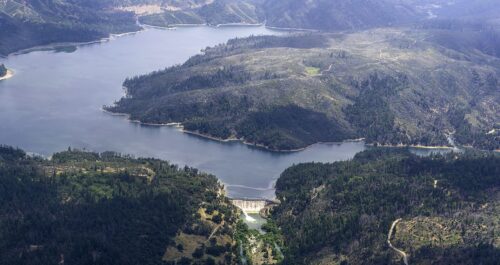
“A member of President Donald Trump’s cabinet on Monday intensified her ongoing campaign to thwart PG&E’s plans to eventually tear down a pair of century-old Eel River dams. Agriculture Secretary Brooke Rollins announced in a social media post that she and Interior Secretary Doug Burgum had met earlier in the day with Pacific Gas and Electric Co. CEO Patti Poppe, along with representatives from the Elsinore Valley Municipal Water District “to begin constructive negotiations on the future of the Potter Valley Project.” The administration’s “hope is clear,” she stated: to “keep the Scott and Cape Horn Dams in place and working for the communities they serve.” That goal stands in direct opposition to PG&E’s long-held plan to decommission the century-old dams, part of Potter Valley hydroelectric project that no longer made financial sense, the utility concluded in 2019. … ” Read more from the Santa Rosa Press Democrat.
Two-Basin Solution partners respond to meeting between USDA, Interior, PG&E, and Elsinore Valley Municipal Water District regarding Eel River Dams
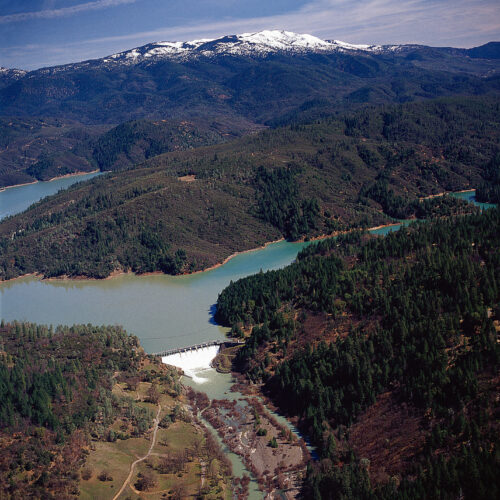
“Today, the coalition of water agencies, counties, Tribes, and conservation organizations behind the Two-Basin Solution expressed serious concern over reports that Agriculture Secretary Brooke Rollins convened a meeting with PG&E’s chief executive, Interior Secretary Doug Burgum and the Elsinore Valley Municipal Water District in Washington, D.C. regarding the future of the Potter Valley Project on the Eel River. “We share the Secretary’s concern with maintaining water security in the region, but the USDA’s actions undermine our locally negotiated agreement that provides that security” said Mari Rodin, a member of the City of Ukiah City Council and an appointee to the Mendocino County Inland Water and Power Commission. “It is incredibly important to us and our communities that control of resources stay in local hands.” … ” Continue reading from the Two Basin Solution Partners.
Tribe with senior Eel River water rights shut out of White House meeting
“Federal agriculture and interior officials convened a meeting Monday at the White House with PG&E and a Southern California water district over the future of the Eel River — and the tribe with senior water rights on that river was not in the room. The Round Valley Indian Tribes said Wednesday that Agriculture Secretary Brooke Rollins had called the meeting, which also included Interior Secretary Doug Burgum and representatives of the Elsinore Valley Municipal Water District. The subject was the Potter Valley Project, a hydroelectric complex on the Eel River that PG&E has moved to decommission. … ” Read more from the Mendocino Voice.
Internal documents from a Southern California water agency outline a vision to turn eel river water rights into a cash bonanza — at the expense of local users
“The Southern California water agency that is trying to acquire rights to Eel River water has been working behind the scenes to do so since at least December, despite never having had an open meeting on the subject. What does it want with those rights? The plan right now, such as it is, appears to be to sell water to Russian River water users in Sonoma and Mendocino counties at a high premium, and to use the proceeds to fund its own operations. All this is according to documents that local nonprofit Friends of the Eel received from the Elsinore Valley Municipal Water District in response to a Public Records Act last week, all of which pertain to the district’s early interest in the Potter Valley Project. “It’s important for Russian River water users to understand the threat to their water security that the Elsinore Valley Municipal Water District is making,” said Alicia Hamann, executive director of Friends of the Eel, in a statement to the Outpost today. … ” Read more from the Lost Coast Outpost.
Tahoe’s famously clear water is getting cloudier each summer — and scientists aren’t sure why
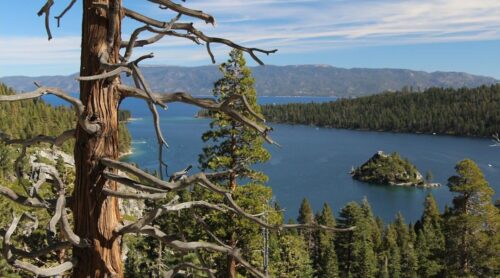 “To the throngs of visitors who’ll flock to Lake Tahoe’s shores this summer, the famously crystalline waters may not appear as clear as they remember. That’s because the lake is getting cloudier this time of year. New research from the UC Davis Tahoe Environmental Research Center shows that Tahoe’s clarity has been gradually worsening during the warm months for the past 60 years. In the 1970s, the average summertime depth of clarity was 84.8 feet; in the 1990s it dropped to 68.7 feet; and in the past decade it sunk to 57.2 feet. Since the first 10 years of recorded findings, the lake’s summertime clarity has declined by nearly 33%. … ” Read more from the San Francisco Chronicle. | Read via Yahoo News.
The curious comeback of Putah Creek’s salmon
“In California, a long-abused river has been reborn. For decades, humans disrupted its course and restricted its flows to the detriment of its ecosystem, only to lately reverse direction and restore it to a facsimile of its natural state. And salmon, the bellwethers of aquatic health, have responded, returning much faster and in greater abundance than anyone anticipated. This description applies not to the Klamath River — or not only to the Klamath, recently liberated from its four lower dams — but rather to the far less-celebrated Putah Creek. Near its headwaters in the Mayacamas Mountains, the Putah is narrow and boulder-studded; as it nears the Sacramento River’s floodplain, it begins to slow and broaden. Along its 85-mile course, it is imprisoned behind dams, siphoned off by ditches, squeezed between artificially straightened and hardened banks. Although it lacked salmon for decades, in 2025 more than 2,000 chinook returned to spawn — an improbable triumph that reflects both human-led restoration and the resilience of the fish themselves. … ” Read more from High Country News.
Palo Alto officials say San Francisco’s PUC is hoarding water
“Palo Alto officials say the San Francisco Public Utilities Commission is hoarding water based on unrealistic drought projections, driving up rates and killing salmon. “This is a very serious problem. Very serious,” Councilman Ed Lauing said last Monday. “If it’s not stopped, this could cause severe rate hikes in water, and that is not what this council wants.” Utsav Gupta, a member of the city’s Utilities Advisory Commission, raised the alarm about the SFPUC planning rates based on a drought that hasn’t happened in 1,100 years, according to tree-ring data. Other agencies like Valley Water and the East Bay Municipal Utility District plan for a repeat of the worst drought on record from 1987 to 1992, but the SFPUC uses an unprecedented and severe 8.5-year drought, Gupta said in a letter to council. … ” Read more from the Palo Alto Daily Post.
Troubled, forgotten slough in the heart of Stockton getting some positive attention
“It’s hard to envision the vibrant landscape that the Mormon Slough could become if Restore the Delta’s community-focused efforts finally bear fruit. The 6.5 mile slough is mostly dry on its westerly trek from about two miles east of Highway 99 through central Stockton to the San Joaquin River. It used to be a natural drainage channel for excess water from the Calaveras River but was intentionally cut off in 1910 when the federal government built a canal to skirt the Calaveras around Stockton to prevent flooding and keep silt from building up in the deep water port. As with so many other natural waterways, however, manmade changes initially seen as improvements triggered unforeseen consequences. … ” Read more from SJV Water.
Showdown in the desert: the small town fending off a new California gold rush
“Lone Pine, population 1,882, lies along a stretch of California highway framed by the vast Inyo mountains and a sweeping desert landscape of sagebrush and dunes. It’s the type of small town tourists drive through en route to Death Valley; where hikers get a motel room between Pacific Crest Trail treks. But amid the quiet downtown strip of bars and shops, there are signs of a battle brewing under the town’s sleepy surface. “Support local exploration and mining,”; “Responsible mining helps us all get outside,”; “Mining gets you there,” read stickers on the storefront of Mojave Precious Metals, a local gold exploration company. At an office around the corner, signs that say “No Gold Mining” and “Protect Conglomerate Mesa” are visible from the street. … ” Read more from the Guardian.
Judge upholds protections for Southern California steelhead trout
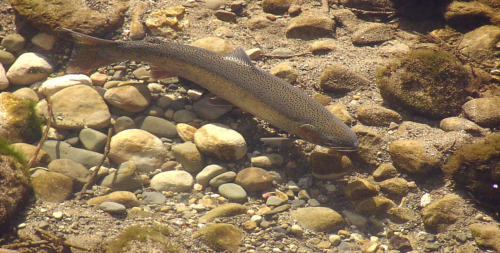
“A Los Angeles County Superior Court judge has rejected a water agency’s challenge to endangered species protections for the Southern California steelhead trout. “The court recognized the science showing the plight of this struggling fish and upheld the protections needed to stave off extinction,” said Evan Levy, an attorney at the Center for Biological Diversity, in a written statement. “Development, dams and water diversions have threatened this species so deeply that only a handful of spawning southern steelhead have been seen in recent years. Now that these state protections have survived legal challenge, I’m looking forward to a new chapter for these remarkably complex fish.” The Ventura County-based United Water Conservation District operates multiple dams in California, which conservation groups say prevent steelhead migration upstream. For years, the agency has challenged the state’s steelhead protections: first in 2023 over temporary protections, then again in 2025. Both petitions have now been rejected. The district has argued that the California’s Fish and Game Commission “relied upon incomplete and flawed data while ignoring better scientific evidence” in granting the steelhead endangered status. … ” Read more from the Courthouse News Service.
Tapping into Torrance’s brackish water plume
“Situated underneath the city of Torrance, Calif., is a vast source of groundwater just waiting to be extracted. It’s just way too salty. The Water Replenishment District (WRD) of Southern California is working on a solution as part of its Brackish Groundwater Reclamation Program. Although the program includes numerous capital projects, one of its most critical efforts is the Torrance Groundwater Desalter Expansion (TGDE), which will treat this salty underground plume and provide up to 7,100 acre-ft per year of clean drinking water for up to 105,000 local residents. Realizing this project, for which a formal groundbreaking was held on June 10, has required a creative delivery, extensive piloting and some coordinated logistics to manage multiple site constraints. When completed by 2028, the TGDE will include four new production wells, feedwater pipelines and additional treatment capacity at the Robert W. Goldsworthy Desalter. … ” Read more from Engineering News Record.
Beach loss worries heightened as big waves, king tides batter Southern California coast
“The visuals from battered Southern California coastlines have been dramatic: massive waves fueled by a big swell and king tides overtopping sand berms, seawater spilling onto boardwalks and streets, sand chomped away causing severe erosion and shrinking beaches just ahead of summer. Is it just nature, doing what nature does? Will sand naturally make its way back to eroded beaches, or is human intervention needed to safeguard the cherished coastline? These are questions coastal communities have been facing for the past several years, and the recent wave action has only turned up the volume. And with an El Niño on the horizon, you have to ask: Is the coast in for even more of a battering? “This event shows just how threatening a big storm event can be when there’s a coincidence of thretening factors: the combination of high tides, big swell and this part of the season being when these beaches tend to be the most narrow,” said Brett Sanders, professor of civil engineering at UC Irvine and an expert on the region’s erosion challenges. “Those factors led to severe impacts observed this week.” … ” Read more from the OC Register.
THE MEX FACTOR: The high cost of saving the Salton Sea
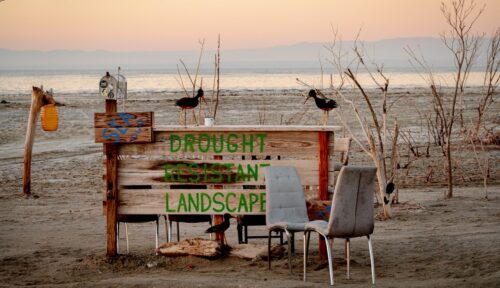 “The search is officially underway for the inaugural leader of the newly established Salton Sea Conservancy. Created under California Senate Bill 583—introduced by state Senator Steve Padilla—the state agency is looking for an experienced executive officer to take the reins of an environmental rescue mission decades in the making. It is a monumental task: building durable partnerships, managing completed restoration projects, and shaping the long-term strategy for a shrinking, dust-yielding lake that threatens both public health and ecological stability in the region. But while the mission is deeply rooted in the soil—and the air—of the Imperial Valley, the compensation package belongs to an entirely different economic stratum. … ” Read more from the Imperial Valley Press.
Lake Mead’s slow demise just sped up in latest federal study
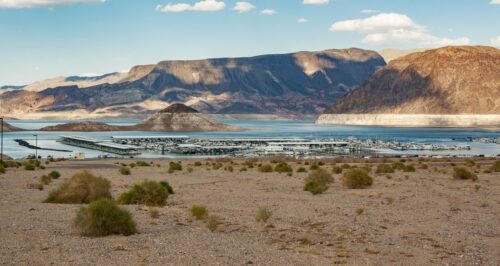 “The reservoir that serves as Southern Nevada’s main water supply is headed for an even more painful decline than thought due to historic drought and recent water management decisions, according to federal forecasters. Lake Mead could plummet to 1,015.77 feet above sea level in July 2027, far below any level seen since the reservoir was filled in the late 1930s. After that, though projections are less reliable the further into the future they go, water managers expect only a small uptick until another record low is set at 1,011.74 feet in May 2028. That low level is nearly 29 feet below the reservoir’s all-time low set in 2022. On Monday, the reservoir was almost 29 percent full at about 1,047 feet above sea level. “It is very grim,” said Sarah Porter, director of the Kyl Center for Water Policy at Arizona State University. “We didn’t expect good news. But the study underscores, again, that we’re in a really bad place.” … ” Read more from the Las Vegas Review-Journal.
Announcements, notices, and funding opportunities …
Notice of board workshop and public comment on the draft guidance on designating tribal beneficial uses
“The State Water Resources Control Board (State Water Board) is inviting your participation in the review of the Draft Guidance on Designating Tribal Beneficial Uses (TBUs). Since time immemorial, California Native American Tribes have stewarded California’s waterbodies to support cultural, spiritual, ceremonial, subsistence and/or traditional practices, lifeways and rights. Tribal Beneficial Uses recognize and honor Tribal Nations’ unique and ongoing relationships with water and ensure that these uses are considered and safeguarded in water quality policies, planning, and permitting regulatory processes. The newly released Draft Guidance on Designating Tribal Beneficial Uses explains the history of Tribal Beneficial Uses, what TBUs are, how TBUs are designated into water quality control plans, and how to engage in the process. This draft guidance does not create any legal requirements or make them more specific, rather it is intended only to describe existing requirements and practices. … ” Read more from the State Water Board.

