

Several news sources featured in the Daily Digest may limit the number of articles you can access without a subscription. However, gift articles and open-access links are provided when available. For more open access California water news articles, explore the main page at MavensNotebook.com.
On the calendar today …
- PUBLIC HEARING: Delta Conveyance Project water right hearing beginning at 9am. The State Water Resources Control Board Administrative Hearings Office is holding a Public Hearing on the pending Petitions for Change of Water Right Permits for the Delta Conveyance Project. Interested members of the public who would like to watch this hearing without participating may do so through the Administrative Hearings Office YouTube channel at: bit.ly/aho-youtube. Click here for the meeting notice.
In California water news today …
California’s waterways could get clogged by a problem that didn’t exist two years ago
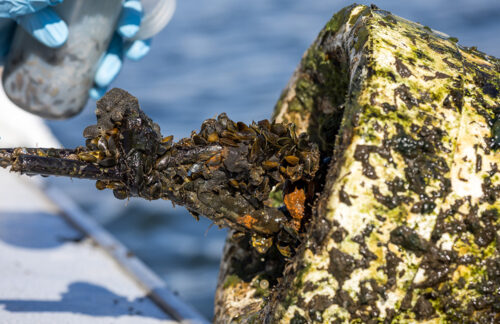
Xavier Mascareñas / DWR
“When golden mussels were found in an international shipping channel in Stockton nearly two years ago, marking the first detection of the invasive shellfish in North America, state officials knew it was going to be bad. Now those fears are being borne out. The roughly 1-inch-long, golden-brown mollusks, native to Asia, have spread from the Sacramento-San Joaquin River Delta, where they were initially spotted, through canals and aqueducts to the Bay Area and Southern California. Along the way, they’ve blanketed boats and docks with their crusty colonies and gummed up pumps and pipelines at major water facilities. “The mussels have the ability to clog an entire pipe,” said Jennifer Allen, spokesperson for the Contra Costa Water District, which is dealing with the pest in its water intake fixtures. “Getting in to clean all the infrastructure is a massive amount of work and potentially requires shutting down parts of the system.” She added, “We’re really only seeing the beginning of what the impacts are.” … ” Read more from the San Francisco Chronicle.
Delta deputies yank mussel-crusted clunkers from the deep
“San Joaquin County’s dive team has been fishing more than just striped bass out of the Sacramento–San Joaquin Delta. On June 9, deputies hauled several submerged vehicles from the murky channels and found them coated in invasive golden mussels, turning abandoned cars into floating condo complexes for a species no one wants. The sheriff’s boating safety unit and dive team led the recovery, pulling out derelict cars and other junk from waterways popular with anglers and recreational boaters. The operation, officials said, was about more than tidying up: removing the wrecks cuts down on navigation hazards and wipes out prime colonization spots for the mussels. … ” Read more from Hoodline.
The scourge of the Delta: Dredge it up!
“Overbite clams (Potamocorbula amurensis) are a small species of bivalve native to Eastern Asia. They have been present in the San Francisco Bay estuary since 1986, and given their ability to quickly multiply and spread, are considered highly invasive within this range (Carlton et al., 1990). Overbite clams consume phytoplankton and copepods, which are also necessary food for the early life stages of many native fish. The sheer abundance of these overbite clams has contributed to the collapse of the pelagic food web in Suisun Bay due to loss of those prey species (Sommer 2007). This has done extensive damage to local populations of many iconic fish species like the Delta smelt, longfin smelt, and striped bass (Sommre 2007). Despite this sad state of affairs, there may be some hope on the horizon to rein in the destructive impacts of overbite clam. … ” Read more from the California Water Blog.
Seeing red: The causes and consequences of harmful algal blooms
“Algae are a vital, yet sometimes overlooked, part of aquatic ecosystems. These single-celled organisms act similar to plants, using sunlight to make their own food through photosynthesis. They form the base of many food webs, supporting everything from tiny zooplankton to large fish and marine mammals. But when conditions align, this essential resource can turn into a serious environmental threat. Harmful algal blooms (HABs) occur when certain species of algae grow rapidly and out of control. This usually happens when they receive an excess of nutrients, along with plenty of sunlight and warm water. These outbreaks can discolor the water, turning it green, red, or brown. Common groups of algae that cause HABs are cyanobacteria, diatoms, and dinoflagellates. Some of these species produce neurotoxins, harmless to most wildlife and humans in small amounts, but damaging at high levels associated with blooms. The effects of HABs ripple through entire ecosystems when algae-produced toxins build up in fish, shellfish, and other animals. These toxins can even make their way into humans through contaminated seafood. … ” Read more from FishBio.
El Niño has arrived: 5 ways California could get pummeled
“El Niño has arrived and it could become one of the largest on record, and California may be in for a bumpy ride. While the climate pattern is often linked with a higher chance of more rain in Southern California, it can affect the state — and its famous coastline — in numerous ways. That’s especially possible during a strong El Niño event, as this one is shaping up to be. In fact, there’s a 63% chance El Niño could be “very strong” toward the end of the year, according to the National Oceanic and Atmospheric Administration’s Climate Prediction Center. And there’s an 88% chance El Niño will be either “very strong” or “strong.” … ” Read more from the LA Times.
New California law for plastic reduction may help improve health of marine ecosystems
“A new law went into effect in California that will change everything plastic-related, from takeout food containers to packaging material. California Senate Bill 54 puts the onus of reducing single-use plastics on the producers and brands of plastic products, instead of the consumer. Oceana, an international environmental advocacy group, is part of the team that wrote the new law. Legal campaign director Tara Brock explained single-use plastics particularly affected marine wildlife because they often inadvertently ingest it or get tangled in it. When marine wildlife ingests plastic particles and materials, the chemicals break down into microplastics, and Brock says that ultimately poses a risk to our health. … ” Read more from Spectrum News.
In commentary today …
Mark Arax essay: Welcome to California: land of plunder and hypocrisy
Mark Arax writes, “I was a fourth-grader in the public schools of California when I first learned about the Gold Rush. I remember our teacher, Mrs Dyer, passing down the story in the manner of lore. On the morning of 24 January 1848, James Marshall, a New Jersey boy come west, stumbled upon four shiny nuggets alongside the American River. He tried to keep his discovery a secret, but the shout of “eureka” from the dirt streets of San Francisco rang out across the shore. It unleashed a force that could not be contained. No need for manifest destiny. Overnight, 80,000 dreamers of every color, creed and country poured in. I didn’t know back then how story became myth and myth became story. The sordid details of history would be mine to fill in. The Gold Rush was California’s first extraction, a flash that cannonballed the whole mad state into being, and it ended the way all such plunders do. A handful of wealthy San Francisco industrialists made off with the riches. Marshall died so poor he could barely cover the price of his burial. … ” Read more from the Guardian.
A frank assessment is first step in shifting water priorities
David Sathuluri, researcher, and Marco Tedesco, professor at Columbia University’s Lamont-Doherty Earth Observatory, write, “California is in the middle of a quiet but high-stakes argument about what it would mean to fix our water system in a hotter, drier century, especially in the age of AI. Echoes of this argument will resonate in everyone’s lives. One side focuses on efficiency: building more conveyance, freeing up markets and moving water to its highest-value use. The opposite side insists that any reform must start from justice: the human right to safe water, tribal rights and the support to those communities already living with contamination and scarcity. A major new working paper from the National Bureau of Economic Research, “Measuring Water Misallocation in California,” speaks directly to this debate. Via detailed empirical work, it shows that California’s water system is ill-suited to the climate realities ahead. Using extensive satellite imagery, crop evapotranspiration data and field-level planting decisions, the authors mapped the productivity of water across the state’s irrigated lands. Results show that water is consistently more valuable south of the Sacramento-San Joaquin Delta than north of it. And yet legal and physical constraints make it hard to move water across this chokepoint. … ” Continue reading at the Santa Rosa Press Democrat.
In regional water news and commentary today …
NORTH COAST
Mendocino’s low water table birthed the town’s iconic water towers
“Built in the late nineteenth century to supply water to Mendocino’s residents, water towers have become an iconic image in Mendocino’s skyline. At the height of their use, there were more than 100 water towers in Mendocino, giving the village the nickname “The Town of Water Towers.” Water towers were not an uncommon sight across the country in the 1800s, especially in California, but Mendocino had many. In 1892, journalist Ninetta Eames wrote in Overland Monthly that “One has the first glimpse of Mendocino City, one of the oldest and most picturesque of all the coast towns … Viewed from a distance on shore or at sea the city seems to have an imposing array of cupolas, which are in reality water tanks, with windmills of every known pattern. There is in fact an individuality about the water works of this town not found in any other place of its size.” … ” Read more from Local News Matters.
SIERRA NEVADA
Brewing battle over Forest Service glyphosate spraying near Lake Tahoe’s pristine waters
“Katherine Levy remembers a childhood deeply rooted in the natural offerings of Lake Tahoe – water skiing in the summer and working as ski instructor on the surrounding snow-covered mountains during winter months. After leaving the area for many years, Levy recently moved back to live out her retirement along the lake’s north shore. But she doesn’t like what she has found upon her return: A US government plan to spray multiple types of herbicides – including the cancer-linked glyphosate weed killer – within national forest property that abuts the community’s cherished lake. “I was horrified to find out what has been going on,” Levy said. … ” Read more from The New Lede.
SACRAMENTO VALLEY
California Water Service says its systems have not been compromised following alleged Iran hack
“The California Water Service says that none of its water systems were compromised, including one in Chico, after an alleged hack from Iranian-backed groups earlier this week. In a statement, California Water Service Spokesperson Yvonne Kingman told us, “Being a critical infrastructure company, we have a number of cybersecurity, water system security, and water quality assurance measures in place to help protect our systems.” She continued, saying, “We have conducted a preliminary scan of our internal IT and OT networks and have no signs of any compromise within our water production and delivery systems. We will continue to monitor internal networks. We have also engaged with our external partners to determine whether they have experienced any breaches.” … ” Read more from Action News Now.
Sacramento-area districts clash over surface water supply. ‘When is this going to stop?’
“Directors of a capital water district don’t often consider filing public records requests for its neighbor, let alone one of its wholesale customers. However, in late May, directors of the San Juan Water District considered it a reasonable next step. Ted Costa, San Juan’s board president, proposed the request in response to a recent inquiry from the Citrus Heights Water District. Costa said a previous request from CHWD required extensive staff time and resulted in San Juan producing about 2,200 pages of records. “We actually emptied the printers for these folks — everything — and now last month we got another request for the very same information that we gave them before,” Costa said May 28 at a board meeting. The records dispute may seem unusual, but it reflects a much larger disagreement among the partnering agencies, including Sacramento Suburban Water District. The agencies are at odds over access to pre-1914 surface water, one of California’s most valuable water supplies. … ” Read more from the Sacramento Bee.
Yolo Basin invites youth to participate in the Traditional Ecological Knowledge Youth Program
“For thousands of years, Patwin-Wintun peoples cared for the wetlands and waterways of the Yolo Basin using stewardship practices that enhanced biodiversity and sustained one of California’s richest delta ecosystems. This summer, Native, BIPOC, and ally youth are invited to experience these teachings firsthand through the Traditional Ecological Knowledge (TEK) Youth Program. Led by Wintun/Maidu educator, naturalist, Fire Boss, and cultural practitioner Diana Almendariz, participants will explore how Indigenous communities lived in relationship with the land, plants, animals, and living water. Through hands-on activities, youth will learn about tule gathering, cultural burning, wetland ecology, wildlife, traditional foods, and Indigenous approaches to environmental stewardship. “The lifeways of Native people helped keep the land and water healthy,” said Almendariz. “These stewardship practices remain essential to restoring and protecting threatened ecosystems today.” … ” Read more from the Daily Democrat.
BAY AREA
High tides cause flooding in Marin County as Bay Area prepares for more this week
“High tides caused localized flooding in parts of Marin County early Monday morning, prompting authorities to close several roads and urge residents to avoid affected areas. In an alert sent around 12:10 a.m., the Central Marin Police Authority said flooding was reported near Doherty Drive and Lucky Drive in Larkspur. In Corte Madera, Lucky Drive and Fifer Avenue, Redwood Highway, and portions of the Boardwalk and Golden Hind Passage neighborhood were also inundated, according to authorities. At least until 3 a.m., motorists and residents are urged to avoid the area and seek alternate routes until water levels recede and roadways can be safely reopened. No injuries or significant damage were immediately reported. … ” Read more from Local News Matters.
Sea water floods S.F.’s Embarcadero amid predictions of record summer tides
“Sea water flooded San Francisco’s Embarcadero late Saturday amid predictions of the highest summer tides on record in the days ahead. Several late-night visitors checked out the scene as the water spilled over the sidewalk and into the street around Pier 14. Pedestrians lifted their pant legs as they waded through water up to their ankles, and bicyclists splashed the overflow around the sidewalk and street. Waves were predicted to reach 1.9 feet at 10:20 p.m. Saturday at bayshore locations along San Francisco and San Pablo bays, plus low-lying areas along the Pacific Coast. The National Weather Service issued a coastal flood advisory through Wednesday morning for San Francisco Bay, with up to 2 feet of inundation above ground level in low-lying areas near shorelines and waterways. … ” Read more from the San Francisco Chronicle.
CENTRAL COAST
A burned Big Basin is reborn
“The landscape at Big Basin Redwoods State Park comes in two main colors these days: black and green. Green is from the growth you’d expect after weeks of heavy rain: redwood leaves washed clean, waxy-leaved blueblossom ceanothus shrubs densely covering the ground. And black from the charred bark of still-standing trees—scars of the 2020 CZU Lightning Complex fires, which burned 97 percent of California’s oldest state park. But burnt doesn’t mean dead. On a sunny day in January, I walk the Redwood Loop Trail with Chris Pereira, Will Fourt, and Garret Hammack, State Parks employees all working to restore Big Basin. By the Mother of the Forest—one of the massive, ancient coastal redwoods that inspired the formation of the Sempervirens Club, now the Sempervirens Fund, in 1900—we stop and look up. She looks darker, slimmer, and shorter than before the fires, but green growth clusters around her trunk and new redwood leaves, jade green, branch out on fresh limbs. … ” Read more from Bay Nature.
SAN JOAQUIN VALLEY
Kern County water agencies, groups launch ‘Golden Rule Campaign,’ aiming to curb golden mussel spread this summer
“A new website has been launched to help combat the invasion of the invasive golden mussel in Kern County and around the state. The website was rolled out in partnership between local Kern County water agencies and groups aiming to help protect the region’s water resources from the ongoing threat of spreading golden mussels. The invasive mussel species is native to China and southeast Asia, and first arrived in California in 2024. In just two years, the tiny sea animals have made their way into water systems throughout the state and wreaked havoc in water supply networks, as just one female mollusk can produce a million eggs every year. If they continue to spread throughout Kern County — and across much of the state without intervention, they could choke out the region’s waterways and pipelines that deliver water to homes, businesses and to farms. … ” Read more from KGET.
SOUTHERN CALIFORNIA
Warnings extended for dangerous coastal conditions at Southern California beaches
“Warnings for dangerous coastal conditions on Sunday, June 14, were extended until late Wednesday at Los Angeles County beaches, and until Friday at Orange County beaches. Dangerous rip currents and breaking waves due to elevated surf of 3 to 6 feet on south-facing Los Angeles County beaches are expected, in addition to “high astronomical tides of 7.5 to 7.9 feet” each evening, according to the National Weather Service. “There is an increased risk of ocean drowning,” the weather service said. “Rip currents can pull swimmers and surfers out to sea. Waves can wash people off beaches and rocks, and capsize small boats near shore. Minor coastal flooding is possible in low-lying areas near the times of high tides.” … ” Read more from the OC Register.
SEE ALSO: Historic swells continue to batter California beaches. When will the surf die down?, from the LA Times
Commentary: Pasadena’s water future: The challenge isn’t demand. It’s supply
Rick Cole, a Pasadena City Councilmember, writes, “In the controversy over housing growth in Pasadena, one concern inevitably surfaces: Will we have enough water? It’s a reasonable question. California has endured repeated droughts. Climate scientists tell us the future is likely to be hotter and drier. And residents understandably wonder whether new apartments and condominiums will strain our water supply. The answer may surprise you. The City of Pasadena has provided water service since 1912. Today Pasadena Water and Power serves roughly 160,000 customers, including residents and businesses in Pasadena and portions of unincorporated communities north of our city limits. Yet despite significant growth over the decades, Pasadena today uses about the same total amount of water that it used in 1949. Think about that for a moment. … ” Read more from Pasadena Now.
Commentary: Improved weather forecasting may allow more storm water capture while protecting flood control operations
Mike Gardner, a member of Western Municipal Water District Board, writes, “The Scripps Institution of Oceanography is using improved weather monitoring and forecasting technologies in a new program called Forecast Informed Reservoir Operations, or FIRO. This program provides data to flood control facility operators to allow them to confidently hold and release storm runoff more slowly while still fulfilling their primary mission of providing protection against downstream flooding. … Locally, Prado Dam, operated by the US Army Corps of Engineers, completed its Final Viability Assessment in December of 2023. Control Manual changes to fully implement the program are pending. To date implementation of FIRO at Prado Dam is increasing beneficial storm water capture by about 10% a year. This water is percolated into the underground aquifer by Orange County Water District for use by their customers. Extra water is stored in wet years for use in dry years. … ” Read more from the Raincross Gazette.
Developers pitched a Calif. data center to fix this city’s woes, residents want anything else
“Last week, Monterey Park won a significant battle in a growing nationwide backlash when it became the first city in the country to effectively ban data centers by popular vote. The message from voters was clear: The power- and water-hungry facilities that power the internet and the booming AI industry were not welcome in their city. But now, the San Gabriel Valley suburb is facing a more difficult question: What do its residents want at the proposed data center site instead? “If we’re going to tell them what we don’t want, and they’re going to listen, then we should leverage that to work with them to develop what we do want,” local organizer Jesse Damon told SGATE by phone Thursday. … ” Read more from SF Gate.
SAN DIEGO
South Bay to see less air pollution, sewage from Tijuana River in near future, state and federal officials say
“South Bay communities are one step closer to relief from a major air pollution hotspot after the California Coastal Commission approved a county-initiated project Wednesday to extend culvert pipes at the Saturn Boulevard crossing of the Tijuana River, where cascading sewage and industrial waste have blanketed nearby neighborhoods in toxic gases for years. Separately, the federal agency tasked with trans-boundary flow and wastewater treatment at the U.S.-Mexico border, the U.S. International Boundary and Water Commission, told local officials at a San Diego Regional Water Quality Control Board meeting Wednesday they are trying to achieve near-zero dry-weather river flow by late 2027, as advocates and board members pushed back on the agency’s transparency and the slow pace of progress. … ” Read more from the San Diego Union-Tribune.
Along the Colorado River …
Tensions are rising between states that rely on the Colorado River
“Water in the Colorado River is dwindling to levels that haven’t been seen in decades, and the seven states whose residents and farmers depend on the river can’t agree on a fair way to divide up what’s left. Negotiations are going nowhere despite more than six months of ongoing talks, plus cajoling by the Trump administration, which twice gathered governors in hopes of a breakthrough that never came. States are already sniping at aspects of a water-use plan the federal Bureau of Reclamation is set to unveil this summer and impose later this year, and they’re threatening to sue each other over water deliveries, raising the prospects of prolonged legal battles just as Western states face demands to sharply reduce water use. … ” Read more from the New York Times.
Colorado River storage crunch tests Southwest water planning
“The Colorado River Basin is heading into another critical planning period with less margin for error than many businesses, utilities and public agencies may be used to. A new analysis from water policy and river management experts warns that the Basin’s major reservoirs could move closer to a functional storage crisis if another dry year follows the pattern of water year 2025. The issue is not just that Lake Powell and Lake Mead remain low. The bigger concern is that realistically available storage has narrowed sharply. That means the water sitting above key protection levels for dam operations, hydropower generation, downstream deliveries and system stability is becoming increasingly limited. The analysis also brings Flaming Gorge Reservoir into the storage picture, as releases from the upstream reservoir are now being used to support Lake Powell. For companies operating in the Southwest, this is not a distant environmental issue. It affects water pricing, project approvals, agricultural supply chains, energy reliability, real estate growth, mining, manufacturing, data center planning and municipal development. … ” Read more from Environment & Energy Leader.
Wyoming’s Mike Vickrey testifies on importance of Colorado River negotiations
“U.S. Senator John Barrasso (R-Wyo.) welcomed Pinedale, Wyoming rancher Mike Vickrey to testify on the importance of Colorado River negotiations during a Senate Energy and Natural Resources committee hearing. Mr. Vickrey, a member of the Green River Valley Cattlemen’s Association, discussed the importance of water certainty for ranchers and farmers in Wyoming and other Upper Basin states. He also discussed the ways that Wyoming contributes to conservation efforts that maintain water access for all seven Basin States. “Mike is a fifth-generation rancher. He also serves on Governor Gordon’s Colorado River Advisory Committee for Wyoming,” said Senator Barrasso. “Mike runs a cow calf and yearling operation with his parents, daughter, and son-in-law. The Vickreys operate on sage brush pastures and irrigated hay fields, west of the Wind River Mountains. Their ranch is at the headwaters of the Green River in Sublette County. It supports numerous wildlife and blue-ribbon fisheries. I am grateful to Mike for sharing his perspective on the Colorado River as a rancher from Wyoming.” … ” Continue reading at the Western Ag Network.
In national water news today …
Trump opens protected Pacific waters to commercial fishing
“The Trump administration struck down prohibitions on commercial fishing Thursday across more than 500,000 square miles of marine national monuments in the Pacific Ocean, as environmental groups vowed to challenge the action in federal court. President Donald Trump signed an executive order to open the Mariana Trench, Papahānaumokuākea and Rose Atoll marine national monuments to commercial fisherman, removing restrictions put in place under the George W. Bush and Obama administrations. “Restoring commercial fishing access to these vital areas reflects the continued commitment of this Administration to American fisheries, which are built on the foundation of rigorous science, robust monitoring, strong enforcement, and the daily commitment of our dedicated fishermen,” NOAA Administrator Neil Jacobs said in a statement. … ” Read more from E&E News.
Lawmakers fight to stop the Trump administration’s dismantling of a $386M ocean observatory project
“A group of Democratic senators and one Republican, as well as two Democratic House committees, sent letters Monday to the National Science Foundation asking it to reverse course on its plan to dismantle a sprawling ocean monitoring network, with House lawmakers going further and accusing the agency of acting illegally. The Ocean Observatories Initiative is a network of more than 900 ocean sensors built at a cost of $386 million. Over the last decade it has tracked ocean circulation, marine ecosystems, climate change and extreme weather, producing data freely available to the public and informing more than 500 scientific publications. The project was slated to run another 15 to 20 years. The National Science Foundation had directed the removal of most of the system’s instruments from waters off Oregon, Washington, Alaska, North Carolina and Greenland by 2027 — a decision scientists said came with no warning and no scientific review. … ” Read more from the Associated Press.

