

A new dataset on San Francisco Bay water includes one of the most toxic chemicals ever studied for a fish species.
By Sierra Garcia, San Francisco Estuary Institute
The chemical, called 6PPDQ, forms in the environment from an ingredient in tires and was first identified in urban stormwater runoff and streams in 2020 by a team of scientists that included SFEI.
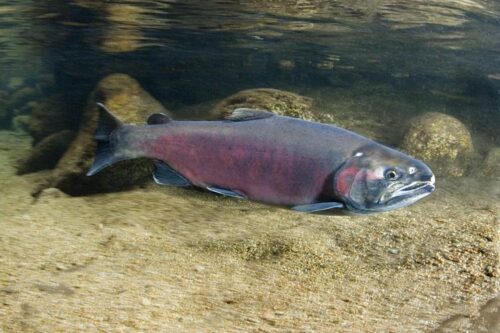 “To my knowledge, this is one of the first accounts of this compound in an estuary,” says SFEI senior scientist Ezra Miller. “So we are on the forefront of this as we have been since the beginning.” Estuaries are areas where freshwater and saltwater meet, and the Bay is part of one of the nation’s largest estuaries.
6PPDQ is highly toxic to coho salmon, which are extinct in the Bay but are returning to streams as a threatened species just outside the Bay. Steelhead trout, a threatened Bay species, are also sensitive to the chemical. The data, which were collected by the Regional Monitoring Program for Water Quality in San Francisco Bay (RMP) by SFEI scientists from 2021 to 2024, show the highest 6PPDQ levels close to shore after winter storms—the same time of year that steelhead return from the ocean to their birth streams to spawn. Previous RMP data found even higher levels of 6PPDQ in Bay Area stormwater runoff and urban streams.
“Especially around the Bay Area, there’s a road up just about every stream channel because that was the easy spot to build,” says CalTrout biologist Charlie Schneider. More traffic is tightly linked to higher 6PPDQ levels in nearby creeks.
Although the levels of 6PPDQ in the Bay won’t kill steelhead, it’s unknown how the young fish may respond to exposure over weeks, months, or even years as they enjoy the Bay’s protection from the open ocean where they’ll eventually migrate.
“We don’t know much about chronic, sublethal impacts,” says Miller.
The California Department of Toxic Substances Control Safer Consumer Products Program is reviewing chemical alternatives for tires and will require manufacturers to swap out the ingredient that transforms to 6PPDQ in the environment once safer options are identified.
Data Include Dozens of Other Chemicals, Mostly at Low Levels
In the same study, SFEI scientists also tested the Bay for dozens of other chemicals, including other tire-derived chemicals as well as pesticides, preservatives, and drugs like caffeine. Most were detected well below levels of concern for aquatic life. Imidacloprid, a common ingredient in garden care products and spot-on flea and tick medication, was an exception. So was the pesticide carbendazim, which acts as a preservative in products like paints.
“Most people probably don’t think about how a lot of the products that we use have some kind of pesticide in them,” says Miller. For compounds like carbendazim, there’s no requirement to label a product as containing a pesticide if the ingredient is used to keep products shelf stable or resistant to breakdown and not to sell a product with pesticidal properties. Comparing carbendazim levels in the Bay between summertime and the winter rainy season suggests that both stormwater runoff and wastewater could carry substantial amounts of the pesticide to the Bay.
The data together build a case for the RMP to continue monitoring the Bay’s water in both the wet and dry seasons.
“The goal of the RMP is to collect data that informs decision-making to protect Bay water quality,” says RMP Lead Scientist Jay Davis. “This monitoring and its connection to regulations by DTSC is a great example of success in this regard.”

