
Several news sources featured in the Daily Digest may limit the number of articles you can access without a subscription. However, gift articles and open-access links are provided when available. For more open access California water news articles, explore the main page at MavensNotebook.com.
On the calendar today …
- WEBINAR: Drought, disaster, and decision-making: can a crisis be averted in the Colorado River Basin? from 9am to 12pm. Join expert researchers and water managers for this virtual mini-symposium as we examine dire conditions and the escalating crisis in the Colorado River Basin, where the future ability to serve 40 million users across Western states, tribes, and Mexico hangs in uncertainty. What to Expect: We’ll unpack climate-driven declines, shed light on complex interstate negotiations, and examine pathways to resilience. Speakers will consider pragmatic outcomes and what a balanced deal could look like for the West — and for California’s water future. Each panel will be followed by moderated Q&A. Click here to register.
- MEETING: Salton Sea Program Annual Report beginning at 12pm. The Salton Sea Program team will provide an overview of the report, share project updates, and answer questions on the work completed in 2025. We will provide the most current information about the Program, the status of the different projects, milestones accomplished on the Phase I: 10-Year Plan, share details about the strong partnerships supporting the work at the Sea, and explain how we continue to deliver on commitments that support ecosystem restoration and protect air quality. Zoom link: https://us02web.zoom.us/j/89862021776 Teleconference Number: (719) 359-4580 Teleconference Access Code: 89862021776#
In California water news today …
Newsom pledges to move forward with Delta water tunnel in California
 “Gov. Gavin Newsom said his administration is “moving forward aggressively” to continue laying the groundwork for a giant tunnel beneath the Sacramento-San Joaquin River Delta to replumb the state’s water system. “We got to move faster. Move faster,” Newsom said to regulators during a speech Thursday at a conference held by the Assn. of California Water Agencies. “We all have to be held to a higher level of accountability.” California’s 40th governor provided a chronological look back at his water policies since taking office in 2019 and asserted the need to continue his effort to modernize state infrastructure to provide for cities and farms into the future. Newsom cast the tunnel as a “climate adaptation project,” noting that climate change is projected to shrink the amount of water the state can deliver with its current infrastructure. With his term expiring at the end of the year, Newsom acknowledged that he will soon “pass the baton” on water policy to the next governor. Democrat or Republican, that person could decide the fate of his signature water project. … ” Read more from the LA Times. | Read via AOL News.
Newsom touts California water progress as Delta tunnel fight continues
“California Gov. Gavin Newsom on Thursday defended his administration’s water policies and pushed for major infrastructure projects, including the controversial Delta Conveyance Project, arguing the state is now “more prepared for our water future than ever before.” Speaking at the annual conference for the Association of California Water Agencies in Sacramento, Newsom highlighted actions his administration says have strengthened the state’s water systems since 2019, including expanding clean drinking water access, advancing water storage projects, restoring salmon habitats and increasing groundwater management efforts. “California has embraced a more balanced and forward-looking approach to water policy — rejecting the false choice between protecting our water future and building the infrastructure we need,” Newsom said in a statement released by his office. “We’re taking an all-of-the-above approach by expanding water projects, restoring habitats, and improving water quality, because real progress comes from partnership, not polarization.” … ” Read more from CBS News.
GOVERNOR NEWSOM: California is more prepared for our water future than ever before
“Today, Governor Gavin Newsom spoke before members of the Association of California Water Agencies (ACWA), presenting a clear path forward to protect California’s water supplies and ensure the state can continue to deliver water for its nearly 40 million residents. The annual event brings together water agencies from across the state that manage local water systems for communities. “California has embraced a more balanced and forward-looking approach to water policy — rejecting the false choice between protecting our water future and building the infrastructure we need,” said Governor Newsom. “We’re taking an all-of-the-above approach by expanding water projects, restoring habitats, and improving water quality, because real progress comes from partnership, not polarization.” … ” Continue reading this press release from Governor Newsom.
PRESS RELEASE: Delta Counties Coalition Responds to Governor Newsom’s Remarks at Association of California Water Agencies Conference
“The Delta Counties Coalition issued the following statement in response to remarks made today by Gavin Newsom at the Association of California Water Agencies conference: “Governor Newsom offered a sweeping reflection on California’s water history during his tenure in office, but in doing so, he largely glossed over the very real and immediate concerns of the communities that would be most impacted by the Delta Tunnel Conveyance Project. … ” Read more from the Delta Counties Coalition.
Map shows California chances of being hit harder by hurricanes in 2026
“Parts of California could face a higher risk of hurricane-related impacts in 2026, as forecasters warn that warm Pacific waters could increase the chances of rare but potentially dangerous tropical systems affecting the state. The Eastern Pacific hurricane season begins on May 15 and runs through November 30. For the incoming hurricane season, which at times could affect California and other Southwestern states, AccuWeather is predicting 17 to 22 named storms, nine to 13 of which could strengthen into hurricanes. Of those, four to eight could strengthen even further into major hurricanes. While hurricanes rarely make direct landfall in California, the new report from AccuWeather underscores growing concern among meteorologists that changing ocean conditions, largely influenced by the increasing chances of an El Niño year, could increase the likelihood of moisture-rich tropical storms or weakened hurricanes moving into the Southwestern U.S., bringing heavy rain, flooding, and dangerous surf to coastal and inland areas. … ” Read more from Newsweek.
Soil-mapping tech offers massive water savings for California citrus
“California citrus growers may soon have a new ally rolling through their orchards: a robotic soil-mapping system designed to show exactly how much water sits beneath each tree. The technology could help growers fine-tune irrigation as the industry faces mounting pressure to reduce groundwater use under the Sustainable Groundwater Management Act (SGMA). California agriculture uses roughly 40 percent of the state’s developed water supply, according to the California Department of Water Resources. Groundwater dependence has increased during drought periods, particularly in the Central Valley, where many citrus operations rely on wells for irrigation. Furthermore, as of May 2026, the Golden State is transitioning away from a period of high reservoir levels toward a projected long-term loss of up to ten percent of its water supply. … ” Read more from the Fresh Fruit Portal.
ILRP: Second ag expert panel nears completion
“The Second Statewide Agricultural Expert Panel, convened by the State Water Board to advise the board on technical aspects of California’s Irrigated Lands Regulatory Program, is close to finalizing its recommendations. Following release of its draft report March 30 and a subsequent public comment period, the expert panel will assemble for two public working group meetings to discuss the submitted comments. The meetings will be 3-6 pm on Monday, May 18 and Wednesday, May 27 and will include time for public comment. In addition to written comments on the draft report, oral comments were taken at a State Water Board staff-led public workshop on April 10. … ” Read more from Jane Sooby at Maven’s Notebook.
David Tangipa says California is at a crossroads for farmers, water, taxes and the future of the state
“California Assemblyman David Tangipa believes the Golden State is approaching a defining moment — one that could determine the future of farming, water, taxes, and economic survival for generations to come. During an in-depth interview with “The Ag Meter” host Nick Papagni, Tangipa discussed everything from voter ID and corruption concerns to water infrastructure, high-speed rail, state spending, and the critical upcoming governor’s race. Throughout the conversation, Tangipa repeatedly emphasized accountability, civic involvement, and the importance of protecting California agriculture. … ” Read more from AgNet West.
Amazon supports California watershed restoration through innovative Forest Resilience Bond
“Amazon is supporting watershed restoration in the Upper Mokelumne River Basin within Eldorado National Forest, a critical drinking water source for San Francisco’s East Bay. The project uses a Forest Resilience Bond, an innovative financing model developed by Blue Forest and the World Resources Institute, which blends public and private funding to accelerate forest restoration at a scale and pace that public funding alone cannot achieve. Key collaborators include the Upper Mokelumne River Watershed Authority (UMRWA), U.S. Forest Service, the Miwok and Washoe Tribes, and utilities like East Bay Municipal Utility District (EBMUD) and Pacific Gas & Electric Company (PG&E). The forest filters, stores, and regulates the region’s water supply, but like many Western forests, the region is increasingly vulnerable to wildfires after decades of unchecked vegetation growth. Restoration work—including mechanical and hand thinning, and native tree restoration in degraded areas—will take place ahead of wildfire season this spring and summer. These efforts reduce fire risk and vegetative water demand while increasing the amount of water that reaches communities that depend on it. … ” Read more from Amazon News.
California red-legged frog recovery reaches 10-year milestone in Yosemite
“The California red-legged frog, a federally threatened species absent from Yosemite National Park for decades, has made a significant comeback after 10 years of coordinated conservation work. Partners marked the milestone today with the symbolic release of the program’s 10,000th frog in Yosemite Valley. The recovery effort is led by the National Park Service in collaboration with U.S. Fish and Wildlife Service, the California Department of Fish and Wildlife, Yosemite Conservancy and San Francisco Zoo & Gardens. “This milestone reflects years of focused work to restore a species that plays an important role in the park’s ecosystem,” said Rob Grasso, aquatic ecologist at Yosemite National Park. “After invasive bullfrogs eliminated red-legged frogs from the area decades ago, we removed those threats and created conditions for recovery. Today, multiple generations of frogs are established in Yosemite Valley.” … ” Read more from the Department of Fish and Wildlife.
Forest fuel treatments reduce wildfire spread, prevent $2.8 billion in damage
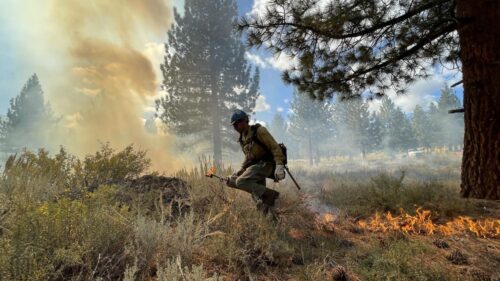
“Every dollar spent on forest fuel treatments saves about $3.75 in wildfire damages, according to a new study, led by researchers at the University of California, Davis, of nearly 300 fires in the western United States. The study estimated that the treatments, such as forest thinning and prescribed burns, prevented $2.8 billion in losses, reduced wildfire spread and fire severity. The researchers analyzed the nearly 300 wildfires that intersected USDA Forest Service fuel reduction treatments in 11 states between 2017 and 2023. The study is the first to evaluate the economic value of Forest Service fuel treatments across the West at a large-scale using data from wildfires that encountered fuel treatments rather than relying on wildfire simulation models. It was published today in Science. “Fuel treatments and forest management are critically underfunded public goods,” said lead author Frederik Strabo, a postdoctoral scholar with the UC Davis Department of Agricultural and Resource Economics. “Our results suggest that when fewer resources are available to agencies like the Forest Service, more of the economic burden of wildfires falls on the public.” … ” Read more from UC Davis.
SEE ALSO: How controlled burns can help save taxpayers billions, from Grist
CAST releases new science publication on invasive plants and wildfire management
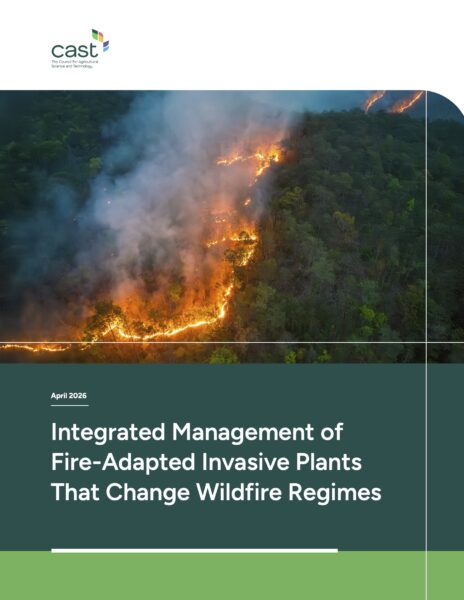 “The Council for Agricultural Science and Technology (CAST) has released Integrated Management of Fire-Adapted Invasive Plants That Change Wildfire Regimes, a peer-reviewed science publication examining how fire-adapted invasive plants alter wildfire behavior across the United States — and what land managers, policymakers and practitioners can do about it. The publication is co-chaired by Matthew Baur, Director of the Western Integrated Pest Management Center, and Gregory Dahl, CAST Representative for the Western Society of Weed Science and former president of the Weed Science Society of America. The author team includes 11 scientists from leading universities, federal agencies and research institutions across the United States. “It’s a big issue — and it’s not just a rancher issue. It’s not just a farmer issue,” said Brian Mealor, Professor and Director of the Sheridan Research & Extension Center and the Institute for Managing Annual Grasses Invading Natural Ecosystems at the University of Wyoming, who presented the publication’s key findings during the webinar. “There are societal issues that are definitely impacted by millions of acres that have been shifted from highly productive, diverse, largely native dominated plant communities across the US — not just the Western US.” … ” Read more from CAST.
In commentary today …
Beware of scapegoating coastal protections
The OC Coastkeeper writes, “The California Coastal Commission is under attack like never before. As deregulation continues to sweep the country, developers and their allies are trying to frame coastal protections as barriers to progress and affordable housing. It’s a familiar playbook. Vague claims about red tape and delays, with little acknowledgment of what’s really driving the conversation: profit and the push for more unchecked development. The Coastal Commission exists because Californians wanted it. Voters created it, and they’ve continued to support it for decades. It’s a big part of why our coast is still publicly accessible and far less developed than much of the East Coast. And despite how it’s often portrayed, the Commission is not anti-development; it’s for responsible development. It approves over 90% of projects it reviews, and the average decision takes about two months. … ” Read more from the OC Coastkeeper.
In regional water news and commentary today …
SIERRA NEVADA
Court rejects Rise Grass Valley’s petition to set aside County’s decision on vested right to mine at the Idaho-Maryland Mine
“In a five-page ruling, Nevada County Superior Judge S. Tice-Raskin rejected Rise Grass Valley’s writ of mandate petition to overturn the Nevada County Board of Supervisors’ unanimous decision to deny vested rights to mine on the historic Idaho-Maryland mine property. On Dec. 14, 2023, the Board of Supervisors – after two days of public hearings – voted unanimously to deny Rise Grass Valley’s Petition for Recognition of Vested Rights to conduct mining operations at the Idaho Maryland Mine. On Feb. 16, 2024, Supervisors voted to deny the proposed Idaho-Maryland Mine project and its Final Environmental Impact Report (EIR), following the Planning Commission’s unanimous May 2023 recommendation to do the same. … ” Read more from YubaNet.
SEE ALSO: , from Investor News Network
Regional voices discuss Forest Service reorganization impacts on the Tahoe Basin
“The Forest Service’s recent restructuring announcement raises questions about how the changes might affect the Tahoe-Truckee Basins, including fire readiness, employee impacts, research and other areas. “It’s hard to forecast what exactly the impacts are going to be until we see exactly how this is all going to unfold,” Olivia Tanager, Sierra Club Toiyabe Chapter Director. “There’s going to be a lot of monitoring that has to happen.” On March 31, the U.S. Department of Agriculture’s Forest Service announced a “sweeping restructuring” over the coming year that includes moving its headquarters from Washington, D.C., to Salt Lake City, Utah. The service also announced a transition from its regional organizational model to a state-based approach. … ” Read more from the Sierra Sun.
BAY AREA
Mountain View neighborhood starts seeing clean water once again after 2 weeks of contamination
“Safe water is flowing through the taps once again for most of a neighborhood in Mountain View that has been dealing with water main contamination for nearly two weeks. The city ended the “boil water” notice for 46 homes near Cuesta Drive Wednesday, though 21 other homes are not in the clear yet. … ” Read more from KGO.
CENTRAL COAST
Property owners to vote on the City of Monterey’s proposed stormwater fee.
“Property owners in the City of Monterey will receive mail-in ballots at the end of May to decide whether to allow the city to charge a monthly fee to fund annual stormwater program operations and maintenance. The proposed monthly stormwater fee would vary based on a property’s impervious surface area, such as driveways and other paved areas, with properties with more impervious area charged more. The city estimates the average single-family household would have a monthly charge of about $4.80 or roughly $58 annually. The city’s stormwater program activities are currently paid for by the general fund, which includes system maintenance, inspections, monitoring and regulatory compliance. If the stormwater fee is approved by property owners, the fee would cover about two-thirds of the cost of operations and maintenance, with the rest coming from the general fund. … ” Read more from Monterey Now.
Water concerns delay approval of San Miguel-area housing development
“Groundwater concerns in the Paso Robles basin and questions over the durability of a decade-old environmental review stalled final approval of a proposed housing project near San Miguel, even as county supervisors rejected an appeal challenging the development. On May 5, the San Luis Obispo County Board of Supervisors voted to deny an appeal of the River’s Edge project, a 43-acre development planned along the Salinas River that would add 190 residential, commercial, and open-space lots near San Miguel. While the appeal was turned down, supervisors delayed final approval until June 2, directing staff to revise parts of the environmental record related to water supply and add new project conditions. … ” Read more from New Times SLO.
SAN JOAQUIN VALLEY
South San Joaquin Irrigation District pursuing $192M plan to keep water flowing
“South San Joaquin Irrigation District — by virtually every measure — has a successful history of protecting and developing water rights secured 117 years ago. It is a constant battle to do so in California where water wars are as old as the state itself. But that isn’t the big worry today for SSJID. It’s reliability. Without making sure the diversion, storage, and distribution system is as bullet-proof as possible, it increases the chances an incident — rockslides, pipe failure, and even prolonged power outages — can cut off water. … ” Read more from the Escalon Times.
CSPA calls for reversal on the Kern River case, to ensure water for fish
“On May 4, 2026, California Sportfishing Protection Alliance joined with the Winnemem Wintu Tribe, San Francisco Crab Boat Owners Association, and North Coast Rivers Alliance to file an amicus brief in an appeal of the Kern River case Bring Back the Kern v. City of Bakersfield, 2025. Attorney Stephan Volker filed the amicus brief in the case, which is now before the California Supreme Court. The amicus parties’ central argument is that both California Fish and Game Code Section 5937 and Article X Section 2 of the California Constitution are mandates. These laws must be understood and read together. The laws do not conflict. FGC Sect. 5937 requires dam owners to allow sufficient water for fish to pass through fishways, and over, around, and through a dam to keep fish downstream of the dam “in good condition”. Article X, Sect. 2 requires that the conservation of waters of the state be exercised “with a view to the reasonable and beneficial use” in the interest of the people and for the public welfare, and that any use of water must be reasonable. … ” Read more from the California Sportfishing Protection Alliance.
EASTERN SIERRA
‘Pressures already on an unsustainable system’: Ridgecrest, Inyokern residents voice concern over possible data center proposed in the area
“Dozens of residents from a small desert community showed up to a Ridgecrest city council meeting on Wednesday to push back against a proposed data center on the edge of town. The AI-driven data center is proposed to be built in Inyokern, a town with less than one thousand residents, who have concerns over the environmental impacts and water resource strains a large data center could bring. The data center in question is proposed by California–based stock corporation R&L Capital, Inc. and is dubbed as the “RB Inyokern Data Center.” It is proposed to be sited near the intersection of U.S. Highway 395 and State Route 178. The project would be in an unincorporated area of Kern County. During a public comment period, Inyokern residents told the Ridgecrest City Council that if a data center were to be built in their town, they would worry about its environmental footprint, its high energy use, noise from the facility, the high amounts of water the facility would use and potential lower property value rates. … ” Read more from KGET.
Six intriguing things about water in the Amargosa Valley
“The water in Amargosa Valley is a scientific oddity in that it serves as a living time capsule, and it supports life in one of our planet’s harshest environments. The Amargosa River flows underground for roughly 185 miles – surfacing only occasionally to create lush oases in the Mojave Desert. Here are some remarkable aspects of this unique water system: Ancient “Fossil Water”: Much of the groundwater in the Amargosa Basin is fossil water that was recharged during the last Ice Age, between 10,000 and 100,000 years ago. The water travels through a massive regional aquifer of limestone and dolomite rock from sources as far away as the Spring Mountains. … ” Read more from Coyote Gulch.
SOUTHERN CALIFORNIA
Las Virgenes Municipal Water District takes action against water theft
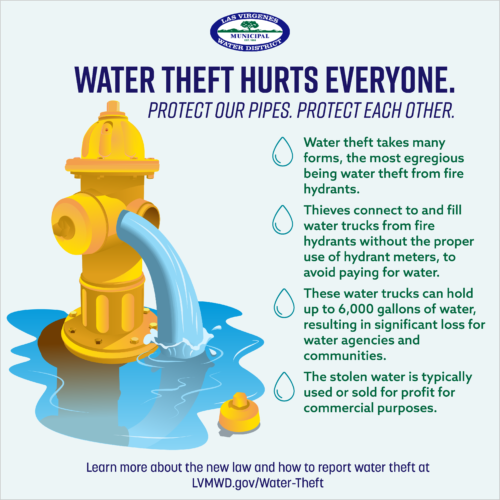 “Las Virgenes Municipal Water District (LVMWD) took decisive action to enforce Senate Bill 394, the landmark water theft legislation co-sponsored by the District and signed into law by Governor Gavin Newsom on October 10, 2025. Following a public hearing on April 7, 2026, the LVMWD Board of Directors introduced and passed Ordinance No. 291, formally updating LVMWD code to align with the new state law and put water thieves on notice that illegal diversions will carry serious consequences. In recent years, LVMWD estimated losses of approximately 45 million gallons of water due to water stolen from unauthorized use of fire hydrants, primarily for commercial purposes including construction, landscaping and farming. Beyond the staggering volume of water lost, illegal hydrant diversions have the potential to damage infrastructure, reduce system pressure, and risk contamination of the public water supply, affecting every ratepayer and resident that LVMWD serves. “Water theft is not a victimless crime. It is a direct threat to the reliability and safety of the water system that 70,000 residents depend on every day,” said LVMWD Board President Andy Coradeschi. “With this ordinance now in place, we have the tools to act swiftly and decisively against anyone who steals from our system and thereby potentially threatens the health of our ratepayers. The era of low-consequence water theft in our service area is over.” … ” Read the full press release from Las Virgenes Municipal Water District.
“The Gardena Willows Wetlands Preserve is full of huge willow trees, ponds teeming with chorus frogs, and immersive walking trails. When walking through this lush oasis, it’s easy to forget that it is in the middle of a developed neighborhood, and the 91 freeway is just a block away. Stormwater runoff from the surrounding neighborhood passes through the Gardena Willows Wetlands before flowing into the Dominguez Channel and out to San Pedro Bay. Pollutants and nutrients in the runoff are naturally filtered by native plants and living soils within the wetlands before flowing downstream, supporting clean water at the coast.
L.A.’s $82 million park enters a key construction phase as greenery takes shape — the 12-acre project is on track for late 2026 completion
“Beyond its sprawling beaches and magical hiking trails across the mountains, the city’s almost always sunny weather makes spending time outdoors a must for every Angeleno. With this in mind, creating green spaces that bring community life together is essential, and one of the most exciting developments in this regard is the Sixth Street Viaduct park system. The urban oasis is now entering its landscaping phase. The site, once dominated by unfinished infrastructure and vacant concrete surfaces, is now being filled in with greenery, as turf has already been installed in several areas, as reported by Urbanize LA. … ” Read more from Secret Los Angeles.
Federal appeals court ruling could save county millions in Chino Airport cleanup costs
“A federal appeals court has revived San Bernardino County’s longstanding legal dispute with its insurance company over cleanup costs at Chino Airport, potentially shifting millions of dollars in liability from the county to its insurer. In a decision issued April 23, a three-judge panel of the Ninth Circuit Court of Appeals found that language in three insurance policies held by the county with the Insurance Company of the State of Pennsylvania was ambiguous and sent the case back to U.S. District Court in Riverside for further proceedings. The ruling could open the door for the county to recover millions more for ongoing groundwater cleanup at the airport tied to decades of industrial waste disposal, with remediation efforts dating back to the late 1980s. “The County is pleased with the Ninth Circuit’s favorable … decision supporting the County’s pursuit of its lawsuit against its insurance company … to pay for necessary and costly treatment of groundwater contamination at the Chino Airport,” county spokesperson Jannelle Needham said in an email. “This is a significant decision for the insurance industry and could impact other cases.” … ” Read more from the OC Register.
IMPERIAL/COACHELLA VALLEYS
A new tech expansion in Southern California is raising alarms over water shortages and drought risks
“The expansion of digital infrastructure in Southern California is driving an intense debate over resource management in the Southwest of The United States, an area defined by water scarcity. A state of the art data center, which requires 330 megawatts of energy and a surface area larger than 17 soccer fields, is currently seeking approval in the Imperial Valley. Although the project developer ensures that service costs for residents will not increase, local inhabitants remain skeptical about the actual impact on the Colorado River supply; indeed, this tension highlights the growing conflict between the advancement of artificial intelligence and essential water security in The United States. Residents whose homes border the projected site for the data center fear that the massive water demand will result in residential restrictions and the devaluation of their properties. … ” Read more from Latin Nation.
SAN DIEGO
Physicians, politicians, activists call for emergency declaration on the Tijuana River
“The heinously polluted Tijuana River, which has sickened residents and even researchers with its hydrogen sulfide fumes, is gaining attention, and now a coalition of politicians, activists, physicians and economists are pushing California Gov. Gavin Newsom to declare the fetid and toxic river valley a public health emergency. They’ve also put together a plan to clean it up and are pleading with state lawmakers to fund it, even as the state faces a multibillion-dollar deficit. “We’re only starting to understand the full reach of the environmental and health impacts and they’re getting worse every day,” Sarah Davidson, clean border water manager for the ocean protection group Surfrider, said at a news conference Thursday. “There’s no saying how far-reaching they are or how far-reaching they will be. So every lawmaker and resident in California should be concerned.” … ” Read more from the LA Times.
Kids are sick and people can’t breathe; how San Diego leaders are responding to a sewage pollution crisis
“San Diego leaders are trying to speed up solutions to sewage pollution from the Tijuana River, while investigating the scope of the problem. Community advocates, healthcare professionals and environmental experts with the Tijuana River Coalition on Thursday offered updates on the toxic pollution that plagues south San Diego. And they outlined efforts to fix it, including state legislation, cleanup funding and studies on health and economic impacts. “As so many folks know, this is one of the longest standing public health issues facing the United States,” said Courtney Baltiyskyy, vice president of public policy and advocacy at the YMCA of San Diego County. “It is a unique issue because it’s on the border between Mexico and the United States and in a place with thriving commerce and extremely unique ecological, natural resources. But we know that the threat to our communities is dire. And it’s worse than ever before.” … ” Read more from Cal Matters.
What will California’s next governor do about the Tijuana River sewage crisis?
“After months of tours and campaigning, many of the top candidates running for California governor visited San Diego’s ongoing environmental emergency—the Tijuana River sewage crisis. Many report feeling chronic headaches, coughing, eye irritation, and a runny, stuffy nose in the South Bay region of San Diego County. This is due to hydrogen sulfide levels coming from the Tijuana River, which now exceed previous highs recorded in 2024. San Diego County Supervisor and former Imperial Beach Mayor Paloma Aguirre is trying to get the State of California involved. While currently calling on California Governor Gavin Newsom to declare a state of emergency, she invited 2026 gubernatorial candidates to see the environmental conditions for themselves. … ” Read more from Fox 5.
Along the Colorado River …
Southwest braces for next heat wave with highs reaching 110 degrees in Phoenix, Palm Springs
“The second heat wave of the year will build across the interior Southwest through Mother’s Day weekend, bringing the region’s highest temperatures so far this year. While not as extreme as March’s event, the heat will still be significant. Highs across much of the interior Southwest will climb to levels not reached since last August. “Temperatures will rise by 20 to 30 degrees Fahrenheit in just a few days, which may catch people off guard,” AccuWeather Senior Meteorologist Tyler Roys said. “Las Vegas and Fresno, California, could experience their first 100-degree day of the year, with some daily records challenged.” Temperatures are forecast to reach 110 degrees in Palm Springs, California, and Phoenix—weeks ahead of the typical first occurrence in early to mid-June. … ” Read more from AccuWeather.
Lake Powell forecast worsens, on track for worst year on record, forecasters say
“The outlook for Lake Powell keeps getting worse. The latest water supply forecast for the nation’s second largest reservoir dropped by 600,000 acre-feet from last month’s projections. The Colorado Basin River Forecast Center now expects Powell will only receive 800,000 acre-feet of water — or roughly 13% of its average. That would be the lowest flow into Lake Powell on record, Cody Moser, forecaster with the center, said Thursday. The current record low happened in 2002, when Powell received 964,000 acre-feet, he added. After a record-hot March and early peak runoff, Powell has already received about half of that forecasted water supply as of May 6, Moser said. … ” Read more from the Salt Lake Tribune.
SEE ALSO:
- Low Colorado River levels in Yuma raise water fears, from KOLD
- ‘No good news’: Colorado River forecast gets historically bad, from KUNC
- Snowstorm offers little relief as Colorado snowpack ranks among worst on record, from the Gazette
Commentary: ‘No new depletions’ has to be in a Colorado River deal
Gary Wockner, Save the Colorado, writes, “The chaos on the Colorado River has reached a fevered pitch. In a March 30, USA Today news story, the river’s most respected climate scientist, Brad Udall, described the extreme drought and its implications on the Southwest and the river as “dire” and “horrific.” That climate-driven warmth and dryness has helped send the nation’s two massive downstream Colorado River reservoirs, Mead and Powell, to their lowest points in history. Even normally conservative reports from the U.S. Bureau of Reclamation are warning that Powell Reservoir could hit so-called “power pool” as soon as August, at which point Glen Canyon Dam could no longer produce hydropower and release enough water to legally satisfy downstream states. A few weeks ago, Reclamation ordered the gates open at Flaming Gorge Dam in Wyoming to send more water downstream in an attempt to save Glen Canyon Dam, a move that everyone considers a last-ditch option. Amidst that dire and horrific chaos, you’d think that all the states — including Colorado — and their water agencies would stop trying to build new dams, reservoirs and pipelines to further deplete the Colorado River, right? Wrong. … ” Read more at the Colorado Newsline.
Ecological drought in the Colorado River basin: Seeing the full picture
“Drought in Colorado isn’t abstract—it’s shaping decisions right now, from headwater streams to major reservoirs. And this year, the signals are hard to ignore. At the same time, conversations about water are tightening. There’s more concern and more sensitivity—especially around anything tied to water availability. That’s exactly why it matters how we talk about ecological drought. This isn’t a new issue. It’s a clearer, science-based way to describe what’s already happening—across rivers, landscapes, and communities. … ” Read more from Audubon.
Arizona water future tied to unresolved tribal rights
“The future of Arizona’s water will depend not only on Colorado River negotiations and groundwater policy, but also on long-unresolved tribal water rights, three water experts told attendees at the 99th Annual Arizona Water Conference and Exhibition here on April 28. Crystal Tulley-Cordova, the principal hydrologist for the Navajo Nation Department of Water Resources, said the Navajo Nation’s water needs remain urgent as many Diné families still live without running water. “In the Navajo Nation, we are well familiar with being able to not be able to turn on a tap,” Tulley-Cordova said. “We have one in three households that lack access to clean water.” … Tulley-Cordova said the Northeastern Arizona Indian Water Rights Settlement is one step toward addressing that gap. The settlement involves 39 parties, including the Navajo Nation, Hopi Tribe, San Juan Southern Paiute Tribe, the U.S. Department of the Interior, the state of Arizona, the Arizona Department of Water Resources, Salt River Project and the city of Flagstaff. … ” Read more from the Navajo Times.
Central Arizona Project supports historic three-state Colorado River deal
“The situation on the Colorado River is dire. Flows have reached historic lows and water saved in major storage reservoirs is approaching critical elevations. To date, solutions to the crisis have been elusive, with lengthy litigation looming as the seven states that share the river have been unable to agree on an appropriate remedy to the situation. That is why today’s announcement that the Lower Division States of Arizona, California and Nevada have come together to announce a bridge proposal that will support the entire Colorado River system through 2028 represents a welcome lifeline and cause for hope. This three-state proposal is a two-year, comprehensive package that will commit a minimum of 3.2 million acre-feet of Lower Division water savings in Lake Mead by 2028. The proposal is a bridge, a pathway to future operations that extend beyond the expiration of the existing river operating guidelines at the end of 2026. However, this massive sacrifice by the Lower Division States is only possible by implementing the entire proposal, which requires a series of critical actions by the federal government. … ” Read more from the CAP’s Know Your Water News.
‘So much worse than I even thought’: Utah’s ‘hyperscale’ data center could create massive heat island near Great Salt Lake
“Skeptics of the proposed hyperscale data center in Box Elder County are sweating about a lot more than its energy demands and potential toll on water supplies. Turn out, it could create a massive heat island capable of devastating the area’s ecology, said Robert Davies, a physics professor at Utah State University. “I suspected it would not be good,” Davies said. “What I’ve found is it’s so much worse than I even thought it would be.” News of the proposed sprawling data complex, dubbed the Stratos Project, became public last month. The project’s boosters say it will likely need 9 gigawatts of energy at full build — more than double the electricity currently used by the entire state of Utah. That energy will likely come from a pipeline carrying natural gas from Wyoming to Nevada, Oregon and California. The project’s developer, “Shark Tank” celebrity Kevin O’Leary, specifically chose Box Elder County’s Hansel Valley to build the complex because the pipeline spans it, state officials have said. … ” Read more from the Salt Lake Tribune.
Otters vanished from Colorado’s rivers. Now the state wants your help tracking their return
“Fifty years ago, Colorado realized it had made a mistake. Its rivers, once alive with the movement of playful otters cutting through currents and pressing their tracks into sandbars, had gone quiet. “They were killed out,” said Colorado Parks and Wildlife Species Coordinator for Wolverine, Lynx and River Otter, Robert Inman. “That was largely due to no regulations being in place on the taking of wildlife during the 1800s-1900s and pollution from mining tailings affecting fisheries — and therefore — otter food.” Now, through a new project on iNaturalist, CPW is asking Coloradans to help document where otters are showing up across the state. “CPW’s mission includes the conservation of our native fauna. River otters are on that list, of course,” Inman said. … ” Read more from Colorado Public Radio.
Watering your lawn won’t “save” Colorado’s water from California
“Grand Junction just hit D3, Extreme Drought, and it got there in two weeks. Two weeks. The Kannah Creek watershed is sitting at 41% of its historical snowpack average, runoff started five to six weeks early, and the city is already warning that watering restrictions with rates three times higher than normal are the next step if people don’t get serious now. … You’ve heard this one. Somebody at a cookout says it with total confidence: “We should water whatever we want, because if we don’t use our allocation, California gets it.” It sounds like it makes sense. It does not make sense. Colorado operates under the 1922 Colorado River Compact, which divides water between Upper and Lower Basin states by geography, not by whoever used the most last Tuesday. The Compact apportions water equitably between geographic regions. Not based on population, economic scale, or political influence. Running your sprinklers in the middle of a historic drought does not protect Colorado’s allocation. It just burns water you don’t have on grass that doesn’t belong here. … ” Read more from KOOL 107.9.
As a Colorado aquifer runs low, dangerous heavy metals threaten rural communities’ drinking water
“Julie Zahringer hears a common refrain at her environmental laboratory in Alamosa, Colorado: A customer has been drinking well water on family land where they’ve lived for years, but recently noticed it has changed. They want to know why. “All of a sudden it looks different, tastes different, there’s odor, there’s color,” said Zahringer. Zahringer’s SDC Laboratory is one of the few testing water in the San Luis Valley, an 8,000-square-mile, high-altitude desert in south-central Colorado. She has tested thousands of wells during more than 30 years in the field. … ” Read more from Inside Climate News.
In national water news today …
Why America is removing so many ‘deadbeat’ dams
Cara Buckley writes, “Today, I published an article that surprised me as I was reporting it out. We often hear about the sorry state of U.S. waterways. But thanks to the removal of dams, more sections of rivers across the U.S. were reconnected last year than at any other point in history, according to the nonprofit group American Rivers. Nearly 4,900 miles of waterways were reconnected because of the removal of around 100 dams. The biggest reason cited for the removals? The ecological benefits, followed by concerns about dam dilapidation and failure, with safety issues coming in third. Last year, Pennsylvania led the way, with 14 dams removed; followed by Massachusetts, with 11; and Vermont, with nine. This tracks with where dams were built in the U.S. in the first place. … ” Read more from the New York Times.
Agency will move forward with plans to propose weakening some Biden-era PFAS limits, official says
“The Trump administration will soon propose softening Biden-era limits on “forever chemicals” in drinking water, delaying but keeping tough standards for two common types and rescinding limits on some rarer forms of the substance, according to an EPA official. The proposal will start the formal process of rolling back parts of the first-ever limits on PFAS in drinking water finalized during former President Joe Biden’s administration. Officials at the time found they increased the risk of cardiovascular disease, certain cancers and babies being born with low birth weight. Jessica Kramer, head of the Environmental Protection Agency’s Office of Water, said at a conference in Washington, D.C., on Thursday the agency intended to rescind and revisit certain limits she said were improperly issued by the Biden administration. The move would align with actions the EPA had said a year ago they intended to take. … ” Read more from the Associated Press.
Proposed NOAA cuts raise questions
“Proposed federal budget cuts to NOAA are drawing attention across the commercial fishing and marine conservation sectors as lawmakers debate funding priorities for fiscal year 2027. The Trump administration’s budget proposal would reduce NOAA funding by more than $1.1 billion, a roughly 17 percent overall decrease. According to budget details highlighted in a release from Oceana, the proposal included a $77 million reduction to fisheries management and science programs. The cuts would follow earlier reductions in 2026 and the loss of more than 400 NOAA Fisheries staff positions last year. Separately, the House Commerce-Justice-Science Appropriations Subcommittee recently released its own fiscal year 2027 spending bill, proposing an approximately 5.2% reduction to NOAA operations funding compared to the prior year. … ” Read more from National Fisherman.
Study projects plant extinction rates through 2100
“No matter how fast a species under threat can move, escape can only be successful if the new destination can meet its needs. An ecological modeling study from the University of California, Davis, found that 7% to 16% of global plant species studied are expected to lose more than 90% of their range, facing high risk of extinction by 2100 under current climate change projections. The study, published today in the journal Science, said habitat loss due to climate change is expected to drive these extinctions, not a plant’s ability to shift locations or “keep pace” with the changing climate. This suggests that conservation strategies focused on assisted migration, where people facilitate species range shifts, may not reduce global plant extinctions induced by climate change. However, combining such efforts with restoration and protecting climate change refugia may be more effective. … ” Read more from UC Davis.
SEE ALSO: Scientists say don’t forget about plants. Climate change is endangering tens of thousands of species, from the Associated Press

