
Several news sources featured in the Daily Digest may limit the number of articles you can access without a subscription. However, gift articles and open-access links are provided when available. For more open access California water news articles, explore the main page at MavensNotebook.com.
In California water news today …
Why the odds keep rising for the strongest El Niño in a century
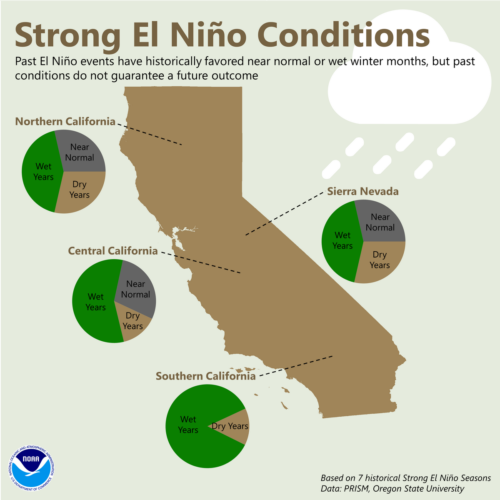 “Chances are rising that an El Niño expected to form soon could become one of the most powerful such events on record, according to new data released this week. The latest outlook from the European Center for Medium-Range Weather Forecasts (ECMWF) shows water temperatures in a key region of the central equatorial Pacific Ocean potentially reaching 3 degrees Celsius (5.4 degrees Fahrenheit) above average late in the year. That could approach or even surpass the current records set in 1877 and 2015 and exceed the threshold for a super El Niño. “Confidence is clearly shifting higher on potentially the biggest El Niño event since the 1870s,” wrote Paul Roundy, a professor of atmospheric science at the State University of New York at Albany. Records for El Niño began around 1850. … ” Read more from the Washington Post.
SEE ALSO: The world is about to get a preview of life in 2035, from the New York Times
Pacific hurricane season is next week — and California faces higher risk
“The 2026 Pacific hurricane season is just around the corner — and the latest numbers suggest a volatile year ahead. In the latest outlook from AccuWeather, forecasters are warning of an active season that could increase flood risks for parts of the Southwest U.S., including Southern California, even without direct landfalls. The Eastern and Central Pacific hurricane seasons officially begin next week, and early forecasts point to a significantly above-average year across both basins, driven by unusually warm ocean waters and a developing El Niño pattern. “The Pacific is unusually warm, and that raises the stakes this season,” AccuWeather Lead Hurricane Expert Alex DaSilva said. “That extra energy stored in the ocean can help storms strengthen faster, last longer and in some cases move farther north toward places like Baja California and far Southern California.” … ” Read more from the Desert Sun.
ACWA names Karla Nemeth as Executive Director, plus Karla Nemeth podcast: The hard truths of California water
 “California Department of Water Resources Director Karla Nemeth has been selected to lead the Association of California Water Agencies (ACWA) as its next executive director, President Ernie Avila announced today. Her selection follows a nationwide recruitment process and overwhelming support of the association’s Board of Directors. Effective Sept. 1, Nemeth will oversee staff of the nation’s largest statewide coalition of public water agencies. Based in Sacramento, ACWA represents approximately 470 members responsible for 90 percent of the water delivered to cities, farms and businesses across California. Nemeth will lead a staff of more than 40, including a Washington D.C.-based office, supporting state and federal advocacy, educational outreach and events. ACWA’s membership includes urban, rural and agricultural water suppliers of all sizes throughout California. She will lead ACWA as its first female executive director in the association’s 116-year history. … ” Continue reading at Maven’s Notebook.
PPIC Report/Policy Brief: Tracking Headwaters Management for Wildfire Resilience in California
“California has dramatically shifted how it manages its headwaters. After more than a century of fire suppression, the state is now engaged in an unprecedented multi-agency effort to reduce the risk of severe wildfire on one million acres of forest each year. Better headwater management will both protect the state’s water supply and help keep residents safe. The state is over halfway to meeting its annual million-acre goal. In the first four years, the task force coordinated and tracked efforts to reduce wildfire hazard on an average of 591,000 acres treated each year. Our research shows that the highest-priority areas received the bulk of the management, indicating that efforts are targeting the right places. … ” Read more from the PPIC. | Read the policy brief.
How Sierra Nevada meadow restoration is securing California’s water future and protecting against climate change
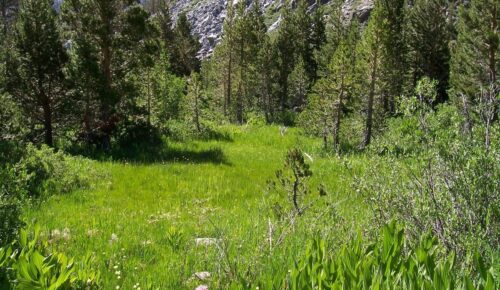
“The Sierra Nevada is widely known as one of the most beautiful landscapes globally, attracting tourists from around the world. But these landscapes are far from merely aesthetic; their health is tied to the health of California communities and wildlife. Specifically, the Sierra Nevada meadows are a crucial carbon sink and water storage source in California, a key component of the state’s ability to withstand the impacts of climate change. Today, however, about 70% of Sierra meadows are degraded, with diminished capacity to hold either water or carbon. Sierra Nevada headwaters supply roughly 60% of California’s domestic water from Northern California down to Southern California; every meadow we restore is an investment in that supply. At CalTrout, we’re part of a multi-year effort to restore key Sierra Nevada meadows, enhancing our ability to store carbon and water across the state and simultaneously providing a blueprint to quantify the benefits. … ” Read more from Cal Trout.
America the undammed: More miles of the country’s rivers were reconnected last year thanks to dam removals than at any other time in history
“Even though the two dams spanning the river in Bedford, Pa., were old, troublesome and functionally useless, locals just couldn’t quit them. The dams were built for swimming and fishing, but so much silt had built up that the river was mere inches deep. They trapped debris, worsened flooding and thwarted migratory fish. They were also falling apart, drawing warnings from the Environmental Protection Agency that they would have to be replaced, repaired or removed, at local taxpayer expense. Yet the people of Bedford had grown attached to the dams, which dated back 50 years. Some also believed, wrongly, that the barriers housed important utility wires or cables. “Somebody always came forward and gave a concrete reason those dams could not possibly be removed,” said Kenny Fetterman, who sits on the Bedford Borough Council. … ” Read more from the New York Times.
California’s first-of-its-kind solar project could save 63 billion gallons of water annually
“California’s canal-top solar pilot has wrapped up, and the early results suggest the idea could do much more than generate clean electricity. It could also help protect one of the state’s most precious resources: water. As PV Magazine detailed, the 1.6-megawatt Nexus project, completed in September, was built over canals operated by the Turlock Irrigation District. The pilot is the first of its kind in the country and was designed to test whether solar panels installed above active irrigation canals can reliably produce power while reducing evaporation, limiting algae growth, and avoiding the need for additional land. The project launched in 2022 through a public-private collaboration among TID; the California Department of Water Resources; Solar Aquagrid; and the University of California, Merced. … ” Read more from The Cool Down.
Modular micro-data centers in cooler climates: Geography, strategy and California’s role
“The explosive growth of artificial intelligence, cloud services and edge applications is not merely a software story; it is a profoundly physical one. Digital infrastructure must be built, powered, cooled and placed somewhere on the map. For most of computing history, that placement defaulted to wherever fiber was dense and capital was available. But as AI workloads intensify and sustainability pressures mount, geography has become a first-order strategic variable. One increasingly important response to this shift is the rise of modular micro-data centers, or MMDCs. Unlike monolithic hyperscale campuses that require years to plan and build, MMDCs are prefabricated units integrating power, cooling and computing capacity that can be deployed in weeks and, in many cases, relocated as conditions change. Their portability turns geography from a fixed constraint into a strategic choice, and that choice increasingly hinges on one question: how is heat managed? … ” Read more from the Daily Journal.
Multi-agency report published identifying conservation priorities for western monarch butterfly
“The California Multi-Agency Monarch and Pollinator Collaborative has published a report on the results of a years-long process to identify priority conservation actions and research needs for the western monarch butterfly. The “Conservation Priorities for the Western Monarch Butterfly in California” report, involving members of 13 state and federal agencies, marks a significant effort to address threats to the western monarch butterfly, whose population has declined catastrophically in recent years. “Monarch recovery starts with restoring habitat, expanding native plants and aligning science with on-the-ground action across agencies and partners. This roadmap gives 13 state and federal entities — and the public — a shared path forward to help these iconic pollinators rebound,” said Meghan Hertel, Director of the California Department of Fish and Wildlife. … ” Read more from the Department of Fish and Wildlife.
Sweeping California law on single-use plastic meets with outrage from all sides as it goes live
“Within days of California’s long-anticipated single use plastic law going into effect, environmentalists and anti-waste activists announced they plan to sue. They say Gov. Gavin Newsom’s administration and CalRecycle inserted exemptions favoring the plastic industry into the law’s regulations that weaken it and undermine legislative intent. “These new rules create huge loopholes for plastic packaging that violate the law,” said Avinash Kar, senior director of the toxics program at the Natural Resources Defense Council. “We expect to challenge this in court.” … On the other side, the packaging industry also is unhappy with the law, and although it has not officially announced its intent to sue, “our members have real concerns about cost, compliance, and constitutionality,” said Matt Clarke, spokesman for the National Assn. of Wholesaler-Distributors, which sued Oregon earlier this year over a similar waste law. … ” Read more from the LA Times. | Read via Yahoo News.
SEE ALSO: Environmental Advocates to Challenge Plastics Regulations in Court, from the NRDC
Schiff outlines California priorities for U.S. farm bill stalled in Congress
“U.S. Sen. Adam Schiff, D-Calif., has outlined a slate of California-focused priorities for the next U.S. farm bill, including opposition to proposed food assistance cuts and protections for a state animal welfare law. The $390 billion measure, which was approved by the House last week on a near-party-line, remains uncertain as it heads to the Senate where Republicans cannot pass the legislation without the support of Democrats. Senate Republican leadership has indicated that its own version may be coming soon. In its current form, the measure would structure major food and agriculture programs for five years, increase subsidies for farmers and cut food assistance programs for lower-income families. Congress last passed a farm bill in 2018. This week, Schiff outlined his California priorities for the bill — some of which conflict with the House-approved version. The majority of House Democrats voted against the bill. California Reps. Jim Costa, D-Fresno, and Adam Gray, D-Merced, were some of the 14 Democrats to vote for it. … ” Read more from the Sacramento Bee.
Why 2026 could be one of the worst wildfire seasons in recent US history
“Wildfire season is fast approaching, and with low snowpack, dry conditions, and soaring temperatures across the U.S., experts are warning that 2026 may be one of the worst on record. Combine those extreme conditions with massive restructuring at the U.S. Forest Service (USFS), and the result is a powder keg for federal wildland firefighters. “We have a wildfire crisis on our hands right now,” said Riva Duncan, an ex-fire chief who spent 32 years fighting wildfires for the USFS and Bureau of Land Management. Today, she’s the president of the advocacy organization Grassroots Wildland Firefighters. “We used to call it a fire season, now it’s a fire year,” Duncan told Outside. “Our fires are larger, more destructive, last longer, and are more difficult to suppress.” … ” Read more from Outside Online.
In regional water news and commentary today …
NORTH COAST
River otters use various hunting strategies at Arcata Marsh
“For nearly three decades, Cal Poly Humboldt Wildlife Professor Jeff Black and citizen scientists have been quietly documenting the lives of one of the North Coast’s most charismatic residents: river otters. Now, marking the 27th and final year of this long-term research effort, Black is sharing new observations at the Arcata Marsh & Wildlife Sanctuary — a place where wastewater treatment, wildlife habitat, and public access intersect. Based on two years of intensive study, the latest findings, published in the Northwestern Naturalist, reveal just how deeply river otters rely on the marsh. Otters were present nearly every day, using the wetlands not only to hunt, but to raise pups, socialize, rest, and navigate a landscape shared with hundreds of daily visitors. “Watching the daily interactions between these top predators and their prey was a treat,” says Black. “These river otters regularly switched between fishing for fish and hunting for waterbirds — depending on which pond they entered.” … ” Read more from the Eureka Times-Standard.
Coastal waters from Mendocino to Bay Area turning into a graveyard for gray whales
“The 40-foot male gray whale on RCA Beach had drifted past Tiburon on March 28, slid through the Golden Gate on a strong tide, and washed ashore in Bolinas the night of April 1. By the next afternoon, a team from the Marine Mammal Center and the California Academy of Sciences was on the sand in waders and elbow-length gloves, racing the next tide for samples — bone saws and meat hooks against the foul stench one writer compared to “a refrigerator left for weeks without power.” They were looking for trauma. Maggie Martinez, a veterinary pathologist who lacks a sense of smell, worked the gastrointestinal tract. “They tell us what and how much they are eating and if they’ve been exposed to any algal bloom toxins,” Martinez said. “I’m also grabbing a couple of tissues, like blubber and muscle, to try to look for trauma.” … ” Read more from Local News Matters.
Mendocino commentary: We need a reliable water future
County Supervisor John Haschak writes, “As the saying goes, we are always one dry winter away from drought. Kudos to the Mendocino County Fire Safe Council for facilitating the water tank program. They delivered close to 200 free water tanks to more than a dozen Firewise Communities, Neighborhood Fire Safe Councils, and fire departments throughout the county. Overall, the program, through the state Department of Water Resources, provided 450 water tanks in Mendocino County. Speaking of water, there has certainly been a weird twist to the Potter Valley Project. While we want local control over many issues, especially one as critical as water, the federal government has stepped in and found a water agency in Southern California that is interested in taking over the dams. This comes after years of negotiations and compromises throughout the North Coast to make sure that we have sustainable water after PG&E decommissions the dams. PG&E doesn’t want the dams because of liability of dam failure and losing money, not a good combination for a profit-driven corporation. … ” Read more from the Mendocino Voice.
Commentary: After Robin Lane: Clearlake needs more than cleanup
Corey Shaffer, an environmental science student and environmental monitoring researcher, writes, “In January, a 16-inch wastewater force main on Robin Lane failed, resulting in a sewage release over roughly 37.5 hours. County officials reported an estimate of 2.9 million gallons during the response; the city of Clearlake later described that figure as the maximum possible release before recovery calculations were finalized. What began as 58 affected properties later expanded to nearly 200 properties relying on private wells as groundwater migration concerns grew. Some families were advised to relocate or depend on alternative water supplies until their wells could be confirmed safe. On May 7, the Clearlake City Council is scheduled to take up formal discussion of the Lake County Sanitation District. Demands for access to records, independent engineering review, regulatory complaints, and governance changes are all on the table. These are the right moves, but they are only the beginning of the right conversation. ccountability after a catastrophic failure is important. Preventing the next one is even more so. … ” Read more from the Lake County News.
SIERRA NEVADA
Written in stone: The geology of Truckee–Tahoe
“Vast, polished granite walls rise from forests and lake shores, shaped by forces far older than the rock climbers who now trace routes across them. Standing beneath formations like Snowshed Wall at Donner Summit, where climbers begin inching their way up the stone as soon as the snow melts, it’s hard not to wonder: how did this landscape come to look like this? If Truckee-Tahoe’s rocks could speak, they would tell a story stretching back millions of years. According to the Lake Tahoe Basin Management Unit, around five million years ago, movement along major fault lines caused large blocks of the Earth’s crust to rise and fall, helping form the Sierra Nevada crest. In the area where Lake Tahoe sits today, two blocks lifted on the east and west while the land between them dropped, creating a deep valley. … ” Read more from the Tahoe Daily Tribune.
SACRAMENTO VALLEY
Chico City Council reverses sewer rate hike, seeks new financing options
“Chico leaders reversed course on a major sewer rate increase after weeks of backlash from residents and business owners who said the plan would hit households and restaurants especially hard. At Tuesday night’s meeting, the Chico City Council voted to reconsider the sewer rate plan it approved March 17 and directed city staff to return June 16 with additional financing options and updated rate analyses. The original proposal, known as Option 1, called for a 180% increase in the first year followed by 3% annual increases over the next four years, totaling a 215% increase over five years. City officials said the hikes were needed to fund about $135 million in sewer system improvements, meet state regulatory requirements, address deferred maintenance and rebuild reserve funds. … ” Read more from KRCR.
Federal funding advances Sacramento Regional Water Bank toward completion
“The Regional Water Authority (RWA) announced today it has secured $708,466 in federal funding through the Water Infrastructure Improvements for the Nation (WIIN) Act, advancing the Sacramento Regional Water Bank (Water Bank) toward full implementation. RWA represents nearly two dozen water providers serving 2.2 million people in the Sacramento region. Administered by the U.S. Department of the Interior, WIIN Act funding will support final planning and technical work needed to bring the Water Bank to operational readiness. The Water Bank uses the region’s groundwater basin as a natural reservoir, storing water in wet periods for use during dry times. While local agencies have practiced conjunctive use—the coordinated management of surface water and groundwater—for decades, the Water Bank formalizes and expands these efforts using existing infrastructure. The aquifer can hold enough water to fill Folsom Reservoir twice. In addition, groundwater banking supports flows in the Lower American River year-round and reduces reliance on the river during dry years—leaving more water for fish and habitat. … ” Read more from the Sacramento Regional Water Bank.
BAY AREA
Commentary: Ross Valley flood-protection plan gets a needed reset
Marin County Supervisor Brian Colbert writes, “Earlier this week, the Marin County Board of Supervisors passed a recommendation – put forward by the Flood Zone 9 Advisory Board and county flood control staff after extensive analysis and community engagement — to discontinue the proposed removal of Building Bridge 2 in downtown San Anselmo. But this moment is about more than a single project. It is an opportunity to reset how we approach flood protection and community resilience across Ross Valley. It is fair to say that few, if any, are satisfied with where flood mitigation efforts stand today. After years of planning and significant costs, we are not where we expected to be. That reality deserves acknowledgment. The challenges are not simply about one project. BB2 reflects broader issues across multiple efforts: how projects were originally conceived, how constraints were communicated – as well as how difficult it has been to align technical requirements, community priorities and feasible outcomes. In several cases, those elements never fully came together. … ” Read more from the Marin Independent Journal.
New shoreline projects could add 168 acres of parks to the East Bay
“The East Bay shoreline is on track to get greener. Plans have recently advanced to transform a former horse racing track in Albany and an industrial lot on the Martin Luther King Jr. Shoreline in East Oakland into waterfront parks. Together, the two projects could add 168 acres of public green space and shoreline access on the East Bay. The projects are expected to plan for sea-level rise from human-caused climate change that could see Bay Area ocean levels rise up to 6 feet by 2100. The initial phase of the project on the MLK Shoreline in Oakland included adding 22,000 cubic yards of soil to raise the level of the area ahead of expected sea-level rise. The next phase will include a makeover of seven acres of land owned by East Bay Regional Park District that’s been leased out for decades, most recently to a trucking company for storage. … ” Read more from the Knee Deep Times.
Restoring salt ponds to marshes is a win. Unless you’re a snowy plover.
“Parenting is no joke for our local western snowy plovers. First there’s finding real estate on the San Francisco Bay—somewhere salty, flat, and undisturbed in which to dig a slight scrape for a clutch of two to six inch-long eggs. Development, introduced beachgrass, and other human disturbance make likely spots scarce. Fewer than a third of the eggs hatch. The chicks that do emerge must move far and fast, even in their first hours. Parents show their thumb-size, flightless offspring where to feed and help distract predators, but getting food is on the chicks. After six days, the mother abdicates parental responsibility to the father and leaves to start her next brood. So few chicks make it, she’s hedging her bets. And yet our local plover population has hit a winning streak, ticking up almost every year since 2020, according to a new report from the San Francisco Bay Bird Observatory (SFBBO). It’s part of a broader success across the whole Pacific coast population, a federally threatened bird whose breeding habitat ranges from Baja California to the state of Washington. … ” Read more from Bay Nature.
Sen. Schiff, Bay Area lawmakers urge Trump admin to release funding for San Francisco Bay Wildlife Refuge Complex
“U.S. Senator Adam Schiff (D-Calif.) and five Bay Area lawmakers urged the Trump administration to release millions of dollars of Congressionally approved funds for San Francisco Bay National Wildlife Refuge Complex, which have been subject to bureaucratic delay at the U.S. Department of Interior. The San Francisco Bay National Wildlife Refuge Complex is an important part of the National Wildlife Refuge System, and in December 2022 and January 2023 experienced severe winter storm damage to its berms, levees, and pump stations that are critical to the Fish and Wildlife Service’s ability to protect Bay Area communities from flooding and manage and restore natural habitats. The lawmakers expressed deep concern that the Complex has yet to receive the full $70 million allocated to them as a part of the 2025 American Relief Act, funding that is crucial to addressing winter storm damage and preventing future flooding in Northern California. … ” Read more from Senator Schiff.
SEE ALSO: Huffman, Bay Area Lawmakers Urge Trump Admin to Release Funding for San Francisco Bay Wildlife Refuge Complex, from Congressman Jared Huffman
Mountain View restores water to majority of homes impacted by water main breach
“After nearly two weeks without safe drinking water, 46 of the 67 Mountain View households affected by the recent water main contamination breach near Cuesta Park have been told that they are in the clear. The city is still working to return full water services to 21 homes in the area. Mountain View announced Wednesday morning that, in coordination with the California State Water Resources Control Board, it had lifted the “boil water” notice – which went into effect on Friday, May 1 – for most of the impacted homes. The households still under the advisory are on Drucilla Drive and Carla Court, where the city is currently working on a “super chlorination” treatment process for the pipeline serving that area. The city first shut off water access for dozens of homes near Cuesta Park on April 24, after city contractor C2R Engineering breached a water main at the corner of Bonita Avenue and Cuesta Drive. This incident caused a cement slurry mix to come into contact with the main water supply. … ” Read more from the Mountain View Voice.
CENTRAL COAST
New Pajaro River Watershed Plan targets climate resilience across four counties.
“In 2024, the California Department of Water Resources (DWR) selected the Pajaro River Watershed as one of five watersheds to pilot its watershed resilience program. On May 5, following 18 months of development and collaboration across public agencies, tribal representatives, agricultural leaders and other stakeholders, the program’s advisory group released the official Pajaro River Watershed Resilience Plan. The initiative is supported by a $2 million grant from DWR and administered by Pajaro Valley Water. It was prompted by climate hazards, including flooding, drought and wildfires, that have exposed vulnerabilities in communities and economies reliant on the watershed. It also responds to recent natural disasters and aging infrastructure, most notably the 2023 Pajaro River levee breach, which flooded more than 2,000 acres of strawberry fields and displaced thousands of residents. “By aligning priorities and working together, we strengthen the region’s ability to acquire funding, implement projects and deliver meaningful benefits to communities, agriculture and ecosystems,” said Brian Lockwood, general manager of PV Water, in a press release. … ” Read more from Monterey Now.
A draft allocation policy aims to structure where new water supply should go in parts of unincorporated Monterey County.
“After decades of water scarcity in parts of unincorporated Monterey County, new water supply from Pure Water Monterey is poised to open the tap. The question is how that water will be tracked and allocated to new projects. On April 19, County Planning Commissioners discussed a draft water allocation policy that outlines a framework for delivering water to California American Water service areas in unincorporated areas within the Monterey Peninsula Water Management District. These areas include parts of Carmel Valley, Pebble Beach, the Highway 68 corridor, Jacks Peak and more. The draft policy, set to return to the Planning Commission on Wednesday, May 13 before heading to the Board of Supervisors for possible adoption in June, seeks to shift water allocations away from a historically first-come, first-served basis to a more structured process. The goal: to fairly distribute the new water supply while also supporting the County’s housing and economic development goals. “We’re dealing with the fact that there’s possibly a limited amount of water to do something, and we don’t know what,” Planning Commissioner Martha Diehl says. “It hasn’t worked like that. It’s a change of state.” … ” Read more from Monterey County Now.
SAN JOAQUIN VALLEY
Yosemite ditches reservations, drawing huge crowds in a free-for-all
“People heading to Yosemite to escape urban congestion fumed this weekend as they waited in a seemingly endless line of cars at the park entrance. Inside, they circled aimlessly around full parking lots, scanning for empty spots instead of majestic views. Near the summit of Half Dome, on the infamous steel cables hikers use to ascend the final stretch of bare granite, another traffic jam formed, trapping people hundreds of feet in the air, according to social media posts. Even before the summer rush, California’s most visited national park is seeing big crowds — the most people in a decade, according to National Park System data. Critics of the free-for-all are blaming the influx on the Trump administration for abandoning a reservation requirement that, for the last few years, has helped control the number of visitors and preserve a sense of natural tranquility. … ” Read more from the LA Times. | Read via Yahoo News.
SOUTHERN CALIFORNIA
LA County orders Chiquita Canyon Landfill to install specialized cover
“Los Angeles County ordered the operators of the Chiquita Canyon Landfill to install a cover to contain odors emanating into Castaic and other nearby communities, officials announced on Wednesday. The county Department of Public Health, acting as the local enforcement agency on behalf of CalRecycle, was successful last week in requiring the landfill to install a thick geomembrane cover over the facility. Members of the Los Angeles County Solid Waste Facilities Hearing Board voted 3-0 last week to deny the landfill’s appeal, and affirmed the county’s compliance order — finding the required mitigation measure to be reasonable and scientifically supported, according to officials. The order, also referred to as directive 4.1, requires the installation of a cover over the entire landfill by Aug. 31, 2026, including a disputed 66-acre portion of the site. The local enforcement agency ensures compliance with solid waste laws, and has the power to require the landfill to operate in a manner that protects public health and the environment. … ” Read more from the LA Daily News.
Trees that survived L.A.’s wildfires are dying at alarming rate. Can they be saved?
“The deadly fires that devastated homes in Pacific Palisades and Altadena also laid waste to a lush canopy of leaves and pine needles that had cooled and shaded residents here for generations. Now, more than a year later, trees that had survived the flames are disappearing at a troubling rate. Since the January 2025 fire siege, roughly 20% of surviving street trees have gone missing, according to preliminary results from a University of California research team. Many of the hundreds of missing trees probably would have recovered from the damage they suffered in the fires, experts say. The results from the survey of about 500 trees in the Palisades and 1,500 in Altadena — including conifers, palms, Chinese elms and carrotwoods — seem to confirm worrying patterns observed by arborists and local volunteers in the burn scars, who said losses will probably continue for years to come. Several factors appear to be at work. … ” Read more from the LA Times. | Read via Yahoo News.
Colorado River crisis: Santa Monica’s water future at risk
“As we ricochet from headline to headline, we may miss the threats not screaming for attention. It’s easy to spot a cracked window after a storm, but it’s harder to catch the slow trickle of a leaking pipe. And speaking of perilous trickles, at a recent Santa Monica Sustainability Commission meeting, Mark Gold, was sounding Cassandra-like warnings about the Colorado River. For those who don’t know Gold, he’s the razor-sharp former (and founding) chair of the commission (for 28 years) and now the Santa Monica representative on the Metropolitan Water District for Southern California Board of Directors. And for those who don’t know about the Colorado River crisis, seven Western states are battling over their rightful share of the dwindling supply of water. “It’s not a matter of if there’s a disaster,” said Gold, who has a doctorate in environmental sciences and engineering from UCLA. “It’s the scope and scale of the disaster that’s the question.” … ” Read more from the Santa Monica Daily Press.
SAN DIEGO
‘Paradise lost’: Dreaded ‘poo-nami’ from Mexico risks shutting down one of America’s best beaches
“They’re up s–t creek without a plunger. Just when you thought it was safe to get back in the water: A picturesque California beach is at risk of being shuttered amid a deluge of sewage from Mexico that’s befouled the coastline. “It was heaven on Earth, and now I call it paradise lost,” Whitney David, 63, a retired surgeon and surfer, told the WSJ of the odiferous scourge. Located off the coast of San Diego Bay, the upscale resort city of Coronado has long been a mecca for bathers. However, recently the region has been polluted by gallons of wastewater — as many as 38 million per day — from our neighbor to the South, which has increasingly rendered this idyllic seaside hub off-limits. New Jersey resident Kristin Cohen, 36, claimed she attempted to take her 3-year-old daughter Chloe, only to be stopped in her tracks by a sign that read “Water Contact May Cause Illness.” “I guess we can’t do that, babe,” she lamented. … ” Read more from the New York Post.
County sales tax measure vague on Tijuana sewage fixes
“The county sales tax signature gatherers seemed to be everywhere – outside Trader Joe’s in Hillcrest. Or on the corner of 30th and University Avenue – the busiest intersection in North Park. They all asked passersby one question: Would you like to stop the Tijuana River sewage crisis at the border? They were promoting a citizens’ initiative to get a countywide half-cent sales tax on the November ballot. I asked one how it would be used on the Tijuana River. They couldn’t point to a specific project. Probably because the “Protect San Diego County Health and Safety Act” doesn’t specifically point to one. Fixing the persistent problem — what the Wall Street Journal called a “tsunami of raw sewage” — has become the main selling point of the tax, which could generate $360 million a year. The measure would dedicate about $80 million of it to “stop sewage flows.” If they packaged it into a bond, it could provide billions to invest immediately. … ” Read more from the Voice of San Diego.
Along the Colorado River …
How far will Lake Mead fall after all of its “banked” water has been withdrawn?
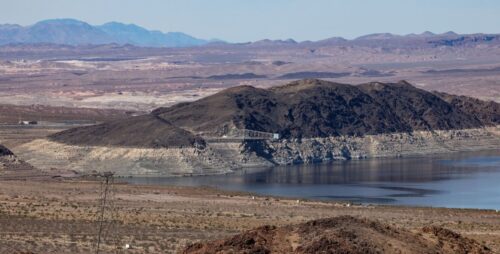 “Water that’s banked in Lake Mead is officially called “Intentionally Created Surplus“, or ICS. The ICS allows major water users to store conserved or unused Colorado River water in the reservoir for their future use. It’s probably obvious to most of you but since Lake Mead serves as a reservoir for the lower basin, the ICS is primarily a program that serves water agencies in the lower basin. As of April 12, 2026, Lake Mead’s water volume was 8.41 million acre-feet, or roughly 32% of its total capacity. But while writing this article we were made aware that we should subtract Lake Mead’s deadpool – which is estimated at 2.5 million acre feet of water that cannot be utilized because Hoover Dam’s water intake towers and turbines are physically positioned too high to draw that water.2 Therefore the approximately 2.67 to 3.47 million acre feet of that water that’s currently banked represents somewhere between 44% and 58% of the 6 million acre feet of water that’s available in Lake Mead. … ” Read more from Coyote Gulch.’
After being stuck for months, Colorado River negotiators float bringing in a mediator to help. We asked an expert: Will that actually help?
“As the clock approaches midnight for new Colorado River guidelines, Utah and the other basin states have proposed bringing on an independent mediator to help states strike a deal. The Tribune called Utah’s expert in collaborative decision-making, Danya Rumore, to get her take on the idea. Rumore is the director of the Environmental Dispute Resolution Program, which is moving from the University of Utah to Utah State University this summer. She has facilitated conversations on some of Utah’s trickiest science, environment and recreation issues — from the Great Salt Lake to national park gateway communities. Here is our conversation, edited for length and clarity. … ” Read more from the Salt Lake Tribune.
Lake Powell runoff to hit record low, putting Arizona’s water supplies at risk
“Very dry and warm weather in the winter and early spring means Colorado River flows into Lake Powell will hit record lows this summer, a new federal forecast says. The past winter brought record-low snowpack in the mountains of Colorado, Utah and Wyoming that feed the Colorado. March brought record heat that caused the snows that had fallen to melt prematurely. The result is that runoff from the melting snow into the river will bring April through July flows into Powell to only 13% of average, says the federal Colorado Basin River Forecast Center, a division of the National Oceanic and Atmospheric Administration. That would make the spring-summer runoff into Powell the lowest of its kind since Lake Powell was created in 1963 by the construction of Glen Canyon Dam. The total amount of water expected to reach Powell is 800,000 acre-feet from April through July. … ” Read more from the Arizona Daily Star.
Lake Powell given lifeline, but its impact could be felt for years
“Lake Powell has been thrown a temporary lifeline as federal officials move to prop up its falling water levels, but the emergency measure could carry consequences for ecosystems and communities across the Colorado River Basin for years to come, according to officials and experts. In an effort to stabilize the reservoir and protect hydropower generation at Glen Canyon Dam, the U.S. Bureau of Reclamation (USBR) announced plans last month to begin releasing water from Flaming Gorge Reservoir while also reducing downstream releases to Lake Mead. The moves are intended to prevent Lake Powell from dropping below critical thresholds, but officials and experts warn it may strain future water supplies, disrupt recreation and local economies,, reduce power output downstream, and damage fish populations. … ” Read more from Newsweek.
Brain-eating amoeba detected in western national park waters
“A new federal study has found a rare but dangerous “brain-eating amoeba” in warm recreational waters at several western national park sites — including the Lake Mead National Recreation Area, Yellowstone National Park, Grand Teton National Park, Olympic National Park and the Newberry National Volcanic Monument. Researchers detected Naegleria fowleri, a microscopic amoeba that causes a typically fatal brain infection, in water samples collected from thermally influenced recreation sites across the West, such as hot springs, geothermal systems and shallow warm-water areas. The study, published by the U.S. Geological Survey and its partner agencies, tested 185 water samples from 40 sites and detected the amoeba in about one-third of all samples collected. … ” Read more from SF Gate.
Colorado anglers fear drought will make it ‘hard to keep fish alive’ this summer
“Colorado’s trout fisheries could face a difficult summer, impacting the state’s billion-dollar angling industry, as widespread drought conditions drive predictions that streamflows will be well below-average. Kirk Klancke, the president of the Colorado Headwaters Chapter of Trout Unlimited, said he is concerned that the drought will stress fisheries this summer, especially if temperatures are anywhere near as elevated as they were this winter. “If this summer is anything like this past winter was, the chances are pretty good that there’s going to be fish kills in our streams,” Klancke said. “It’s 100% given that, without some miracle monsoon season, we’re going to see (river) temperatures that threaten trout — and fishermen who care will be fishing in the mornings.” … ” Read more from the Aspen Times.
In national water news today …
America’s aging water systems trigger a surge in billion-dollar fixes
“Investments in wastewater and water treatment infrastructure across the United States are accelerating at an unprecedented pace. Federal data from the EPA indicates that more than $630 billion in water infrastructure improvements will be needed over the next two decades, with wastewater systems accounting for a significant share of that total. Much of this demand is driven by aging facilities, many of which were built more than 40 to 60 years ago and are now operating beyond their intended life cycles. At the same time, tightening regulatory standards for nutrient removal, increased climate-related risks, and population growth are forcing communities to modernize or replace outdated systems. An additional factor, weather related events are causing an immediate need for sustainability and other types of reconfigurations on systems in many parts of the U.S. … ” Read more from Smart Water Magazine.
Study finds oceanic climate pattern brought historic heat
“As the summer months draw near and temperatures continue to rise, a group of researchers recently found evidence that an Indian Ocean climate phenomenon is the driving force behind a streak of increasing global temperatures. Both 2023 and 2024 set new records for global heat, accompanied by devastating wildfires, severe heat waves and an unprecedented number of climate-related disasters that exceeded predictions based on climate change. A team of researchers from the University of Maryland decided to tackle the question of what’s causing the spike in a new study released Wednesday in the journal Earth System Dynamics. They proposed that the Indian Ocean Dipole, a climate cycle also known as the Indian Niño, is a contributing factor in temperature surges. The team worked together to build a climate model that forecasts global temperatures by accounting for a comprehensive range of variables, including natural and human-induced factors. … ” Read more from the Courthouse News Service.

