
Several news sources featured in the Daily Digest may limit the number of articles you can access without a subscription. However, gift articles and open-access links are provided when available. For more open access California water news articles, explore the main page at MavensNotebook.com.
On the calendar today …
- MEETING: State Water Resources Control Board meets beginning at 9am. Agenda items include current hydrologic conditions and response, and Update on status of the Underground Storage Tank Cleanup Fund and Underground Storage Tank Cleanup Program. Click here for the full agenda.
- WEBINAR: OpenET: Strengthening Water Resilience with Satellite-Based Evapotranspiration Data from 10am to 11am. The U.N. recently declared a “global water bankruptcy,” highlighting that water scarcity is one of the biggest challenges of our time, as water underpins food systems, ecosystems, public health, and social and political stability. One major hurdle of sustainable water management has been the lack of widely available, low-cost data on water consumption. OpenET changes this by making satellite-based data on water use widely accessible at the field scale across the contiguous United States. In this webinar, Sara Larsen, CEO of OpenET Inc., will dive into the OpenET platform, sharing why it is needed, how it was created by a unique public-private-philanthropic partnership, and who is using it. She’ll also share what’s on the horizon for OpenET, including plans for expansion and new features. Click here to register.
In California water news today …
A whiplash spring and California’s water supply
“It has been widely reported that March was a disaster for California’s snowpack. Summer seemed to arrive three months early, with record-shattering heat and dryness and a mere pittance of precipitation. Did a relatively cool, rainy, and even snowy April make up for it? The short answer is no—but it helped. It’s important to remember that snowpack is California’s third-largest source of water storage, behind surface reservoirs and groundwater. Our statewide water supply grid is built around storing roughly 30% of statewide water supply in snowpack, a relatively reliable source of water through the 20th century. In a typical year, snow accumulates from December through March. Around April 1, warming temperatures, lengthening days, and a higher angle of the sun cause the snowpack to warm up and start melting, raising rivers and filling reservoirs. Depending on how thick the snowpack is, this melting can last well into June and even July in some years. … ” Read more from the PPIC.
Lake Oroville nears full capacity
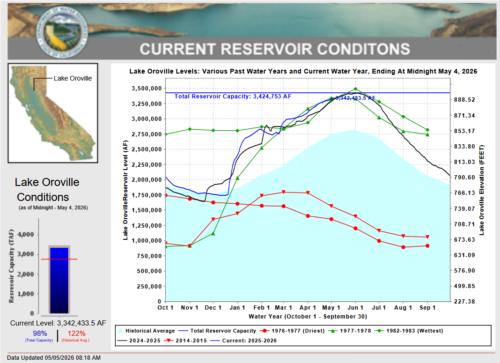 “Grasses across the north state have rebounded after weekend rain, turning green again as rainfall totals climb above the historical average in the area. Just six feet from full capacity, Lake Oroville’s water level reached 894 feet Monday, about 122% of average this time of year, according to an email Monday from the Department of Water Resources. The lake is at 97% of its capacity, and how quickly it reaches 900 feet will depend on seasonal inflows, according to DWR. Total releases to the Feather River are decreasing from 1300 cubic feet per second Sunday to 1050 cubic feet per second Tuesday. National Weather Service meterologist Nathan Rick said Monday that rainfall amounts in Oroville are above average for the water year, with Oroville recording 26.1 inches from Oct. 1, 2025 to May 1 compared to 24.06 on average. … ” Read more from the Chico Enterprise-Record.
Potter Valley fight intensifies as community pushes back against dam removal and water loss
“The AgNet News Hour highlighted a growing battle in Northern California, where residents and agricultural leaders are pushing back against efforts to remove key dams in Potter Valley, an issue that could have major consequences for water supply, farming, and rural communities. The episode featured an in-depth interview with Keely Covello, a journalist and Potter Valley native who has become a leading voice in the fight to preserve the region’s water infrastructure. “This is a David and Goliath story,” Covello said. “We are in the thick of the fight.” At the center of the issue is the Potter Valley Project, a system of dams and water infrastructure that supports farms, ranches, and communities across the region. The project plays a critical role in delivering water to an estimated 750,000 people, making it a cornerstone of both local agriculture and broader regional supply. … ” Read more from AgNet West.
California almond acreage drops for first time since 1995
“A land study shows California’s bearing almond acreage decreasing for the first time in more than three decades. The Almond Board of California reported that the 1.385 million acres of almond acres measured in its Land IQ study means a net decrease of 15,227 acres from last year. This means any acreage coming into production was not enough to outpace the 47,588 acres removed in the 2025-26 crop year, according to a news release from April 23. In November, the almond board will release its findings on total almond acreage, giving a bigger picture of planting trends. “While we’re seeing stabilization in bearing acreage, global demand remains strong and is the foundation of our industry,” said Clarice Turner, president and CEO of the almond board. “Continued, strategic investment in market development is essential to supporting long-term growth and to position California almonds for the future.” … ” Read more from GV Wire.
The hidden risk: Why water quality is the next big challenge for specialty crops
“In the world of specialty crops, the conversation around water has long been dominated by the urgent need for volume, with many farmers wondering if they will have enough supply to simply get through the season. However, Kilimo CEO Jairo Trad points to a more insidious threat mounting in the global supply chain. While drought remains a visible crisis, water quality — specifically the degradation caused by overfertilization and runoff — is emerging as a significant risk that many producers have yet to fully quantify. Founded in Córdoba, Argentina, in 2014, Kilimo was born from Trad’s observations of how weather volatility could decide the fate of a family farm. Today, the climate-tech company uses artificial intelligence and machine learning to analyze satellite imagery and meteorological data, helping farmers across seven countries, including U.S. and Chile, reduce water use by up to 30%. As the company expands its footprint in high-stakes regions like California’s San Joaquin Valley, the focus is shifting toward a more holistic view of water stewardship. … ” Read more from The Packer.
UC Santa Cruz receives California Department of Fish and Wildlife funding to assess health of state’s streams
“Healthy watersheds support wildlife, recreation, and clean water for communities across California. From a public-health standpoint, we need to know if a river or stream is safe to swim or fish in. From the lens of wildlife support, in addition to being clean, a healthy aquatic habitat must sustain a whole food web. Knowing a stream’s health also indicates how resilient it is to adversities such as wildfires, land-use changes and agricultural runoff. When stream health is compromised, the potential consequences are dire: from a community’s loss of recreational options or a food source, to the rapid collapse of an ecosystem that evolved over millennia. California invests in work to monitor ecosystems and to understand the range of pressures on them, as well as opportunities to maintain or restore them. For example, through its Cannabis Restoration Grant Program, the California Department of Fish and Wildlife (CDFW) funds innovative research and projects that help support and protect California’s natural resources in areas affected by cannabis cultivation—such as initiatives that help scientists and land managers better detect impacts and guide restoration. … ” Read more from UC Santa Cruz.
Solar on canals reduces water evaporation by 70% and algae growth by 85%
“In September 2025, the Nexus pilot project in California, United States, was completed. The 1.6 MW solar installation is located on canals operated by the Turlock Irrigation District (TID) and was developed through a public-private partnership between the California Department of Water Resources, TID, Solar AquaGrid, and the University of California (UC), Merced. The project aimed to generate empirical data under real-world operating conditions. … The project monitors key performance indicators including electricity generation, evaporation losses, water quality, aquatic vegetation growth, and canal maintenance requirements. After one irrigation season, initial results indicate measurable benefits for the water sector. Canal sections covered with PV modules showed reduced evaporation and lower aquatic weed proliferation, which may translate into reduced operating costs. … ” Read more from PV Magazine.
Coded-wire tags show persistent hatchery dominance
“Every fall, Chinook salmon return to California’s Central Valley (CV) to spawn. Beneath the surface of this event lies a managed system that relies on hatcheries, tagging programs, and monitoring to understand where these fish come from and how they survive. A recent report from the Central Valley Constant Fractional Marking (CFM) Program offers a look at that system via data from coded-wire tags. To scientists, these data provide invaluable information for guiding the management of this species. Each year, CV hatcheries release roughly 32 million fall-run Chinook salmon juveniles. Under the CFM program, roughly 25% are marked by adipose fin clipping and implanted with a coded-wire tag (CWT). This translates to 7–9 million tagged fish annually, with each tag carrying information about the fish’s origin hatchery, brood year, release strategy, and more. When adults return approximately 2.5 years later, a small portion of these fish are recovered and sampled. … ” Read more from FishBio.
California’s Heritage and Wild Trout Program: A tale of partnership among government, nonprofits, and the public
“The California Department of Fish and Wildlife’s (CDFW’s) Heritage and Wild Trout Program (the Program) manages designated waters for wild trout species. The term “wild trout” means a fish born and reared in a specific location without human intervention. The term “heritage trout” refers to trout that have lived in a specific location since prehistoric times. The Heritage and Wild Trout Program is an example of how a state agency, nonprofit organizations, and the public can collaborate on conservation and education efforts. CDFW established the Program in 1971 with the help of CalTrout, a San Francisco nonprofit seeking to ensure healthy waters and wild fish. Together, the two entities have broadened the Program’s coverage area and mission through the decades. … ” Read more from the California Sportfishing Protection Alliance.
A new study shows that most young salmon entering the Delta never make it out
“A major new study is putting a name to something scientists have suspected for years: young California salmon are disappearing in the Sacramento-San Joaquin Delta, and nobody can see it happening. Researchers from the University of Essex, NOAA Fisheries, UC Davis and Cramer Fish Sciences tracked juvenile Chinook salmon through the Delta and found that early-migrating fish made up about 80% of the young salmon entering the system but only 26% of those leaving it. Just 15% survived long enough to return as spawning adults. The scientists are calling these lost fish “river ghosts” because they die unseen beneath the water, their fate hidden in a system that has been fundamentally reshaped by human engineering. … ” Read more from Active NorCal.
Rio Vista concerned about ‘hidden’ California Forever data center proposal
“The city said California Forever is not telling the whole story about its proposed expansion project in Suisun City – stating the project could be wildly different from what has been hailed as a plan that would pump up the county’s economy for years to come. The Rio Vista administration said in a statement released on Monday that the project could become the largest standalone data center in the nation, rather than the housing- and job-creating proposal that California Forever and some Suisun City officials promote. Suisun City City Manager Bret Prebula said he was “disappointed” by Rio Vista and called the city’s statement “game playing, and more of the same from Rio Vista in an effort to create misinformation for a project they themselves tried to steal away.” “To put it simply, the power and water needs of at-scale data centers makes no sense to the project, especially if one actually reads the Specific Plan. Nor has this ever been an expressed desire of City Council,” Prebula said in response to the Daily Republic. … ” Read more from the Daily Republic.
Kelp forests connected to sandy beach food webs
“UC Santa Barbara marine scientists are uncovering just how tightly the beach and the nearshore are connected along the California coast. Often treated as discrete ecosystems because of the natural divide between land and sea, the two are subtly linked by physical and ecological processes that couple the extent and condition of the kelp forests to the robustness and complexity of the food web on the shore. Through a paper published in Nature Scientific Reports, lead author Kyle Emery and colleagues quantify and characterize these connections, which add to our overall knowledge of the importance of the relationship between these adjacent ecosystems. According to the researchers, “the highly coupled nature of these coastal ecosystems increases the likelihood that negative impacts to donor ecosystems will cascade to affect the structure and function of subsidized recipient ecosystems.” This work was supported by the National Science Foundation. … ” Read more from The Current.
Trump slashed scientific research funds. A massive California bond could offset the cuts
“Scientists, doctors, students and patients from across California rallied in Sacramento Monday, calling on state lawmakers to support a $23 billion bond — the largest ever of its kind — to fund life-saving research facing insurmountable instability during the Trump administration. The $23 billion general obligation bond introduced by Sen. Scott Wiener, D-San Francisco has a long road to approval: It must be OK’d by the Legislature and signed by Gov. Gavin Newsom in order to appear on the ballot this November, where it would then need a majority of voters’ support. Wiener’s measure would support researchers in the state university system who are desperate for stability, as labs studying how to slow the growth of cancerous tumors or treat HIV reel under President Donald Trump’s funding whims. … ” Read more from the San Francisco Chronicle.
Column: The water industry’s talent crisis won’t wait
Sophie Borgne writes, “Every new data center built to power the AI boom needs two things most people think about (electricity and land) and one thing most people don’t: water. Cooling is the hidden constraint behind every rack of GPUs, and as compute demand scales, so does the pressure on local water systems. But water demand isn’t just an AI story. It’s an everything story. Manufacturing, agriculture, energy, healthcare: water is the resource every sector depends on, and the infrastructure behind it hasn’t kept up. I’ve spent 25 years in automation, digital operations, and essential infrastructure, most of it at Schneider Electric. In that time, I’ve watched the water sector evolve from a mostly mechanical industry into one driven by software and data. What hasn’t kept pace is the workforce. With nearly half of water and wastewater plant operators aged 45 and older, the people who have traditionally operated and maintained America’s water systems are retiring, while awareness among the next generation has not kept pace. … ” Read more from Water Online.
In regional water news and commentary today …
NORTH COAST
Commercial salmon fishing resumes on the Mendocino coast
“Fishermen in Arena Cove are abuzz as they prepare their boats for salmon fishing for the first time since 2022. This week marks the end of a three-year closure on commercial salmon fishing. “We all just love salmon fishing, more than probably any other fishing,” said Peter Boggdahn, who has been a fisherman in Point Arena since 1990. He began fishing for salmon in 2002. “All the fishermen are super excited about it, like little kids before Christmas.” The decision to resume commercial salmon fishing came via the Pacific Fishery Management Council Agency after significant improvements in key California salmon populations were observed. … ” Read more from the Mendocino Voice.
SACRAMENTO VALLEY
‘Save the pipevine swallowtail’: Caterpillar campaign launches in Bidwell Park
“Why did the caterpillar cross Petersen Memorial Drive? To feast on the pipevine plant, abundant in Bidwell Park. It’s pipevine swallowtail season, meaning black and orange caterpillars are milling about all through Bidwell Park to eat their namesake — the California pipevine — and prep for the pupal stage. These wriggly creatures can be hard to spot, so officials are advising parkgoers to keep an eye on the ground to avoid stepping on them. David Simmen, a retiree who moved to Chico in 2019, urged the Bidwell Park and Playground Commission to close Petersen Memorial Drive to cars for 10 days to protect the small creatures. While the commission decided against closing the road to cars, it worked with Simmen to raise awareness using a flyer he and his daughter made, posting it around the park April 29. Explaining his motivations, Simmen said, “There’s just so much chaos in the world now” and he wanted to do something positive to make a difference. … ” Read more from the Chico Enterprise-Record.
NAPA/SONOMA
Use of remote site incubators in the Russian River watershed
“In the context of fisheries management, a Remote Site Incubator (RSI) is a device that incubates salmonid eggs in a streamside setting before releasing the incubated fry into nearby habitat. The Russian River Coho Salmon Captive Broodstock Program in California is one program that uses RSIs. This program involves spawning adult broodstock at Warm Springs Hatchery in Geyserville and transferring the eyed eggs to a streamside incubator. There they hatch and begin early development in the target watershed. An RSI acts as a sort of small portable hatchery. It provides a protected place for fertilized eggs to hatch using water from the target watershed. … ” Read more from the California Sportfishing Protection Alliance.
BAY AREA
Purple waves rolled onto a Northern California beach. What caused the strange color?
“Purple-tinted waves washed ashore at Point Reyes over the weekend, creating a striking scene along the Northern California coast and raising an obvious question: What turned the surf violet? The West Marin Feed, a local news account, posted a photo by local artist Marilyn Beck, calling it “not something you see every day, a purple wave in Point Reyes.” The account attributed the color to a bloom of juvenile salps — small, gelatinous marine animals that can appear in large numbers near shore. Salps are often mistaken for jellyfish, but scientists say they are a different kind of animal. They are barrel-shaped filter feeders that move through the water by pumping seawater through their bodies, straining out tiny organisms such as phytoplankton. Unlike jellyfish, salps do not have stinging tentacles. … ” Read more from the San Francisco Chronicle.
Sausalito considers remedies for Gate 5 Road flooding
“Several dozen property owners, maritime business operators, floating-home residents and local officials in Sausalito turned out to discuss ideas to reduce flooding along Gate 5 Road. On Wednesday, they filled the Bay Model’s large hallway, where a half-dozen tables were covered with shoreline maps and surrounded by poster boards depicting current, near-term and future threats and solutions. Craig Merrilees, who lives in a houseboat and is a board member of the recently formed Sausalito Working Waterfront Coalition, studied a map of flood conditions prepared by the city’s consultants. He suggested it could more precisely depict where sea walls have been built over the years. “If you have sea walls, you have a level of protection,” he said. “Where you don’t, the sea finds you and fills that up in a hurry.” … ” Read more from the Marin Independent Journal.
Mountain View to super-chlorinate contaminated water pipeline
“At least 18 households in Mountain View are expected to remain under a boil water notice as the city works to disinfect a pipeline this week. Test results continue to show coliform bacteria in a pipeline serving Drucilla Drive and Carla Court, according to the city. On Wednesday, the city will begin the process for a “super chlorination” of the pipeline. Water to 18 households will first be turned off for six hours – from 9 a.m. to 3 p.m. – while a contractor puts in temporary lines, which will deliver water to the homes during the chlorination period. Residents will still have to boil tap water for at least a minute before it can be used. … ” Read more from the San Jose Mercury News.
SAN JOAQUIN VALLEY
Beaver dam spotted along Dry Creek in Modesto highlights role of local wildlife in ecosystem
“A beaver dam has been spotted along Dry Creek in Modesto, according to the City of Modesto Parks, Recreation & Neighborhoods, drawing attention to the quiet but significant role beavers play in local ecosystems. City officials shared the sighting on social media, noting that beavers function as “natural engineers” whose dams can slow the flow of water through creeks and streams. That process, they say, helps reduce erosion, improve water quality, and create wetland habitats that support fish, birds, and other wildlife. In addition to reshaping waterways, beaver activity can increase biodiversity by creating a mix of aquatic and semi-aquatic environments that support a wider range of species. … ” Read more from ABC 10.
SOUTHERN CALIFORNIA
A vacant lot near Eaton Wash will become Pasadena’s newest park — with a stormwater system underneath
“A long-vacant city-owned parcel next to Eaton Blanche Park is about to become two things at once: a passive park with gardens, walking paths and a dog run, and an underground stormwater capture facility designed to clean polluted runoff before it reaches the Los Angeles River. The Pasadena Department of Public Works will unveil the 90% park design at a community outreach event on Thursday, May 14, from 3 to 6 p.m. at Willard Elementary School, 301 South Madre Street. The open house — the fifth public engagement event since winter 2025 — will include family-friendly activities and an opportunity for residents to review the design that four earlier rounds of community input helped shape, according to a city press release issued May 4. The Eaton Wash Stormwater Capture Project sits on a vacant city-owned parcel east of the Eaton Wash Channel, adjacent to Eaton Blanche Park. … ” Read more from Pasadena Now.
Huntington Beach homeowners’ battle with O.C. Sanitation District will go to trial
“An Orange County Superior Court judge has denied the O.C. Sanitation District’s motion for summary adjudication in a battle against a group of homeowners on Rhone Lane in Huntington Beach. Judge Deborah Servino ruled Friday that the battle over a 30-foot-wide easement in the backyards of the residents may move to trial, beginning early next year. Resident Tony Shahedi, one of the members of the lawsuit with the utility, said Monday that he and his neighbors were happy with the decision. “It clears the way for us to go to trial,” he said. “We got our day in court, which we are happy to have.” … ” Read more from the LA Times.
Increased water storage positions Banning for faster fire response
“A new one-million-gallon reservoir built by Banning Heights Mutual Water Company (BHMWC) with gap funding assistance from the San Gorgonio Pass Water Agency (SGPWA) is expanding drinking water capacity and strengthening wildfire readiness in the hills above Banning. The new reservoir supports SGPWA’s Heli-Hydrant network, providing critical refill access for firefighting helicopters during emergencies. “This project shows what is possible when agencies come together with a shared purpose,” said SGPWA Board President Robert Ybarra. “We have strengthened our water system and made it easier for first responders to do their jobs safely and effectively. This is about protecting lives and supporting our community.” The new reservoir serves 552 residents across 170 connections. BHMWC secured a $3.756 million Department of Water Resources grant through SGPWA and the California Rural Water Association’s Small Systems Water Assistance Program to complete the project, with construction beginning in late 2025. … ” Read more from the San Gorgonio Pass Water Agency.
IMPERIAL/COACHELLA VALLEYS
Salton Sea plans face critical flaw: Not enough water, Army Corps finds
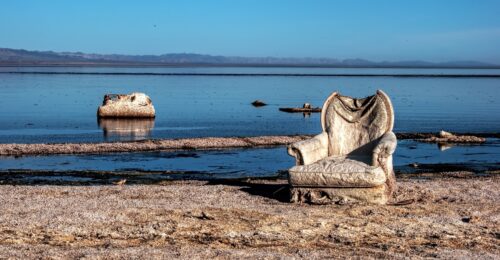 “There is not enough water. That is the blunt assessment from the U.S. Army Corps of Engineers on the feasibility of four modest plans intended to address environmental and health problems at the Salton Sea. The announcement came during a community informational meeting at the North Shore Yacht Club in Mecca, one of a series of recent meetings the Corps has held on the long-standing crisis. The four plans, developed to ease the dust and air pollution created as the Salton Sea shrinks and more lakebed is exposed, share one critical flaw: none has the water needed to be viable. … ” Read more from the Uken Report.
Imperial County voters face legal challenge over proposed data center ban
“A group of Imperial County residents and property owners filed a lawsuit Friday seeking to block a proposed ballot initiative that would ban large data centers across unincorporated areas of the county. The Verified Petition for Writ of Mandate, Declaratory and Injunctive Relief was filed in Imperial County Superior Court by petitioners Tom Dubose, Kevin Smith, Ryan Dickerson, Daryl Dickerson, and Carl Stills against the County of Imperial and Registrar of Voters Linsey Dale. The proponents of the measure — Kristian Salgado, Francisco Leal, Christopher Scurries, James Tison, and Jacob Rodriguez — are named as real parties in interest. … ” Read more from the Desert Review.
SAN DIEGO
LAFCO calls off investigation into San Diego County Water Authority
“No one is getting rid of the San Diego County Water Authority just yet. The San Diego Local Agency Formation Commission, or LAFCO, had planned to look into the possibility in what’s called a municipal service review, or MSR. But on Monday, LAFCO commissioners scrapped that process. Service reviews are a key piece of LAFCO’s work. LAFCO has the power to audit services provided by local government agencies — as well as form, combine and dissolve government agencies. … ” Read more from the Voice of San Diego (scroll down).
Coalition submits 151,000 signatures for ballot measure to combat Tijuana River pollution
“A coalition of healthcare workers, first responders and union leaders Monday submitted more than 151,000 signatures for a ballot measure intended to stop the Tijuana River pollution crisis on a local level, while also bolstering healthcare. If passed, the measure would increase the county sales tax by 0.5%. The San Diego Health & Safety Act, which needs 102,923 valid signatures from San Diego County registered voters, will likely make it to November’s ballot. Proponents said they want to take matters into their own hands after decades of state and federal leadership not solving the pollution issue. It is also intended to handle a bevy of issues related to public health and safety. … ” Read more from Channel 8.
One of California’s ritziest beach towns has a problem: a tsunami of raw sewage
“Kristin Cohen draped towels over beach chairs on the white sand, eager to take her daughter, Chloe, into the ocean. A yellow sign stopped her cold: “Water Contact May Cause Illness.” “I guess we can’t do that, babe,” Cohen, 36, a vacationer from New Jersey, told 3½ -year-old Chloe, who stared back, confused, then got an ice pop as consolation. Such signs are now a fixture in Coronado, an upscale resort city on a slender peninsula in San Diego Bay, known for some of America’s best beaches. But its legendary waters are increasingly off-limits, fouled by sewage-tainted wastewater—as much as 30 million gallons a day—from neighboring Mexico. “It was heaven on earth and now I call it paradise lost,” said Whitney David, 63, a retired surgeon and surfer who left Coronado largely because of the sewage. “All kinds of trash you would see floating in the ocean—food wrappers, bottles, clothing. Once in a while, you would even see a piece of crap.” … ” Read more from the Wall Street Journal (unlocked article-minimize subscription ask, article is behind it).
Along the Colorado River …
After a season without snow, Colorado storm could be its biggest all year
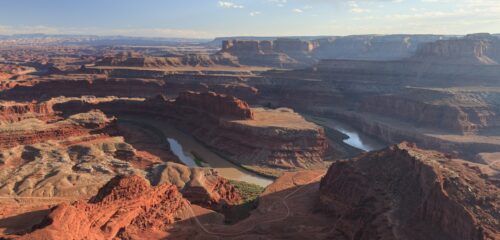 “Weeks after most of Colorado’s ski resorts shut down for the spring, a late-season snowstorm is expected to drop more than two feet of snow across the Rocky Mountains this week. Snow this time of year is not unusual for the region, but it is unusual for this year, after a prolonged snow drought and record heat in March all but eliminated the critical snowpack across much of the American West. As of late last week, nearly 60 percent of Colorado was in an “extreme” or “exceptional” drought, according to the U.S. drought monitor. “In terms of the liquid content, this will certainly be one of the bigger storms” the region has had this year, said Russell Danielson, a meteorologist with the National Weather Service in Boulder. … ” Read more from the New York Times.
Feds will front big bucks to conserve Colorado River water, says Arizona water chief
“The federal government has agreed to pump more than $450 million into programs to carry out additional Colorado River water conservation, Arizona Department of Water Resources chief Tom Buschatzke said Monday. The spending is necessary to make the new proposal from Arizona, Nevada and California work, Buschatzke and other water officials said Friday in releasing their offer to save 700,000 to 1 million acre-feet of river water through 2028. A million acre-feet is the equivalent of approximately 10 years’ worth of Colorado River deliveries to Tucson Water. The U.S. Interior Department proposed that the money be spent, and the U.S. Office of Management and Budget, which must sign off on all federal expenditures, approved it, Buschatze said at a news briefing Monday afternoon on the new plan from the three Lower Colorado River Basin states. … ” Read more from the Arizona Daily Star.
Lower basin states propose major Colorado River savings plan
“In a significant development for Colorado River management, the Lower Basin states of Arizona, California, and Nevada advanced on May 1 a near-term proposal to conserve more than 3.2 million acre-feet of water through 2028, aiming to stabilize critically low reservoir levels at Lake Powell and Lake Mead. For the Imperial Valley’s agricultural community, which relies on the river for every drop of irrigation water, the plan underscores both the severity of the drought and the continued emphasis on voluntary, funded conservation efforts. The proposal builds on earlier commitments and responds to persistently dry hydrology, record-low inflows, and the risk of reaching dangerous reservoir elevations. It includes 1.25 million acre-feet per year in Lower Basin reductions for 2027 and 2028 (California’s share: 440,000 acre-feet annually), plus an additional targeted 700,000 acre-feet (with a goal of up to 1 million) in expanded system conservation across the Lower Basin. … ” Read more from the Desert Review.
Southwestern states offer last-ditch attempt at Colorado River peace
“The three states that draw Colorado River water out of the declining reservoirs behind Hoover and Glen Canyon dams have offered to increase conservation over the next two years to buy time for a longer-term deal among all seven states in the watershed. Arizona, California and Nevada submitted a proposal to federal officials that would see them collectively add up to a million acre-feet a year in water-use reductions on top of 1.5 million acre-feet they had already proposed cutting among themselves and Mexico. Such a plan, if the U.S. Bureau of Reclamation agrees to enact it, would inflict new scarcity on Central Arizona Project customers but forestall a potentially dire situation in which the canal loses most of its water. … ” Read more from Arizona Central.
SEE ALSO:
- Imperial Valley backs major Colorado River Pact to stave off reservoir collapse, from the Imperial Valley Press
- Lower Basin Colorado River plan targets 3.2M acre-feet savings, from Western Water
- Phoenix-area water cuts would be less ‘devastating’ under new Colorado River plan, from KJZZ
- Three States Propose Last-Ditch Plan To Avoid Colorado River Crisis, from Newsweek
Commentary: We’ve carried the water. It’s time Colorado carries its weight.
Arizona Chamber of Commerce & Industry President and CEO Danny Seiden writes, “There’s been plenty of coverage lately about Arizona preparing to defend its water rights on the Colorado River. And yes, we’ve hired a law firm. Hard to blame us. What’s gotten less attention is the other side of this story: what’s actually happening at the negotiating table. The answer isn’t complicated. Arizona and other Lower Basin states have put real solutions on the table. Colorado and its Upper Basin partners have not. Arizona’s chief water negotiator, ADWR Director Tom Buschatzke, was blunt after February’s deadline collapsed. Despite months of discussions, the Lower Basin states received one consistent message from the Upper Basin: there will be no firm commitment to reduce water use, no matter how bad the hydrology gets or how low the reservoirs fall. That’s not a negotiating position. That’s a refusal to engage. And the stakes are real. … ” Read more from Chamber Business News.
Commentary: Let the Colorado River run free through Glen Canyon
Ron Rudolph, a former assistant executive director of Friends of the Earth, writes, “It is time to modify Glen Canyon Dam so the river can move past it, consolidating storage in Lake Mead, accelerating Glen Canyon’s restoration and opening new possibilities for recreation, research, and cultural discovery. There is a generational opportunity to restore what author Wallace Stegner called “the most serenely beautiful of all the canyons of the Colorado River.” Lake Powell, the erstwhile “Jewel of the Colorado,” is shrinking, exposing the hubris of an era that hoped the massive Glen Canyon Dam and an unpredictable river could sustain a giant reservoir in the middle of the desert indefinitely. Two of the benefits used to justify the drowning of Glen Canyon — motorized recreation and hydroelectric power — are disappearing, and with them the rationale for keeping the reservoir and dam in their current form. A third rationale, water storage to help comply with the obligations of the Colorado River Compact, can be achieved more efficiently by relying on Lake Mead alone. Now less than one-third full, Lake Mead’s storage capacity can accommodate more than three times the water currently in Lake Powell, and 1.75 times all water stored in the main reservoirs of the upper Colorado River. … ” Read more from the National Parks Traveler.
The utility of operationally neutral and flexible conservation pools in the Colorado River basin
“As everyone is well aware, the snowpack and associated runoff this year are truly awful. It will be one of the worst, if not worst, on record. The Bureau of Reclamation is using unprecedented policy levers to keep Lake Powell from reaching levels so low that the safety of the dam may come into question. And it is unclear if those policy levers will be enough, especially if the rest of the spring and summer are warm and dry. This got us thinking—are there other tools in the toolbox we are not considering? While current guidelines may not contain much else, you only have to look as far as Reclamation’s Post-2026 Draft Environmental Impact Statement to see there are options being proposed. We explore how one of those—flexible and operationally neutral conservation pools—can actually provide system protection without the political, legal, and hydrological risk that comes with currently available options. The current Intentionally Created Surplus program in the Lower Basin is an excellent framework to explore how conserved water can be creatively moved between reservoirs, wherever it is needed most. … ” Read more from the Inkstain Blog.
Understanding water rights in the Colorado River Basin
“The Colorado River provides water to some 40 million people across seven U.S. states and Mexico. And, after a historically hot and dry winter, those western states are scrambling to shore up supplies. One solution comes from California, Arizona, and Nevada. The three Lower Basin states recently announced a water-saving plan that aims to “stabilize the Colorado River through 2028.” The proposal suggests a 13% reduction in California’s use of the river water; Arizona and Nevada will also cut back. To help explain the ongoing water crisis in the Colorado River Basin, “Marketplace Morning Report” host Sabri Ben-Achour called up Amy Scott. She’s been following the situation from her home base in Denver and covered the topic as host of Marketplace’s climate podcast “How We Survive. The following is an edited transcript of their conversation. … ” Read more or listen to podcast from Marketplace.
Las Vegas valley Catholic church joins suit against grass removal mandates
“A Las Vegas Valley Catholic church is among the latest members of a suit against the Southern Nevada Water Authority and its grass removal mandates for non-functional turf. Our Lady of Victory Catholic Church joined the complaint, according to new court documents filed in late April. The church is run by the Society of St. Pius X. A number of homeowners associations all across the Valley also joined the complaint. To comply with mandates to remove non-functional turf, a church coordinator tells FOX5 by phone that applications were filed online for a waiver; four out of six plots of grass were granted waivers. … ” Read more from Channel 5.
Western Slope water providers concerned as river depth drops to below 3 feet in some areas
“The Colorado River is flowing at record low depths, raising concerns for water providers and consumers across the Western Slope. According to the National Oceanic and Atmospheric Administration (NOAA), the Colorado River below the Grand Valley Diversion near Palisade reached a max depth of 9.91 feet in June 2024. As of 12:00 a.m. May 4, the peak depth was recorded at 2.92 feet, flowing at 240 cubic feet/second. Mesa County is in an exceptional drought, according to the Drought Response Information Project (DRIP). Exceptional drought is the most severe category, where shortages of water could create water emergencies. Ty Jones, district manager of Clifton Water District, said the river flows at less than a fourth then it was in 2025. He said the region is in uncharted territory. … ” Read more from Channel 8.
Planting native trees in the Colorado River Delta is bringing breeding birds back
“For more than a decade, the Raise the River coalition, including the National Audubon Society, has worked in collaboration with the United States and Mexico under the framework of Colorado River Treaty agreements (Minutes 319 and 323), to bring back healthy habitats in the Colorado River Delta. Working from my perch at Colorado State University with support from Audubon as well as federal funding, and with partners in Mexico and the United States, I led a series of studies to find out whether those efforts are actually helping birds. The short answer is yes, and in meaningful ways. Bird surveys at 230 sites across the delta, carried out from 2002 to 2021, paint an encouraging picture: over those 20 years, researchers counted more than 100,000 individual birds. In areas where native trees and shrubs such as cottonwoods, willows, and mesquites were planted, birds that depend on riverside forests, like Abert’s Towhee, Song Sparrow, and Yellow-breasted Chat, started showing up in greater numbers. … ” Read more from Audubon.
In national water news today …
Flooding, stormwater costs would rise from Clean Water Act rollbacks, engineers say
“Ever since U.S. residents saw the Cuyahoga River in Ohio burning in 1969 – a stark symbol of unchecked industrial pollution – clean water advocates have had a vivid image to rally around. Just three years later, Congress passed the Clean Water Act, putting water – humankind’s most precious resource – on the path toward recovery by establishing a framework to restore and protect U.S. waterways. The next chapter in the rebound story, however, includes legislative attempts to roll back key provisions of the landmark CWA. Provisions related to stormwater, in particular, have become targets of those seeking change to the law. Troy Dorman, Ph.D., P.E., M.ASCE, called attempts to roll back stormwater regulations, including amendments adopted under the Water Quality Act of 1987, misguided. Stormwater received a D on ASCE’s 2025 Report Card for America’s Infrastructure, underscoring that the sector remains underfunded and in need of significant improvement. … ” Read more from Civil Engineering Source.
Data centers have a PFAS problem
“In suburban Virginia, a cluster of monumental gray buildings rise up around the unincorporated settlement of Ashburn in Loudoun County. Ringed by fencing and humming with AC, this is the new front of the digital economy—a place that has become known as Data Center Alley, the biggest data center hub in the world. … Computers in data centers run hot, and they need to be kept from overheating. Excess water is often used to keep them cool. So are PFAS chemicals. “This is the most common way of cooling in data centers,” says Norbert Conrad, deputy director of the High Performance Computing Center in Stuttgart, Germany. “It’s similar to how a fridge is cooled, just much bigger. You use a compressor and gases to cool air or water for the computers.” … ” Read more from the Sierra Club.
Musk promised his data center would reuse water. That’s now stalled.
“When Elon Musk brought xAI to Memphis, Tennessee, the company made a promise to locals worried that its data center would drain the local water supply: They would build a state-of-the-art water recycling plant, a national model for environmental best practices. Two years later, Musk’s first data center dedicated to his AI chatbot is up and running, but construction has come to a screeching halt at the promised water recycling plant, designed to clean municipal wastewater for use in cooling the superpowered computing center. The company announced it was stopping work on the water recycling plant in April, a month after its CEO touted it in a meeting with President Donald Trump. Now, Memphis residents are worried about their drinking water in an episode legal experts and scientists say is indicative of a broader pitfall of the data center boom. … ” Read more from E&E News.
Most new data centers in the U.S. are coming to rural areas
“The United States has more than 3,000 operational data centers, and that number is expected to grow substantially in the years ahead. More than 1,500 new data centers are in various stages of development nationwide, according to a Pew Research Center analysis of data from Data Center Map. These planned data centers are largely in different parts of the country from those that currently exist: 67% of planned data centers are in rural areas, while 87% of existing data centers are in urban ones; 39% of planned data centers are in counties that currently don’t have any. … ” Read more from the Pew Charitable Trust.
Heat-trapping microplastics found to play role in climate change
“Microplastics in the atmosphere are heating the planet, magnifying climate change impacts, according to new research. Scientists in China and the US found that tiny, colored plastic particles absorb sunlight as winds blow them around the world, trapping heat and contributing to temperature rise, according to the peer-reviewed paper published Monday in the journal Nature Climate Change. “The plastic problem is not just in our blue oceans, it is also in the invisible skies above us,” Hongbo Fu, a co-author of the study and an atmospheric scientist at Fudan University in Shanghai, said at a press conference. “Climate models need to be updated.” The researchers’ laboratory experiments and atmospheric modeling indicate that airborne plastic pollution has 16.2% of the heat-trapping impact of black carbon, the second biggest contributor to global warming after carbon dioxide. That effect is small on a global scale, according to the scientists, but can be significant in areas with high volumes of plastic, such as parts of the Pacific Ocean. There, plastic particles had 4.7 times the impact of black carbon. … ” Read more from Bloomberg.
SEE ALSO: How microplastics are likely helping to heat up the planet, from the Washington Post

