
Several news sources featured in the Daily Digest may limit the number of articles you can access without a subscription. However, gift articles and open-access links are provided when available. For more open access California water news articles, explore the main page at MavensNotebook.com.
In California water news this weekend …
Lower Basin states advance plan to deliver up to 3.2 million acre-feet through 2028 to Protect Colorado River
 “The Lower Basin States of Arizona, California, and Nevada today advanced a plan to stabilize the Colorado River through 2028, responding to declining reservoir levels, record low inflows to Lake Powell, and increasing risk of reaching critical elevations at both Lake Powell and Lake Mead. Earlier in the post-2026 process, the Lower Basin took a significant step by proposing 1.25 million acre-feet in annual reductions, with an additional 250,000 acre-feet from Mexico, totaling approximately 1.5 million acre-feet per year. This proposal builds on that foundation with an expanded system conservation program across the Lower Basin with an estimated contribution of at least 700,000 acre-feet. In total, the plan identifies up to 3.2 million acre-feet of water savings to the system through 2028. “With this proposal, the Lower Basin is putting forth real action to stabilize water supply along the Colorado River. We’re putting forward additional measurable water contributions for the system. Without that, the system will continue to decline,” said JB Hamby. … ” Continue reading this press release.
California, Arizona and Nevada announce new water-saving plan for dwindling Colorado River
“With the Colorado River’s giant reservoirs declining toward critically low levels, negotiators for California, Arizona and Nevada announced Friday that they have agreed on a water-saving plan for the next two years. Representatives of the three states said in a written statement that their plan aims to “stabilize the Colorado River through 2028.” It will require larger cuts in water use than they had offered previously in talks with other states and the federal government. “We’re putting forward additional measurable water contributions for the system,” said JB Hamby, the chairman of California’s Colorado River Board. “Without that, the system will continue to decline.” … ” Read more from the LA Times. | Read via AOL News.
SEE ALSO:
- Colorado River impasse: Lower Basin states including Nevada issue new plan, from the Las Vegas Review Journal
- Nevada wants to cut its own Colorado River share for emergency conservation need, from the Las Vegas Review Journal
- New Colorado River plan calls for California water cuts, conservation, from the Desert Sun
- This new Colorado River plan could give Arizona a ‘lifeline and cause for hope’, from KJZZ
DWR unveils new vision to strengthen water management and climate resilience in San Joaquin Valley
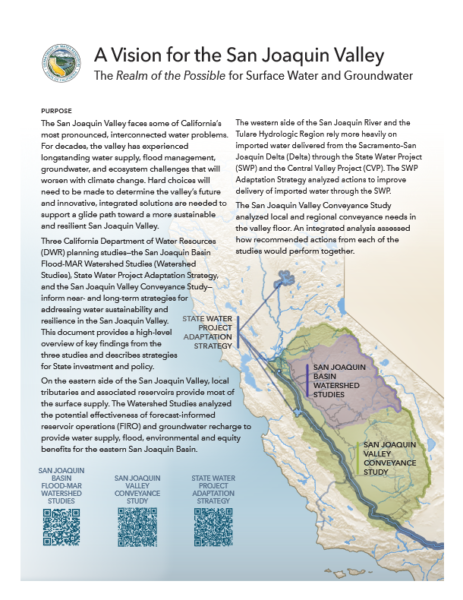 “The San Joaquin Valley is at a turning point, where long-standing complex and interconnected water management challenges are intensifying with climate change and creating mounting pressures for communities, agriculture, and ecosystems. To confront these growing pressures, the Department of Water Resources (DWR) has developed A Vision for the San Joaquin Valley, an integrated plan with near- and long-term strategies to strengthen water management and climate resilience. “Decades of severe groundwater overdraft and accelerating climate conditions have put the San Joaquin Valley on an unsustainable path,” said DWR Director Karla Nemeth. “This vision provides the necessary framework for climate-resilient water management, aligning partners and guiding coordinated action to safeguard communities, agriculture, and ecosystems across the region.” … ” Read more from DWR.
DELTA CONVEYANCE PROJECT: Procedural rulings on evidentiary objections
The State Water Board has issued two rulings on evidentiary objections in the ongoing Delta Conveyance Project change in point of diversion proceedings at the Administrative Hearings Office. Click here for the rulings.
Potential Potter Valley Project buyer suggests PG&E failed to tell ‘actual truth’
“This month, Agricultural Secretary Brooke Rollins tweeted that the U.S. Department of Agriculture had been in contact with a potential buyer for the Potter Valley Project, a PG&E-owned hydroelectric project currently in the process of surrendering its license and decommissioning its facilities. The vice president of that potential buyer’s board, Elsinore Valley Municipal Water District Darcy Burke, appeared on the podcast of ranching advocacy blog UNWON last week and made a series of claims about PG&E’s efforts to decommission the project. Burke suggested that the plan that is currently in place — a plan in which the project’s assets, including the Scott and Cape Horn dams, would be removed and replaced with a New Eel-Russian Facility to maintain seasonal diversions from the Eel to the Russian River — is “criminal.” … ” Read more from the Eureka Times-Standard.
Plan to send Eel River water to SoCal is either a pipe dream or massive water grab
Regina Chichizola, resident of Westhaven and the director of Communities United for Water Protection, writes, “Last week, Agriculture Secretary (Brooke) Rollins announced that she is working with the Elsinore Valley Municipal Water District in Southern California to take over PGE’s Potter Valley Project in Northern California. This proposal, which comes 7 years after the bidding period ended, is either a pipe dream, a stalling mechanism, or a water grab beyond anything the North Coast has ever seen. The proposal comes after PG&E spent years planning for dam removal due to the lack of bids, and 6 years after Russian River agricultural interests, Eel River residents, Tribes, coastal fishing interests, and the involved counties brokered the Two Basin Solution. This compromise, which took years to complete, aimed to take out the dams but keep a reduced diversion to the Russian River. … ” Read more from the Eureka Times-Standard.
SEE ALSO: The Potter Valley dams are coming down, from the Mendocino Voice
California farms see compliance costs grow alongside crops
“According to a December 2025 report by the Public Policy Institute of California, “Business Regulation and Business Starts in California,” California does not necessarily have more business regulations than other states, but it is an outlier for the detailed restrictions or requirements embedded in its rules. California is the most regulated state in terms of occurrences of “shall,” “must,” “may not,” “required,” and “prohibited” within its regulations, according to PPIC. … Specific to agriculture, a Joint Informational Hearing of the Assembly Committees on Economic Development, Growth, and Agriculture on October 24, 2025, brought together legislators, academic experts, and local agricultural leaders at California State University, Fresno to discuss the issues contributing to rising food and production costs. During the hearing, Ryan Jacobsen — CEO of the Fresno County Farm Bureau — explained that regulatory complexity is a major driver of high compliance costs, and local farmers may deal with over 90 different state agencies. … ” Read more from Valley Ag Voice.
Lawmakers face familiar fights ahead of legislative deadlines
“The California Legislature reconvened from its summer recess on April 6, and the deadline for the Senate and Assembly to pass bills introduced in their respective houses is approaching on May 29, 2026. Proposed legislation on water, labor, and pesticides will take center stage in 2026 — along with the serious task of naming the state wasp per Senate Bill 1178. Assembly Bill 2447 introduced by Democratic Assemblymember Rebecca Bauer-Kahan would require the State Water Resources Control Board to require the Regional Water Boards to update the Irrigated Lands Regulatory Program to reduce nitrogen waste discharges from commercial irrigated agricultural lands by January 1, 2030. … ” Read more from Valley Ag Voice.
Toxic shellfish found along Northern California coast
“California health officials are urging people to avoid eating shellfish gathered along parts of the Bay Area coast after dangerous toxins were found in local waters. The California Department of Public Health said in a recent advisory shared by local officials Friday that consumers should not eat sport-harvested mussels, clams, scallops or oysters from Marin, Sonoma and San Mateo counties after testing detected high levels of paralytic shellfish poisoning, or PSP, toxins in mussels. The toxins occur naturally in marine environments and cannot be removed by cooking, according to the department. … The warning applies only to shellfish collected recreationally, such as by people harvesting along beaches. “This warning does not apply to commercially sold mussels, clams, scallops, and oysters from approved sources,” the department said, noting that licensed harvesters and dealers are required to test shellfish regularly for toxins. … ” Read more from the SF Chronicle.
Thousands of sea creatures stranded on California shores as El Niño brews
 “Thousands, or potentially millions, of tiny blue sea creatures have shown up along the California coast in recent weeks. The creatures with a brilliant blue bottom and clear sail-like structure are called Velella velella, also known as “by-the-wind sailors.” “Blooms” of these jellyfish-type animals tend to show up along California beaches in the spring as coastal winds blow their tiny “sails” directly onto the sand, said Chrissy Piotrowski, senior collections manager of invertebrate zoology at the California Academy of Sciences. “They wash ashore en masse, because that’s sort of how they move around in the ocean,” she told SFGATE. “So you’ll see large blooms and mass strandings.” … ” Read more from SF Gate.
AI data centers, already harmful, appear to be creating their own microclimates
“As global temperatures rise, data centers for artificial intelligence are creating “heat islands” that could have significant impacts on communities and their surrounding environments in the years to come, a March 2026 study shows, raising alarm among international researchers. The preprint of the study, which has not yet been published in a peer-reviewed journal, looked at data from 2004 to 2024. Researchers from multiple institutions, including the University of Cambridge and Nanyang Technological University, used satellite data from that time to assess rising land surface temperatures at AI data centers worldwide. After conducting an analysis, they estimated that surrounding surface areas typically increase by an average of 2 degrees Celsius — or 3.6 degrees Fahrenheit — once AI centers start operating, suggesting that the data center heat island effect “is real and significant, especially in the context of global warming and climate transformation.” Overall, “our results show that the data heat island effect could have a remarkable influence on communities and regional welfare in the future,” researchers said in the study. … ” Read more from SF Gate.
Northern California could face a fire-prone summer — here are the wild cards
“A thin snowpack is making Northern California and the West vulnerable to major summer fires as forests dry quickly. Fire activity is expected to be above normal in June for the Bay Area, Sacramento Valley, northern Sierra foothills, parts of the North Coast and much of northeast California, according to a forecast released Friday by the National Interagency Fire Center. By July and August, the fire danger will expand to mountainous regions, including Tahoe, the Trinity Alps and southern Cascades. Summer fog is expected to take an edge off fire danger along the coast. California got plenty of rain this winter. But the weather was warm, and not enough snow fell. California’s snowpack stood at just 21% of normal Friday, with less in the north and more to the south. That means drier vegetation at high elevations as summer kicks in. … ” Read more from the San Francisco Chronicle.
And lastly … The “big one” might not come alone: Double West Coast earthquake threat
“Two major fault systems along North America’s West Coast, the Cascadia subduction zone and the San Andreas fault, may be more closely connected than previously believed. A new study suggests that activity on one fault could trigger earthquakes on the other, raising the possibility of closely timed seismic events. “We’re used to hearing the ‘Big One’ — Cascadia — being this catastrophic huge thing,” said Chris Goldfinger, a marine geologist at Oregon State University and lead author of the study. “It turns out it’s not the worst case scenario.” … ” Read more from Science Daily.
In people news this weekend …
Promotions, passings, profiles – submit people news items to maven@mavensnotebook.com.
MEGHAN HERTEL: New CDFW director addresses priorities, predators
 The California Department of Fish and Wildlife swore in its new director, Meghan Hertel, in February. Before that, she worked as the deputy secretary of biodiversity and habitat at the state Natural Resources Agency. Hertel spoke with Ag Alert® about burgeoning priorities in her new role and the part that California’s agricultural community plays in conservation. “Some of the things that I’m thinking about as top priorities are really making sure that we lean into what the department’s mission is, which is protecting and restoring California’s natural resources. We’re here to take care of California’s nature and to do so in a way that that nature is available for the enjoyment of people now and into the future. But we need to be able to do that in a way where we’re still getting work done. … ” Read the full Q&A from Ag Alert.
Podcasts …
WATER IS A MANY SPLENDOR’ED THING: A Delta Economy
 California society leans heavily on the Sacramento-San Joaquin River Delta to support life styles and the needs of the economy. Today, the focus is looking at commitment to a future that encourages a strengthened economy that maintains a resilient and healthy Delta. Water is a Many Splendor’ed Thing brings you another water relationship that has a personally significant impact to your life. Produced by Stephen Baker, Bringing People Together to Solve Water Problems, water@operationunite.co 530-205-6388
AgNET NEWS HOUR: Fertilizer costs, policy debate, and water challenges take center state for California agriculture
The highlighted major issues shaping agriculture right now, including rising fertilizer costs, ongoing political debates in California, and serious water challenges facing growers in key production regions like Monterey County.
ECONEWS REPORT: New threat to Eel River dam removal?
On April 21st, US Department of Agriculture Secretary Brooke Rollins rocked the North Coast with a Tweet: She claimed that a Los Angeles-area local water district, the Elsinore Valley Municipal Water District, wanted to purchase the Eel River dams to operate them for hydroelectric power and provide irrigation. The Water District has since walked back Sec. Rollin’s Tweet, claiming that it had no firm plans and its interest was, at present, only exploratory. Now, Congressman Huffman is involved and livid—rightfully so, as he has worked hard on a solution that would work for both parts of his district—and has initiated an investigation into this affair. Alicia Hamann and Scott Greacen of Friends of the Eel River join the show to discuss whether the public should take this threat seriously and what can be done to keep dam removal on track.
VIC BEDOIAN: UCLA Study Examines Mono Lake’s Future
A recent State Water Board meeting took a close look at Mono Lake’s ecological condition, with a focus on Climate change and the impact of water exports to Los Angeles. A major feature was the introduction of a new Mono Lake model by the UCLA Center for Climate Science. Researchers looked at the future and how the lake’s ecosystem will respond to climate change. Vic Bedoian reports from Fresno.
RIPPLE EFFECT: Western Water Market – version 2.0
Kristina Ribellia, President and Founder of Western Water Market, joins us to give a 2026 update of her platform. A lot has happened in the past few years. We cover auctions, arbiters, quality control, and efforts to facilitate transactions through news letters, social media, and targeted outreach. We also discuss skepticism and resistance towards water markets. A great on-the-ground perspective of real-world water economy.
In regional water news this weekend …
NORTH COAST
Klamath Water Users director testifies in D.C. on bill that aims to give irrigators more say
“The House Committee on Natural Resources heard testimony Wednesday on legislation aimed at giving local irrigators a stronger voice in decisions affecting their water use and the lands they depend on. H.R. 8259, the Federal Water Projects Consultation Improvement Act of 2026, was introduced April 14 in the U.S. House of Representatives in Washington, D.C., by Oregon Rep. Cliff Bentz. The bill seeks to improve transparency and ensure more direct input from local water users in the operation of federal water projects. “Federal agencies often make decisions without sufficient input from local communities that depend on and operate irrigation systems and water projects affected by Endangered Species Act listings,” Bentz said. … ” Read more from Herald & News.
Upcoming logging permit changes could mean more sediment in Elk River, CalTrout says
“Next week, the North Coast Regional Water Quality Control Board will consider tweaking regulations for Humboldt Redwood Company’s sediment discharge agreement for the Upper Elk River. HRC is seeking a handful of changes to the agreement, which is the regulatory tool used by the Water Board to control nonpoint source pollution. Logging activities in the watershed have long caused sediment to run off land and be deposited into the Elk River. While Water Board staff found the proposed changes minor, saying in a staff report that they “will not result in a decrease in water quality protection,” the environmental group CalTrout leans the other way. The Elk River was designated a sediment-impaired waterbody in 1998 by the Environmental Protection Agency. Sediment has clogged river channels, causing extensive nuisance flooding in the area and a shoddy habitat for fish, who use the river as spawning and rearing habitat. … ” Read more from the Lost Coast Outpost.
SIERRA NEVADA
Tahoe’s other popular lake is getting strict new rules ahead of summer
“One of the Sierra’s favorite alpine lake getaways is getting a host of new rules for visitors — just in time for the busy summer season. Like many mountain escapes that beckon weekend visitors from the Central Valley and Bay Area, Donner Lake can become chaotic in the summertime. Carloads of families hoping to score a coveted parking spot by the water’s edge, trucks lining up trailers to launch at boat ramps, construction crews carrying out seasonal road work, dog walkers, bicyclists, kayakers — everyone gets funneled onto the 3-mile stretch of Donner Pass Road along the lake’s northern shore. “It’s just a really big recipe for conflict,” said Truckee Town Council Member Dave Polivy. … ” Read more from the San Francisco Chronicle.
Sand Harbor boat launch at Tahoe opens without docks due to storm damage
“The boat launch at Sand Harbor State Park opened Friday for the season, though visitors should be aware that no docks are available at the launch due to storm damage sustained during an April weather event. High winds and rough lake conditions damaged the docks at the boat launch, requiring them to be removed from the water for repairs. Nevada State Parks staff are actively working to fabricate new docks and return them to service as quickly as possible. … ” Read more from Carson Now.
SACRAMENTO VALLEY
Summer reservations now required at Burney Falls, California’s ‘8th wonder of the world’
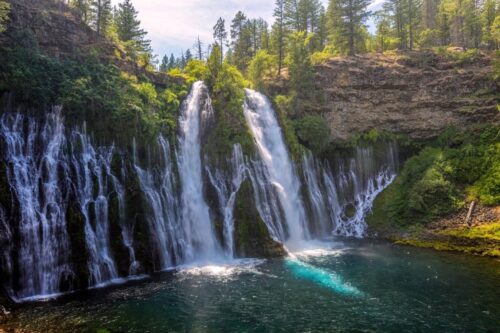 “In an effort to quell extreme overcrowding at Burney Falls, the 129-foot waterfall that attracts hundreds of thousands of visitors to its remote Shasta County location each year, California State Parks announced it will now require reservations at McArthur-Burney Falls Memorial State Park. The pilot system will require visitors to obtain a reservation to enter the park on weekends and holidays from May 15 to Sept. 27, the park’s peak visitation period, according to a California State Parks news release Friday. Visitors must purchase a reservation in advance via LAZ Parking. A reservation will be $10 per vehicle, with a 55-cent processing fee, State Parks said. … ” Read more from SF Gate.
Folsom creates new destination brand: Paddling Capital of the West
“Folsom is launching its new destination brand, calling itself the “Paddling Capital of the West.” “More than a tagline, the initiative recognizes Folsom as the premier hub that it is for stand-up paddle boarding, kayaking, and a broad diversity of on water paddling experiences — unmatched by any other destination in the west,” Visit Folsom and Choose Folsom wrote in statement announcing the new slogan Thursday. The campaign is a collaboration between Visit Folsom and Choose Folsom, the city’s chamber of commerce. Folsom has Lake Natoma, which the campaign says caters to beginners, families and competitive paddlers, citing the lake’s 5 mph speed limit. It also has Folsom Lake, which offers opportunities for distance and open-water exploration. … ” Read more from the Sacramento Bee.
BAY AREA
Mountain View residents struggling after a week without clean water: ‘Living hell’
“Mountain View homeowners are fed up after going more than a week without usable water. Crews have spent the week trying to flush the water system around Cuesta Drive after it became contaminated. For Kathy Bonilla, the past week has been “a living hell.” Bonilla is one of 66 Mountain View residents whose homes have been without clean water after it was accidentally contaminated during a city water project. The disruption has left households unable to shower, do laundry, brush their teeth, wash dishes or drink tap water. … During the meeting, city officials told residents the water advisory had been changed from “do not use” to a “boil advisory.” “I’m not boiling water or taking a shower,” Edwards said. “I’m waiting ’til my water is actually clean and tested and good to go. I’ve waited this long.” … ” Read more from KGO.
CENTRAL COAST
Monterey County agriculture at a crossroads: Water, labor, and the future of America’s salad bowl
“In a compelling interview with “the Ag Meter” host Nick Papagni, sits down with Norm Groot of the Monterey County Farm Bureau to unpack the realities facing one of the most productive agricultural regions in the world. From water crises to labor challenges and shifting markets, this conversation reveals what’s truly at stake for farmers—and for America’s food supply. Monterey County is a powerhouse, ranking fourth in both California and the U.S. in agricultural production. With more than 150 crops grown annually—including strawberries, lettuce, broccoli, spinach, and wine grapes—the region plays a vital role in feeding the nation. Often called the “Salad Bowl of the World,” its leafy greens sector alone generates over $2 billion annually. But behind this success lies a growing list of challenges that threaten long-term sustainability. … ” Read more from AgNet West.
SAN JOAQUIN VALLEY
Chaotic week closes as farmers face midnight deadline to report pumping
“Farmers in Tulare and Kings counties who pump more than 20 acre feet a year must register their wells and file pumping reports by midnight today, May 1, or face late penalties. After some confusion, exacerbated by an email sent April 30 by Mid-Kings River Groundwater Sustainability Agency (GSA) that the deadline would be extended one week and late fees waived, the deadline and fees are not budging, according to a Water Board press release. “Fee waivers are not available for anyone who fails to file their report on time,” the release states. … ” Read more from SJV Water.
New state rules tighten groundwater oversight across Kings County
“New state rules are now tightening oversight of groundwater use across most of Kings County, requiring farmers to report how much water they pump after the state placed the Tulare Lake subbasin on probation. For years, growers have been able to pump groundwater from wells on their own land without reporting it to the state. That is no longer the case. Under the new system, farmers must now track and report groundwater use and will also face new fees tied to how much water they pump. Farm leaders say the added costs come at a time when agriculture is already under financial pressure, forcing some operations to reconsider spending and production decisions. … ” Read more from KMPH.
SOUTHERN CALIFORNIA
SCV Water officially unveils new PFAS treatment plant
“The Santa Clarita Valley Water Agency cut the ribbon on its fourth PFAS treatment plant Wednesday, bringing the number of local wells brought back into production since 2020 up to nine. Local officials joined SCV Water Agency engineers in front of the treatment plant — four massive containers joined by a string of pipes and valves — beside the intersection of Bouquet Creek and Bouquet Canyon Road Wednesday morning. SCV Water Agency board President Maria Gutzeit told The Signal the new plant, called the T&U Wells Treatment Facility, had significant support. … ” Read more from The Signal.
Huntington Beach homeowners win early court ruling in sewer dispute against OC Sanitation District
“A judge has denied a motion filed by the Orange County Sanitation District in its case against a group of Huntington Beach residents over a decades-old sewer easement, allowing the case to move forward to trial. Residents along Rhone Lane appeared in court after years of conflict with O.C. Sanitation, which says it needs improved access to an underground sewer pipeline that runs through the backyards of nearly 30 homes. Some construction has already begun on properties where owners agreed to allow work, but others are fighting the effort in court. “This is something that we’ve been living with since, what, December of 2023,” resident Tony Shahidi said. … ” Read more from KABC.
Representatives Issa, Calvert, and Senator Padilla introduce Pechanga Water Settlement Amendment Bill
“This week, Congressman Darrell Issa (CA-48), alongside Congressman Ken Calvert (CA-41), and Senator Alex Padilla (CA) introduced bipartisan legislation that will make technical amendments to the Pechanga Band of Luiseno Mission Indians Water Rights Settlement Act. “The Pechanga Band of Mission Indians is a critically important civic and cultural institution to our Southern California community, and I know they will carry out its rightful stewardship with precision and care to preserve and protect the tribal lands,” said Rep. Issa. “We worked diligently to introduce this legislation that will allow Pechanga to address important community concerns, and my thanks go to Senator Padilla for his partnership and support of our tribal communities across California.” … ” Read more from Representative Darrell Issa.
Along the Colorado River …
Arizona could be hurt by cutbacks in Colorado River water releases
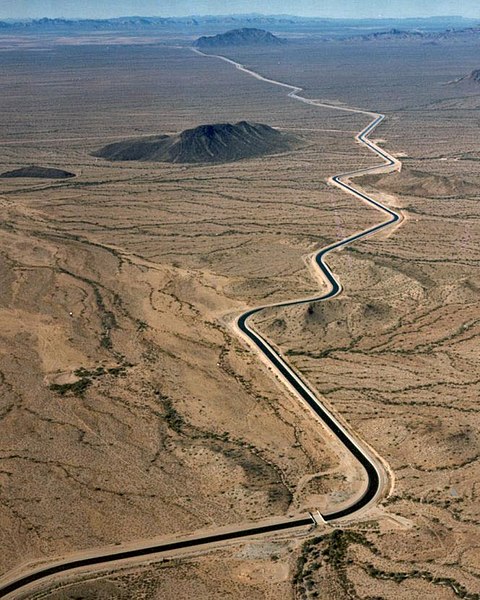 “While it’s clear Lake Mead will get less water from Lake Powell this year, it’s not clear how that cut will affect how much water Arizona and the other two Lower Colorado River Basin states will get from Mead as a result. The U.S. Bureau of Reclamation plans a 20% cut in its release of river water from Powell to Mead to keep Powell propped up in the face of record low mountain snows, possibly record low spring-summer flows into Powell, and record-setting heat across the West in March. If the bureau passes that cut on to water users in the Lower Basin by reducing water releases from Mead, that could set off sudden cutbacks in river water deliveries to the Central Arizona Project that serves Tucson, as well as to Yuma-area and Imperial Valley farmers and to large Southern California water users. They’re normally told much farther in advance how much river water they’ll get from Mead. So a mid-year cutback of this nature would deprive them of water they’ve planned on getting. … ” Read more from the Arizona Daily Star.
SEE ALSO: Federal actions could trigger Colorado river litigation, from the Arizona Daily Star
Fish out of water: Historic drought leaves little water for endangered species in critical stretch of Colorado River
“With drought and high temperatures putting unprecedented pressure on water users throughout Colorado, from cities to agriculture, there’s one segment that can be affected first — and maybe worst — when it comes to a lack of water: rivers themselves and the ecosystems that depend on them. As cities enact water restrictions and farmers and ranchers prepare for the worst, impacts of the water shortage are readily apparent in a chronically dry stretch of the Colorado River between Palisade and the confluence of the Gunnison River that is critical habitat for endangered fish, known as the 15-mile reach. The Upper Colorado River Endangered Fish Recovery Program works to return water to this stretch of river in the Grand Valley, but because of this year’s historically dry conditions, the program could have only 16,000 acre-feet, half its typical amount of water for fish. Beyond that guaranteed amount, the program mostly uses water-sharing agreements that can secure additional acre-feet to boost flows — but only when other users don’t need the water and can voluntarily loan it. This year finds nearly everyone who depends on the Colorado River and its tributaries in dire straits. … ” Read more from Aspen Journalism.
Desalinated seawater could ease pressure on the Colorado River
As the Colorado River declines, the states of Arizona and Nevada are looking for new water sources. The solution may be the ocean off the California coast. Both states are negotiating with the San Diego County Water Authority to gain access to fresh water from the desalination plant in Carlsbad, which is the largest in North America. No water is physically transported between the states. Instead, it is about exchanging rights to different water sources. Arizona and Nevada would finance a portion of the 56,000 acre-feet of water the desalination plant produces each year. In exchange, the states would gain access to San Diego’s share of the Colorado River. The agreement could supply around 500,000 people with water. … ” Read more from Warp News.
In national water news this weekend …
EPA’s draft sixth contaminant candidate list targets microplastics and pharmaceuticals in drinking water
“On April 2, 2026, the US Environmental Protection Agency (EPA) Administrator, Lee Zeldin, announced the draft Sixth Contaminant Candidate List (CCL 6) at a joint event1 with Department of Health and Human Services (HHS) Secretary Robert F. Kennedy Jr. This announcement focused on the draft CCL 6’s inclusion — for the first time — of microplastics and pharmaceuticals as priority contaminant groups for evaluation under the Safe Drinking Water Act (SDWA). The announcement signals a new chapter of federal attention on exposure to these emerging contaminants through drinking water. EPA published a Federal Register notice on April 6 officially announcing availability of the draft CCL 6, and interested parties have until June 5, 2026, to submit public comments.2 Thereafter, in addition to consideration of public comments, EPA will consult with its independent Science Advisory Board before finalizing the list, which EPA expects to do by November 17, 2026. Meanwhile, at this same April 2 event, HHS announced the launch of STOMP: Systematic Targeting of MicroPlastics, a $144 million program to develop methods for measuring and studying the impacts of micro- and nano-plastics in, and for removal from, the human body. … ” Read more from Latham Watkins.
[spacer]
