
Several news sources featured in the Daily Digest may limit the number of articles you can access without a subscription. However, gift articles and open-access links are provided when available. For more open access California water news articles, explore the main page at MavensNotebook.com.
On the calendar today …
- ONLINE MEETING: Salton Sea Feasibility Study from 12pm to 1:30pm. Join the U.S. Army Corps of Engineers to get the latest on the different project alternatives being considered for the long-term restoration of the Salton Sea. Learn about Imperial Streams and Salton Sea Aquatic Ecosystem Restoration Feasibility Study and how it can lead to significant federal funding for the long-term restoration of the Salton Sea to improve air quality and provide critical environmental habitat for birds along the Pacific Flyway. Meet the team working on the study, get engaged, and ask questions. Zoom Link: https://bit.ly/SSMPzoom Teleconference Dial-in: (669) 444-9171 To learn more about the Study, please visit: https://bit.ly/SaltonSeaFeasibilityStudy
In California water news today …
California will soon have more than 300 data centers. Where will they get their water?
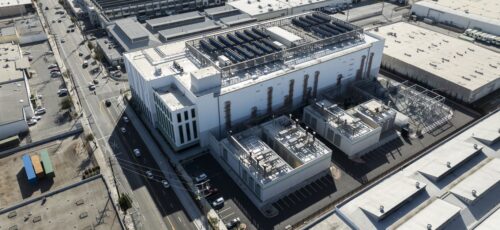
“For patrons of the deli on West Aten Road, it was the white “Not In My Backyard” signs jutting out of lawns. For local irrigation district workers, it was something called an “electric service application.” For Margie Padilla, it was a rant on Facebook. The 43-year-old mom came across a post online while she had a few minutes to scan social media last spring after a day spent tending her garden and taking care of her two boys. “Somebody was complaining about this center,” Padilla said. “I was like, ‘Whoa, what’s going on here?’” What’s going on is the second-largest new data center being considered statewide, which would be less than half a mile from Padilla’s stucco home in the center of Imperial Valley. If finished by 2028, as the developer expects, the at least 950,000-square-foot, two-story data center could be the largest operating statewide, taking up 17 football fields’ worth of land. The roughly $10 billion, 330-megawatt data center would require 750,000 gallons of water a day to operate, said developer Sebastian Rucci, who insists electricity and water costs won’t rise due to the data center. … ” Read more from Inside Climate News.
Delta wetlands project tests carbon storage potential
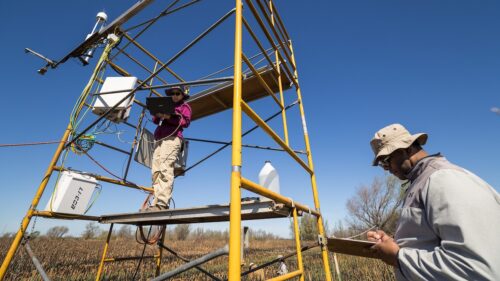
“The Sacramento-San Joaquin Delta has long been recognized for its ability to store carbon, so experts from DWR and partner agencies are exploring the practice of culturally informed burning to accelerate the sequestration process in the region. “The Delta wetlands are climate powerhouses,” said Tyler Anthony, a carbon sequestration specialist with DWR. “These are very ideal locations to sequester carbon.” Before the Delta’s transition to farming after the Gold Rush, it was a vast mosaic of tidal and freshwater wetlands that sustained a natural cycle of growth, decay, and renewal that was often enhanced through cultural burning within the wetlands. This process naturally drew carbon dioxide from the atmosphere and stored it in the soil while maintaining ecological balance. As Delta wetlands were diked to accommodate agriculture in the late 19th century, the carbon cycle was disrupted. Exposed peat soils decomposed, releasing carbon dioxide, increasing greenhouse gas emissions, and causing significant land subsidence. Today, DWR and academic researchers are reintroducing water and vegetation to Delta tracts to reinvigorate carbon sequestration. It coincides with the parallel interest and renewed attention to traditional land stewardship practices. … ” Read more from DWR.
California water by the numbers. Do you know what they mean?
“We interpret the state of California’s water using unconnected numbers. In January it was 0%, as in zero percent of the state was in drought. Good news! In April it was 18%, as in a mountain snowpack at 18% of normal. Bad news. In March it was 122%, as in the state’s reservoirs holding 122% of what they would normally be holding this time of year. Good news! But in February it was 20%, as in the allocation from the Central Valley Project to San Joaquin Valley farmers. Bad news. Are we in a good place waterwise, or not? Our reservoirs are currently filling rapidly with fresh mountain run-off, yet there are rumblings of a dire hot and dry summer approaching. How can this be? Do we really allow 78% of potential irrigation water to flow into the ocean, as those signs along San Joaquin Valley highways claim? Not everyone agrees this is true. Why is east-side agriculture, where irrigation water comes from Millerton Lake via the Friant-Kern Canal, so affected by the Shasta Reservoir, hundreds of miles to the north? Why does the rapid decline in the Colorado River, a water source for Los Angeles and Imperial Valley, affect negotiations over Delta water, and even the level of little Mono Lake? … ” Read more from GV Wire.
Congressman opens investigation into Trump administration’s involvement in California dam removal
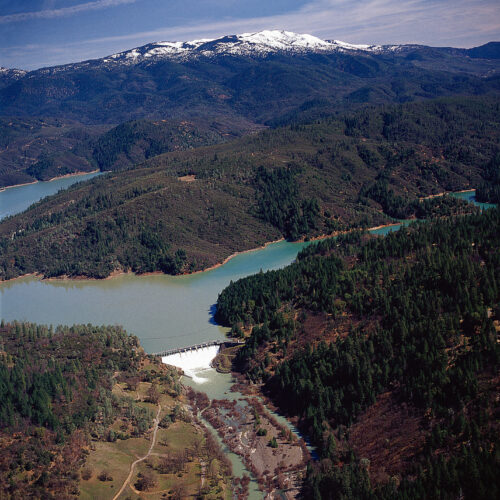
“A Northern California member of Congress is opening an inquiry into the Trump administration’s bid to stop dam removal on the Eel River, citing potential legal, environmental, economic and water-supply problems. Rep. Jared Huffman, D-San Rafael, wants details on why Agriculture Secretary Brooke Rollins is advocating for a Southern California water agency to buy the century-old Potter Valley hydroelectric project in Mendocino and Lake counties, including its two dams, and continue operating it. … While Rollins has said she’s interested in preserving the dams to provide water for local agriculture, her plan to get a new operator, unveiled last week, came as a huge surprise to most in Northern California, with numerous questions. Among them is whether it’s even possible to transfer ownership of the hydroelectric project since the decommissioning is already underway and, perhaps more curiously, what a water agency in Riverside County, more than 500 miles away, wants with the Eel River. … ” Read more from the San Francisco Chronicle.
Huffman demands answers on Trump scheme to ship North Coast Water to SoCal water district
“Today, House Natural Resources Committee Ranking Member Jared Huffman (D-Calif.) announced he has opened an investigation into the Trump administration’s latest scheme to steal water from Northern California and divert it to Southern California. As part of his investigation, he sent a letter to Agriculture Secretary Brooke Rollins and Interior Secretary Doug Burgum demanding records and information about their efforts to facilitate a Southern California water district’s takeover of dams and water rights on the Eel River, hundreds of miles outside its service area. He sent a similar letter to the Elsinore Valley Municipal Water District. “The communities and Tribal Nations I represent would be directly impacted by the proposal Secretary Rollins and the District have described,” Huffman wrote. “Yet your agencies have thus far provided no information to explain why a Southern California water district would seek to acquire water rights and water infrastructure on the Eel River, hundreds of miles north of its service area.” … ” Read more from Congressman Huffman.
SEE ALSO:
- Huffman demands ‘clear and complete account’ of Trump officials’ role in Southern California water district’s plans for Potter Valley Project, from the Eureka Times-Standard
Where solar meets soil: The multi-benefit potential of ecovoltaics and agrivoltaics
“The energy industry has seen significant change within just the past year as national energy demand has increased, due in part to data centers, crypto mining, and electric vehicles consuming more energy. This surge comes as the federal government has blocked or slowed renewable energy generation construction and prioritized fossil fuels, which account for 87 percent of carbon dioxide emissions globally. While the federal government is focused on increasing fossil fuel sources, such as the Department of Energy’s $625 million effort to expand coal production, photovoltaic (PV) solar technology has become more efficient, and over the past 15 years its production costs have decreased by 88 percent—making it an ideal alternative energy source for many types of industries. In the agricultural sector, solar can offer benefits that fossil fuels cannot. For instance, solar energy generation can provide economic benefits to landowners, such as farmers and ranchers, while also minimizing ecosystem impacts and potentially even improving biodiversity on PV solar farms. Ecovoltaics and agrivoltaics are two emerging methods—each of which use a dual-use approach—that are being studied and applied in order to realize these benefits. … ” Read more from ESA.
Feds pull plug on solar farm funding
“Some farmers have a negative view of solar panels, thinking that solar developers are taking away productive ag land to erect miles of arrays. The truth is, most photovoltaic solar goes on land with a parched water table — or unproductive land — that growers hope can generate enough income to keep their farms afloat.Putting solar panels over the canals also keeps surrounding land from being taken out of production in order to make way for solar arrays. … The Turlock Irrigation District, which has already put solar panels over its canal, claims it generates new revenue for the water district, making it more self-reliant. … In 2024, the Delta-Mendota Water District was awarded $15 million by Congress to do its own pilot version of the covered canal within the district. But now, two years later, no money has been released by the administration, despite farmers wanting to try the technology and Congress approving the money. … ” Read the full story at the Mid-Valley Times.
Court rejects State Water Contractors’ attempt to disqualify judge presiding over delta tunnel cases, citing “belated forum shopping”
“On April 27, 2026, the Sacramento County Superior Court, Assistant Presiding Judge Steven M. Gervercer, denied a motion by the State Water Contractors (Water Contractors) to disqualify Judge Stephen P. Acquisto, who has been presiding for more than two years over ten coordinated cases challenging the Department of Water Resources’ (DWR) approvals of the Delta Conveyance Project (DCP) under the California Environmental Quality Act, Delta Reform Act and other statutes, and two other related cases. The cases had been pending for nearly two years when the Water Contractors, proponents of the Delta tunnel, moved to intervene. Petitioners, including all five Delta Counties, North, Central and South Delta Water Agencies, Stockton, Sacramento Area Sewer District and a broad coalition of tribes and environmental and non-governmental organizations, opposed intervention on the grounds that the cases had progressed too far (including the June 2024 issuance of a preliminary injunction against DWR’s geotechnical activities and years of work on the administrative record) and intervention was likely to create confusion and delay. … ” Read more from Somach Simmons & Dunn.
Invasive nutria threaten California wetlands as state removes more than 7,800 rodents
“More than 7,000 invasive South American rodents known as nutria have been removed from California since 2017, according to California Department of Fish and Wildlife (CDFW). The removal is part of the state’s effort to stop nutria from becoming permanently established and damaging wetlands, farms and flood-control systems. Considered to have been eradicated from California since the 1970s, nutria came under the wildlife department’s radar in 2017 when they found a breeding population in Merced County. The discovery prompted a quick response from wildlife authorities across several counties in the state. Since then, Merced County has recorded the highest number of nutria removals. Authorities there took 3,194 nutria as of April 2026. Fresno followed Merced County with 2,080 removals. Solano saw 1,133 removals while Stanislaus had 1,005 removals of the invasive rodents. … ” Read more from edhat.
UCLA study: Dust data could improve weather forecasts
“Airborne dust from the world’s deserts the may play a more influential role in shaping weather and climate conditions than previously understood, possibly leading to more accurate forecasts and climate-change assessments, according to a UCLA study published Tuesday. According to the study, atmospheric dust traps about twice as much heat as earlier estimates suggested, a finding that could significantly alter how scientists create forecasting models for short-term weather patterns as well as long-term climate change. The research team led by UCLA atmospheric scientist Jasper Kok determined that dust’s ability to trap heat is about 10% of the warming that results from human-emitted carbon dioxide, compared with previous estimates of around 5%. … ” Read more from Hey SoCal.
California Forever project could threaten sensitive Solano County habitat, environmentalists say
“The billionaire-backed California Forever project, which is in talks with Suisun City to expand the city’s borders and build a city for thousands of residents, could threaten the sensitive Jepson Prairie habitat right outside of its borders and the endangered species who live there, environmentalists said during a tour of the site on Friday. Jepson Prairie is a 1,566-acre preserve south of Dixon and east of Travis Air Force Base that is home to several vernal pools, which are seasonal wetlands that fill with water in the winter and dry up in the summer. When the pools exist, flowers bloom around the perimeter and shrimp and salamanders lay their eggs. When the pools dry up, they look like muddy plains, which is beneficial for certain crustaceans that need to “bake their eggs in the summer sun” to hatch them, said California Native Plant Society ecologist Carol Witham. … ” Read more from the Vallejo Sun.
Another tech-backed utopian community planned for Northern California
“Plans have surfaced for another tech-backed utopian community in Northern California. While plans around “California Forever,” a tech billionaire-backed community proposed for Solano County have gone somewhat quiet, this week there was a meeting around another, similar community proposed for neighboring Sonoma County. The proposed development is called “Esmeralda.” Unlike California Forever, which is basically a plan to build a new city from scratch, Esmeralda would be developed within the existing city limits of Cloverdale. The Esmeralda plan calls for the development of a “walkable, compact village” on an existing site within Cloverdale. The site, according to the plan’s website, offers “stunning views of the Mayacamas Mountains” and has been approved for development for 20 years. A development plan for the 266-acre site includes up to 605 units of housing, a flagship hotel, retail and office space, a private golf course and “some light industrial uses.” … ” Read more from KRON.
We are bombarding America’s forests with roundup
“In remote Northeast California, about 10 miles outside the lumber mill town of Chester and a half-hour’s drive from the old hunting cabin I bought and fixed up about a decade ago, I steer my old Toyota Tacoma down a bumpy dirt road to where the Lassen National Forest gives way to private timberland. Lilly rides shotgun. We’d come to this exact spot seven years ago. Lilly, my sharp-eyed border collie, had jumped out of the truck and chased a rabbit through a meadow of knee-high grass, returning covered in mud and burrs. The landscape was straight out of an L.L.Bean catalog: a flower-dotted meadow buzzing with life. Douglas firs, incense cedars, and some of the tallest sugar pines on the planet sheltered protected species ranging from gray wolves to Pacific fishers and northern goshawks. The Sierra Nevada red fox, one of California’s rarest mammals, was known to live nearby, amid the vast patchwork of private and public lands. The Lassen area is where I come to reset, forage for wild mushrooms, and let stress evaporate. But today, I’m looking out over a barren, sun-bleached expanse that stretches across the former meadow and up the sides of denuded mountains as far as the eye can see. No birds. No animals. No insects. No big trees. Just some waist-high piles of volcanic rock, a nod to the still-active Lassen Peak nearby. It is eerily quiet—desolate. … ” Continue reading at Mother Jones.
Measure to change landmark California Environmental Quality Act has enough signatures to qualify for ballot, backers say
“California voters will face a number of high-stakes races this November, including choosing a governor and helping decide control of Congress. They are also heading toward a major showdown over one of the state’s most powerful and controversial environmental laws. The California Chamber of Commerce has collected more than 945,000 signatures — nearly twice the 546,651 required — to qualify a measure on the November statewide ballot to overhaul the California Environmental Quality Act, commonly known as CEQA. On Monday, it began turning them in to elections officials. The changes, if approved by a majority of voters, will help lower housing, energy and water costs, supporters say, by cutting burdensome regulations and making it easier to build everything from homes to reservoirs to solar farms. Environmental groups call the measure a giveaway to developers and are lining up to fight it. … ” Read more from the Eureka Times-Standard.
In commentary today …
Claims of Delta tunnel progress contradicted by reality
The California Water Impact Network writes, “In recent testimony before the State Water Board, the General Manager of the Zone 7 Water Agency—which serves the Silicon Valley suburbs of Dublin, San Ramon, and Livermore—stated that her agency is continuing to pursue the Delta Conveyance Project (DCP) because it is “moving forward” through the regulatory process. Her assessment, however, is incomplete and unsubstantiated. The reality is that the DCP is unraveling quickly due to legal and cost issues, a failure that should alarm the water agencies that have bought into the extravagant promises and false advertising. The courts, certainly, have seen through the hype. On April 15, 2026, the California Supreme Court denied the Department of Water Resource’s (DWR) petition to appeal a lower court ruling that found that DWR lacks legal authority to issue bonds for the $60-$100 billion DCP. … ” Continue reading from C-WIN.
New oil drilling in California would put land, water, lives at risk
Keegan Bowers. a graduating physician at the Kaiser Permanente Oakland Pediatric Residency Program, writes, ““The Golden State” motto has come to symbolize California’s stunning natural landscape and bright future, which is exactly where Trump plans to plant his poison-producing, “drill baby, drill” oil agenda. The public comment period for the environmental impact statements of the Bureau of Land Management’s two Oil and Gas Leasing and Development projects closed March 13, and is currently under review by Gov. Gavin Newsom. Together, these projects propose leasing over 1.5 million acres of public land in California’s Bakersfield and Central Coast Field Offices to oil and gas companies for drilling. This is expected to result in as many as 77 new oil projects over the next 20 years, impacting lands near national parks and surrounding communities. … ” Read more from the Sacramento Bee.
In regional water news and commentary today …
NORTH COAST
Harnessing geospatial data to identify climate-resilient habitats in the Eel River watershed
“Continued funding from California Trout (CalTrout) is advancing research to identify climate-resilient habitats in one of Northern California’s most important watersheds, the Eel River. Environmental Science & Management Professor Jim Graham recently secured renewed support from CalTrout to expand a multi-year project in the Eel River watershed—a critical stronghold for salmonids and other species. The funding supports graduate student Farrah Tyler, who is leading the development of a Riparian Climate Refugia (RCR) dataset using geospatial modeling. The project focuses on identifying “climate refugia,” or areas on the landscape that are naturally buffered from climate change impacts. These areas—often defined by cooler temperatures, dense canopy cover, and low human disturbance—can provide essential habitat where species are more likely to persist as conditions shift. … ” Read more from Humboldt Now.
Humboldt hill property owner faces potential fines, misdemeanor charges for dirt dumping and stream bed alteration
“More than a year before Mike Duncan took ownership of his residential parcel up on Humboldt Hill, he was warned against altering the stream bed that runs across it. Duncan was having a house built for himself and his family on this hillside property just south of Eureka, and in an email sent almost exactly two years ago, Kathryn M. Rian, environmental scientist with the California Department of Fish & Wildlife (CDFW), explicitly mentioned this creek, telling Duncan, “[D]o not alter this stream in any way.” The unnamed headwater stream runs from Duncan’s property through a Wiyot-managed wildlife preserve on its way to Humboldt Bay. As the Outpost reported last month, Duncan did subsequently alter that stream bed through unpermitted grading and construction activity. He violated several county codes and state laws in the process and could now be facing criminal charges and hundreds of thousands of dollars in civil penalties. … ” Read more from the Lost Coast Outpost.
Project focuses on controlling phosphorus as part of improving Clear Lake’s health
“Earlier this month, one of several projects aiming to improve Clear Lake’s health wrapped up, completing a key phase of treatment meant to address phosphorus loading in an area along the Northshore. The county of Lake and EutroPHIX led the phosphorus mitigation demonstration project to improve the lake’s water quality, one of several projects to receive approval and funding through the Blue Ribbon Committee for the Rehabilitation of Clear Lake, or BRC. The BRC was created in 2017 by Assembly Bill 707, written by Assemblymember Cecilia Aguiar-Curry. Ahead of the actual treatment work on the lake, the county and EutroPHIX held a town hall at the Soper Reese Theatre in Lakeport on March 25 to explain the science to a group of about two dozen community members. … ” Read more from the Lake County News.
SIERRA NEVADA
‘Beyond Awestruck: The Scientific Search for Connection’ three-part docuseries studies feelings of awe invoked by Lake Tahoe
“The pressures of life, whether they come from the struggle to pay your bills, the workload you’re carrying, or while experiencing the negative aspects of things you can’t control, there’s a moment for many where all of that slips away – it’s just you as you are and the nature around you. For those of us living in or visiting Lake Tahoe, that relief can be found just outside the door. “Beyond Awestruck: The Scientific Search for Connection” is a three-part docuseries studying the feeling of awe a person experiences, what invokes that feeling and the benefits imposed. The study’s muse? One-of-a-kind Lake Tahoe. “Awe and experiences in nature are pivotal to the human experience. They matter for people’s well-being. They matter for people’s social relationships, and here we’re really trying to map out the ways in which experiences of awe and experiences in nature help people solve essential problems in their lives,” said Paul Piff, Ph.D., Associate Professor of Psychology at the University of California, Irvine and leader of the experiment to measure moments of awe. … ” Read more from the Tahoe Daily Tribune.
SACRAMENTO VALLEY
Redding sees novel approach to salmon recovery through installation of ‘rockwads’
“Large bundles of rock and wood called ‘rockwads’ are being put into the Sacramento River just north of Turtle Bay to provide a vital area for young fish to hide. Project leaders said they hope the novel approach to salmon recovery will recreate natural hiding areas for native fish. People’s use of the Sacramento River over the last several decades has left it fairly bare of debris. The installation of the Shasta Dam essentially blocking off the historic debris flow that would come down from the mountains following major storms. That debris that once acted as hiding spots for young salmon and trout to avoid larger predators. This has been one of several factors experts believe to have contributed to California’s salmon population declining. … ” Read more from KRCR.
BAY AREA
San Francisco to decide on proposed water, sewer rate hikes
“San Francisco officials are set to vote Tuesday on proposed increases to water and sewer rates following months of discussions and outreach. The San Francisco Public Utilities Commission is scheduled to hear arguments on the proposed combined rate hikes and decide whether to adopt a new rate schedule that could take effect as soon as this summer. … ” Read more from KNBC.
CENTRAL COAST
Citizen Suit Action/Clean Water Act: California Sport Fishing Protection Alliance files judicial action addressing Aromas Quarry
“The California Sportfishing Protection Alliance and Environment California, Inc. (collectively, “Alliance”) filed an April 15th Complaint for Declaratory and Injunctive Relief and Civil Penalties (“Complaint”) against Granite Rock Company (“GRC”) in the United States District court for the Northern District of California alleging violations of the Clean Water Act. … The Alliance alleges that GRC has violated the NPDES permit’s monthly average limits on total dissolved solids (“TDS”), aluminum, iron, and molybdenum. The Complaint also alleges that GRC has violated the NPDES permit’s monitoring requirements. … ” Read the full post at Mitchell Williams.
Montecito Sanitary District rebuffs water board’s takeover bid
“A long-running plan by the Montecito Water District board to swallow the Montecito Sanitary District in a merger hit a roadblock this month, following the unexpected resignation of a sanitary district director. On April 22, a memorandum of understanding drafted by the water board was up for a vote at the Montecito Sanitary District board, outlining how the agencies would “coordinate and collaborate” on the “consolidation” of the Montecito water and sanitary districts and Summerland Sanitary District into “a unified entity.” The Montecito Water District board “will be the governing body of the unified entity,” the MOU stated. … ” Read more from the Santa Barbara News-Press.
SAN JOAQUIN VALLEY
San Joaquin County declares local emergency over invasive golden mussels
“In only two years, a non-native species of mussels first found in the Port of Stockton has spread so quickly and is causing so much damage in the Delta that the San Joaquin County Board of Supervisors has declared a local emergency amid the invaders. “This is out of control in our Delta,” Supervisor Paul Canepa said in backing the emergency proclamation, which passed unanimously in a vote at Tuesday’s meeting. This isn’t the first time mussels have invaded local waters. But the golden variety, believed to have arrived in Stockton on a ship from Asia, is deemed particular devilish compared to zebra and quagga mussels. While relatively tiny, the golden mussels can grow quickly into clusters that clog drainage pipes, dam gates and jam up boat plumbing. … ” Read more from Stocktonia.
Los Banos Creek dam upgrade completed, boosting water reliability and flood protection
“Local, state and federal officials last week celebrated the completion of the Los Banos Creek Detention Dam Project, a $5.5 million upgrade designed to improve water reliability, groundwater recharge and flood protection in western Merced County. The project modernizes operations at the Los Banos Creek Detention Dam, which captures flows from the intermittent creek that begins in the Diablo Range in San Benito County. The dam, built in 1966 by the U.S. Bureau of Reclamation, was originally constructed to detain floodwater and protect the San Luis Canal, Delta‑Mendota Canal, the city of Los Banos and surrounding agricultural areas. The reservoir, with a capacity of 34,000 acre‑feet, is jointly owned by Reclamation and operated by the California Department of Water Resources. Water released from the facility supports crop production, wetlands, waterfowl habitat and riparian ecosystems. … ” Read more from the Los Banos Enterprise.
‘Lifting us up’: Largest state park expansion in decades spotlights Central Valley
“Sycamore Island, a 600-acre property on the banks of the San Joaquin River in the Central Valley, is a little pocket of nature in the middle of a metropolis. Nesting bald eagles live here, said Kari Daniska, CEO of the San Joaquin River Conservancy, and people often visit to get away from the hustle of city life in Madera and Fresno, paddle in a canoe or cast a fishing line in the river. “Sycamore Island is the perfect place to go and just take a deep breath and relax and be immersed in nature,” Daniska said. Last week, Sycamore Island became part of California’s largest expansion to its state park system in decades. On Earth Day, Gov. Gavin Newsom unveiled plans for three new California state parks and announced the expansion of several more. The state parks expansion touches the redwoods, the Sierra Nevada, the Pacific Coast and the Central Valley. … ” Read more from SF Gate.
IMPERIAL/COACHELLA VALLEYS
Congressman Dr. Raul Ruiz secures EPA administrator’s commitment to address New River
“On Tuesday, April 28, Congressman Dr. Raul Ruiz (CA-25) pressed The Environmental Protection Administration (EPA) Administrator Lee Zeldin at the House Energy and Commerce Subcommittee on Environment hearing on the FY2027 EPA Budget, securing a commitment from the administrator to visit the New River region, engage with the binational water quality study, and apply the same federal model used to address the Tijuana River crisis to the New River in the Imperial Valley. “The New River is considered the most polluted waterway in North America,” said Congressman Ruiz. “The difference between the Tijuana River and the New River is not legal authority or technical capacity, it is attention and urgency.” … ” Read more from the Calexico Chronicle.
Along the Colorado River …
Lower Basin pushes back as Reclamation advances drought actions
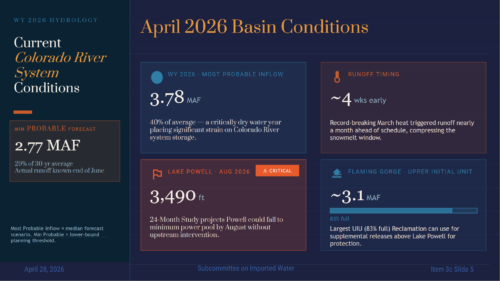 “The Colorado River Basin has been sliding toward a critically dry year since January—enough to put extraordinary federal action on the table. Although there were brief hopes that late-winter storms might turn things around in February, March, or April, these hopes have largely evaporated. As a result, the federal government has now signaled it will step in. At Metropolitan’s April meeting of the Imported Water Subcommittee, Shanti Rosset, Metropolitan’s Colorado River policy manager, outlined the Bureau of Reclamation’s proposed actions. Conditions on the Colorado River have continued to worsen throughout the spring. Specifically, the most likely inflow forecast for water year 2026 is 3.7 million acre feet—just under 40% of the 30-year historical average—which would make it a critically dry year. This situation is further compounded by timing: record-breaking March heat triggered runoff nearly a month early, shortening the snowmelt period and reducing the system’s ability to store water. In Reclamation’s lowest probable inflow scenario, the projection falls to 2.77 million acre feet, about 29% of the average. … ” Continue reading at Maven’s Notebook.
Much-needed snow to close out April, start May in Colorado Rockies
“A late-season storm will bring much-needed snow to the Colorado Rockies late this week as cold air from Canada interacts with moisture originating from the Pacific Ocean. The storm is forecast to bring cold rain to Denver while producing accumulating snow across the central Rockies from Thursday into Friday. Snow will be mainly confined to higher elevations, with a mix of rain and snow in the foothills and mid-level terrain. It will be far from the blockbuster snowstorm, with some ridges and peaks picking up 6–12 inches of snow. At this point in the season, any moisture is beneficial—especially in the form of snow. As it melts in late spring and early summer, snowpack provides a steady supply of runoff to streams and rivers, lasting from days to months depending on depth. … ” Read more from AccuWeather.
States seek a ‘marriage counselor’ in Colorado River brawl. Are they too late?
“The two teams of states battling over the Colorado River are nearing the end of a game they might both lose. Now, one of them is calling for last-minute, third-party intervention. In a Thursday joint statement, the Upper Colorado River Basin states of Colorado, Utah, New Mexico and Wyoming called for “immediate mediation” in the yearslong deadlock with the Lower Colorado River Basin states of Nevada, California and Arizona. They offered no details about who could fill that role or which entity would pay for the costs. “Time is short, but structured negotiations through mediation offer a new path for authentic discussions,” New Mexico’s Upper Colorado River Commissioner Estevan López said in a statement. “Even at this late stage, we should pursue every opportunity to reach a workable agreement.” … ” Read more from the Las Vegas Review-Journal.
SEE ALSO: Could a mediator help break the Colorado River deadlock? Utah thinks so, from KUER
Glen Canyon Dam faces its existential moment
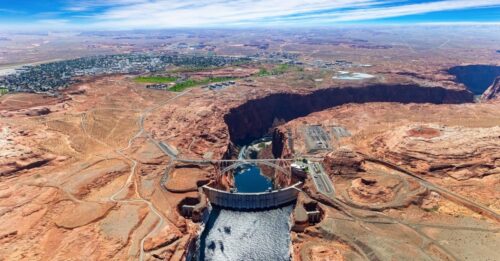
“In the span of U.S. history certain years are turning points, milestones in the nation’s story. 1776. 1865. 1929. 1968. Circumstance and consequence conspire to make it so. For the Colorado River and those who rely on it, 2026 is on the verge of similar prominence. Circumstances in the basin today are that urgent. A slow-developing water supply calamity, decades in the making, has boiled over, like a cold war turning hot. Extreme heat in March – triple-digit temperatures never witnessed that early in the year – obliterated a meager snowpack. The basin’s big reservoirs, the supposed buffers against short-term drought, were already uncomfortably low after a quarter-century of declining river flows. They will drop even lower. The amount of water flowing this summer into Lake Powell, the nation’s second-largest reservoir, will be one of the smallest ever measured, barely a trickle. “This is unprecedented, but it’s not unpredicted,” said Eric Balken, executive director of the Glen Canyon Institute. “I like to say that this is the most predicted disaster of all time.” … ” Read more from the Circle of Blue.
The great shuffle: emergency water moves aim to save Glen Canyon power
“The “plumbing” of the Colorado River has reached a mechanical and political breaking point. On Friday, federal officials announced an unprecedented “Great Shuffle” of water resources—a strategic move to prevent Glen Canyon Dam from reaching a catastrophic “power pool” shutdown this summer. The Bureau of Reclamation (BOR) has finalized plans to release between 660,000 and 1 million acre-feet of water from Flaming Gorge Reservoir to bolster Lake Powell. Simultaneously, downstream releases to Lake Mead will be slashed by 20%. The move signals that the federal government is prioritizing Glen Canyon Dam’s hydroelectric output as the reservoir inches toward the critical 3,490-foot mark. … ” Read more from the Lake Powell Chronicles.
Arizona state water department will appeal judge’s decision to strike down water restrictions.
“An Arizona trial court has struck down the Arizona Department of Water Resources’ restriction on home development, but homebuilders won’t be starting construction any time soon as a result on lots that have been gathering dust over the past few years. The Goldwater Institute sued Gov. Katie Hobbs administration in January 2025 over water restrictions on behalf of the Home Builders Association of Central Arizona. … ” Read more from Channel 15.
How the city with the most to lose in the Colorado River crisis is trying to adapt
“The Colorado River is running dry, and the federal government has proposed big cuts to the amount of water that flows to cities and farms in Arizona. KJZZ’s Alex Hager visits the town where those cuts will hit first and hardest. On the outer edges of the Phoenix metro, you’ll find Cave Creek, a town of about 5,000 people where cacti dot the hills above quiet neighborhoods. When it comes to water, about 95% of this town’s supply comes from one source, the Colorado River. It’s a baking hot spring day, and blue-green water is flowing through the wide concrete canal that brings Colorado River water here from more than 100 miles away. It’s then pumped out of the canal north to Cave Creek. … ” Read more or listen to show at NPR.
Phoenix explores mutual aid to conserve threatened water supply
“The city of Phoenix is taking steps to secure its water future as federal cuts to an already dwindling share of the Colorado River loom. For decades, the city has stored extra water underground, anticipating worsening drought conditions. If the feds follow through with slashing Arizona’s share of the Colorado, the cache could prevent immediate disaster but won’t be enough to keep Phoenix afloat forever. “We cannot conserve our way out of this crisis,” Phoenix Water Management Resources Advisor Max Wilson told the city council Tuesday afternoon. The council unanimously authorized city staff to begin negotiating mutual aid and transactional agreements with other Arizona municipalities, tribes and other water providers. The program, called the Secure Arizona Water Program, intends to establish an emergency reserve in which water users can set aside “small, discrete amounts of water,” to provide short-term emergency resources, Wilson explained. … ” Read more from the Courthouse News Service.
City leaders say Phoenix is ‘prepared’ in face of drought, but conditions on Colorado River remain a concern
“City officials say Phoenix has been preparing for drought conditions for “over 100 years.” But drought conditions could be closer than residents realize. The City of Phoenix discussed the Colorado River, Phoenix’s water supply, and the city’s water demand during a city council meeting on Tuesday, April 28. The water in Phoenix comes from a variety of sources: The Salt and Verde rivers, the Colorado River, and groundwater, according to the city council. It’s that “diversified portfolio” and decades of planning and investment that are allowing the city to maintain services to residents. “Phoenix is not running out of water. We have planned for drought for decades, and we continue to invest in the infrastructure, conservation programs and water supplies needed to serve our community today and into the future,” Phoenix Water Services Director Brandy Kelso said. “As conditions evolve, maintaining that reliability will continue to be a shared effort between the City and our customers.” … ” Read more from Channel 12.
Salt River Project is revitalizing old canals in south Phoenix. Could it help cool the hottest parts of town?
“Flood irrigation can really change the feel of a neighborhood in metro Phoenix. If you’ve ever walked through an old irrigated neighborhood in the summer, you can feel the difference. There are big, old growth trees, there’s grass, it’s easy to tell it’s cooler. But, there are lots of underserved neighborhoods in south Phoenix and other parts of town where the old canals that deliver that irrigated water need to be repaired. Enter Salt River Project’s new program: the Community Irrigation Revitalization Initiative, or CIRI. In the Valley, SRP is making investments in historically disadvantaged neighborhoods that have flood irrigation systems that are aging and in need of significant repair, so water can flow, grass can grow and trees can develop deep roots. And it has the potential to really transform neighborhoods. … ” Read more from KJZZ.
Despite a new law, conservationists are worried about AI water use in Utah
“Utah has taken steps to rein in water use by large data centers, but conservationists and other advocates say more needs to be done to protect the state’s dwindling water resources. Lawmakers recently passed the Data Center Water Transparency Amendments, which require server farm developers to provide an estimate of future water use. The facilities often need massive amounts of water to cool their servers, particularly for artificial intelligence systems. Zach Frankel, Great Salt Lake Waterkeeper and executive director of the Utah Rivers Council, said in some rural areas, there is not enough water to go around. “Two data centers in a community will use as much water as a city of 100,000 people,” Frankel said. “You could see data centers come in that essentially triple the water use compared to the municipal population.” … ” Read more from Utah Public Radio.
Fontenelle Reservoir about half-full as downstream states demand more water
“As thirsty downstream states along the Colorado River drainage continue to clamor for water, Wyoming is having problems of its own, as indicated by low levels at Fontenelle Reservoir in Lincoln County. As of early April, Fontenelle Reservoir was at 49% of its full storage capacity, according to the Bureau of Reclamation — despite March inflows roughly 99% of average. Downstream from Fontenelle, Flaming Gorge Reservoir will be drawn down between 660,000 and up to 1 million acre-feet between now and April 2027, according to the Bureau of Reclamation. The Flaming Gorge drawdown is expected to help make up for increasingly desperate shortages at Lake Powell. It and Lake Mead are the primary water sources for the Colorado River’s Lower Basin States — Arizona, Nevada and California. … ” Read more from Cowboy State Daily.
In national water news today …
Summer forecast 2026: Heat, severe storms to shape the season as El Niño develops, strengthens
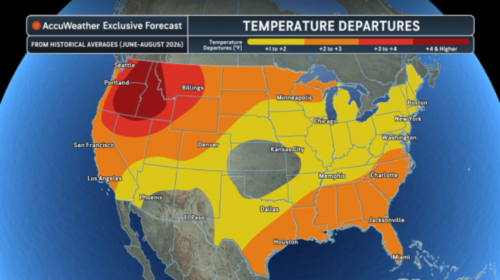 “Summer 2026 is expected to bring a volatile mix of heat, severe thunderstorms and flooding to the United States, with El Niño developing and flexing its influence on the weather pattern. A hot summer is predicted across most of the contiguous United States in 2026, with almost no areas expected to have temperatures below the historical average for the season. The widespread heat will drive up energy demand and could lead to higher electric bills. The worst of the heat will focus across parts of California, Idaho, Montana, Nevada, Oregon, Utah, Washington and Wyoming, fueling a widespread fire threat. … ” Read more from AccuWeather.
More than 60 percent of U.S. is covered by drought as impacts worsen
“Large swaths of the United States are in desperate need of soaking rainfall as drought continues to deepen. Stretching from Oregon to Florida and northward to the nation’s capital, nearly 63 percent of the country is facing drought conditions of varying intensity, just 2 percentage points shy of the most widespread drought this century, which occurred in 2012. The driest state compared with its average has been Utah, where there has been a 59 percent reduction in precipitation since October. Not far behind are Colorado, Arizona and New Mexico, seeing a 46, 43 and 39 percent reduction, respectively. “The West’s hydrology and climate are very much out of sync with the historical rhythm,” said assistant Utah state climatologist Jon Meyer. … ” Read more from the Washington Post.
USGS releases first nationwide tool for water resource planning
“The U.S. Geological Survey (USGS) has released the first nationwide tool to help city planners determine if communities have enough water for current and future needs. According to a news release from USGS, nearly 27 million Americans, or 8% of the population, live in areas where water demand approaches or exceeds supply. Accessing comprehensive information on water sources and availability required communication across multiple agencies and often navigating fragmented datasets. The new tool from USGS is designed to eliminate many of those barriers. The tool, called the USGS National Water Availability Assessment Data Companion, provides water managers, agricultural communities and researchers with detailed information about water supply and demand across approximately 80,000 watersheds nationwide. … ” Read more from Water Finance & Management.
King Charles calls for environmental stewardship in address to Congress
“King Charles III gave lawmakers a word of caution on environmental issues and natural resources during his address to Congress on Tuesday afternoon. The British monarch, an outspoken environmentalist, devoted a portion of his speech to conservation, invoking the words of former President Theodore Roosevelt and framing the protection of natural resources as a national security imperative. “Even as we celebrate the beauty that surrounds us, our generation must decide how to address the collapse of critical natural systems, which threatens far more than the harmony and essential diversity of nature,” the king said. “We ignore, at our peril, the fact that these natural systems — in other words, nature’s own economy — provide the foundation for our prosperity and our national security,” he said. Some of his remarks on the environment drew bipartisan applause. … ” Read more from E&E News.

