
Several news sources featured in the Daily Digest may limit the number of articles you can access without a subscription. However, gift articles and open-access links are provided when available. For more open access California water news articles, explore the main page at MavensNotebook.com.
On the calendar today …
- WEBINAR: State of California’s Coast and Ocean: First-ever Ocean Report Tells a Story of Progress and Pressure from 10am to 11am. California’s iconic coastline is home to millions, a cornerstone of our economy, and is known for its incredible diversity of marine ecosystems, from world-class beaches to majestic kelp forests. Today, it faces rising threats from climate change, biodiversity loss, pollution, and new federal efforts to expand offshore oil drilling. In response, scientists have come together like never before to track the health of our coast and ocean. For the first time ever, California’s Ocean Protection Council brings together the latest science in a clear, action-focused report on the state of our coast and ocean. Join us on California Ocean Day to hear what the data shows, what it means for California, and what comes next. Click here to register.
- WEBINAR: Basin Characterization Exchange: Subsurface Geologic Framework Modeling in the Southern San Joaquin Basin from 12:30pm to 1:30pm. Presented by Dan Boyd, California Geological Survey. Three-dimensional (3D) subsurface geological framework models represent an increasingly important data resource for managing risk to life-safety, public and private infrastructure, and the economic welfare of the state. In support of improving the state’s capacity to map and characterize the subsurface for applications such as geologic carbon sequestration and overall responsible pore-space management, the California Geological Survey (CGS) initiated a pilot project to develop a 3D geologic framework model. The project scope was developed in consultation with stakeholders and guided by the availability, density, and quality of subsurface data to construct a defensible regional 3D geologic framework model. Click here to register.
In California water news today …
What California’s next governor needs to know about water
“California water issues are notoriously complex: an alphabet soup of agencies manage California water, and the acronym-heavy insider-speak can be impenetrable—even for an experienced water expert. Moreover, California does not manage its water alone: federal agencies are responsible for many water-related activities and services across the state. In the past year the federal government has been downsizing—creating uncertainty across all aspects of California’s water management, including mitigating the impacts of natural disasters like wildfires and floods. Managing California’s water in a time of changing responsibilities, economic pressures, and climate volatility won’t be easy. Clarity around basic issues will help. … ” Read more from the PPIC.
SEE ALSO: SYRCL calls on candidates for California governor to commit to a clean water future, from The Union
Reaction to Delta tunnel decision – like project – is polarizing
“The State Water Contractors hailed the Delta Stewardship Council’s certification of the Delta Conveyance Project, while a coalition of opponents argued the agency ignored the project’s flaws for political expediency. The council determined that the project is consistent with the Delta Plan, but also sent two issues back to the state Department of Water Resources to demonstrate consistency with a Golden Mussel mitigation strategy and the siting of planned Delta Conveyance Project facilities in relation of farmland designated for use for recharging recycled water. Solano County did not respond immediately to a request for comment. “The State Water Contractors strongly support the Department of Water Resources’ certification and commend the Delta Stewardship Council for their thorough, thoughtful review and rejection of the majority of appeals from the appellants,” Chandra Chilmakuri, assistant general manager of the State Water Contractors, said in a statement about Thursday’s decision. … ” Read more from the Daily Republic.
The trade that never happens: On water scarcity, market design, and the mechanism we’re missing
“There is a strange irony at the heart of California’s water crisis. In the Central Valley, the most productive agricultural region on earth, farmers are watching crops fail. The water exists. It’s simply in the wrong place. A grower upstream has more than she needs this season. A grower ten miles away is facing cuts that will cost him his almond orchard. Both know the other exists. Both would benefit from a trade. And yet, in most cases, the trade never happens. The system for moving water from one pair of hands to another is so slow, so opaque, so legally fraught, and so riddled with fear about unintended consequences that most people don’t even try. They absorb the scarcity and move on. I find this deeply unsatisfying. And I’ve spent the better part of three years thinking about why it happens and what it would actually take to fix it. … ” Continue reading from Bilen Essayas at Substack.
California groundwater goals at risk, study finds
“In 2014, California passed the Sustainable Groundwater Management Act, called SGMA. The law was designed to stop decades of over-pumping and protect underground water supplies for the future. Under this law, local agencies were required to create plans to bring groundwater use into balance. These plans set specific water level goals that must be reached by 2040 and maintained through 2070. A new study first published April 21, 2026, takes a close look at those goals. It asks a simple but important question: are they realistic? … ” Read more from Western Water.
Specialized research and expertise drive California’s golden mussel response, Dudek says
“Dudek, a U.S.-based environmental, planning, and engineering consulting firm, is supporting California’s response to the spread of golden mussels through specialized research and multidisciplinary expertise that is helping water managers assess infrastructure risk and act quickly across complex water systems statewide. First detected in California in late 2024, golden mussels have since been identified throughout the state, including in the State Water Project (SWP), one of the largest and most complex water conveyance systems in the world. The SWP comprises 705 miles of canals, tunnels, and pipelines that deliver water to facilities serving more than 26 million residents and 750,000 acres of farmland throughout the state. Golden mussels pose a threat to infrastructure due to their rapid reproduction and ability to persist across a wide range of water conditions. The species can form dense colonies on pipes, screens, pumps, and other submerged infrastructure, prompting water managers to assess system vulnerabilities, operations and maintenance needs, and long-term reliability. While the species is still in the early stages of establishment in California, agencies are taking a proactive approach focused on early assessment, coordinated planning, and system-specific management strategies. … ” Continue reading from Dudek.
Drought status update for California-Nevada
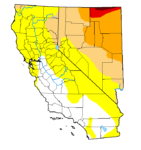 “Abnormally Dry (D0) and drought conditions have returned to California and expanded and intensified in Nevada, according to the U.S. Drought Monitor. California’s drought-free period earlier in the water year was short lived. Currently, 65% of California is Abnormally Dry (D0) and nearly 77% of Nevada is in drought (D1-D4). A dry and warm March, with record-breaking heat, led to rapid and early snowmelt across California and Nevada. In early April, 98-100% of SNOTEL stations were in a snow drought (defined as snow water equivalent below the 20th percentile). April 1 statewide snow water equivalent was the lowest on record (going back to 1981) for Nevada, and the second lowest on record for California. Recent storms and future forecasted storms through the end of April into early May have and may continue to buffer further drought degradation in some areas. As the region enters its climatological dry season, seasonal forecasts favor warmer-than-normal conditions for May–July. Above-normal significant wildland fire potential is forecast in northern California and eastern Nevada in June–July. … ” Read the full Drought Status Update from NIDIS.
New website chronicles Oroville Dam history, state’s broken agreements
“A new website launched by Butte County chronicles the more than 50-year legacy of broken promises for local recreational facility development made by the California Department of Water Resources when the Oroville Dam was built. The website, ourwatertheirpower.org, compiles historical records and planning documents to clearly show the gap between what was committed to by California Department of Water Resources versus what was, or more accurately what wasn’t, delivered. “It’s a complicated issue and hard to understand,” said Butte County Chief Administrative Officer Andy Pickett. “The website was created to provide people a clear understanding of the dam, its massive benefits to the state and the heavy burden it’s placed on the local community. It also serves as a repository of all documents of all the history of the dam.” … ” Read more from the Chico Enterprise-Record.
PG&E reviews proposals for Potter Valley Project as decommissioning continues
“A long-running effort to divert water from the Eel River into the Russian River basin is under review as Pacific Gas & Electric Co. moves forward with plans to decommission the Potter Valley Project, a 9.2-megawatt hydroelectric facility in Northern California. PG&E is evaluating proposals from entities interested in owning and operating the project’s dams, a process expected to take years and carry significant implications for regional water supplies and fish habitat. In a statement, PG&E officials said, “PG&E has been and remains open to reviewing and considering any proposal from an entity or entities that have the technical and financial capability to own and operate the dams.” … ” Read more from KRCR.
Why thousands of blue sea creatures are suddenly appearing on California beaches
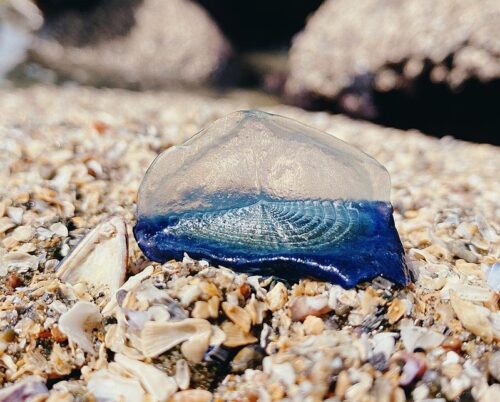 “Thousands of bright-blue sea creatures known as Velella velella, commonly called “by-the-wind sailors,” washed up on Baker Beach in San Francisco on Monday, covering stretches of sand beneath the Golden Gate Bridge. The striking organisms, which look a bit like tiny jellyfish with translucent sails, are a common sight on California beaches in spring and early summer. But when they arrive in large numbers, they can transform a shoreline almost overnight. Despite their jellyfish-like appearance, Velella velella are not true jellyfish. The National Park Service describes them as free-floating hydrozoans, related to jellyfish, sea anemones and corals. They live at the ocean’s surface and drift with the wind, using a small, clear sail to move across the water. … ” Read more from the San Francisco Chronicle.
California’s fight over pipeline tests state’s right to push back against Washington during war
“Crude oil pumped from the depths of the Pacific Ocean is flowing for the first time in more than a decade through a pipeline that crosses California state park land after the Trump administration defied state officials to restart drilling off Santa Barbara, calling it essential to national security. State officials call it trespassing and are asking a federal judge at a hearing Monday in Los Angeles to order Sable Offshore Corp. to stop using the pipeline — which snakes for 4 miles (6 kilometers) through a portion of Gaviota State Park — and to remove it. The pipeline system owned by the Texas firm had been idle since one of its pipelines ruptured in 2015 and caused one of California’s worst oil spills, blackening beaches for 150 miles (240 kilometers) from Santa Barbara to Los Angeles. The spill polluted a biologically rich habitat for endangered whales and sea turtles, killing scores of pelicans, seals and dolphins, and decimating the fishing industry. … ” Read more from the Associated Press.
Wildfires are torching state budgets
“Oregonians buying nicotine pouches like Zyn and Rogue were met with a surprise at the cash register starting this year. Each tin had new 65-cent tax on it, meant to bolster funding for the state’s wildfire reduction efforts. Wildfires burned more than 1.9 million acres in Oregon in 2024. By the time they finally died down at the end of October, the state had spent more than $350 million fighting them, greatly exceeding the $10 million it had allocated. “By July 21, I had already completely blown through my cash on hand,” said Kyle Williams, Oregon Department of Forestry’s deputy director for fire operations. Contractors weren’t promptly paid for services they’d already provided, from digging fuel breaks to supplying meals, and the state had to hold an emergency legislative session to allocate the money. That summer highlighted the flaws in how the state funds both firefighting and the preventive work that reduces the chances of large, destructive blazes in the first place. … ” Read more from the High Country News.
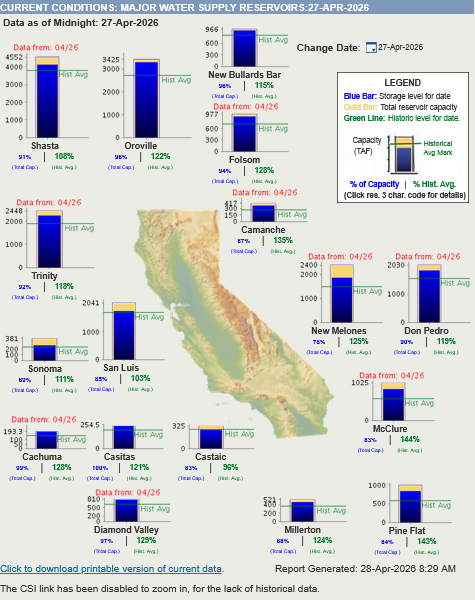
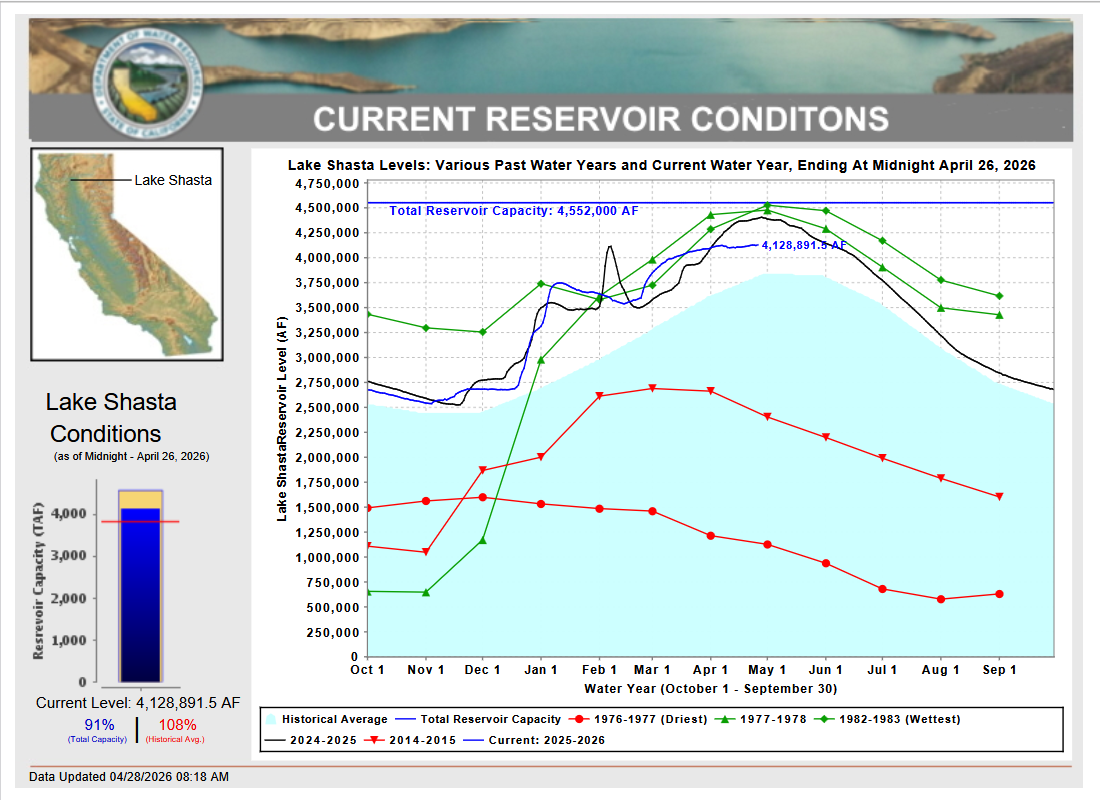
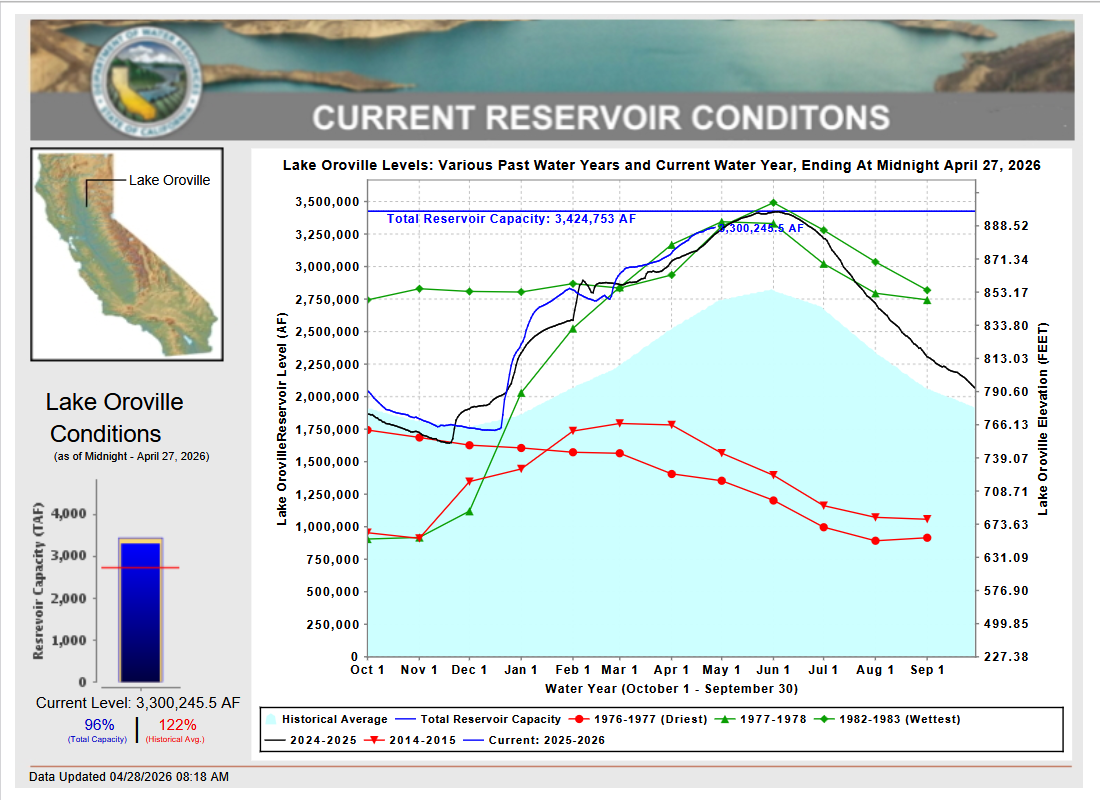
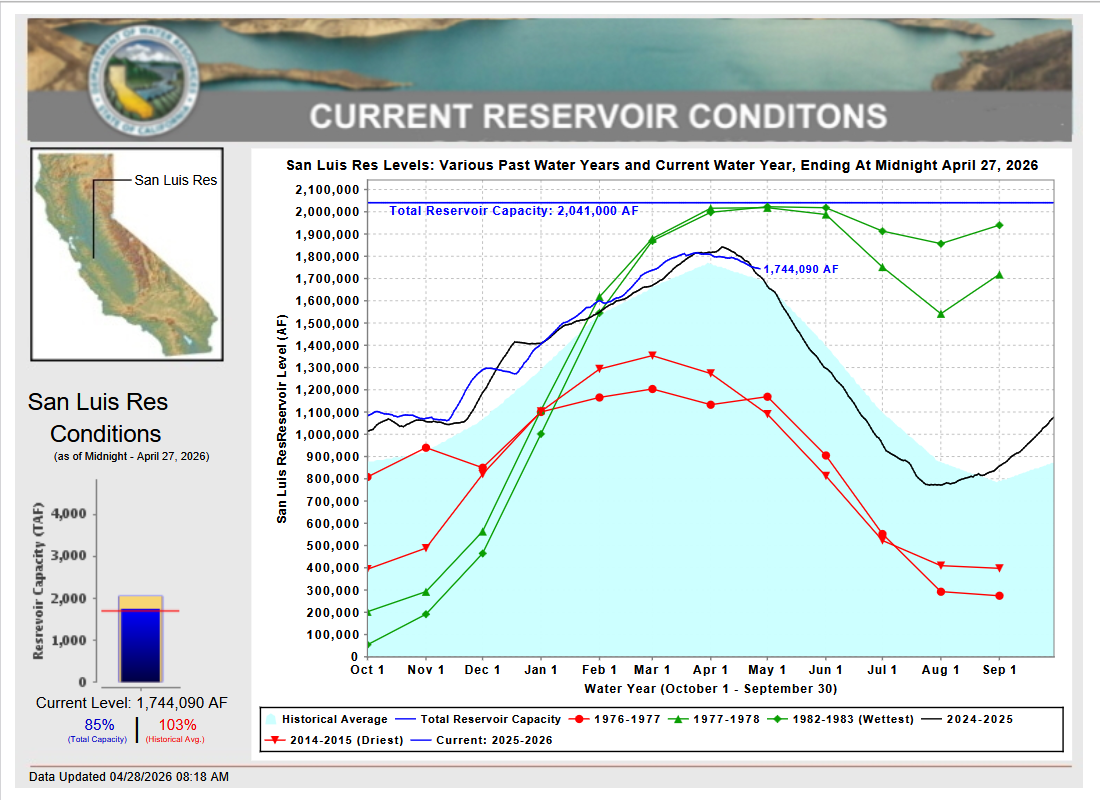
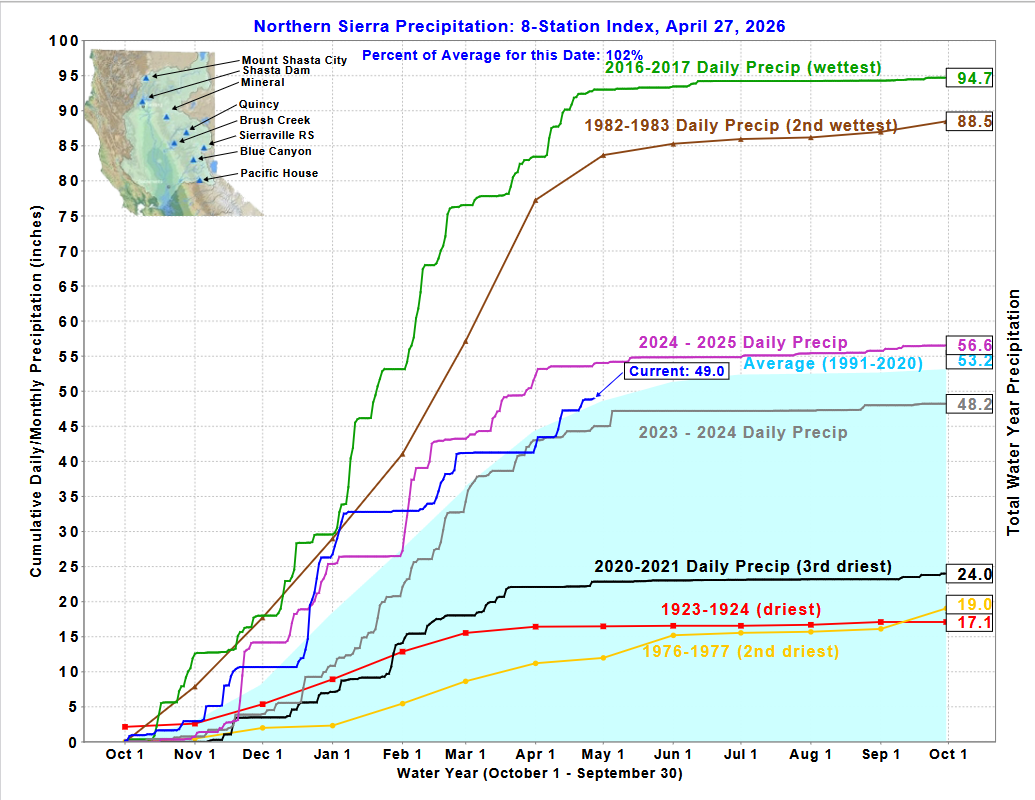
A look at current reservoir and water conditions …
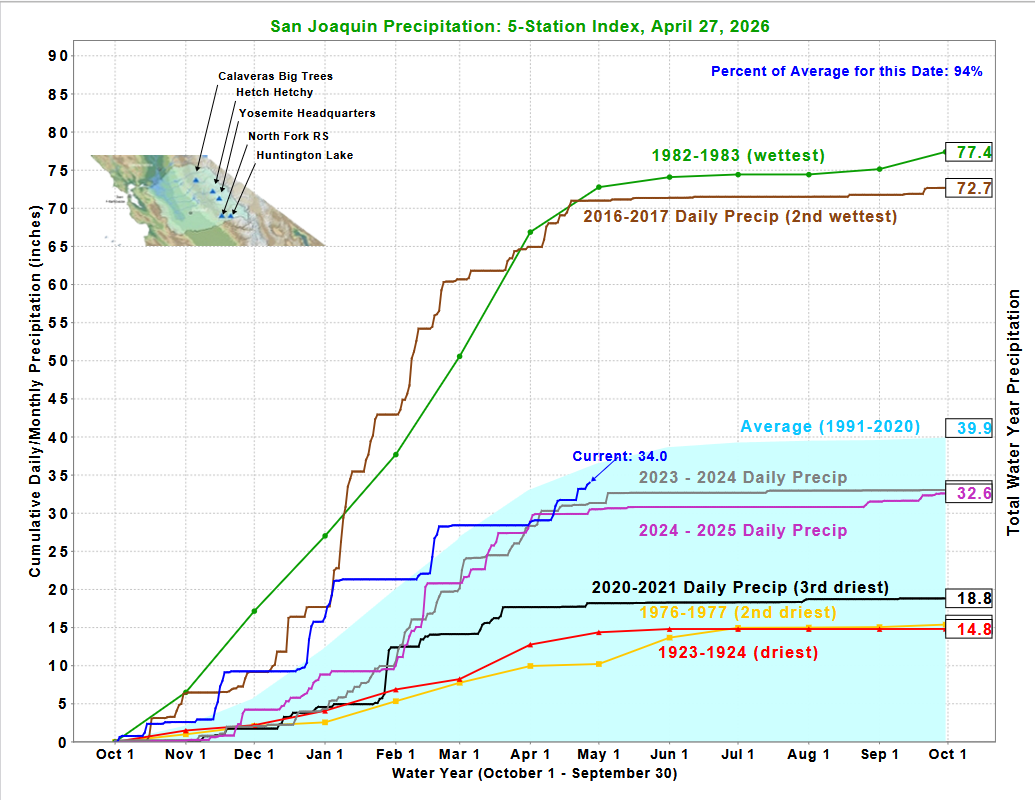
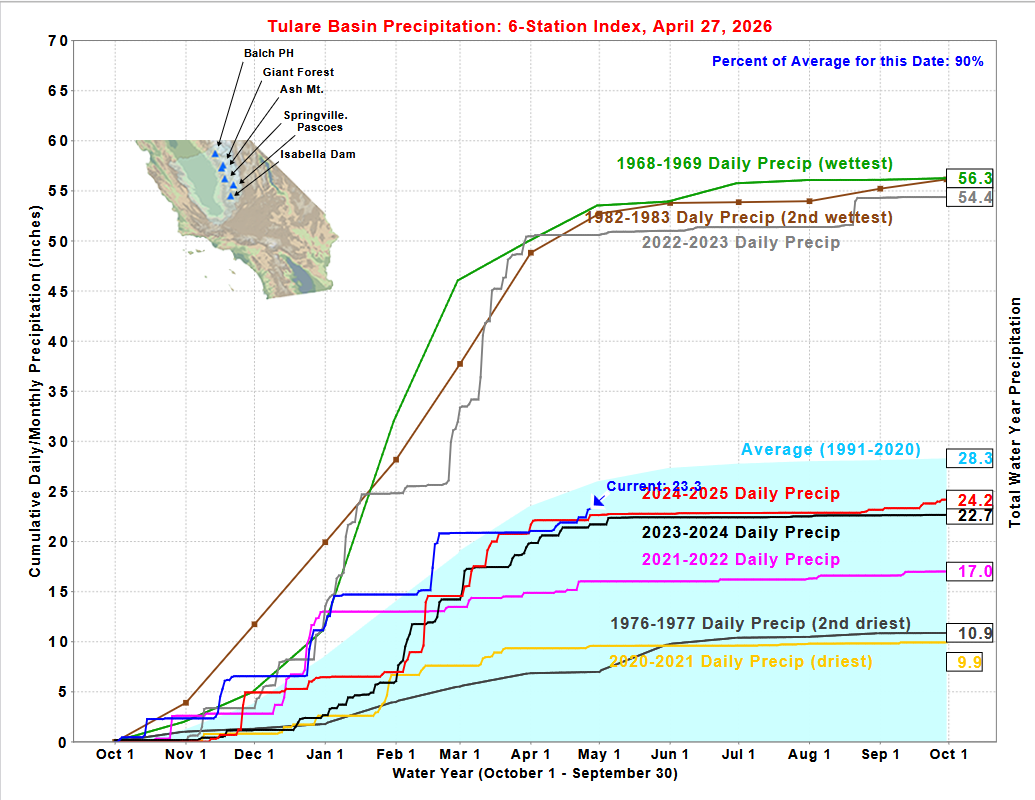
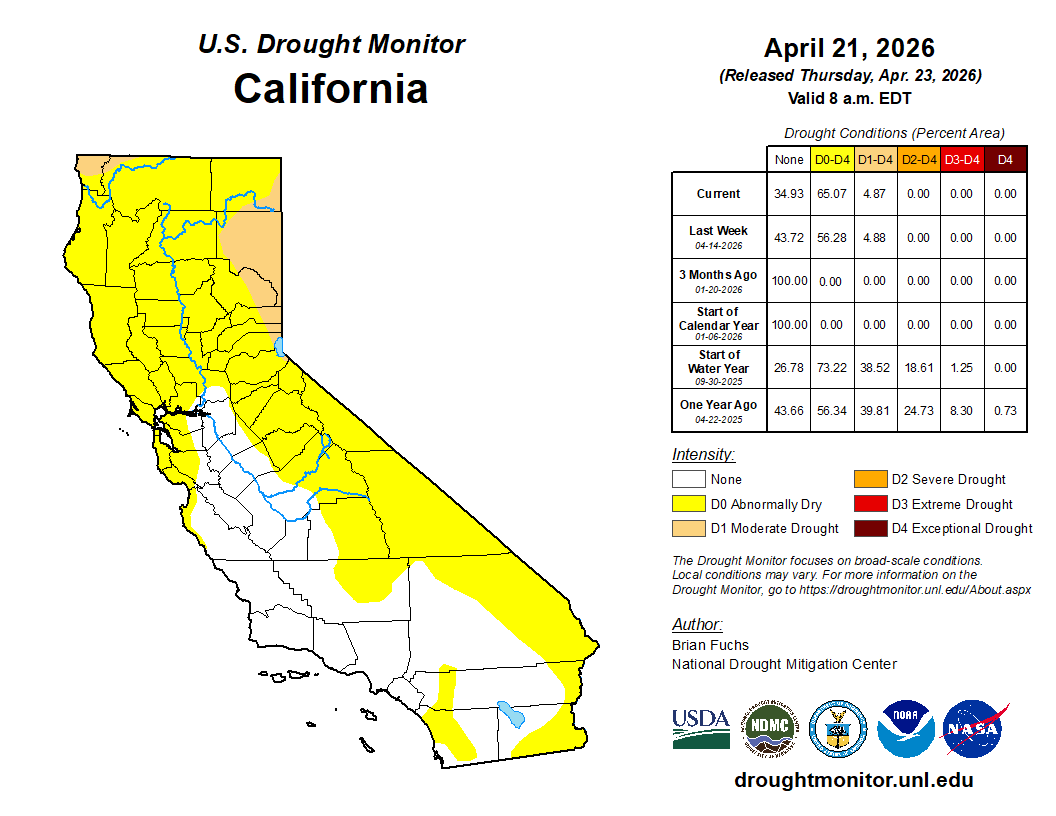
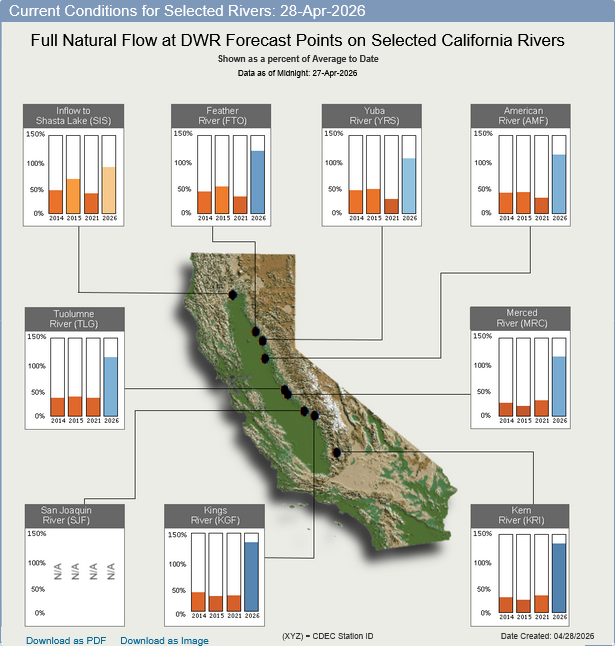
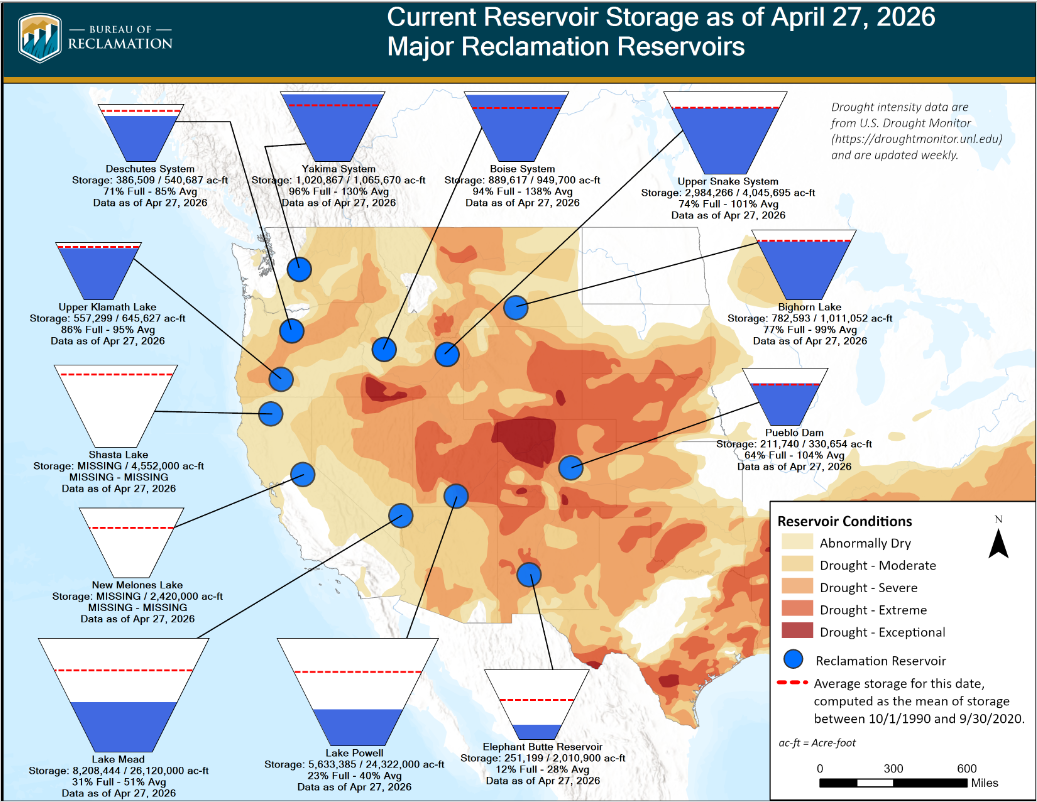
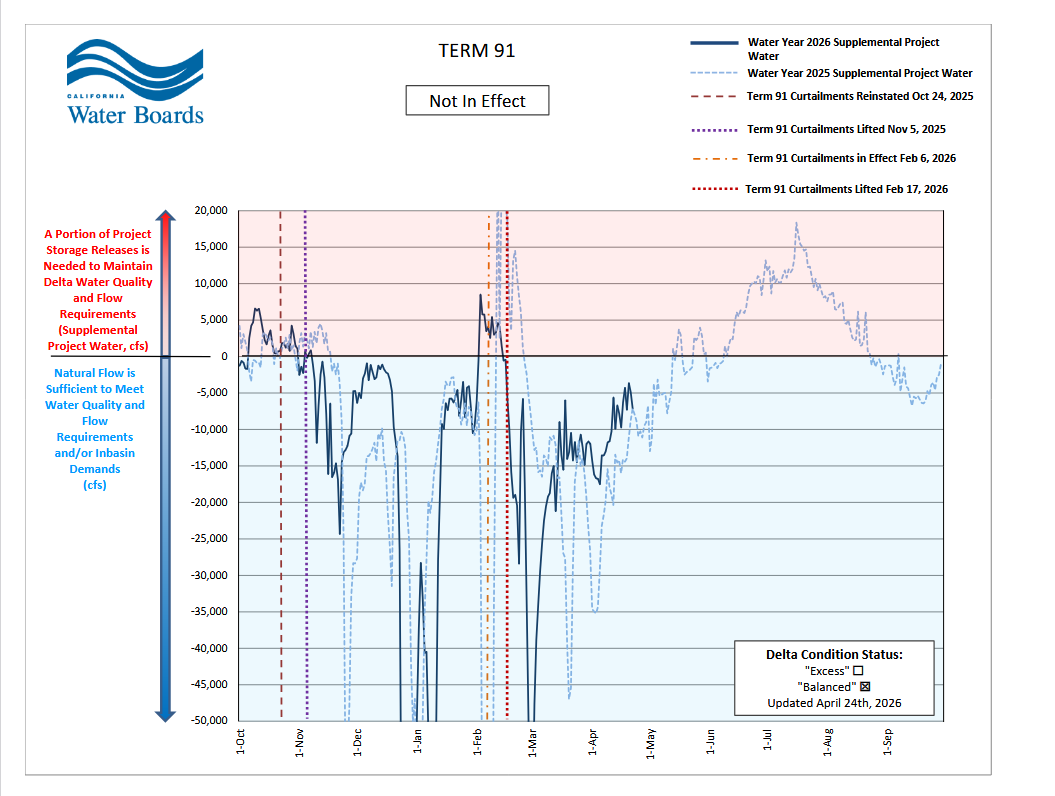
In regional water news and commentary today …
NORTH COAST
The fish hawk, the Osprey raptor is a canary-in-the coal mine, signaling bio-system’s health
“On Thursday, April 23, the Redbud Audubon Society hosted a zoom program presented by Elizabeth Meisman focusing on the Northern California Osprey Collaborative, a new, community-driven raptor research initiative working to better understand and conserve breeding ospreys across this region. Ospreys, also known as the “fish-hawk” is a bewildering bird that can be found across the world, most of which are migratory and can be found in Clear Lake, Humboldt Bay and the Bay Area, feed primarily on fish. … Ospreys are amazing birds found all over the world and most of which are migratory and feed primarily on herring, flounder, carp, sunfish, bass, whitefish, and salmon. They also have a habitat locally at Clear Lake, Lake Pillsbury, Humboldt Bay and the San Franciso Bay Area. They are a large bird just slightly smaller than an eagle. Females tend to have what is called a necklace, heavily barred.” Meisman said. … ” Read more from the Lake Record-Bee.
Scientists test new treatment to tackle harmful algae blooms in Clear Lake
“By some measures, Clear Lake is thriving. It holds more fish per acre than any other lake in the United States and supports a vast population of birds and other wildlife. But, by another measure that has defined the lake for decades, Clear Lake is deeply out of balance. Every year, harmful algal blooms take over the lake’s surface, producing toxins that can make people and animals who use the lake sick. The blooms shut down recreational activities and strain local tourism. But now, a group of scientists believe they have found a way to restore Clear Lake’s water quality by tackling phosphorus, one of the biggest drivers of the harmful algal blooms. … ” Read more from the Mendocino Beacon.
SACRAMENTO VALLEY
Redding storm smashes 1897 rain record. Is this hydroclimate whiplash?
“A heavy storm on Sunday dumped enough heavy rain on Redding to break a 129-year-old precipitation record. A deluge of 1.39 inches fell in parts of the city on April 26, smashing the 1.05-inch record set in 1897, according to National Weather Service data. That storm brought the year’s rain total closer to Redding’s average rainfall for this time of year after a very dry March, according to weather service data. A total of 15.08 inches of rain fell on Redding from Jan. 1 to April 26, 2026 — almost a third of it (4.05 inches) fell in April. But Sunday’s storm may not be enough to pull the city out of an unusually dry period starting in May or June, climate scientists said. … ” Read more from the Redding Record-Searchlight.
New delay in Sacramento County vote on controversial Natomas housing project
“Sacramento County’s Board of Supervisors will vote Tuesday on a housing development in the Natomas Basin that the Sacramento City Council has already formally opposed. The Upper Westside project for the past year has been the source of ongoing tension between the county and city elected leaders. Its plans include building out 9,400 homes for about 25,000 people and creating a new community near the Sacramento International Airport, one the size of a small city. If completed, the community would stretch 2,000 acres along Garden Highway. The City Council voted 8 to 1 to oppose the development last August. It sent a formal letter urging the county not to proceed with it. … ” Read more from Capital Public Radio.
Environmental groups push back on American River Parkway levee work
“On Guy West Bridge just off of the Sacramento State campus, Mark Berry, president of the Save the American River Association (SARA), spoke about the levee fortification project along the American River Parkway. From the bridge, one side of the levee appeared bare, with small plantings, while the other had mature trees. The area next to the Sac State campus, designated Contract 2, site 2-3, was fortified in 2023 and revegetated in 2024. “The utilization of the parkway is kind of immense,” Berry said. “It gets eight million visitors a year, almost as many as Yellowstone and Yosemite combined. And it generates 360, maybe 70 million dollars a year toward the economy.” … ” Read more from the Sac State Hornet.
NAPA/SONOMA
A proposal for a utopian development is splitting a Bay Area town in two
“Located at the northernmost tip of Sonoma County, Cloverdale doesn’t have the same kind of cachet as its southern neighbors Healdsburg and Petaluma. But big things are brewing in the town of nearly 9,000. In July 2024, the Press Democrat reported that Esmeralda Land Company — an outfit run by a Stanford-educated software engineer named Devon Zuegel — entered a purchase agreement to buy a massive 267-acre site in Cloverdale with plans to build a 600-unit, “‘pedestrian-first’ eco-village” on the land. Zuegel is promoting Esmeralda as a utopian community that will bring new energy to a vacant plot of land, but the proposal is splitting residents and officials, and setting off a fiery debate about Cloverdale’s future. … ” Read more from SF Gate.
BAY AREA
San Francisco Bay Water Board approves $5.6 million penalty for sewage spill to Suisun Bay
“The San Francisco Bay Regional Water Quality Control Board has approved a $5,557,700 settlement with Delta Diablo, a wastewater treatment agency serving eastern Contra Costa County, in connection with a sewage spill that released more than 23 million gallons of untreated wastewater into marshland connected to Suisun Bay. The spill began around Nov. 5, 2024, and continued for nearly a month before being discovered on Dec. 2. It originated from a subsurface break in the Shore Acres Force Main beneath a marsh, which delayed detection. Delta Diablo repaired a 20-foot section of the pipeline within two days, stopping the discharge by Dec. 4. “Sewage spills of this magnitude pose serious risks to water quality, wildlife habitat, and public health,” said Eileen White, executive officer of the San Francisco Bay Water Board. “This settlement holds the discharger accountable while making critical investments to modernize infrastructure and reduce the risk of future spills.” … ” Read more from the State Water Board.
Bay Area suburb could be without water until the end of the week
“Residents in a Peninsula suburb could be without water until at least midweek after an active drinking water line became contaminated during maintenance work. The problems started Friday in the Mountain View neighborhood of Cuesta Park when a contractor was working on a water replacement project, the city said on its website. As the contractor was attempting to fill an old pipe with cement near Bonita Avenue and Cuesta Drive, cement slurry, a liquid mix of cement, water and other chemicals, accidentally spilled into an active main providing drinking water, Lenka Wright, a spokesperson for the city, told SFGATE. … ” Read more from SF Gate.
SEE ALSO: Mountain View declares state of emergency after water main breach, from Local News Matters
CENTRAL COAST
Environmental justice committee meets pesticide-concerned public
“Expanded air monitoring and more precise alerts about potentially hazardous pesticides were the demands of the public at the first in-person meeting of the California Department of Pesticide Regulation’s Environmental Justice Advisory Committee. The 11 person Committee – with three “alternates” to substitute – met on Friday night at the Salinas Rotunda. The newly formed committee is designed to voice the concerns of the public to DPR. The Salinas and Pajaro Valleys were well represented with committee members Horacio Amezquita, Robert Chacanaca, Erika Alfaro and Sarait Martinez currently or formerly living in the area. Rocio Ortiz, an Environmental Studies and Global Studies student at Cal State Monterey Bay and Victor Torres, a student at Monterey Peninsula College, both members of the youth environmental justice group, Future Leaders of Change, are also members of the committee. … ” Read more from the Monterey Herald.
SAN JOAQUIN VALLEY
Water district accuses east Kern group of dragging its feet on groundwater compliance, wants state action
“The Kern-Tulare Water District in northeastern Kern County is asking the state to take a closer look at what it says is excessive pumping in a so-called “whiteland” area that is harming its own groundwater supplies. Representatives of the Eastside Water Management Area (EWMA), meanwhile, say the group is working through a laborious process to get the legal authority and funding to take action on over pumping. It was “surprised and disappointed” by Kern-Tulare’s April 20 letter to the Department of Water Resources’ Sustainable Groundwater Management Act (SGMA) department, a spokesman said at the Kern Non-Districted Lands April 27 meeting where the dispute spilled over. “We’ve been working for a long time with (EWMA) to get them headed in the right direction to no avail,” said Andrew Hart, who sits on both the Kern-Tulare and Kern Non-Districted Lands boards. … ” Read more from SJV Water.
North Kern looks at new irrigation technology
“Joel Kimmelshue of Land IQ gave a presentation to the North Kern Water Storage District board of directors at its April 21 meeting on one of the company’s latest new tools: Daily Evapotranspiration (ET) and Irrigation Management Tool to help farmers make informed decisions with daily data. Evapotranspiration measures how much water plants take up and release, transpire, into the atmosphere. Kimmelshue said while growers like the current Land IQ information, it only comes once a month and shows how crops used water the previous month. Growers wanted more current information, he said. … ” Read more from SJV Water.
SOUTHERN CALIFORNIA
LA County water contact warning continues after rain
“Beachgoers in Los Angeles County are being urged to continue to avoid all water contact today, especially near discharging storm drains, creeks, and rivers, due to potentially higher bacteria levels after this weekend’s light rainfall. The Los Angeles County Department of Public Health issued an Ocean Water Quality Rain Advisory until at least 5 a.m. Wednesday. The warning also applies to any runoff that may flow onto the beach sand. … ” Read more from NBC 4.
IMPERIAL/COACHELLA VALLEYS
Coachella residents call for data center moratorium as debate expands across Southern California
“An hour’s drive north of the Imperial Valley, a new battleground is emerging in California’s debate over data centers and artificial intelligence. The Coachella Valley, known for its famed music festival and date palm farms, is now the planned site for a massive 240-acre technology campus that includes a large data center project. The campus would be built in the city of Coachella, a small, largely working-class city where 97% of residents identify as Latino. It would be a key part of the city’s ongoing efforts to create its own energy utility. … ” Read more from KPBS.
SAN DIEGO
Julian businesses demand a permanent fix after another water main break leaves parts of the town without water
“A familiar problem has returned to Julian, where another water main break has left parts of the town without water for nearly two days. The outage is affecting multiple businesses, including the Julian Market and Deli along Main St. Business owners say the recurring issue has happened multiple times over the past few years, and they are calling for a permanent solution. “We’ve been watching the main water pipe break and because of that we haven’t been able to do business a lot of restaurants had to close,” Angela Barrios said. … ” Read more from Channel 10.
Finally, a fix in the works for Tijuana sewage pump
MacKenzie Elmer writes, “In 2021, I wrote that a contract to fix an ailing wastewater pump in Tijuana would be awarded to a contractor that spring. It did happen in spring – only five years late. On Monday officials from Baja California and the U.S. convened outside that aging pump to announce construction would finally begin. The pump station, known as PB-1, is one of the many problem child pieces of infrastructure built to stop sewage spilling into the Tijuana River. It suffers mechanical failures, power outages and gets sent more water than it has the capacity to handle quite often. … ” Read more from the Voice of San Diego.
Critical upgrades to Tijuana’s wastewater system to begin
“A critical area of Tijuana’s wastewater system, which repeatedly fails, sending millions of gallons of untreated sewage a day into the binational Tijuana River, is being upgraded. On Monday, officials with Mexico and U.S. governments and the North American Development Bank (NADBank) broke ground on a project to improve the PB1A and PB1B lift stations. The pumps move wastewater from a larger pump station in Tijuana, called PBCILA, across the U.S.-Mexico border to the South Bay International Wastewater Treatment Plant that’s located in the Tijuana River Valley. When they fail, including because of power outages, sewage flows tend to bypass a drain at the border wall and reach the Tijuana River. Sewage pollution has led to beach closures on both sides of the border and people reporting health symptoms, such as headaches, nausea and respiratory problems. … ” Read more from KPBS.
Along the Colorado River …
Hoover Dam’s power output could drop 40 percent this year under new plans to balance out record low snowpack
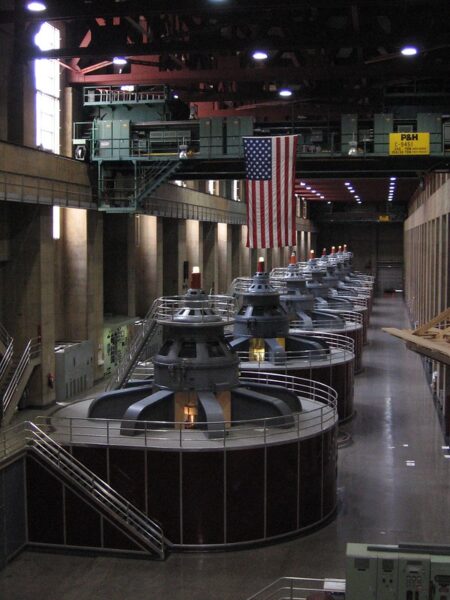
“The Hoover Dam will generate up to 40 percent less power this year as federal and state officials scramble to protect the Colorado River system from a historic drought driven partly by climate change. For nearly a century, water collecting in Lake Mead and rushing out through the dam’s turbines has helped power large swathes of Nevada, Arizona, and southern California, including Las Vegas and Los Angeles. But on April 17, the U.S. Bureau of Reclamation announced that it will be forced to reduce water flows from Lake Powell on the Arizona-Utah border, about 300 miles upstream, in order to stop that reservoir’s Glen Canyon Dam from shutting down completely. That in turn will further sap Lake Mead’s already historically low water level, potentially leaving some of the Hoover Dam’s turbines high, dry, and unable to spin. “Long-term drought has reduced Colorado River system storage to about 36 percent of capacity, and the combination of the lowest snowpack on record and record-breaking March heat has further intensified drought conditions across the Basin,” said the bureau. … ” Read more from The Independent.
SEE ALSO: Lake Powell cuts could dramatically reduce Hoover Dam’s ability to generate power, from KJZZ
Staring down crisis on the Colorado River, 3 states seek a side deal
“With the drought-riddled Colorado River careening toward crisis levels in the coming months and seven Western states bitterly deadlocked on how to share its diminished flows, one faction is attempting to break off and go it alone. Over the past week, the downstream states of Arizona, California and Nevada have been negotiating feverishly over a potential deal to divvy up water delivery cuts for the next few years and develop a handful of tools for blunting the pain that will stem from them. It’s a Hail Mary bid to exert some control over their own fate as the Interior Department prepares to begin unilaterally operating the river’s system of dams and canals starting in October. So far, the agency has floated potential options that could have sprawling economic consequences for the arid region’s cities, farmers and tribes. “The idea is to try to get through the immediate next couple of years of extreme drought and have some security,” said Terry Goddard, president of the board of that oversees the Central Arizona Project, the canal system that delivers water to Phoenix, Tucson and their suburbs and is extremely legally vulnerable in the water fight. … ” Lake Powell cuts could dramatically reduce Hoover Dam’s ability to generate power, (sorry, subscription required).
Rainmaker touts proof that cloud seeding delivers results
“A private cloud-seeding company, Rainmaker, says it has unambiguously validated the effectiveness of its technology. On Monday, the company announced that the tech has produced 143 million gallons of freshwater for Utah and Oregon residents. Founded in 2023, Rainmaker uses drones to disperse silver iodide into clouds, then they track precipitation with advanced radar. However, Rainmaker — and every other rain-enhancement company — has been up against the notoriously difficult challenge of validation. Since there is no control set to test, and because the weather is chaotic and variable, the Government Accountability Office declares the benefits of the technology to be “unproven.” … ” Read more from Deseret News.
Conservation saves Arizona town from summer shortage, but risk remains
“This small town in Pinal County could have run out of water before July as drought reduced supplies and tightened allocations, but water conservation has bought them time to avert a bigger crisis. Residents and businesses have collectively reduced municipal water consumption by 30% in the past weeks, stretching the town’s resources until September, Mayor Curtis Stacy told The Arizona Republic. By then, the town could have more than two extra wells running and, they hope, monsoon rains to boost the San Carlos reservoir and increase how much water is available. … ” Read more from Arizona Central.
Queen Creek diversifies its water sources
r, writes, “Water is almost a daily topic of conversation – especially in Arizona as we hear more and more about the grim outlook of the Colorado River and continuing drought conditions. Currently in a tier one shortage, more cuts are anticipated to the Colorado River. It’s important to understand how cuts to the river impact Queen Creek. About 10% of Queen Creek’s water supply comes from the Colorado River, so we’re in a really good position with a very minimal reliance on the Colorado River. We’re also working to reduce reliance on local groundwater, moving away from the Central Arizona Groundwater Replenishing District (CAGRD). CAGRD primarily relies on Central Arizona Project (CAP) water, which comes from the Colorado River. … ” Read more from the Queen Creek Tribune.
Utah grapples with unprecedented water conditions in the year of the ‘no-pack’
“Utah cities, ski resorts, farmers and scientists tracking and preparing for the fallout of this year’s lowest-ever snowpack and winter drought are already feeling the effects. The impact was clear at Utah’s ski resorts, where visitation dropped from last season’s 6.5 million skier days to about 5 million this season, said Hilary Arens, director of sustainability and water resources at Snowbird Resort. “With a lower snowpack, less skiers, Snowbird is making less money,” Arens said Monday during a panel discussion in Salt Lake City, sitting under a display declaring 2026 the “year of no-pack.” Hosted by the nonprofit Great Salt Lake Alliance, panelists discussed the wide-ranging implications for Utah’s economy and environment, and the realities of a future with less water. … ” Read more from the Utah News Dispatch.
‘Hyperscale’ data center project in Utah — expected to generate and consume more power than entire state — nears final approval
“Celebrity investor Kevin O’Leary plans to build a massive hyperscale data center project in Box Elder County — which state boosters say will fund modern buildings at Hill Air Force Base while generating all of its own power, cleaning the water it uses so it can be sent to the Great Salt Lake and creating 2,000 high-paying jobs in the rural area. The board that oversees the state’s Military Installation Development Authority, or MIDA, approved a series of resolutions Friday to move the multibillion-dollar project forward, agreeing to move fast and charge far lower taxes than usual to help O’Leary “lure the hyperscalers” to Utah. “There’s only five hyperscalers in America, OK, so it’s pretty easy to know who they’re negotiating with,” Paul Morris, MIDA’s executive director, told the board Friday. “You can look those up and you know who they’re talking to.” … ” Read more from the Salt Lake Tribune..
“Be a pain in the ANS”— Colorado’s fight against invasive mussels
“When most people hear the word “mussel,” they probably think of seafood, not a growing environmental threat. But in Colorado, state officials are urging the public to pay attention to a different kind of mussel entirely: invasive freshwater species that can multiply rapidly, disrupt aquatic ecosystems, and damage critical water infrastructure. Colorado Parks and Wildlife’s (CPW) aquatic nuisance species program focuses on preventing the spread of invasive organisms like zebra mussels, quagga mussels, and golden mussels. Zebra and quagga mussels have been present in the United States since the late 1980s, while golden mussels were first detected in California in 2024 and are spreading there quickly. Golden mussels are not currently known to be in Colorado, but officials say the threat is real. … ” Read more from KGNU.
A freakishly dry spring is literally changing the landscape in Colorado
“Drought is spreading fast in Colorado and major cities are declaring their earliest water restrictions in history, urging residents to cut back on the thirstiest water user: the classic American lawn. The state is now nearly half-covered by extreme drought conditions — even though there was essentially no extreme drought there at the start of 2026. Now, extreme drought in Colorado is at its highest level in five years, and at its highest level for April in more than two decades. Colorado is no stranger to dry years, but this year is unique for above average dryness coinciding with extreme early-season warmth, according to the University of Colorado Boulder. City officials are warning people will have to make changes, most notably, adjusting their expectations for how their lawns will look this year. Those changes could reshape the aesthetics of the region for the long haul. … ” Read more from CNN.
In national water news today …
‘Have your dog pee on it’: Zeldin tangles with lawmakers during budget hearing
“Lee Zeldin started off his tour of congressional hearings this week with a bang. The EPA administrator appeared Monday before the House Appropriations subcommittee that oversees his agency to defend a fiscal 2027 budget proposal that would slice the agency down to $4.2 billion — or more than half of its enacted funding. The proposed cuts drew scrutiny from both sides of the aisle, and Zeldin was quick to spar on a variety of other fronts, including chemicals, climate change and the administration’s drive to deregulate. … Lawmakers from both sides of the aisle once again demonstrated a lack of interest in coming anywhere close to the Trump administration’s requested budget cut for EPA. While Democrats like subcommittee ranking member Chellie Pingree of Maine and Appropriations ranking member Rosa DeLauro of Connecticut blasted the cuts, they were backed up by subcommittee Chair Mike Simpson (R-Idaho). “You’re not going to see state and tribal grants cut by 83 percent,” Simpson said at the end of the hearing. “That was not Democrats fighting back. That was Republicans and Democrats.” … ” Read more from E&E News.
Stalled farm bill, slashed grants undercut farmers’ water protection efforts
“More than two years have passed since the Agriculture Improvement Act — better known as the Farm Bill — expired, leaving the nation’s primary agricultural policy framework in a state of prolonged uncertainty. The bill, which steers the economics, logistics, and environmental priorities of America’s food production and land and water use, is one of the largest pieces of legislation authored by Congress. The 2018 package, which lapsed in 2023, is more than 500 pages long. Two full legislative sessions have come and gone without the approval of a new five-year Farm Bill, and this year is unlikely to yield more productive results. The U.S. House Agriculture Committee passed a new version of the bill out of committee earlier this month, but its chances of gaining Senate approval, policy experts tell Circle of Blue, are slim. … ” Read more from the Circle of Blue.

