
Several news sources featured in the Daily Digest may limit the number of articles you can access without a subscription. However, gift articles and open-access links are provided when available. For more open access California water news articles, explore the main page at MavensNotebook.com.
On the calendar today …
- MEETING: SB 1157 Benefits & Impacts Working Group Meeting from 1:30 to 4:30pm. The Department of Water Resources (DWR) invites you to join our project team and the SB 1157 Benefits & Impacts Working Group for our 3rd working group meeting. This group supports DWR in quantifying the benefits and impacts of the 2030 indoor residential water use standard on water, wastewater, and recycled water systems. Register Here
In California water news today …
Wild vs. hatchery: Charting California’s fisheries path forward
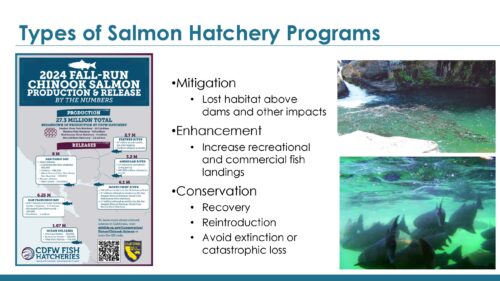 “Hatcheries are a complex issue, tasked with meeting diverse demands that are often at odds: producing large numbers of fish for commercial and recreational fisheries while also serving purposes such as mitigation and conservation. These objectives often clash: hatchery fish can differ from wild fish and impact their recovery, so decisions about production, methods, and release strategies require careful consideration of conflicting factors. These complex challenges were discussed at the 2026 California Water Law Symposium, where a panel evaluated how hatchery policies fit into broader salmon recovery strategies under state and federal law. … ” Read more from Maven’s Notebook.
The next El Niño could lock earth into a hotter climate
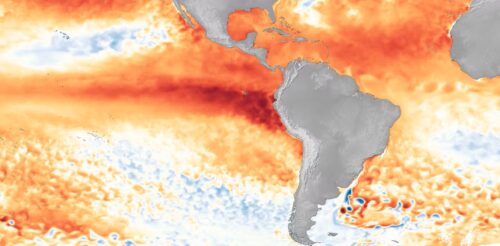
“The Pacific Ocean is a giant climate cauldron, with a powerful heat engine that affects storms, fisheries and rainfall patterns half a world away, and scientists are watching closely to see if it’s about to boil over. Their projections suggest the tropical Pacific is simmering toward a strong El Niño, the warm phase of an ocean-atmosphere cycle that can intensify and shift those impacts. In a world already superheated by greenhouse gases, a strong El Niño during the next 12 to 18 months could permanently push the planet’s average annual temperature past the 1.5 degrees Celsius warming threshold enshrined in scientific documents and political agreements as a turning point for potentially irreversible climate impacts. Climate scientists also recently published a study showing that strong El Niño events can trigger what they called “climate regime shifts,” meaning abrupt, lasting changes in heat, rainfall and drought patterns. … ” Read more from Inside Climate News.
1 in 5 Americans may have a dangerous toxin in their tap water
 “Over 62 million Americans — roughly 1 in 5 people — may be exposed to potentially dangerous levels of nitrates in their tap water, a new report has shown. A compound of nitrogen and oxygen found naturally in air, water, soil and plants, nitrates become a health risk when rainfall causes nitrogen-rich fertilizers used in agriculture to leach into groundwater, streams and rivers and end up in public water systems miles downstream. … Thirteen-year-old Ben is so concerned about nitrates in the tap water of his hometown of Des Moines, Iowa, that he recently sent his local congressman a letter and poem. “I remember when I could drink water from the faucet, but now it is a health concern,” Ben wrote Iowa State Rep. Dr. Austin Baeth. “Please don’t ignore this problem!” … ” Read more from CNN.
SEE ALSO: Nearly One-Fifth of Americans Are Consuming Water With High Levels of Nitrates, from Inside Climate News
California’s water crisis could turn farmland into massive solar field
“California’s largest agricultural water district wants to turn a growing water crisis into an economic pivot. The Valley Clean Infrastructure Plan aims to repurpose tens of thousands of acres of water‑starved farmland in California’s San Joaquin Valley into a massive solar‑and‑battery network, producing power for the state’s grid, lowering energy costs for farmers, and creating a new economic lifeline as groundwater rules force fields to fallow. “This is not only the largest project in California, or the United States,” said Jeff Fortune, president of the Westlands Water District board. “This will be the largest project in the world.” If built out, the network could add roughly 21 gigawatts of solar and battery capacity across about 136,000 acres of repurposed farmland — an energy buildout on par with all the large‑scale solar California has on the grid today, district documents show. … ” Read more from USA Today.
AI water use distractions and lessons for California
“Artificial intelligence (AI) will affect many economic and natural resource sectors as these new technologies develop and mature. We are in the early years of this process. Like most new things, AI has become an object of small and great hopes and fears – from hopes for saving and helping humans to fears for destroying human minds and civilizations. A common concern in the media is AI’s water use and its larger implications. While most AI concerns are speculative in these early days, AI water use is an example of our fears and hopes, as well as how some advocates (and researchers) can seize on public attention as an opportunity for advocacy (and funding). … ” Read more from the California Water Blog.
Company claims cloud-seeding breakthrough could help the parched West
“Scientists have been shooting particles into clouds since the 1940s, praying it will bring more rain and snow. While researchers agree that “cloud seeding” can work in a laboratory setting, many have doubted how much precipitation it can generate in the real world. But that hasn’t stopped Western states from blasting silver iodide into the sky for decades, hoping it will relieve harsh droughts. Now, start-up company Rainmaker said it has proved its cloud-seeding drones produced 142 million gallons of water in the form of snow. Some scientists said it’s too soon to know if the results are legitimate, as the data has yet to be peer reviewed, and even then it is a small amount of water in the face of the West’s intense drought. But if confirmed it could be a breakthrough, making it the first commercial cloud-seeding operation to prove it made precipitation. … ” Read more from the Washington Post.
SEE ALSO: Rainmaker’s Cloud Seeding Breakthrough: First-Ever Proof of Manmade Precipitation, 143M Gallons for Oregon & Utah, press release from PR Newsire
New method to raise investment funds for projects that restore coastal wetlands for climate adaptation
“The Center for Coastal Climate Resilience (CCCR) at the University of California, Santa Cruz, has partnered with The Nature Conservancy to develop a new tool for funding wetland conservation and restoration projects through verifiable “Coastal Resilience Assets.” The value of these assets are based on the storm and flood protection benefits that the wetlands provide. Wetlands play an extremely valuable role in storm protection. For example, mangroves reduced storm damages from Hurricane Ian by more than $4.1 billion; and in San Francisco Bay, the value of some marshes that serve as flood protection infrastructure exceeds $350,000 per acre. “This is a first-of-its kind method that creates certifiable investment opportunities for nature-based adaptation projects,” said CCCR Director Michael W. Beck. “If you’re interested in investing in projects that help reduce climate risk to people and nature, these assets create that certifiable opportunity.” … ” Read more from UC Santa Cruz.
San Joaquin County may declare Golden mussel emergency in Delta
“San Joaquin County Supervisors are expected to declare a local emergency involving the growing threat of golden mussels in the Delta when they meet Tuesday. The invasive species negatively impact Delta waterways, infrastructure, agriculture, ecosystem, and recreation. The golden mussel presents a serious and escalating threat due to its ability to rapidly colonize and damage infrastructure that delivers water, restrict water flows, and disrupt ecosystem balance. While the State has implemented a Golden Mussel Response Framework focused primarily on preventing the spread of the Statewide species, there remains a critical gap in addressing the immediate protection of existing infrastructure and water systems within the Delta and Central Valley…. ” Read more from the Manteca Bulletin.
Surviving the Storm: California’s 2026 salmon season returns after historic closure
“After the longest multi-year commercial fishery closure in California’s history, the Pacific Fishery Management Council’s (PFMC) recent decision to open the 2026 salmon fishery allows recreational commercial fishers to take to the seas again. Since the first Chinook salmon population collapse almost two decades ago, spawner abundance (“escapement”) in Central Valley (CV) rivers has been on a long road to recovery. Salmon escapement has often fallen short of management goals because of stressors like drought, high water temperatures, pressure from non-native species, and decreased habitat suitability and connectivity. These declines have generated enough concern from fisheries managers that the fishery was closed for an unprecedented three years (2023 to 2025). With more optimistic forecasts this year, we are excited to present our annual review of key findings from the previous years’ salmon population, illuminating how CV Chinook salmon are faring in response to management decisions. … ” Read more from FishBio.
California’s 40,000-acre question: What happens when vineyards disappear?
“Drive north through Hopland this spring, past Ukiah into Redwood Valley. You’ll notice gaps. Where Cabernet and Zinfandel twisted toward the sun last October, now there’s bare dirt, stacked rootstock, maybe even a For Sale sign. Growers across California are pulling vines at a pace nobody alive has seen. Nowhere is the identity question sharper than in Mendocino County, where wine has been a way of life for four generations. This isn’t a story about oversupply. That’s the symptom. This is about what happens to a place when the crop that defined it starts to disappear. How much vineyard has California lost? Somewhere around 38,000 acres ripped out in the last two years, depending on who’s counting. Wine industry groups say pulling another 40,000 would finally bring supply and demand back into balance. That’s a lot of bare dirt. Counties on the North Coast: Napa 3,117 acres removed, Sonoma 2,711, Mendocino 832, Lake 777. Mendocino has far less total acreage than its neighbors, but those 832 acres hit harder. They’re concentrated around Ukiah and Hopland, where the county’s identity as wine country is most visible. … ” Read more from Local News Matters.
Could a change to environmental law reduce California costs?
“California voters will face a number of high-stakes races this November, including choosing a governor and helping decide control of Congress. They are also heading toward a major showdown over one of the state’s most powerful and controversial environmental laws. The California Chamber of Commerce has collected more than 945,000 signatures — nearly twice the 546,651 required — to qualify a measure on the November statewide ballot to overhaul the California Environmental Quality Act, commonly known as CEQA. On Monday it will begin turning them in to elections officials. The changes, if approved by a majority of voters, will help lower housing, energy and water costs, supporters say, by cutting burdensome regulations and making it easier to build everything from homes to reservoirs to solar farms. Environmental groups call the measure a giveaway to developers and are lining up to fight it. The contest is expected to be the first clear indication in years about whether Californians are willing to rewrite environmental regulations, which they have traditionally supported, as concerns about housing prices, utility bills and other costs have soared to the top of polls. … ” Read more from the San Jose Mercury News.
Congressman McClintock calls for policy shift as water, labor, and regulation pressures mount in California agriculture
“The AgNet News Hour continued its in-depth conversation with Congressman Tom McClintock, focusing on the growing challenges facing California agriculture and the policy changes he believes are necessary to restore the state’s economic strength. McClintock pointed to water management as one of the most critical issues impacting farmers today, emphasizing that California’s challenges are not due to a lack of resources, but rather decisions made over decades. “There is no water shortage in California,” McClintock said. “The problem is that water is unevenly distributed over space and time.” He explained that the state once led the nation in water infrastructure, building dams and aqueducts that allowed farmers and communities to thrive. However, a lack of investment in new storage has left California struggling to manage supply during dry years, even as population demands have increased. “We have not built a major reservoir… since 1979,” he said. … ” Read more from AgNet West.
In commentary today …
California gets wake-up call on ‘forever chemicals’ in pesticides
Dennis P. Calvert, president and CEO of BioLargo, writes, “California prides itself on setting the nation’s environmental standards. From vehicle emissions to plastic waste, we often lead while others follow. But when it comes to PFAS “forever chemicals” in pesticides, California is falling behind. As reported by the media in California, recent testing has found that a significant share of produce contains pesticide residues, and some of those pesticides are part of the PFAS chemical family. These chemicals, prized by manufacturers for their durability, can persist in the environment for decades and some have been linked to cancer, immune system damage and developmental harm. If California wants to remain a world-leader in the environmental space, it cannot allow its farms to become a new pipeline for forever chemicals in our food and soil. Other states like Maine, Rhode Island, Minnesota and North Carolina are all way ahead of us when it comes to PFAS study and mitigation. … ” Read more from the Times of San Diego.
In regional water news and commentary today …
NORTH COAST
Hearing to discuss bill on Klamath Basin flows
“A House Natural Resources subcommittee this week will wade into a fight over how to share water between farmers and tribal fisherman in the Klamath Basin. The Subcommittee on Water, Wildlife and Fisheries is set to take up Oregon Republican Rep. Cliff Bentz’s H.R. 8259, the “Reclamation Project Consultation Improvement Act.” Bentz introduced the bill earlier this month in a bid to give irrigation districts and farmers more sway in how flows are managed in areas where the Bureau of Reclamation operates. That includes the Klamath Basin, where Reclamation is rewriting the endangered species rules that govern its dams and pumps. “Water is the lifeblood of the West, and the people who rely on it deserve a voice in decisions that affect it,” Bentz said in a statement, arguing that the Endangered Species Act does not give those users sufficient input. … ” Read more from E&E News (sorry, subscription required).
$6 million federal investment to bring spring chinook salmon back to Klamath Tribes’ ancestral waters
“The Bureau of Indian Affairs and NOAA Fisheries recently invested $6 million in a tribally led initiative to implement the first-ever large-scale reintroduction of critically imperiled spring-run Chinook salmon within The Klamath Tribes’ ancestral territory. The funds will enable the Klamath Tribes to establish up to 40 remote incubation sites in cold-water streams above upper Klamath Lake, as well as support the installation of four additional raceways and increase water efficiency at the Oregon Department of Fish and Wildlife’s Klamath Fish Hatchery near Chiloquin, Oregon. Klamath Tribes Chairman William Ray Jr. believes these pass-through funds will serve not only the Klamath Tribes but the entire ecosystem. “We appreciate all of these partners coming together to bring the c’iyaal’s home to the Klamath Tribes in hopes that within the next generation we can re-establish a fishable population to feed our people, to heal our people,” he said. “It has been over a hundred years since the Klamath Tribes have had c’iyaal’s in our waters, we have gone without, and it has caused harm.” … ” Read more from the Redheaded Blackbelt.
Klamath Indigenous Land Trust names new executive director to lead post-dam-removal restoration work
“The Klamath Indigenous Land Trust (KILT)[on Wednesday] announced the hiring of Laurel Harkness as its new Executive Director, marking a significant step forward for the organization as it advances Indigenous-led stewardship and restoration across the Klamath Basin. Harkness brings more than two decades of leadership experience at the intersection of conservation, rural economic development, and public policy. Most recently, she served as Coalition Director for the Rural Voices for Conservation Coalition, where she led multi-state partnerships supporting stewardship economies, Tribal engagement, and resilient landscapes. … ” Read more from the Redheaded Blackbelt.
California is turning an old railroad into a 300-mile trail from SF to Humboldt, opening a wild stretch of once-inaccessible terrain along the Eel River
“California’s Great Redwood Trail (GRT) is shaping up to become one of the longest rail-to-trail conversion projects in the country. It just hit a milestone this past March, when the Great Redwood Trail Agency board approved a master plan years in the making. The GRT is a planned 300-mile, multi-use trail tracing the route of the decommissioned Northwestern Pacific Railroad, starting at the San Francisco Bay in the south and finishing at the Humboldt Bay in the north. The Eel River Canyon section is one of the GRT’s most wild and spectacular stretches, following the old railroad corridor through difficult terrain previously inaccessible to the public. The 2026 Master Plan has greenlit the Eel River Canyon segment, which follows 70+ miles of the Eel River, as a backcountry experience. Travelers will use rugged trails rather than paved paths through one of the most scenic, yet geologically unstable, parts of Northern California. Since the rail lines collapsed, this part of the state has been mostly cut off from public access for decades. … ” Read more from Secret San Francisco.
Restoring a California creek enhances salmonid habitat in redwood forests
“In Northern California’s coastal forests, massive redwoods tower over their surroundings. Crossing between these behemoths are countless streams that snake through the forest, emptying into larger rivers and eventually the Pacific Ocean. These waterways are crucial for salmon, which traverse upstream to their historic spawning grounds. However, human pressures have long hindered these upstream migrations. Large dams on major rivers are usually the culprit and receive significant attention when they’re removed, celebrated for releasing sediment buildup and providing upstream access. But sometimes salmon must travel far into the watershed, reaching smaller streams in the heart of forests. Such is the case of Cooper Mill Creek in California, a small but important salmon spawning creek that was impeded by human infrastructure for decades. However, a recent fish passage and habitat improvement project has changed Cooper Mill. These projects aren’t guaranteed success, so after the project is finished, scientists are monitoring the stream to ensure it will remain suitable for these keystone species. … ” Read more from the Environmental Monitor.
SACRAMENTO VALLEY
Commentary: Is Sacramento County about to start a land use war with the city?
Opinion columnist Tom Philp writes, “At a crucial time in history when the city and county of Sacramento cannot agree on how to manage homelessness, the county is poised to pick a fight over the other hot‑button topic: growth. At issue is the vast Natomas Basin surrounding the Sacramento International Airport, where the county could approve a 25,000‑resident community known as Upper Westside that the city opposes for all the right reasons. County supervisors are scheduled to consider the project Tuesday afternoon. To give you a sense of just how flawed this project is, the city that surrounds Upper Westside is refusing to provide it with a water supply. So the county has studied building an expensive water‑treatment plant just for this development and stick its residents with the bill. It is an example of why the county has no business rezoning this farmland for growth and why, per its long‑time agreement with Sacramento, the city should plan for the property’s future. … ” Read more from the Sacramento Bee.
BAY AREA
From Bay Area waters to global seas, panel on ‘ocean intelligence’ sees bluer future
“How does global warming affect the maritime shipping industry? How do ocean changes affect the movement of military vessels, the migration of whales, and the dispersal of oil spills and plastics in ever-shifting currents? These were some of the questions addressed Thursday at an Earth Day Ocean Intelligence Forum. The event was hosted by Sofar Ocean, a San Francisco-based technology company that builds and disperses hundreds of remote, solar-powered data collection buoys across the world’s oceans. “We’ve thrown them out of planes, we’ve thrown them off of the backs of recreational yachts, any way we can get them out there,” said Sofar founder Evan Shapiro. “We’ve turned piles of hardware into piles of data all over the world.” … ” Read more from Local News Matters.
Suisun Bay sewage spill draws record $5.6M penalty from regional water board
“A sanitation district in eastern Contra Costa County has been fined a record $5.6 million for a sewage spill in Suisun Bay. The San Francisco Bay Regional Water Quality Control Board approved the settlement with Delta Diablo for discharging more than 23 million gallons of untreated wastewater into marshland connected with the bay in 2024. “This $5.6 million administrative civil liability is the largest penalty ever approved by the regional water board,” it said Friday in a statement. Delta Diablo Sanitation District treats sewage for about 218,000 customers in Antioch and Pittsburg, and the unincorporated community of Bay Point, according to the district’s website. … ” Read more from Local News Matters.
Some residents in Mountain View won’t have potable water until at least midweek
“Mountain View residents who have had their water shut off since Friday will have to wait until at least mid-week to be able to use water from their tap for anything other than toilet flushing, the city said Sunday. About two thirds of the residents in Mountain View’s Cuesta Park neighborhood had their water restored on Sunday morning for toilet use only and will have to contend with that until city crews can render the water potable. About 67 households in the 600 block of Cuesta Drive and 600-700 block of Leona Lane had water shut off due to a breach of a water main during maintenance work, according to Lenka Wright, a City of Mountain View spokesperson. Wright clarified Sunday that the water shutoff was not due to a water main break but due to contamination that got into the pipeline during maintenance work involving the replacement of a portion of the main by a contractor. Cement slurry got into the system, forcing a shutoff and “Do Not Use” order for any purpose. … ” Read more from Local News Matters.
SEE ALSO: Mountain View residents impacted by water main issue won’t have tap water for days, city says, from KGO
CENTRAL COAST
New Monterey County fire equipment will save millions of gallons of water
“Monterey County firefighters have a new piece of equipment to help train and test, while also saving millions of gallons of water every year. Monterey County Regional Fire District and Cal Water partnered on the purchase of the new Pump Pod® DRAFTS (Direct Recirculating Apparatus Firefighting Training Sustainability) Unit. Through Cal Water’s Conservation Department, the agency provided Monterey County Regional Fire District $124,965 as a rebate. “This new equipment strengthens our hardworking fire department by giving them the tools they need to respond more efficiently and effectively,” Fire District Division Chief Justin Linquist said in a news release. “It enhances their ability to provide the highest level of care and protection to our residents, while also advancing our shared sustainability goals.” … ” Read more from the Salinas Californian.
SOUTHERN CALIFORNIA
California’s super warm water is driving unusual shark behavior
“Southern California’s waters appear to be teeming this spring with white sharks, drawing the attention of fishers, surfers and biologists. A reportedly aggressive 10-foot shark off Huntington Beach led to a partial ocean closure and the postponement of a professional surf competition on Thursday. State experts explain that the extreme marine heat wave baking the Pacific Ocean likely prompted baby white sharks to arrive in February, at least a month earlier than normal, and that older and bigger sharks are now starting to follow. “Every year about this time, females are coming back from their open ocean migrations to give birth somewhere in Southern California, and then those baby white sharks show up at our beaches,” Chris Lowe, the director of Cal State Long Beach’s Shark Lab, told SFGATE. “What made this year unusual is that we started seeing newborns in February, which is really early. Normally, it starts in April and peaks in July.” … ” Read more from SF Gate.
SAN DIEGO
Water testing increased after complaint at Oceanside Harbor
“Water testing has been temporarily increased to once a month at the Oceanside Harbor after someone reported seeing a suspicious liquid dumped from a boat. “The increased testing was prompted by a recent complaint about a possible sewage discharge in the harbor,” said Harbor Division Manager Joe Ravitch in an email Thursday. “While we’ve received occasional concerns over time, none have been substantiated,” Ravitch said. “This was a good opportunity to take a closer look and make sure we had current data.” Water samples taken just before the March 28 Ironman competition proved negative, he said. The triathlon includes a 1.2-mile swim in the harbor. … ” Read more from the San Diego Union-Tribune.
San Diego’s plan to combat excess water: Selling it.
“Amid drought and water scarcity concerns, San Diego faces a unique problem: too much water. The solution? The San Diego County Water Authority is going to sell some of its water to Western Municipal Water District, which serves nearly 1 million people. Over the next 21 years, the water authority will transfer at least 10,000 acre-feet of water per year, a deal that will be worth about $100 million over the first five years. An additional $74 million in new revenue will be generated by water sold to the Eastern Municipal Water District of Southern California. The San Diego County Water Authority has “invested heavily” to get more water, and these investments have paid off. But while plentiful, the water is also some of the most expensive in the state. … ” Read more from Water Online.
Along the Colorado River …
Snow is scarce in the Upper Colorado Basin
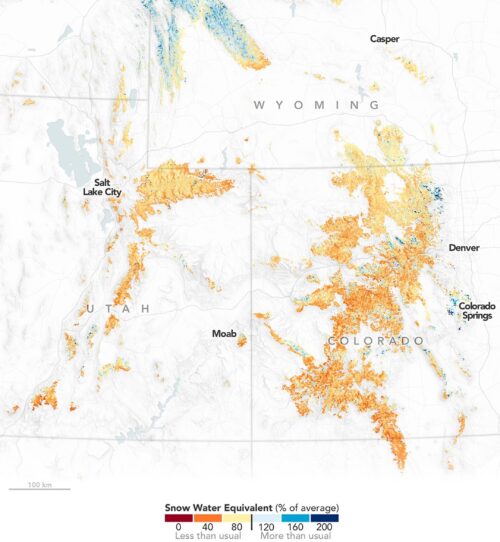
“The through line for the western United States so far in the 2026 water year is simple: there’s very little snow. With few exceptions, the mountains of the U.S. West have seen unusually little snow accumulation since October 2025, constituting a widespread snow drought. The lack of mountain snowpack has resource managers on alert going into the warmer months. Meager meltwater can affect hydropower production, agriculture, aquatic ecosystems, and wildland fire risk. The Upper Colorado Basin was exceptionally dry in spring 2026. This map illustrates the state of its snowpack on March 15, depicting estimates of snow water equivalent as a percentage of the 2001-2025 average. Snow water equivalent (SWE) is a measure of how much water there would be if all the snow in a given area melted at once. SWE peaked for the season around March 15 at below-average values for the time of year in most watersheds. Note that values below 8,000 feet (2,400 meters) in elevation are not shown, as snow at lower elevations often melts quickly and is therefore not representative of overall snowpack health. … ” Read more from NASA.
Experts warn Colorado River system is heading toward ‘water bankruptcy.’ Here’s what that means.
“The Colorado River, lifeline to 40 million people across the Southwest, is sliding deeper into what experts are calling “water bankruptcy.””We have overused the account,” Thomas Rebermark, policy director with the Stockholm International Water Institute, told Channel 13. “We’re constantly overusing more than we actually get from the water system,” he continued. In a United Nations report published earlier this year, researchers define the idea: The concept of water bankruptcy draws attention to the evidence that societies rely on both renewable water flows and long-term natural storage, comparable to drawing on income and savings, and that in many basins and aquifers, sustained withdrawals have exceeded renewable replenishment and safe depletion thresholds. … ” Read more from Channel 13.
Hoover Dam is headed for trouble under new emergency Colorado River plan
“Federal water managers are putting the nation’s largest dam in a precarious position as they try to balance out the Colorado River system in a year of record low snowpack. Toward the bottom of the Bureau of Reclamation’s marquee announcement last week was a paragraph that said lower flows out of Lake Powell could reduce Hoover Dam’s hydroelectric power generation by about 40 percent as soon as this fall. According to projections, Lake Mead could fall nearly 30 feet in the next two years, more than 8 feet past the 2022 record low. The announcement underscores a problem that rural, urban and tribal utilities across Nevada, California and Arizona have been grappling with — aging turbines cannot accommodate low reservoir levels, and a lack of accessible funding means officials may have to look elsewhere to meet their power needs. … ” Read more from the Las Vegas Review Journal.
Dam it? Scottsdale ponders water options in face of Colorado cut
“For a Monday late afternoon, the United Methodist Church of North Scottsdale was fairly crowded, with most pews occupied. Those sitting in rapt attention were advised to pray. “For rain,” state water guru Rudy Fischer said. “And snow.” With massive water cuts expected, the Central Arizona Project board member and North Scottsdale resident had curious advice to his neighbors: Don’t worry about it. “We’ll be fine,” he said. Just the same, he stressed the best thing CAP-reliant Scottsdale can do is to continue cutting its water use. … ” Read more from the East Valley Tribune.
Colorado River water woes threaten Arizona’s AI boom
“Arizona’s water-reliant data centers powering the artificial intelligence surge are expanding rapidly — just as the state faces shrinking supplies amid a climate-driven water crisis. AI projects under construction in the state could spike data center water demand 67% to 5 billion gallons annually in coming years, Bloomberg Intelligence predicts, based on its modeling of industry and government data. Some developers have more than a third of their project pipeline in Arizona, but water availability and community opposition will increasingly affect the tech industry’s competitiveness in the state, said Bloomberg Intelligence analyst Melanie Rua. Many of the facilities are concentrated in the water-stressed Phoenix area. … ” Read more from Bloomberg.
Utah’s drought intensifies again as peak snowpack runoff has ‘come and gone’
“Utah natural resources officials say they met with local leaders and water providers across the state this week to help them prepare for what’s expected during what is normally the state’s driest season, after determining that this year’s peak snowpack runoff has officially passed. Peak runoff typically begins about this time in the season; however, the Utah Division of Water Resources reported Thursday that it has “already come and gone” with statewide stream flow anticipated to be half of the state’s median average. The current statewide snowpack is the same as the median average for late May toward the end of the normal runoff. That means the state’s reservoirs aren’t expected to gain much, if anything, for the rest of this year, which wasn’t much of a surprise after the state’s snowpack peaked at a record low in March. … ” Read more from KSL.
Colorado farmers tighten their belts ahead of summer drought
“Michael Vicenti did quick mental math while driving his pickup past acre after acre at the Ute Mountain Ute Farm and Ranch, trying to tally the impact of a record dry winter. “I believe we’re going to have maybe 900 fields that are fallowed,” he said. The tribe’s Farm and Ranch Enterprise expects to receive less than 14% of its usual water supply this year — and it isn’t alone. After the worst winter on record ended with a record heat wave in March, many farmers and ranchers in Colorado are headed into the summer tightening their belts and searching for any extra drop of water they can find. At the Farm and Ranch, some of the fields were brown; on others, cattle grazed. The green plants on a few fields would soon be dormant, Vicenti said. The crews wouldn’t be able to water them. “We’re just going to have to make the best of it,” Vicenti said. “According to our calculations, we’ll have enough water until June. That’s it.” … ” Read more from the Colorado Sun.

