
Several news sources featured in the Daily Digest may limit the number of articles you can access without a subscription. However, gift articles and open-access links are provided when available. For more open access California water news articles, explore the main page at MavensNotebook.com.
In California water news this weekend …
Trump administration takes emergency step to sustain key Colorado River reservoir
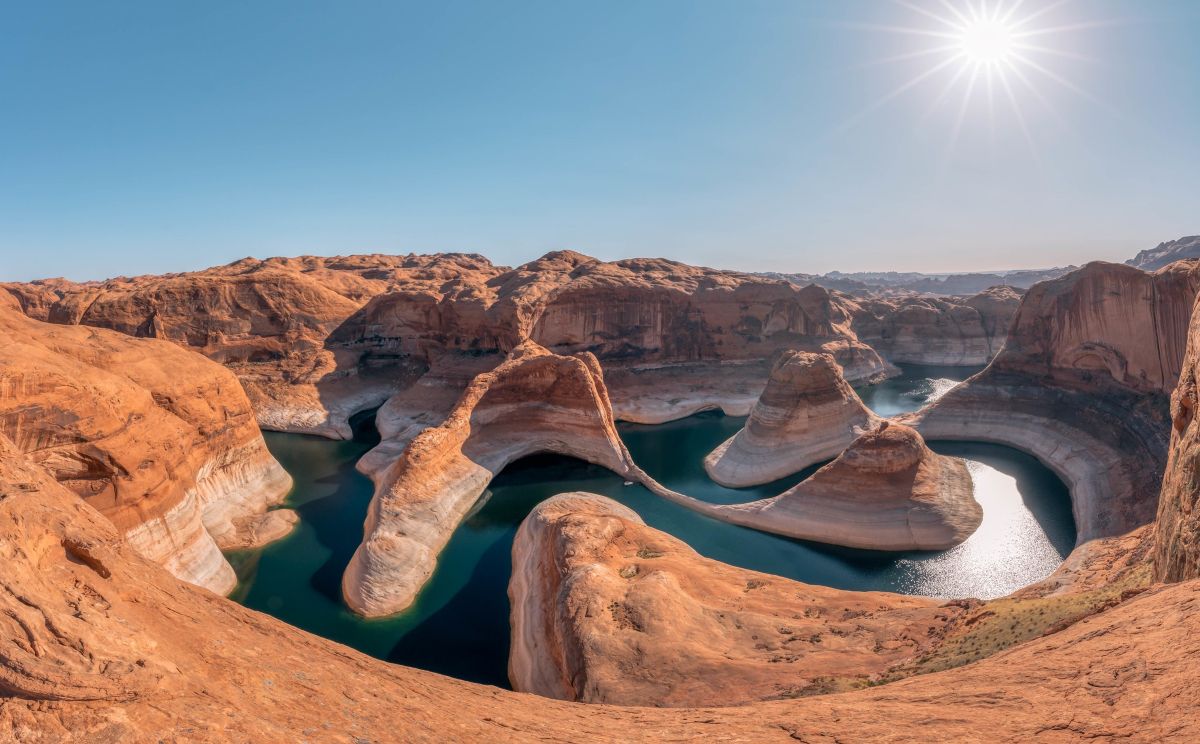
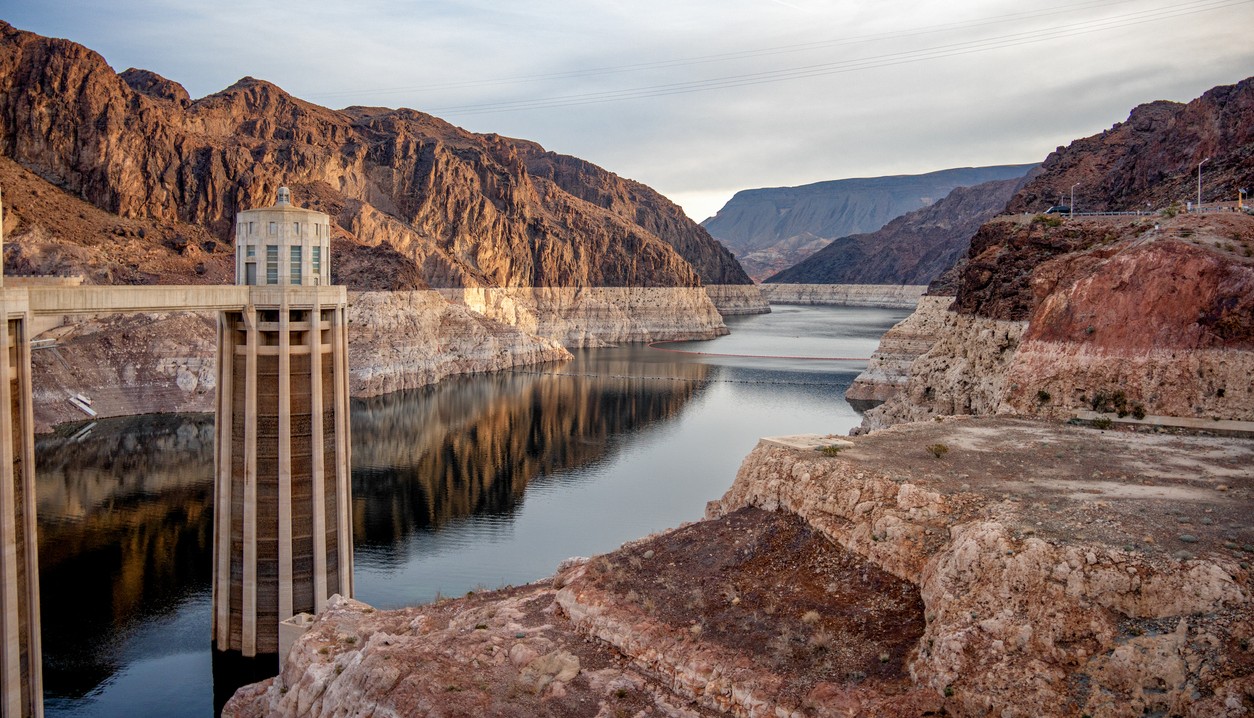
“The water crisis along the Colorado River, a critical source for California and six other states, has gotten so serious that the Trump administration is responding with emergency measures to prevent disaster at the nation’s second largest reservoir. The effort to boost the water level of Lake Powell will bring consequences, cutting water to farms and cities across the Southwest. The actions will begin all the way up on the Wyoming-Utah border, where the federal government will release a significant amount of water from Flaming Gorge Reservoir on the Green River, a major tributary of the Colorado. Hundreds of miles downstream, that will help raise the level of Lake Powell, which straddles the Utah-Arizona border and is three-quarters empty, the U.S. Bureau of Reclamation said Friday. Next, the Trump administration will keep more water in that lake, shrinking the amount flowing downriver into Lake Mead near Las Vegas, which holds water for Southern California, Nevada and Arizona. … ” Read more from the LA Times. | Read via AOL News.
Hydropower at risk as Colorado River outlook grows more dire
“Within charts listing projections of water levels, inflow and outflow, and anticipated releases for 15 reservoirs in the Colorado River Basin, one message was clear: The river is in dire straits and conditions likely won’t get better anytime soon. The warmest winter on record, coupled with an ongoing drought, has produced dismal conditions for the West’s water lifeline, conditions reflected by the Bureau of Reclamation in its April 24-month report. The system’s storage has plunged to about 36% of its capacity, the agency said in a statement. More alarming in the near term is the threat to hydropower production at Glen Canyon Dam. Water levels in Lake Powell would drop too low to operate the turbines by fall, according to the latest projections, unless the federal government steps in. … ” Read more from Arizona Central.
SEE ALSO:
- Feds take emergency action to keep water flowing into Lake Mead, from the Las Vegas Review-Journal
- Feds act to protect Lake Powell from drastic declines, from the Arizona Daily Star
- Interior unveils emergency plans for Colorado River, from E&E News
- Feds to release Flaming Gorge water to support Lake Powell, as new hazards emerge, from KSL
- Feds order Flaming Gorge drop to save imperiled Lake Powell from potential structural failure, from the WyoFile
Storm to bring California more rain, thunder and Sierra Nevada snow
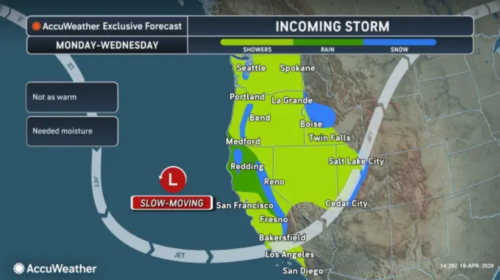 “A new storm will push into California from Monday to Wednesday, bringing rain, mountain snow and locally gusty thunderstorms. The storm will create slick travel conditions and ponding in poorly drained areas across northern and central parts of the state. Even though the storm will pale in comparison to some of the storms from the early spring and winter, storms such as this are valuable, as the historical average rainfall and mountain snow tend to dwindle from April to May, with the dry season looming ahead. The storm is on track to bring a general 0.50 of an inch to 1.50 inches of rain to Northern and Central California. Localized totals of 1.50 to 3.00 inches are possible along the west-facing slopes of the Coast Ranges and the lower west- and southwest-facing slopes of the Siskiyous and the northern and central Sierra Nevada. … ” Read more from AccuWeather.
Tulare County water managers push back on state subsidence data

“Water managers from eight groundwater agencies in Tulare County are pushing back against a state Water Resources Control Board staff’s report that they have not done the work to earn a “good guy” pass from fees and reporting requirements. Managers are also critical of the state’s subsidence methodology that they claim is unfair and flawed. “We aggressively rang their bell on these two issues,” said Lower Tule River and Pixley irrigation districts groundwater sustainability agency (GSA) resources manager Travis Millwee. He and other staff members spent a day meeting with state board staff and Water Board members April 8 on these issues. “But the takeaway is that the ship is in motion.” … ” Read more from SJV Water.
SGMA update on Kings County case
Geoff Vanden Heuvel, Director of Regulatory and Economic Affairs for the Milk Producers Council, writes, “The Kings County Farm Bureau (KCFB) was in court this week on their lawsuit against the State Water Resources Control Board. Here is an update from Dusty Ference, KCFB Executive Director: “I want to share a timely update following yesterday’s court appearance in our case against the State Water Resources Control Board. The hearing was expected to be a procedural step to set our Preliminary Injunction hearing. It did not unfold that way. Even so, we left the courthouse encouraged. While we did not get everything we asked for, the outcome puts us in a stronger position than expected. Here is the situation, clearly and directly. … ” Read more from the Milk Producers Council.
Rosedale-Rio Bravo reduces support for “Delta tunnel;” agrees to buy more land above Lake Isabella
“The Rosedale-Rio Bravo Water Storage District significantly reduced how much it will pay toward the planning phase of the so-called Delta Conveyance Project, which will take Sacramento River water under the ecologically sensitive Sacramento-San Joaquin Delta. The district will now only pay for 1% percent of its contracted water supplies, or 299 acre feet per year. That’s down from 100% participation at the beginning of last year, then 20% participation in fall of 2025. Rosedale-Rio Bravo is the latest in a string of agricultural water districts in Kern County that have reduced their funding commitments, or are considering doing so, for the tunnel. … ” Read more from SJV Water.
This California delicacy has been unavailable for 3 years. Soon restaurants can serve it again
“Local king salmon will be on menus in California for the first time in four years after federal fishery managers voted this week to reopen the state’s coastal waters to salmon fishing. Since 2022, commercial fishing fleets have been barred from catching the celebrated fish in the state because of a frightening plunge in their numbers. A forecasted bump in the population prompted federal regulators to change course this year, albeit cautiously: They approved a limited commercial season, which begins in May. With strict quotas, restricted fishing days and certain ocean waters kept off limits, salmon fishermen worry that the season may leave them with little to show for financially, a concern that is heightened by losses during the three years with no catch. Restaurants and supermarkets, meanwhile, expect limited quantities of salmon — and likely high prices. Still, many in the business are just happy to see the fish return to the docks. … ” Read more from the San Francisco Chronicle.
SEE ALSO: Sport and commercial salmon fishing to open on California ocean waters this year, subject to quotas, from Dan Bacher at the Elk Grove News
The mussel threat is already here
 “You may recall a line of bravado from any number of action movies, “That ain’t a threat, it’s a promise.” Sorry to say this part out loud but, the invasive Limnoperna fortunei, also known as the golden mussel, is no longer a hypothetical threat – it’s here in the San Joaquin Valley. More importantly, these mussels can clog pipes, damage pumps, and threaten the reliability of California’s water delivery systems. First detected in North America in 2024, golden mussels have rapidly spread throughout California’s interconnected water system. Like COVID, the golden mussel comes from a large country in East Asia. The first new world detection was in South America in the 1990s. They showed up in North America in 2024 and are thought to have been introduced by ship ballast. According to the California Department of Fish & Wildlife (CDF&W), golden mussels have been found from Martinez in the East Bay to San Diego. … ” Read more from the Water Blueprint for the San Joaquin Valley.
Tucked between Sacramento and Stockton is California’s wondrous Delta waterway filled with wildlife
“The 50,000-acre Cosumnes River Preserve is treasured by locals, yet few of the road-trippers blasting down California’s busy Interstate 5 corridor know that this mysterious wonderland teeming with wildlife even exists. Located midway between Stockton to the south and Sacramento to the north (around 25 miles from each), the preserve is just a short detour off the freeway, but it feels a world away. The preserve is situated on the eastern edge of the Sacramento-San Joaquin River Delta (aka “The Delta”), a prime agricultural region crisscrossed by numerous interconnected waterways. Here, California farmers grow fruit, vegetables, and rice. It’s also home to one of California’s most wildly underrated wine regions. … ” Read more from Islands (a travel website).
What is low-tech process-based restoration?
“Acronyms such as LTPBR (Low-Tech Process-Based Restoration), PBR (Process-Based Restoration), BDA (Beaver Dam Analog), PALS (Post-Assisted Log Structure), LWD (Large Woody Debris), and ELJ (Engineered Log Jam) are used all over the stream restoration community. Whether referring to the design manual published by Wheaton et al. through Utah State University or just referring to the general philosophy behind improving stream function with beaver dams or large wood structures, LTPBR or PBR are useful (albeit sometimes misused) titles for a broad style of stream restoration. Why is PBR, LT (Low-Tech)? It is not a light Pabst Blue Ribbon, but that does exist. Low-Tech means that the restoration approach does not require heavy machinery and uses hand-built, non-engineered structures made of natural materials with short-term life spans. … ” Continue reading from Trout Unlimited.
Pastoria Solar Project completes ‘trifecta’ of solar, battery and efficient natural gas generation
“Hundreds of energy industry leaders, officials from the California Department of Water Resources, elected officials and labor leaders gathered Thursday at the foot of the Tehachapi Mountains south of Bakersfield to mark the completion of the largest renewable energy project ever contracted by the DWR. And it’s right here in Kern County. Calpine, a business unit of Constellation Energy Corp., announced it has completed the 105-megawatt Pastoria Solar Project, a 500-acre solar field made up of 226,000 solar panels that automatically track with the sun throughout the day. Located not far from the State Water Project’s Edmonston Pumping Plant, the single largest electricity user in California, the project and the energy it will produce represent a major step toward DWR’s goal of carbon neutrality by 2035, project officials said. … ” Read more from the Bakersfield Californian.
A historic marine heat wave is battering California’s coast and impacting the weather
“The largest marine heat wave in the world is lapping at the California coast and shattering ocean temperature records in the northeast Pacific. It will have major implications for California’s weather — supercharging spring storms, setting the stage for an active North American monsoon and Pacific hurricane season, and potentially harming marine plants and animals that are accustomed to the cool, nutrient-rich water typical of the current that runs down the California coast. Summer may feel warmer and muggier than usual in Los Angeles, and perhaps even in San Francisco — a stark contrast to 2025, which was notably cool and foggy along the California coast. More Sierra Nevada thunderstorms are possible by the middle of summer as a result of an enhanced monsoon. … ” Read more from the San Francisco Chronicle.
Firefighters show off amazing new way to extinguish flames — by blasting them with sound, not water
“The sound you can’t hear might just save your house. It sounds like something out of a sci-fi blockbuster, but firefighters in California are firing up a fascinating new way to fight flames — with sound waves. The San Bernardino County Fire Department recently showed off a futuristic system that detects and extinguishes flames without water or chemicals. Instead, it uses powerful — but completely silent — sound vibrations to snuff out the fire itself. … ” Read more from the New York Post.
Wildfires used to ‘go to sleep’ at night. Climate change has them burning overtime
“Burning time for North American wildfires is going into overtime. Flames are lasting later into the night and starting earlier in the morning because human-caused climate change is extending the hotter and drier conditions that feed fires, a new study found. Fires used to die down or even die out at night as temperatures dropped and humidity increased, but that’s happening less often. The number of hours in North America when the weather is favorable for wildfires is 36% higher than 50 years ago, according to a study Friday in Science Advances. Places such as California have 550 more potential burning hours than the mid-1970s. Parts of southwestern New Mexico and central Arizona are seeing as much as 2,000 more hours a year when the weather is prone to burning fires, the highest increase seen in the study, which looked at Canada and the United States. The research looked at times when conditions were ripe for fire, but that didn’t mean fires occurred during all that time. … ” Read more from the Associated Press.
In commentary this weekend …
Thinning our forests will harm, not preserve our snowpack
Rebecca Diehl, a forest and ecosystem advocate in Summit County and the Utah representative for Eco-Integrity Alliance, writes, “This record-breaking low snow year is a painful reminder that our changing climate affects lives and livelihoods. It should be an urgent call to action — but what action? How can we rapidly cool the planet and preserve our snowpack? One answer is simple and costs no money: protect our remaining forests. According to consensus science, temperatures across the planet are rising due to a few primary drivers: burning fossil fuels, deforestation and forest degradation from logging. What you may not realize is that our very own Utah leaders are engaged in large-scale forest degradation across public and private lands including the Uinta-Wasatch-Cache National Forests and open-space recreation areas, stoking our fears to sell it. I was evacuated during the Parleys Canyon fire, and it was indeed scary, but what I see happening in our forests and open space is making me far more afraid. … ” Read more from Deseret News.
Podcasts …
WATER IS A MANY SPLENDOR’ED THING: Sustainable Groundwater
 Do you think your water supply is like a bank account? Andrew Stone, American Ground Water Trust, explains how sustainability of water is very much the same as deposits and withdraws in your home or business bank account? Now, superimpose public expectation for daily water and a high temporal variability in groundwater recharge and suddenly maintaining a healthy water bank account becomes a bit of a challenge. Water is a Many Splendor’ed Thing brings you another water relationship that has a personally significant impact to your life. Produced by Stephen Baker, Bringing People Together to Solve Water Problems, water@operationunite.co 530-205-6388
TERRA VERDE: Free Water While It Lasts
As the Colorado River Basin faces historic drought, shrinking reservoirs, and intensifying climate pressures, new research reveals a striking reality: Some of the largest water users in the West pay little to nothing for their supply. In this episode of Terra Verde, host and producer Hannah Wilton speaks with Isabel Friedman, a senior advocacy associate with the Natural Resources Defense Council, and Noah Garrison, the Environmental Science Practicum Director at of University of California, Los Angeles’s Institute of the Environment and Sustainability about their report, Free Water While It Lasts: An Analysis of Wholesale Water Pricing in the Lower Colorado River Basin States.
ECONEWS: A new mandate for state-owned forests?
How should state-owned demonstration forests be managed? For private timber production or for climate, biodiversity, clean water, and other values? That’s the question being considered by the California legislature with AB 2494 (Rogers). AB 2494 proposes a virtual reserval of priorities. Currently, state law directs that these public lands be managed for “maximum sustained timber production” while “giving consideration” to other resource management. Under AB 2494, managing for other resources takes top billing while still allowing for commercial timber production where that production is used as a tool to achieve the resource objectives. EPIC staff Melodie Meyer and Josefina Barrantes join environmental attorney Alex Leumer to discuss.
THE LANDSCAPE: The dangerous rush to consolidate America’s wildfire response
Producers Lauren Bogard and Lilly Bock-Brownstein are joined by Timothy Ingalsbee of Firefighters United for Safety, Ethics, and Ecology (FUSEE). Timothy explains why the Trump administration’s rushed reorganization of federal firefighting is so risky, what it means for the firefighters already heading into a dangerous season short-staffed, and why he sees the whole effort as less like reform and more like sabotage.
Sunday videos …
Nature: Oak trees in California
Last Sunday, CBS Sunday Morning ended seeing green – new oak leaves sprouting in the woodlands near Petaluma, California. Videographer: Lee McEachern.
How Hoover Dam works
Explore the incredible Hoover Dam in 3D x-ray vision, including its construction and functionality, from overviews down to the fine details.
In regional water news this weekend …
NORTH COAST
$2.9M state grant funds Scott River salmon restoration
“Efforts to restore the East Fork Scott River gained momentum with a $2.9 million grant that will also provide learning opportunities for local students and Tribal youth, according to California Trout. The funding will be used to restore the river at the Wildlands Conservancy’s Beaver Valley Headwaters Preserve, considered a vital refuge for coho salmon in the Klamath River Basin, said CalTrout spokesperson Kara Glenwright in a community announcement. The project will focus on reconnecting floodplains, restoring channel complexity and improving water quality, enhancing spawning and rearing habitats for salmon. The grant is part of nearly $60 million approved by the California Wildlife Conservation Board for 27 projects across 18 counties. … ” Read more from the Siskiyou Daily News.
SIERRA NEVADA
Sierra Nevada Conservancy and Placer County Water Agency host Forests to Fuels Field Tour for policymakers
“On April 9, the Sierra Nevada Conservancy held a Forests to Fuels Field Tour with the Placer County Water Agency to the agency’s pump station in Auburn and the Deer Creek Fuels Reduction project outside Nevada City to show policymakers, legislative staff and stakeholders the importance of biomass utilization facilities to support expanding forest health and wildfire resilience projects throughout the Sierra-Cascade. The tour was hosted by Assemblymember Heather Hadwick, who represents California’s 1st Assembly District. … ” Read more from the Lassen County Times.
SACRAMENTO VALLEY
130,000 chinook salmon released into Lake Oroville
“Nearly 130,000 chinook salmon were released into Lake Oroville this week, wildlife officials announced Friday. The California Department of Fish and Wildlife said it released 129,000 fall-run inland chinook salmon fingerlings into the lake on April 15 to support recreational fishing. The fish are between 4 and 6 inches in length. They were raised at Feather River Fish Hatchery and are sterile, meaning they cannot reproduce. All fish stocked in the lake undergo rigorous testing to ensure they’re disease-free. That’s because the lake supplies water to the hatchery. The introduction of harmful diseases, such as infectious hematopoietic necrosis, can cause significant fish loss, the California Department of Fish and Wildlife said. … ” Read more from Fox 40.
Inflation drives up costs for major Sacramento area public works projects
“From building bridges to water and power plants, several public works projects in the Sacramento region are being impacted by rising costs. UC Davis economics professor Derek Stimel says large-scale projects face much higher risks from inflation. “You have the war with Iran and all the uncertainty and all the impacts on oil prices and transportation costs because so much of this material that is needed for these big projects is imported,” Stimel said. The pricetag for building a new I Street bridge in Sacramento was estimated to be $300 million last year, but construction bids have now come back and the new cost is between $98 million and $217 million more. “The general inflation and the economy really pushed up labor costs in construction,” Stimel said. … ” Read more from CBS Sacramento.
NAPA/SONOMA
Bay area locals are helping to save the coast from purple sea urchins
“At first glance, it hardly looks like the beginning of a sea-urchin foraging expedition: a circle of more than 40 people on the grass pretending to be kelp, feet rooted to the ocean floor, swaying from the knees up in the current, arms elastic like stalks, heads bobbing. It could be a flash mob reviving the ’60s dance sensation “The Swim.” “Wave your kelpy arms all around as your back warms up and your arms warm up,” says teacher Ryn Sullivan, who, along with colleague Ricardo Romero Gianoli, leads curious landlubbers into the ocean for Fork in the Path, a Berkeley-based company that curates wild-food foraging adventures throughout the Bay Area. … They’ve come from miles around—some as far as Connecticut and Los Angeles, others as close as Occidental and Sebastopol—a ragtag band of foragers all in search of the notorious purple sea urchin. Martin Wobig drove over an hour from Santa Rosa to learn to harvest a creature he’s never actually tasted, although he’s seen uni on the menu many times at sushi restaurants. “I’m curious to see what they taste like. I mean, they’re gonads, so that’s the initial thought,” he says, grimacing slightly. “But they’re supposed to be a delicacy.” … ” Read more from Sonoma Magazine.
How much does regulatory compliance cost Napa wine grape growers?
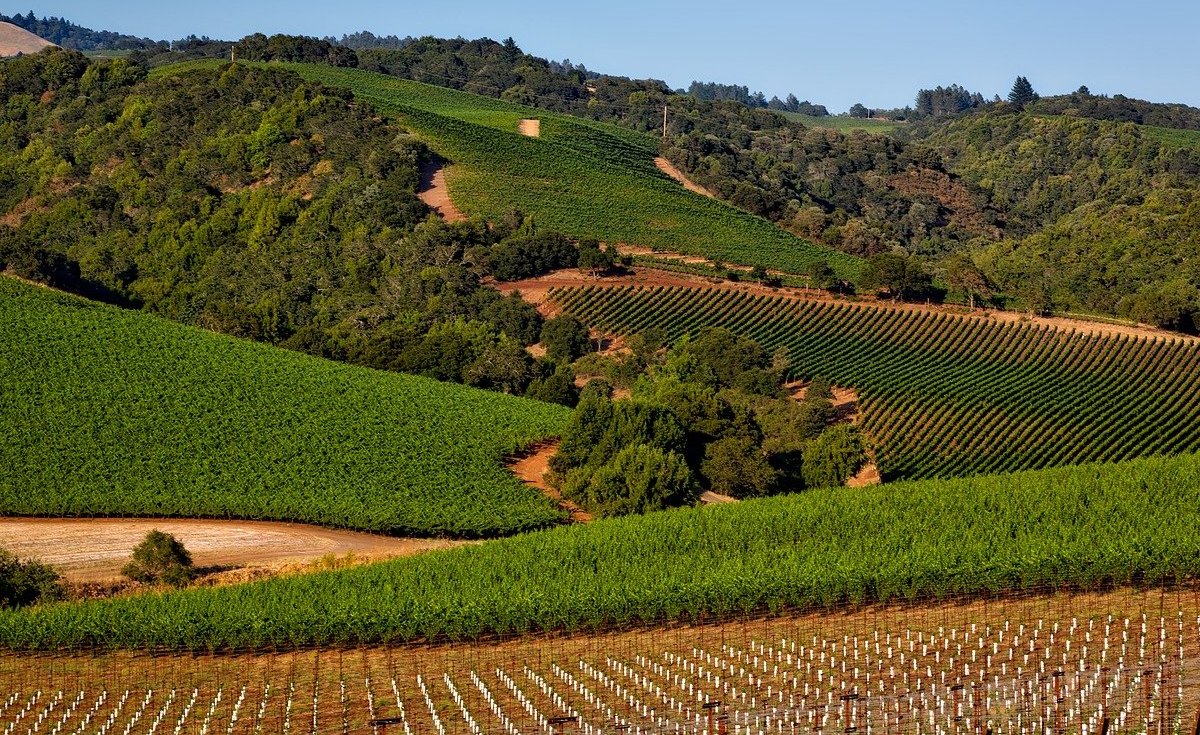 “A new study quantifying the regulatory burden on Napa County wine grape growers is intensifying a debate over the future of agriculture in one of the world’s most renowned wine regions. And it comes as local industry groups press county leaders to ease land-use and permitting constraints amid what many describe as the most challenging business environment in decades. The report, released late last month by Cal Poly San Luis Obispo, provides a detailed accounting of the costs associated with compliance across federal, state and local regulations. At the same time, growers are facing reduced grape prices and fewer long-term contracts with wineries amid weak consumer demand and higher inventories. The study estimates that regulatory compliance costs can exceed $1,700 per acre annually for large vineyard operations and more than $1,100 per acre for smaller ones. For the anonymous 1,000-acre vineyard operation used as one test case, that translates to roughly $1.7 million per year, while the other test case, a 200-acre grower, incurred about $226,000. … ” Read more from the Santa Rosa Press Democrat.
BAY AREA
This coastal Bay Area hiking spot has exploded in popularity. Now it needs new rules
“One of the Bay Area’s favorite hiking destinations is about to get new rules and restrictions. Wedged between Devils Slide and Linda Mar Beach, the magnificent Pedro Point Headlands in Pacifica offer a quick escape into nature, with rugged trails that lead hikers to the high bluffs overlooking the ocean and town’s main valley. Although giant stands of eucalyptus hide the place from view of passersby on Highway 1 and the main trailhead is tucked behind a hardware store, the headlands have exploded in popularity in recent years. On a sunny Saturday or Sunday, the site will often see upward of 500 people — mountain bikers, hikers, dog walkers and picnickers — according to Sam Casillas, president of the Pacifica Land Trust, which co-manages the 250-acre preserve. … ” Read more from the San Francisco Chronicle.
CENTRAL COAST
‘Everything’s getting pinched’: UCSB and Isla Vista grapple with constricting coastline
“Do you feel squeezed?” That’s what the sign asks. More specifically — the ocean is warming and expanding, driving stronger storms and higher sea levels, now eating into the Santa Barbara coastline. Is that process tightening the space between land and water — making you feel compressed? At the University of California, Santa Barbara campus, that question is posted directly onto a fence now set back from the bluff in front of Anacapa Residence Hall — a fence that, until recently, sat closer to the edge. The relocation is part of the university’s Sea Level Rise Adaptation Strategy and its public outreach effort — a way of making visible what is otherwise incremental and easy to ignore: the coastline is moving. … “If you look at how much space is available along that stretch [of Lagoon Road], it’s variable,” said Charles Lester, director of UCSB’s Ocean and Coastal Policy Center. “But if you come toward Anacapa, it starts to get narrow … everything’s getting pinched.” … ” Read more from the Santa Barbara Independent.
SAN JOAQUIN VALLEY
Lindsay could sell water, sewer system
“Voters in Lindsay could decide if the city’s water and sewer systems should be sold in the November 3 midterm election. The Lindsay City Council by a 5-0 vote at its meeting on Tuesday approved accepting applications from those interested in purchasing the city’s water and sewer systems. The city began accepting applications on Wednesday. The council authorized the “release of Statement of Qualifications (SOQ) to identify qualified firms interested in acquiring, operating, and improving the City of Lindsay’s water and wastewater systems.” The deadline for those interested to apply is May 5. The top applicants will be notified by May 8 and negotiations and site visit with possible purchasers would begin on May 18. … ” Read more from the Porterville Recorder.
SOUTHERN CALIFORNIA
Whittier Narrows Dam safety project could close several well-known Pico Rivera facilities for years
“A major safety modification project at the Whittier Narrows Dam could close or disrupt several well-known community facilities in Pico Rivera for years, as the Army Corps of Engineers works to address concerns about the aging structure. The Whittier Narrows Dam is part of a flood control system that protects more than 1 million people across the Los Angeles area. Built in 1957, the dam is now considered a safety concern and in need of critical repairs, prompting a large-scale project that will affect nearby parks, sports facilities and traffic patterns. One of the most visible impacts will be at Streamland Park, home of the Pico Boys Baseball League. … ” Read more from ABC 7.
IMPERIAL/COACHELLA VALLEYS
Southwest High School community health worker students explore Salton Sea environmental restoration
“Career Technical Education Community Health Worker students from Southwest High School recently participated in an immersive educational field experience at the Salton Sea Management Area Restoration Site in collaboration with the Imperial County Air Pollution Control District. The trip aligned with the school’s Project ACE (Air Community Education) initiative, giving students hands-on learning opportunities focused on environmental health and the impacts of air quality on community well-being. During the visit, guided by experts from the Salton Sea Management Area Restoration Program, students explored active restoration efforts designed to reduce dust emissions, improve air quality, and restore natural habitats around the Salton Sea, an area critically linked to environmental and public health in Imperial County. Staff from the Imperial County Air Pollution Control District facilitated student discussions on particulate matter, community monitoring, and long-term strategies to protect residents from environmental hazards. … ” Read more from the Imperial Valley Press.
Along the Colorado River …
Western states need water. San Diego has extra. Will they make a deal?
“As most Western communities expect to grapple with water shortages this summer and fall, one is looking to share its unlikely surplus. San Diego County in California spent nearly $1 billion on a desalination plant after a 1990s drought left it with scarce supply. Now, with the seawater-to-tap water plant running at just one-third of capacity, its water utility is shopping around deals to sell its water across the West. Because of drought and minimal snowmelt, little water is expected to flow into Colorado River basin reservoirs this year, creating a shortage that could lead states such as Arizona, Nevada and Utah to try to buy excess water from San Diego. “We’ve all collectively taken a step back and have realized we can’t continue to put a fence around ourselves,” said Dan Denham, general manager of the San Diego County Water Authority. “We can’t go at this alone any longer.” … ” Read more from the New York Times.
New AI tool detects drought conditions at over 80% of Arizona’s rivers and streams
“Over 80% of Arizona’s rivers and streams are experiencing drought conditions, and there’s no relief in sight, according to a new AI forecasting tool. The U.S. Geological Survey’s River DroughtCast shows the current streamflow drought status across the U.S. and forecasts conditions in weekly intervals for the next three months. “Measuring streamflow is really useful because it tells us how much water is available for all sorts of different uses,” USGS research hydrologist John Hammond told KTAR News 92.3 FM. … ” Read more from KTAR.
Risks to Grand Canyon’s endangered fish grow as Colorado River declines, invasive fish barriers delayed
“New projections released today by the Bureau of Reclamation show sharply declining Colorado River flows and plummeting reservoir levels at Lake Powell, conditions that increase threats from invasive species to endangered humpback chub populations in the Grand Canyon. Record-breaking heat in March wiped out the basin’s snowpack, causing levels on Lake Powell to fall below 3,530 feet, the threshold at which invasive smallmouth bass are far more likely to pass through Glen Canyon Dam. This threatens decades of humpback chub recovery in the Grand Canyon. Bass invasions have harmed and eliminated humpback chub populations throughout the Upper Colorado River Basin. “The Bureau of Reclamation is risking an unstoppable biological invasion that wipes out the world’s last source population of humpback chub in the Grand Canyon,” said Taylor McKinnon, Southwest director at the Center for Biological Diversity. “The agency must take urgent action to block invasive fish from passing through the dam before it’s too late.” … ” Read more from the Center for the Biological Diversity.
River District proposes actions to address drought
“Western Slope water managers are scrambling to soften the blow from the effects of one of the worst snow-drought years on record. The Glenwood Springs-based Colorado River Water Conservation District staff is proposing a series of drought-mitigation actions to reduce impacts to water users within its 15-county region. According to a staff memo, the River District has several pools of water in Western Slope reservoirs – Wolford and Ruedi – that may help mitigate some of the worst consequences of the drought for its constituents. Staff is asking the board to impose rules around how that limited supply can be used. … ” Read more from Aspen Journalism.
Cloud seeding couldn’t save Colorado from a historically bad snowpack, but the dry winter sparked more interest in the technology
“Colorado’s weather modification program is seeing an increased interest in cloud seeding technology after the record-low snowpack this past winter. In the past couple of weeks, Weather Modification Program Manager Andrew Rickert said he’s received inquiries from two major ski resorts hoping to learn more about cloud seeding, which can increase the amount of snowfall a storm drops. “After a year like this, it makes sense that these ski resorts are looking for anything they can do to bolster snowpack,” Rickert said. “They’re very interested in seeing what else they can do to get more precipitation.” … ” Read more from the Post Independent.
A Colorado reservoir dried up. Now, local wildlife experts are turning it into a lush habitat
“It was a big, beautiful body of water. Now, the reservoir has dried up, and it’s an empty bed of dirt. Soon, it’ll be covered in grass and vegetation. But the hope is that someday, it will return. That’s Two Buttes Reservoir, an area under the protection of Colorado Parks and Wildlife (CPW), which is moving through a fascinating natural cycle. The reservoir is loved by animals and humans alike, serving as a critical habitat area for wildlife and a recreational space for fishing, camping and hunting. It relies on rain to maintain and fill its water levels. But because of extended drought conditions, in late January, it became completely empty. … ” Read more from AOL News.
In national water news this weekend …
A more troubling picture of sea level rise is coming into view
“Sea levels are much higher than we thought. Real-world oceans are making a mockery of flood-risk forecasts based on crude global modeling. And to make matters worse, coastal lands almost everywhere are subsiding faster than anyone realized — often many times faster than the seas are rising. These findings come from two major new studies that are reshaping our understanding of the threats posed by rising tides and sinking land and underlining the imminent risk of inundation facing tens of millions of people in some of the world’s largest megacities, say researchers not involved in the studies. “The impacts of sea level rise under climate change have been systematically underestimated,” concluded Matt Palmer, a specialist on sea level rise at the U.K. Met Office’s Hadley Centre for Climate Science. “We could see devastating impacts much earlier than predicted — particularly in the Global South.” … ” Read more from Grist.

