
Several news sources featured in the Daily Digest may limit the number of articles you can access without a subscription. However, gift articles and open-access links are provided when available. For more open access California water news articles, explore the main page at MavensNotebook.com.
On the calendar today …
- MEETING: Central Valley Regional Water Board (Clovis) beginning at 9am. Agenda items include an informational item on a pilot project for management and recycling of waste streams from nitrate drinking water treatment systems, an NPDES permit for Aerojet Rocketdyne groundwater extraction facilities, and City of Firebaugh WDR. Click here for the full agenda.
- WEBINAR: Secretary Speaker Series: Live from Los Angeles: Mediterranean Partnership Driving Global Climate Action beginning at 12pm. Climate impacts are intensifying across Mediterranean regions. Extreme heat, drought, and wildfire are threatening communities and ecosystems. As national action slows, regional governments are stepping up to deliver solutions. Join Secretary Wade Crowfoot and global leaders as they convene in Los Angeles for the Mediterranean Climate Action Partnership Summit. Hear how regions are cooling their cities, protecting against wildfire, managing precious water supplies, and how cross-border collaboration is accelerating action to protect people and nature. Click here to register.
- WEBINAR: Inundation Mapping for California State Water Project Dams and Critical Appurtenant Structures from 12pm to 1pm. Speaker: Thomas Molls, PE, PhD. Click here to register.
A special note …
Today marks 19 years since I launched my very first water news website.
So a heartfelt thank you to all of you who stop by every day to get their water news – I wouldn’t do it without you.
And a big thank you to all of my donors and sponsors, for I couldn’t do it without you!
In California water news today …
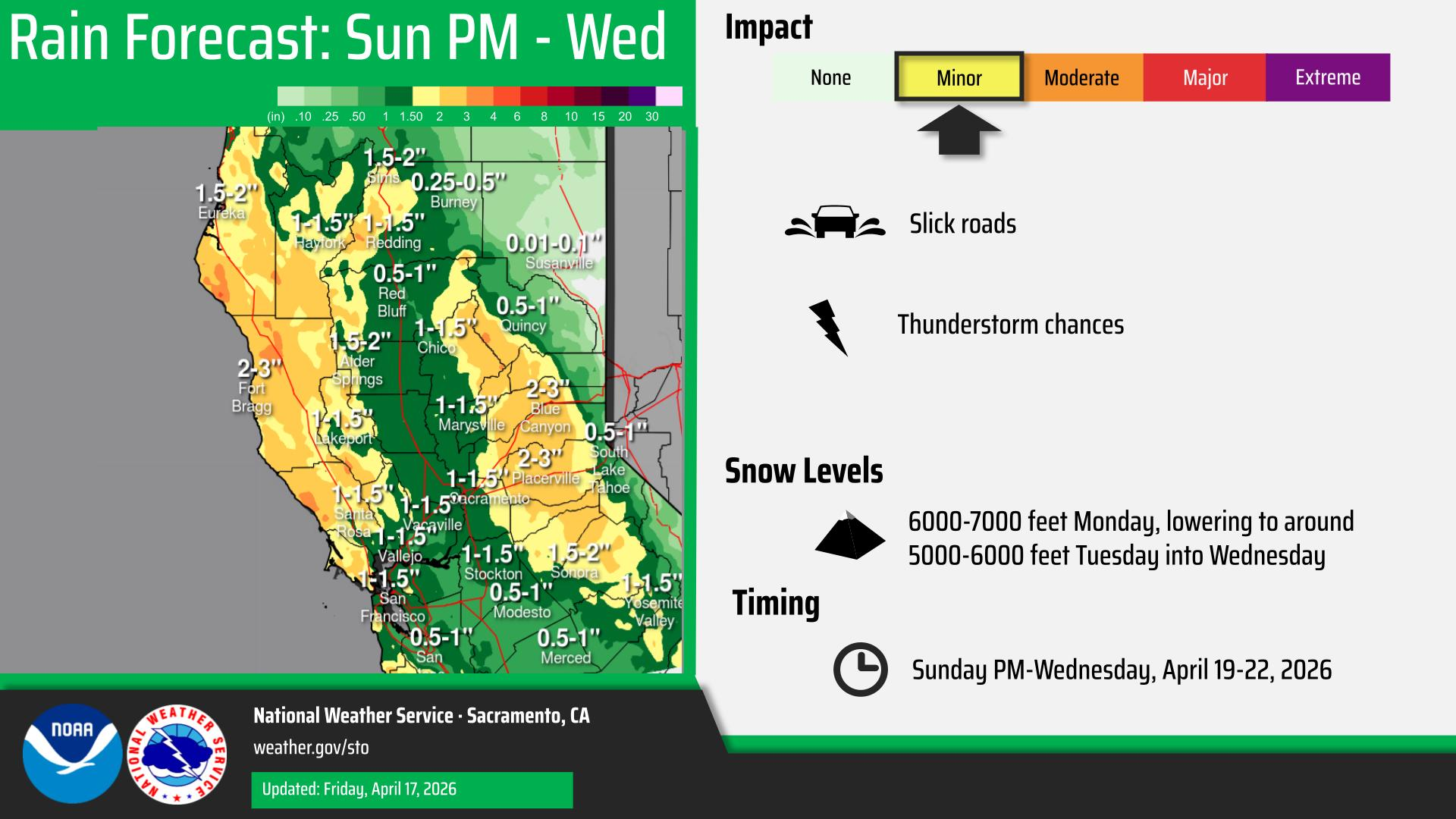
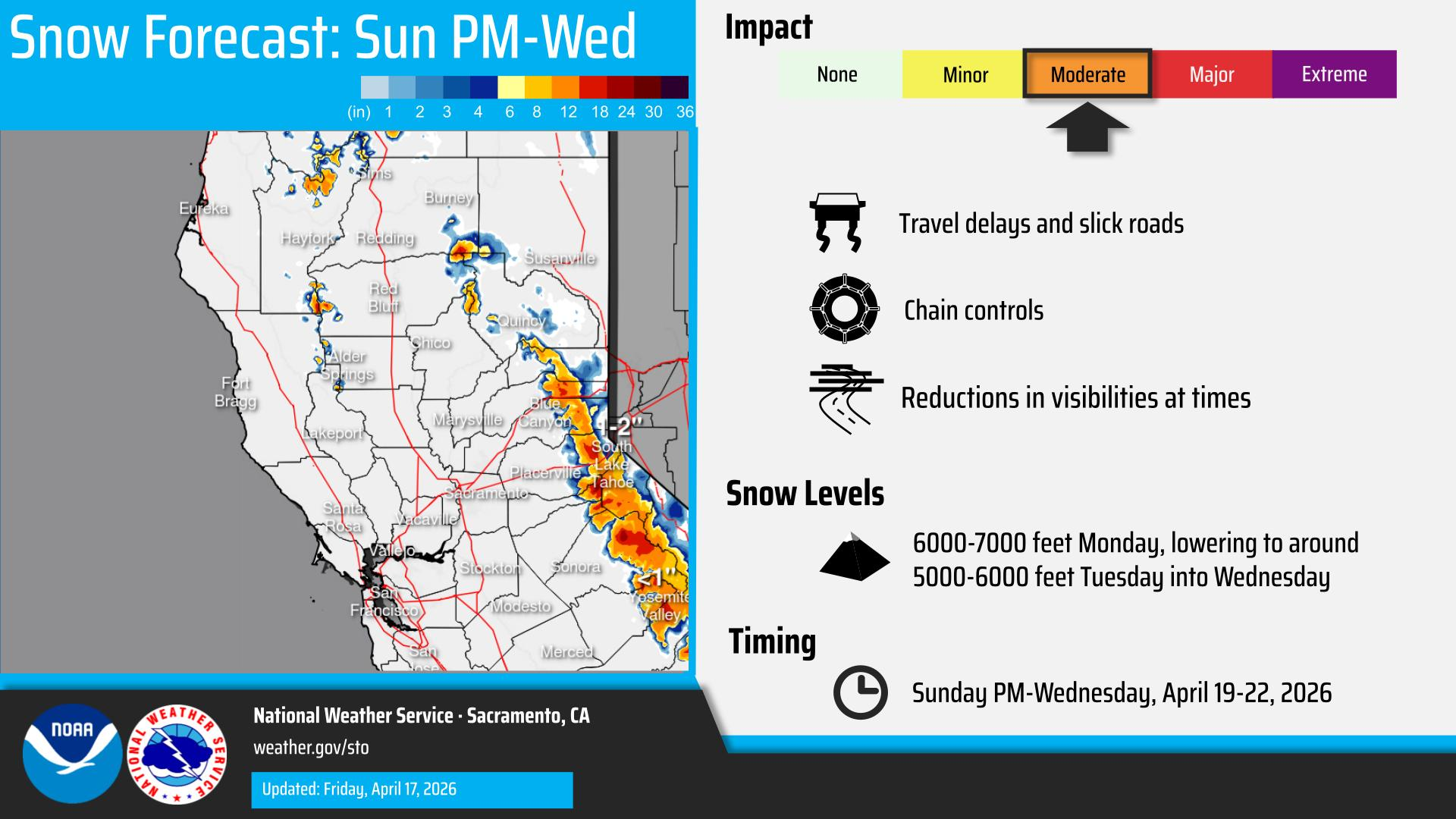
Rain and snow are returning to California. Here are the details
“The dry winds whipping the Bay Area have kicked off a warming trend that will bring above-normal high temperatures through Saturday — but the next chance of wet weather isn’t far away. By Sunday, clouds and winds are predicted to increase as a Pacific storm nudges toward Northern California. Precipitation chances will enter the forecast Monday, with rain and mountain snow probably sticking around through at least Wednesday. The system will have many similarities to the weekend storm that generated unusually large April rain and snow totals, but also some differences. … ” Read more from the San Francisco Chronicle.
‘Abnormally dry’ conditions continue to spread across California
“Abnormally dry conditions continue to spread across California, according to the latest update from the U.S. Drought Monitor. The new map, released Thursday, shows counties across the state are now classified as “abnormally dry,” the first level on the drought scale. The update comes as California’s snowpack has plunged to a record low, sitting at just 10% to 20% of normal. Cal Fire Chief Joe Tyler explained that when the snowpack is low, moisture disappears faster and vegetation dries out weeks earlier than normal. And the drier the grass and brush, the easier it ignites and the faster fire moves through it. … ” Read more from KTLA.
California snowpack hits ‘new record low’ says Cal Fire chief
“Many people closed the books on California’s winter snowpack saga on April 1, when officials measured abysmal snowpack levels on the critical date which usually marks the point where all accumulated snow begins to melt off. It was no surprise when California’s Department of Water Resources (DWR) reported record lows, revealing that the statewide snowpack sat at just 18 percent of its April 1 average. It almost seemed cruel when a storm brought snow to the Sierra Nevada and the few ski resorts in the state still open. Palisades Tahoe, for example, enjoyed more than three feet of powder just before the midway point of the month and looked like it was in the dead of winter. “Mother Nature hit the reset button yesterday,” said resort PR on Monday. Even if that’s the case at high elevation, it turns out the statewide picture has actually gotten worse. … ” Read more from The Inertia.
Storms boost Lake Oroville’s water level
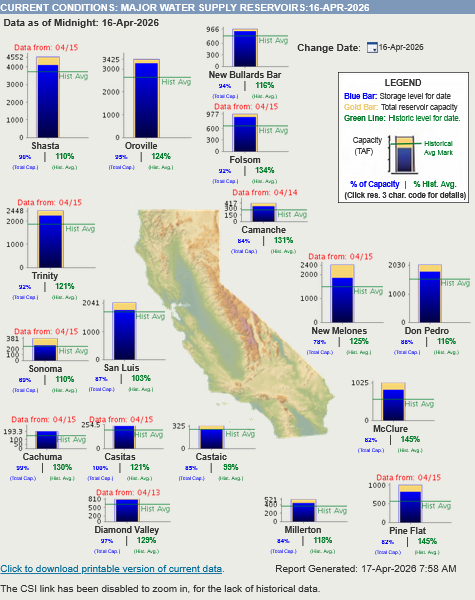 “After a series of dry months and a meager snow pack, recent storm systems provided some much-needed water elevation to Lake Oroville. On Tuesday, it was documented that the estimated inflows into Lake Oroville were 11,500 cubic feet per second. Raquel Borrayo, a spokesperson for the California Department of Water Resources, said outflows from the spillway were measured at roughly 5,300 cfs plus an additional 5,000 cfs into Feather River via the Thermalito Afterbay Outlet and the Oroville river channel. … ” Read more from the Chico Enterprise-Record.
How bad are California drought conditions after storms? See lake, snow levels
“Recent thunderstorms swept through California, bringing heavy rain and mountain snow. In January, the U.S. Drought Monitor showed 0% of California was experiencing “abnormally dry” conditions — or worse — for the first time in 25 years. However, a stretch of record heat in March quickly changed that, melting much of the state’s snowpack. “Changes this week included improvements in moderate drought in northeastern California,” the U.S. Drought Monitor said in its national drought summary on Thursday, April 16. How are snowpack and water levels across California? Which areas are experiencing the worst drought conditions? … ” Read more from the Sacramento Bee.
Striking before-and-after images show extent of California’s snow drought
“As California experiences its second-worst snow drought in 50 years, new images show a stark comparison with last year’s snow levels. This year, the Sierra snowpack peaked on Feb. 25. It was only 73% of average, then rapidly dwindled from there. Then, summerlike heat in March broke monthly records in many areas of the Western United States. Daniel Swain, a climate scientist with UC Agriculture and Natural Resources, described it as one of the most “extreme heat events ever observed in the American Southwest.” Though a spring storm dropped up to 3.5 feet of snow in California’s Sierra Nevada mountains last week, extending ski season, snow levels remain extremely low. … ” Read more from the LA Times.
Warmer winters and snow drought may threaten western U.S. water by speeding flows, study finds
“As future shifts in climate lead to more rain and less snow in the western United States, new research finds that water will move faster through a landscape, likely leading to negative impacts on summer water levels and water quality. The study is especially relevant at this moment because the western United States experienced similar snow drought conditions this past winter, with generally typical precipitation amounts, but less snow because of warmer temperatures. “This winter has been exactly like what our paper had said the future will be like,” said Zach Butler, a postdoctoral scholar at Oregon State University and lead study author, who has a part-time job forecasting winter weather in Oregon for the site OpenSnow. The research can help inform future water management decisions. While the timing of water release relative to snowpack has long informed water planning, understanding how long it takes for water to travel through a landscape is not well understood and is important, especially at a time of increasing weather disturbances and extreme conditions. … ” Read more from Oregon State University.
Court to consider Kings County groundwater pumping case in June
“Kings County farmers will have to wait several more weeks to find out if they owe millions of dollars in back fees. The Kings County Superior Court set a hearing date for June 3 to consider a request from the Kings County Farm Bureau (KCFB) to issue a preliminary injunction on the state collecting groundwater pumping fees. The backstory: Two years ago, the KCFB filed a lawsuit against the state after the Water Resources Control Board designated the Tulare Lake Subbasin as probationary. That designation came with a $20 per acre-foot extraction fee for groundwater. … ” Read more from the San Joaquin Valley Sun.
SEE ALSO: State blocked from collecting fees from Tulare Lake subbasin for now, from the Porterville Recorder
Change detection made easier with new LIDAR survey
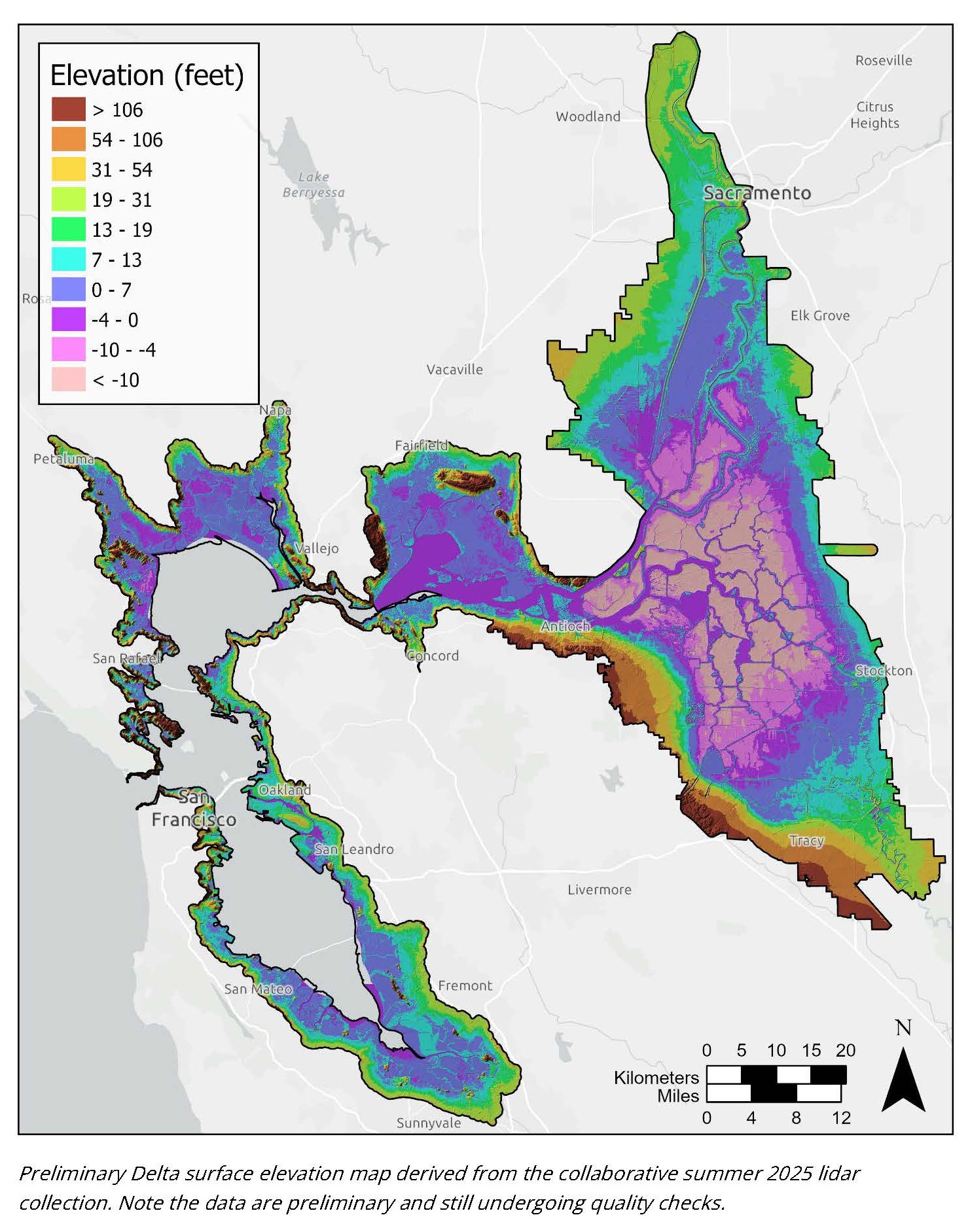 “Small airplanes flew 368 trips back and forth around the edges of San Francisco Bay and the Delta last summer to capture what scientist Lisamarie Windham-Myers calls “the first seamless elevation map of the Estuary.” On their flights, moving back and forth in linear swaths like a lawnmower, the planes sent laser beams down to the surface, which then bounced back to the plane. Each bounce yielded a measurement of surface elevation from a remote-sensing technology called lidar (short for light detection and ranging). The result, to be released this July, will be a high-resolution map of the entire estuary’s 1.25 million acres of wetlands, shores, islands, and levees. “For years, every time anyone needed elevation data, they went out and collected it on their own, using their own equipment, their own standards, their own patch of geography,” says Megan Nguyen, who works with Windham-Myers at the Delta Stewardship Council. While that’s fine for work on single projects, the data sets are all different and form, at best, a patchwork quilt of information. … ” Read more from Knee Deep Times.
HOA Homefront: Nonfunctional turf will require irrigation with reclaimed water
“In 2029, a new law will ban watering of nonfunctional turf with potable water. What is nonfunctional turf, and must your HOA prepare to remove it? In 2023 the Legislature passed Assembly Bill 1572 and created Water Code Section 10608.14, applicable to properties including common-interest developments. This new statute requires various property owners, including HOAs, to either remove nonfunctional turf or begin irrigating it with reclaimed water. HOAs must comply before 2029. Since most HOAs do not have reclaimed water readily available to them without great expense, many HOAs are erroneously assuming they must remove grass areas not regularly used by residents. However, a careful review of the statutes and connected regulations reveals that probably very few if any California common-interest developments will be affected by this law. … ” Read more from the OC Register.
Tribes and environmental groups criticize Legislative Analyst’s Office report on updated Bay-Delta Plan
“A new report from the California Legislative Analyst’s Office is drawing strong criticism from a broad coalition of environmental organizations and Tribes, arguing that the report on the State Water Resources Control Board’s proposed update to the water quality control plan for the San Francisco Bay-Sacramento-San Joaquin Delta (“Bay-Delta Plan”) falls short of providing lawmakers with a fair and complete assessment of options, according to a press release from Restore the Delta: “Coalition members argue the report assumes approval of the voluntary agreements (VAs) and fails to serve as a balanced, neutral evaluation of the regulatory alternative that is grounded in enforceable water quality standard. … ” Read more from Dan Bacher at the Daily Kos.
The ocean off California keeps breaking heat records

“An extreme marine heat wave is simmering the Pacific Ocean off the coast of California, and experts are warning that it could affect coastal weather and ecosystems for months. The ocean heat wave started forming at the end of last year but has worsened in recent weeks, according to readings from the Scripps Pier in La Jolla, which has broken more than 25 daily temperature records this year. The surface water temperature on Wednesday was 68.5 degrees — 7.7 degrees above average for the date. The sea bottom was 67.6 degrees, the hottest April 15 in about 100 years of records. The heat wave is deep, persistent and widespread, spanning from roughly San Francisco to the Mexican border. Those are “pretty significant indicators that this has both staying power and will have consequences for weeks or months or even seasons to come for Southern California,” said Daniel Swain, a climate scientist with the University of California’s Agriculture and Natural Resources. … ” Read more from the LA Times. | Read via AOL News.
California marine protected areas have revitalized patches of ocean. Will they expand or shrink?
“More than a decade after California began setting aside patches of ocean for conservation, change could be coming to its marine protected areas. The state is considering a variety of changes to the network — a few proposals shrink those areas or remove certain protections, while most propose expanding existing protected areas or adding new ones. The levels of protection can range from a total ban on commercial fishing and certain recreational activities, to highly limited allowances. The California Department of Fish and Wildlife is in the process of reviewing dozens of proposals from tribes, environmental groups, the fishing industry and other stakeholders. … ” Read more from the LAist.
Forest Service plan to close research stations stokes fear as wildfire season approaches
“The U.S. Forest Service’s plan to close scores of research stations could threaten the nation’s wildfire readiness, many foresters fear, and erode decades of work to understand timber production, soil health, pests and diseases, watersheds and wildlife. Late last month, the Forest Service announced plans to close 57 of its 77 research stations, located across 31 states, merging them into a single organization in Fort Collins, Colorado. The agency described the move as a way to consolidate, not cut, the agency’s scientific work, and “unify research priorities.” It’s unclear how many scientists will be affected by the transition, but it comes as part of a larger agency reorganization that is expected to move roughly 5,000 employees to new outposts. Forest Service leaders have framed the closures as a way to reduce the agency’s real estate footprint, citing a facilities budget Congress has shrunk, as opposed to curtailing its scientific work. … ” Read more from Stateline.
In commentary today …
An overlooked reason for rising energy and water bills in California
Danielle Blacet-Hyden, executive director of the California Municipal Utilities Association, writes, “There are several reasons why your water and electricity bills keep rising. Many increases can be blamed on market forces beyond anyone’s control, but what’s being left out of the affordability discussion is how well-intended but unfunded policy decisions — three in particular — risk making cost of living expenses even worse, especially for the state’s not-for-profit utility customers. One example is California’s Cap-and-Invest program (formerly Cap and Trade), which enables the trading of carbon credits — called “allowances” — to reduce greenhouse gas emissions. These allowances help not-for-profit utilities keep rates lower, help fund investments in clean energy and support low-income assistance programs. … ” Read more from the Sacramento Bee.
C-WIN: Safe & sustainable water consumption: Without enforcement, regulations on water exports are worthless
“Two terms are often used by legal and policy experts when discussing water consumption: safe yield[1] and sustainable yield.[2] They are sometimes used interchangeably, and they describe the same general concept: the amount of water that can be diverted from surface or groundwater without significant environmental impacts or inequitable social and economic consequences. They arose, however, from different processes. Safe yield has its roots in property rights and the court proceedings that were employed to determine and assign them; it can apply to both surface and groundwater. It’s a legally intensive and orderly approach to water distribution, but it’s only equitable if small or minimally funded parties receive fair treatment during court proceedings to determine allocations for every water user. … ” Read more from C-WIN.
In regional water news and commentary today …
NORTH COAST
Sen. Mike McGuire, CalFire officials warn ‘super’ El Niño could fuel unpredictable fire season
“As wildfire season quickly approaches, state officials are bracing for a “Super El Niño” that could bring extreme and unpredictable weather to Northern California, potentially increasing fire risk. Combined with ongoing drought conditions and poor snowpack in the northern Sierras, fire officials worry that we could be in for another challenging fire season. At last night’s annual town hall on wildfire preparedness and prevention, State Sen. Mike McGuire said the incoming El Niño is predicted to be “the strongest that we’ve seen in 140 years,” according to new data from the European Centre for Medium-Range Weather Forecasts (ECMWF) and National Weather Service (NWS). “From what we’ve seen in the past, [El Niño] brings in unsettled tropical moisture that brings lightning into the region, and that could spell trouble,” McGuire said. “You need to be prepared.” … ” Read more from the Lost Coast Outpost.
SEE ALSO: McGuire hosts wildfire preparedness town hall ahead of ‘worst El Niño in 140 years’ , from the Eureka Times-Standard
Less rain, more storage: Water year update for Lake Mendocino
“Although the Ukiah Valley has received a lot less rain so far this year than in 2025, new storage procedures at Lake Mendocino have allowed a lot more of that water to remain in the reservoir than ever before, regional water officials reported this week. “Without (Forecast Informed Reservoir Operations) and that ability to retain more water, the reservoir would be below 68,000 acre-feet (instead of at 84,000 acre-feet),” said Donald Seymour, Deputy Chief Engineer for Sonoma Water, speaking Wednesday during a virtual update on the status of both Lake Mendocino and Lake Sonoma. In terms of rainfall, the month of March “was completely dry, so if we were held to the old rules, we’d be 16,000 acre-feet lower in the reservoir now,” continued Seymour, referring to the official implementation last October of the FIRO weather-forecasting model into the official manual the U.S. Army Corps of Engineers uses to determine how much water to release from Lake Mendocino. … ” Read moire from the Ukiah Daily Journal.
SIERRA NEVADA
South Tahoe PUD updates construction standards to protect drinking water quality
“The South Tahoe Public Utility District (STPUD) announces an important update to its water system construction standards: stop and waste valves (“stop and drains”) on new construction projects can no longer be buried. This change is being implemented to reduce the risk of cross-contamination and to further protect the safety of the community’s drinking water. STPUD is responsible for ensuring that the public drinking water system remains safe from contamination and pollution. A key component of this responsibility is the District’s Cross-Connection Control and Backflow Prevention Program, which identifies potential hazards and ensures that customers have proper backflow protection in place. This program aligns with California regulations and the State Water Resources Control Board’s Cross-Connection Control Policy Handbook. It includes hazard assessments, approved backflow devices, annual testing, and ongoing system oversight. … ” Read more from the Tahoe Daily Tribune.
Stanislaus and Eldorado forests move ahead with Mokelumne Amador Calaveras Forest Health Projects
“The U.S. Forest Service announces the publication of the completed environmental impact statement for the Mokelumne Amador Calaveras Forest Health and Resilience Project in the Federal Register tomorrow. The project area spans 246,838 acres and aims to reduce wildfire risks, protect communities, and improve forest health. The project activities include thinning through timber harvest, fuel reduction through mastication, fuel break construction, prescribed fire, and mitigation of non-native invasive plants. Several treatments will often overlap on the same acres. These actions help to reduce the density and accumulation of vegetation in strategic areas improving forest resilience to wildfire and drought. The project has been a collaborative effort in partnership with the Upper Mokelumne River Watershed Authority, who provided planning management with a consultant team (Stantec). The project has also been developed in collaboration with the Amador-Calaveras Consensus Group – a collaborative, comprised of professionals, environmental groups, industry representatives, recreation groups, local and regional government, and research scientists. … ” Read more from Forest Service.
SEE ALSO: U.S. Forest Service Advances Wildfire Project Spanning Two Forests, from My Mother Lode
NAPA/SONOMA
Health authorities warn against eating sport-harvested bivalve shellfish from Sonoma Coast
“High levels of naturally occurring toxins circulating in the ocean off the Sonoma Coast have led public authorities to recommend people not eat sport-harvested mussels, clams, scallops or oysters from the area. The state warning, first posted April 9 and reiterated this week by Sonoma County’s health officer, comes ahead of the regular May 1-Oct. 1 statewide ban on sport-harvested mussels due to higher seasonal levels of some ocean toxins. The new warning covers all bivalve shellfish harvested by recreational anglers and foragers along the Sonoma Coast. A similar state warning against eating sport-harvested bivalve shellfish from the Marin and San Mateo coasts was issued on March 30. … ” Read more from the Santa Rosa Press Democrat.
BAY AREA
Living shorelines test run reports back
“Biologist Kathy Boyer worries about Corte Madera Marsh. The gradual crumbling of an old levee has left this patch of endangered rail habitat in Marin County more exposed. It’s visibly eroding away to Boyer’s experienced eye. She thinks it might benefit from the installation of some new gray-green infrastructure: some nearshore reefs and coarse gravel beaches, perhaps? She imagines a project that reflects the latest thinking about how humans can help the natural engineers of the region’s shallow water and tidal habitats gain a stronger foot or roothold in the soft, shifting Bay mud while the water level of the Bay continues to rise. “We can’t just leave it to erode down to nothing, but we’re sure to lose some mudflat and some marsh, even if we put something up against it to provide protection,” says Boyer. “It’s a perfect case in point for the kinds of compromises and tradeoffs we have to think about now.” … ” Read more from Knee Deep Times.
Is placing sediment in the shallows to feed marshes working?
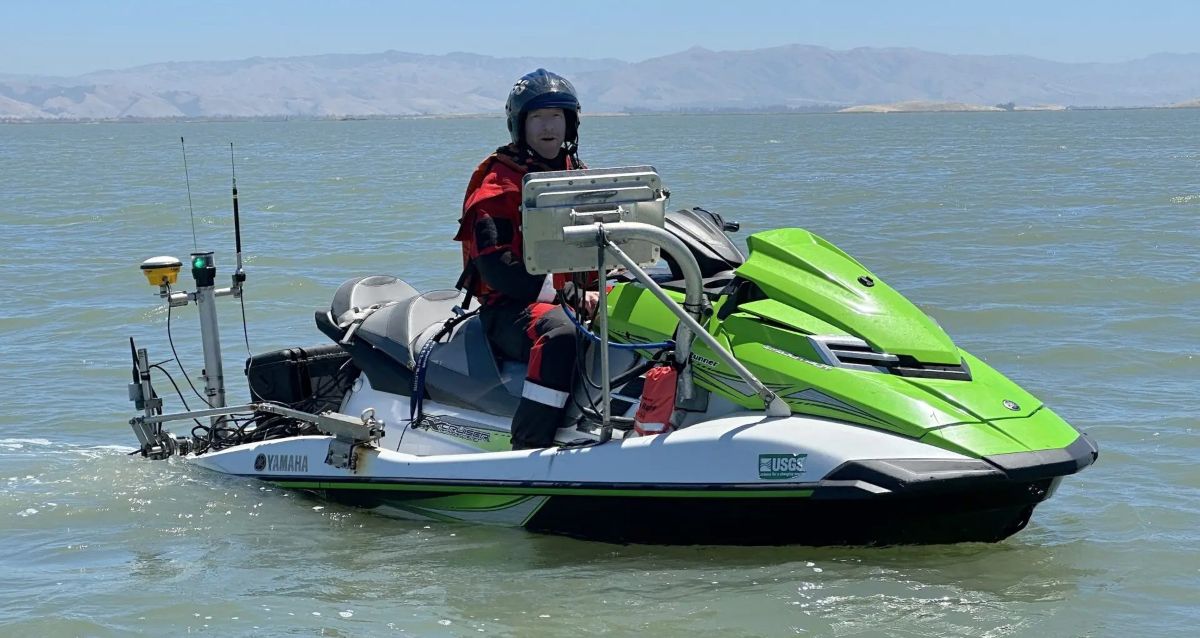
“Scientists experimenting with placing mounds of dredged sediment in the shallows near marshes to see if it helps them build up elevation in the face of sea level rise have more promising results. As reported in this Boxes of Mud story in KneeDeep in March 2025, the experiment involved dredging materials from the Redwood City harbor, barging them over to the East Bay shore near Eden Landing, depositing 950,000 cubic yards back into the Bay, and then carefully monitoring the outcomes. A year since the first reported results, the team of researchers from the U.S. Army Corps of Engineers and the U.S. Geological Survey now have further confirmation that the idea of beneficial reuse to bump up sediment supply for mudflats and marshes is working, and has minimal impacts on creatures in the oozes, fish, or nearby beds of eelgrass. “The mounds have continued to erode slowly and disperse,” says lead scientist Julie Beagle with the Corps. Initially, she says, they thought it would be more dispersive, like a “one time boost,” but “the slow release feeder system” that resulted turns out to be even more promising in the long run. … ” Read more from Knee Deep Times.
Plan for new S.F. Marina waterfront park advances after neighborhood battle
“Plans to convert Gashouse Cove in San Francisco’s East Harbor into an expanded 5-acre public park next to the Marina Green with a community dock and water recreation are finally moving forward — more than two years after the city went back to the drawing board in the face of intense pushback from Marina District residents. Driving the project is PG&E’s environmental cleanup of Gashouse Cove, the site of a 19th century power plant, under a legal settlement with the city. The project requires the relocation of boat slips from the East Harbor — one of two small harbors along the Marina waterfront — but the original plan, which involved installing around 185 boat slips into the West Harbor, would have blocked views for Marina residents. … ” Read more from the San Francisco Chronicle.
Bay Area construction company illegally polluted river, lawsuit alleges
“A huge quarry owned by one of the Bay Area’s most prominent construction companies has violated water pollution standards more than 900 times in the past six years, according to a lawsuit filed in federal court in San Jose. Water that builds up in the A.R. Wilson Quarry in Aromas, owned by Graniterock, has repeatedly been discharged into the nearby Pajaro River, which empties into the Monterey Bay National Marine Sanctuary, the lawsuit by Environment California and the California Sportfishing Protection Alliance alleges. The quarry water contains aluminum, iron, molybdenum, high levels of salts and sediment, and other contaminants that can harm steelhead trout and other fish and wildlife, according to the lawsuit. … ” Read more from the San Jose Mercury News.
SEE ALSO: Lawsuit alleges ongoing stormwater violations at California quarry, from Stormwater Solutions
Editorial: Zone 7’s pipeline to Chain of Lakes is worth studying
The Livermore Independent editorial board writes, “Zone 7 Water Agency is considering building a seven-mile pipeline from Chain of Lakes to the South Bay Aqueduct. The preliminary price tag, $240 million, is steep, but not out of line. In 2021, the estimate for the Zone 7 share of Sites Reservoir was $176 million. The Chain of Lakes project is certainly worth considering to secure the Tri-Valley’s water supply.The current system of reservoirs and aqueducts in the State Water Project is designed to move water where it is needed most. The project draws water from a single point on the Sacramento-San Joaquin Delta, a weak point that could cripple the local water supply if it were damaged in an earthquake or other disaster. The pipeline project would provide much-needed redundancy in the system, ensuring the Tri-Valley won’t be left out to dry, so to speak, if the worst happens. … ” Read more from the Livermore Independent.
CENTRAL COAST
Community Project Spotlight: Beaver dam analog workshop with SLO Beaver Brigade
“The Estuary Program’s Community Projects are efforts developed in collaboration with partners to support our goals of protecting and restoring Morro Bay. Recently, the Estuary Program partnered with the San Luis Obispo Beaver Brigade (SLOBB) to host a day-long interactive workshop to educate agencies, local non–profits, landowners, and community members about low-tech process-based restoration on the Central Coast. The workshop included presentations on restoration techniques and benefits, a guided tour of an active restoration site on Walters Creek, and hands-on building of beaver dam analog structures. … ” Read more from the Morro Bay NEP.
SOUTHERN CALIFORNIA
Legal fight underway over popular Malibu waterfall trail
“The city of Malibu and a local conservation authority are publicly feuding over the management — and future — of a popular 150-foot, multitiered waterfall and trail system located just off Pacific Coast Highway. Malibu filed a lawsuit Tuesday against the Santa Monica Mountains Conservancy and the Mountains Recreation and Conservation Authority, seeking to take over the trails to the waterfall and to “address a long-documented pattern of unsafe and inadequate trail management by MRCA,” the city said in a news release Tuesday. … ” Read more from SF Gate.
Mayor Bass has a new plan for addressing climate change in Los Angeles
“L.A. Mayor Karen Bass has released a new plan setting goals for the city to combat climate change and adapt to a warmer future. Bass’ Climate Action Plan calls for doubling local solar power in Los Angeles by 2030 and reducing the use of fossil fuels in buildings and city buses. It outlines how the city intends to reduce emissions of greenhouse gases at the Port of Los Angeles and L.A. International Airport. And it sets targets for reducing water use, addressing risks from extreme heat, and expanding parks and green spaces to cool neighborhoods and restore natural habitat. … ” Read more from the LA Times.
IMPERIAL/COACHELLA VALLEYS
Panel discussion educates on topics surrounding Lithium Valley
“The Calipatria Foundation and Los Amigos de la Comunidad hosted a panel discussion on Lithium Valley, featuring Supervisor Ryan Kelley and Imperial Valley College LIFT associates, at the Calipatria Community Center on Wednesday, April 15. Topics of discussion included the Program Environmental Impact Report (PEIR), Lithium Valley Specific Plan (LVSP), and the LIFT program offered at Imperial Valley College (IVC). The first half of the panel focused on a rundown of Lithium Valley, presented by speaker Eric Reyes of Los Amigos de la Comunidad. Reyes explained that the LVSP covers a 51,000-acre zone around the southeastern part of the Salton Sea between Niland and Calipatria. … ” Read more from the Calexico Chronicle.
SAN DIEGO
Tijuana River sewage is making the air toxic and sickening thousands in California
“The smell of rotten eggs permeates Steve Egger’s Southern California home, especially at night as the nearby Tijuana River foams up with sewage from Mexico before emptying into the Pacific Ocean. Egger, 72, says he and his wife have frequent headaches and wake up congested and coughing up phlegm. Their home is outfitted with a hospital-grade filtration system that cycles the air every 15 minutes. Despite those measures, “most nights we breathe in a horrible stench,” he said. “It’s awful.” Since 2018, more than 100 billion gallons (378 billion liters) of raw sewage laden with industrial chemicals and trash have poured into the Tijuana River, according to the International Boundary and Water Commission. … ” Read more from the Associated Press.
Along the Colorado River …
As Colorado River crisis deepens, water could be released from Flaming Gorge to prop up Lake Powell
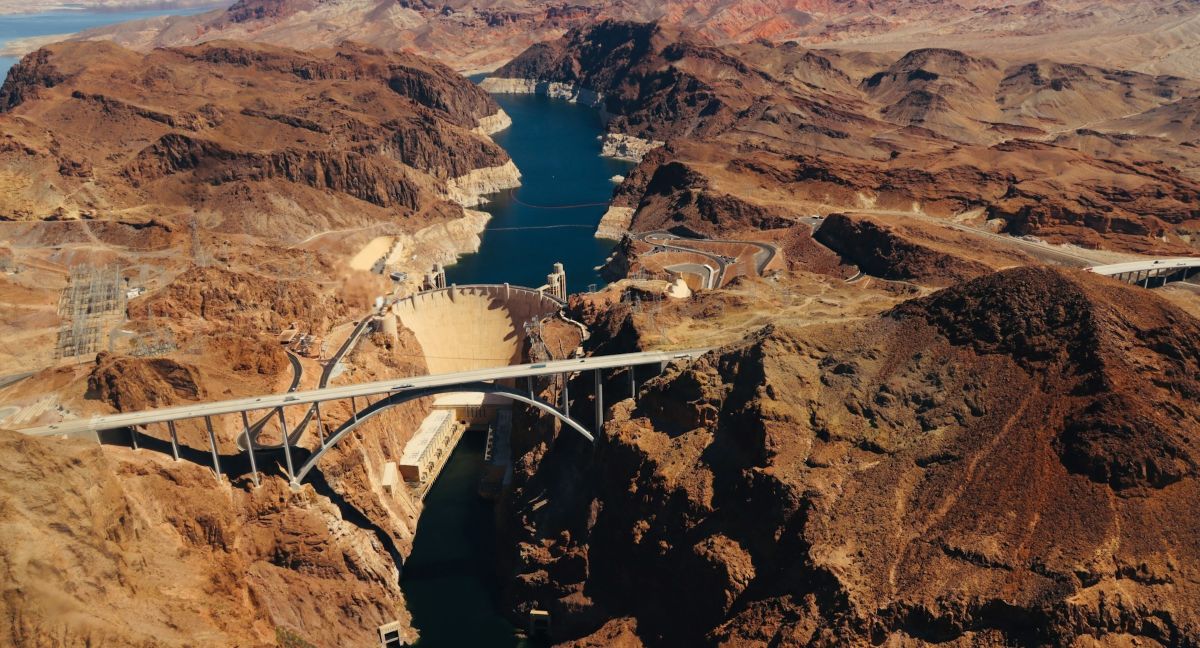 “It’s opening day at Cedar Springs Marina. The family-owned recreation hotspot is preparing to welcome visitors for another season of fun at Flaming Gorge. “Hundreds of thousands come through,” John Rauch, one of the marina’s operators, told FOX 13 News on Wednesday. “Business wise? Boat rentals, we’re looking at thousands of boat rentals. We have a couple hundred almost seasonal customers here.” But Cedar Springs Marina may have to pack up and move to deeper waters if the U.S. Bureau of Reclamation orders the release of water from Flaming Gorge and other nearby reservoirs to prop up Lake Powell. A draft drought plan shared with FOX 13 News calls for anywhere from 660,000-acre feet to 1 million-acre feet from Flaming Gorge, down the Colorado River system into Lake Powell. … ” Read more from the Utah News Dispatch.
The wild wild Western water wars
“The California Gold Rush was in full swing in 1852 when prospector Robert Phillips settled into his new digs in the Sierra Nevada foothills north of Sacramento. There was a waterway running along his land that he could use to excavate gold. But there was a catch. Matthew Irwin, his neighbor, had already diverted the flow for his own operation. Phillips wanted to redirect the stream back to its original course. Sharing is caring, right? Wrong. Irwin wouldn’t agree, claiming he’d been in the area before Phillips. The men lawyered up and ended up in the Supreme Court of California. Three years later, Irwin won. The judges decided that Phillips, as the new arrival, had “no right to complain, no right to interfere with the prior occupation of his neighbor, and must abide the disadvantages of his own selection.” Gold was the motivating factor, but the case was all about water. And thus was a legal precedent established that largely holds in Western states to this day: “first in time, first in right.” Or we might just say “dibs.” … ” Read more from the American Prospect.
Big cuts are coming for Colorado River water. This Arizona town will feel them first
“On the outer edges of the Phoenix metro, the small town of Cave Creek sits nestled among the saguaro-dotted hills. It’s home to about 5,000 people and known mostly for its quiet residential neighborhoods, art galleries and an annual rodeo. It’s also on the front lines of the Colorado River crisis. Climate change and a 26-year megadrought have crippled the river, which supplies nearly 40 million people across seven Western states and Mexico. Negotiations about how to share its shrinking supply are stuck at an impasse, and the federal government has proposed steep cutbacks to protect the nation’s largest reservoirs. Cave Creek, which gets about 95% of its water from the Colorado River, will be among the first to feel the impact of those cuts. … ” Read more from KJZZ.
Commentary: Mayors warn against possible Colorado River cuts
Kate Gallego, mayor of Phoenix, and Mark Freeman, mayor of Mesa, write “Few issues unite Arizonans more than water security. Throughout the desert, we understand that water is life and take pride in our culture of conservation. The careful stewardship of our water has guided our state and our cities, for decades. Arizona uses less water per capita today than it did in the 1950s, even as our population and economy have soared. In Phoenix and Mesa, we have invested heavily in conservation, reuse, infrastructure and groundwater recharge and storage. While we have long prepared for times of shortage, today we sound the alarm that one of our most important water resources, the Colorado River, is under extraordinary strain. … ” Read more from the City of Phoenix.
Buh-bye La Niña, hello ‘super’ El Niño? What it means for Arizona
“After a record-warm winter and a spring heat wave, La Niña said her farewell last month as sea surface temperatures in the Pacific Ocean returned to normal. Now forecasters are predicting a strong swing in the other direction — a “super” El Niño that could bring much-needed relief to the Southwest’s relentless drought. Warmer waters are brewing in the equatorial Pacific signaling an important shift in the planet’s impending weather patterns. On April 9, the National Weather Service said there was a 61% chance of La Niña’s temperamental counterpart arriving as early as June. The Earth seesaws between the two on an irregular schedule. The last time El Niño showed up, in 2023, sea surface temperatures along the equator in the Pacific rose 1.5 degrees Celsius above normal. But this year’s El Niño could be more intense than that — there’s a 25% chance sea surface temperatures could reach 2 degrees above average. … ” Read more from Arizona Central.
How is Colorado’s river otter population faring 50 years after reintroduction?
“Fifty years ago, Colorado Parks and Wildlife took steps to return the river otter to waterways across the state. Now, the agency has dedicated the next 12 months to documenting how the playful, water-loving mammals are doing — and it wants the public’s help. On Monday, April 13, Parks and Wildlife launched a program to track the success of its reintroduction efforts five decades later. With what it’s calling the Otter YEAR, short for yearlong engagement and assessment of river otters, the wildlife agency will be documenting the places where the mammals live and gauging their population size. Parks and Wildlife staff and partner organizations will be conducting population surveys and submitting observations through the iNaturalist app — a community science and social network platform that allows users to record, identify and track flora and fauna. The agency has planned efforts in the Yampa, Green, Colorado and Gunnison rivers. … ” Read more from the Aspen Times.
In national water news today …
What’s in the water? EPA signals direction of future drinking water regulations
“On April 6, 2026, the U.S. Environmental Protection Agency (EPA) published in the Federal Register its draft Sixth Contaminant Candidate List (CCL), which lists contaminants currently not subject to any national primary drinking water regulations. These contaminants are either presently known or in the future will appear in public water systems and may be subject to future regulations under the Safe Drinking Water Act (SDWA). This draft Sixth CCL contains 75 individual chemicals, 9 microbes, and 4 main chemical groups: disinfection byproducts (DBPs), microplastics, per and polyfluoroalkyl substances (PFAS), and pharmaceuticals. … ” Read more from the Environmental Law Monitor.
Drinking water systems cite struggles with costs and timelines for cleaning up PFAS
“Communities across the US are struggling to cope with impending federal requirements for eradicating two toxic PFAS chemicals from their drinking water systems, utility leaders said at a water policy conference this week. The US Environmental Protection Agency (EPA) last year announced a proposal to delay the deadline for utilities to comply with new regulation limiting toxic types of per- and polyfluoroalkyl (PFAS) chemicals in drinking water supplies. But even with the potential for a two-year cushion – compliance for meeting new standards may be pushed from 2029 to 2031 – utilities are faltering, industry experts said. “I think a lot of utilities are feeling uncertain as to, if maybe not the levels, the timeline for compliance,” Mark White, who plans and upgrades water treatment facilities for the American engineering and construction company CDM Smith, said April 13 at a conference of the Association of Metropolitan Water Agencies (AMWA) water policy held in Washington, DC. … ” Read more from The New Lede.

