
Several news sources featured in the Daily Digest may limit the number of articles you can access without a subscription. However, gift articles and open-access links are provided when available. For more open access California water news articles, explore the main page at MavensNotebook.com.
In California water news today …
Bridging the gap between new climate science and water planning in California
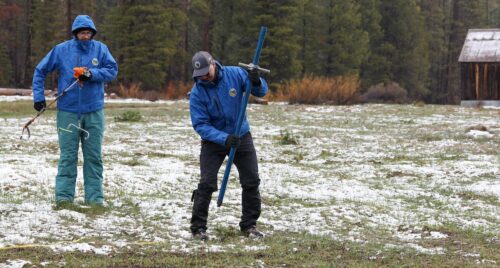
“The snowpack that supplies about one third of California’s water needs historically peaked in April—but the state can no longer count on this natural water storage as the world warms. This winter is a perfect example. Precipitation was near average but the winter was so warm that much of it fell as rain, so the snowpack was sparse to begin with. Then a record heat wave in March melted so much snow that when the state measured it in April, barely any was left at the survey site. The latest climate change research shows that the future of water in California is changing in unprecedented ways. As seen this past winter, snowpacks will shrink as temperatures rise, shifting precipitation from snowfall to rainfall. Atmospheric river storms will be more powerful and hit the state in clusters, saturating the ground and exacerbating the risk of flooding. Swings between drought and deluge will sharpen, intensifying climate extremes. “Our future climate will not be like our past,” says Jayantha Obeysekera, who directs the Florida International University’s Sea Level Solutions Center and is a member of the Delta Independent Science Board. “We need to begin considering potential future conditions in our planning.” … ” Read more from Robin Meadows at Maven’s Notebook.
How the strongest storm on Earth became a warning sign for a potentially historic El Niño
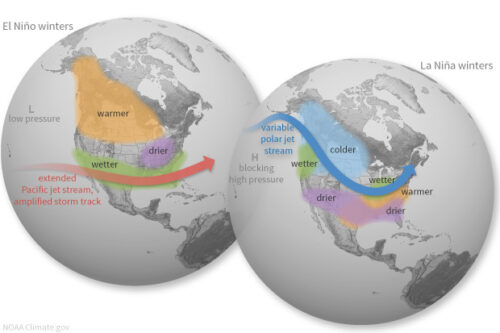
“Super Typhoon Sinlaku, which will soon make landfall on American islands in the western Pacific with winds near 180 mph, is a catastrophic storm. How did it become so strong so quickly? The short answer is that it is a product of an overheated ocean. The implications of this are even more interesting, or arguably alarming: Because it is so powerful, it is now helping push that heat across the Pacific toward what could be the strongest El Niño in a generation. Sinlaku went from a tropical depression to a Category 5 super typhoon in roughly 72 hours, intensifying by 75 mph in a single 24-hour period. That kind of rapid intensification requires extraordinary oceanic fuel, and the western Pacific had plenty to spare. … ” Read more from the San Francisco Chronicle.
The West’s snow drought meant record dryness — but also record flooding
“Mountain snowpack is the West’s largest reservoir, providing water for 100 million people and diverse ecosystems. The amount of water stored in the snowpack historically peaks around April 1. But this year, the snowpack in many places was absent, or nearly so, by then — the lowest level in the 45 years since automated measurements began. A stubborn high-pressure ridge contributed to the snow drought by shunting winter storms north to Canada in January. But the main culprit, according to the nonprofit Climate Central, was exceptional heat from climate change, which also caused a spring heat wave that decimated what snow there was at a time when other dry winters have seen “miracle March” snowstorms. … ” Read more from High Country News.
California ski resort extends its season after a major spring snowstorm
“A spring storm dumped more than than 3.5 feet (1 meter) of snow in California’s eastern Sierra Nevada, briefly closing a key interstate and extending the ski season at Mammoth Mountain. The weekend storm came just weeks after a March heat wave melted much of California’s snow, forcing many ski resorts to close. More snow was possible Monday. On April 1, the Sierra snowpack, which provides one-third of California’s water, stood at just 18% of average, a reading in the mountains near Lake Tahoe found. It was the second-lowest mark for that date on record. The UC Berkeley Central Sierra Snow Lab reported 42.5 inches (53.5 cm) between Friday and Sunday, which “has been great to create a late-season snowpack. ” “Unfortunately, record warm temps this winter means that we’re still well below average for the water year,” the lab said on social media. … ” Read more from the Associated Press.
This simple metal tube helps scientists predict drought before it happens
“On a snowy February morning, Toby Rodgers strapped on a pair of snowshoes and trudged across a snowy field in Washington’s Cascade mountains. Rodgers, a hydrologist for the U.S. Department of Agriculture’s Natural Resources Conservation Service, had traveled into the mountains that morning to sample snow. He had also brought along something unusual looking: a long aluminum tube, with a sharp serrated bit on the end. When he reached his destination, Rodgers carefully positioned the tube in front of him, then quickly drove the tube into the ground. Then, he pulled the snow-filled tube out of the ground, and weighed it on a spring scale. From this simple measurement, Rodgers could get a sense of how much snow was in the mountains — and how much water might be in the rivers, lakes, and reservoirs downstream when it melts in the summer. The tube that Rodgers used is called the Church Sampler. And while it’s super-simple and low-tech, it’s arguably one of the most influential devices ever invented for predicting drought and managing water. … ” Read more from Grist.
Sport and commercial salmon fishing to open on California ocean waters this year, subject to quotas
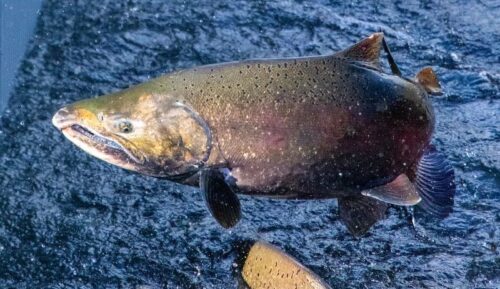 “California ocean waters will open to recreational and commercial salmon fishing this year, but are subject to a new quota season that halts fishing once the number of Chinook Salmon reaches a predetermined number to ensure that enough salmon return to the Sacramento, Klamath and coastal watersheds this coming fall. The Pacific Fishery Management Council (PFMC) at its April 7 to 12 meeting ending Sunday in Portland, Oregon, finalized the sport and commercial fishing seasons in the ocean off the West Coast. Recreational salmon fishing already opened on Saturday, April 11, from Pigeon Point south to the Mexican border, but the seasons in the rest of California were made official over the weekend. … ” Read more from the Daily Kos.
SEE ALSO: California allows commercial salmon fishing for first time in 3 years, from the Sacramento Bee
California reopens salmon fishing, but Crescent City fishermen still shut out
“The Pacific Fishery Management Council will allow commercial fishing for Chinook salmon off California’s coast after a three-year ban aimed at helping populations recover from drought. Recent signs suggest salmon populations are rebounding, said California Department of Fish and Wildlife information officer Steve Gonzalez. “Salmon are on a three-year cycle, so the three years where the fishery was closed kind of reflects the three years prior that there was a drought,” Gonzalez said. “What we’re seeing now is the first year of a wet winter, and then other policies that we changed and improved on.” … But fishermen in Crescent City aren’t celebrating. Commercial salmon fishing is remains prohibited within protected areas, including the Klamath Management Zone, which covers Crescent City and Eureka. … ” Read more from Jefferson Public Radio.
Hazardous gravel mine development puts San Joaquin as #2 on America’s Most Endangered Rivers® List of 2026
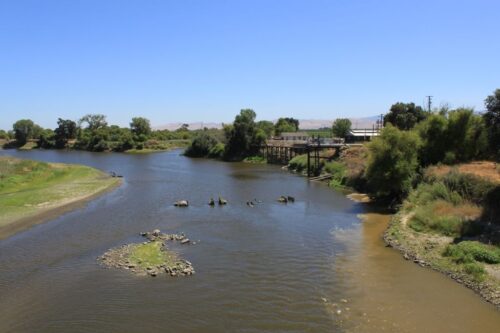 “American Rivers is today announcing the San Joaquin River as one of America’s Most Endangered Rivers® of 2026 due to a 600-foot-deep blast mine proposed alongside it, threatening its flows, water quality, and the people and wildlife that rely on it. The San Joaquin River is the water source for 30 million Californians, supports nearly half of the state’s $61 billion agricultural economy, and is the prime habitat for Chinook salmon and Steelhead trout. “This river makes life in our state possible,” said Patricia Flores, California Central Valley associate director for American Rivers. “A mine of such a proposed magnitude could push the San Joaquin to the edge of collapse, and once that damage is done, it is done. Why risk such an important waterway that millions depend on?” The global gravel mining company CEMEX seeks a 100-year permit for the mine, which would divert water from the life-sustaining San Joaquin River to a quarry site, potentially exposing the water supply to hazardous mining pollution. … ” Read more from American Rivers.
SEE ALSO: America’s Most Endangered Rivers® of 2026 Highlights Remedies for Healthy Rivers and a Cleaner Water Supply, from American Rivers
Report: California has largest flood coverage gap in US
“California has one of the largest flood insurance coverage gaps in the country, a new report shows. Neptune Flood released a new report showing residential flood insurance penetration across the state is 1.4%, despite 2.3 million properties facing flood risk over the next 30 years. The report, California Underwater: A Blind Spot in the Golden State, shows flooding from atmospheric rivers, urbanization, aging infrastructure, and post-wildfire conditions are a growing threat to California homeowners. Flood modeling shows that more than 2.2 times as many properties (600,000 additional properties) are at substantial flood risk as depicted in flood maps from the Federal Emergency Management Agency. The top 10 California counties account for nearly two-thirds of all National Flood Insurance Program losses since 1978, yet only 2.7% of residential properties in those counties carry flood insurance, according to Neptune Flood. … ” Read more from the Insurance Journal.
Hydropower generation expected to recover despite snow drought in the West
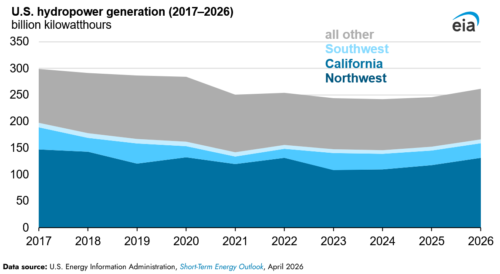 “In our April Short-Term Energy Outlook (STEO), we expect U.S. hydropower generation will increase by 5% in 2026 but remain 1.8% below the 10-year average following snow drought conditions in some states. Hydropower generation in 2025 increased to 245 billion kilowatthours (BkWh), about 4 BkWh more than the record-low generation year 2024. In 2026, we expect generation will be 259 BkWh, which would represent 6% of U.S. electricity generation. Seasonal precipitation in the form of rain and snowpack accumulation are the two main factors that help predict water supply and hydropower generation. Seasonal precipitation influences soil moisture, and moister soil helps to preserve the snowpack, which in turn acts as a natural reservoir. … We forecast hydropower generation in California to be 28.5 BkWh in our April STEO, which is 6% less than last year’s generation but 15% more than the 10-year average. … ” Read more from the US Energy Information Administration.
Wildfires killed nearly 20% of the world’s giant sequoias. How crews are racing to save the rest.
“Five years ago, a tragic and depressing environmental story unfolded when thousands of giant sequoia trees, an iconic California species that tower 300 feet high and can live for 3,000 years, were killed during multiple large wildfires that roared across the southern Sierra Nevada. The fires in 2020 and 2021 at Sequoia National Park, Sequoia National Forest and other areas burned with unprecedented intensity, killing nearly 20% of the world’s giant sequoias, and exposing the growing vulnerability of the most massive trees on the earth. “It was heartbreaking,” said Kevin Conway, state forests program manager for Cal Fire, the state’s primary firefighting agency. “You can’t help but ask, what could I have done? What should I have done? Could I have prevented this?” … ” Read more from the San Jose Mercury News.
California bill aims to ban PFAS pesticides
“California Assembly Bill 1603 (AB 1603) seeks to ban pesticides containing per- and polyfluoroalkyl substances (PFAS). The legislation was introduced by Assemblymember Nick Schultz (D-44). Specifically, AB 1603 would prohibit the California Department of Pesticide Regulation from registering a pesticide that has not previously been registered by the department and contains intentionally added PFAS as active, adjuvant, or inert ingredients. If passed as-is, the legislation would classify PFAS as restricted materials by July 1, 2028. The manufacture and sale of pesticides containing certain PFAS would be prohibited by January 2030 and all PFAS pesticides would be prohibited by January 2035. … ” Read more from Food Safety Magazine.
In commentary today …
Anna Kathawalla writes, ” … California agriculture is tied to the Sustainable Groundwater Management Act (SGMA), a bill passed in 2014 with the goal of reducing groundwater overdraft throughout the state, an agriculture-driven environmental hazard that is depleting aquifers and causing subsidence. The main tension behind SGMA is that the act is expected to cause between 500,000 to 1 million acres of San Joaquin Valley agricultural land to come out of production before 2040, and the act does not come with a built-in support system to help farmers figure out what to do with their land when agriculture is no longer an option. Neither SGMA nor the Valley farmers who it’s hurting the most are at fault—farmers are simply employing decades old agricultural practices to meet national food demand and SGMA is simply trying to preserve the state’s water resources. AW is one of the first farmers to feel the impacts of SGMA fully realized on his land. SGMA, although passed more than a decade ago, is just now taking hold across the state, and farmers are now faced with the difficult choice of farming under restrictions and the potential of facing fines, or not farming at all. … ” Read more from Common Dreams.
In regional water news and commentary today …
NORTH COAST
Middletown Advisory Council ponders whether they can save the creeks and fish from perennial drought
“Newly seated Chair Charles Morse, appealed to the MATH Council on April 9 whether they had the political will and funding to restore the South County creeks and fish habitats after years of drought and assume more responsibility as thoughtful stewards. “What can we do to revive it- we got to do something about people on the creek; they run out of water constantly,” Morse said. The County seems to love to take money for permits for big Ag things, let’s say cannabis, for instance and it sucks a lot of water out and then there’s no water in the Santa Lina Creek. And we know because the water doesn’t make it from June through September to Perry’s Bend. I looked at the 2025/26 Local Area Plan and thought if I can find the money and energy, maybe revive the town.” But it is not just finance that is needed but the water as well. The Callayomi Water District is the go-to utility in the area, but they are not obligated to get anybody in the south county any water. “They are a business and are obligated to get water to where their pipes are, and their pipes don’t go anywhere near there,” Morse said. … ” Read more from the Lake County Record-Bee.
SIERRA NEVADA
Tahoe/Truckee sees 3.5 feet of snow, More weather on the horizon
“A storm dumped fresh snow across the Sierra Nevada on Sunday, quickly erasing March’s dry spell and delivering a strong late-season boost to the mountains. Conditions made for a prime day of skiing and snowboarding in Tahoe. At higher elevations, Palisades Tahoe and Kirkwood Mountain Resort reported roughly 3.5 feet of new snow. According to OpenSnow forecaster Bryan Allegretto, the storm pushed April’s snowfall total to around 70 inches so far, marking the snowiest April since 2022. The season total now sits at approximately 348 inches, or about 88% of the seasonal average for this time of year. Looking ahead, forecasters expect a stretch of calmer conditions through midweek, with sunny skies and cold temperatures persisting through Wednesday. A weak system could bring light rain and snow showers Wednesday night into Thursday, followed by dry weather returning Friday and Saturday. Despite the brief break, winter is not necessarily finished for the Sierra. … ” Read more from the Tahoe Daily Tribune.
Fix for what ails Tahoe is costly, lawmakers learn
“Preserving Lake Tahoe’s clear, blue water depends in large part on reducing vehicle travel. The basin, however, lacks reliable and efficient transit for residents, tourists, and commerce, and a funding source to fix it, say experts who testified Friday before the Nevada Legislative Committee for Review and Oversight of the Lake Tahoe Regional Planning Agency. “It’s not the people coming to Tahoe that place the largest strain on this fragile ecosystem,” former Tahoe Regional Planning Agency board member John Friedrich told lawmakers. “It’s the cars they travel in.” Lake Tahoe is surrounded by State Route 28, which is snarled, especially in the summer, by a mix of traffic from 55,000 residents and some 25 million visitors a year, according to studies commissioned by the TRPA. Vehicles emissions, microplastics from tires, and dust from trucks and autos are among the factors preventing Tahoe from reaching a visibility goal of 97 feet deep. “As we say in Tahoe, ‘what happens on the land affects the lake.’ It’s all connected,” observed Tahoe Regional Planning Agency Executive Director Julie Regan. “All that TRPA endeavors to achieve is in service to our environmental threshold standards.” … ” Read more from the Nevada Current.
Yuba Water Agency launches multi-phase project to restore damaged powerhouse
“A major infrastructure failure at Yuba Water Agency’s New Colgate Powerhouse has triggered a long-term recovery effort expected to take years, after a massive penstock rupture released thousands of gallons of water and caused extensive damage along the North Yuba River. According to the Yuba Water Agency, the rupture occurred Feb. 13, when a 14-foot-diameter penstock pipe above the powerhouse failed, sending an estimated 400 acre-feet of water cascading down a hillside. The sudden release caused severe erosion and damaged the New Colgate Powerhouse, nearby electrical switchyards and portions of Lake Francis Road, officials said. Authorities stated that the facility will be unable to generate electricity for the foreseeable future. … ” Read more from Fox 40.
PCWA and Middle Fork Project Finance Authority reach settlement with PG&E over the Mosquito Fire
“The Placer County Water Agency (PCWA) and the Middle Fork Project Finance Authority (MFPFA) have entered into a settlement agreement with Pacific Gas and Electric Company and Pacific Gas and Electric Corporation (collectively PG&E), resolving all litigation resulting from the 2022 Mosquito Fire. The Mosquito Fire ignited on September 6, 2022, near Oxbow Reservoir outside Foresthill and burned approximately 76,788 acres across Placer and El Dorado counties. The fire resulted in PCWA’s Middle Fork American River Hydroelectric Project (Project) being offline for approximately 6 months, interrupting power generation and impacting operations. The fire also caused damage to several PCWA facilities and surrounding natural resources affecting Project operations. … ” Read more from YubaNet.
SACRAMENTO VALLEY
Construction begins on Iron Canyon Fish Passage Project, unlocking miles of critical salmon habitat on Big Chico Creek
“California Trout (CalTrout), the Mechoopda Indian Tribe, the Big Chico Creek Ecological Reserve (BCCER), and the City of Chico, today announced the start of the instream phase of construction on the Iron Canyon Fish Passage Project on Ótakim Séwi (Big Chico Creek) in Upper Bidwell Park. In 1956, concrete and rebar fish ladder weirs were constructed through a rockfall barrier in Iron Canyon—a narrow bedrock gorge deep within Bidwell Park. The purpose was to help steelhead and spring-run Chinook salmon reach miles of critical cold-water spawning and holding habitat during low water years. Over time, this fish ladder has become nonfunctioning, causing steelhead and salmon to hold downstream where water temperatures are too warm for their survival. The Iron Canyon Fish Passage Project will remediate the barrier, restoring access to 8.5 additional miles of habitat and returning a piece of a watershed that has sustained people, wildlife, and ecosystems for thousands of years. … ” Read more from Cal Trout.
SEE ALSO: Fish passage project to break barriers on Big Chico Creek, from the Chico Enterprise-Record
BAY AREA
San Francisco Bay is evolving into a death trap for gray whales
“Like many gray whales, a young male called Denali likely wintered in the balmy waters off Baja before propelling northward each spring to fill his belly in the Arctic. Marine scientists saw this whale, named after his white spot shaped like Alaska, every year between 2020 and 2024. But last April, partway through his 10,000-mile annual migration, Denali died in San Francisco Bay. Local scientists from the Marine Mammal Center and California Academy of Sciences, who examined Denali’s body near the Golden Gate Bridge, believe that a vessel probably struck him. In 2025, Denali was one of 21 dead gray whales, a record-high number for the Bay Area. The first research to document the fatalities, published in the journal Frontiers in Marine Science on Sunday, found that at least 18% of the gray whales spotted in San Francisco Bay from 2018 to 2025 died. Vessels killed at least 40% of them, and many others starved, the study found. … ” Read more from SF Gate.
CENTRAL COAST
Carpinteria’s $90 million water recycling project—a first for Santa Barbara County—will break ground in May
” … the memory of scarcity lingers. During the drought of 2012 to 2018, Cachuma shrank to a pond in a bed of cracked earth. Supplies from the state aqueduct — like Cachuma, a source of “imported” water for the South Coast—dwindled to five percent of entitlements. Water basins were pumped to historic lows. That’s when the push for “locally-controlled” water supplies began. In 2017, the City of Santa Barbara reactivated its desalination plant at a cost of $72 million. In 2021, the Montecito Water District signed up to pay $33 million of that amount in return for a 50-year supply of city water. Now, an even more costly water project is about to break ground in the Carpinteria Valley—a $90 million system for converting wastewater to drinking water. It’s a joint project of the valley’s water and sanitary districts, and it’s the first of its kind in the county. … ” Read more from the Santa Barbara News-Press.
SAN JOAQUIN VALLEY
Woodward Reservoir looks to improve spillway to meet California dam standards
“A 13-square-mile watershed in Stanislaus County that distributes water to farmers is seeking help from engineers to keep up with standards set by the California Department of Water Resources (DWR). CBS News Sacramento spoke with Forrest Killingsworth, the South San Joaquin Irrigation District engineering department manager, who said they are stewards of these water resources and want adequate facilities to protect the public. The Woodward Reservoir in Oakdale is a man-made storage facility holding around 34,000 acre-feet of water, helping the South San Joaquin Irrigation District distribute irrigation ag water to their customers in a more timely manner, according to Killingsworth, and they’re working with the DWR’s Division of Safety of Dams (DSOD) to find the best way to protect it. … ” Read more fro MSN News.
Westside’s solar footprint grows along I-5
“In the past six months, about a dozen huge utility-scale solar projects have launched permitting requests on thousands of acres of former farmland near I-5, the Valley’s driest region, where farmers have been hardest hit by water scarcity worries and SGMA regulation. Many are wondering how they will be able to pay their bills in the future. For many Kern, Kings and Fresno county landowners, harvesting solar energy is the most attractive answer. While the current administration in Washington has downplayed the benefits of renewable energy, even calling it a scam, farmers are watching missiles fly over the Middle East, where fossil fuels are being fought over. Meanwhile there are no missiles flying over I-5. Now it turns out that none other than the United Arab Emirates is investing here — not in oil but in solar. … ” Read more from the Hanford Sentinel.
SOUTHERN CALIFORNIA
Residents file lawsuit as sewer easement project cuts 30 feet into Huntington Beach backyards
“More than two dozen homeowners in Huntington Beach are on the verge of losing portions of their yards — including sheds, swimming pools, and in at least one case, part of a house. The Orange County Sanitation District (OC San) said the properties sit on a longstanding sewer easement and has decided now is the time to enforce it, reclaiming about 30 feet from the properties. The easement has been there since the 1960s, and the regional wastewater pipeline transports between 10 and 25 million gallons of wastewater per day, according to the district. OC San says it needs better access, and that means taking about 30 feet from each property. Demolition has already begun on Rhone Lane, where 29 homes are affected. Residents there say they feel blindsided. … ” Read more from KABC.
West Harbor waterfront getting ready to roll out, will include advanced ‘green’ initiatives
“As San Pedro’s new waterfront prepares for its debut this summer, the $500 million, 42-acre development is also preparing to implement a “Think Blue/Go Green” initiative that will bring solar canopies, electric vehicle charging stations and other environmental elements to the mile-long attraction. The plans, announced ahead of — and weaving into — Earth Day on April 22 will also make use of sustainable materials and waste reduction strategies, developers said. It will be a big summer debut ahead for San Pedro’s long-awaited new waterfront. West Harbor’s public opening comes with its role as an official Los Angeles World Cup 26 Fan Zone viewing location at the harbor-facing amphitheater in July. … ” Read more from the LA Daily News.
Neon green fireworms light up Long Beach water with their mating
“It’s like abstract art, squiggly neon green lines moving swiftly through the seawater. Bioluminescent fireworms engaging in a mating ritual in Long Beach’s Colorado Lagoon have been creating a buzz in recent days. This stuff just seems like something out of a movie, something you dream about,” said photographer Patrick Coyne, who drove from Torrance to document the sea creatures. “When you physically get to see it in person with your eyes, it feels like you’re in a dream.” Fellow photographer Mark Girardeau, who runs the website and account Orange County Outdoors, described how the fireworms rise from the seabed during certain moon phases for about 30 minutes to spawn at the surface. They are rarely seen, and few photos or videos exist of the bioluminescent creatures. … ” Read more from the OC Register.
San Gorgonio Pass Water Agency celebrates 65 years
“This year marks the 65th anniversary of the San Gorgonio Pass Water Agency, the Beaumont-based state water contractor that supplies imported water from Northern California for water agencies across the pass. Imported water is needed, both to protect the integrity of local groundwater ba- sins and to supply local water agencies. “Cities across the pass couldn’t grow without imported water,” said Pass Agen- cy General Manager Lance Eckhart. “In fact, there isn’t enough groundwater to support all of the economic development the Pass Area communities have experienced over the past few decades. That’s why the Pass Agency exists.” … ” Read more from the Record-Gazette.
IMPERIAL/COACHELLA VALLEYS
The Salton Sea Program’s 2026 Annual Report now available
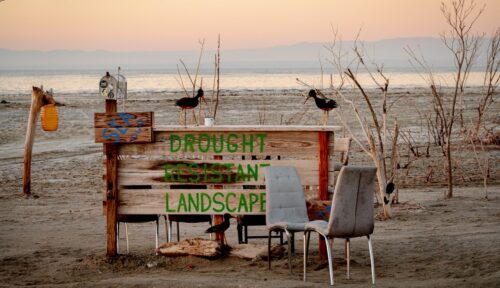 “The California Natural Resources Agency has released the 2026 Annual Report for the Salton Sea Program, offering a clear look at how much progress was made in 2025 —and what’s coming next. Here are just a few highlights from the annual report: The State’s Salton Sea Program achieved a key breakthrough in 2025: filling its first major network of “mega ponds” with water, which has brought fish and thousands of birds back to the Salton Sea – all while suppressing dust for the benefit of Salton Sea communities. This project, called the Species Conservation Habitat (SCH) project, is still in construction and will cover some 9,500 acres at full buildout – which is the same size as 7,200 football fields. Its existing mega ponds cover about three square miles – roughly four times the size of Disneyland…. ” Read more from the Natural Resources Agency.
State celebrates milestone as first major Salton Sea habitat project fills with water, marking new era in restoration efforts
“After years of planning, permitting, and massive earth-moving work, California’s landmark Species Conservation Habitat (SCH) Project at the southwest end of the Salton Sea has begun filling with water, ushering in a new chapter for one of the state’s most challenging environmental crises. The 2026 Annual Report on the Salton Sea Program, released by the California Natural Resources Agency, highlights this achievement as a watershed moment—literally and figuratively—for restoring habitat, suppressing dust, and improving air quality around the shrinking lake. The SCH Project, now in active construction and planned to cover approximately 9,500 acres at full buildout, saw its initial 3-square-mile “mega-ponds” filled in March 2025. … ” Read more from Desert Review.
SAN DIEGO
‘We can’t go back’: Sewage crisis reaching breaking point for some South Bay residents
“New numbers from UC San Diego’s Airborne Institute are showing a grim reality for people in the South Bay as hydrogen sulfide readings climb to dangerous levels. Some recent readings came in at 150 times the state’s safety standards. The state’s limit is 30 parts per billion. The last time the university recorded measurements this high was in September 2024. “Once they got there, they quickly spiked,” San Diego State Environmental Professor Dr. Paula Granados said back in 2024. “They were in the range of nine to 12 parts per million of hydrogen sulfide on all of these. And so at those levels, this is whenever you start to see dangerous health conditions.” Symptoms of exposure can include headaches, nausea, and nose and throat irritation. … ” Read more from Channel 10.
Along the Colorado River …
Colorado River Basin states could learn from what we developed in Australia
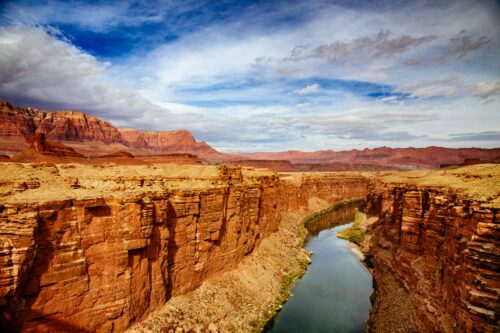 Mike Young writes, “No one should be surprised that Colorado River Basin states have struggled to renegotiate the Colorado River Compact. The compact’s framework was drafted in 1922, back when Henry Ford was still selling Model T Fords. Developed to protect gold miners, the West’s “first-in-time, first-in-right” water allocation system is even older. Colorado Basin water users deserve a modern water-right and allocation system — one that can be confidently described as robust enough to withstand the test of time. For now, the 1994 Water Treaty with Mexico could be left as it is. A state-of-the-art compact would reserve enough water to maintain a base flow and then allocate the remaining water to states in the form of a defined share of inflows and then onto water-right holders as shares. In order to allocate shares to right holders, each section of the river would need to be divided into a high-security pool, a general-security pool and a low-security pool. … ” Read more from the Colorado Sun.
Feds’ $140 million promised to Colorado River drought mitigation projects remains stuck for ‘bureaucratic’ reasons
“Despite pressure from Colorado’s congressional delegation, around $140 million in federal funding previously granted to Western Slope water projects has lingered in limbo for nearly 16 months. The funds, awarded to 17 Western Slope projects in the final days of President Joe Biden’s administration, were part of the Inflation Reduction Act’s drought mitigation grant opportunity for the Upper Colorado River Basin. This included $40 million granted to the Colorado River District to aid in its purchase of the Shoshone water rights, the oldest and largest non-consumptive right on the Colorado River tied to the hydropower plant in Glenwood Canyon. … ” Read more from the Aspen Times.
SEE ALSO: Reps. Biggs and Stanton say Colorado River states need drought mitigation funding now, from KJZZ
Scientists finally know where the Colorado River’s missing water is going
“For years, water managers have been puzzled as the Colorado River kept delivering less water than expected—even when snowpack levels looked promising. New research reveals the missing piece: spring rain, or rather, the lack of it. Warmer, drier springs mean plants are soaking up more snowmelt before it can reach rivers, fueled by sunny skies that boost growth and evaporation. In fact, this shift explains nearly 70% of the shortfall, tying the mystery directly to the long-running Millennium drought. … ” Read more from Science Daily.
Utah’s snowpack situation is a piece of a larger Western problem
“Nearly 60% of Utah remains in severe or worse drought after the state’s snowpack peaked about a month prematurely at its lowest level since daily collection began in the 1980s. Snowpack on April 1 is the lowest since data was first collected in 1930, federal hydrologists added. This signals trouble for smaller reservoirs that rely on snowpack to refill each year, as well as for other reservoirs in central and southern Utah that suffered a difficult season last year. It also opens the state up to other water challenges, earlier wildfire conditions, agricultural damage and possibly fewer recreation opportunities this summer. That requires early planning and coordination to navigate the hurdle, said Joel Ferry, director of the Utah Department of Natural Resources. … ” Read more from KSL.
Hobbs vetoes Republican measure to wrangle Mayes’ use of nuisance laws
“Gov. Katie Hobbs has vetoed a bill that sought to clip the legal wings of Democratic Attorney General Kris Mayes, with one Republican legislator even calling her a “bully” for how she is pursuing companies over their groundwater pumping. The Democratic Hobbs announced her veto along with a sweeping list of other legislative actions shortly after noon on Monday. In a letter to House Speaker Steve Montenegro, Hobbs gave this reasoning for vetoing HB 2167: “I will not curtail a tool that is used to protect Arizonans from bad actors.” … ” Read more from KJZZ.
Low river levels’ impact on local power plant
“Low water levels on the Colorado River have shut down the Vinelands Power Plant in Palisade, costing owners money. Jackie Fisher, District Manager for Orchard Mesa Irrigation District, said, “Irrigation is our first and foremost priority, and that is being satisfied currently. But the river level has not provided enough water to support generation at the Vinelands.” With no energy being generated, the revenue stream is not as consistent, putting a strain on the budget and obligations for loan repayment. “It’s devastating to the district when we lack the revenues that we count on in being able to run the power plant. But with no water to run through the power plant, we just have to face the reality of doing the best we can with the generation and revenues received previously and hopefully in the future,” said Fisher. … ” Read more from Channel 8.
A super El Niño is in the forecast. Here’s what that means for Colorado.
“As Coloradans grapple with a record low snowpack heading into summer, the super El Niño and strong monsoon season in the forecast could provide some late summer relief. Colorado’s weather is impacted by everything from temperature changes in the Pacific Ocean to pressure patterns over Texas — not to mention rising temperatures around the globe. This year’s La Niña conditions, created by cooler water temperatures in the Pacific, should have brought snow to Colorado’s northern mountains. Instead, the state ended the winter a month early with record hot days and a rapid snowmelt, prompting drought restrictions and water cutbacks around Colorado. As of last week, the La Niña is over and the odds are increasingly good for a super El Niño later in 2026 — a climate pattern that has historically brought wetter winter conditions to Colorado, according to the National Weather Service. … ” Read more from the Colorado Sun.
Teton commissioner doesn’t want water diverted to make up for Colorado River
“Teton County Commissioner Luther Propst told his colleagues Monday he expects a proposal to surface in Congress within the next few years to divert water from the Upper Hoback into the Upper Green River drainage to meet Colorado River obligations. He wants Teton County on record now opposing that idea, before the fight arrives. “I will not be at all surprised if in the next few years there’s a proposal floating around Congress to move water from the Upper Hoback to the Upper Green,” Propst said during a Teton County Board of County Commissioners discussion of a letter to the Bridger-Teton National Forest on wild and scenic rivers eligibility. … ” Read more from Cowboy State Daily.
In national water news today …
Bipartisan backlash slows America’s datacenter construction boom
“America’s rapid expansion of datacenters to support the AI industry is facing a growing bipartisan backlash from local communities who are pushing back against the high costs and limited benefits of these large-scale facilities. Recent examples include a California community blocking a new datacenter outright and a Republican-leaning Wisconsin town passing the nation’s first anti-datacenter referendum, rejecting a Trump-backed project. The opposition is driven by concerns over water usage, power consumption, and noise, with residents feeling the facilities will consume significant local resources without delivering meaningful benefits. … ” Read more from National Today.
Greens see chance to protect species in ‘God Squad’ fight
“The Trump administration’s move to exempt oil and gas activities in the Gulf of Mexico from endangered species considerations could hand environmentalists a public engagement opportunity, although one they would prefer not to have. The use of the so-called God Squad last month to grant a more than 600,000-square-mile exemption for the oil industry puts the spotlight on the kind of charismatic species — whales and sea turtles — that not only conservationists but the general public hold dear. In particular, it highlights the plight of the Rice’s whale, which has only a few dozen of its kind left. “This action by the Trump administration may prove to be a galvanizing moment for a whole new generation of advocates and voters who support the Endangered Species Act and the wildlife and ecosystems it protects,” said Ben Greuel, national wildlife campaign manager at the Sierra Club. … ” Read more from E&E News.

