
Several news sources featured in the Daily Digest may limit the number of articles you can access without a subscription. However, gift articles and open-access links are provided when available. For more open access California water news articles, explore the main page at MavensNotebook.com.
In California water news this weekend …
Multiple storms to usher in rain and mountain snow to the West
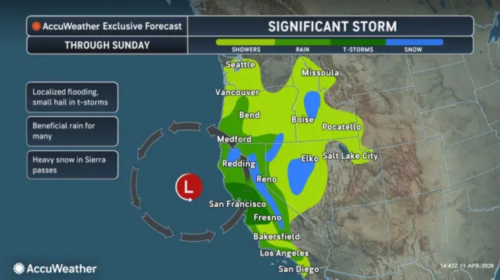 “Two storms will make their way into the western United States this weekend and early next week bringing rain, spotty thunderstorms and mountain snow to the region. Showers will persist Saturday from California into western Washington ahead of the next storm that will move onshore later Saturday into Sunday across Northern California. This storm will be stronger compared to the previous storm that moved through the region late in the week with more in the way of heavier rain across portions of Northern and Central California. Thunderstorms may also occur across portions of Central California as the storm presses inland later Saturday into Sunday. Locally gusty winds and small hail can accompany any thunderstorm. … Another storm will make its way into the West Tuesday and Wednesday, this time focusing farther north across the Northwest and portions of Idaho and western Montana, spreading rain and mountain snow across the area. … ” Read more from AccuWeather.
A snowy, rainy storm is hitting California. Will it curb the coming fire risk?
“A powerful late-season storm system is hitting California and the intermountain west, and over the next several days will dump several feet of high-elevation snow in the Sierra Nevada and deliver multiple inches of rain up and down the coast. The storm arrived into a very warm air mass, with temperatures running 5 to 15 degrees above normal on Thursday and Friday before the system’s arrival. The earliest fragments of the system delivered heavy showers and thunderstorms to Northern California and southwest Oregon. While the back half of the storm will feature plenty of cold air and mountain snow, it ran into a warmth emblematic of the recent season. Persistent and record warmth has fueled a rare snow drought in California and the Western United States more broadly — conditions that are setting up the region for a problematic summer of wildfire risk. … ” Read more from the Washington Post.
El Niño set to form by August with rising heat and crop risks
“A planet-heating El Niño is favored to emerge by August, with rising odds of an unusually powerful event that threatens record-breaking temperatures during the Northern Hemisphere’s summer. In an outlook Thursday, the US Climate Prediction Center said there’s a 25% chance for the El Niño to become “very strong” — based on warming in a key stretch of the tropical Pacific — by February 2027. Even mild El Niño events can disrupt crops in Vietnam, Brazil and parts of Africa, while raising wildfire risks in Australia and suppressing hurricane activity in the Atlantic. The possibility of a strong event with sharper impacts on global weather patterns hinges on the development of wind anomalies across the equatorial Pacific in the coming months, forecasters said. Changes in those winds can lead to greater heating in the belt that produces El Niño and its cooling counterpart, La Niña. Forecasts made in spring, however, tend to be less reliable. … ” Read more from Bloomberg.
Experts warn faster snowmelt could strain water supplies, urgency for storage solutions
“California’s snowpack, long considered a natural form of drip irrigation for the state’s rivers and waterways, is showing signs of melting faster and earlier than normal. Experts say a recent heat wave and the potential effects of long-term climate change are contributing to the shift. Steven Springhorn, supervising engineering geologist with the California Department of Water Resources, said the state has begun to see the impacts of increasingly extreme weather. “And really, what we’ve been starting to see a glimpse of over the last decade with the different, extreme weather events we’ve had in California. And so, you know, we see these very extremes, shifts from all or nothing, right, where we have mostly dry conditions, but we have these big pulses of intense storms. And most of the time, especially this year, they’ve come in warm,” Springhorn said. … ” Read more from Channel 7.
California salmon fishing poised to finally reopen. Can the industry recover?
 “After three years of unprecedented closures that devastated California’s fishing industry, commercial salmon fishing is poised to reopen this spring. The return comes with a catch: Regulators at the interstate Pacific Fishery Management Council will strictly constrain fishing dates and impose harvest limits for both commercial and recreational fishing to protect the threatened California Coastal Chinook. The council is set to finalize the details this weekend. It’s not the season the fleet had hoped for after years of closures. But those who survived the shutdowns fear a graver threat: state and federal decisions could reshape California’s water systems and rivers. “Water policy in California is about to change drastically and irreversibly, and nobody has the energy to pay attention to that,” said Sarah Bates, who fishes commercially from San Francisco. “I am concerned that salmon is going to be (commercially) extinct in our lifetimes.” … ” Read more from Cal Matters.
Millions of salmon released into ‘deadly’ Sacramento River low flows. What to know
“The U.S. Fish and Wildlife Service released more than 6.2 million fall-run Chinook salmon from the Coleman National Fish Hatchery into Battle Creek on March 25 as part of a federal effort to support the salmon population. But the salmon were set loose into what conservationists described as “deadly” low-flow conditions in the Sacramento River. Conservationists called on the Bureau of Reclamation to release more water into the river. On Tuesday, the bureau announced a plan to release more water from Keswick Dam into the Sacramento River. Here are key points to know … ” Read more from the Sacramento Bee.
Meet Sacramento’s data center defender
“California legislators are dead set on passing new laws to regulate data centers. Khara Boender is playing defense. Boender is the senior manager of state policy for the Data Center Coalition, the industry group that represents data centers owners and their interests. She’s been extremely busy in recent weeks, wading through the many, many new proposals targeting their members. The bevy of new bills is linked to the explosion of artificial intelligence, which has spurred a nationwide race to build out the digital infrastructure needed to support new AI models. And while data centers are nothing new — they expanded in lockstep with the growth of the internet — state officials expect them to use huge amounts of electricity and water in coming years. California lawmakers don’t want that growth to strain the state’s resources, of course. To that end, they’ve introduced eight bills this year that would reshape how data centers pay for electricity and grid upgrades, and require the industry to disclose information about its water and electricity use to the government. … Boender’s team is opposing all of the bills but one. … ” Read more from Politico.
Map of California data centers: See where projects are operating or planned near you
“While Silicon Valley is leading the AI revolution, it’s a different story when it comes to the data centers that power tools like ChatGPT. California is currently home to 5% of the U.S.’ total data center capacity, according to a Chronicle analysis of data from energy database company Cleanview. But if all data center plans announced during the current building boom pan out, California’s share will shrink to 1%. … “We’ve fallen way behind because we don’t have energy utilities at scale,” Jerry Inguagiato, a Silicon Valley-based leader on commercial real estate firm CBRE’s data centers team, told the Chronicle. “Frankly California’s market will probably continue to fall behind. There are plans for projects, but the hammers aren’t swinging because the utilities aren’t there to deliver right now.” … ” Read more from the San Francisco Chronicle.
SEE ALSO: Data Centers in California: Explore the largest data centers in California and see all data centers in California on a map, from Cleanview
Solano County attempts to sway maritime manufacturer to invest billions locally
“Saronic Technologies, an autonomous maritime manufacturer, attended a meeting at the Solano County Government Building on Monday with staff from the California Governor’s Office of Business and Economic Development, Solano County, California Forever, Cal Poly Maritime, and the Solano County Economic Development Corporation, according to SED Corp CEO Chris Rico. “This is being spearheaded by the Governor’s office at a very high level,” Rico said. The meeting discussion focused on the possibility of bringing Saronic’s Port Alpha to Solano County, particularly the Solano Shipyard proposed by California Forever near Collinsville. The project could bring $3 billion of investment to the county, Rico said, but the company looks to act as quickly as possible. “We don’t wait — we build for what our customers need, when they need it.” Saronic CEO Dino Mavrookas said in a press release last year. … ” Read more from the Santa Rosa Press Democrat.
Invasive rodent plaguing California may have been deliberately released. Here’s the theory
“State wildlife officials have finally come up with a theory to explain where a giant, highly destructive rodent that’s been terrorizing California came from: Oregon. Nutria, a creature with the body of a small beaver, webbed feet like a platypus, and the tail of a rat, reappeared in the state’s wetlands a few years ago, nearly four decades after it was considered eradicated. California has been battling the rodent ever since, and recent research by wildlife officials suggests the rodents’ sudden return may have been intentional. The study, released Tuesday by the California Department of Fish and Wildlife, found that the state’s nutria populations share a close genetic match to nutria from Oregon. The distance between the states makes it near impossible for them to have migrated on their own, according to researchers, which means they were likely transported here intentionally. … ” Read more from the LA Times. | Read via AOL News.
Assemblymember Ransom warns state is running out of time to stop spread of golden mussels
“State Assemblymember Rhodesia Ransom (D-Stockton) warned Wednesday that California is quickly running out of time to contain the rapid spread of invasive golden mussels, an emerging threat to the state’s water infrastructure, agriculture, recreation and ratepayers. Golden mussels, first detected in California near the Port of Stockton in 2024, are small invasive mollusks that attach to boats, piers, water intake pipes and other surfaces. They form dense colonies that can clog pipes, damage infrastructure and disrupt water deliveries for farms and cities. Ransom addressed the issue during a budget hearing, urging immediate state action before the problem becomes far more expensive and difficult to manage. “My community in San Joaquin County is ground zero for this infestation, and we are already seeing the damage firsthand. California has a narrow window to get ahead of this, and we are already missing it. If we don’t act now, this will only get more expensive and harder to control,” Ransom said. … ” Read more from Stocktonia.
Climate change is outpacing evolution. Scientists are using DNA to catch up
“Evolution works over millennia. Climate change is moving far faster. That mismatch is killing some of the planet’s most vital ecosystems, from California’s towering redwoods to the seagrass meadows along its coast, both of which store vast amounts of carbon and support complex webs of life. Marine heat waves, record wildfires and coastal development are pushing these systems beyond their limits as climate change, driven by emissions of fuels like oil and gas, accelerates. An estimated 1 million species face extinction, many within decades, largely due to human activities such as habitat destruction, pollution and overuse of natural resources, according to a 2019 report by a United Nations-affiliated intergovernmental scientific body. Scientists are working to close the gap with an emerging discipline called conservation genomics: sequencing an organism’s complete genetic blueprint to pinpoint individuals with traits suited to survive drought, disease and other climate extremes, then using that information to guide restoration. … ” Read more from KVPR.
In people news this weekend …
Promotions, passings, profiles – submit people news items to maven@mavensnotebook.com.
Russian River nonprofit to fold as Brenda Adelman looks back on five decades of environmental activism
“The record heat that last month barreled into the final days of winter in California ushered in the sounds of summer along the lower Russian River. Beachgoers laughed and splashed as kayakers and paddleboarders paraded between the banks, all of them beckoned to the water weeks earlier than most years. Still, the soundtrack was music to Brenda Adleman’s ears. The 86-year-old activist has for more than half her life fought to clean and protect the Russian River, serving as a chief watchdog and champion for the 1,500-square mile watershed. At the outset of her work in the early 1980s, the lower river was still used by Santa Rosa as the primary way to dispose of its wastewater. That is no longer the case in large part due to unrelenting pressure from Adelman and allies at that time, whose broader legacy over the ensuing decades would include greater public recognition and regulatory care given to the river — a lifeblood for residents, visitors and farms alike, and a sensitive refuge for wildlife. … ” Read more from the Santa Rosa Press Democrat.
Charlton “Chuck” Bonham, of Berkeley, has been appointed to the California State Park and Recreation Commission.
From the Office of the Governor: Bonham has been the California Executive Director at the Nature Conservancy since 2026. He was the Director of the California Department of Fish and Wildlife from 2011 to 2025. Bonham held multiple positions at Trout Unlimited from 2000 to 2011, including California Director and Senior Attorney. Bonham was a Member of the Sacramento-San Joaquin Delta Conservancy Board from 2010 to 2011. He was an Instructor at Nantahala Outdoor Center from 1994 to 1997. Bonham was a Small Business Development Agent for the United States Peace Corps from 1991 to 1993. He earned a Juris Doctor degree from the Northwestern School of Law of Lewis and Clark College and a Bachelor of Business Administration degree from the University of Georgia. This position requires Senate confirmation and the compensation is $100 per diem. Bonham is a Democrat.
Podcasts …
AgNET NEWS HOUR: California Ag Secretary Karen Ross discusses future of farming, water, and regulation challenges
Ross emphasized that agriculture in California is at a critical moment, balancing economic pressures, regulatory demands, and long-term sustainability goals. She noted that farming today requires navigating a complex landscape of competing interests across a state with more than 39 million residents. One of the biggest issues discussed was water—an ongoing concern for growers across the state. Ross pointed to changing weather patterns, including reduced snowpack reliability, as a major factor impacting water availability. While some argue the issue is tied to infrastructure, she stressed that shifting hydrology must also be considered.
ONCE UPON A BAY: Geeking out at the Bay Model
A love letter to a giant analog computer made of concrete, copper, and tidewater. Mike and Kate spend a day inside the San Francisco Bay Model, an enormous mid‑century scale model in Sausalito that once tested radical plans to dam, pave over, and reroute the Bay. Guided by long‑time Park Ranger Linda Holm of the U.S. Army Corps of Engineers, they trace how this 1.5‑acre, hand‑sculpted “water computer” helped sink the Reber Plan, shaped debates over the Peripheral Canal, and continues to inform navigation, oil‑spill response, and sediment management today.
WATER RESOURCES PODCAST: Water-Electricity nexus in the Western US
Nathalie Voisin discusses water-electricity interconnection, highlighting hydropower, hydropower droughts, grid reliability, and future of water-energy management.
TALKING UNDER WATER: The battle over Colorado River resources is brewing
In this episode Talking Under Water co-hosts discuss escalating water use restrictions in Denver, the broader legal and political fight over Colorado River allocations, and what differing conservation strategies reveal about the future of water management in the West. The conversation begins with Denver Water’s declaration of a Stage 1 drought, outlining outdoor watering limits, fines for repeat violations, and how these measures compare with long‑standing, highly structured conservation programs in Southern Nevada. The episode then zooms out to the Colorado River basin, breaking down the growing split between upper and lower basin states, the looming possibility of Supreme Court litigation, and disagreements over delivery obligations rooted in the 1922 Colorado River Compact.
RIPPLE EFFECT: Great Salet Lake – Dust issues with Dr. Dust
Dr. Kevin Perry, Professor of Atmospheric Sciences at the University of Utah, also know as “Dr. Dust”, joins us to talk all about dust. We cover the rising concern of the newly-exposed dry lakebed, and how the resultant dust may expose the whole valley to dangerous toxic materials. We learn what is being done now and what can be done in the future to protect us. You may be surprised to learn that not everything is as you’ve been told. A very informative discussion.
WATERLOOP: Where rivers meet the ocean: Why American’s estuaries matter
Estuaries—places where rivers meet the ocean—are some of the most important ecosystems in the United States, supporting coastal economies, protecting communities, and serving as nurseries for much of the nation’s seafood. In this episode from the Reservoir Center in Washington, D.C., Daniel Hayden, CEO of Restore America’s Estuaries, explains why these places—from Chesapeake Bay to Puget Sound – are essential to nature, the economy, and people. Hayden highlights collaborative restoration efforts across the country, including eelgrass recovery in Morro Bay, oyster shell recycling programs in Gulf Coast communities, and wetland restoration projects led by tribal partners along Long Island Sound. The conversation also explores how restoring abandoned cranberry bogs in New England is reconnecting wetlands to nearby estuaries and bringing native ecosystems back to life.
WATER IS A MANY SPLENDOR’ED THING: True Success is a Healthy Economy and Environment
 The benefits provided by some industries come at a cost to our water resources. Giancarlo is a hydrogeologist in Lucca, Italy. His passion is studying and supporting industry and society’s need for water. Water is a Many Splendor ’ed Thing brings you another water relationship that has a personally significant impact to your life. Produced by Stephen Baker, Bringing People Together to Solve Water Problems, water@operationunite.co 530-205-6388
In regional water news this weekend …
NORTH COAST
Water crisis drives worst Klamath Basin farming conditions in over 100 years
“Drought conditions in the Klamath Basin are forcing farmers to abandon profitable crops and leaving tens of thousands of acres idle as water managers struggle to balance federal environmental requirements with agricultural survival. Fernando Rayas, owner of Rayas Farms, said he had to cut production in half. He abandoned one farm entirely because there wasn’t enough water to support it. Dry and warm conditions forced Rayas to abandon profitable outdoor crops. He now relies on greenhouses just to survive. “The outside stuff, it’s what was our moneymaker for the year,” Rayas said. “And this year we have to cut back on all the stuff we grow outdoors.” … ” Read more from Channel 12.
SIERRA NEVADA
Irrigation season begins: water flows as NID balances full reservoirs and low snowpack
“Water returns to local canals on April 15, signaling the start of irrigation season for thousands of foothill farmers and ranchers who depend on it each year. As the Nevada Irrigation District (NID) turns the system back on, the annual flow once again brings life to fields, pastures, and gardens across the region. From ranches and vineyards to family gardens, more than 5,200 agricultural customers rely on this moment. Water released from Scotts Flat Reservoir serves Nevada County, while Rollins Reservoir supplies Placer County—together supporting the irrigation of more than 30,000 acres. “We’re excited to get the system up and running again,” said NID Assistant Manager Greg Jones. “These flows are what keep our farms and fields thriving every season.” … ” Read more from YubaNet.
Story Map: Lake Tahoe nearshore water quality: E. coli
“The Lahontan Regional Water Quality Control Board (Water Board) together with the Tahoe Regional Planning Agency (TRPA) and Nevada Division of Environmental Protection (NDEP), funds and administers an E. coli bacteria monitoring program at Lake Tahoe’s recreational beaches every summer. The goal of the program is to provide beach managers with E. coli water quality data so that they take steps to protect people who are recreating in or on the water. Lake Tahoe is a bi-state lake and monitoring occurs on both the California and Nevada sides of the lake. Each state has its own bacteria standards. … ” View the story map.
Tahoe City PUD project sparks tension over environment and infrastructure in Tahoma
“The Tahoe City Public Utility District is moving forward with its largest-ever infrastructure effort, the Tahoe Cedars Water System Reconstruction Project. Now, some Tahoma residents are raising concerns about potential environmental impacts tied to construction staging. The project aims to fully rebuild the aging Tahoe Cedars water system, originally constructed in the 1940s and now considered actively failing. In 2021, TCPUD’s board adopted a comprehensive master plan recommending full replacement of the system following years of financial planning and evaluation. At an estimated $72 million, the project is significantly larger, more complex and more costly than any previous water system reconstruction undertaken by the district. Funding is expected to come from a mix of water rates, property tax revenue, infrastructure charges and potential grants. … ” Read more from the Tahoe Daily Tribune.
SACRAMENTO VALLEY
River projects in the Northstate aim to help salmon and wildlife
“A nonprofit group is working with government agencies and local Tribes to restore parts of a river system in the Northstate, with the goal of helping fish, wildlife and nearby communities. River Partners, based in Chico, is leading two projects along the Sacramento River near Battle Creek, between Redding and Red Bluff. The effort focuses on rebuilding natural habitats so animals, especially salmon, can survive and thrive. The projects, called Rancho Breisgau and Battle Creek Ranch, are part of a larger plan to reconnect a long stretch of river habitat reaching toward Lassen Volcanic National Park. Healthy rivers and floodplains give fish places to swim, rest and grow, while also supporting birds and other wildlife. … ” Read more from KRCR.
NAPA/SONOMA
Napa nonprofit installing new ‘Beacon Boxes’ to help guide crews during wildfire emergencies
“In the North Bay, wildfire season is fast approaching, and firefighters in Napa County are preparing with a new tool designed to guide them to the right roads and water sources during a fire emergency. It’s called a Beacon Box. “There’s two ways of opening these with a code or breakaway lock,” said Erick Hernandez from Cal Fire. Hernandez showed what’s inside a big red locker off Sage Canyon Road in St. Helena. Its contents could save homes and lives. “This map will give us some numbers. We know we have the location of 78 structures and commercial wineries,” Hernandez said. … ” Read more from ABC 7.
BAY AREA
Solano County Water Agency hears budget, legislative updates
“The Solano County Water Agency provided its Board of Directors with an update on its budget situation and land holdings across the county at a meeting on Thursday evening. Some 21.4 percent of all SCWA funding is in a general fund for use by administration and the Solano Watermaster, about $16.8 million. Another 61.1 percent, about $48 million, sits in a restricted fund for the State Water Project. And $12.8 million is in a restricted fund for Ulatis Flood Control, and about $867,000 is in a restricted fund for Green Valley Flood Control. The organization’s total fund balance rose to $71.1 million in June of 2025, roughly $7.5 million higher than it was in June of 2024. The approved budget, beginning in June, is $73.7 million. Revenues for this year are projected at $50.4 million and expenditures are projected at $42.9 million. The year-end projected fund balance for this year was $78.6 million. Sam Moore, Supervising Water Resource Technician, walked the board through the details of Solano County Water Agency’s holdings — specifically Peterson Ranch, Sackett Ranch and Lang Tule Ranch. … ” Continue reading at the Vacaville Reporter.
Former Richmond dry cleaners fined $100,800 over toxic cleanup violations
“The California Department of Toxic Substances Control (DTSC) recently announced a $100,800 settlement with the owners and former operators of a vacant dry cleaning site in Richmond. This agreement follows a 2023 order involving Omo’s Fabricare Dry Cleaners at 12210 San Pablo Ave. The site has been fenced and empty since the building was torn down in 2017, according to public documents. The settlement includes the property owner, Casa Nido Partnership, and former operators Catherine O’Hanks, Earl Ray Anderson and Sandra Vernell. The penalties were issued because the group did not follow previous orders to clean up a chemical called tetrachloroethylene (PCE), according to DTSC. The dry cleaner reportedly used this cancer-causing chemical from 1960 to 2000. … ” Read more from the Richmond Standard.
CENTRAL COAST
Santa Barbara harbor dredging funds restored after federal cut
“Two months after a federal budget proposal left Santa Barbara Harbor facing a $4 million dredging shortfall, U.S. Representative Salud Carbajal announced this week that $6.15 million in federal funding has been secured to restore the work for this year. In February, city officials warned that the loss of federal support — which had funded routine dredging for nearly three decades — could jeopardize maritime access, emergency response operations, and a wide swath of the local economy. Without regular maintenance, sand buildup at the harbor entrance restricts navigation and can force closures. The earlier exclusion followed a broader federal funding pullback directed by the Office of Management and Budget in late 2025, which paused or reduced support for a range of Army Corps projects, many of them in blue state. Waterfront Director Mike Wiltshire described the pattern at the time as “more political than practical.” But that initial pullback was a proposal not the final word. In response, Carbajal raised the issue with the U.S. Army Corps of Engineers and Coast Guard leadership during congressional hearings and submitted a formal letter in late January formally requesting $4 million for dredging. … ” Continue reading at the Santa Barbara Independent.
SAN JOAQUIN VALLEY
Fresno County to ban ‘human compost’ on certain land
“Following outcry over a special type of compost used by the San Joaquin River Parkway Trust, Fresno County has introduced a new law banning the spread of reduced human remains, also known as human compost, on some public and private lands. The Fresno County Board of Supervisors unanimously approved the first reading of an ordinance on April 7 that prohibits the use of human compost on all public land within the unincorporated areas of the county and on private land where food is grown for human consumption. Supervisors said the ordinance attempts to balance property rights with public health and safety concerns. “I think for me, it’s a sacred thing, and I’m one who believes that when it does come time to spread human remains, it’s something that should be done in a manner that pays respect to individuals,” Supervisor Nathan Magsig said. “On a health side, … I did have concerns, so I appreciate this ordinance that’s before us.” … ” Read more from the Mid-Valley Times.
SOUTHERN CALIFORNIA
Lead levels are still too high inside and outside the Exide cleanup zone, study finds
“New research is backing up what many residents in the Vernon area have already feared: the Exide cleanup is missing a lot of lead. UC Irvine researchers found excessive lead in the area 11 years after the battery plant closed, as well as evidence that the remediation area may need to be expanded. Lead is a toxic metal that can cause short- and long-term health effects, including neurological and reproductive changes. Exposure is especially dangerous for children and pregnant people. … As of March 27, over 6,000 properties have been cleaned, according to the state’s Department of Toxic Substances Control, which oversees the effort. Residents have complained for years about issues with the process and its thoroughness. Even though homes were deemed clean, investigations have found excessive lead on the grounds. Contractors have also reportedly violated state standards for soil removal and environmental regulations with toxic dust spread. … ” Read more from the LAist.
LA County supervisors to consider examining health and environmental impacts of data centers
“The Los Angeles County Board of Supervisors on Tuesday is expected to consider, a motion aimed at assessing the impact of the growing number of data centers in the region. The centers have drawn criticism for their potential health and environmental effects on surrounding communities, and for the amount of energy they use. Around the country, the growth in the number of data centers — which house servers, storage systems and other technology — has been driven in part by the proliferation of artificial intelligence, which has drastically increased the need for critical internet technology infrastructure. … ” Read more from the LAist.
$500k awarded to restore Topanga Lagoon and improve coastal access
“The Resource Conservation District of the Santa Monica Mountains (RCDSMM) has received $500,000 in Measure A funding to advance the Topanga Lagoon Restoration Project, a multiagency initiative to restore coastal habitat and improve public access at Topanga Beach. The project is led by RCDSMM in partnership with the Los Angeles County Department of Beaches and Harbors (DBH), California State Parks, and Caltrans. Topanga Beach draws nearly one million visitors annually but has faced two decades of challenges from coastal erosion, aging infrastructure, and damage from the 2025 Palisades Fire. Planned improvements include erosion and sea-level rise mitigation, an FAA-approved helipad for emergency response, upgraded transit stops and parking, and a one-acre expansion of usable beach. … ” Read more from the Santa Monica Daily Press.
IMPERIAL/COACHELLA VALLEYS
California’s largest and most polluted lake gets a new conservancy
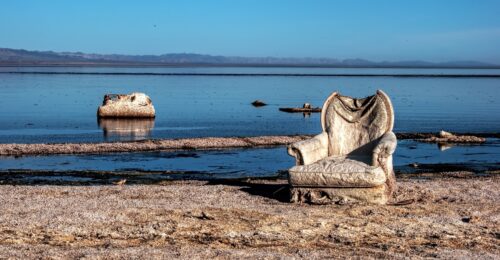 “California has launched the Salton Sea Conservancy, a new state agency to oversee restoration, manage habitat and improve air quality at the deteriorating inland lake. On Friday Gov. Gavin Newsom announced the appointment of a 20-member conservancy board, with members from state agencies, Riverside and Imperial County governments, local water districts, tribal groups and public organizations. The new conservancy is the first created in California in more than 15 years, since the Sacramento-San Joaquin Delta Conservancy was established in 2010. The new body will direct state resources toward what has long been a local problem in the Southern California desert, Newsom said in a statement. “For too long, communities around the Salton Sea have carried the burden of environmental challenges and neglect,” Newsom said in a statement. “Today, California is changing that by launching the Salton Sea Conservancy to advance cleaner air, protect public health, restore critical ecosystems, and ensure the work we’ve started creates lasting opportunities for Salton Sea communities.” … ” Read more from Cal Matters.
SEE ALSO: Governor Newsom launches first new conservancy in 15 years to accelerate progress at the Salton Sea, press release from the Office of the Governor
Along the Colorado River …
Colorado River projected to deliver one-fifth of normal water to Lake Powell after ‘astonishing’ March heatwave
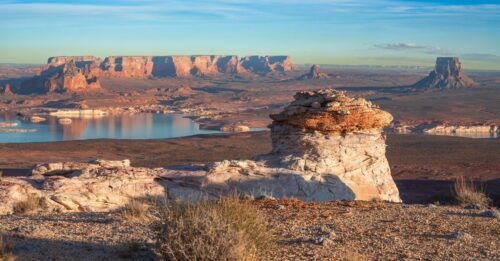
“An unprecedented March heatwave has forecasters shrinking already-low estimates for how much water will flow into the Colorado River during spring runoff, which is already well underway this year. The latest models show that the Colorado River is projected to deliver only about 1.4 million acre feet of water — roughly one-fifth of normal — to Lake Powell, the nation’s second-largest reservoir. Colorado River Basin Forecast Center hydrologist Cody Moser said during a water briefing on Tuesday, April 7, that if those projections were to bear out, it would be the third lowest amount of water delivered to Lake Powell in the reservoir’s 63 year history. … ” Read more from the Steamboat Pilot & Today.
‘It’s incredibly bad’: No end in sight to Colorado River water crisis
“The outlook for the Colorado River, and Lake Powell in particular, continues to worsen due to an historically warm winter and dismal snowpack. Projections show that Lake Powell on the Utah-Arizona border could drop low enough this year that it stops producing hydroelectric power at the Glen Canyon Dam. If it drops even lower, the dam is in danger of structural failure. Wyoming relies on some of that hydroelectric power, according to state officials. The state will also play a major, legally obligated role in trying to help prevent such a catastrophe. Primarily, the Bureau of Reclamation will release extra water from Flaming Gorge Reservoir — potentially 1 million acre feet, which is more than a quarter of its storage capacity of about 3.8 million acre-feet. … ” Read more from the WyoFile.
EXPLORE MORE COVERAGE:
- Upper basin governors urge caution on Colorado River water releases, from Colorado Biz
- Warmest winter’s impact on Colorado River deepens, Lake Powell concerns grow, from KLAS
A town in Arizona could run out of water in just three months. Here’s why.
“The Town of Kearny, Arizona, sits about 85 miles southeast of Phoenix and, as of 2023, is home to just under 2,000 people. It could also run out of water in just over three months. The town declared a state of emergency on March 30, stating that a “public health and safety emergency continues to exist,” as well as a “severe water shortage and emergency.” The state of emergency moved the town into Water Conservation Level “5WE,” the highest level of water conservation. Water use is restricted to only the most essential tasks, like bathing and cooking. Residents are even being asked to wear clothes two or three times before washing them. … ” Read more from Channel 12.
Nevada’s first water reuse project breaks ground
“A major water project is moving forward just north of Reno, Nevada, marking a first for the state. On April 8, 2026, regional officials announced plans for an advanced purified water facility designed to turn treated wastewater into a reliable new water source. The project is being developed through a partnership known as OneWater Nevada, led by the City of Reno and the Truckee Meadows Water Authority. The effort reflects a growing need across the West to stretch limited water supplies as populations grow and drought conditions persist. … ” Read more from Western Water.
A super El Niño is building. Can it bring relief to Colorado’s drought?
“Hype around the potential of a rare super El Niño, and a possibly record-breaking one at that, gives hope there may be an end to Colorado’s historic drought conditions in sight. With that hope should come a level of caution. After all, we are talking about long-range weather forecasting, which isn’t an exact science. Still, if Pacific Ocean water temperatures continue to trend warmer the way models are showing, we could see a record super El Niño. But what does that mean and how might it impact weather in Fort Collins, Colorado and around the U.S.? … ” Read more from the Coloradoan.
[spacer]
