
Several news sources featured in the Daily Digest may limit the number of articles you can access without a subscription. However, gift articles and open-access links are provided when available. For more open access California water news articles, explore the main page at MavensNotebook.com.
On the calendar today …
- MEETING: Bay Planning Coalition Water Resources Committee from 1pm to 2pm. The meeting will feature a presentation from Kelly Rodman of the State Water Resources Control Board on the Statewide Urban Stormwater Infiltration Policy, including an overview of its risk-based framework for stormwater capture and groundwater protection. The meeting will also include committee updates. Click here to register.
In California water news today …
Record heat sizzled away the snow. Here’s how California is preparing for what’s ahead
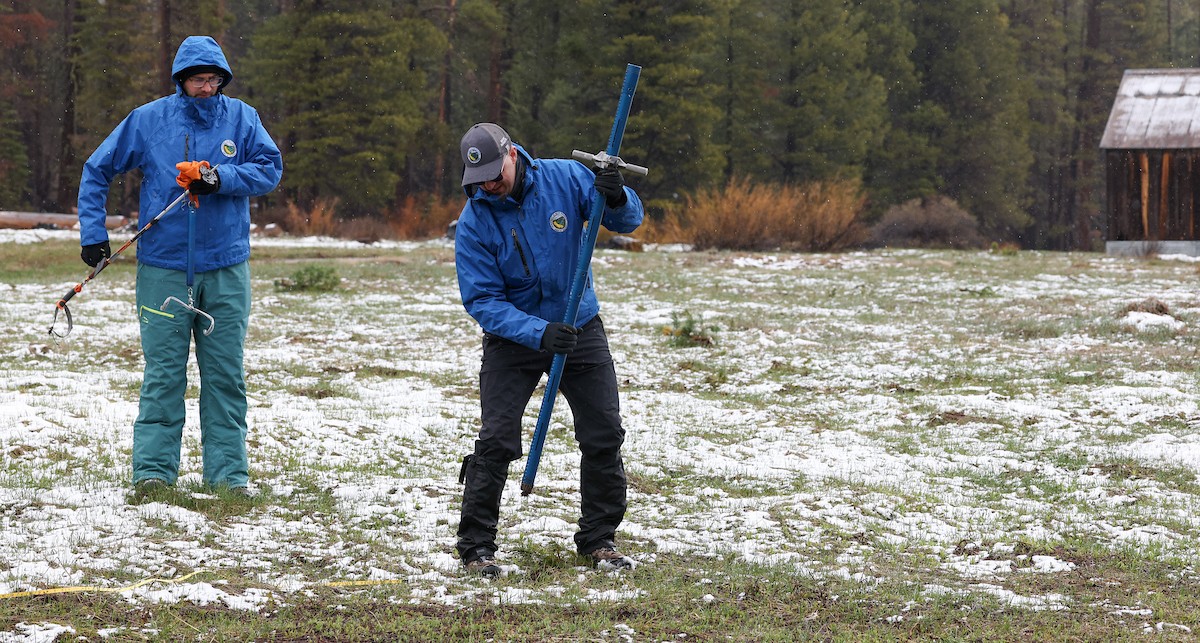
“The Department of Water Resources found no measurable snow April 1 at a place in the Sierra Nevada mountains where more than two feet of snow stood in late February. A record-breaking hot and dry March sizzled away the snow, leaving a field of mud and grass. “Are we heading into hydrologic drought?” said DWR Director Karla Nemeth at the snow survey. “The answer is, I don’t know. We could be . . . we’ll know with more clarity next year if this year in fact is the start of a hydrologic drought in California and throughout the West.” Whatever future conditions hold, California is better prepared than ever for drought. Major, recent investments and policy changes have strengthened the capacity of small and large water systems to cope with prolonged lack of precipitation. … ” Read more from DWR.
Late Sierra storm could dump feet of snow, make travel ‘difficult to impossible’
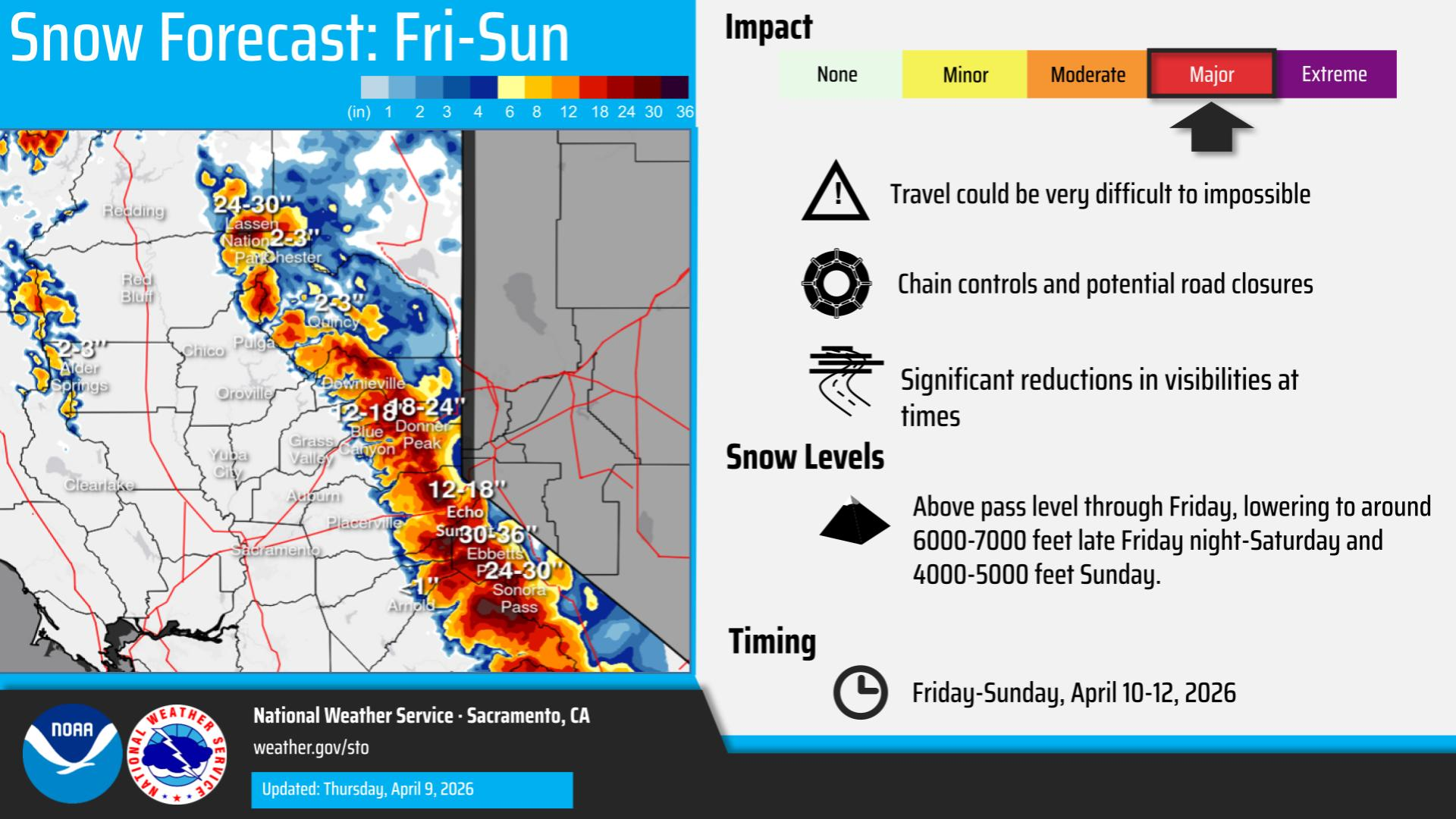 “California’s dismal snowpack is about to get a late-season boost. A weekend storm is forecast to drop feet of snow across the Sierra Nevada, prompting the National Weather Service to issue a winter storm watch. The watch is in effect from Friday evening through Saturday evening above 4,500 feet for the west slope of the northern Sierra, including Interstate 80 and Highway 50. Snow is predicted to be heaviest midday Saturday through midday Sunday, which could make travel “very difficult to impossible,” the weather service warned. … ” Read more from the San Francisco Chronicle. | Read via Yahoo News.
SEE ALSO: Northern California weather turns unsettled with rain, snow, thunderstorms, from the San Francisco Chronicle
“Super El Niño” developing. What that could mean for Northern California rain?
“The wet season is coming to an end across California, and this means we’re already starting to think about next winter. And the biggest seasonal forecasting tool we have is the El Niño Southern Oscillation, ENSO, better known as El Niño/La Niña. ENSO plays a big role in North American weather patterns. El Niño years are typically wetter and warmer across the west, while La Niña years are usually cooler and drier. In the positive phase, or El Niño, warmer-than-normal sea surface temperatures are present across the equatorial Pacific Ocean. Specifically in an area called the Niño 3.4 Region. In the negative phase, or La Niña, the opposite is true – cooler-than-normal sea surface temperatures are observed. Tracking sub-surface and surface sea temperatures, we can determine what phase of ENSO we are currently in, and what phase is coming. … ” Read more from Channel 10.
Turning flood risk into water supply: Inside DWR’s San Joaquin Basin Studies
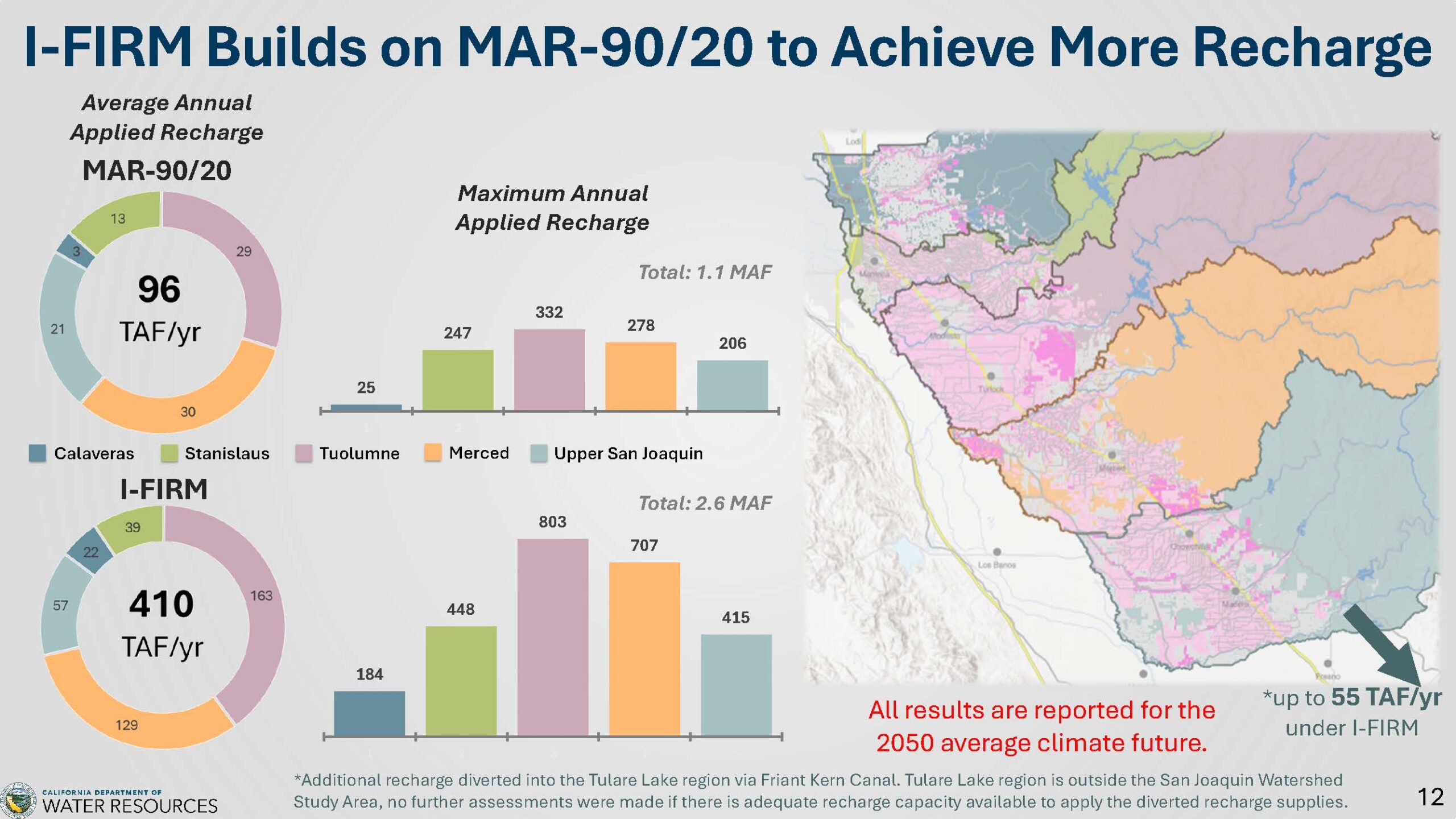 “The San Joaquin Basin faces complex water management challenges that demand a unified approach. Decades of groundwater overuse, increasing flood risks, and the accelerating impacts of climate change threaten the region’s water supplies, communities, agriculture, and ecosystems. To address these issues, the Department of Water Resources (DWR) has undertaken a series of interconnected studies, including the San Joaquin Basin Flood-MAR Watershed Studies. These efforts highlight a critical insight: the whole is greater than the sum of its parts. Implementing strategies like Integrated Forecast-Informed Resource Management (IFIRM) across all watersheds is essential to maximize benefits. Achieving this will require unprecedented coordination among multiple agencies—a challenging but achievable goal that holds the promise of a more resilient future for the entire basin. The San Joaquin Basin Flood-MAR Watershed Studies are one of three related DWR efforts that, together, provide a holistic look at water management challenges and options across the San Joaquin Valley. … ” Continue reading at Maven’s Notebook.
Small pumpers excluded from state sanctions prompting backlash and allegations that some may try to game the system
“Though the state put groundwater pumping in Kings and Tulare counties under greater scrutiny in 2024, it gave some pumpers a pass on Tuesday, April 7, from having to report extractions and pay fees to the state. That prompted complaints of fairness from some groundwater sustainability agencies (GSAs) and concerns from others that some pumpers may be gaming the system. The Water Resources Control Board voted to exclude “small pumpers,” defined as 20 acre feet or less per year, from reporting and $20-per-acre-foot fee mandates required under probation in the Tule and Tulare Lake subbasins, which include most of Kings County and the southern half of Tulare County’s flatlands. The one caveat is that small pumpers within two miles of the Friant-Kern Canal – badly damaged by subsidence – must still report extractions and pay the fees. … ” Read more from SJV Water.
SEE ALSO: State Water Board adopts minimal impact exclusions for SGMA reporting and fees in Tulare Lake and Tule subbasins, press release from the State Water Board
How much water do we have? Scientists map the water beneath our feet
“For scientists, measuring the water in a river or a lake is relatively straightforward. It’s much more complicated to figure out how much water lies underground. After years of research, a team of scientists has finally mapped what remains of these hidden waters across the United States, and they’ve produced the most extensive estimate of the country’s groundwater to date. Researchers at Princeton University and the University of Arizona took data from about 800,000 wells and applied a machine-learning model to estimate the depth of the water table nationwide. “Groundwater is out of sight and out of mind for most people,” said Reed Maxwell, a hydrologist at Princeton and co-author of the recent study in the journal Nature. “Knowing how much we have will be helpful in knowing how to use it wisely.” … ” Read more from the LA Times. | Read via Boiling Point Newslettter.
New state water plan in the works for a hotter future
“There once was a time when heavy snow in the Sierra Nevada meant California could rest assured. There would be enough water stored in the slowly melting snowpack to last through another summer, another fire season, another harvest. In recent years, as temperatures have risen, Mother Nature’s storage system is failing. Snow turns to rain sooner and melts earlier. Flood waters pour past loaded reservoirs, leaving dry season dryer with no backup in the mountains. Every five years, the state updates its plan, which is a strategy for managing its existing water resources and developing new ones for the future. On Wednesday, the DWR hosted a webinar to share recent research and invite the public to provide input in upcoming meetings of the Water Commission and the California Water Plan Advisory Committee. … ” Read more from SF Gate.
Sacramento River pulse flows help migrating salmon thrive
“The Bureau of Reclamation released water from Keswick Dam just after midnight Wednesday, causing water levels to rise along the Sacramento River. The flow reached about 10,000 cubic feet per second by 1 a.m. The increase is part of a spring pulse flow, a short-term release designed to mimic natural river conditions. The release helps juvenile Chinook salmon migrate safely to the Pacific Ocean. “We always look at the best time to do pulse flows because a lot of juvenile salmon are born naturally during this time or released from hatcheries, and this little extra kick of water helps direct them exactly where they need to go, which is out into the ocean,” said Michael Burke, public affairs specialist for the Bureau of Reclamation. … ” Read more from Action News Now.
California Forever: Solano attempts to sway maritime manufacturer
“Saronic Technologies, an autonomous maritime manufacturer, attended a meeting at the Solano County Government Building on Monday with staff from the California Governor’s Office of Business and Economic Development, Solano County, California Forever, Cal Poly Maritime, and the Solano County Economic Development Corporation, according to SED Corp CEO Chris Rico. “This is being spearheaded by the Governor’s office at a very high level,” Rico said. The meeting discussion focused on the possibility of bringing Saronic’s Port Alpha to Solano County, particularly the Solano Shipyard proposed by California Forever near Collinsville. The project could bring $3 billion of investment to the county, Rico said, but the company looks to act as quickly as possible. … ” Read more from the Vallejo Times-Herald via MSN News.
Asm. Ransom warns California running out of time to curb invasive golden mussels
“Assemblymember Rhodesia Ransom warned Wednesday that California is running out of time to contain the rapid spread of invasive golden mussels, urging immediate state action to protect water systems, agriculture and consumers. Speaking during a state budget subcommittee hearing, Ransom called for funding to establish five decontamination centers in the Sacramento-San Joaquin Delta, which she said is critical to slowing the species’ expansion into other waterways. “My community in San Joaquin County is ground zero for this infestation, and we are already seeing the damage firsthand,” Ransom said. “California has a narrow window to get ahead of this, and we are already missing it. If we don’t act now, this will only get more expensive and harder to control.” … ” Read more from Fox 40.
California bill aims to keep toxic PFAS off its crops
“California Assemblymember Nick Schultz is leading an effort to phase out the use of pesticides containing toxic “forever chemicals” to safeguard the nation’s produce. Schultz, D-Burbank, introduced A.B. 1603 earlier this year to ban the use, sale and manufacture of PFAS pesticides in California starting in 2035. The state is the nation’s top agricultural producer, its fruits, nuts and vegetables landing on plates across the U.S. California has passed so many laws to get these highly persistent, harmful synthetic chemicals out of homes and the environment, the assemblymember said at a briefing Wednesday, he was shocked to learn that pesticides with intentionally added PFAS are regularly sprayed on the state’s crops. “I was even more startled to find out that these PFAS pesticides are present on the fruit and vegetables that we purchase at the grocery store, on the fruits and vegetables that we feed our families,” Schultz said. … ” Read more from Inside Climate News.
Padilla announces more than $160 million for California ports, flood protection, and water infrastructure
“Today, U.S. Senator Alex Padilla (D-Calif.), a member of the Environment and Public Works Subcommittee on Fisheries, Water, and Wildlife, announced more than $160 million in federal funding that he secured for the U.S. Army Corps of Engineers (USACE) fiscal year 2026 work plan to strengthen California’s ports, maintain safe navigation channels, restore critical ecosystems, and reduce flood risk for communities across the state. The funding follows Padilla’s sustained advocacy to secure federal infrastructure investments for California and reflects key priorities he advanced in the annual appropriations process. “California’s ports and waterways are both an engine of our state’s economy and essential to keeping goods moving across the country,” said Senator Padilla. “This funding ensures our major ports remain competitive, our harbors stay navigable and safe, and our communities are better protected from flooding and climate impacts.” … ” Read more from Senator Alex Padilla.
Padilla, colleagues strongly oppose proposed EPA rule that would threaten state, tribal rights to regulate water quality
“Today, U.S. Senator Alex Padilla (D-Calif.) led ten Democratic Senators in strongly opposing the Environmental Protection Agency’s (EPA) proposed rule limiting the application of Section 401 of the Clean Water Act, under which states and Tribes would effectively be unable to regulate many of the water quality impacts of hydropower dams within their lands. In their letter to EPA Administrator Lee Zeldin and Assistant Administrator for Water Jess Kramer, the Senators warned that the proposed rule would eviscerate the Clean Water Act’s core principle of cooperative federalism and leave states and Tribes without the necessary authority to protect their waters. The Senators warned that EPA’s proposed rule would also reduce opportunities for Tribes to protect water quality by repealing a provision from the 2023 rule that allows them to develop their own regulations. “This is a step backward, and Tribes have not even had sufficient time to apply for or implement these new authorities before EPA seeks to reverse course. Rather than providing clarity, this change would create additional uncertainty in the regulatory process,” wrote the Senators. … ” Read more from Senator Alex Padilla.
In regional water news and commentary today …
NORTH COAST
The Everglades of the West
“Riding shotgun across Kurt Thomas’s 2,000-acre cattle ranch in Chiloquin, Oregon, feels like driving back in time. “Hold on tight, sweetheart,” he says, swerving his ATV around a beaver hole. As we move along a narrow dike in the valley, cattle are nowhere in sight. Instead, a different type of world emerges. To my left, a spring-fed tributary flows into the headwaters of the Klamath River. To my right, cattails, tules, geese, egrets, wocus, ducks, otters and beavers work overtime to run a lush 700-acre wetland. “All we had to do was stop the pumps, and within 18 months, we had 8-foot-high wetlands. Now we’ve got a creek, a wetland, a cattle ranch and no lost income,” said Kurt, 79, a first-generation Klamath rancher. “It wasn’t rocket science.” … ” Read more from Patagonia.
Klamath irrigation supply will be ‘woefully’ short
“The U.S. Bureau of Reclamation announced an initial water supply of 221,000 acre-feet from Upper Klamath Lake, just over half of what is needed for local farmers, ranchers and other irrigators, according to the Klamath Water User Association. The organization described the supply as “woefully short of need.” “It’s much less than what we want to hear, although realistically not less than what we expected at this time,” said Elizabeth Nielsen, KWUA executive director. “The entire west is in a drought, with negligible snowpack remaining in the Klamath Basin. On top of that, we have an unworkable set of regulatory requirements that can’t be changed in time for this season,” Nielsen added, in a news release. … ” Read more from the Capital Press.
Blue Lake City Council votes to settle dispute over water storage
“At a special session Tuesday evening, the Blue Lake City Council voted to approve an agreement between the city and the trustee of a site on which the city’s 400,000-gallon water storage tank sits. The agreement, “to convey an easement and joint escrow instructions between the City of Blue Lake and Erin McClure, in her capacity as Trustee of the Patricia Charley Trust,” has been an issue for the past 15 years, as the city’s previous lease agreement expired in 2011. In recent years, McClure and the city have attempted to reach an agreement. Those negotiations seemed to come to a boiling point at the end of 2025 when City Attorney Ryan Plotz sent a letter to McClure declaring that “the council desires to try one last time to reach a deal.” At that time, McClure said that she feared that the city would attempt to claim the property through eminent domain, and she took to social media to voice her displeasure with the city. … ” Read more from the Eureka Times-Standard.
Inside California’s audacious bid to build the world’s deepest floating wind farm
“Here along the rugged North Coast of California, there’s little to suggest that Humboldt Bay, with its eelgrass, oysters and osprey nests, will soon become a launchpad for one of the most ambitious clean energy projects in state history: a hub for floating offshore wind. The plan is for major private players to erect hundreds of wind turbines in the bay — each rising as high as L.A.’s tallest skyscrapers — then tow them out to the ocean. Some experts believe the wind project is critical to California’s goal of 100% carbon neutrality by 2045 and represents a key climate change solution. The state has a target of 25 gigawatts of offshore wind energy by that year — enough to power about 25 million homes — and nearly all of it would come from five lease areas in federal waters near Humboldt and Morro bays. Yet the technology for wind power that floats — as opposed to standard towers permanently attached to the sea floor — is just emerging, and has never been attempted in waters as deep as the Pacific off Northern California. … ” Read more from the LA Times. | Read via Yahoo News.
Protecting salmon and steelhead in the Navarro River
“Salmon and steelhead are fundamental to the health of the Navarro River watershed, but decades of low population numbers tell a troubling story. Historically, tens of thousands of salmon and steelhead would return from the ocean each year and fight their way back upstream to the Navarro headwaters to spawn. A century of water diversions, extensive logging and overfishing have caused salmon populations to decline. We have reasons for hope: in winter 2024-2025, we saw an exciting increase in salmon returns. But there are even more reasons for action: in all other years since monitoring began in 2008, only hundreds of coho returned. TNC is working to ensure more water in streams when salmon need it, for a future with more salmon. We’re partnering with water users in the Navarro River watershed to develop solutions for nature and people. … ” Read more from The Nature Conservancy.
SACRAMENTO VALLEY
Anderson installs solar panels at wastewater treatment plant to cut long-term costs
“The city of Anderson has completed a 757-kilowatt solar array project at its wastewater treatment plant. The panels, installed by Schneider Electric, are expected to generate more than $7.5 million in guaranteed energy savings over the next 20 years. “Our wastewater treatment plant is one of the most energy-intensive facilities we operate. With rising energy costs, it became clear we needed smarter, more sustainable solutions,” said Adam Whelen, the city’s public works director. The city has obtained grandfathered status under PG&E’s Net Energy Metering 2.0 program, ensuring favorable solar credit rates for years to come. … ” Read more from KRCR.
Butte County seeks federal help on Afterbay Project
“The Butte County Board of Supervisors has asked President Donald Trump to help move forward a long-planned recreation project near the Thermalito Afterbay, saying a federal delay now threatens the project’s future. The project includes a new boat ramp, day-use area and campground led by the Sutter Butte Flood Control Agency. The agency has secured all required state and federal permits except for final approval from the Federal Energy Regulatory Commission. That approval must come by April 13 so the agency can award a construction contract before its bid and grant timelines expire. County officials said the project has broad support from local and tribal communities and would bring long-needed recreational access to a heavily used area near the Afterbay outlet. … ” Read more from the Gridley Herald.
Folsom staff explains law restricting lawns
“Folsom institutions can keep ornamental lawns as long as they don’t irrigate with drinking water. City staff recently explained Assembly Bill 1572, the new law targeting decorative public lawns across the state. The conservation effort aims to replace unused grass with water-wise landscaping. Beginning next year, the legislation generally phases out drinking water to irrigate nonfunctional turf. The law does not apply to single residential homes, authorities stressed. “The change is designed to preserve California’s water resources, prepare for long-term water shortages and more effectively manage our state’s drinking water supply,” said water chief Marcus Yasutake at the March 24 City Council meeting. The Folsom Director of Environmental and Water Resources gave an overview to the City Council with steps planned for outreach to affected property owners. … ” Read more from Gold Country Media.
BAY AREA
Storms sweeping bay area this week to bring rain and thunderstorms
“After a streak of sunshine, forecasters said storms are likely to bring rain, potential thunderstorms, lightning and hail to the Bay Area this week, with some snowfall in the Sierra Nevada. Thursday will remain mostly dry, but overcast with “a little more shower activity” across the North Bay, which indicates a low-pressure system is brewing, said Dylan Flynn, a meteorologist with the National Weather Service’s Bay Area office. Friday is when the potential for rain and thunderstorms kicks up across the Bay Area, as the storm drifts over the Pacific Ocean toward the state. Flynn said the slow, erratic storm will hit the coast Friday, but it’s hard to say exactly where it will make landfall. … ” Read more from KQED.
Editorial: Slow rollout of MMWD smart meters is worth it
The Marin Independent Journal editorial board writes, “For more than a decade, the Marin Municipal Water District has talked about having all of its analog meters replaced with smart meters. In fact, by 2022, the district had plans to complete the conversion by 2026. After those plans were sidetracked by the cost and software hitches, MMWD leadership is now set to complete the task by 2036. Smart meters are the norm for many Bay Area communities. The meters provide ratepayers with real-time data on their water usage. They also provide agencies the ability to detect large leaks and repair them – a benefit to both the customer and the district’s water supply. Although a proven tool for conserving water, MMWD – which has long focused on conservation – has been slow to complete the conversion. … ” Read more from the Marin Independent Journal.
Wagner Ranch Nature Area planning gets underway
“Around 100 people attended a community meeting at Wagner Ranch Elementary School in Orinda on March 24. The meeting was hosted by the John Muir Land Trust (JMLT), which acquired the property from the Orinda Union School District in December last year. The purpose of the meeting was to begin planning for the restoration and renewal of the property and for its future use under the auspices of the land trust. JMLT Executive Director Linus Eukel opened the meeting. “We think it is a gem,” he said, “and something that serves the public beautifully.” Being close in, the nature area is a good public gathering place, according to Eukel. … ” Read more from La Morinda Weekly.
Palo Alto group buys Coyote Valley farmland in San Jose for $5.3 million
“In the latest step to preserve agriculture and open space in Coyote Valley, the largely undeveloped area on San Jose’s southern edges that was once planned for large technology campuses, a non-profit environmental group has purchased a 71-acre farm to keep it rural for generations to come. The Peninsula Open Space Trust, based in Palo Alto, paid the O’Connell family, which had owned the property since the 1950s, $5.3 million. The farm grows bell peppers, corn, and lettuce, along with pumpkins, for the nearby Spina Farms Pumpkin Patch, a popular attraction for South Bay families at Halloween. Located along Santa Teresa Boulevard just south of Bailey Avenue and west of Highway 101, the land had been considered a potential site for a battery storage plant and other development. Instead, it will be transferred to the Santa Clara Valley Open Space Authority and continue to be leased to B&T Farms, the current tenant. … ” Read more from the San Jose Mercury News.
CENTRAL COAST
Santa Cruz Wharf sets date for full reopening, but some of its defining features will be absent
“When the Santa Cruz Wharf fully opens this month — more than a year after a winter storm tore away 180 feet of its sea facing end — visitors will find a landmark that is smaller and without some of its defining features. The approximately $1 million repair project is restoring a 1,200-square-foot area at the tip of one of the world’s longest wooden piers. But the rebuilt area includes just one sea lion viewing opening, compared with four before the collapse. There are no confirmed plans to rebuild the 180 feet of structure destroyed in the storm or the Dolphin Restaurant, which once stood at the wharf’s edge. The wharf, which will return with an April 29 ribbon cutting, draws more than 1.5 million visitors each year, traffic that supports the shops and businesses tied to about 10% of the city’s local economy. Some visitors said on social media that they were disappointed by the reduction in sea lion viewing holes, a signature feature of the pier. … ” Read more from the San Francisco Chronicle.
Water quality enforcement penalties boost Salinas River beaver renaissance
“Funding from a 2021 settlement agreement between the Central Coast Regional Water Quality Control Board and Pacific Gas and Electric Co. is supporting the Drinkable Rivers Program in San Luis Obispo County, a program that puts elected officials, students and others on the water to witness the benefits of beaver dams and ponds. “The program not only helps the river, wildlife and the environment, it also directly involves the public,” said Ryan Lodge, executive officer of the Central Coast Water Board. “Providing hands-on experience for people who care deeply about the environment builds support for protecting the Salinas River in the long term. Additionally, the settlement with PG&E for water quality violations illustrates how our enforcement actions can both serve as a deterrent and lead to measures that benefit the public and the environment.” … ” Read more from the State Water Board’s Ebb and Flow.
Monterey County seeks input on environmental health risks in unincorporated areas for a first-ever policy.
“Katie Rodriguez here, thinking about how difficult it can be to translate policy language into what it actually means in terms of community impact. Take the Monterey County Environmental Justice Element (EJE) as an example. A draft of the plan is now available for public review through Monday, May 11. The EJE is a requirement mandated by California Senate Bill 1000, which went into effect in 2018, requiring county general plans to address degraded environmental conditions that may lead to inequitable outcomes. What that means: The EJE requires local governments to map out which communities suffer from the highest levels of pollution with the least resources, using this information to adopt policies that reduce the disproportionate health risks, pollution exposure and land-use inequities. Studies have shown that residents in such areas, as a result, are more likely to suffer from a lower quality of life and worsened health outcomes compared to areas that are more affluent. … ” Read more from Monterey County Now.
SAN JOAQUIN VALLEY
Stanislaus farmers avoid state groundwater intervention with board decision
“A groundwater subbasin in western Stanislaus and nearby counties is no longer threatened with state probation, thanks to a water board decision Tuesday. The state Water Resources Control Board took action to move the Delta-Mendota Subbasin back to the jurisdiction of the California Department of Water Resources. Under the Sustainable Groundwater Management Act, groundwater agencies are referred for “state intervention” if they’re not showing they can manage groundwater sustainably. Twenty-three agencies, including the cities of Patterson and Los Banos and many water districts, are in the Delta-Mendota Subbasin, which was referred to the state Water Resources Control Board in 2023 for intervention because their sustainability plans were inconsistent and would not result in stable groundwater levels. Faced with state fees and well monitoring, the local agencies adopted a unified plan that included improvements and a mitigation program for drinking water wells…. ” Read more from the Modesto Bee.
Los Banos Creek Detention Dam Project completed, expands water management capabilities
“Local, state, and federal agencies this week marked the completion of the Los Banos Creek Detention Dam Project, an upgrade to an existing flood-control facility designed to improve water management in western Merced County. The Los Banos Creek Detention Dam, originally constructed in 1966 by the U.S. Bureau of Reclamation, was built to capture floodwaters and protect the San Luis Canal, Delta-Mendota Canal, and nearby communities, including Los Banos. According to project documents, the completed work modifies how the reservoir operates, allowing it to function as both a flood-control facility and a managed water system. … ” Read more from the Los Banos Enterprise.
‘Human composting’ along San Joaquin River sparks debate. But what’s behind it?
“The wind moves softly through the trees at Sumner Peck Ranch, along the San Joaquin River north of Fresno. Much of the soil here looks as normal as one would expect soil to look – green and earthy – but some of this is different. It’s been composted not from food scraps, but from human bodies. Some people call it “human compost,” but Sharon Weaver prefers a different term. “It is technically called natural organic reduction soil,” said Weaver, who is executive director of the non-profit San Joaquin River Parkway and Conservation Trust. Whatever it’s called, it’s derived from human remains. … ” Read more from KVPR.
Arvin-Edison Water District to expand groundwater recharge facilities
“With the help of Congressman David Valadao, the Arvin-Edison Water District will be expanding its groundwater recharge capacities. The $2 million project will include converting about 160 acres of farmland in the 22nd Congressional District into groundwater recharge facilities to help strengthen water sustainability in the region. The expanded project will help bank more water underground that can be stored until it is needed in hotter, drier years. “Water will go underground, and it stays there until we need it,” said Jeevan Muhar, the chief executive officer of the Arvin-Edison Water District. “This happens to be one of those years.” … ” Read more from KGET.
California orders Kern County oil producer to clean up its wells. Its owner is already facing prison.
“California’s energy regulator is trying to force a Kern County oil operator to clean up oilfields that have been out of compliance but whose owner is already facing a lengthy prison sentence. The California Geologic Energy Management Division (CalGEM) earlier this year issued an emergency order to 25 Hill Properties Inc. and its owner, Ronald Engelberg, ordering the firm to remediate an out-of-compliance oilfield sump and out-of-service tank. In February, Engelberg pleaded not guilty to five criminal and civil felony charges before a Kern County Superior Court judge and was released on bail. The charges came after CalGEM staff discovered an uncovered pit containing oil, water and a dead bird during an inspection at the Jameson Trust, located south of the city of Taft. Inspectors also found dead birds and rodents in an out-of-service oil tank previously identified as being out of compliance in 2021. … ” Read more from KVPR.
EASTERN SIERRA
Controversial mining project on Conglomerate Mesa greenlighted despite widespread opposition
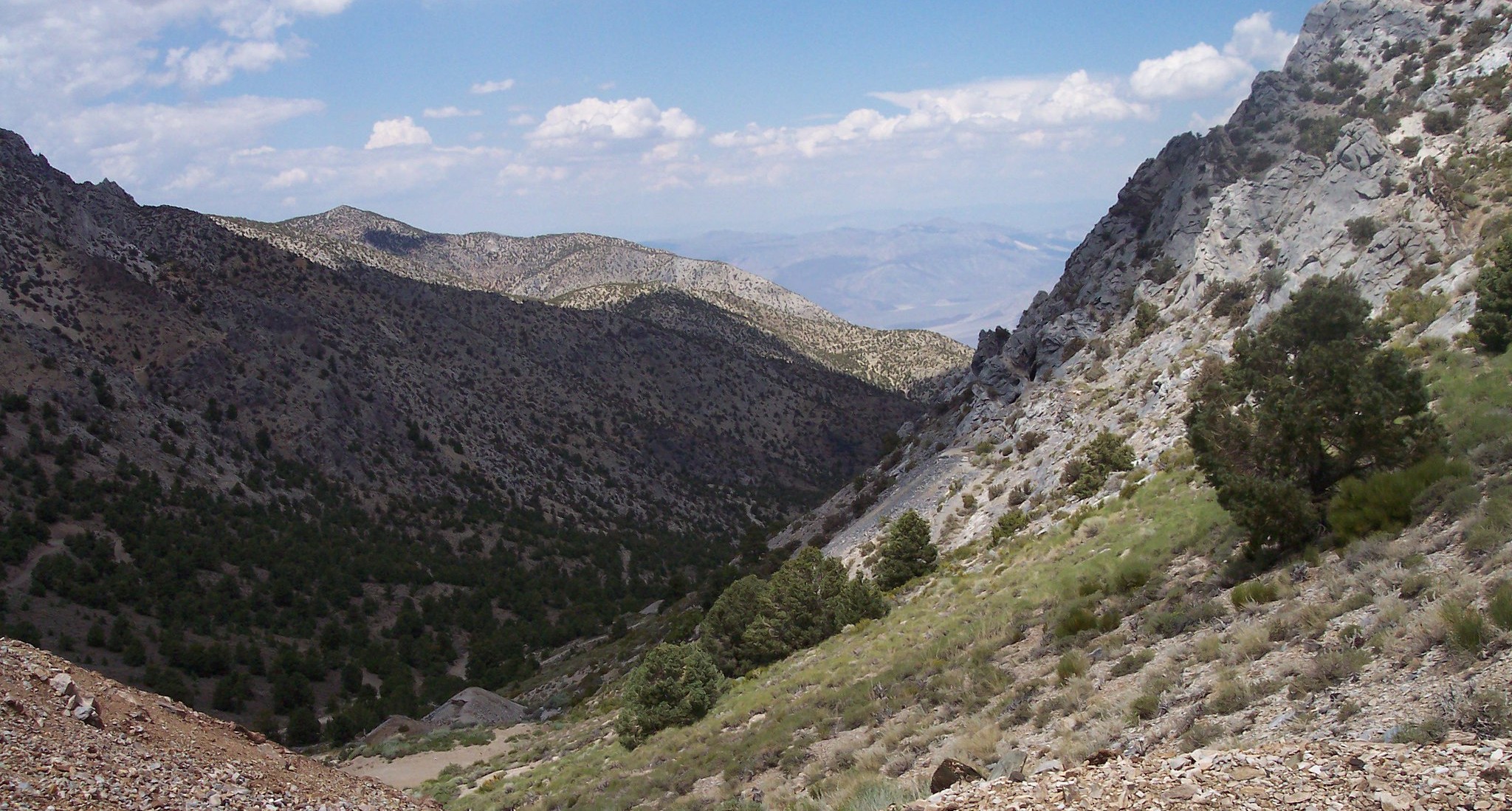
“On April 6, 2026, the Bureau of Land Management approved a proposal for an expanded mining exploration drilling project at Conglomerate Mesa, located on traditional homelands of the Paiute-Shoshone and Timbisha Shoshone and about one mile west of California’s Death Valley National Park. In a letter of opposition, the Lone Pine Paiute-Shoshone Reservation stated, “The Lone Pine Paiute Shoshone Tribe has concerns for the area, as it was used by our people long ago when they traveled through to other areas; our people picked pine nuts, hunted, and camped there. Traces of our uses are still relevant today. It would be a shame to open it up to mining, which we are opposed to.” In this next phase of destructive gold mining exploration, Canadian company K2 Gold, through its subsidiary Mojave Precious Metals, had proposed significant new road construction and 120 drill holes at 30 sites on Conglomerate Mesa. After receiving over 14,000 public comments on the Draft Environmental Impact Statement (DEIS), mostly in opposition to the project, the BLM and the mining company decided to opt for an alternative that limits the exploration to 76 drill holes at 22 sites, with no road construction and access via “helicopter only.” … ” Continue reading this press release from Friends of the Inyo.
SOUTHERN CALIFORNIA
Heat gives way to cooler weather in Southern California — and probably rain
“After a stretch of warmth, Southern California is cooling down heading into the weekend — with rain and a slight chance of thunderstorms in the forecast. The cooling trend will visit Los Angeles and Orange counties and the Inland Empire, with two rounds of precipitation expected from late Friday through Monday, according to the National Weather Service. The coolness follows earlier bouts of 90-degree temperatures across Southern California. On Thursday, April 9, as an onshore flow strengthens, cloud cover and slightly lower temperatures will land through the end of the week. … ” Read more from the LA Daily News.
LA water reservoir shutdown sparks fury as residents fear another Palisades disaster
“Fury is erupting in a fire-prone corner of Los Angeles after residents learned two key reservoirs meant to protect their community will be taken offline, raising fears of a repeat of the 2025 devastation in the Pacific Palisades. The Pacoima Reservoir and Big Tujunga Reservoir, both located in the Sunland Tujunga area — where steep canyons press up against dense neighborhoods — are both slated to undergo restoration projects. The county-led efforts include the Pacoima Reservoir Restoration Project and sediment removal work at Big Tujunga Reservoir. Both aim to address years of buildup caused by repeated wildfires and storm runoff that have filled the reservoirs with debris and reduced their capacity. The big problem: Both projects require lowering water levels, sometimes significantly, during the dry season, when wildfire risk is at its peak. … ” Read more from the New York Post.
IMPERIAL/COACHELLA VALLEYS
California residents are split over a local lithium treasure trove
“An estimated $500 billion worth of lithium lies below the Salton Sea, a large lake in Imperial County, California, east of San Diego, and many people are eager to tap into this “white gold mine.” But the sea is located in a region of the Golden State where there are already numerous environmental concerns, and some residents worry that plundering for lithium could exacerbate the problem. There has been a renewed push to extract the Salton Sea’s lithium, as the mineral is crucially important for rechargeable electric batteries. The lithium in question could likely “power our smartphones, electric cars and electricity grids,” said Soumya Karlamangla at The New York Times, and a modercry’s abundant natural resources. … ” Read more from The Week.
Brawley officials push back against social media rumors of new data center
“City officials are setting the record straight following a wave of social media speculation regarding the future of the former Brawley Water Treatment Plant. In a formal announcement released Monday, the City of Brawley clarified that recent claims circulating online about a proposed data center at the site are entirely unfounded. According to city administrators, there is currently no paperwork, interest, or official dialogue regarding such a project. “This claim is not based on any official submission, communication, or application received by the City of Brawley,” the city stated in an official advisory. “No development application, feasibility request, or project proposal for a data center has been filed with the city.” … ” Read more from the Imperial Valley Press.
Imperial County takes step to advance controversial data center
“The Imperial County Board of Supervisors on Tuesday approved a key lot merger that advances a proposed data center project, clearing a major hurdle and opening a path toward construction. The decision came during a contentious public hearing marked by restricted public access, vocal protests, and at least one arrest. As County News reported last month, the massive project has drawn criticism from some community members and the City of Imperial, particularly over environmental concerns. Concerns include pollution, water use, and the potential strain on local infrastructure. The city has accused the county of improperly approving the project without adequate environmental review, arguing that the data center was wrongfully exempted from the California Environmental Quality Act (CEQA). … ” Read more from California City News.
SAN DIEGO
State Bill to protect workers from Tijuana River Pollution passes committee
“A state bill that helps ensure people working near the Tijuana River Valley will have appropriate protection and training passed on Wednesday in the Senate Committee. SB 1046, sponsored by Sen. Catherine S. Blakespear (D-Encinitas), was enacted to protect workers from exposure to ongoing pollution in the Tijuana River Valley. The bill would set safety standards for workers exposed to hazardous transboundary pollution crossing the California-Mexico border. The bill passed Wednesday in the Senate Labor, Public Employment and Retirement Committee. … ” Read more from Fox 5.
Along the Colorado River …
March heat wave fueled worst end-of-winter snowpack on record
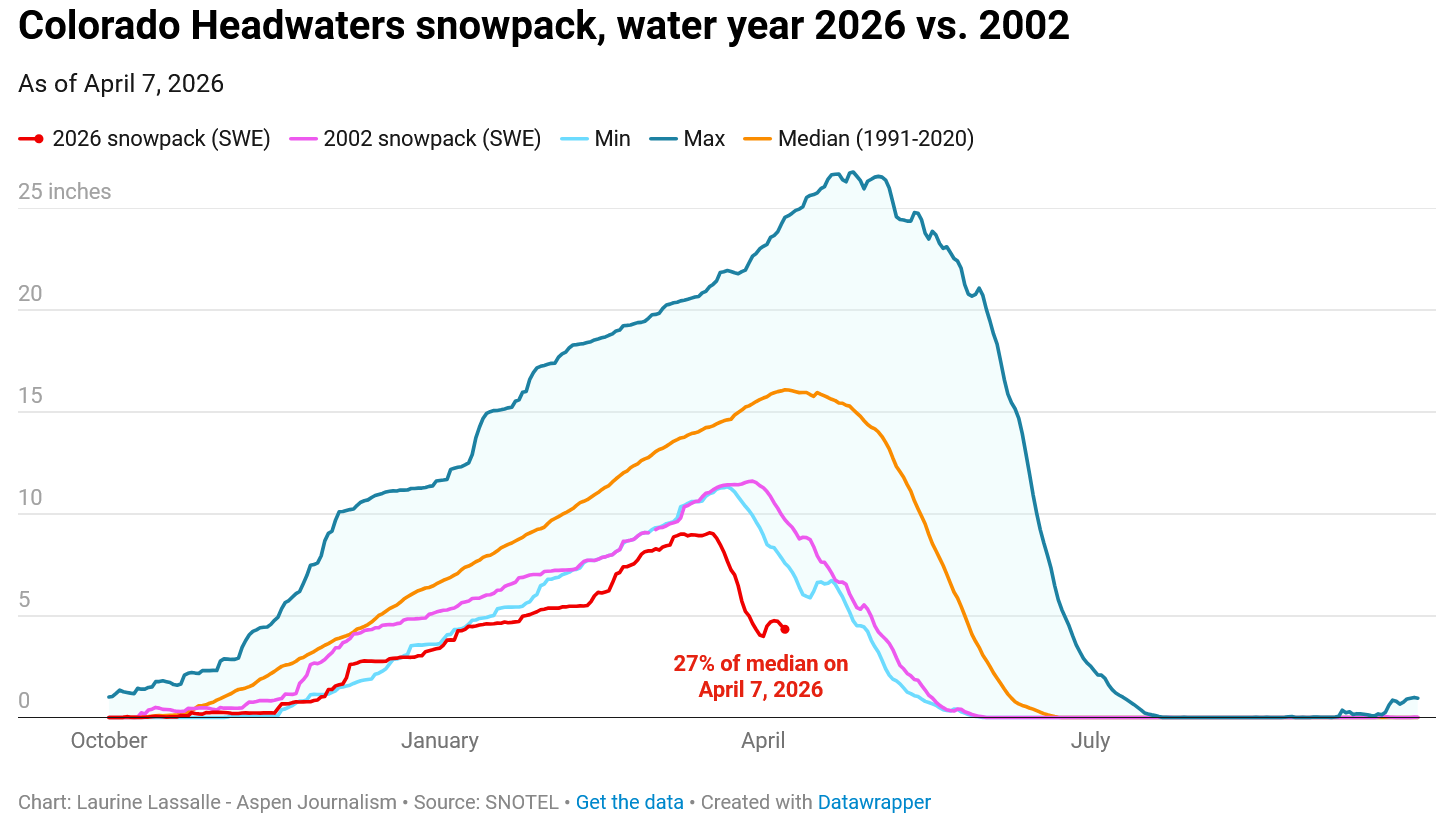 “Water managers are planning for an extremely dry summer as Colorado wraps up winter 2026 with the worst snowpack on record for early April. The Colorado River basin has seen slightly drier water years, but never a hotter one in the era of modern record keeping. A March heatwave that broke records statewide fueled an early peak of the snowpack, followed by rapid melting. This was the warmest March in 132 years of record-keeping for Colorado – three to four degrees Fahrenheit warmer than any other March, according to the Colorado Climate Center. “Climate change definitely raises the probability of heat waves significantly,” said Peter Goble, assistant state climatologist at Colorado State University. “This heat wave was so far out of the range of what we’ve seen in March before that I don’t expect this to be the new normal, but it was certainly made to some degree more likely by climate change.” … ” Read more from Aspen Journalism.
Lake Powell’s water forecast was bad. A record-hot March made it worse.
“After a record dry winter and a summer-like March, the latest water outlook for Lake Powell and the greater Colorado River Basin shows an increasingly grim future. “This water year is going to be extremely difficult,” said William Merkley, manager of the Uintah Water Conservancy District. Powell will receive 1.4 million acre-feet of inflow this April to July — just 22% of average, according to the April 1 forecast from the Colorado Basin River Forecast Center. That’s a nearly 1 million acre-feet drop from the center’s March forecast. That could mean an even worse outlook for Powell than last forecasted by the Bureau of Reclamation in its March report, which showed Powell dropping below “power pool,” or 3,490 feet, by the end of December. At that level, Glen Canyon Dam can no longer produce electricity and can’t sustain long-term releases downstream to Arizona, California, Nevada and Mexico. … ” Read more from the Salt Lake Tribune.
Colorado River basin under increasing strain; will cutting back on water use be enough to help?
“As drought conditions intensify across the American West and the impact of climate change accelerates, cities such as Phoenix, Denver and Las Vegas may face a sobering reality. While it certainly helps, water conservation may no longer be enough. For decades, cities across the Colorado River basin have successfully implemented and relied upon conservation efforts to reduce water use and stretch limited supplies, all while planning for the future and supporting economic growth. The basin itself supplies water to nearly 40 million people and millions of acres of farmland, but it is under increasing strain. Prolonged drought, rising temperatures and declining water flows — combined with Lake Mead’s falling storage levels — are redefining the limits of what conservation alone may achieve. … ” Read more from Arizona State University.
Video: As shrinking Colorado River imperils California agriculture, data centers seek more water
“Imperial Valley, a desert region located in the southeast corner of California, has one water source: the Colorado River. Large amounts of river water have allowed the area to become an agricultural powerhouse, producing two-thirds of the vegetables Americans eat in the winter. But over the past century, the river’s water supply has fallen nearly a third due to overuse, prolonged drought and climate change. That continued decline has farmers worried about the future of their industry in the region. At the same time, AI data centers, lithium extraction and geothermal energy projects are set to increase their water use in the area. On the border with Arizona, the Indigenous Quechan tribe is also grappling with a drying river, which threatens to upend their farm-based economy and undermine their cultural identity.” Watch video at Capital & Main.
Commentary: A record-hot March. Now comes an El Niño?
Allan Best writes, “Just what we need in Colorado, an El Niño that could cause a hotter-than-average summer for the Western United States and other parts of the globe, continuing into 2027. Risk of an El Ninõ has been rising, reported the Washington Post on Monday citing the work of a medium-range weather forecasting organization. This one could push global temperatures to record levels, particularly in 2027. “Real potential for the strongest El Ninõ event in 140 years,” wrote Paul Rondy, a professor of atmospheric science at the State University of New York at Albany. This, explained the Post, could also yield milder winter temperatures in the United States. We already know something about warm winters. November was the third warmest November on record in Colorado. December and February broke records, as Colorado state climatologist Russ Schumacher has reported. … ” Read more from Big Pivots.
Cloud seeding could be a cost-effective way to put a little more water in the Colorado River
“In all of our reporting on drought and the heat in the Southwest, have you ever thought, “Man, it’d be nice if we could just make it rain right now. We really need some rain”? Well, as you may or may not know, we actually can do that. It is called cloud seeding, and it’s being used here in Arizona and in states across the West to literally make clouds rain or snow. But we’ll get into that in a moment. The question is, how much water can it add to our increasingly dry climate? Could it, for example, make a dent in the water supply headed to the Colorado River as negotiators continue to fail to make a deal to conserve the river’s water supply and threaten our collective water future? For some insights on those questions and more, I’m joined by KJZZ’s Alex Hager, who covers water for us. Good morning there, Alex. … ” Read transcript or listen to show at KJZZ.
ASU-SRP snow surveys show much of Arizona’s headwater snowpack melted in weeks
“Arizona’s mountain snowmelt provides a significant portion of the Phoenix metropolitan water supply. Results from a new airborne snow survey over northeastern Arizona found that due to a dry and warm winter, most of the snow water measured in January and February had melted by mid-March, offering water managers an unusually clear view of how quickly the season changed. Gathering critical data on just how much water is available can help Salt River Project manage it. The Upper Black River Basin in eastern Arizona, where the surveys were conducted, may be remote, but the snow that falls there feeds the Salt River system upstream of Roosevelt Dam. It is part of SRP’s network of reservoirs that supply water to more than 2.5 million people in the Phoenix metropolitan area. Three airborne snow surveys conducted this winter tracked how much water was stored in the basin’s snowpack. … ” Read more from Arizona State University.
Nevada Commentary: The war on grass is killing our trees
Norm Schilling, a longtime desert horticulturist, writes, “When the Southern Nevada Water Authority’s turf conversion program started in 1999, I was on board with the idea. I was a true believer, an environmentalist and conservationist who’d proudly served for many years as lead groundskeeper at its partner agency, the Las Vegas Valley Water District. The rationale behind the Water Smart Landscapes rebate program was valid: There was simply too much grass that served little to no purpose in Southern Nevada. Much of it was irrigated inefficiently, especially on highly sloped surfaces that caused a huge amount of runoff and water waste. I strongly believed then — and still do now — that a desert landscape is far more beautiful than a boring lawn. The water authority’s cash-for-grass incentive started off paying people 50 cents per square foot of grass removed from their yards. It later increased to $1, and it’s risen to roughly $7 per square foot today. (For its part, the water district contributes to the incentives by discouraging lawns through excessive use charges — without necessarily considering factors such as property size, number of residents or existing vegetation, but that’s another subject.) … ” Read more from the Nevada Independent.
Colorado’s drought is hitting every city differently. Here’s why.
“Water managers across the Denver metro area are responding to one of the worst snowpack seasons on record – but not all in the same way, or on the same timeline. From Denver to Aurora to Boulder to Thornton and Arvada, cities are either implementing or considering water restrictions this spring. The reason each municipality moves at a different pace comes down to a patchwork of reservoirs, water rights and supply contracts that make drought a uniquely local problem to solve in different ways, even when it’s a regional one. “It’s not a one-size-fits-all approach for drought,” said Shonnie Cline of Aurora Water. … ” Read more from Channel 9.
In national water news today …
Trump wants to remake the way we fight wildfires. The stakes couldn’t be higher.
“The Trump administration on Friday outlined the most detailed plans yet for its new Wildland Fire Service, which would overhaul how the nation fights wildfires in the run up to what experts say could be one of the worst U.S. fire seasons in recent memory. As intense drought conditions turn the American West into a tinderbox, firefighters and fire policy experts argue a unified super agency will help the country confront a new era of megafires. But congressional Democrats and public lands advocates warn it could strip away even more employees from land management agencies weakened by the U.S. DOGE Service. The Interior Department launched the Wildland Fire Service in January, combining all firefighting operations previously overseen by the department’s Bureau of Land Management, National Park Service, Fish and Wildlife Service, Bureau of Indian Affairs, Office of Aviation Services and Office of Wildland Fire. On Friday, the administration elaborated how it would operate the new agency for fiscal year 2027, proposing a $4 billion budget and 4,500-person staff. The plan also would fund a new center for centralizing wildfire intelligence. … ” Read more from the Washington Post.
Climate change denial sees a resurgence in Trump’s Washington
“Climate change is a hoax perpetrated by “leftist politicians.” Fossil fuels are the greenest energy sources. More carbon dioxide in the atmosphere will be harmless. These were some of the false claims made at a conference on Wednesday held by groups that reject the overwhelming scientific consensus on climate change. What might have seemed like a fringe event in years past this time boasted a prominent keynote speaker: Lee Zeldin, the administrator of the Environmental Protection Agency and one of President Trump’s possible choices for the next attorney general. “We aren’t just following blind obedience to whatever the dire, doom-and-gloom prediction of the day is,” Mr. Zeldin said at the conference, which drew around 220 attendees to the basement ballroom of a hotel in downtown Washington. … ” Read more from the New York Times.
The US just experienced its hottest March on record
“The United States experienced its hottest average temperature on record for March, with 10 states experiencing their hottest March in 131 years, according to new data released by NOAA. “The continental U.S. average temperature in March was 50.85°F, 9.35°F above the 20th-century average, marking the first time any month’s average has exceeded 9°F above that baseline,” NOAA said. March included several heat waves across the nation. A total of 1,432 counties — covering 52.8 percent of the nation and 38 percent of the population of the U.S. — had never been warmer in March, NOAA said. … ” Read more from AccuWeather.

