
Several news sources featured in the Daily Digest may limit the number of articles you can access without a subscription. However, gift articles and open-access links are provided when available. For more open access California water news articles, explore the main page at MavensNotebook.com.
On the calendar today …
- MEETING: State Water Resources Control Board beginning at 9am. Agenda items include Consideration of a proposed Resolution to return the Delta-Mendota Groundwater Subbasin to the Department of Water Resources consistent with SGMA; Consideration of proposed resolutions to adopt an Exclusion of small pumpers in the Tule Subbasin and Tulare Lake Subbasin from the requirement for reporting in basins designated probationary pursuant to SGMA; Recycled Water Research Program Updates; and Discussion on yearly Board Priorities. Click here for the full agenda.
In California water news today …
Strongest El Niño in a century? What this rare phenomenon could bring.
“The chances for a planet-warming super El Niño this year are rising, according to an updated model forecast issued Sunday. The latest ECMWF outlook indicates there’s a high chance for a supercharged version of the climate pattern that affects regional-to-global weather patterns this summer or fall, doubling down on a super El Niño prediction from last month. During a typical El Niño, a warming patch of water in the equatorial Pacific Ocean influences what regions experience droughts, floods, extreme heat, hurricanes and declining sea ice. During relatively rare super El Niño events, happening once every 10 to 15 years on average, the effects may be stronger, more persistent and more widespread. That’s because sea temperatures in that key region of the Pacific Ocean warm more than 2 degrees Celsius (3.6 degrees Fahrenheit) above average, leading to a strong atmospheric response — typically peaking in December or January. … ” Read more from the Washington Post.
A biblical megaflood could hit California at any moment. And that’s only the beginning
“California. The Golden State. Home to almost 40 million people and the world’s fourth-largest economy, it is a global capital of technological innovation and the epicentre of the entertainment industry. But beneath the glitz and glamour, prosperity and prestige, the state is a natural disaster hotspot. From earthquakes to wildfires, Californians are accustomed to battling the forces of nature. … California is built on extremes at both ends. Alongside vast wealth sits deep poverty; alongside years of drought and fire come episodes of torrential rain and devastating floods. Only in 2023, hundreds of thousands were left without power as storms and flooding battered the state. Highways collapsed, trains derailed, and thousands were evacuated from their homes. That sounds bad enough, but according to the latest research, episodes like this pale in comparison to what’s to come. Scientists and officials are now preparing for not one threatening storm, but a 30-day maelstrom of megastorms unlike anything seen in the state for almost 200 years. … ” Read more from BBC’s Science Focus.
Late-week storm to bring some rain, mountain snow to California before spreading into Southwest
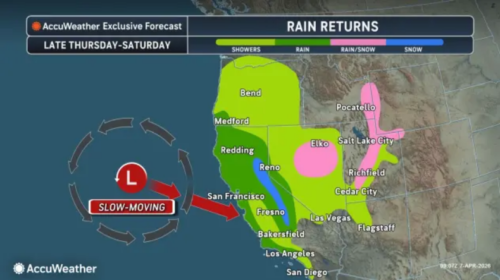 “A storm from the Pacific is forecast to spin slowly toward California later this week before drifting inland over the weekend, bringing some much-needed rain and a bit of high-elevation snow. While the storm is far from the strongest of the rainy season, its extended duration will bring multiple days of showers for some locations. Dry weather will persist across much of the West through midweek, along with a renewed warming trend in parts of the interior Southwest. Meanwhile, a departing storm will bring showers and thunderstorms to New Mexico and Colorado into Tuesday night. … The first showers from the Pacific storm will arrive along the northern California coast Wednesday night and reach the San Francisco area on Thursday. … ” Read more from AccuWeather.
The weather system off California’s coast is making a beautiful circle in the sky
“The weather pattern that will hit California this week looks spectacular on satellite. Imagery from the NOAA GOES-West satellite, orbiting 22,236 miles above the surface, shows a large spiral of clouds spinning off the California coast. That spiral is a cut-off low. A cut-off low forms when a dip in the jet stream deepens so dramatically that it pinches off entirely, leaving a pocket of cold air spinning in isolation with no steering flow to push it along. The system slows, wobbles, and can linger for days, making it one of the harder setups for forecasters to pin down. … This particular cut-off low will take its time moving toward California and won’t get close to the coast until sometime on Thursday. … ” Read more from the San Francisco Chronicle.
Surprising effects of fire on fish and freshwater ecosystems
“Fire is a fact of life for many ecosystems. While many species are adapted to these recurrent natural phenomena, fires continue to increase in frequency, intensity, and severity. Along with more frequent fires also comes salvage practices such as timber harvesting and replanting. While fires and post-fire salvage practices touch the whole ecosystem, most post-fire studies focus on economically and culturally important species like salmonids, without looking at effects across the entire freshwater community. In a time when fire frequency and severity are on the rise, this information could prove critical to inform post-fire management practices. … ” Read more from FishBio.
Managed wetlands prove a culinary hot spot for San Francisco Bay fish
“California’s Bay Area may be a culinary hot spot for people, but food options for fish in the San Francisco Estuary have been limited and declining in recent decades. A study from the University of California, Davis, shows there is a part of the estuary that is teeming with fish food—the managed wetlands of Suisun Marsh. The study, published in the journal Estuaries and Coasts, found that managed wetlands produce 11 to 22 times more zooplankton than tidal habitats, including tidal restoration sites. Zooplankton are drifting, microscopic animals that form the foundation of a fish’s diet. The paper said zooplankton increases in response to controlled floods. If managers adopted strategies to connect managed wetlands with tidal habitats, they could time seasonal flood releases to send a DoorDash-like delivery of plankton pulsing into waterbodies to feed more fish. … ” Read more from ECO Magazine.
Video shows impressive behind-the-scenes footage of California dam removal project
“The “trust the process” philosophy doesn’t just refer to patient Philadelphia 76ers fans. When it comes to removing a dam and restoring rivers, the optics and the final vision take some time to materialize. A video shared by the nonprofit California Trout on Facebook and Instagram showed the arduous process in motion. The footage was of Pacific Gas and Electric Company’s removal of the Inskip Diversion Dam from the South Fork of Battle Creek in Northern California. This project aims to support local fish species, including trout, Chinook salmon, and steelhead, by restoring their natural habitats. “The dam no longer served a useful purpose and the benefits of removing the dam outweigh the benefits of leaving it in place,” California Trout wrote in the caption. “Like surgery, river restoration is not necessarily pretty…at first.” … ” Read more from The Cool Down.
California agriculture at a crossroads: Insights from Ryan Jacobsen at Fresno State
“At a recent gubernatorial debate hosted at Fresno State, agricultural leadership took center stage as Ryan Jacobsen, CEO of the Fresno County Farm Bureau, shared his candid perspective on the future of farming in California. Speaking with AgNet West’s “Ag Meter”, Nick Papagni, Jacobsen offered a grounded, insightful look into policy, regulation, and the pressing challenges facing farmers today. Jacobsen entered the debate expecting broad political generalities—but walked away impressed.Rather than vague talking points, candidates delivered specific proposals and demonstrated a clear understanding of the issues. While ideological divides were evident, Jacobsen noted an unexpected level of agreement on certain agricultural concerns. The forum ultimately helped elevate rural and farming issues that are often overlooked in statewide political conversations. … ” Read more from Ag Net West.
California farming at a crossroads: Shannon Douglass on policy, pressure, and the path forward
“California agriculture is facing one of its most pivotal moments in decades. In a recent interview at Fresno State with “the Ag Meter”, California Farm Bureau President Shannon Douglass shared candid insights on the challenges confronting farmers—and the political decisions that could shape the industry’s future. Douglass expressed optimism following a major gubernatorial debate that brought six candidates together to discuss issues impacting California agriculture. For her, the significance went beyond politics. She emphasized how meaningful it was to see 30 agricultural groups unite, highlighting the Central Valley’s importance and reinforcing agriculture’s critical role in California’s economy. … ” Read more from Ag Net West.
Bill calls for “surfing reserves” off California’s coast to protect threats
“California’s coastline is dotted with world-class surf breaks — from the iconic Malibu that helped fuel the culture and popularity of the sport to the monster waves at Mavericks in Northern California that test elite big wave surfers to Lower Trestles, the site of the LA28 Olympics — and proposed legislation could protect them. A bill authored by Assemblymember Jacqui Irwin, D-Thousand Oaks, would designate state surfing reserves using the California Coastal Act of 1976, which aims at giving protections for coastal areas from development and ensuring public access. Irwin notes that the coastline spans 1,100 miles, and the state is home to a number of world-famous surf breaks. “These breaks are destinations for millions of domestic and international surfers, and generate several billion dollars of economic activity every year,” she said in a statement. “While the state is a leader in ocean conservation, California does not have a policy framework designed to specifically protect surf resources, which are all the natural resources and conditions that work together to create surfable waves.” … ” Read more from the OC Register.
In commentary today …
This California lake revolutionized American environmental law
Caroline Tracey, author of “Salt Lakes: An Unnatural History, writes, “Mono Lake stands out in the high desert of eastern California, a disc of blue amid a landscape of sagebrush and sandy soil. In 1872, Mark Twain called it “this lonely tenant of the loneliest spot on earth.” Lonely as it may be, legal cases involving Mono have revolutionized environmental law in California, the American West and the U.S., bringing about important changes to water use and air quality regulations in recent decades and showing the way ahead for tribal resource rights today. In the early 20th century, the Los Angeles Department of Water and Power built the Los Angeles Aqueduct to capture snowmelt from the eastern face of the Sierra Nevada and channel water to the city. Within a decade, California’s Owens Lake, where the water had naturally flowed and collected for thousands of years, dried up. In 1941, the Los Angeles utility added an extension that allowed it to drain water from the nearby Mono Basin, tapping rivers and streams that had long fed Mono Lake. … ” Read more from the San Francisco Chronicle.
In regional water news and commentary today …
NORTH COAST
Lake Ewauna Wellness Project aims to restore wetlands in Klamath Basin
“A major transformation is on the horizon for the Klamath Basin that could reshape the landscape. The Lake Ewauna Wellness Project aims to turn one of the few underdeveloped downtown lakefronts in the country into a destination for wildlife and community. The lake is fed by Upper Klamath Lake via the Link River. “It’s more than just a wetland restoration for us,” said Randy Cox, CEO of the Klamath County Economic Development Association. “It’s to create habitat for wildlife education, recreation, and also the opportunity for people to get connected to nature.” … ” Read more from KDRV.
Humboldt Bay water districts update invasive mussel prevention plan for Ruth Lake
“Boaters heading to Ruth Lake this summer will face a new mandatory 30-day quarantine requirement aimed at keeping highly destructive invasive mussels out of the reservoir that supplies water to the Humboldt Bay region. The Humboldt Bay Municipal Water District and the Ruth Lake Community Services District announced the joint implementation of the quarantine program for watercraft entering Ruth Lake with ballast tanks or other components that cannot be drained. The districts said the measure is intended to prevent the introduction of golden, zebra, and quagga mussels, which can clog water infrastructure, damage boat engines, and destroy native ecosystems. … ” Read more from KRCR.
SIERRA NEVADA
Wintry spring to arrive in Tahoe: prolonged rain and mountain snow expected
“Following months of limited storm activity, the Tahoe region could see a more sustained period of precipitation as a new weather pattern moves in later this week. “After a frustrating winter with only two stormy weather pattern periods from the end of November through March, we look to finally have a pattern coming that we could have used a lot more this season,” wrote forecaster Bryan Allegretto on OpenSnow. Allegretto said a broad area of lower pressure may settle over the West Coast by April 9 and linger through at least April 20. Unlike midwinter systems driven by a strong jet stream and colder air masses, this pattern will feature weaker, slow-moving low-pressure systems. “These are weak cut-off or closed lows that are moving through slowly and will get a boost in showers from daytime heating,” Allegretto wrote. “Overall, above-average precipitation for this time of year is forecast.” … ” Read more from the Tahoe Daily Tribune.
Balancing growth and conservation in Nevada’s water future
“On a peaceful Saturday evening last summer in southwest Reno, resident and homeowner Brian Burriss kneels beside a patch of desert sagebrush and river rock, carefully twisting a drip emitter, as the sun sets behind the mountains, painting the sky with a warm orange glow. Water trickles out slowly, each drop disappearing instantly into the dirt, parched from summer heat. The sound of sprinklers once filled these summer nights, a soft, rhythmic hiss of water on grass. Now, the street is mostly silent. A few years ago, this neighborhood was a lush carpet of green, with grass lawns marking the streets. Today, much of those are gone, replaced by drought-tolerant shrubs and pale gravel that gleams in the heat. For Burriss, this landscaping choice is not just aesthetics. It’s economics. “You pay for every gallon,” Burriss said, straightening up. “So you start thinking about what really needs watering.” … ” Read more from the Sierra Nevada Ally.
SEE ALSO: Nevada snowpack hits record lows, but rain keeps Tahoe/Truckee water outlook near normal, from KOLO
NAPA/SONOMA
Three Sonoma County wineries leading the way in sustainability
“Sonoma County is home to 60,000 acres of vineyards, and 99% of them are certified sustainable. Impressive as that is, not all local vintners share the same level of dedication to earth-friendly practices. Here are three Sonoma County wineries that go above and beyond. … ” The article profiles Littorai Winery, Ram’s Gate Winery, and Ridge Vineyards. Read more at Sonoma Magazine.
BAY AREA
Cold front brings Bay Area rain, Sierra Nevada snow
“The warm weather that lit up Dolores Park this weekend, where thousands celebrated the Hunky Jesus and Foxy Mary contest, is about to take a turn. National Weather Service forecasters expect a cold front to move over the region, bringing cooler temperatures and rain across the Bay Area, with potential snow in the Sierra Nevada. By Wednesday, temperatures will drop to normal springtime averages. Temperatures along the coast will be in the 60s and 70s inland, said Rachel Kennedy, a meteorologist with the weather service’s Bay Area office. “It’s just not going to be as warm as it’s been recently,” Kennedy said. … ” Read more from KQED.
Bolinas water system leak releases 300,000 gallons
“A leak in a water line released about 300,000 gallons and prompted a service shutoff, according to the Bolinas Community Public Utility District. Corrosion caused a 1-inch hole in a 10-inch line that carries water from storage tanks to the distribution system, said Georgia Woods, the general manager. The district discovered the leak Saturday and turned off water to customers for about three hours, Woods said. “An additional three hours were required to fully recharge and stabilize the system, for a total operational impact of approximately six hours,” she said. The district estimates that the leak lasted about 24 hours. … ” Read more from the Marin Independent Journal.
Last illegal boats cleared from Richardson Bay’s eelgrass protection zone
“The last of the anchor-outs, a group of live-on sailboats and powerboats moored illegally for years in the middle of Sausalito’s Richardson Bay, are finally moving on. Less than two years after launching a program to clear Richardson Bay’s 700-acre eelgrass Protection Zone, the last remaining boat left last week, according to the Richardson Bay Regional Agency. Two other vessels, anchored outside of the Eelgrass Protection Zone, are expected to be gone by October. Agency Board Chair Jack Ryan called the development a “huge accomplishment” for “everyone who appreciates and supports the enormous environmental benefits of Richardson Bay.” … ” Read more from the San Francisco Chronicle.
Mountain View fined $1.2M for sewage pollution in creek
“Mountain View is facing nearly $1.2 million in civil penalties after a judge ruled on March 31 that the city has been violating federal law by allowing raw sewage to get into Stevens Creek through its stormwater system, posing serious health risks. U.S. District Judge Edward Davila fined the city for failing to comply with the requirements of permits that are mandated by the Clean Water Act, which regulates the discharge of waste into U.S. waters and sets quality standards. Davila also found Sunnyvale to be in violation of the law, and fined it the same amount as Mountain View. The penalties will be paid to the federal government. “The violations here are serious and long-running,” Davila wrote in a March 31 court order. “They involve actual pollution — not just paperwork violations — that can pose public health risks.” … ” Read more from San Jose Spotlight.
CENTRAL COAST
California announces reopening of Chinook salmon fishery in Monterey Bay for the 2026 season
“The California Department of Fish and Wildlife announced that Monterey Bay—part of the Central Coast region, which spans from Pigeon Point south to the Mexico border—will open to recreational salmon fishing on April 11. For the first time in four years, the region is also expected to reopen to commercial fishing sometime in May. It’s highly anticipated news following years of consecutive closures tied to low population counts. The commercial fishing season for Chinook has been closed since 2022, and the recreational fishing window, while open last year for the first time since 2022, was limited to short periods in June, July and September. Regional harvest guidelines for sport fishing set a maximum of 21,000 Chinook salmon total—also known as King Salmon. Fishing dates and guidelines for commercial salmon fishing have not yet been released. “We’re still on a quota-based fishery, meaning there’s a total harvest limit, so when we reach that number, it’s gonna end,” says Tim Obert, a fisherman based in Santa Cruz who serves on a number of salmon groups, including the California Salmon Council and the California Advisory Committee for Salmon and Steelhead Trout. … ” Read more from Monterey Now.
SOUTHERN CALIFORNIA
Rain in the forecast later this week as temperatures drop
“After a warm weekend, Southern California will see cooler temperatures this week and even some rain over the weekend. L.A. and Orange County beaches will see temperatures in the mid 60s to around 70 degrees, though some Orange County coastal areas could reach 76 degrees. Meanwhile, daytime highs for the valleys and Inland Empire will reach into the low 80s, with the warmest areas expected to reach 84 degrees. Coachella Valley will see temperatures in the 90s. … ” Read more from the LAist.
New wetland brings life to L.A.’s industrial river corridor
“After devastating floods in the 1930s, the LA River was wrapped in concrete, basically turning it into a giant 51-mile storm drain. That stopped the flooding, but it also severed ecosystems and cut Angelenos off from accessing the waterway that flows through the city. For decades, myriad public agencies, environmental groups and nonprofits have slowly, bit by bit, been renaturalizing the river and creating new life in the corridors around it. Now, that dream is taking another step forward with a plan to transform 100 acres of land next to the LA River into a massive state park – the largest, continuous open space along the waterway. In an industrial area of Frogtown, crews are turning an old rail yard into both a wetland and a public park. It’s about two-thirds complete and will likely open sometime next year. “What’s happening on the river right now is a once-in-a-generation transformation of industrial land into public green space,” says Candice Dickens-Russell, CEO of the Friends of the LA River. “And that’s worth getting excited about.” … ” Read more from KCRW.
SAN DIEGO
Environmentalists worry EPA proposed budget cuts will impact Tijuana River Valley cleanup efforts
“The White House seeks to slash the Environmental Protection Agency’s budget from roughly $8.8 billion down to $4.2 billion, that’s a 52-percent reduction from the current year. This proposal targets climate programs, environmental justice initiatives and state grants for enforcement. The spending cuts would eliminate “environmental justice” programs and the atmospheric-protection program also referred to as climate-protection. More than $1 billion would be cut from categorical grant programs that assist states in enforcing federal environmental laws like the Clean Air Act and Clean Water Act. … ” Read more from the Border Report.
Along the Colorado River …
In the West’s water war, Arizona’s governor is betting on Trump — and Iran
“Many Democratic governors are hitting President Donald Trump on the Iran war, but Arizona Gov. Katie Hobbs sees it as an opportunity. Where Govs. Gavin Newsom of California and Josh Shapiro of Pennsylvania are slamming the gas price spikes stemming from the U.S.-Israel war with Iran, Hobbs is touting Arizona defense contractors’ work on Tomahawk missiles that the U.S. military deploys in the conflict. Her aim: to get Trump to intervene on behalf of the state in the West’s biggest water war. “This administration’s goals rely on Arizona receiving our fair share of Colorado River water. It relies on Arizona-made missiles, Arizona-made semiconductors and Arizona-grown agriculture,” Hobbs told an audience of business leaders during a keynote address at the U.S. Chamber of Commerce’s infrastructure conference last month, held just steps from the White House. … ” Read more from E&E News.
Interior Sec. Doug Burgum on Colorado River talks: ‘Everybody’s got to make some sacrifices’
“Interior Secretary Doug Burgum said Monday that Arizona and the other states that use Colorado River water need to make sacrifices as they divvy up a shrinking but crucial resource. The seven Colorado River Basin states are working under interim guidelines that were implemented in response to drought conditions in 2007 and expire at the end of 2026. The original compact dates back to 1922. “It was made during the time when it was a wet cycle. There was more water to distribute. So, everybody’s got to make some sacrifices. Use that word, that’s the key word,” Burgum told KTAR News 92.3 FM’s The Mike Broomhead Show. ,,, “It’s one of the worst years in 20 years in terms of spring runoff. And it’s going to require everybody to dig in and take bigger cuts than they want, and we haven’t reached that spot yet,” said Burgum, who was planning to visit Saguaro National Park outside Tucson later Monday. … ” Read more from KTAR.
Interior secretary says ‘nobody will be happy’ with Colorado River decision
“U.S. Interior Secretary Doug Burgum, pressed Monday to spell out how he’ll handle the Colorado River’s water crisis, wouldn’t get specific but said repeatedly that “nobody will be happy” with how his department will split a rapidly dwindling supply of river water among the seven states, including Arizona, that want a piece of it. Speaking at a roundtable in the Tucson area populated by a host of public lands industry leaders and University of Arizona President Suresh Garimella, Burgum pledged to hand down a decision this month on the first of two crucial, divisive issues his office is confronting regarding the river. That decision will be how much water the Interior Department’s Bureau of Reclamation will release from its upstream reservoirs in the four Upper Colorado River Basin states to head off a potential calamity in which Glen Canyon Dam, forming the boundary between the Upper and Lower Basins, would no longer receive enough water to continue generating electricity that serves customers in seven Western states. … ” Read more from the Arizona Daily Star.
SEE ALSO: Burgum says ‘sacrifices’ must be made on Colorado River, from E&E News
Water woes: Colorado River getting less snow, sending projections for Lake Mead lower
“Forecasts keep going from bad to worse for water in the West, and a new report released Friday brought more bad news for the outlook at Lake Mead. Experts are now projecting the Colorado River will bring just over a third of the normal amount of water to Lake Powell from April through July as snowpack levels hover around their lowest levels during the drought that began in 2000. A report released at mid-month from the U.S. Bureau of Reclamation, which is responsible for dam operations along the Colorado River, showed Lake Mead declining even further than projections showed last month. The nation’s largest reservoir is currently 34% full, but water from this year’s snowpack won’t be enough to keep it there. … ” Read more from KLAS.
Commentary: AI is not draining the Colorado River. I measured it.
Dr. Len Necefer writes, “People are worried about Artificial Intelligence (AI) and its use of water. If you care about the Colorado River, if you have watched Lake Powell’s water level drop and Lake Mead shrink, and have felt the dread of living in a place that is running out of its most essential resource, then hearing that a new technology is guzzling water hits a nerve. It should. The instinct to protect what is disappearing is a good one. But it turns out that AI isn’t as dire a threat to our water as people may think. I work on the Colorado River water for a living as a filmmaker and storyteller. I have a PhD in engineering and public policy. I am Diné. The threats to the river are not abstract to me; they are very real. So earlier this year, I decided to quantify something that has been missing in the conversation about AI and water: I measured my own AI water use. … ” Read more from Outside Magazine.
As drought deepens, Yuma area embraces new technology to save water
“As the Colorado River faces mounting strain from prolonged drought, record demand and a hotter, drier future, communities across the Desert Southwest are looking for ways to stretch every drop. In the Yuma area, where the river supplies both irrigation and drinking water, irrigation districts are adopting a new tool aimed at improving accuracy, reducing waste, and building a more sustainable future for agriculture: automated canal gates. At the Yuma Agricultural Center, irrigation leaders are learning how these high-tech systems can change how water moves through a canal network, replacing manual adjustments with remote controls, sensors and software designed to deliver water with greater precision. “We are currently trying to develop a fully autonomous automated irrigation district,” said Nick Bard of the Bard Water District. … ” Read more from Arizona Family.
Utah extreme drought conditions explode across state
“In an ominous warning to what is expected to be a long, dry and dangerous summer, drought conditions exploded across Utah last week, with nearly two-thirds of the state now under extreme drought. Over a period of just one week, extreme drought coverage in Utah blew up, going from just 6.99 percent to 59.3 percent of the state in days. Until this week, Utah had not come close to that large a blanket of extreme conditions since Sept. 2022, and not as early as April since 2021. As of Monday, the entire state of Utah is under some level of drought. … ” Read more from Fox 13.
A freakishly dry spring is literally changing the landscape in Colorado
“Drought is spreading fast in Colorado and major cities are declaring their earliest water restrictions in history, urging residents to cut back on the thirstiest water user: the classic American lawn. The state is now nearly half-covered by extreme drought conditions — even though there was essentially no extreme drought there at the start of 2026. Now, extreme drought in Colorado is at its highest level in five years, and at its highest level for April in more than two decades. Colorado is no stranger to dry years, but this year is unique for above average dryness coinciding with extreme early-season warmth, according to the University of Colorado Boulder. City officials are warning people will have to make changes, most notably, adjusting their expectations for how their lawns will look this year. Those changes could reshape the aesthetics of the region for the long haul. … ” Read more from CNN.
Why scientists still use a milk scale and antique aluminum tubes to track Colorado’s record-low snowpack
“On an unseasonably warm morning in late March, Brian Domonkos parked a government-issued truck at the base of Horseshoe Mountain, a nearly 14,000-foot-tall peak outside Fairplay, Colorado. A monthly trip each winter to this spot is part of Domonkos’ job as the supervisor of the Colorado Snow Survey, a long-running federal program overseen by the U.S. Department of Agriculture. Since 1967, government researchers have tracked snow levels at the site — called a manual snow course — to predict runoff for farmers and water managers. The USDA’s Natural Resources Conservation Service maintains around 80 similar survey sites in Colorado and more than 1,100 nationwide. Some of those survey sites date back to the 1930s. The methods to record snow haven’t changed much either, relying on some of the same old-fashioned tools put into practice nearly a century ago. It’s now possible to estimate snowpack using satellites or automated weigh stations. Results from the long-running snow course network, however, have drawn growing interest as a severe drought bears down on the Western U.S. As the oldest dataset, it alone can show whether current conditions are unprecedented or if past dry years might offer an analog to help predict future runoff. … ” Read more from Colorado Public Radio.
River access in Colorado has been contentious for a half century. Legislators are still stymied.
“A river access advocacy group is splintered. Landowners are organized to protect a decades-old “float but don’t touch” decree. And lawmakers, halfway through the legislative session, have yet to take up any bill that would change that state’s murky rules around recreational access to the state’s waterways. As a short and dry river season takes shape after a snow-starved winter, it appears the status quo will hold. But passions are roiling at Colorado’s uniquely volatile confluence of property rights, recreational pressures and river safety. “I think there is a way to respect private property rights and protect the right to float,” natural resource attorney Amy Beatie told a Crested Butte crowd March 19 gathered to watch the new “Common Waters” documentary. … ” Read more from the Colorado Sun.
In national water news today …
Trump’s budget proposes massive cuts for climate and environmental programs
“President Trump’s annual budget request to Congress continues his administration’s defunding of climate change programs, environmental protection and renewable energy, slashing the budgets of the Environmental Protection Agency, the National Oceanic and Atmospheric Administration and the Federal Emergency Management Agency. The spending plan for fiscal 2027 “builds on the President’s vision by continuing to constrain non-defense spending,” wrote Russell Vought, director of the Office of Management and Budget, in a foreword to the 92-page document, which includes an historic, $1.5 trillion defense budget, an increase of 44 percent. EPA spending would be cut in half under Trump’s proposal, released Friday, and grants from the agency would be slashed by $1 billion. Congress rejected a similar budget request from the president last year. … ” Read more from Inside Climate News.
A new era of industrial logging looms
“For the last 25 years, 58 million acres of American forest have had no new roads, no logging equipment, and no reason to appear on anyone’s industrial map. This year that is changing — and much faster than most people realize. The 2001 Roadless Area Conservation Rule has functioned as a safeguard for some of the most secluded and pristine lands in the Western U.S, prohibiting the construction of roads as well as timber harvesting on 30% of the acreage managed by the U.S. Forest Service. These pockets have remained as negative space shaded in green on maps of North America and have resisted change as development has impacted everything around them. The Roadless Rule was a boundary that defined where industrialization stopped and where nature began. On June 23, 2025, Secretary of Agriculture Brooke Rollins announced the intent to rescind the rule entirely. As of 2026, the process has moved into its most critical phase; the U.S. Department of Agriculture has announced an imminent release of the draft environmental impact statement and a formal proposed rule this spring. This release triggers a final public comment period before a definitive decision is expected in late 2026. … ” Read more from High Country News.

