
Several news sources featured in the Daily Digest may limit the number of articles you can access without a subscription. However, gift articles and open-access links are provided when available. For more open access California water news articles, explore the main page at MavensNotebook.com.
In California water news today …
Endangered salmon returned to California’s far north — then the money dried up
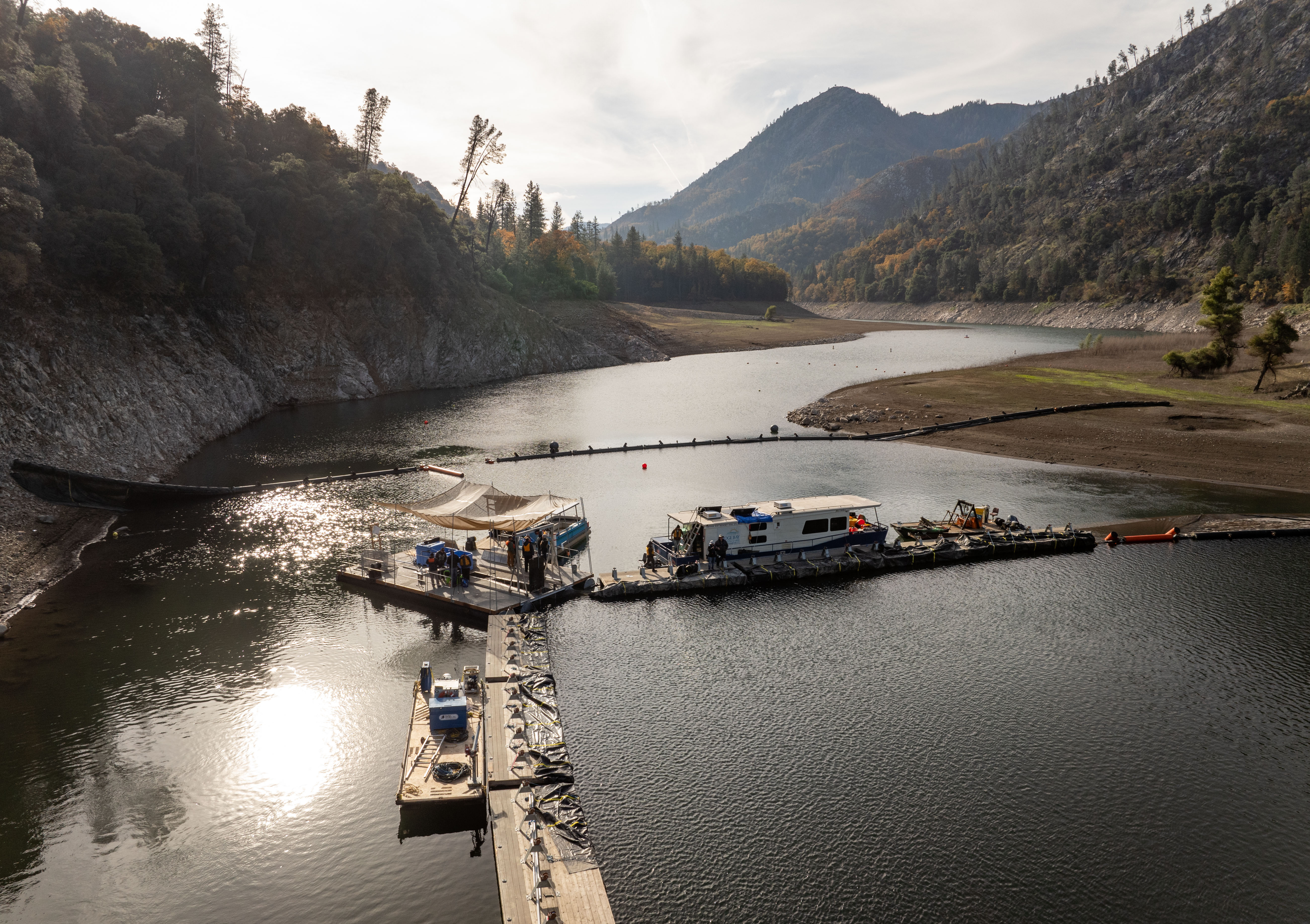
“Two years ago, Gov. Gavin Newsom unveiled a strategy to save declining salmon — spotlighting a historic partnership with the Winnemem Wintu Tribe to reintroduce endangered winter-run Chinook to the vital, cold waters upstream of Lake Shasta in far northern California. Now, tribe officials say the state is ending its support, potentially causing salmon restoration efforts on the McCloud River to die mid-stream. The tribe is now grappling with the sudden loss of jobs, along with the dimming of hope that the culturally sacred fish will be restored to their ancestral waters. “It makes me feel betrayed. It makes the tribe feel betrayed,” said Gary Mulcahy, government liaison for the tribe. “It’s like they just gave up.” “The pilot was designed to take urgent action during severe drought conditions while testing key tools and approaches needed for potential long-term reintroduction,” California Department of Fish and Wildlife spokesperson Stephen Gonzalez said in an email. … ” Read more from Cal Matters.
Significant early April warmup in the West to exacerbate ongoing drought
“After an exceptionally toasty March, a surge of warmth in the West over the holiday weekend and into the first full week of April will again challenge records in many areas, say AccuWeather meteorologists. While the warmup will not rival last month’s in terms of both severity and length, it will act to make drought conditions plaguing the region worse. Fortunately, for those starved for moisture, including firefighters battling wildfires in the region, some storminess will return later in the week as the weather pattern changes again. “An area of high pressure will build back into the western United States this weekend and last through early next week,” said AccuWeather Meteorologist Kai Kerkow. “This will bring a return to warm weather, especially across California, with some record highs even being challenged.” … ” Read more from AccuWeather.
California and the West’s current snow drought in a long-term context: key points for researchers
“We are well into the 2026 water year in the western United States, and so far, it appears to be an unseasonably warm one. Media across California, the western states, and the nation are covering the impact of our warm winter on snowpack and water resources. This post attempts to put headlines and current events into a longer-term context, explaining long-term changes we expect in snowpack water storage. In late January and early February, the LA Times reported that snowpack in the Sierra Nevada was about 59% of average for that time of year. The San Francisco Chronicle noted a particularly significant snow deficit in the Northern Sierra, and that the culprit was largely not lack of precipitation, but rather early onset of melt. And the New York Times commented that a snow drought has gripped not only California but also the rest of the West, likely foretelling diminished runoff later this year. More recently, record spring heat across California and the West has driven a “snow-eater heatwave”, melting out much of the already-meager snowpack (Rhoades et al. 2025). … ” Read more from the California Water Blog.
California faces first sign of a new drought
“When state experts visited the Sierra Nevada on Wednesday for their annual snow survey, they found literally nothing left to measure. The snow had melted already. Preliminary data shows that this year’s April 1 snowpack is the second lowest on record, according to the California Department of Water Resources. That’s a big loss for California, which relies on the so-called frozen reservoir for about a third of its water needs. Even though precipitation did in fact blanket California this winter, the record-breaking heat meant it either arrived as rain or else melted away quickly. “We’ve been having a warm snow drought this winter,” Andrew Schwartz, the director of the UC Berkeley Central Sierra Snow Lab, told SFGATE. “There are a few ways to get to snow drought. What we’re seeing this year is plenty of precipitation but warm temperatures, meaning rain instead of snow.” … ” Read more from SF Gate.
DWR conserving water at Lake Oroville
“During the winter and early spring months, flood control releases from Oroville Dam ensure the safety of the City of Oroville and downstream communities by reserving storage space to capture high storm inflows while permitting controlled and coordinated releases from the dam. As the warm summer months approach and rain and snowstorms driven by atmospheric rivers wane, DWR transitions from making flood control releases at Oroville Dam to conserving as much water in the reservoir as possible, while still meeting water delivery and environmental requirements. Given the largely dry conditions and low snowpack in the Feather River watershed, DWR has flexibility to conserve water and encroach into the flood space and has received approval from the U.S. Army Corps of Engineers (USACE) for the current release schedule. … ” Read more from DWR.
My California whitewater paddling trip was canceled — because of a tiny frog
“The disappointing news came last week: A whitewater trip I’d been looking forward to — that winds through gorgeous and seldom-paddled granite canyons in the Sierra foothills — had been abruptly canceled. Because of a frog. Dozens of kayakers and rafters like me had been eager to get on the South Fork American River’s Slab Creek run, a remote stretch of water north of Placerville that’s only recently become a viable paddling destination. Last Sunday was supposed to be one of the few days of the year when a reservoir there releases flows that transform the mellow river corridor into a 5-mile whitewater party of huge rapids that attract paddlers from around the state. … ” Read more from the San Francisco Chronicle.
How the San Diego County Water Authority uses data and inspection technology to guide infrastructure decisions
“When Martin Coghill talks about water infrastructure, he does not start with technology. He starts with responsibility. Coghill is the Operations and Maintenance Manager for Asset Management at the San Diego County Water Authority, where he leads a team focused on corrosion control and aqueduct integrity. Together, they help maintain a system of roughly 308 miles of large-diameter pipelines that ultimately serve about 3.3 million people across the region. For Coghill, the scale of the system shapes every decision his team makes. “We simply can’t afford to run our assets to failure,” he explained. “With the size of pipes involved, the consequences can be significant locally, but they can also affect the region as a whole.” … ” Read more from Pipeline Inspection and Condition Analysis Corporation.
A Healthy Soils Week Conversation: Tawny Mata on healthy soil practices as a strategy for resilience
“To kick off Healthy Soils Week, we spoke with Dr. Tawny Mata, Director of the Office of Agricultural Resilience and Sustainability at the California Department of Food and Agriculture (CDFA), about healthy soil practices, groundwater resilience, and what it takes to bring science from research into real-world agricultural management. Healthy Soils Week highlights the essential role soils play in supporting resilient farms, thriving ecosystems, and strong rural communities. Since 2018, CDFA’s Healthy Soils Program has supported farmers and ranchers in adopting practices like compost application, cover cropping, hedgerow planting, and reduced tillage. These approaches help build soil organic carbon, improve water retention, reduce greenhouse gas emissions, and support biodiversity—delivering climate and water benefits while strengthening long-term farm productivity. Our conversation explores how these practices translate from policy and research into practical, on-the-ground action across California. … ” Read more from Sustainable Conservation.
These California research stations prepare for fire risk. The Trump administration is shutting them down
“The Trump administration announced this week it will shut down six of eight U.S. Forest Service research facilities in California as part of a major national reorganization that could leave the state underequipped to manage escalating wildfire and drought threats. The closures in Fresno, Chico, Fort Bragg, Mount Shasta, Anderson and Hat Creek in Shasta County are part of a broader plan announced this week to shutter 57 of the agency’s 77 research facilities across 31 states and move its headquarters from Washington, D.C. to Salt Lake City, Utah. In California, just two research facilities will remain, in Placerville and Riverside. The closures come amid record warm winter temperatures in California that have rapidly eroded the state’s snowpack and heightened concerns that wildfire season could come early. Scientists at the research facilities study how forests change over time, including how they recover following fires. … ” Read more from the San Francisco Chronicle. | Read via MSN News.
SEE ALSO: Forest Service will close research stations that study wildfire risk, from MSN News
OCEANS & COAST
Record high ocean temperatures off southern California raise fears of prolonged marine heatwave
“For more than a century, shoreline stations operated by the Scripps Institution of Oceanography have measured water temperatures along the California coast. This year, they are flashing a warning sign. Over the last three months, several stations have repeatedly posted record-breaking daily high temperatures – with the La Jolla station registering temperatures a full 10F above historical average at one point last month. The waters of southern California historically warm every few years as tropical currents make their way north, a phenomenon known as El Niño. But the marine heatwave that started last fall wasn’t caused by tropical currents. Instead, a high-pressure atmospheric system – think of calm, sunny days – has perched above southern California, warming both air and sea above historic levels. The same phenomenon has helped fuel a ferocious California heatwave on land. … ” Read more from The Guardian.
Seabirds are dying in large numbers along California beaches
“From Mendocino to San Diego, beachgoers have been alarmed recently by large numbers of dead seabirds appearing on California’s beaches. The mass mortality event seems to be primarily impacting Brandt’s cormorants and common murres, though California brown pelicans have also been affected, according to the California Department of Fish and Wildlife. All of the animals are species of aquatic birds native to the northern Pacific Coast. “They didn’t even try to fly away. They just feebly made noise,” a woman told the Santa Barbara Independent on Saturday after spotting over two dozen dead or dying cormorants near Goleta Beach. “A few were on their stomachs, wings spread [and] gasping for breath…. Heartbreaking.” … ” Read more from SF Gate.
POLICY & REGULATION
Demonstration forest bill would modernize management practices
“A new bill, AB 2494, is advancing through the California State Assembly this month. That bill, introduced by Assemblymember Chris Rogers (D-Santa Rosa) and co-authored by Assemblymembers Damon Connolly (D-San Rafael) and Rick Zbur (D-Los Angeles) and Sen. Mike McGuire (D-San Rafael), would modernize the operations of the demonstration state forest system. AB 2494 would modify the definition of “management” under which demonstration forests are currently administered by Cal Fire, shifting from a framework that privileges timber harvesting as the primary function of the state’s 14 demonstration forests to one that, according to the bill’s supporters, better aligns with the state’s goals for conservation, carbon sequestration and public benefit. … ” Read more from the Eureka Times-Standard.
Capturing the Storm: AB 2026 and codifying flood managed aquifer recharge
AB 2026 is a California Assembly bill recently introduced by Assemblymember Aguiar-Curry, referred on March 23, 2026, to the Assembly Committee on Water, Parks, and Wildlife. Although the bill is only about 25 percent of its way through the legislative process, it represents an early but consequential attempt to reduce legal and procedural barriers that limit when and how local water agencies can divert high-flows for groundwater recharge, with direct implications for Sustainable Groundwater Management Act (SGMA) compliance and flood response planning. … ” Read more from Somach Simmons & Dunn.
California’s nitrogen problem—and the bill that could fix it
“Introduced by Assembly Member Rebecca Bauer-Kahan, Assembly Bill 2447, the Nitrogen Pollution Reduction Act, would require the State Water Resources Control Board (SWRCB) and regional boards to establish enforceable limits on nitrogen fertilizer to reduce water pollution. The act also encourages the use of sustainable farming practices, streamlined reporting for small and diversified farmers, and research and investment in safer fertilizer technologies. The SWRCB has had both the authority and the data to address nitrogen pollution from agriculture for decades but has failed to take meaningful action. AB 2447 gives the SWRCB a clear mandate to tackle nitrogen pollution at the source. … ” Read more from the NRDC.
California governor debate highlights sharp divide on energy, water, and farm regulations
“The AgNet News Hour continued its coverage of the California governor’s race, breaking down key moments from last week’s Fresno State debate where candidates laid out sharply different visions for the future of agriculture, energy, and water policy. With farmers and ag leaders in attendance, the debate made one thing clear, there is little agreement on how to fix rising costs and ongoing challenges facing California agriculture. Energy costs emerged as a major concern, with candidates offering competing solutions. Some pushed for expanded domestic oil and gas production and reducing regulations, while others emphasized continued investment in renewable energy and infrastructure. “We will use California natural gas to generate electricity… to cut your electric bills in half,” Steve Hilton said, pointing to underutilized energy capacity in the state. … ” Read more from Ag Net West.
In regional water news and commentary today …
NORTH COAST
Not enough water for Klamath Basin irrigators this year
“The Klamath Water Users Association and its member irrigation districts have warned farmers and ranchers to expect water supply that’s less than full delivery or demand this year. “This will be yet another year when you, your family and other farmers and ranchers will be required to make tough decisions to ensure the survival, rather than the prosperity, of generational family operations,” stated an April 1 letter. Details aren’t fully known, but the nonprofit’s initial estimate indicates 40,000 acres may need to go unirrigated to ensure water is available for crops in September and October. “The number is probably more along the lines of up to 50,000 acres,” said Scott Seus, KWUA president, in an April 2 interview. … ” Read more from the Capital Press.
April snow survey results for Scott River Subbasin
“These measurements are a part of the statewide California Cooperative Snow Survey program, which helps the state forecast the quantity of water available for agriculture, power generation, recreation, and stream flow releases later in the year. March is best described as a month featuring unseasonably warm and dry weather. Consequently, the meager snowpack of February became further diminished. Across all snow survey points, snow depth was at 1.8% of the long-term average for the time of year, while the Snow Water Equivalent (SWE) – a measure of water content – was at 1.5% the historical average. Current conditions are very similar to those measured in 2015 for the April survey, and to a lesser extent 2014 and 2022, all years with below average snowpack. … ” Read more from the Klamath National Forest.
Minimum baseflows – survival or recovery: Which levels will the Water Board choose?
“The California State Water Resources Control Board (Water Board) is advancing a process to establish permanent streamflow requirements for the Shasta and Scott rivers. The Water Board’s current work will narrow the range of flows and focus deeper investigations in a forthcoming scientific basis report and economic analysis. This report will inform the Water Board’s selection of permanent minimum baseflows. Interim flows currently in effect in the rivers expire in 2030. The Shasta and Scott rivers are two of the state’s most viable habitats for boosting recovery of wild Chinook and coho salmon, steelhead trout, and Pacific lamprey. The clean, cold, volcanic springs flowing from the northern flanks of Mount Shasta make the Shasta River one of the most productive spawning tributaries for anadromous fish in the Klamath basin. Estimates suggest that more than 80,000 Chinook salmon once returned every year to spawn in the Shasta River. … ” Read more from the California Sportfishing Protection Alliance.
Boaters heading to Ruth Lake now face mandatory 30-day wait if their vessel has ballast tanks
“The Humboldt Bay Municipal Water District (HBMWD) and the Ruth Lake Community Services District (RLCSD) are jointly announcing the implementation of a mandatory 30-day quarantine program for all watercraft entering Ruth Lake with ballast tanks or other components that cannot be drained. This measure is essential to prevent the introduction of Golden, Zebra, and Quagga mussels which are highly destructive aquatic invasive species that pose a serious threat to our water infrastructure, the lake’s ecosystem, and the region’s long-term water supply. … ” Read more from the Redheaded Blackbelt.
SIERRA NEVADA
What Tahoe’s warm spells will spell for California
“After a flurry of snow in February melted away for a mostly warm March, Tahoe’s snowpack is lower than usual this year, though it’s at relatively normal precipitation levels for the year. Despite a small cold front passing through in early April, it’s shaping up to be a potentially drier summer with higher fire risks. Having a long-lasting snowpack is key for ensuring consistent water access throughout the year. As it melts, it provides water through some of the driest months of the year. The Sierra Nevada’s snowpack supplies roughly 30% of water throughout California, and while rainfall to date is currently at 104% of the average precipitation, earlier melting snowpacks can lead to different issues. Regional scientist at the Sierra Nevada Conservancy Sarah Campe said, “Researchers are still learning the nuances around low precipitation years and snowpack, but we know precipitation may run off if the snow doesn’t stick.” … ” Read more from the Tahoe Daily Tribune.
April starts with record low snowpack in Northern Nevada, water managers prepare
“March heat has left critical snowpack at record-low levels across northern Nevada, leaving water managers the difficult task of managing a fraction of the water provided in previous years. Snowpack in Nevada and parts of the Eastern Sierra mountains is currently less than a quarter of what’s typically seen for this time of year, breaking new record lows in several basins. In Nevada, the last three months have been the warmest on record, according to the National Oceanic and Atmospheric Administration. Rapid snow melt followed a record breaking March ‘heat dome’ that caused temperatures to rise up to about 25 degrees F above normal across Reno, Elko, and Las Vegas, according to the National Weather Service. That heat decimated Nevada’s remaining snowpack, leaving only two snow measuring stations outside the Sierra with any snow to measure by early April. … ” Read more from the Nevada Current.
Lake Tahoe is one of the nation’s best for trout fishing. Where did it rank?
“Fishing season is here and if you’re looking to find the best spots for finding trout then look no further. FishBooker, a fishing guide platform, highlighted lakes across the country known for their trout fisheries, trophy potential and unforgettable scenery. The ranking includes lakes from South Carolina to California’s Lake Tahoe. Taking the first spot as the best lake for anglers is Lake Tahoe. Lake Tahoe offers fishing year-round which makes it an amazing spot for anglers no matter what fish they are looking for. … ” Read more from the Sacramento Bee.
Tahoe Conservancy to begin 25-acre forestry project in Tahoma
“The California Tahoe Conservancy is implementing a project to improve forest health and wildfire resilience on 25 acres of public land in Tahoma in El Dorado County. By thinning the overcrowded forest and removing hazardous fuels, the project will help reduce wildfire risk for the surrounding neighborhoods. This project includes 118 Conservancy properties, seven National Forest Lands properties, and 23 El Dorado County properties. The contractor will mulch small-diameter trees, branches, and shrubs. Larger trees and branches will be cut into firewood rounds, available for free collection by members of the public who have completed a free Conservancy fuelwood collection permit. … ” Read more from South Tahoe Now.
SACRAMENTO VALLEY
The spring-run chinook salmon of Deer and Mill creeks
Eric Woodruff writes, “It’s the time of year when I start to think about spring-run Chinook salmon. As the warm temperatures of spring begin to melt the snowpack, cold and clear water flows from the southern Cascades and Lassen foothills. This seasonal change initiates the return of adult Central Valley spring-run Chinook to hold and then spawn in their natal streams. Located in Tehama County, California, Deer and Mill Creeks are significant tributaries of the lower Sacramento River. Along with Butte Creek, Deer and Mill Creeks are two of only a handful of streams that still support self-sustaining runs of spring-run Chinook salmon. … ” Read more from the California Sportfishing Protection Alliance. … ” Read more from the California Sportfishing Protection Alliance.
NAPA/SONOMA
On the Sonoma Coast, a logging plan has neighbors worried about water
“In the chilling shade of a redwood forest, landowner Bruce Berry and his forestry consultant revved a pair of off-road quads up an old logging road cut along a steep canyon near the Sonoma Coast — the latest flashpoint in a longstanding debate over whether California’s coastal forests should be logged at all. They drove up into the sunny warmth of a ridgetop meadow overlooking the Russian River. A thick bank of fog was retreating fast, revealing ocean waves crashing on Goat Rock and the sun-baked town of Jenner. Sensitive to false rumors he plans to clear cut the property, Berry was quick to explain the meadow has always been there, to his knowledge. He insisted that his longtime logging family has always used careful selective harvesting methods so their forests will always look healthy. “You’re just going to see trees, trees, trees,” Berry said. … ” Read more from the San Francisco Chronicle.
BAY AREA
The Bay Area’s warm stretch is over for now. Rain is on the way
“The Bay Area spent the first weekend of April the same way it spent most of March, with temperatures running well above normal. Highs soared into the 70s and 80s in the city and across the inland valleys on Saturday and Sunday, 15 to 20 degrees above normal. Monday will feel like a completely different season. A surge of cold marine air began pushing onshore Sunday evening, and by Monday morning it will have transformed the coast. The ridge of high pressure driving the weekend warmth collapsed eastward, reestablishing onshore flow and pushing the marine layer back inland. … ” Read more from the San Francisco Chronicle.
A stunning new California beach preserve has drawn hordes of visitors. Where should they park?
“The secret is out: A new hiking destination along the Sonoma Coast allows visitors to walk down to a beautiful beach that was all but off-limits to the public for more than a century. Visitation there has surged — and the question is, what to do about it. Perched on the grassy hills of Bodega Bay overlooking the ocean, the Estero Americano Coast Preserve opened to daily visitors earlier this year. A wave of media attention celebrating the site’s fresh hiking trails and access to a wide sun-soaked beach ensued, and the resulting spike in sightseers caught nearby neighbors off-guard. Planners had anticipated that the preserve would be an attraction and that visitation would tick up during the sunny summer season. But on a warm Sunday in January, trail counters at the preserve registered about 1,200 hikers. … ” Read more from the San Francisco Chronicle. | Read via Yahoo News.
Entire Marin town shuts off running water amid ‘substantial’ leak
“The small coastal enclave of Bolinas was without water Saturday night after its public utility district shut off supply to the entire town due to a “substantial water leak” within the system. The Bolinas Community Public Utility District told residents in a post on its website to start filling up containers with extra water and expect to be without running water for the evening. The utility said that a contractor was on site by 6 p.m. Saturday and was working to repair the leak as quickly as possible, though the district didn’t say where the leak was. Water was expected to go off around 6:45 p.m. … ” Read more from the San Francisco Chronicle. | Read via Yahoo News.
How a new dredging approach could benefit a Marin County creek, protect Bay marshes
“It is hard to think of a tidal marsh as being in danger of sea level rise. After all, it is already surrounded by water. But a tidal marsh — like the 100-acre wetland at China Camp State Park in southern Marin County — is essentially a water garden that depends on sunlight and shallow shores. Its grasses shelter unique fish that feed birds and special status species like the salt marsh harvest mouse and golden eagles. As seas rise, marshes can drown and become open water, wiping out entire ecosystems that people and animals depend on unless they are replenished with new sediment. A pilot project underway in Marin County could open the door to a new, lower-cost and lower-carbon method of wetland restoration by sending waves of new sediment from areas of human settlement into nearby marshes. … ” Read more from Local News Matters.
Notes from the Field: Sunol Valley Fish Passage Project
“On March 6th, Sustainable Conservation community members gathered to tour the recently completed Sunol Valley Fish Passage restoration project on Alameda Creek, and to witness the positive impact of simplifying California’s permitting processes to implement restoration projects faster, more affordably, and at scale. The project, led by CalTrout and PG&E, successfully connected over 20 miles of habitat for native fish such as Chinook salmon, steelhead trout, and Pacific lamprey on the largest local tributary to the San Francisco Bay. The day was hosted by DeSilva Gates Aggregates in Sunol, whose active quarry site the group passed through to access and view the restoration site. San Francisco Public Utilities Commission, Applied River Sciences, Hanford ARC, Alameda Creek Alliance, Sequoia Ecological Consulting, Stantec Consulting Services, and Martin Marietta Materials were other key partners that helped the project across the finish line. … ” Read more fr4om Sustainable Conservation.
Cities Of Sunnyvale, Mountain View violated Clean Water Act, court rules
“A federal judge has ruled that the cities of Sunnyvale and Mountain View violated certain provisions of the Clean Water Act for water quality violations in two local creeks that flow into San Francisco Bay. San Francisco Baykeeper, an environmental advocacy organization, filed a lawsuit against the cities in 2020. The suit alleged that the cities of Sunnyvale and Mountain View allowed their stormwater systems to dump bacteria pollution into Stevens Creek and Calabazas Creek , which connect to the Bay. The cities attempted to dismiss the case five times before it went to trial last year. “Cities should be providing their residents with a healthy environment and local creeks that are safe for recreation, not fighting to keep polluting,” said Baykeeper executive director Sejal Choksi-Chugh in a statement. … ” Read more from SF Gate.
SEE ALSO: Mountain View slapped with $1.2M fine for sewage pollution in creek, from the Mountain View Voice
CENTRAL COAST
Ventura Capital Improvement Plan approved
“The City Council, on Tuesday, March 24, adopted its 2030- 2031 Capital Improvement Program (CIP). … “Since the study session in 2026, project information sheets have been provided, and if the Council directs, the projects listed may be added to the CIP Project List, and potential grant list,” he said…. “There are 18 new projects before the Council, and the bulk of the projects are water and wastewater,” he said. “The recommendations in the proposed 2027-2031 Capital Improvement Program are to support all City Council strategic priorities.” Councilmember Will McReynolds asked about the Water Commission, and asked about the Water Avenue Treatment Plant, Chlorine Scrubber, and the water treatment at Saticoy Country Club, regarding selenium. … ” Read more from the Tri-County Sentinel.
SAN JOAQUIN VALLEY
San Joaquin County seeks $2 million in federal funds to help replace aging water pipes in Lincoln Village
“With aging pipes in a major Stockton neighborhood where people get their drinking water, San Joaquin County is looking to federal lawmakers to help. Lincoln Village is an older development in Stockton, right next to the Lincoln Center, and the county is asking for $2 million in help for an ongoing water-line replacement project going there. It’s part of nearly $19 million in funding the county is asking federal lawmakers for as part of the 2027 Federal budget process. “Lincoln Village is a great place to live and so is Stockton,” Don Ruhstaller, Lincoln Village resident, said. … ” Read more from CBS News.
Tehachapi-Cummings County Water District invites residents to tour the local water importation system April 16, 17
“The Tehachapi-Cummings County Water District will hold an annual tour of its system April 16 and 17 that the district’s leaders hope will illuminate how the area gets its water and the effort it takes to bring it here. TCCWD General Manager Tom Neisler said the the tour is an opportunity for the district to show the magnitude of its pumping system, which brings thousands of acre-feet of water up the mountain but is not necessarily the first thing people associate with the organization. Neisler said TCCWD is as much an industrial operation as it is a water district, with four pumping plants and 31 miles of 27‐ to 39‐inch pipeline carrying water up steep grades on Tejon Ranch to the district from the California Aqueduct near the base of the Grapevine. The water is then stored in Brite Lake and other groundwater storage facilities. … ” Read more from the Tehachapi News.
EASTERN SIERRA
DWP diverts despite strong local supply
““Roller coaster” and “whiplash” metaphors have dominated articles about California water and weather in recent months, but other elements of the water landscape are also noteworthy. In Los Angeles, investments in local water supply resilience have been delivering strong returns. By focusing on increasing stormwater capture capability to recharge groundwater basins, the Los Angeles Department of Water & Power (DWP) was able to capitalize on heavy precipitation in the late fall and winter months. Between October 1, 2025, and mid-January, 56,000 acre-feet of stormwater were captured. By late February, stormwater capture exceeded 80,000 acre-feet. In other words, this past winter DWP captured five times the amount of water it diverts from Mono Basin streams from Los Angeles stormwater alone. … ” Read more from the Mono Lake Committee.
SEE ALSO: April 1 Mono Lake level: 6,382.75 feet above sea level, from the Mono Lake Committee
SOUTHERN CALIFORNIA
Meant to filter storm water, LA’s bioswales are now dumping grounds
“Across from an auto shop on Venice Boulevard and Albany Street sits a narrow, sunken strip of land lined with overgrown shrubs and cacti. It’s mostly filled with trash — from plastic bags and cups to containers, straws, chip bags and aluminum foil. It’s original purpose was to capture and filter storm water runoff, helping reduce flooding and keep pollutants from flowing into the ocean. But neighbors in Pico Union say that this bioswale and many others across the city have become dumping grounds. … Local resident Aurora Corona — a longtime Pico Union community organizer involved in local environmental and cleanup efforts — said in some instances it looks like the bioswales were not fully installed. Citywide, there are about 23 bioswales that appear abandoned, Corona said. Many are located in central and South Los Angeles and spread across at least eight council districts. … ” Read more from the LAist.
A foul problem: Fire survivors with cesspools and septic tanks face unique rebuilding challenges
” … About three years after buying their dream home, the Eaton Fire reduced it and all 29 houses in the neighborhood to ash. Now, not only is Whirledge trying to rebuild, but he’s also facing a challenge left over from last century: his house used a cesspool for its sewage. All of his neighbors used cesspools or septic tanks too — meaning they aren’t connected to the pipes of the county sewer system. From the cost of undergrounding power lines to upgrading water and, now, some sewer systems, rebuilding with better infrastructure after a disaster is proving to be a complex and expensive challenge, with the costs largely borne by people who lost their homes, are underinsured or not insured at all, and simply trying to put their lives back together. In turn, some residents, including Whirledge, are being forced to become experts in infrastructure they once rarely gave thought to. … ” Read the full story at the LAist.
Cerritos residents launch ballot fight to kill water rate increases
“What started as more than 6,400 written protests over water and sewer rate increases has now escalated into a formal ballot initiative effort aimed at repealing those hikes altogether. A Notice of Intention to Circulate Petition has been filed, signaling the official launch of a voter-driven campaign to overturn the rate increases approved by the Cerritos City Council on January 26, 2026. The proposed measure, titled the Water and Sewer Rate Repeal and Replacement Ordinance, seeks to scrap the recently approved increases and force the city to go back to the drawing board—this time requiring a full, transparent cost-of-service analysis before any new rates can be adopted. In plain English: voters are attempting to hit the reset button. … ” Read more from Los Cerritos News.
IMPERIAL/COACHELLA VALLEYS
The California lake billed as the ‘Saudi Arabia of Lithium’
“Beneath California’s Salton Sea, there is so much metal essential to rechargeable batteries that Gov. Gavin Newsom calls the vast lake “the Saudi Arabia of lithium.” An estimated $500 billion worth of lithium here could help power our smartphones, electric cars and electricity grids. And a so-called white gold rush could bring jobs, tax dollars and economic revitalization to one of the most impoverished places in the nation. But not everyone is eagerly welcoming the lithium industry. The Salton Sea is already an environmental disaster zone. It’s shrinking, and as it does, it spews plumes of pesticide-laden dust throughout Imperial County, home to 182,000 people. Extracting lithium requires a steady supply of fresh water, and locals worry the process will deplete the region’s scarce water resources. Some also fear that the industrial disruption of the lake will create even more air pollution. … ” Read more from the New York Times.
Toxic dust from California’s shrinking Salton Sea is harming children’s lung growth – our study tracked the impact in 700 kids
“Southern California’s Salton Sea was once a resort playground, with sunny beaches, celebrities and people waterskiing on the vast inland lake in the 1950s and ’60s. Today, those resorts are long gone, replaced by a drying and increasingly toxic landscape. As the lake shrinks, wind blowing across the exposed lake bed kicks up toxic dust left by years of agriculture chemicals and metals washing into the lake. That dust makes its way into the lungs of the children of the Imperial Valley. New research from our team of epidemiologists at University of Southern California and University of California, Irvine, shows that blowing dust is impeding the lung growth of children in the region – especially those living closest to the Salton Sea. In fact, the effects on lung function close to the Salton Sea have been greater than what studies find in urban California communities near busy roadways. … ” Read more from The Conversation.
SEE ALSO: For water and mining policy near Salton Sea, keep in mind local children’s health, from the LA Times
Imperial County supervisors to hold key vote on controversial data center project
“The Imperial County Board of Supervisors will hold a crucial vote Tuesday that will determine whether construction can begin on a massive data center complex that supporters said would generate new revenue and some jobs, and opponents fear it could strain the rural county’s power grid, water supply and air quality. The vote will take place despite a last-minute attempt to halt it by the city of Imperial, which borders the planned project site. On Wednesday, the city asked an Imperial County Superior Court judge to issue a temporary restraining order that would block county officials from holding the scheduled vote. The judge, Louie Brooks Anderholt, declined to intervene. … ” Read more from KPBS.
SEE ALSO:
- ‘This data center will come.’ The fight over California’s largest AI development, from iNewsSource
- Developer of Imperial Valley AI data center sues activist and environmental nonprofit for defamation, alleged “greenmail”, from The Desert Review
- Ranked: The U.S. States Building the Most Data Centers, from the Visual Capitalist
SAN DIEGO
Two gubernatorial candidates on Tijuana River pollution
“For years, local officials and environmentalists in South San Diego County — where sewage entering from Mexico has polluted the shores for decades — have suggested that the state has not deployed enough resources to address the soiled waters of the Tijuana River. Nearly $700 million in federal money since 2022 has been sent to the U.S. International Boundary and Water Commission, the national agency in charge of cross-border rivers, to upgrade deteriorating American water treatment plants near the border. At the state level, San Diego lawmakers in January helped secure $30 million toward river cleanup projects. … ” Read more from the Voice of San Diego.
Along the Colorado River …
Colorado’s 2026 water rights battles
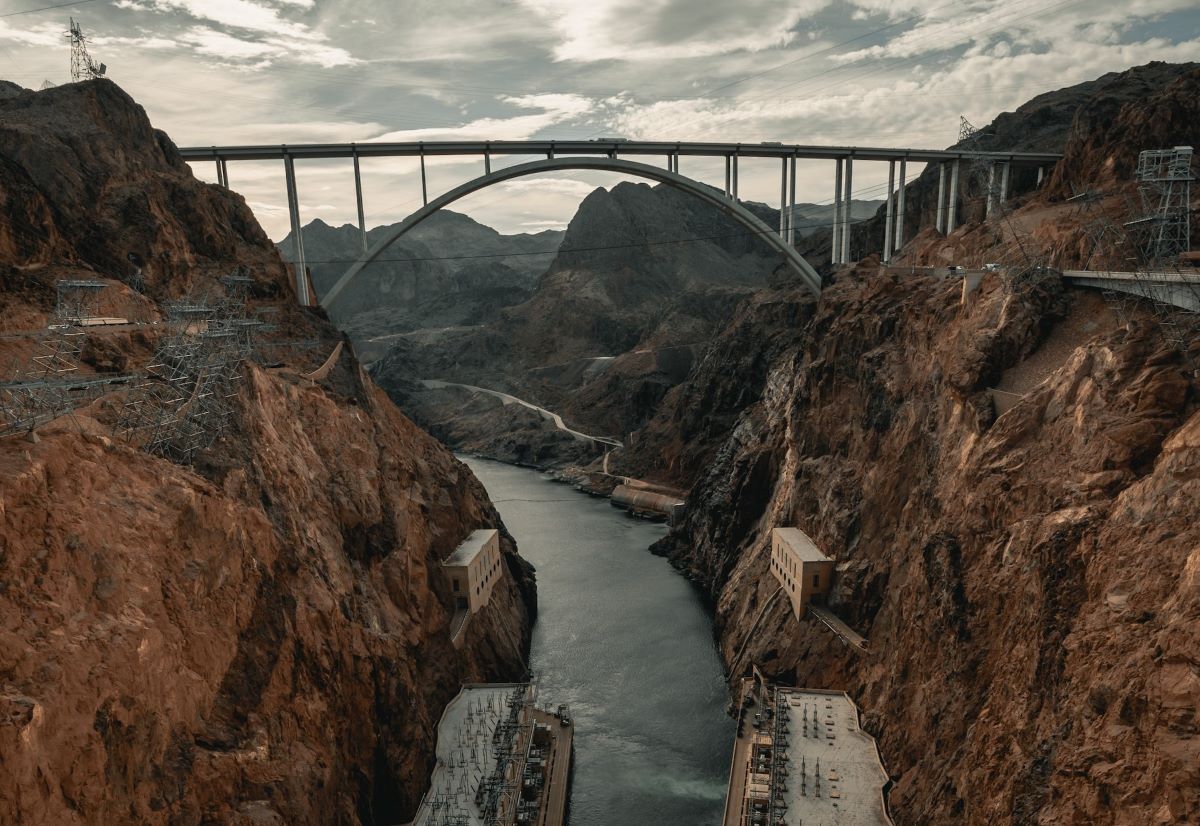 “2026 will determine whether Colorado’s water future is written in the halls of the state capitol or the chambers of a federal court. As the 2007 Interim Guidelines expire, Colorado is facing a once-in-a-generation reckoning over water law. … The most immediate legal theater in 2026 is the negotiation of the Post-2026 Operational Framework. Seven basin states remain divided over how to share the burden of reduced flows in a system that is fundamentally over-allocated. The primary legal rift exists between the Upper Basin states—Colorado, Wyoming, Utah and New Mexico—and the Lower Basin states of California, Arizona and Nevada. Colorado’s legal position, championed by the Colorado Water Conservation Board, asserts that the Upper Basin shouldn’t be forced into mandatory cuts to compensate for the Lower Basin’s historical overconsumption. This stance is rooted in the 1922 Colorado River Compact, which the Upper Basin argues does not require them to guarantee a specific volume of water if climate-driven hydrology fails to provide it. While the Lower Basin is often scrutinized for its high demand, Nevada has emerged as a model for urban conservation that many experts believe must be scaled. As detailed by the Southern Nevada Water Authority, the Las Vegas Valley recycles nearly 99% of all indoor water, returning it to Lake Mead to earn return-flow credits. … ” Read more from Best Lawyers.
Nevada-based stopgap proposal gains traction in Colorado River negotiations
“A spring heat wave is already melting this year’s dismally bad snowpack in the Colorado Rockies, and new projections show that only a quarter of the normal amount of water will flow through the river this summer. “That’s the third lowest on record,” said Alan Halaly, water reporter for the Las Vegas Review-Journal. “The only years that beat it are the ones that kind of started this 20-year drought cycle that we’ve been in. So, it’s dire conditions, and it’s certainly turning up the heat when we’re talking about delivering some sort of agreement [on the Colorado]. That agreement between the seven states that use the water from the Colorado River remains elusive. However, a proposal from Nevada’s chief negotiator, John Entsminger, seems to have garnered some attention. It would look to put in place a temporary agreement requiring the release of more water from Upper Basin reservoirs. … ” Read more from Nevada Public Radio.
Colorado Water Commissioner: The window is closing for a negotiated Colorado River settlement
” … the Southwestern Water Conservation District hosted its annual seminar at Ignacio, Colorado’s Sky Ute Casino, on March 27, 2026. The event brings together irrigators, water managers, scientists, public officials, and business owners. For this year’s keynote, Becky Mitchell updated attendees on how the current negotiations have been going. As Colorado’s commissioner to the Upper Colorado River Commission, Mitchell has been taking the lead in the ongoing negotiations with the 6 other states that use the river. For the past 2 years, Mitchell and her counterparts have been deadlocked over how to cut their collective river water use by about 20%. Last Friday, with no news of a breakthrough to share, Mitchell recapped history and summarized the state’s position. At times, her remarks felt a bit like a general ‘returning from the front’ to remind citizens what and who she’s fighting for. … ” Read more from KSUT.
Colorado River advocates’ toolbox chips away at threats with many approaches — including personhood
“Amelia Flores always knows where she is in relation to the Colorado River. At her home, a half-mile from its course through western Arizona, she can hear the boats and smell the river. Feel the breeze over its waters. In November, the Colorado River Indian Tribal Council chairwoman joined other council members in making a historic decision to protect their namesake river by giving it the same rights as a person. Tribal members knew they wanted to protect their lifeblood from escalating threats, but it took about a year to decide the right way to do it. “It didn’t mature overnight,” Flores said. “It just evolved as the concerns started to grow.” The Colorado River Indian Tribes, or CRIT, a federally recognized tribe located in southwestern Arizona just south of Lake Havasu, is just one of many groups trying to find a way to preserve the shrinking Colorado River. It is the water supply for 40 million people and multibillion-dollar industries, and the home of endangered fish species and sensitive environments, like the Grand Canyon. … ” Read more from the Colorado Sun.
Engineers say Colorado River crisis could use Wyoming’s ‘Godfather of water’ about now
“If the dead could bear witness, the ghost of Dr. Elwood Mead might be standing at the rim of the reservoir that bears his name, watching it drain toward oblivion, and muttering the same words he used when he first arrived in the Wyoming Territory 138 years ago. “The virtue of self-denial had not been conspicuous on the part of claimants,” is how the young engineer described what he found in 1888 when he surveyed the water claims filed in county courthouses across the territory. Years later, he noted that, “If the amount of water claimed had existed, Wyoming would have been a lake.” That observation could run today word-for-word in a report on the Colorado River, which has never held as much water as users have attributed to it. … ” Read more from Cowboy State Daily.
U.S.-Mexico water sharing should change under a dry Colorado River, new report argues
“A new report from a group of Colorado River experts is calling for a change in the way the United States shares water with Mexico. The paper’s authors write that the change would give water managers a new degree of flexibility during record-breaking dry times. Currently, the U.S. is required to send a fixed amount of water to Mexico every year. The new paper instead recommends sending a percentage of the water that is actually in the Colorado River each year. It comes at a time when states that use the river are stuck in tense negotiations about sharing its shrinking supply, and the region’s water policy stands at the precipice of potential change. The paper, co-authored by a group of academics and former policymakers, writes that the old rules no longer make sense as drought and climate change have greatly reduced the amount of water in the river and its reservoirs. … ” Read more from KJZZ.
Cleanup’s almost done at notorious Nevada mine. Potential plans to dig again raise fears.
“Nearly a decade after the state and federal government agreed to keep Nevada’s largest abandoned mine off a federal list of highly polluted sites, the mine is almost cleaned up. But now, conversations about reopening the 3,400-acre Anaconda Copper Mine in Lyon County to production are troubling groups that have monitored the defunct property for years. They’re questioning if that could deplete local water sources and cause further pollution — and whether they’ll have any opportunities to weigh in. As the mine’s cleanup approaches its slated 2030 completion date, companies involved with Anaconda have performed exploratory testing at the site and applied for mining-related water permits — moves that have drawn substantial protests. On top of concerns about how mining there again would affect the environment, critics fear the potential sale of roughly half of the mine’s land to a private company, which would mean it’s subject to less stringent environmental review. … ” Read more from the Nevada Independent.
Lowest-ever snowpack conditions in Utah are ‘truly unprecedented’
“What many would hope was an April Fool’s Day joke is anything but, as Utah has recorded its lowest-ever snowpack conditions as of April 1. In a special report issued Friday, the Natural Resources Conservation Service said that at no point since measurements began in 1930 has the snowpack been as low in Utah. The report was issued ahead of what is expected to be a dismal Water Supply Outlook Report. The agency called the 2026 snowpack “truly unprecedented,” with the next lowest having been recorded in 2015, but it was approximately five times higher than the current snowpack conditions. The latest numbers come as Utah’s typical snowpack peak just passed on Thursday. … ” Read more from Fox 13.
Colorado drought operations coming soon
“Colorado River watchers can expect to know a lot more about what this year’s management will look like in the next couple of weeks. The pivotal April streamflow forecasts/water supply outlooks are set to drop next week, after which we will have a clearer picture of just how grim this year will be. And the Bureau of Reclamation’s April 24-month study will have new (probably worse than March) projections for Powell inflow this year. Water managers will also lay out this year’s plan for action under the Drought Operations Agreement in mid-April, according to Upper Colorado River Commission officials. It’s already known that releases will be coming from Upper Basin reservoirs (Flaming Gorge, Blue Mesa and Navajo) to prop up Powell, but officials haven’t said yet exactly when and how much from each reservoir. But March snowpack and runoff projections were too optimistic and reservoir releases under DROA alone won’t be enough to keep Powell from falling below critical elevations. … ” Read more from Aspen Journalism’s The Runoff.
In national water news today …
Why strengthening our water workforce is an investment in public health
“Behind every tap delivering safe drinking water stands a skilled professional – and utilities are running out of them. This expectation of reliable, clean water – so fundamental that it’s often taken for granted – relies largely on the skilled professionals who operate, maintain and manage our nation’s water systems. Yet the water sector is at a critical juncture in managing its most valuable asset: its people. Addressing workforce challenges is not just an industry concern but a public health imperative. Recent research from the National Association of Water Companies (NAWC) and Bluefield Research, based on in-depth conversations with leaders on the front lines of the water industry across 30 utilities and stakeholders in 18 states, provides a comprehensive, ground-level view of the workforce pressures utilities face. The findings confirm what industry leaders have long known: the sector’s “Silver Tsunami” of retiring workers, combined with increased competition for talent and evolving workforce expectations, demands immediate and innovative action. … ” Read more from Water Finance & Management.
Climate experts say spring is coming earlier. How will that affect agriculture and ecosystems?
“As a row crop farmer in St. Joseph, Missouri, Joe Lau said he’s noticing more extreme weather these days. Warmer seasons throughout the year. Quarter-inch predictions of rain stamped out by storms that bring 3 inches. Increased pressure from pests on his corn. He’s also noticed that spring is coming earlier. The USA National Phenology Network shows that this year spring arrived three to five weeks earlier than the average between 1991 to 2020 in much of the central U.S. and two to three weeks earlier in southern Midwest states. “I have allergies bad,” said Lau, who also grows soybeans. “And this year in particular, it’s hit me hard. It’s wild that we are talking about allergy issues in winter, but that’s technically the reality of it.” Last month, Climate Central, a nonprofit specializing in communicating climate science, published an analysis that found that spring is trending to an earlier arrival from 1981 to 2025 in most of the United States. … ” Read more from Grist.
EPA flags microplastics as ‘priority’ water contaminants, but the move doesn’t guarantee regulation
“Citing the Trump administration’s promise to “Make America Healthy Again,” the U.S. Environmental Protection Agency placed microplastics and pharmaceuticals on a draft list of contaminants maintained by the agency. The Sixth Contaminant Candidate List includes known or likely contaminants in public water systems that are currently unregulated but may be subject to future regulation by the EPA. In a joint announcement yesterday with EPA Administrator Lee Zeldin and Health and Human Services Secretary Robert F. Kennedy Jr., the agency heralded the move as a “historic” response to concerns raised by Americans over toxic chemicals and plastic pollution in drinking water. But environmental defense groups, as well as food and water advocacy organizations, have criticized the action as political posturing without any regulatory teeth. “This is just smoke and mirrors,” said Suzanne Novak, a senior attorney and director of drinking water advocacy at Earthjustice, an environmental public-interest group. “This is the first step in a process that almost always leads to not regulating.” … ” Read more from Inside Climate News.
Microplastics are everywhere — even in the labs studying them. That’s a problem for research
“As the science of detecting microplastics matures, so too does consensus about their ubiquity. Everywhere researchers have looked to find them, there they’ve been: In human brains and lungs; in breast milk and semen; in alpine snow and deep-sea sediment; in corn plants and beer. And that, say researchers, is the rub: Scientists are not just finding them in our livers, arteries and ovaries. They are also everywhere else: in research laboratories, pipettes, refrigerators, solvents, bottles, goggles and the very lab coats investigators are wearing to find them. So how do we know if those particles seen under the lens of a microscope are inherent in the sample, or contamination from plastic fibers floating in the air? Or from tiny particles that sloughed off from the inside of a bottle of solvent? … ” Read more from the LA Times.
Much of humanity may face hot-dry extremes five times more often by end-century
“In their current state, climate policies around the world could leave a significant chunk of the global population exposed to simultaneous extreme heat and drought over five times more often by the end of this century than during the mid-to-late 20th century. In a new study, researchers project the increase will affect 28% of the global population overall, concentrated in low-income, tropical nations that have contributed only a small fraction of humanity’s greenhouse gas emissions to date. “Heat and drought amplify each other,” said Di Cai, a climate scientist at the Ocean University of China and lead author of the study. “In compound hot-dry extremes, they lead to water restrictions and unstable food prices. For outdoor workers, it is dangerous.” … ” Read more from AGU.

