
Several news sources featured in the Daily Digest may limit the number of articles you can access without a subscription. However, gift articles and open-access links are provided when available. For more open access California water news articles, explore the main page at MavensNotebook.com.
In California water news today …
As Sierra snowpack dwindles, concern mounts over fire risk and water management
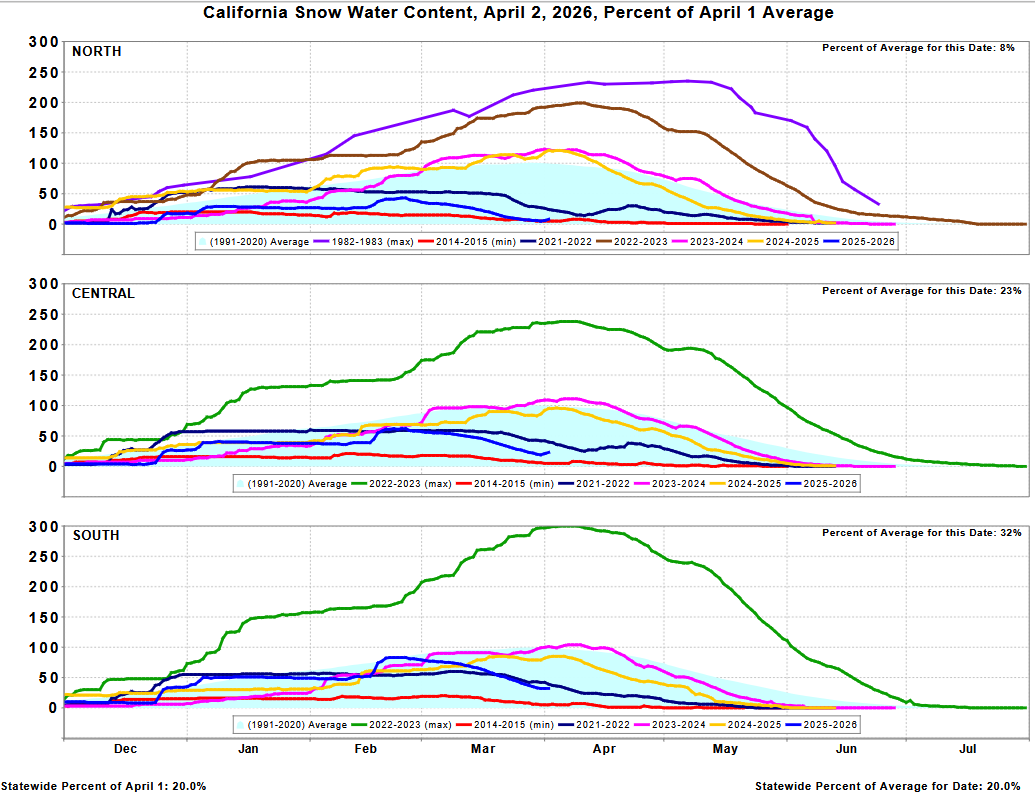 “Every year, as winter winds down into April, officials with California’s Department of Water Resources perform their snowpack measurements for the last time. The state considers the final winter survey, conducted on April 1, as the best indicator of how much water might be available for farms and cities during the dry summer months to follow. That’s because the measurement is conducted when the snowpack is at its highest. From then on, the snow melts, feeding into rivers and reservoirs throughout the state. South of Lake Tahoe, surveyors at the Phillips Station usually dig down through feet of snow to make water supply predictions. But this year, they said, there’s nothing to measure. … ” Read more from KQED.
March’s heat smashed records. Calif.’s water experts just found one more
“When state experts visited the Sierra Nevada on Wednesday for their annual snow survey, they found literally nothing left to measure. The snow had melted already. Preliminary data shows that this year’s April 1 snowpack is the second lowest on record, according to the California Department of Water Resources. That’s a big loss for California, which relies on the so-called frozen reservoir for about a third of its water needs. Even though precipitation did in fact blanket California this winter, the record-breaking heat meant it either arrived as rain or else melted away quickly. “We’ve been having a warm snow drought this winter,” Andrew Schwartz, the director of the UC Berkeley Central Sierra Snow Lab, told SFGATE. “There are a few ways to get to snow drought. What we’re seeing this year is plenty of precipitation but warm temperatures, meaning rain instead of snow.” … ” Read more from SF Gate.
Latest emergency water conservation info shared by California
“California water officials are not implementing statewide emergency water conservation mandates despite concerning snowpack measurements at Phillips Station, a California Water Boards spokesperson told Newsweek. … Despite the grim news, no emergency conservation measures have been implemented. “Statewide emergency water conservation mandates are not being implemented due to the results of yesterday’s Department of Water Resources snow survey,” the California Water Boards spokesperson told Newsweek on Thursday. “The State Water Board is not currently discussing emergency drought regulations, which could only be implemented under a state of emergency issued by the governor, nor does it expect to do so this summer.” … ” Read more from Newsweek.
SEE ALSO:
-
- CA’s record-low snowpack could mean fires, water rationing, from KCRW
- More than a third of California ‘abnormally dry.’ What it means for water levels, from the Sacramento Bee
What are triplet cyclones? This rare phenomenon could have global impacts.
“A rare weather phenomenon could unfold in a remote part of the West Pacific Ocean starting this weekend, one that may have serious local impacts for some island nations and could have broader ripple effects for a weather pattern known for triggering unusual warmth, floods and drought. While the systems are developing, tropical cyclones could form on either side of the equator at about the same time and longitude — mirroring each other, as twins. In fact, there’s an increasing chance for triplet cyclones, with two south of the equator and one to the north. Twin cyclones happen roughly once every few years, with triplet cyclones even rarer. One of the storms, forming near eastern Papua New Guinea and the Solomon Islands, could bring 50 to 100 inches of rain or more as it stalls through next week. That could have devastating consequences. “Imagine putting your finger into a pool and moving it in a straight line. You would see swirls develop on either side of your finger,” wrote the National Oceanic and Atmospheric Administration about twin cyclones. “The same concept is at play with tropical cyclones, it is just Mother Nature doing the stirring.” The effects of that movement could ripple well beyond this far-flung region. … ” Read more from the Washington Post.
California Coast and Ocean Report released by Governor’s Office
“The California Ocean Protection Council, in partnership with the California Ocean Science Trust, released its 2026 California Coast and Ocean Report detailing the pressures the Golden State’s coast faces, including the historic progress made in protecting marine ecosystems and thriving coastal communities. California is also investing over $6 million in funding for science and restoration projects that support our oceans. The report is considered the first comprehensive, science-based assessment of coastal and ocean health in California’s history, describing not only the pressures facing California’s coast and ocean, but also the progress the state is making to support resilient marine ecosystems and thriving coastal communities. … ” Read more from the Mendocino Beacon.
Guide to Leasing, Permitting, and Authorizing Commercial Aquaculture Operations off the California Coast
“Starting an aquaculture farm is a complicated process. Future farmers need to select species and gear, create a business plan, acquire space, and consider and mitigate environmental impacts. They also need to secure permits. Growers looking to operate in the federal and state waters along the West Coast generally need to acquire permits from local, state, and federal agencies and coordinate with local Tribes. These permits help ensure farmed seafood is healthy, safe, and environmentally sustainable. However, acquiring necessary permits can be a major challenge for potential farmers. NOAA has developed resources aimed at helping West Coast growers obtain their permits and get their farms in the water. This guide assists individuals or groups seeking information about permitting and other requirements for new commercial aquaculture projects. It also provides guidance on the expansion of existing aquaculture operations in state or federal waters off the coast of California. These resources, for both state and federal waters, help potential farmers chart the course for success. View the California guide from NOAA.
CSUF’s Outstanding Professor awardee discusses risks of ‘forever chemicals’
“Developed in the 1940s and widely used in a variety of products and industries, the synthetic substances perfluoroalkyl and polyfluoroalkyl were lauded for their ability to repel water and grease, reduce flammability and resist degradation. But this class of substances, commonly referred to as “PFAS,” are toxic “forever chemicals” that don’t break down over time. This is a serious concern, especially given that an estimated 97% of Americans have detectable levels of PFAS in their blood, according to the Centers for Disease Control and Prevention. This PFAS issue was the subject of a lecture by Sudarshan Kurwadkar, Cal State Fullerton professor of civil and environmental engineering, on March 25 in the campus’ Pollak Library. Focusing on our drinking water, Kurwadkar’s talk, “PFAS in California: Scale, Science, and Communities at Risk,” reviewed the magnitude and distribution of these substances in the state, their many troubling health effects, sources of contamination, government intervention and more. … ” Read more from the OC Register.
Microplastics and pharmaceuticals named a priority threat in drinking water by health, environment officials
“U.S. Secretary of Health and Human Services Robert F. Kennedy Jr. and Environmental Protection Agency Administrator Lee Zeldin announced new initiatives to tackle microplastics in the human body and drinking water on Thursday. Kennedy said the government will create a $144-million program called STOMP, for the systematic targeting of microplastics. “We are focusing on three questions, what is in the body, what’s causing harm, and how do we remove it?” Kennedy said. Zeldin said the environmental agency will add microplastics and pharmaceuticals to its list of concerning chemicals in drinking water. “For the first time in the program’s history, EPA is designating both microplastics and pharmaceuticals as priority contaminant groups,” he said. … ” Read more from the LA Times. | Read via AOL News.
SEE ALSO:
- E.P.A. Targets Microplastics and Drugs in Drinking Water, from the New York Times
- EPA eyes tracking microplastics, medicines in tap water, from E&E News
- EPA Takes Bold Action to Ensure Drinking Water is Safe from Microplastics, Pharmaceuticals, and Potential Hidden Contaminants, press release from the EPA
Gubernatorial hopefuls address California agriculture priorities
“On April 1, six California gubernatorial candidates attended a bipartisan, agricultural-focused forum at California State University, Fresno. The event — titled “Affordability and Rural California” — was hosted by Western Growers and the Maddy Institute, along with 28 other supporting agricultural organizations. Forum participants included Chad Bianco (R); Steve Hilton (R); Matt Mahan (D); Katie Porter (D); Xavier Becerra (D); and Antonio Villaraigosa (D). Democratic candidates Tom Steyer and Eric Swalwell were invited but did not attend. Candidates discussed topics rooted in the issues Central Valley farmers and ranchers are facing, from water availability to the various compliance costs that weigh down operations. Much of the forum featured similar answers from the candidates on why California is facing an affordability crisis and the factors harming agricultural regions. For instance, when asked to raise their hands if they believe that the state needs to rethink how it balances climate goals and mandates with people’s needs for energy price relief, all six candidates raised their hands. … ” Read more from the Valley Ag Voice.
Forest Service shake-up comes as risky wildfire season looms
“In announcing one of the largest reorganizations in the 120-year history of the U.S. Forest Service, the Trump administration declared that there would be “no interruption or change” to the agency’s firefighting force. But critics say the upheaval comes at the worst possible time—with the agency’s ranks already depleted and demoralized, and a new federal wildfire forecast showing exceptionally high fire risk in both the Southeast and across much of the West over the next three months. By the end of March, 1.62 million acres had already burned across the country this year —231 percent of the previous 10-year average, the National Interagency Fire Center said in its seasonal forecast released Wednesday. That included the largest wildfire in Nebraska’s history, which last month scorched 640,000 acres and killed an 86-year-old woman who was trying to escape. It is a sign of the challenges facing the federal government’s largest team of wildland firefighters, those in the Forest Service, who already were being integrated with a new U.S. Wildland Fire Service located in the Department of Interior. … ” Read more from Inside Climate News.
In commentary today …
How the Delta Conveyance Project is being designed with sound engineering and transparency
Graham Bradner, Executive Director for the Delta Conveyance Design and Construction Authority, writes, “California’s Delta Conveyance Project is among the most significant water infrastructure investments in the state’s history. It is a modern upgrade to a more than 60-year-old water delivery system that serves millions of Californians and supports much of the state’s economy. The project is intended to address well-documented risks to water supply and reliability from sea-level rise, seismic vulnerability, and increasingly variable hydrology driven by climate change. Because of its scale and importance, the project demands a high standard of technical rigor, transparency, and realism in how costs and risks are assessed. The Delta Conveyance Design and Construction Authority (DCA) – the purpose-built organization designing and engineering the project – follows a disciplined and transparent public process to drive down costs, manage risk, and maintain construction schedule. The DCA’s approach reflects both the complexity of the project and its responsibility to the public water agencies that will ultimately decide whether to fund the project. … ” Continue reading at Maven’s Notebook.
Yuba River Disaster: It could be coming to a river near you
Keiko Mertz, director of Friends of the River, writes, “The recent rupture of a massive pipe at the New Colgate Powerhouse on the Yuba River, about 50 miles north of Sacramento, was not a natural disaster. It was an infrastructure failure. The rupture of the penstock pipe in February sent a torrent of water down a steep hillside, triggering erosion that carried sediment and man-made debris into the Yuba River. An oil sheen was detected. The emergency also triggered the shutdown of another powerhouse downstream, causing a sudden drop in river flows, killing hundreds — possibly thousands — of young Chinook salmon at a time when the state has been trying to help struggling salmon populations recover. We still don’t know exactly why it happened. Federal regulators have ordered Yuba Water Agency, the public owner and operator of the project, to retain independent forensic engineers to determine the root cause of the failure and to have independent consultants oversee reconstruction. But more of the same is likely to happen in California. … ” Read more from Cal Matters.
In regional water news and commentary today …
NORTH COAST
The final master plan for the Great Redwood Trail is out. What does it mean for Humboldt?
“The roadmap is set. After four years of planning and public outreach, the Great Redwood Trail Agency (GRTA) has approved a master plan to guide the development of a 300-mile hiking, biking and equestrian trail along the abandoned railway between Humboldt Bay and San Francisco Bay. Once complete, the Great Redwood Trail is projected to be the longest rail-to-trail project in the nation. The 738-page master plan lays out a comprehensive framework for designing, constructing and managing the northern segment of the planned route, which follows the tracks of the defunct Northwestern Pacific Railroad through scenic stretches of rural Humboldt, Mendocino and Trinity counties. (The southern portion of the trail is overseen by the Sonoma-Marin Area Rail Transit and isn’t covered in the GRTA’s master plan.) … ” Read more from the Lost Coast Outpost.
SIERRA NEVADA
Placer County to host virtual town hall on proposed Cabin Creek Biomass Facility
“Placer County will host a virtual town hall meeting on Monday, April 13, at 6 p.m. to provide information and gather community input on the proposed Cabin Creek Biomass Facility project. The meeting will focus on a proposed small-scale, multi-phased biochar production facility at the Cabin Creek site on county-owned land south of the Town of Truckee in eastern Placer County. Community members are encouraged to attend, learn more about the project and share feedback. The first phase of the project is designed to use a variety of sustainably sourced biomass materials, including non-merchantable biomass, to create a high-quality biochar through non-combustion thermal conversion technology. The second phase focuses on expanding biochar production and capturing byproducts for electricity and heat production. … ” Read more from YubaNet.
SACRAMENTO VALLEY
Latest storm drops modest rain totals around Sacramento, dusting of Sierra snow
“A midweek storm brought light rain to Sacramento and a modest burst of snow to the Sierra, but not nearly enough to undo the damage from a historically hot March that wiped out much of California’s snowpack. Sacramento picked up about a quarter-inch of rain over 48 hours ending Thursday morning. In the foothills, totals climbed quickly, reaching nearly 3 inches in parts of El Dorado and Amador counties. In the Sierra, several familiar locations saw snow depth increase by roughly 7 to 12 inches — a late-season boost that offered some help, but little change to the state’s overall water outlook for the summer. … ” Read more from the Sacramento Bee.
NAPA/SONOMA
Residents across Sonoma County face sewer rate hikes. Here’s how much they could pay
“Homeowners across Sonoma County could soon be paying more for their sewer rates as rising operating costs and decades-old infrastructure continue to strain wastewater systems countywide, officials say. Sonoma Water, the agency that manages many of the county’s wastewater sanitation zones and districts, has proposed increases in all eight of its operational areas spanning from Penngrove to the Russian River and Sea Ranch Sanitation Districts. Depending on the district, residents can anticipate their bills to rise anywhere from 3.5% to 8.9%. … ” Read more from the Santa Rosa Press Democrat.
Napa officials break ground on next phase of flood-control project
“Floodwalls north of the Oxbow Bypass are set to rise over the next two years, as the next phase of Napa’s decades-long flood-control project rumbles forward. A groundbreaking ceremony held adjacent to the Napa River, behind the River Terrace Inn Wednesday, April 1, commemorated the start of construction by Suisun City-based Shimmick Construction Co., which will involve building 7,586 new feet of floodwall along with 3,227 new feet of trail, a project that will newly protect over 400 properties from flooding. … ” Read more from the Santa Rosa Press Democrat.
CENTRAL COAST
Monterey County seeking feedback on environmental justice in unincorporated areas
“Unincorporated areas of Monterey County often face the worst environmental conditions; hazards like air pollution, trash, unsafe drinking water and lack of access to medical facilities are often concentrated in these rural areas of the county. In hopes of better understanding and addressing environmental health threats like these in unincorporated areas, the county of Monterey is looking for public feedback as part of its efforts to create the first-ever Environmental Justice Element of the county’s General Plan. “The goal is to ultimately ensure that all communities have fair access to healthy environments and essential resources,” said Sarah Wikle, principal planner with County of Monterey Housing and Community Development. Currently, there is a Draft Environmental Justice Element available for public viewing and input through May 11. … ” Read more from the Monterey Herald.
SLO County ponders the future of using treated sewage on land after moratorium extension
“San Luis Obispo County has continuously banned applying treated sewage sludge on unincorporated land, and the prohibition was recently extended for three more years. On Feb. 10, the Board of Supervisors approved stretching an interim moratorium that’s been in place since 2004 until March 31, 2029. The moratorium extension is a move Atascadero resident David Broadwater supports. But his preference is a permanent ban on applying treated sludge on soil, sprouting from recent community concern that it contains “forever chemicals.” According to the staff report, there’s a possibility that county staff may present a permanent ordinance later. “[The staff report] uses passive tense in saying that there is an ‘intent,’ but the report doesn’t say whose intent that is or what kind of ordinance it may be. So, I think the board needs to contact these sewage plants about alternative methods well before that,” Broadwater said. “I’m afraid what they will do is adopt or propose a permissive ordinance that allows [applying treated sludge on land].” … ” Read more from New Times SLO.
SEE ALSO: Commentary: Palatable sludge, at New Times SLO
Morro Bay moves forward to buy Cayucos out of former wastewater plant
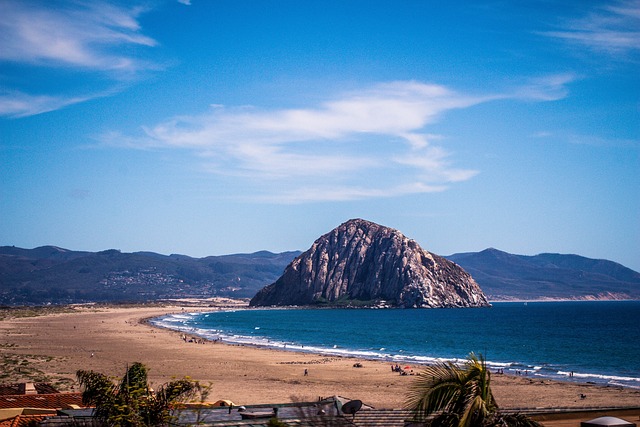 “Morro Bay is moving forward with a $3.87 million agreement to purchase the Cayucos Sanitary District’s 40 percent stake in the jointly owned former wastewater treatment plant. The property, located along Atascadero Road and the Embarcadero, has been jointly owned by the two agencies since 1953, when the original plant was constructed under a joint powers agreement to serve both communities. The facility was last upgraded in 1984 but is no longer in use after Morro Bay and Cayucos each built separate wastewater treatment systems. Under the proposed purchase and sale agreement, Morro Bay would acquire full ownership of the roughly 19-acre site including the former plant, a former concrete plant, a portion of the Morro Dunes RV Park, and nearby coastal land. Currently, the city owns 60 percent of the land and 65 percent of the plant and pipeline infrastructure, while Cayucos holds the remaining shares. … ” Read more from New Times SLO.
SAN JOAQUIN VALLEY
Friant settles groundwater pumping lawsuit against Eastern Tule GSA
“The Friant Water Authority has settled a lawsuit involving two other local agencies over groundwater pumping. The agency announced the settlement on Thursday. The backstory: Friant Water Authority and Arvin-Edison Water Storage District (AEWSD) filed a lawsuit against Eastern Tule Groundwater Sustainability Agency (ETGSA) in 2024. The two agencies disagreed with ETGSA over how much the sustainability agency should pay to cover subsidence repairs for the Friant-Kern Canal. Repairs are underway on the Friant-Kern Canal, which lost around 60% of its capacity due to a 33-mile stretch of subsidence. … ” Read more from SJV Sun.
Cal Water brings sixth water storage tank online in Visalia
“California Water Service (Cal Water) has completed work on a water infrastructure project that will upgrade and improve water supply reliability and fire protection in Visalia. Cal Water completed construction on a sixth water storage tank and booster station and added it to its system last week. The one-million-gallon tank will help augment water supply as residential growth continues in northeast Visalia. “This is a critical investment in Visalia’s future that strengthens the water system and supports our ability to continue delivering reliable service to every home and business for decades to come,” said Stuart Skoglund, Cal Water’s Interim Visalia District Manager, noting that Cal Water also recently completed work on a 975,000-gallon water storage tank and booster station in downtown Visalia. “As part of our commitment to delivering quality, service, and value to our customers, we’re improving overall system performance and safeguarding the high‑quality drinking water our community depends on every day.” … ” Read more from Valley Voice.
EASTERN SIERRA
LADWP announces annual Mono Lake level reading, taking final measurement with Mono Lake Committee
“Today, the Los Angeles Department of Water and Power (LADWP), Mono Lake Committee, and partner organizations gathered at Mono Lake to mark the beginning of the new runoff year in the Eastern Sierra. LADWP has long observed April 1 as the date it performs the final Eastern Sierra snow survey of the season and records the elevation of Mono Lake. These measurements provide essential data to inform forecasting and water deliveries for the City of Los Angeles. Today, the surface elevation measurement at Mono Lake was 6,382.75 feet above sea level. “The elevation at Mono Lake is largely determined by hydrologic factors, such as precipitation, evaporation, and runoff, and, on average, has been trending up for the past three decades,” said Chief Operating Officer and Senior Assistant General Manager Water System, Anselmo G. Collins. “The Mono Basin serves a meaningful role in our overall water supply portfolio, and we value this water – it reinforces our responsibility to the region, which is why we invest substantially in environmental enhancement projects and wildlife protection to sustain a healthy Mono Lake.” … ” Read more from LADWP.
SNOWPACS project helps Walker River Basin communities navigate a changing water future
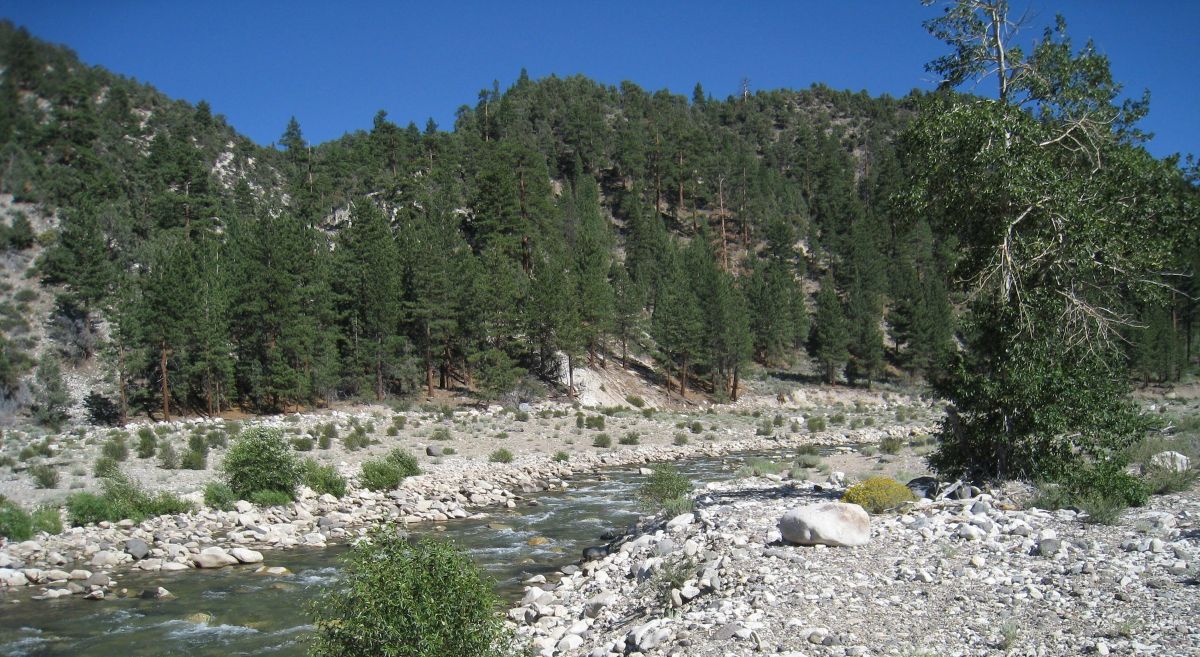 “In the arid valleys of the American West, winter snowpack from surrounding mountains forms a vital resource, serving as a natural reservoir of frozen water that melts each spring to feed rivers, lakes and irrigation systems. But as winters grow warmer and mountain storms shift from snow to rain, the presence and volume of that snowpack is becoming less predictable, creating new challenges for farmers and other water users. At the University of Nevada, Reno, a multi-year, interdisciplinary initiative called SNOWPACS – Synthesizing kNowledge to Optimize Water Policy under Changing Snowpack – is investigating options for helping farmers and other water users navigate water availability changes and challenges in snow-fed river basins. Funded by the USDA National Institute for Food and Agriculture, the project focuses on understanding and predicting how changes in snowpack and water availability affect agricultural production and food security and how water policy can be shaped to help communities adapt. The project team is examining these questions through case studies set in two Western river basins: the Walker River Basin of Nevada and California, and the South Platte River Basin of Colorado. Each of these basins is home to communities that are impacted by changing snowpack conditions. … ” Read more from Nevada Today.
SOUTHERN CALIFORNIA
LA County awards $500,000 to support Topanga Lagoon project
“Los Angeles County officials today awarded $500,000 in Measure A funding to an environmental organization to support its work restoring Topanga Beach. During a morning news conference, L.A. County Supervisor Lindsey Horvath presented the Resource Conservation District of the Santa Monica Mountains, or RCDSMM, with a half-million-dollar check. The funding will assist the organization in its effort to restore coastal habitat, improve public access and address long-standing challenges at Topanga Beach. “LA County’s Third District is proud to support the continued restoration of the Topanga Lagoon. This investment advances the long-term resilience of our coastline, expands access to nature and recreation for our communities, and protects vital ecosystems as we confront the climate crisis,” Horvath said in a statement. … ” Read more from the LA Daily News.
Committee weighs data centers as officials cite power, water demands
“City officials began weighing whether to allow data centers in the City, with discussion focusing on the facilities’ significant demands on electricity and water infrastructure as well as how they should be defined and regulated. The Housing, Homelessness and Planning Committee on Wednesday received a staff presentation outlining what data centers are, how they operate and the potential impacts they could have if permitted locally. The discussion centered on whether the City is prepared to regulate data centers before proposals emerge, particularly given their significant demands on energy, water and infrastructure. … ” Read more from Pasadena Now.
SAN DIEGO
A new front in the Tijuana sewage battle
“For decades, South San Diego County residents have known the Tijuana River as a noxious source of cross-border sewage pollution. This week, business owners in Imperial Beach added a new dimension to the river’s troubled reputation. They called it an economic Grim Reaper. Following a back-channel request from Imperial Beach Mayor Mitch McKay, top-ranking officials from the U.S. Small Business Administration on Tuesday met with a roundtable of local business owners to hear first-hand about the economic toll taken by years of unchecked sewage discharges in one of San Diego County’s most densely populated regions. Business owners took full advantage of the opportunity to share their woes. They told of vanishing tourists, lost customers, decimated revenues and near-empty sidewalks along what should be a vibrant Southern California beachfront. … ” Read more from the Voice of San Diego.
Along the Colorado River …
A drying Colorado River threatens Imperial Valley’s future
 “In the southeast corner of California, 300-foot-tall sand dunes rise from a sunbaked landscape dotted with ocotillo and creosote bushes. Summer temperatures here regularly exceed 110 degrees, and annual rainfall is comparable to that of the Sahara Desert. Despite its unforgiving terrain, more than 180,000 residents live in Imperial County, one of the country’s most productive agricultural regions and more recently a magnet for data center development and lithium extraction proposals. This has all been made possible by turn-of-the-20th century canals that carve up the region, supplying it with more than a million gallons of Colorado River water every minute. “We’ve often called it the lifeblood of Imperial Valley,” said Robert Schettler, a spokesperson for Imperial Irrigation District, the area’s public utility, which manages the region’s over 3,000 miles of drains and canals. “If something were to happen to that river, we would all have to pack up and leave.” … ” Read more from Capital & Main.
“Snow drought” – What does it mean to the Colorado River Basin?
“As planners and water managers in the Western U.S., we tend to think of mountain snowpacks as reservoirs because they constitute a free, readily available means for short-term storage of surface water. In this context, snow drought is a generic, catch-all term to denote an abnormally low snowpack. The term “snow drought” first came into use among scientists in the 1970s and it was refined by a seminal paper published in EOS, the magazine of the American Geophysical Union, Feb. 2017 (Harpold, A.A., M. Dettinger, and S. Rajagopal). That article addressed differences between the types of snow drought, namely: “Dry snow drought” – lack of winter precipitation, and “Warm snow drought” – higher winter temperatures. preventing precipitation from falling as snow (i.e. precipitation falls as rain instead of snow). Southern reaches of the Colorado River Basin have already shown a marked decrease in total winter precipitation (“dry snow drought”). … ” Read more from the Central Arizona Project.
Saving water in the West is expensive. Can big companies help pay for it?
“The Colorado River is drying up, and the people who use it are figuring out how to cope with less water. Across the Western U.S., cities, farms, and tribes are cutting back on how much they use, but doing that can get expensive. Lately, a new source of money has been helping fuel those conservation projects as big companies are starting to chip in. South of Phoenix, the water used by the Gila River Indian Community moves through a canal next to a field of crops. As the water advances, sensors pick up where the water is at before a system of high-tech motorized gates spill it out onto a field of alfalfa. David DeJong, who manages the irrigation here, said they used to run water across this field for eight to twelve hours to get it fully soaked. But with the new tech, it only takes about one. “The key here is to get the water across the field as quickly as possible,” he said. … ” Read more from Marketplace.
Congressional Report: Colorado River at a breaking point
“The Congressional Research Service released an updated report for Congress examining how the Colorado River is managed, how drought is affecting supplies, and what role the federal government may play moving forward. The Congressional Research Service is a nonpartisan research arm of Congress, and its reports are widely used by lawmakers to understand complex policy issues. The March 31, 2026, report outlines long-standing legal agreements, current water shortages, and the approaching expiration of key operating rules in 2026. It also signals that Congress may soon face important decisions about funding, authority, and long-term management of one of the West’s most critical water systems. … ” Read more from Western Water.
Colorado River in spotlight at Southwestern Water Conservation District Annual Seminar
“Last Friday, March 27th, the Southwestern Water Conservation District hosted its annual seminar in Ignacio in southwest Colorado. The event brings together irrigators, water managers, scientists, public officials, and business owners. For this year’s keynote, one of Colorado’s most powerful water officials staked out the state’s position on the Colorado River. For Rocky Mountain Community Radio, KSUT’s Adam Burke reports. This report was shared with us via Rocky Mountain Community Radio, a network of public media stations in Colorado, Wyoming, Utah and New Mexico, including KGNU. … ” Listen at KGNU.
Arizona’s Water Crisis: Urgent realities and possible solutions
Loring Green writes, “The Arizona Daily Star and reporter Tony Davis deserve recognition for their in-depth coverage in the March 29 article, “State’s Water Reckoning …” This piece delivers a sobering message about the existential threat facing Arizona’s future. The challenge is not a distant possibility — it’s here and now. The 2026 Upper Colorado Basin snowpack is the lowest in the past decade and ranks as the third worst since 1940. The anticipated spring runoff will fall far below projections, while Lake Powell and Lake Mead are already severely depleted. Significant reductions to our Central Arizona Project (CAP) water allotment are imminent, and addressing the resulting deficit will require immediate, difficult and costly measures. The following are potential strategies to help address the crisis. … ” Read more from the Arizona Daily Star.
Grand Canyon water restrictions could close South Rim lodging if pipeline issues continue
“Grand Canyon National Park is under Stage 3 water restrictions as of Wednesday due to a break in the water pipeline that serves millions of visitors and residents each year. National Park Service officials implemented the Stage 3 restrictions as crews work to repair the break and restore water storage tanks to sustainable levels. If conditions do not improve, the park may move into Stage 4 water restrictions, which would close overnight lodging and Trailer Village. Water levels have dropped to about 15 feet, prompting mandatory conservation measures. Camper services at Mather Campground are closed, and water spigots have been turned off. Restrooms remain open. … ” Read more from AccuWeather.
The $2.7 trillion coin toss: Arizona’s high-stakes gamble on a shrinking river
“At the edge of a concrete canal cutting through the Sonoran Desert, the water moves with a deceptive, silent efficiency. This artery, the Central Arizona Project (CAP), is the mechanical heart of the state’s economy, pumping the Colorado River hundreds of miles uphill to reach the kitchen sinks of Phoenix and the high-tech cleanrooms of the semiconductor industry. However, this multi-billion-dollar infrastructure is currently racing toward a deadline that could render it a relic. At midnight on December 31, 2026, the temporary rules governing how seven states share the river will expire, leaving Arizona at the mercy of a “Thunderdome” legal landscape. According to Rhett Larson, the Richard Morrison Professor of Water Law at Arizona State University, the crisis is not merely a matter of a dry winter or a bad decade of snowpack. It is a fundamental structural failure. Larson posits that the Southwest is currently attempting to survive using a “19th-century law” to manage “20th-century infrastructure” for a “21st-century climate and population.” This framework suggests that the very tools used to build the West are now the primary obstacles to saving it. … ” Read more from the Lake Powell Chronicle.
‘Development at all costs’?: Appeal filed against Utah-Nevada groundwater pipeline
“What some see as a water grab for a fast-growing metro in Utah could have implications for the groundwater flows that support Nevada’s only national park and surrounding farm land. On Wednesday, a broad coalition of farmers, county and city governments and environmentalists filed an appeal to the Bureau of Land Management after it approved permits for a pipeline that would contribute to the drain of aquifers in the name of growth in Iron County, Utah, which includes Cedar City. The appeal includes Nevada’s White Pine County, the Central Nevada Regional Water Authority, the N-4 State Grazing Board of Nevada, the Utah counties of Beaver, Millard and Juab, the city of Milford and individual residents of Utah and Nevada. “We aren’t merely appealing a regulatory decision,” said nonprofit Great Basin Water Network executive director Kyle Roerink. “We are appealing to common sense and reason. Powerful people want development at all costs and at breakneck speed in Cedar City. The pipeline, however, is their most expensive and risky choice for augmenting supply.” … ” Read more from the Las Vegas Review Journal.
West Desert water could be ‘sucked dry’ by southern Utah pipeline project, a broad coalition warns
“A diverse group of rural Utah counties, ranchers, environmental groups and a tribe are raising red flags about a recently approved water pipeline in the West Desert. The Indian Peaks Band of the Paiute Indian Tribe of Utah, the Center for Biological Diversity and a coalition that includes Utah and Nevada counties, residents and the Great Basin Water Network filed three separate appeals with the Interior Board of Land Appeals on Wednesday, challenging the Bureau of Land Management’s approval of the Pine Valley Water Supply Project last month. The appeals also include petitions to temporarily halt the project while they are considered. The project proposed by the Cedar Valley Water Conservancy, formerly known as the Central Iron County Water Conservancy District, would pump up to 15,000 acre-feet of groundwater from Pine Valley in Beaver County and pipe it to Iron County. … ” Read more from the Salt Lake Tribune.
It’s been the worst year for Colorado’s snowpack in recorded history. A striking new map shows why.
“When the state climatologist warns he’s not going to sugarcoat the drought we’re in, expect a bitter pill. The traditional April 1 water outlook from Colorado Climate Center’s Russ Schumacher puts the water equivalent in the dismal snowpack at just 22% of the historic median for the date, far lower than any year they’ve recorded under the current system. Did you know it was 99 degrees in Burlington, at the Kansas border, on March 25? That had escaped us, too. But Schumacher cites that shocker to underline how quickly the sun blasted out the statewide snowpack in the last two weeks of March. The average liquid water stored in Colorado’s snow was down to 3.1 inches on April 1. That’s less than 40% of what remained on that date in the previous lowest year, 2012, when 9.1 inches of water equivalent was still left in the pack. “It’s now safe to conclude that this has been the worst year for Colorado snowpack in recorded history,” Schumacher wrote in his blog Thursday. … ” Read more from the Colorado Sun.
Commentary: Will more of the Colorado River flow uphill toward the Front Range money?
Gary Wockner writes, “There’s a saying in the West that “water flows uphill towards money.” Here in Colorado, that saying is rooted in hard fact that includes tunnels, pipelines and pump stations all pushing and pumping water uphill, from the western side of the state, over and through the Continental Divide, to the eastern side of the state where the vast majority of the people live. In Grand County, which is where the Colorado River begins at the Continental Divide, 70% of the river is already diverted out before it reaches the boundary with Eagle County downstream. Much of that water is pumped uphill through the Continental Divide to the Front Range. Never satisfied, the “growth machine” along the Front Range always wants more water to fuel its profits, and the source of that water always has been, and will continue to be, Colorado’s rivers. The latest instate squabble involves a small and very old hydroelectricity plant on the Colorado River downstream near Glenwood Springs. … ” Read more from the Colorado Sun.
Even if Coloradans slash their water use, their bills will likely rise during drought
“Colorado homeowners and businesses are already planning for a brutally dry summer. They should also be planning for an expensive one, as Denver and other cities prepare to impose drought fees to encourage conservation and to buffer their budgets against millions of dollars in lost water sales as customers cut back. Denver, which announced Stage 1 drought restrictions last week, said its preliminary estimates suggest $30 million to $70 million in lost revenue as a result of restrictions. It has annual revenue of $488.5 million. Denver is Colorado’s largest water utility, serving more than 1.5 million people in the city of Denver and across the southern and western suburbs. The agency said its surcharges will be designed to penalize high-volume outdoor water use, while keeping the price for drinking, cooking and bathing water unchanged. … ” Read more from the Colorado Sun.

