
Several news sources featured in the Daily Digest may limit the number of articles you can access without a subscription. However, gift articles and open-access links are provided when available. For more open access California water news articles, explore the main page at MavensNotebook.com.
On the calendar today …
- MEETING: Delta Independent Science Board beginning at 9am. Agenda items include an overview of the Interagency Ecological Program and the Regulatory Landscape for Contaminants Monitoring; Summary of the Emerging Climate Science Symposium; and the Delta Lead Scientist’s report. Click here for the meeting notice.
- WORKSHOP: Drought Resilience Interagency & Partners (DRIP) Collaborative Drought Indicators & Metrics Workshop beginning from 9am to 12:30pm. Join the Department of Water Resources for the Drought Resilience Interagency & Partners (DRIP) Collaborative Drought Indicators & Metrics Workshop #1. Members of the public are able to attend the meeting remotely via Zoom. Remote participation will be conducted via a Zoom platform. Register here: https://ca-water-gov.zoom.us/meeting/register/KgkscrmeRyKmgDR3DaHBmA.
- HYBRID: California Conservation Corps Salmon Restoration Program on the North Coast from 7pm to 8pm. Join Rachael Aguirre, a fish habitat assistant at the California Conservation Corps, to explore the history and current practices of the CCC’s Salmon Restoration Program on the North Coast. This 1-hour talk is part of the First Wednesday Lecture Series sponsored by Friends of the Arcata Marsh (FOAM). The event will be held at the Arcata Marsh Interpretive Center starting at 7 p.m., followed by a Q&A session. This presentation will be both in-person and simulcast via Zoom at https://humboldtstate.zoom.us/j/88248246788?pwd=AuQSlOmC4Zwkq4hzWctlzTySkjKyjY.1#success.
In California water news today …
April 1 is supposed to be peak snow in California. Forget that this year
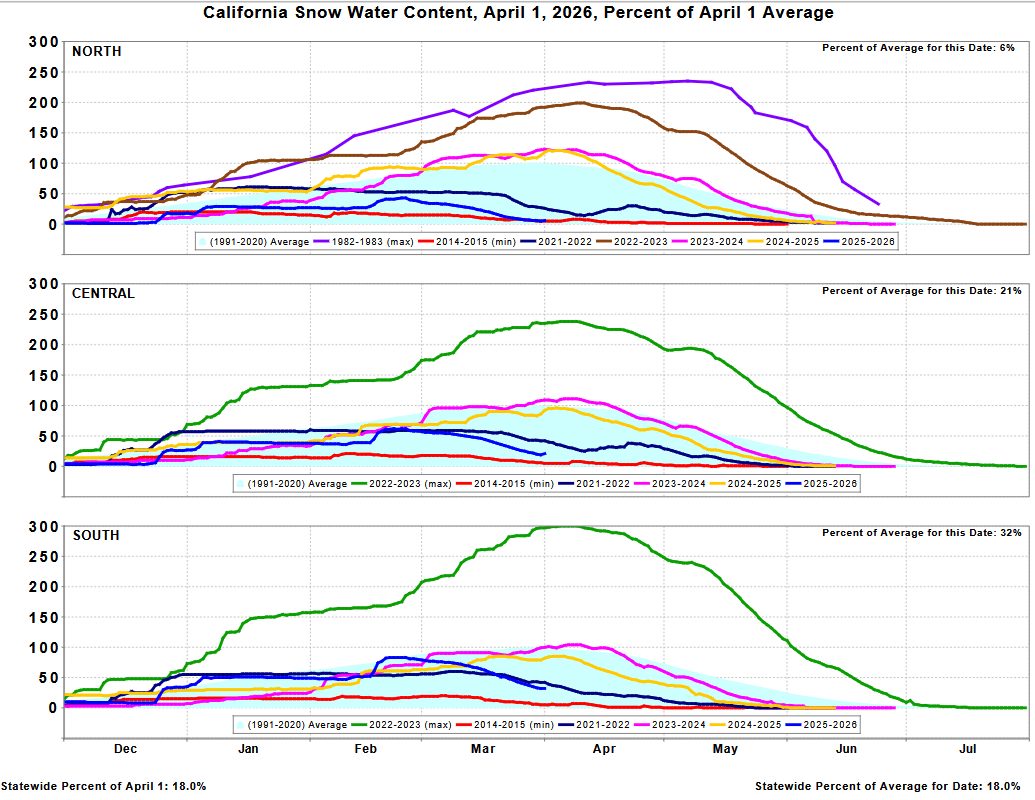 “California’s snowpack is supposed to reach its peak April 1, so today, state surveyors hold their final Sierra snow survey of the year. But instead of peak snow, there’s almost none. Snow across California’s Sierra Nevada measured just 18% of average Monday — among the smallest in decades. A month of record-shattering heat thawed the snow and sent runoff coursing into streams and rivers, leaving only minimal water in the mountains as the state heads into dry season. The early melt is a symptom of global warming that scientists say is becoming more pronounced. “This particular year is as clear an indication of the influence of climate change as anything we’ve seen,” said Peter Gleick, a leading water scientist and co-founder of the Pacific Institute. “Climate change is influencing California’s water system quickly and severely.” … ” Read more from the LA Times. | Read via MSN News.
‘On a whole other level’: rapid snow melt-off in American west stuns scientists
“Snow surveys taking place across the American west this week are offering a grim prognosis, after a historically warm winter and searing March temperatures left the critical snowpack at record-low levels across the region. Experts warned that even as the heat begins to subside, the stunning pace of melt-off over the past month has left key basins in uncharted territory for the dry seasons ahead. Though there’s still potential for more snow in the forecast, experts said it will likely be too little too late. “This year is on a whole other level,” said Colorado State University climatologist Dr Russ Schumacher, speaking about the intense heat that began rapidly melting the already sparse snowpack in March. “Seeing this year so far below any of the other years we have data for is very concerning.” … ” Read more from The Guardian.
Winter’s alarmingly low snowpack offers a glimpse of the changing rhythm of water in the western US
“Winter is more than just a season in the western U.S. – it is a savings account to get farms and homes through the long, dry summer ahead. As the snowpack that accumulates in the mountains through winter slowly melts in late spring and summer, it feeds into rivers and reservoirs that keep communities and ecosystems functioning. The April 1 snowpack measurement has long been the single most important number in western water management, considered a strong proxy for how much water the mountains are holding in reserve. But in 2026, that savings account has been woefully deficient. Across the western United States, temperatures from November through February were among the warmest on record, with many areas 5 to 10 degrees Fahrenheit (2.8 to 5.5 degrees Celsius) above the 20th-century average. March continued to break heat records. At lower elevations, the higher temperatures meant a significant part of the winter’s precipitation fell as rain rather than snow. In some places, snowfall accumulated but melted quickly during warm periods. … ” Read more from The Conversation.
Tahoe area braces for snow, potentially ‘damaging wind’
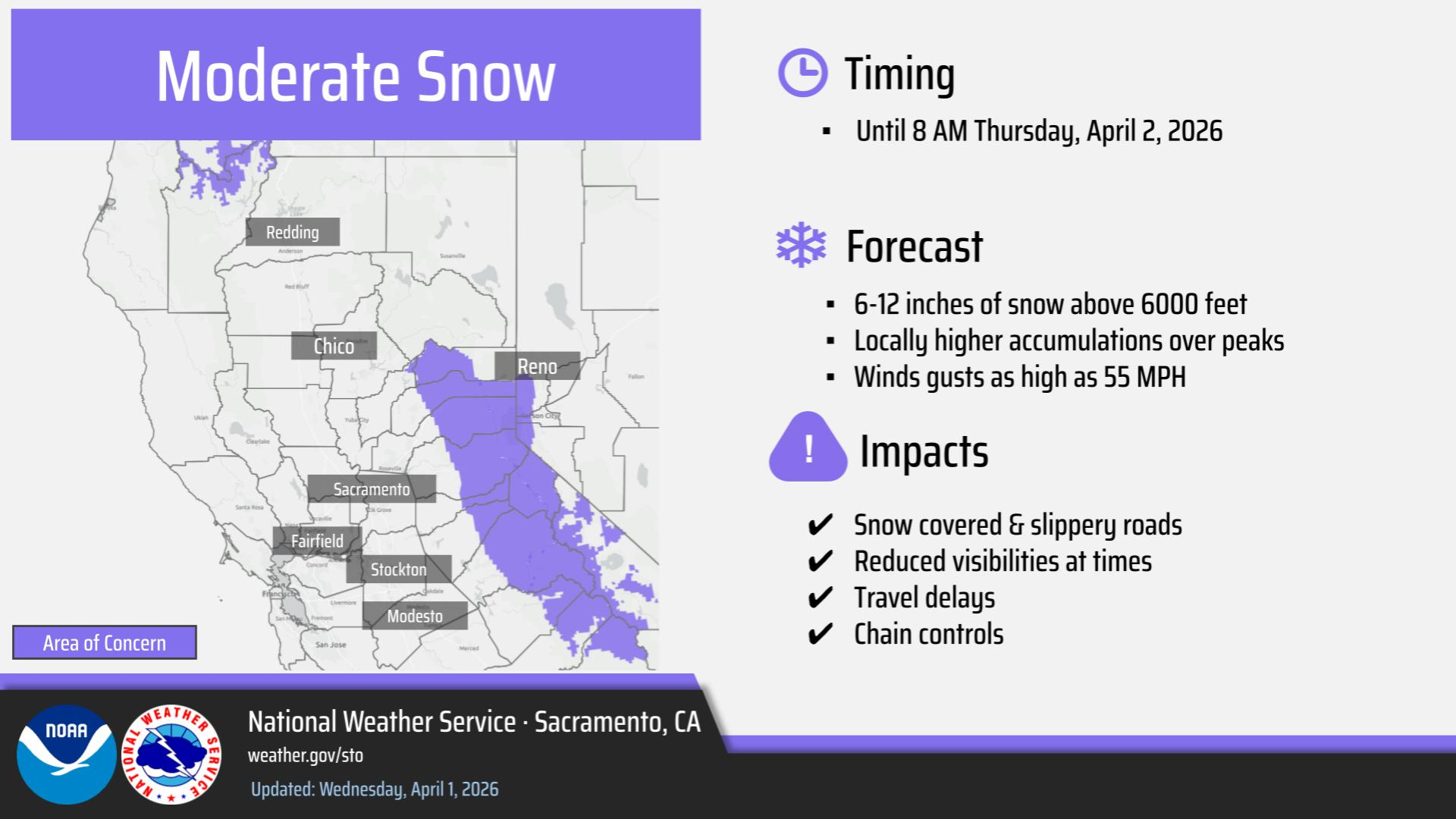 “The Tahoe area is bracing for its first storm in six weeks, coming on the heels of a dry March with record warmth that decimated the Sierra Nevada snowpack. Rain and high elevation snow showers were falling in Tahoe on Tuesday, but a more significant storm is anticipated Wednesday into Thursday morning. That storm is predicted to be colder and windier. The storm arriving tomorrow is forecast to drop a foot of snow at Donner Summit and generate “damaging winds,” along the eastern Sierra front, including Reno, according to the National Weather Service. Wave heights of up to 6 feet are possible on the eastern shore of Lake Tahoe. A low-pressure system moving into the Pacific Northwest is forecast to swing a cold front across Northern California and Nevada on Wednesday. That front will drop the rain-snow line as low as 5,000 feet, bringing Tahoe its first significant snow since a February blizzard that culminated in a deadly avalanche. … ” Read more from the San Francisco Chronicle.
SEE ALSO: See winter return to Tahoe ski resort with up to 25 inches of snow forecasted, from the Sacramento Bee
Decadelong fight over Yuba River dams ends in favor of feds
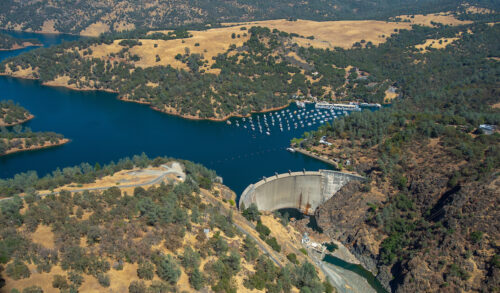
“The federal government has complied with the Endangered Species Act in its activities at two dams on California’s Yuba River, a judge ruled Tuesday in a decade-old case. However, U.S. District Judge Daniel Calabretta had one carveout in his decision. He determined the National Marine Fisheries Service and U.S. Army Corps of Engineers improperly excluded the Brophy Diversion from an analysis. He remanded that aspect of the case to the service for reassessment. The judge’s decision on the motions for summary judgement closes the 2016 case that at its heart focused on three fish: Central Valley spring chinook salmon, Central Valley steelhead, and North American green sturgeon. Friends of the River had argued the service and corps improperly defined the range of agency action at Daguerre Point and Englebright dams. Operating under the wrong legal definition violated the Endangered Species Act and the corps’ duty to protect the fish. … ” Read more from Courthouse News Service.
A clearer view: The first seamless elevation map of the Bay-Delta
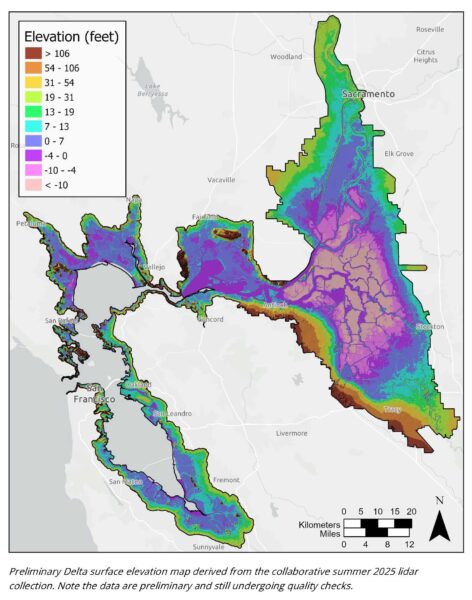 “At the March Delta Stewardship Council meeting, the Delta Lead Scientist’s Report showcased a complete, high-quality elevation map of the entire Bay-Delta estuary—from the Golden Gate to the upper estuary. This marks the first time such a seamless dataset has been created, addressing long-standing challenges in regional mapping. The Bay-Delta is a dynamic landscape, constantly reshaped by natural forces and human interventions. Recent events, such as levee breaches during 2023 storms on the Cosumnes River and intentional restoration projects like Lookout Slough, along with rising sea levels and flooding, such as the Highway 101 inundation in Marin County, further underscore the importance of precise mapping for flood risk assessment, restoration planning, and infrastructure protection. Accurate, consistent elevation data enables better decisions. However, Bay-Delta mapping was previously patchy—collected for varying purposes, with different equipment and standards, across separate areas and years. As a result, agencies stitched datasets and filled gaps with estimates, adding uncertainty to flood protection, habitat restoration, and water management. … ” Read more from Maven’s Notebook.
Inside the fight for water in the Central Valley
“California agriculture is facing a defining moment—and water sits at the center of it all. In a compelling conversation with “The Ag Meter”, host Nick Papagni, sits down with Lindsay Cederquist, Director of Water Resources at Diversified Land Management, to unpack the realities farmers are facing today. From shrinking water allocations to rising costs and regulatory pressure, this interview delivers a raw, honest look at the challenges—and opportunities—ahead. Cederquist works directly with growers across the Central Valley, helping them navigate complex water portfolios year by year. And as she explains, no two years are ever the same. “We sit down and ask: how are we going to get through this water year?” … ” Read more from Ag Net West.
Structural shifts redefining California’s farming economy
“California’s agricultural industry is defined by constant adjustment. At current, mounting financial pressures including high input costs, declining commodity prices, water uncertainty, consolidations, and bankruptcy filings, are pointing to long-term, structural changes in the industry, according to Dr. Aaron Hegde, professor of economics at California State University, Bakersfield and Executive Director at Grimm Family Center for Agricultural Business. “This is a trend that’s been happening for the last 100 years. The number of farms decreases, the average size of each farm increases. Historically, it’s been people buying out their neighbors because they either go out of business or there’s no next generation,” Hegde said. “Now, instead of neighbors buying out their neighbors, it’s companies buying out. So, I think what you might see is, as you see in the meat processing industry, a few companies, a few private equities or a few corporations that basically own ag.” … ” Read more from Valley Ag Voice.
California Water Plan targets 9 million acre-feet by 2040
“In February, Governor Gavin Newsom announced the formal launch of California Water Plan 2028, with a statewide water supply target of 9 million acre-feet by 2040, roughly equal to two Shasta Reservoirs. The plan update was spurred by Senate Bill 72, authored by Democratic Assemblymember Anna Caballero and signed into law in October 2025, which mandates the modernization of the California Water Plan by improving data and setting measurable water supply targets. The California Water Plan is already updated every five years by the Department of Water Resources which outlines how the state manages and uses water. Throughout the update, DWR looks at strategies for meeting future water needs, including conservation, recycling, desalination, new storage, and water transfers. DWR is also tasked with establishing an advisory committee to assist in updating the plan. … ” Read more from Valley Ag Voice.
McNerney crafts water solution that benefits the Delta as well as those relying on imported north state water
“It was late January 2007. Jerry McNerney was the newly minted 11th District representative in Congress having defeated Richard Pombo more than two months earlier. His aides had arranged a press conference at one of the two Big League Dreams sports complex restaurants in Manteca. McNerney, with an engineering background, had a reputation as an environmentalist, having served as an alternative energy consultant to PG&E and the likes and working as CEO of the Horizontal Axis Wind Turbine Power startup prior to his election. … ” Read more from the Manteca Bulletin.
You can’t manage what you don’t measure: Reservoirs and California’s climate blind spot
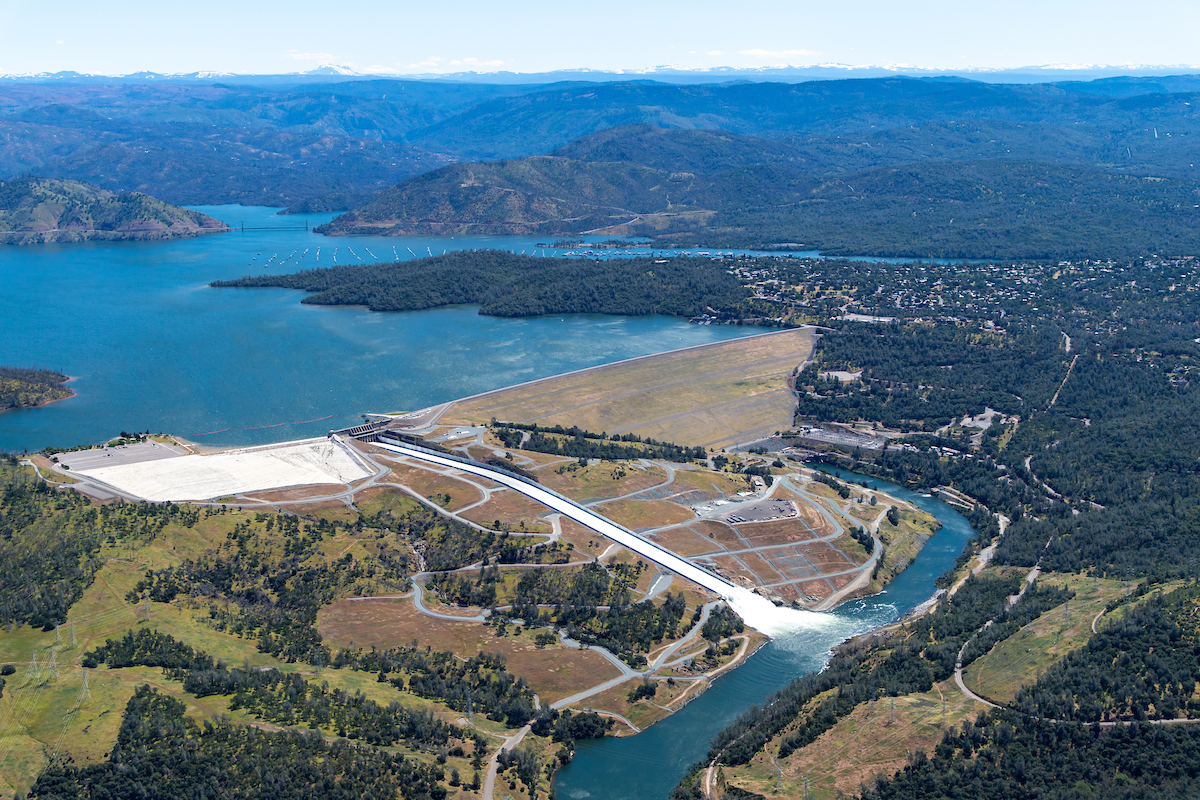
On this date, the water storage was 3,520,058 acre-feet (AF), 100 percent of the total capacity. Sara Nevis / DWR
“Climate change is the greatest threat to California’s cold-water fisheries. Rising air temperatures, shrinking snowpack, and more volatile hydrology are already warming rivers, changing flow patterns, and putting salmon and trout at risk. CalTrout’s SOS II report makes this clear: without urgent action to protect and restore cold-water habitats, many of California’s native salmonids face continued decline or extinction. California is investing heavily in nature-based climate solutions that mitigate greenhouse gas emissions, the primary driver of climate change. The more we understand about the activities or infrastructure that emit high levels of greenhouse gases, the more effective our strategies will be at reducing them. Today, one major source of greenhouse gas emissions remains largely unaccounted for and unregulated, our reservoirs. For decades, reservoirs have been treated as climate-neutral infrastructure in the public discourse. But science tells a different story. When rivers are dammed, organic material accumulates and decomposes underwater, producing methane, an extremely potent greenhouse gas. Across California, reservoir emissions are likely significant but are not currently measured or included in the state’s greenhouse gas inventory. … ” Read more from Cal Trout.
Fish domination of avian food webs
“Food webs are the backbones of ecosystems: they chart the flow of energy through ecosystems in terms of who eats whom, and their structure helps determine whether an ecosystem will be stable over time. While food web studies often focus on relationships within a particular habitat type – a lake or a forest, for example – broader predator-prey relationships can couple a lake to the forest that surrounds it. We conducted such a study, examining predator-prey relationships at the aquatic-terrestrial interface, and we report an unexpected new finding: fish are important predators of birds in food webs spanning water bodies and shorelines (i.e., riparian zones) across North America. … ” Read more from the California Water Blog.
New AI tool from the USGS forecasts drought 90 days ahead nationwide
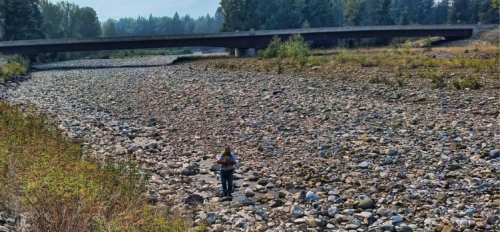
“The U.S. Geological Survey released a new machine learning tool that forecasts droughts up to 90 days ahead nationwide. The tool may provide communities extra time to prepare for water shortages that could impact agriculture, municipal supplies, recreation and ecosystems. The tool forecasts streamflow drought, which is when rivers and streams drop below normal levels for extended periods, which may directly impact water availability even when rainfall returns to normal. The USGS River DroughtCast uses machine learning models trained on data from thousands of USGS streamgages, some with more than 100 years of continuous records, to forecast when rivers and streams will drop to abnormally low levels. “The USGS is putting more than a century of streamflow data to work in a completely new way, using machine learning to predict streamflow drought weeks in advance,” said John Hammond, USGS project manager for the drought forecasting system. … ” Read more from the USGS.
U.S. cities that are facing a potential loss of municipal water
“As of early 2026, many American cities face critical threats to their municipal water supplies due to a combination of overdrawn aquifers, shrinking reservoirs, and aging infrastructure. While historically associated with the Southwest, water stress has increasingly impacted the Northeast and Midwest due to infrastructure failures and shifting climate pattern. Here are twenty American cities most threatened by a potential reduction of municipal water supplies … ” Read the list at Coyote Gulch.
Southern California fire department using sound waves to fight fires as alternative to water
“Water has long been the go-to when it comes to fighting a fire. But what about sound waves? It might be hard to wrap your head around the concept at first, but the San Bernardino County Fire Department is testing out the idea of using sound to extinguish flames. The technology – called Sonic Fire Tech – was developed by ex-NASA engineers and works without water or chemicals. San Bernardino County Fire Department officials explained that the device, which resembles a leaf blower, is designed to detect and suppress fire using sound waves. “This technology works without water or chemicals, creating a protective zone that can stop ignition in milliseconds while avoiding the collateral damage often seen with traditional suppression methods,” the fire department said in a social media post showcasing the device. … ” Read more from KTLA.
In commentary today …
Here’s what California’s dismal snowpack means for the state’s future
Peter Gleick, co-founder and a senior fellow at the Pacific Institute, writes, “April 1 is the most important day for evaluating California’s water resources for the year and is considered the end of the rainy season, which runs from Oct. 1 through March 31. The last day of March is also when final snowpack measurements are made in the Sierra. The bad news this year is that the snow is already almost gone. On average, California’s April 1 snowpack stores around 27 inches of water, equivalent to billions of gallons of water. This year, it is less than 5 inches, and the mountains are largely bare. What we’re seeing is a clear signal of human-caused climate change. California received about its average precipitation this winter; however, only a small fraction was snow. Extraordinarily high temperatures wiped out the snow, either sublimating it off into the atmosphere or turning it into runoff too early in the year to be captured by reservoirs. From a water-supply perspective, the state is in OK shape: Major reservoirs are full, ensuring that, this year at least, cities and farms will get most of their desired allocations. The longer-term trends, however, are worrying. Ever-rising temperatures will continue to turn snow to rain and melt our snowpacks earlier. Our water supply depends on mountain snow storage to supplement our artificial reservoirs. Without the snowpack, we will draw down our reservoirs earlier, cutting into our reserves and worsening the impact of the inevitable droughts we suffer. … ” Read more from the San Francisco Chronicle.
Bad news for all: AHO’s draft water rights decision for proposed Sites Reservoir
“On March 20, 2026, the Administrative Hearings Office (AHO) for the State Water Resources Control Board (Board) issued a Draft Decision regarding water rights for the proposed Sites Reservoir. The Draft Decision followed over a year of evidentiary hearings that ended with reply briefs in June 2025. The Draft Decision is accompanied by a Draft Water Rights Permit. The Draft Decision proposes granting the water rights, but with a series of conditions that are much stricter than those proposed by the applicant, the Sites Project Authority. Many of these conditions are the consequence of evidence presented by non-governmental organizations (NGOs) who protested the application, including CSPA. Are CSPA and other NGO protestants happy with the proposed decision to grant the water rights? Nope. Denial is still the right answer. Further diversions from an over-allocated Central Valley watershed are not in the public interest. NGOs presented evidence that demand reduction and alternative water supply sources are feasible to protect public trust resources and still meet reasonable water use. … ” Read more from the California Sportfishing Protection Alliance.
Investigate the AI campaigns flooding public agencies with fake comments
Mary Nichols, former chair of the California Air Resources Board, writes, “California built its tradition of open government — including for citizen boards that set the rules for such functions as automotive repair and security guard licensing — precisely to keep well-funded corporate interests in check. Lobbyists and special interests are constantly scheming to defeat the will of the majority. Now they are able to do more damage using artificial intelligence to simulate fake grassroots opposition to clean air measures, and they are surreptitiously using the identities of real people to deceive regulators. Last June, the South Coast Air Quality Management District received more than 20,000 comments opposing a pair of clean air rules that would have prevented 2,500 premature deaths and 10,000 new cases of asthma. A February investigation by the Los Angeles Times revealed that those comments were submitted through CiviClick, a Washington-based AI-powered comment generation platform, orchestrated by a local political consultant with ties to the natural gas industry. When the district’s cybersecurity team reached out to a small sample of commenters to verify their identities, a majority of respondents said that they had not submitted the comments in their names. Even so, the flood of fake comments seemingly worked. … ” Continue reading from the LA Times.
In regional water news and commentary today …
NORTH COAST
How Rio Dell is balancing growth, tourism and infrastructure needs
“Rio Dell sits on a peninsula along the Eel River in Northern California, marking the southern gateway to the Avenue of the Giants, a scenic drive through redwood forests. About 22 miles south of Eureka, the city has roughly 3,400 residents. Mayor Debra Garnes points to the view from Highway 101 as a defining feature. On many mornings, fog drifts through the trees. “It is just a beautiful place,” Garnes said. “It is quiet and peaceful.” Rio Dell’s identity has shifted over time. The community grew alongside the Pacific Lumber Co. in neighboring Scotia and once carried the nickname “Wildwood” for its rowdy bars and brothels. The town was incorporated in 1965, in part to establish a police force. The name Wildwood remains on the main road, though the atmosphere today is quieter. … ” Read more from Jefferson Public Radio.
This has been Eureka’s driest march in 100 years and the second-driest ever recorded
“It’s supposed to rain a lot in March, especially here in Humboldt County — but that has not been the case this year. Eureka averages about five and a half inches of precipitation in March, but the 2026 version has delivered less than half an inch, according to data from the National Weather Service. And with none in the forecast today, we can go ahead and mark this down in the record books as the city’s driest March since 1926 and the second-driest since modern record-keeping began in 1886. While the National Weather Service has just the one measuring station in the county, this super-dry spell has been “pretty similar across the board in Humboldt,” meteorologist Jacob Boomsma told the Outpost in a phone interview earlier today. … ” Read more from the Lost Coast Outpost.
Coyote Valley third grade classes’ vistas broaden while raising juvenile trout from eggs
“Students learned a valuable lesson in stewardship they share with the natural world that surrounds them while devoting their attention to a school of young Rainbow Trout in an aquarium, until they were ready at last to be released in the wild the past two months. Third Grade Teacher Eric Schaffer noted their Rainbow Trout program in conjunction with the California Department of Fish and Wildlife the past nine years has succeeded at a grand scale. During the preceding years several third-grade classes have received 50 trout eggs each and raised them from the Alevin stage to the Fry stage (about three months) where the fish initially are held in refrigerated aquariums. But on Monday they were released into Putah Creek. “Theoretically these fish could wind up in Lake Berryessa,” he said. “Or they could go to St. Helena Creek, or up to Big Canyon Creek.” … ” Read more from the Lake Record-Bee.
SIERRA NEVADA
Sen. Schiff delivers $2.2 million in federal funding for South Lake Tahoe, part of $254 million secured for California
“Today, U.S. Senator Adam Schiff (D-Calif.) is announcing he secured $2.2 million in federal funding for South Lake Tahoe projects that support critical infrastructure development that ensures water sustainability, and for the development of essential affordable housing. Schiff delivered $1.2 million to South Lake Tahoe to enhance water infrastructure resilience by replacing aging water mains with larger, more resilient pipelines that will improve system capacity, reduce leaks, and ensure a reliable drinking water supply. This project will also improve public safety and wildfire preparedness. … ” Read more from the Tahoe Daily Tribune.
SACRAMENTO VALLEY
Rain this week may not be enough to stop summer drought in Redding
“A wet storm this week will bring rain relief to Redding after a dry March — but it may not be enough to stave off looming summer drought conditions and an early start to high fire season, weather forecasters said. This week’s storm will drop up to an inch of badly-needed rain on Redding by Thursday, the National Weather Service said. It will also dust mountain areas along Interstate 5 and in eastern Shasta County with up to 2 inches of snow; dropping snow levels to around 4,000 feet by Thursday. That storm may not make up for an unusually dry start to 2026. Climate predictions said the Redding area could fall into drought conditions by the end of spring, boosting fire risk. … ” Read more from the Redding Record-Searchlight.
Unusually warm and dry March sees Folsom Lake rise, not fall. Here’s why
“As raindrops fell at Folsom Lake for the first time in over a month, an unusual picture was on display. The water level of the lake was higher than normal, even as March saw record warm temperatures and a prolonged dry stretch. That warm, dry stretch led to considerable Sierra snowmelt, which has fed into the lake, raising the lake’s level 26 feet since February 19, according to the California Data Exchange Center. The amount of water stored in the lake is roughly 134% of the historical average for this date, according to the Bureau of Reclamation, which manages Folsom Lake. … ” Read more from KCRA.
BAY AREA
Predicting harmful algal blooms and toxicity in the San Francisco Estuary
“In fall 2023, National Oceanic and Atmospheric Administration (NOAA) awarded a five‑year, $3 million Monitoring and Event Response Research Program (MERHAB) grant to improve Harmful Algal Bloom (HAB) detection in the San Francisco Estuary. Scientists at the USGS California Water Science Center (CAWSC) are some of the lead principal investigators on this project. One of the tasks led by the CAWSC is studying HAB transport between freshwater and saltwater regions of the estuary, which includes sampling toxins and HAB cells through methods such as shellfish testing. On December 18, 2025, CAWSC’s Amelia Ayers and Zoë Siman‑Tov, along with a Restore the Delta intern Lexi Yokomizo, visited Martinez Harbor to sample the invasive shrimp species Palaemon macrodactylus for HAB‑related toxins. … ” Read more from the USGS.
Column: Marin Municipal Water District should push forward with pipeline plan
Columnist Dick Spotswood writes, “Marin, like much of America, tends to let its public issues fester for decades. Then out of frustration, we see newly elected leaders backed by an active citizenry finally address that quandary. The issue of water resilience has festered for years at Marin Municipal Water District. There’s been much talk but little action. That’s changing. MMWD, which supplies water for southern and central Marin homes, businesses, government facilities and for fire flow, serves 191,000 customers. In dry years, there is insufficient water storage capacity to satisfy the public’s reasonable needs. Under a stronger, goal-oriented board and soon-to-retired General Manager Ben Horenstein, that lack of water resilience will end. The approved plan, “the atmospheric river capture project,” will tap a wasted resource. Excess winter water from the Russian River flows into the Pacific Ocean at Jenner on the Sonoma Coast. … ” Read more from the Marin Independent Journal.
Nonprofit looks to transform Golden Gate Fields, vacant since 2024, into public park
“A nonprofit is looking to turn the former site of Golden Gate Fields in the East Bay into a public park. The horse racing venue closed in 2024 after 83 years of operation. The nonprofit Trust for Public Land has secured the right to purchase the property for $175 million. The organization wants to transfer it to East Bay Regional Park District for long-term ownership. “There continues to be a nature gap across California and the United States,” said Juan Altamirano with Trust for Public Land. “And this is one of those areas that is a treasured space by the community, and we aim to turn it into public space that everyone can enjoy.” … ” Read more from KTVU.
Outgoing Zone 7 directors explain why they’re not seeking reelection
“As their terms on the Zone 7 Water Agency Board of Directors come to an end, two outgoing directors reflected on their accomplishments and experiences serving on the board and explained why they are not running for reelection in this year’s primary. Residents in Pleasanton, Livermore and Dublin will be choosing from among eight candidates for four at-large positions on the Zone 7 board. The board is made up of seven directors who oversee the agency that provides flood control for the Alameda County part of the Tri-Valley and serves as the potable water wholesaler for the area. Director Dawn Benson is one of the three incumbents who will not be seeking reelection this June. She said the reason behind that decision was that she has a lot of projects coming her way at her job over at the East Bay Municipal Utility District and didn’t think it was wise to serve on the board during her upcoming busy schedule. … ” Read more from Pleasanton Weekly.
CENTRAL COAST
Watsonville: Great things in store for massive new water tank
“Watsonville’s newest water infrastructure project is a giant storage tank—a behemoth that stands 35 feet tall, holds 2 million gallons and is expected to help the city maintain its supply during droughts and disasters, when demand is at its peak. A group of city officials gathered Monday for a ribbon-cutting ceremony marking completion of the Zone 2 Reservoir project at 51 Burchell Ave. The tank took six years to build. Watsonville Mayor Kristal Salcido said the project underscores the importance of the city’s behind-the-scenes public works systems. “Sometimes I think that infrastructure doesn’t really get the attention it should in our community. And something like drinking water — let me tell you — if your constituents go to turn on the tap and it doesn’t work, they will notice real fast,” she said. “These are the basic services. These are the foundational services that our community expects every single day.” … ” Read more from The Pajaronian.
Planning for the future of Santa Barbara’s waterfront
“Santa Barbara city officials are looking toward the future of the waterfront, developing a 30-year plan considering both quick fixes and long-term enhancements to mitigate the impacts from sea-level rise, erosion, and flood hazards over the next few decades and beyond. The city’s Harbor Commission had a chance to weigh in on the 30-year Waterfront Front Adaptation Plan during its March 19 meeting, where city staff outlined the process that will hopefully lead to a completed draft plan ready for City Council approval in spring 2027. It’s a two-and-a-half-year effort that the city is halfway through at this point, according to Senior Climate Adaptation Analyst Timmy Bolton, who gave the presentation during the recent commission hearing. City staff gathered public input in 2024 and spent most of 2025 developing a list of options to be presented through the gauntlet of city review boards and stakeholder groups this year for more input. This will help city planners whittle down a draft with priority projects covering the entire three-mile area from Leadbetter Beach near Shoreline Drive down Cabrillo Boulevard through the harbor, West Beach, and East Beach. … ” Read more from the Santa Barbara Independent.
Montecito: Improving resilience across the district
“Fire protection is a top priority for Montecito Water District (MWD) as part of its commitment to supplying water to meet this community’s needs every day. MWD remains ready and prepared to provide water for fighting fires across Montecito and Summerland and is focused on ongoing projects to improve resilience. MWD’s robust and diversified water portfolio ensures water supplies are readily accessible in local storage, rain or shine. Regional and district reservoirs can hold more than 20 million gallons. Additionally, real-time production capability from combined water sources is as much as 15 million gallons daily. As a point of reference, peak summer demand on a hot day is about six million gallons for the entire district. In an emergency, MWD has the capacity to produce and supply more than five times this demand. … ” Read more from the Montecito Journal.
Strengthening the Santa Clara River and the region’s water supply
The United Water Conservation District writes, “As winter rains move down the Santa Clara River, the Freeman Diversion comes to life. Water begins moving into United Water’s canal system, starting a process that will eventually recharge groundwater across the Oxnard Plain. Alongside the diversion, another path carries water through a narrow ladder designed for fish, allowing them to continue upstream. Now United Water is preparing to improve that passage. Engineers and fish passage experts are advancing upgrades to the Denil fish ladder at the Freeman Diversion. The improvements are designed to increase attraction flows, reduce turbulence and modernize gates, fish screens and bypass systems while enhancing the facility’s role in groundwater recharge. The project builds on decades of coordination among water managers, scientists and regulatory agencies focused on protecting both the region’s water supply and the Santa Clara River ecosystem. … ” Read more from the Ventura County Star.
SAN JOAQUIN VALLEY
Volunteers needed to foster and release trout into the Kings River
“It’s time for the Kings River Fisheries Management Program’s annual trout program where volunteers can help release trout into the Kings River on April 16. Orientation is required for all first-time volunteers who may contact Environmental Resource Analyst Lori Werner at lwerner@krcd.org for more information. The program needs six to 10 volunteers for the trout release event. Sign up for that day can be found here. It’s strongly recommended that volunteers for release day are able to transport five gallon buckets in their vehicles and be physically able to carry 20-pound buckets over uneven terrain. … ” Read more from SJV Water.
Group looks to AI for water in the Kern River
“The public interest group, Bring Back the Kern, is launching a competition for residents to use artificial intelligence to generate images of a flowing Kern River through Bakersfield, where it is mostly dry, according to a press release from the group. The contest has been dubbed “A.I.pril Fools for the Kern River” and runs Wednesday, April 1 through April 15. The idea is to draw attention to the fact that the river runs dry through Bakersfield in most years as agricultural diversions take most of the water. “We have a river. It just doesn’t have any water in it,” Bring Back the Kern Project Coordinator Chris Molina is quoted in a press release by the group. “We want people to use AI to show Bakersfield what it’s missing — and what it could have.” … ” Read more from SJV Water.
SOUTHERN CALIFORNIA
Castaic: County denies appeal for Northlake; project moves ahead
“The L.A. County Board of Supervisors approved Northlake at an appeal, after hearing from the developer about the “environmentally superior” revise of the decades-old plan, despite the concerns of several environmentalist groups and Castaic residents. The plans by Woodbridge Capital are ultimately to construct 3,150, including 315 affordable-housing units, 95 of them exclusively for seniors, west of Castaic Lake and east of Interstate 5, on nearly 800 acres north of Castaic. At the March 24 appeal in front of the board, a representative for Woodbridge told the board of its changes to the first phase: 2,295 homes, 720 acres of open space; a fire station; and a tract map to create 21 large-lot parcels for development on 1,307 acres. The developer touted the housing and additional environmental protection, after the court sided with environmentalists in a 2019 lawsuit that ordered a recirculation of the plan. … ” Read more from The Signal.
Taylor Yard wetland project advances along the L.A. River in Glassell Park
“Residents and stakeholders got a look last month at the Bowtie Demonstration Project, a 3.2-acre recreated wetland along the L.A. River and the latest project at the former Taylor Yard railyard to enter construction. Grading and pathway installation are complete, and key infrastructure — including an underground treatment system and irrigation — is in place in the recreated wetlands, part of the larger 18-acre Bowtie project. A recent $2.9 million L.A. County grant brings total funding to nearly $25 million for additional work, including a future welcome center and restrooms. The project is funded and overseen by The Nature Conservancy, in partnership with the landowner, California State Parks. Importantly, the wetland is designed to clean and conserve water by combining engineered systems with natural processes. … ” Read more from the Eastsider LA.
IMPERIAL/COACHELLA VALLEYS
Schiff secures $6 million for Imperial Valley projects
“U.S. Senator Adam Schiff (D-Calif.) announced Tuesday that more than $6 million in federal funding has been earmarked for the Imperial Valley, targeting a critical mix of environmental restoration and municipal infrastructure in one of California’s most climate-vulnerable regions. The allocation is part of a broader $254 million federal funding package Schiff secured for the state in the 2026 fiscal year. For the Imperial Valley, the investment represents a multi-pronged approach to local needs, ranging from the toxic dust of the receding Salton Sea to the literal pavement of small-town commerce. “I’m proud to have fought for and delivered more than $6 million in federal dollars for Brawley and Imperial,” Schiff said in a statement. “This funding will restore the Bombay Beach Wetlands, improve community infrastructure, and help new projects break ground, improving lives for those in the El Centro area.” … ” Read more from the Imperial Valley Press.
SAN DIEGO
Seabird deaths along California beaches raise alarm over warm-water conditions
“Seabirds have been washing up dead on local beaches in San Diego since February, and experts say the likely cause is a mass starvation event tied to unusually warm ocean water. “We believe this is a mass starvation event. When you take a look at the warm ocean blob people have been talking about, it’s absolutely all over the place in California right now,” said JD Bergeron, CEO of International Bird Rescue. Bergeron said three species appear to be hit hardest: brown pelicans, common murres, and Brandt’s cormorants. The warmer water is pushing bait fish deeper in search of cooler conditions, making it harder for seabirds to find food near the surface. “That is consistent with birds like pelicans that can only dive; even the most athletic adult pelican can only dive about 6 feet deep. So, if the food is deeper than that, you have a problem,” Bergeron said. … ” Read more from Channel 8.
Feds visit Imperial Beach to assess economic toll of Tijuana River pollution crisis
“William Briggs, deputy administrator of the U.S. Small Business Administration, traveled to Imperial Beach on Tuesday to hear directly from small business owners about the economic impact of the ongoing Tijuana River pollution crisis, framing the visit as a fact-finding mission ahead of potential federal action. Briggs convened a roundtable at the invitation of Imperial Beach Mayor Mitch McKay alongside local business owners, city officials and representatives from Neighborhood National Bank and the Small Business Development Center network. The visit came approximately two months after both EPA Administrator Lee Zeldin and SBA Administrator Kelly Loeffler made a joint visit to the area. “I’m here as part of the administration’s continuing effort to listen to this issue, make sure that we’re aware of it, and to hear directly from small businesses today,” Briggs said. … ” Read more from the San Diego Union-Tribune.
SEE ALSO: Federal SBA official visits Imperial Beach as border sewage crisis takes toll on small businesses, from Channel 8
Along the Colorado River …
Low snowpack, early melt triggers alarm bells for farmers, drought managers
 “In a typical year, the Snowbird parking lot on a late March morning is among the best places to watch skiers descend one of the Wasatch Front’s iconic backcountry lines: the South face of Mount Superior. Not this year. At 9:30 a.m. on Saturday morning, not a single skier dotted the terrain. Instead, two waterfalls streamed through the chutes. In the parking lot, skiers heading up to the resort donned snow pants, but left many jackets behind. They’d be forced off the mountain by 2 p.m. due to rapidly deteriorating conditions: The snow was melting too quickly to safely keep the mountain open. This lack of snow affects more than just skiers. Utah relies on snowpack for 95% of its water throughout the year. For everyone from the parks managers maintaining soccer fields to the farmers planning their crops, rapid snowmelt this early in the season is setting off alarm bells. … ” Read more from Straight Arrow News.
Record low Colorado mountain snow won’t bode well for water in the drought-stricken West
“Hydrologist Maureen Gutsch trudged through the mud and slush to confirm a grim picture: Colorado just had its worst snowpack since statewide record keeping began in 1941. Even more troubling, mountain snow accumulations peaked a month early and contained just half the average moisture. As a warm winter with poor skiing conditions gave way to early springtime record heat, snow is vanishing from all but the highest elevations in the West. It’s a clear sign that water shortages could worsen the ongoing significant drought, barring an unexpected deluge. Gutsch struggled to match the mood of the sunny, 56-degree (13.3 degrees Celsius) weather as she stood in a section of the Rocky Mountains that’s considered the headwaters of the Colorado River. “We love being out here. We love being in the snow, taking these measurements. This year, it’s kind of hard to enjoy it because it’s slightly depressing with the conditions that we’ve seen,” said Gutsch, who is with the U.S. Department of Agriculture’s Natural Resources Conservation Service. … ” Read more from US News & World Report.
Recycled wastewater is coming for Phoenix faucets. Leaders say it’s needed amid drought
“In north Phoenix, where the landscape is a patchwork of scrubby desert and master-planned communities, the future of the city’s water system is taking shape. With climate change and drought shrinking the amount of water in the rivers and reservoirs that supply the nation’s fifth-largest city, Phoenix is betting big on technology that can turn sewage into clean, safe drinking water. It will allow water managers to squeeze every last drop out of the supply they already have at a time when they expect less to be coming down the pipe from once-dependable sources. “What we’re doing here in Phoenix,” said Max Wilson, the city’s water resources management advisor, “is really building the pathway for what’s just going to be the new normal for the next generation.” … ” Read more from KJZZ.
Water use criticized in proposed hydropower project southwest of Las Vegas
“Las Vegas water officials and conservation groups are speaking out against a power project proposed near Red Rock Canyon National Conservation Area. The Desert Bloom project would create a closed loop, releasing water from a reservoir to generate hydropower during peak demand. The same water would then be pumped uphill to the reservoir during off-peak demand. “Southern Nevada has invested decades of work into reducing water use and stretching limited Colorado River resources,” according to Southern Nevada Water Authority (SNWA) spokesperson Bronson Mack. “A project that will consume approximately 10,000 acre‑feet (about 3 billion gallons) of water simply does not align with Southern Nevada’s conservation goals. The priority is safeguarding community water supplies through efficient water use—not expanding large-scale water consumption,” Mack said. … ” Read more from Channel 8.
The data center ‘tsunami’ has flooded Nevada. Are lawmakers too late to regulate?
“The AI data center rush already has reached the nation’s driest state in a major way, but lawmakers are just now catching up on considering statewide regulations. Nevada’s interim committees on natural resources and growth and infrastructure held a wide-reaching meeting Wednesday, when industry representatives, utility heads, researchers, tribal leaders and environmentalists provided information that could inform a bill in the 2027 session. Energy and water demands from data centers remain the top two concerns in the absence of state laws to rein in use. “At the end of the day, we need to be able to reassure our communities that there’s a certain standard moving forward,” said Assemblymember Howard Watts III, D-Las Vegas. … ” Read more from the Las Vegas Review-Journal.
‘A true emergency’: Nevada agency asks court to toss ‘useless grass’ case
“A judge has largely ignored the Southern Nevada Water Authority’s requests to throw out a case challenging its ban on using water from Lake Mead to irrigate so-called “nonfunctional turf” or “useless grass.” Now, the agency’s lawyers are asking the Nevada Supreme Court to intervene. “This is a true emergency,” lawyers wrote in a brief filed Tuesday. “SNWA is being wrongfully restrained from complying with a directive from the Nevada Legislature.” The case surrounds the water authority’s enforcement of a 2021 state law that created the irrigation ban, which will go into effect at the beginning of next year. The agency convened a committee that established the definitions of nonfunctional turf, and its staff has since identified homeowners associations and businesses that must remove plots of grass or face consequences. … ” Read more from the Las Vegas Review-Journal.
Winter never came to Colorado. What does it mean for water supplies?
“For the past weeks, temperatures in Colorado have surged 20 to 30 degrees above average for March, normally one of the state’s snowiest months. That’s on top of an unusually warm and dry winter for the American Southwest, a region already grappling with long-term water shortages since around 2000. In Colorado, snowpack sits at about 40% of normal levels, among the lowest since comprehensive modern records began roughly four decades ago. In parts of the southern Colorado River Basin, a 250,000-square-mile watershed spanning seven states in the southwest, snowpack has dropped to less than one-third of normal. The basin provides water for 40 million people and 5.5 million acres of farmland. Snowpack acts like frozen water towers, said Ben Livneh, associate professor in the department of Civil, Environmental and Architectural Engineering. As temperatures rise and the Southwest enters its typically hot and dry spring and summer months, melting snow provides about 80% of the water used by downstream communities in the Colorado River Basin. … ” Read more from the University of Colorado at Boulder.
Denver Water, Xcel enact plan to ease shortages
“Facing an abysmal snowpack and spring runoff, the state’s largest Front Range water provider has enacted an agreement that lets it take more water from the Western Slope for a limited time. On March 18, Denver Water put the Shoshone call reduction agreement into effect with water rights owner Xcel Energy, which allows Denver Water to divert more water from the headwaters of the Colorado River in an attempt to alleviate shortages. The agreement reduces the call at the Shoshone hydroelectric plant in Glenwood Canyon by half, from 1,408 cfs to 704 cfs. The call reduction can only be implemented when two drought conditions are met: an April to July streamflow forecast for the Colorado River measured at the Kremmling stream gauge must be at 85% or less than average and the forecasted storage for the 10 largest Denver Water reservoirs for July 1 must be at or below 80% full. … ” Read more from Aspen Journalism.
In national water news today …
Forest Service overhaul sows confusion, concern
“On March 31, the U.S. Forest Service announced plans to move its headquarters from Washington, D.C., to Salt Lake City, Utah. It will also close or repurpose all nine of its regional offices, create 15 state offices, and shutter research and development facilities in more than 30 states. According to a news release, the plan is intended to make the agency more “nimble, efficient [and] effective.” Forest Service leaders told staff on a call after the announcement that no changes will be made to fire and aviation management programs or field-based operational firefighters. Since first announcing its intent to reorganize the agency last July, the Trump administration has marketed the plan as a way to streamline Forest Service operations, with a focus on boosting timber production and communicating more closely with local communities. But during a congressional hearing and public comment period on the subject last summer, more than 80% of the 14,000 public comments submitted were negative, with many tribal representatives, conservation groups and former Forest Service staffers opposing the move. … ” Read more from High Country News.
U.S. panel votes to exempt Gulf of Mexico drilling from Endangered Species Act
“A committee led by the interior secretary known as the “God Squad” voted Tuesday to exempt oil and gas companies from complying with the Endangered Species Act when drilling in the Gulf of Mexico, a move expected to threaten Rice’s whale and other species with extinction. Meeting for the first time in more than 30 years, the group — nicknamed for its ability to decide the fate of species — approved the exemption on “national security” grounds in a discussion that took about 15 minutes. Trump officials said the decision would protect critical domestic energy production at a time when global supplies are disrupted by the war with Iran. It’s the first time an administration has sought a national security exemption since the passage of the 1973 Endangered Species Act. … ” Read more from the Washington Post.

