
Several news sources featured in the Daily Digest may limit the number of articles you can access without a subscription. However, gift articles and open-access links are provided when available. For more open access California water news articles, explore the main page at MavensNotebook.com.
In California water news this weekend …
Pacific storms to snap record heat wave in western US this week with cooler air, spotty rain
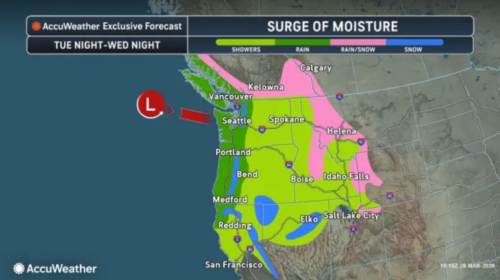 “Many areas have already recorded their highest temperatures of the extensive heat wave, but several more hot days are ahead across much of the Rockies and Plains. Relief from the heat is on the horizon; however, a shift in the weather pattern will send multiple storms, cooling much of the region and bringing rain and mountain snow to some areas. … From Tuesday into Tuesday night, the next storm will move in from the Pacific Ocean. This storm will bring rain to California, northern Nevada and parts of southern Oregon and Idaho. How far south steady, soaking rain reaches remains uncertain, with only sporadic showers, at most, anticipated in much of Nevada. The primary impact of the Tuesday storm will be cooler air spreading across much of the West. … ” Read more from AccuWeather.
As historic March heatwave finally fades, a brief cooler/wetter interlude will occur across the U.S. West in early April before warmth & dryness likely return
Daniel Swain writes, “Well, it sure has been…quite a month. Meteorologically speaking, March 2026 will go down in the record books as the warmest March on record for at least a third, and possibly half or more, of the continental United States. But even more remarkable is the ~10 day window of peak heat during this truly exceptional March heatwave–when many, if not most, locations across the western two thirds of the United States in a broad swath stretching from the Pacific Coast in California eastward past the Mississippi River broke their all-time March monthly heat records. The margin by which March heat records were shattered was so wide that more than a handful of locations also broke their all-time April heat records, and in a few locations even tied or broke their May heat records! … ” Read more from Weather West.
SEE ALSO: Incoming rain, snow for West after most intense March heat wave ever still won’t fix unprecedented snowpack, from Fox Weather
Court denies DWR’s motion to disqualify law firm from litigation challenging Delta tunnel project
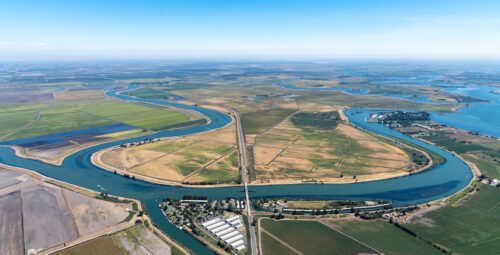
“Today, Judge Stephen Acquisto of the Sacramento County Superior Court rejected an attempt by the California Department of Water Resources (DWR) to deprive two million residents of the Sacramento-San Joaquin Delta of their choice of legal representation in challenges to DWR’s efforts to construct a massive water conveyance tunnel and industrial facilities in the heart of the Delta National Heritage Area. The Sacramento law firm of Somach Simmons & Dunn (SSD) represents the County of Sacramento, Sacramento County Water Agency, Sacramento Area Sewer District, and City of Stockton in ongoing litigation challenging DWR’s plans to divert flows from the Sacramento River and route it around the Delta to its State Water Project contractors in the Silicon Valley, Central Valley, and Southern California. … ” Read more from Somach Simmons & Dunn.
Governor announces end to 2021 drought emergency after AquAlliance and CSPA sue
“Fourteen days after being sued by AquAlliance and the California Sportfishing Protection Alliance (CSPA) for unlawfully prolonging the 2021 Drought Emergency, Governor Newsom suddenly signed a proclamation on March 24, 2026,1 officially ending the drought emergency he declared on May 10, 2021. The AquAlliance/CSPA lawsuit was filed in Alameda County on March 10, 2026, seeking an immediate end to the declared drought emergency. 2 The lawsuit also charged that the rules under the declared emergency weakened environmental protection. In support of their petition, plaintiffs AquAlliance and CSPA submitted the February 24, 2026 U.S. Drought Monitor map showing that no counties in California were in a condition of drought. The plaintiffs also submitted a March 2, 2026 map of major California reservoirs published by the California Department of Water Resources showing all depicted reservoirs at or above average storage for the date. … ” Continue reading this press release from AquAlliance.
After ever-costlier California fires, new study could shape state’s response to era of ‘climate-fueled economic crisis’
“The release of another new study on the impacts of natural disasters in California may not normally get more than a shrug of wider public attention. But a pending report out of the California Earthquake Authority looks to be more consequential than most as it seeks to answer the urgent, loaded question of how the state will address mounting and rippling costs of catastrophic events and who will pay. The study comes at a critical time, viewed by some experts and officials as a crossroads for how California confronts the aftermath of increasingly costly and climate-driven disasters that are likely to be more destructive in the future. … ” Read more from the Santa Rosa Press Democrat.
This year’s wildfires have already set records that could foreshadow a smoky, fiery summer
“As the Western United States limps away from one of the warmest and driest winters on record, wildfires have burned over 127 percent more acreage so far in 2026 than the 10-year average, potentially setting the stage for a long, fiery summer. Updated data from the National Interagency Fire Center on the number of ignitions and total acres burned through March 27 shows the country has experienced over 15,000 starts that have consumed more than 1.5 million acres so far this year. The 10-year averages through March 27 are about 9,195 starts and 664,792 acres burned. While 2024 and 2017 both saw higher total acreage burned to this point, 2026 ranked first for the number of ignitions by late March in any year of the past decade, with 587 more fires than the next-highest year. More fires in what has historically been a wetter part of the year “is becoming less a trend, more a pattern and normality,” said Timothy Ingalsbee, co-founder and executive director of Firefighters United for Safety, Ethics, and Ecology. “It is a clear signal of ongoing climate change.” … ” Read more from Inside Climate News.
In commentary this weekend …
Three steps we can take to solve California’s water crisis
Congressman Vince Fong writes, “Water is life. It’s a simple saying that holds profound meaning, especially in California’s Central Valley. Unfortunately, the Golden State has pursued policies that limit the construction of new reservoirs and prioritize wasteful water flows that are exacerbated by our boom-and-bust cycle of water availability. The consequences of this crisis are severe. Entire communities in the Central Valley are sinking due to subsidence — some by nearly 12 feet. Farmers are forced to ration the limited water resources they receive, threatening agricultural productivity in a region that grows nearly three-quarters of the nation’s fresh fruits and nuts and half of the nation’s vegetables. Families in more urban areas face rising costs and increasing regulations to conserve water. To make matters worse, the barrage of severe wildfires over the past decade has damaged tributaries, contaminating water sources and harming critical infrastructure. But this isn’t just a California problem. The lack of reliable water resources for America’s food production capital is a matter of economic security and affects every American. … ” Read more from the Washington Times.
Podcasts …
ONCE UPON A BAY: Gold, Cuban cigars, & mud
Marine archaeologist Jim Delgado uncovers the shipwrecks, secrets, and human stories buried under San Francisco’s streets and waves. From Gold Rush vessels entombed beneath the Financial District to wrecks off the Marin Headlands, Jim reveals how these “unread books” preserve a hidden record of the city’s boom-and-bust beginnings.
WATER IS A MANY SPLENDOR’ED THING: Fish in Palm Springs
 One of the more pleasant surprises that I have found is fresh fish in the desert. Louis Pagano has had a passion for the watery landscapes of the planet and has probably visited every ocean of the world. He’s the fish guy and provides fish at his desert restaurants in the southern California desert. And when not at his restaurants, he is on the water, fishing and noticing some pretty unusual water conditions and aquatic behavior. Something is up in our oceans and he, in his 70 plus years, is seeing some pretty strange fish behavior. Water is a Many Splendor’ed Thing brings you another water relationship that has a personally significant impact to your life. Produced by Stephen Baker, Bringing People Together to Solve Water Problems, water@operationunite.co 530-205-6388
VOICE OF SAN DIEGO: Psst. Hey Buddy… I Got Some Water for Sale
San Diego has a water surplus and is selling it, including a deal to provide 10,000 acre-feet annually to Temecula, expected to net $100 million over five years. (at 44:28).
WATER RESOURCES PODCAST: Hydroclimatic trends in the Western US
Dennis Lettenmaier discusses trends in snow, flooding, and drought in the Western U.S. with a focus on the Colorado River Basin.
NPR SHORT WAVE: The world has a groundwater problem. Can we solve it?
Groundwater is responsible for about half of the water people use globally. It’s drying up. Hayes Kelman started noticing the family farm in western Kansas was slowly getting less water around the time he was in high school. Now, as an adult and co-owner of Kelman farms, he is acutely aware that there’s a problem: the aquifer he uses to water his crops is being drained faster than it can be refilled. If something doesn’t change, someday it will run out of water. Today, producer Berly McCoy dives into the state of the world’s groundwater and asks: What happens when people pull too much? And can the damage be reversed?
WATERLOOP: A new strategy: Water is national security
Water is emerging as a defining factor in U.S. economic growth and national security—from where data centers and energy projects can scale to how communities absorb the rising costs of floods, droughts, and insurance risk. In response, a new Aspen National Water Strategy has been released, laying out a plan to rethink how the country manages water. This episode is a conversation with the co-leads for developing the strategy, Martin Doyle of Duke University and Newsha Ajami of Lawrence Berkeley National Laboratory. Their central argument is a shift in framing: water is not just an environmental or local utility issue—it’s a core economic input and a strategic asset.
In regional water news this weekend …
SIERRA NEVADA
Is this the worst Tahoe ski season ever — or just the weirdest?
“An abnormally warm end to winter that has all but robbed Tahoe ski areas of snow has many people wondering whether this is among the region’s worst or shortest ski seasons. Already 10 California ski areas have shut down — with one having operated for less than two months — marking an abrupt end to what may rank as the warmest winter in Tahoe’s recorded history. Each resort has remarked on the balmy temperatures as an unyielding force pressing down on the mountains for over a month that has quickly cooked away the snowpack and made it impossible for ski areas to manufacture snow on their slopes. Even Palisades Tahoe, one of the Sierra’s premier spring skiing resorts, can’t sustain much longer. … ” Read more from the San Francisco Chronicle.
Caldor Fire Restoration Decision released
“The newly released Final Environmental Assessment and Decision Notice for the Caldor Fire Restoration Project offers restoration details for the roughly 11,700 acres of national forest lands in and around the Caldor Fire area. “This decision will guide active forest management activities that will help accelerate post-fire recovery and enhance community protection,” said Deputy Forest Supervisor, Rosalie Herrera on the Lake Tahoe Basin Management Unit. “Proposed restoration measures are designed to restore meadows and streams, improve wildlife habitat, and reduce hazardous fuel loads in areas affected by the Caldor Fire.” … ” Read more from the Tahoe Daily Tribune.
Nevada Irrigation District launches public outreach on proposed water rate changes
“The Nevada Irrigation District (NID) has begun outreach to inform customers about proposed changes to the District’s treated and irrigation water rates. A Proposition 218 notice has been mailed to all property owners and tenants within the District, initiating a 45-day public review period. Customers are encouraged to watch for the notice in the coming days to learn more about the proposed changes and the rate-setting process. … ” Read more from YubaNet.
NAPA/SONOMA
Sonoma County Regional Parks receives grant to restore critical salmon habitat on Mark West Creek
“A $1.5 million California Wildlife Conservation Board grant will fund Sonoma County Regional Parks’ efforts to restore wetlands, streams and habitat for coho salmon and steelhead trout at Mark West Creek Regional Park and Open Space Preserve. Developed in partnership with the Sonoma Resource Conservation District and Trout Unlimited, this project will improve conditions in a key tributary of the Russian River watershed. Mark West Creek is one of the few streams in the Russian River watershed that continues flowing during dry summer months, but declining water levels and changes to the creek channel threaten fish habitat and stream health. The grant-funded project will let Regional Parks and its partners restore natural conditions by installing structures that mimic beaver dams, placing large logs in streams, restoring small channels and wetlands and modifying or removing concrete dams that block fish passage. Known as “process-based restoration”, the work will rely on low-tech approaches and materials to revive the natural systems that shape a healthy creek. … ” Read more from the County of Sonoma.
BAY AREA
Muir Beach water pipeline goal complicated by road project
“A proposed pipeline to increase drinking water reliability to Muir Beach could improve the area’s watershed habitat and bolster wildfire safety, but hurdles stand in the way. A plan is in the works to rehabilitate Frank Valley Road, the two-lane route that connects the community of about 300 people to Mill Valley and the Muir Woods National Monument. The pipeline would be installed along the road. The $26.2 million, federally funded road rehabilitation job is set for construction in the summer of 2028. That’s putting pressure on the pipeline project, which still has no funding. … ” Read more from the Marin Independent Journal.
SAN JOAQUIN VALLEY
Lawyers allowed to question Kern River historian. So, lets talk about Col. Baker…
“Lawyers fighting for more flows in the Kern River got the green light to question a noted river historian and author per a court ruling issued Friday afternoon. It may seem like a “No duh” objective to pick the brain of someone steeped in the history of the Kern River in a trial about the Kern River, but lawyers representing a local agricultural water district had concerns about the breadth and nature of questions that would be posed to Douglas R. Littlefield, Phd. Kern County Judge Gregory Pulskamp agreed with both sides and allowed the questioning but limited what Littlefield could be asked. That’s because the Buena Vista Water Storage District has hired Littlefield as an “expert” witness in this and previous legal actions. So, he’s not just someone who knows basic facts. He’s also potentially privvy to Buena Vista’s legal strategies. … ” Read more from SJV Water.
SOUTHERN CALIFORNIA
Early spring storms bringing snow to California, drizzle to Los Angeles
“The storm season isn’t over just yet, as an early spring system headed for California is expected to bring snow to the Sierra and light rain to Los Angeles next week. Two waves of precipitation are headed to the Tahoe region, with the first wave beginning Monday into Tuesday evening, according to the National Weather Service. The Sierras could get up to two inches near Mammoth. A second, stronger system is expected to drop from Alaska Wednesday into Thursday, with up to a foot of snow predicted for the highest peaks in the Tahoe basin and about 2 to 5 inches of snow outside of the highest peaks, according to the weather service. Lake Tahoe could receive up to 3 inches of snow. … ” Read more from the LA Times.
Researchers predict a ‘sharky summer’ at SoCal beaches. Here’s why
“It’s going to be a “sharky” summer in Southern California. According to researchers, shark sightings are high right now across SoCal beaches, and that’s not going to change as the weather gets warmer. NBC Los Angeles visited Pacific Palisades Friday and spoke with beachgoers along a stretch of the beach that’s a hotspot for shark sightings, particularly at sunset. Shark spotters told NBCLA they’re seeing more sharks than usual in the region right now and most of the time, people in the water never realize how close the marine life can get. Malibu-based artist Carlos Gauna films drone videos of sharks at local beaches. He told NBCLA that right now, they’re not hard to find. “This year, there’s been a big uptick in sharks,” he said. … ” Read more from NBC LA.
IMPERIAL/COACHELLA VALLEYS
Imperial County demands equity and action on New River crisis
“In a strong message to the State Water Resources Control Board, the Imperial County Board of Supervisors is demanding critical changes to state grant programs, arguing that current funding models are failing to address the acute environmental and public health crisis along the New River. The demands are detailed in a multi-page letter authored by Board Chairwoman Peggy Price, who contends that the current grant process for Proposition 4 border funds disadvantages communities with the most “lived experience” of the crisis. Price argues that equity is not just about competition but “recognizing unequal starting points.” Imperial County supervisors—including Jesus Eduardo Escobar (District 1), Martha Cardenas-Singh (District 2), Price (District 3), Ryan E. Kelley (District 4), and John Hawk (District 5)—are pushing for specific “Proposed Amendments.” … ” Read more from the Imperial Valley Press.
Residents speak out against proposed data center in Imperial County
“Residents packed the chambers and poured into the parking lot during a Thursday meeting of the Imperial County Board of Supervisors held to solicit feedback about plans to develop a massive data center without first conducting a state environmental review. Speakers were overwhelmingly opposed to the project, citing a range of health and environmental concerns, and criticized the board for allowing the proposal to move forward despite outcry from the community. “This project does not exist in isolation; it impacts real neighborhoods, families and schools and is also setting a precedent for how you treat your constituents,” said Gina Snow, who lives near the proposed site. “If the full scope of this project cannot be clearly presented and independently verified, then residents are essentially being asked to make decisions without information they deserve.” … ” Read more from the LA Times.
Along the Colorado River …
What experts say it will take to solve West’s water problems
 “Hundreds of water experts from across the United States convened at Arizona State University last week to tackle the West’s mounting water challenges and water problems, seeking solutions that go beyond scarcity toward coordinated systems, investment and collaboration. “Water stress is not just a constraint. It is a signal that our current systems are misaligned with the realities of climate, society and economic demand,” said Upmanu Lall, director of the ASU Water Institute at the Julie Ann Wrigley Global Futures Laboratory. The “Transforming Water, West” convening brought together more than 400 scientists, entrepreneurs, investors and policymakers with a shared understanding that incremental change is no longer enough. The region’s water challenges demand something more coordinated and more ambitious. Held March 20 in Tempe, the event felt less like a traditional conference and more like a working session. Conversations moved quickly from formal remarks to casual exchanges about infrastructure, climate adaptation and investment strategies. … ” Read more from Arizona Big Media.
Colorado River outlook bleak as heat wave pushes snowpack into record-low territory
“A single chart is putting the Southwest’s water problems into focus this spring. It shows the effect of a heatwave felt in Las Vegas. That heat also took a major toll on snowpack that feeds the Colorado River, far to the northeast in the mountain ranges of western Colorado, southwest Wyoming and northwest New Mexico. Snow is usually accumulating at this time of year, with the peak snowpack levels still about 10 days away. But not this year. The snow started to melt weeks ago, and the snowpack will only bring about a third of the normal amount that usually flows down the river. … ” Read more from KLAS.
Nevada vows to ‘fight like hell’ if Colorado River share is unfairly cut
“Instead of agreeing on a traditional, 20-year deal for the Colorado River, the states that share the water source are focused on a short-term plan as they stare down the basin’s worst snow season in two decades. But that doesn’t mean officials are ready to agree any time soon, despite mounting federal pressure to do so. “We are thoroughly prepared to fight like hell if it comes to that,” said John Entsminger, Nevada’s governor-appointed negotiator and general manager of the Southern Nevada Water Authority. “We’re trying to avoid that, but we have a number of long-term relationships and contracts with outside counsel. If it comes to fighting to protect the water interests of Southern Nevada, we’re ready.” A new deal must be in place before the start of the next water year in October, whether the states come to an agreement or the Trump administration imposes one upon them. … ” Read more from the Las Vegas Review-Journal.
Feds give early approval to Nevada hydropower project
“Federal regulators have provided early approval of a hydropower megaproject in Nevada, despite local government officials’ opposition. The proposed Desert Bloom Project, which is a dam system, would reportedly generate power for around 110,000 Nevada homes. The dam would also use a vast amount of water, which has led some to oppose the move. “Southern Nevada has invested decades of work into reducing water use and stretching limited Colorado River resources,” said Bronson Mack, Southern Nevada Water Authority spokesperson, answering The Center Square’s question by email. “A project that will consume approximately 10,000 acre‑feet (about 3 billion gallons) of water simply does not align with Southern Nevada’s conservation goals. The priority is safeguarding community water supplies through efficient water use — not expanding large-scale water consumption.” … ” Read more from the Center Square.
Ranchers in southern Arizona live on the ‘knife edge’ of long drought
“The borders of Arizona, New Mexico and Mexico converge at a point: Bill McDonald’s ranch. Its owner is a charismatic cowboy over 6 feet tall with slightly drooping jowls and bright blue eyes, a community fixture and something of a local legend. McDonald runs his cattle operations the way his family has for four generations, rotating hundreds of animals across thousands of acres of pastures. At 74, McDonald walks slowly with a slight stoop, but his mind is still razor sharp. These days, his thoughts often turn toward an ongoing crisis. The drought. Ranching on the borderlands of southeastern Arizona and southwestern New Mexico is seasoned with challenges arising from the whims of nature. At an elevation of 4,500 feet and higher, the area is cool enough to sustain a grassland too temperamental to survive in the lower lying desert valleys. Lacking any permanent surface water, the drumbeat of life here is dictated by the rhythms of the rain. … ” Read more from Arizona Central.
Winter heat caused rapid snowmelt in Salt River system
“This winter’s abnormally hot, dry conditions dealt a major blow to snow stored in Arizona’s mountain ranges. A new survey of snowpack in the Salt River Watershed tracked plummeting snow totals using high-tech sensors attached to airplanes, helping water managers make plans for a major Phoenix-area water supply. Between late February and the middle of March, snow totals dropped by more than 90% in the Upper Black River basin. The mountainous region of eastern Arizona contributes snowmelt to the Salt River system, which fills reservoirs like Roosevelt Lake. That is part of the Salt River Project, which supplies water to more than 2.5 million people around the Valley. … ” Read more from KJZZ.
From slushy ice to barren slopes, here’s what skiers in Colorado saw this week
“Wondering how bad snow conditions are on Colorado’s ski slopes? Just take a look at the social media posts this week from skiers and snowboarders who hoped to encounter powder but instead were met with slushy ice or bare spots. Snowfall this season was at a 50-year low and record-high temperatures worsened conditions by melting an already emaciated snowpack, as The Colorado Sun previously reported. It’s gotten so bad that ski resorts are closing earlier than usual, with a number of resorts set to close this weekend or already closed. Winter Park shut down Mary Jane lifts at noon Friday to preserve snow for Saturday, the official last day of the 50th season on the mountain beloved for its steep, deep mogul runs. … ” Read more from the Colorado Sun.
Colorado residents face earliest water restrictions ever — a harbinger of worse to come
“As a result of a snow drought and a heat wave that have both set records, some Colorado residents face the earliest restrictions on their water use ever imposed. Denver Water announced Wednesday that it is seeking a 20% cut in water use, asking people to turn off automatic watering systems until mid-May and restricting the watering of trees and shrubs to twice a week. “The situation is quite serious,” said Todd Hartman, a spokesperson for the utility. “We’re in such a dire situation that we could be coming back to the public in two or three months and saying you’re limited to one day a week.” … ” Read more from NBC Colorado.
In national water news this weekend …
Judge declines to halt ‘God Squad’ meeting
“A federal judge has declined to act on an emergency request from an environmental group to stop the Trump administration from exploring an exemption to the Endangered Species Act for oil and gas drilling, setting the stage for an unusual government meeting to be held next week. The rarely convened Endangered Species Committee is set to meet Tuesday to discuss an exemption under the Endangered Species Act related to fossil fuel drilling in the Gulf of Mexico, which President Donald Trump renamed the Gulf of America. During a Friday hearing, Judge Rudolph Contreras of the U.S. District Court for the District of Columbia declined to grant an emergency effort by the Center for Biological Diversity to put a stop to the meeting through a lawsuit filed last week. … ” Read more from E&E News.
Also on Maven’s Notebook this weekend …
DELTA CONVEYANCE PROJECT: Ruling on DTEC’s Evidentiary Objections to DWR’s “Subpoena Panel” Exhibits and Related Testimony (Hearing on Proposed Delta Conveyance Project)

