
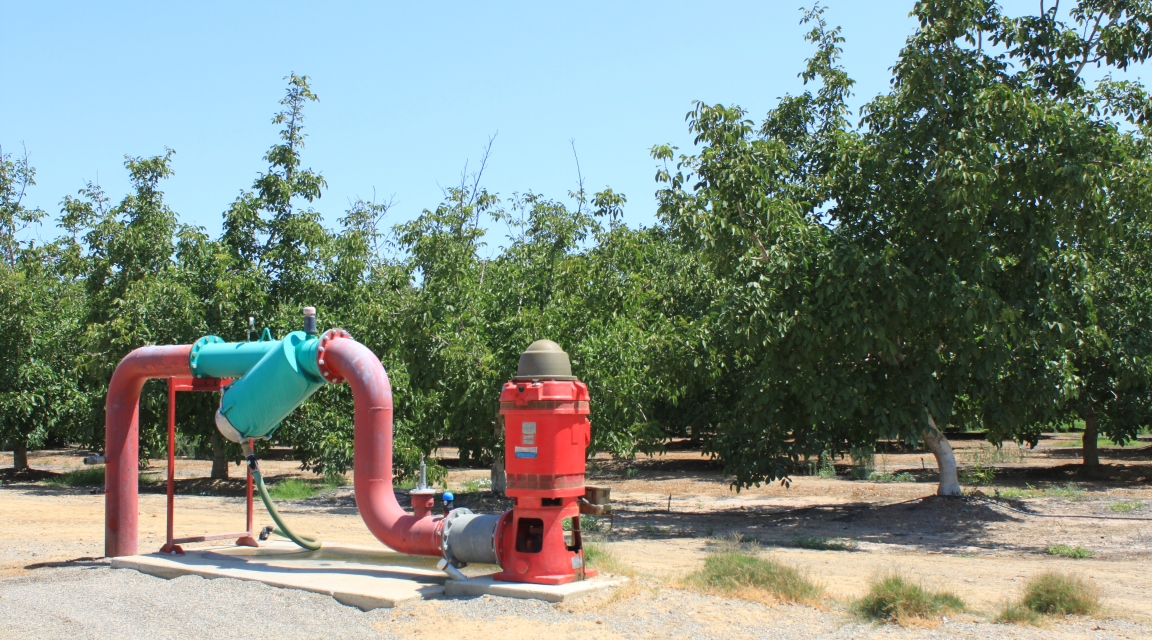
In December 2025, the Groundwater Resources Association of California hosted a two-day webinar to examine the complex connections between Interconnected Surface Water (ISW) and groundwater. The sessions explored how pumping groundwater affects surface water flow and the ecosystems that rely on it.
The webinar featured experts providing key information on interconnected surface water depletion and how it can be integrated into SGMA implementation. First, Dr. Vivek Bedekar explained ISW depletion and highlighted management needs. Next, Dr. Nicholas Murphy described groundwater-dependent ecosystems and their importance in sustainability planning. Then, Dr. Thomas Harter examined Scott Valley’s groundwater sustainability plan in relation to ISW management.
To conclude, Craig Altare, a Supervising Engineering Geologist with the Department of Water Resources, reviewed SGMA regulatory requirements for ISW depletion and introduced DWR’s forthcoming guidance document, which aims to help GSAs achieve regulatory compliance.
REGULATORY CONTEXT: ISW DEPLETION UNDER SGMA
Interconnected surface water depletion is one of the six sustainability indicators identified by SGMA and the GSP regulations. GSAs are required to avoid significant and unreasonable adverse impacts on beneficial uses of surface water caused by groundwater conditions occurring throughout their basin.
“Even with that regulatory language, which is relatively clear, interconnected surface water depletion is among the most challenging, technically challenging parts of SGMA to implement,” said Mr. Altare. “Surface water flows respond to many different processes: climate variability, runoff and reservoir operations, surface water diversions, riparian ET, and groundwater pumping. Distinguishing how much of a low flow condition that may be an adverse impact is attributable specifically to groundwater extraction is not always obvious. In fact, it’s probably mostly not obvious.”
When DWR reviewed the first round of groundwater sustainability plans, there was wide variation in how basins approached ISW depletion, with different data sources, metrics, and interpretations of the regulations. As a result, many GSAs received recommended corrective actions because their ISW analyzes or their sustainable management criteria needed further development.
“The goal of DWR’s upcoming guidance is to provide a practical framework that GSA can use to evaluate, define, and manage ISW depletion in a way that aligns with SGMA and the regulations while still allowing for local flexibility,” he said.
WHAT A GUIDANCE DOCUMENT IS (AND IS NOT)
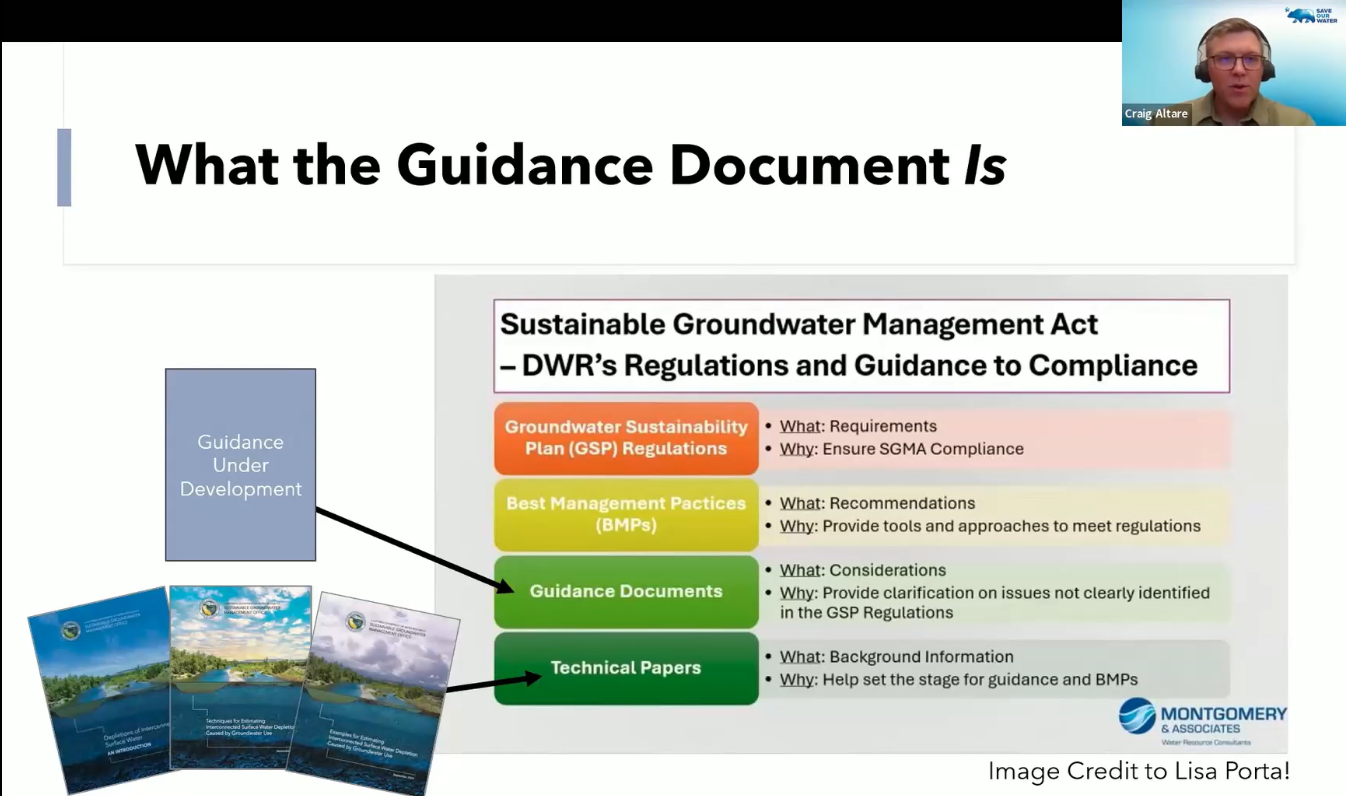 The ISW guidance will be a technical resource for GSAs as they evaluate and manage interconnected surface water under SGMA. It’s written for a broad audience, not just hydrogeologists and modelers, but also GSA managers, planners, and really anyone who’s involved in the development or implementation of a GSP.
Guidance documents provide considerations and address issues that aren’t clearly addressed in the regulations. “The document is meant to complement the existing SGMA framework,” said Mr. Altare. “It builds on those earlier materials, like the law, the regulations, BMPs, and other guidance materials, and it clarifies how GSA is going to apply them in the context of ISW depletion. Any examples it provides are going to be simplified, but they illustrate approaches that are technically reasonable and aligned with the regulations.”
The guidance document aligns with the existing regulatory framework. It does not introduce new requirements or change SGMA or GSP regulations. It is not meant as a manual for other surface water-related frameworks. Its focus is on helping GSAs meet SGMA obligations for ISW depletion. The guidance does not require specific technical methods. GSAs can choose approaches that fit their basin conditions, as long as they comply with SGMA and related regulations.
The guidance does not replace local decision-making. GSAs must decide what is significant and unreasonable for their basins. They also select metrics and thresholds that reflect local priorities.
“A helpful way to think about this document is as a roadmap, not a checklist or a one-size-fits-all mandate,” said Mr. Altare. “Some elements of the guidance will apply broadly across many basins, and others may only be relevant to where certain ISW conditions exist. But the goal is to provide clarity, support, and a technical foundation; it’s not to dictate specific outcomes or specific methods.”
DWR is developing the ISW depletion guidance and expects to finalize it by early 2026. DWR will release a draft for public comment, giving stakeholders the chance to review and provide feedback. The three ISW technical papers will also be re-released for collective review.
IDENTIFYING INTERCONNECTED SURFACE WATER SYSTEMS
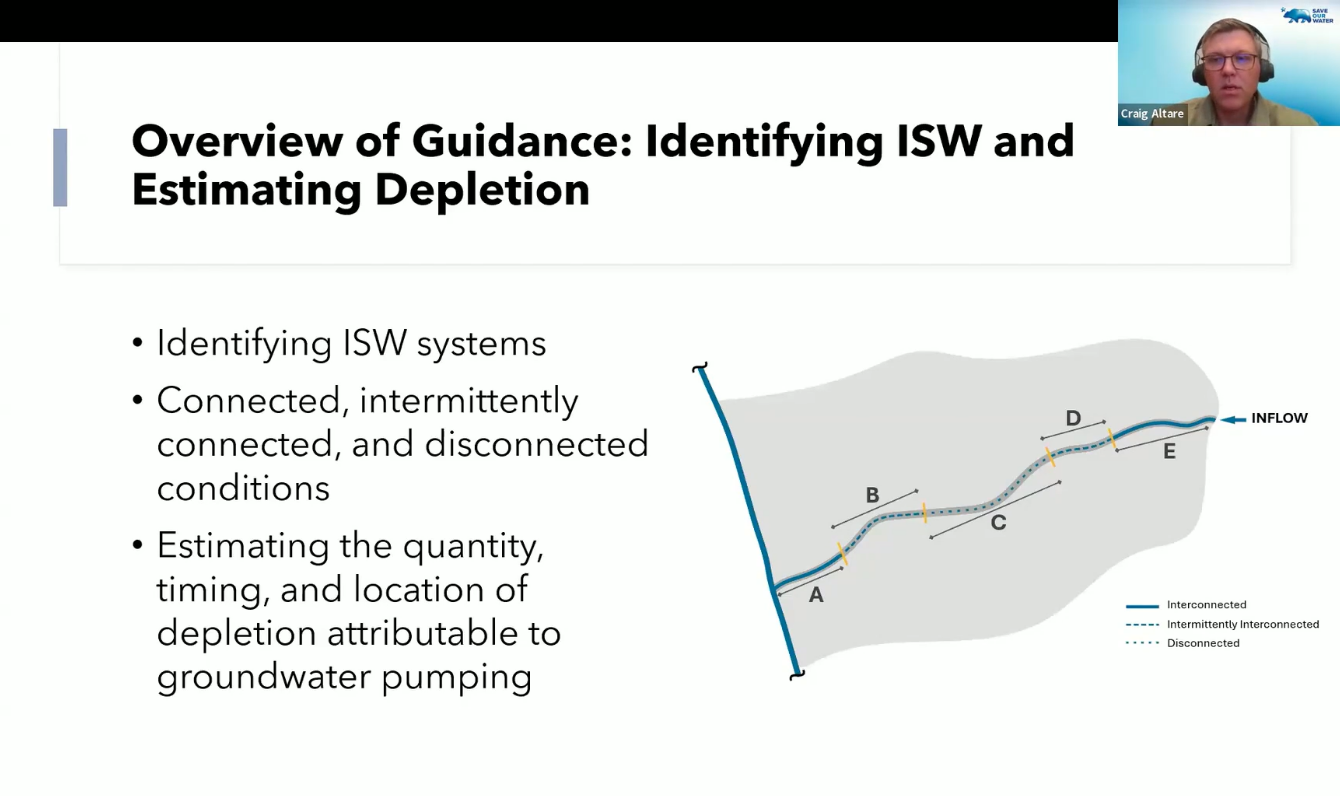 The first topic addressed is the requirement to identify interconnected surface water systems. The regulations define interconnected surface water as surface water that’s hydraulically connected to groundwater at any point through a continuous, saturated zone. The guidance discusses several considerations for making that determination, including the dynamic nature of connectivity, which means, for example, that connections can vary spatially along a stream and across seasons and water-year types.
Identifying a surface water system as an ISW signals that its beneficial uses and users could be affected by depletion caused by pumping. A GSA shouldn’t limit their analysis of potential adverse impacts only to the consistently interconnected reaches, because pumping can alter the timing and duration of connection – meaning intermittently connected or even typically disconnected reaches within a larger interconnected system may still experience impact due to groundwater pumping. The guidance encourages GSAs to focus on areas where depletion from pumping could appreciably reduce flow or stage, and to document any excluded areas and the rationale for doing so.
The guidance document addresses how to estimate the quantity, timing, and location of pumping attributable depletion. Key considerations include accounting for the lag between pumping and stream response, and selecting and documenting appropriate spatial and temporal resolutions, recognizing that some depletion may occur outside the basin boundaries.
Finally, the guidance emphasizes iterative improvement. As monitoring networks expand and new data become available, GSAs should revisit and update their understanding of groundwater-surface water interactions as models and tools are refined.
DEVELOPING SUSTAINABLE MANAGEMENT CRITERIA
 Identifying ISW systems and making robust depletion estimates should serve as the technical foundation for defining undesirable results and developing sustainable management criteria. This is the next major component of the guidance. The guidance follows a logical sequence. It begins with several preliminary considerations before turning to undesirable results and the metrics that support them.
The guidance provides examples of beneficial uses, users, and property interests that a GSA may consider. It also points to external tools and datasets that can help GSAs determine where those uses occur and which flow or stage conditions they depend on.
Mr. Altare noted that groundwater and surface water systems don’t align neatly with administrative boundaries, so pumping in one basin can deplete surface water downstream or in adjacent areas. “That means it’s possible that beneficial uses and users outside of GSA basin boundaries could be affected by depletion,” he said. “We recommend that GSA pay attention to groundwater level conditions near shared boundaries, and we strongly encourage that their sustainable management criteria, both for ISW and other applicable indicators, are compatible with neighboring basins, which may require coordination.”
GSAs are encouraged to engage interested parties throughout the identification and development of interconnected surface waters criteria and during implementation of their plan. “Other agencies, Tribes, water masters, water suppliers, irrigators, environmental groups, and many others can offer important information about potentially affected uses,” he said. “While consensus among interested parties during that engagement process is not required, GSAs should document how input was evaluated and how relevant standards identified by those interested parties were considered. Together, those preliminary steps help to ensure that the eventual definition of undesirable results, and the metrics and thresholds tied to them, are grounded in a clear understanding of the people and the ecosystems that depend on those surface water systems, both within and beyond the basin.”
UNDESIRABLE RESULTS
SGMA defines an undesirable result as a significant and unreasonable adverse impact on the beneficial uses of surface water resulting from groundwater conditions throughout the basin.
The regulations require that GSA address three components:
- Identify the cause of groundwater conditions occurring throughout the basin: For ISW depletion, the immediate cause will generally be the net groundwater pumping, meaning extraction and consumptive use of groundwater, minus any offsetting recharge or demand reduction projects and actions.
- A plain language definition: A qualitative statement describing what the GSA considers significant and unreasonable for the beneficial uses and users that were identified earlier in the process. A strong plain language definition should describe what the effects are, such as loss of critical habitat or impairment of surface water supplies, where in the ISW system those effects would or could occur, and when or under what conditions they would arise.
- A quantitative definition: GSAs also need to operationalize their qualitative, plain language definition into a measurable one: That quantitative definition specifies the metrics, locations, and conditions under which an undesirable result is deemed to have occurred, and it must be based on a combination of minimum threshold exceedances that, taken together, indicate significant and unreasonable effects.
“In other words, it answers that question of how many exceedances, where and when, would rise to the level of the undesirable result that we just described in plain language,” Mr. Altare said. “So taken together, the plain language and quantitative definitions should give a clear and defensible understanding of how the basin will determine whether an undesirable result related to ISW depletion has occurred during GSP implementation.”
PRE-2015 CONDITIONS
 The SGMA legislation explicitly states that undesirable results that existed before January 1, 2015, do not need to be corrected unless a GSA chooses to do so.
In the context of ISW depletion, that baseline matters in two main ways. First, if a GSA determines that an undesirable result existed as of January 1, 2015, the basin is not required to remedy that historical condition. Second, a GSA may choose to manage so that ISW depletion does not worsen relative to pre 2015 conditions, even if they aren’t sure that the conditions as of 2015 represented an undesirable result. Some GSAs may see it as a conservative, practical approach that reduces the risk of creating new undesirable results, and some may choose to use it for convenience.
The guidance emphasizes that the 2015 baseline is not a blanket exemption. GSA is must distinguish between conditions that existed before 2015 and conditions that worsen afterward, including degradation that may emerge because of lagged effects due to the time lag between pumping and depletion, meaning that pumping that occurred before SGMA may continue to cause depletion after 2015 and if conditions were not in equilibrium prior to 2015 then pumping in 2015 and beyond could further increase depletion, even if annual pumping totals are unchanged.
“Said another way, if a basin had a long-term trend of declining base flow attributable to groundwater use, and that decline began before 2015 but substantially worsened during GSP implementation, then that likely represents a new undesirable result that must be evaluated,” he said.
Finally, the guidance makes clear that SGMA does not require GSAs to manage those pre-2015 depletion levels, though it does not prohibit increased depletion relative to those pre-2015 conditions. Of course, if a GSA intends to allow additional depletion, it must develop and implement sustainable management criteria to avoid significant and unreasonable impacts on beneficial uses and users.
MINIMUM THRESHOLDS AND MEASURABLE OBJECTIVES
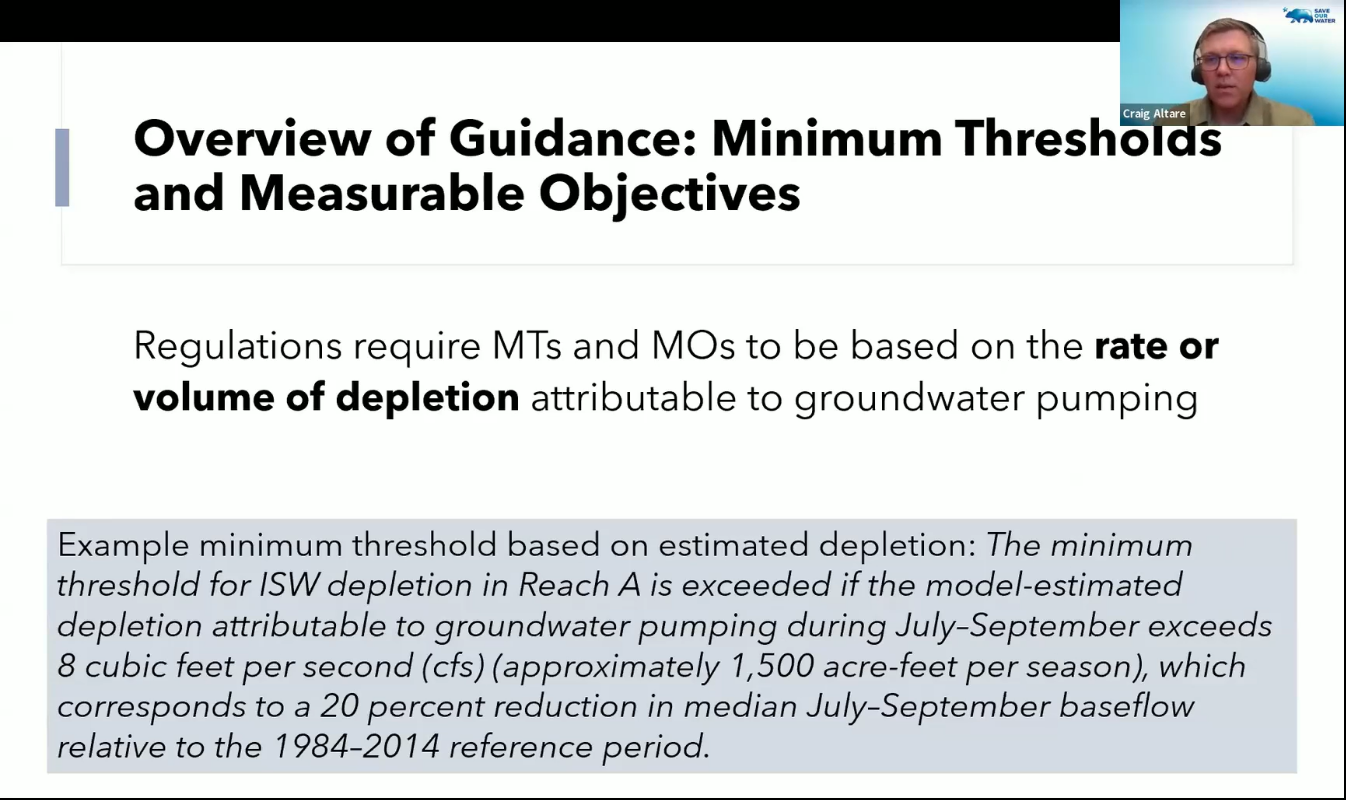 The GSP regulations specify that sustainable management criteria for interconnected surface water must be based on the rate or volume of depletion attributable to groundwater pumping. However, because depletion can’t be measured directly in the field, GSAs have to rely on estimates, typically from numerical models or other analytical tools.
If a GSA has the tools to estimate depletion directly and regularly, then this approach may be the most straightforward way to develop ISW-specific sustainable management criteria. If GSAs either can’t directly estimate depletion or decide that using a proxy is more efficient or expedient for whatever reason, the GSA regulations explicitly allow groundwater levels to serve as a proxy for multiple sustainability indicators, including ISW depletion, provided a significant correlation is demonstrated. In other words, the proxy must reliably reflect the location, quantity, and timing of pumping-induced depletion.
“One approach that’s received attention is from a 2018 paper by the Environmental Defense Fund, which suggests the groundwater levels representative of pre-2015 conditions could serve as a compliance proxy for maintaining depletion at or below pre 2015 levels,” said Mr. Altare. “Conceptually, that can work, but only if groundwater level monitoring, pumping patterns, and monitoring are monitored robustly enough to demonstrate that depletion is not worsening.”
The guidance cautions that GSAs should carefully evaluate other possible proxies beyond groundwater levels. “While the groundwater levels are mentioned specifically in the GSP regulations, there is also a substantial compliance element of the regulations, and it’s possible that pumping volumes, for example, may be informative for ISW depletion in basins that are near quasi equilibrium perhaps and stream flows or stage metrics may be useful where GSAs have operational control or where flow requirements are well established.”
He noted that proxies do come with challenges. For example, pumping totals don’t necessarily reveal the timing or location of depletion, and stream flow conditions can be strongly influenced by external factors such as hydrology, diversions, or reservoir operations.
“The overarching message is that proxies are permissible, but only when the GSAs can clearly demonstrate how those metrics reflect the pumping-driven depletion and how it supports defensible sustainable management criteria.”
TO CONCLUDE …
The guidance doesn’t add any new regulatory requirements. It works within the existing framework of the GSP regulations and SGMA, and can be used to develop consistent approaches for evaluating and managing depletion.
Sustainable management criteria really need to be tied to the rate or volume of depletion attributable to pumping, and that can be done directly through model depletion estimates or indirectly, through defensible proxies such as groundwater levels, as long as those proxies are clearly linked to depletion and to the basin’s beneficial uses and users.
“Our hope is that the guidance will help GSA develop clearer and more defensible approaches to ISW depletion and support long-term sustainable groundwater management across the state,” said Mr. Altare.
- Part 1: Unraveling the dynamics of interconnected surface water depletion, by Dr. Vivek Bedekar
- Part 2: Interconnected surface water (ISW) management considerations for groundwater-dependent ecosystems – tools and approaches, by Dr. Nicholas Murphy
- Part 3: Developing a GSP to manage interconnected surface water: A case study, by Thomas Harter
- Part 4: Untangling ISW Depletion: What DWR’s Upcoming Guidance Means for GSAs, by DWR’s Craig Altare
- Video, day 1
- Video, day 2

