
A wrap-up of posts published on Maven’s Notebook this week …
Note to readers: Sign up for weekly email service and you will receive notification of this post on Friday mornings. Readers on daily email service can add weekly email service by updating their subscription preferences. Click here to sign up!
In California water news this week …
Western heat wave shatters March records, to expand with more extremes
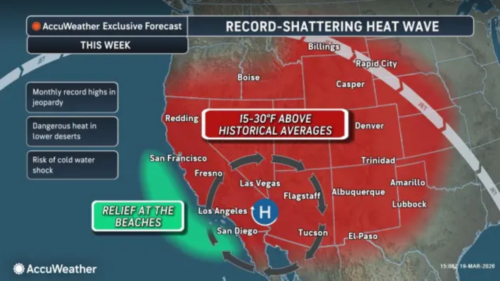 “Dozens of record-high temperatures, including all-time March records, have already been set in the western United States during this week’s heat wave, with the heat set to intensify and expand before it starts to loosen its grip. Temperatures will climb to levels more typical of late May and June across a broad area of the western and central United States through this weekend and, in some areas, into next week. Widespread highs will reach the 80s and 90s F, with multiple desert locations climbing past 100 degrees. These temperatures are 15–30 degrees above the historical average for the latter half of March. Heat-sensitive individuals may face an elevated risk of health problems due to the early-season surge in warmth. Some households may not yet have switched their climate control systems from heating to cooling, which could be especially dangerous as the record-breaking heat persists. … ” Read more from AccuWeather.
SEE ALSO: Maps and charts show how this Western U.S. heat wave is a historic weather moment, from the San Francisco Chronicle
Record heat, melting snow: What does it mean for California’s reservoirs?
“A record-baking heat wave is scalding California, with major consequences for the state’s most important reservoir: its snowpack. Providing about a third of the state’s water supply, the Sierra Nevada snowpack is a vital source of spring and summer runoff that refills reservoirs when the state needs the water most. But a warm wet storm followed February’s snow, and now, March temperatures are shattering records — prompting warnings of rapid snowmelt and swift rivers. Historically, the snowpack is at its deepest in April. But climate change is shifting runoff earlier, leaving less water trickling down the mountains in warmer months for homes, farms, fish, hydropower and forests. “In an ideal world, you’d have your reservoir full right now, and this additional huge snowpack reservoir that we know will help replenish and provide more water supply,” said Levi Johnson, operations manager for the Central Valley Project, the massive federal water system that funnels northern California river water to the Central Valley and parts of the Bay Area. This year, he said, “we’re not going to have that.” … ” Read more from Cal Matters.
‘Snow-eater heat wave’ is searing California. What does it mean for fire season?
“California’s summerlike heat, coming far earlier than normal, is rapidly melting the state’s snowpack and raising fears that the wildfire season will begin early. Fire danger, for now, is low. Grasses are green and snowmelt is keeping vegetation watered in the Sierra Nevada. But the heat wave is a blowdryer, in a sense, zapping moisture from grasses and quickly wiping away high-elevation snowpack. That’s what worries scientists and officials come summer. “Generally early loss of snow means things have the potential to become drier earlier in the season and more dried out and flammable by later summer,” said Daniel McEvoy, a climatologist at the Western Regional Climate Center and Desert Research Institute. At higher elevations, snowmelt is helping keep the landscape moist and less prone to burning, though warm temperatures this winter have significantly limited snowfall and the fire protection it provides. … ” Read more from the San Francisco Chronicle.
California analyst urges lawmakers to supervise upcoming water control plan
 “The analyst for California lawmakers advised Wednesday for the Legislature to lean into its oversight role of an upcoming water plan to firm up water supply throughout the parched state. The Legislative Analyst’s Office in its report focused on an update to the water quality control plan for the San Francisco Bay-Sacramento-San Joaquin Delta. That plan will create water quality standards intended to protect fish and wildlife in the Bay-Delta, along with the Sacramento and San Joaquin rivers and their tributaries. A resource that’s always the subject of dispute, water’s importance has only grown with a changing climate that delivers less rain and the failure of the seven Colorado River basin states — of which California is one — to reach a water-sharing agreement this year. The analyst’s office noted that the State Water Resource Control Board likely will approve an updated Bay-Delta plan this year. Lawmakers could shoulder an essential role in ensuring its implementation. … ” Read more from the Courthouse News Service.
Tribes and environmental groups criticize Legislative Analyst’s Office report on updated Bay-Delta Plan
 “A new report from the California Legislative Analyst’s Office is drawing strong criticism from a broad coalition of environmental organizations and Tribes, arguing that the report on the State Water Resources Control Board’s proposed update to the water quality control plan for the San Francisco Bay-Sacramento-San Joaquin Delta (“Bay-Delta Plan”) falls short of providing lawmakers with a fair and complete assessment of options. Coalition members argue the report assumes approval of the voluntary agreements (VAs) and fails to serve as a balanced, neutral evaluation of the regulatory alternative that is grounded in enforceable water quality standards. The coalition also raised concerns about the lack of enforceability within the VA framework, warning that it could allow water agencies to self-report compliance with minimal oversight. This approach poses serious risks to an already fragile ecosystem, while failing to protect Tribal Beneficial Uses or address harmful algal blooms. Coalition leaders further criticized the report’s framing of “environmental flows,” arguing that the term is a misnomer for unimpaired flows and that flows necessary for ecosystem health should be established through enforceable regulatory standards, not negotiated or purchased by water users. … ” Read more from Restore the Delta.
The many benefits of dredging the Sacramento-San Joaquin Delta
Edward Ring, Director of Water and Energy Policy at the California Policy Center, writes, “The salmon decline in the delta has been attributed to the impact of water withdrawals into the California Aqueduct and the Delta Mendota Canal. But something else happened at the same time as the pumps began operating; dredging in most channels in the delta virtually ceased. For the last 50 years, especially in the south delta, silt has been accumulating. This has harmed an aquatic environment that, for the century prior to the 1970s, had a thriving salmon population that was not adversely affected by dredging. Many delta channels that had been maintained at depths of 12 feet or more up until the 1970s are now less than two feet deep. The introduced non-native species of bass that prefer warm shallow water are now free to prey on salmon and other pelagic fish that prefer cooler and deeper water. Even without bass predation, salmon can’t possibly migrate as effectively in water that is so much warmer, and the water isn’t warmer because of climate change, it’s mostly warmer because the channels are so shallow. … ” Continue reading from Edward Ring.
California will get $540 million for water projects, Trump administration announces
“The Trump administration announced Tuesday it will spend $540 million on water infrastructure projects in California, much of it to repair aging and sinking canals in the Central Valley. The largest share, $235 million, will be used to rehabilitate the Delta-Mendota Canal, which carries water to farmlands. An additional $200 million will help continue repairs on the Friant-Kern Canal, another major conduit for water in the valley. Sinking ground due to heavy groundwater pumping has damaged segments of the Friant-Kern Canal and reduced its capacity. Secretary of the Interior Doug Burgum said in the announcement that the investments, together with nearly $350 million for water projects in other western states, “strengthen our nation’s water security, modernize aging infrastructure and support the farmers, communities and industries that depend on reliable water supplies.” California water agencies praised the announcement, saying the funding will improve the water system. … ” Read more from the LA Times.
A contentious project to raise California’s Shasta Dam just got a funding boost from Trump
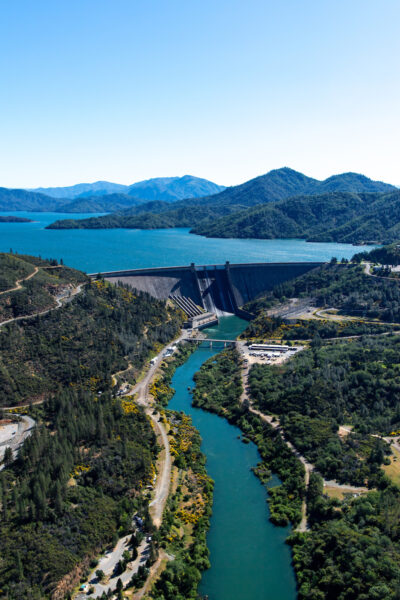
“Following pressure from powerful California growers, the Trump administration’s Interior Department announced Tuesday that it will put $40 million toward efforts to raise Shasta Dam — a controversial project that opponents say could swamp sacred sites and harm a protected river. North of Redding, the 602-foot-high dam on the Sacramento River forms California’s largest reservoir, storing more than 40% of the water socked away for irrigating Central Valley farmland. The administration announced the funding for “planning and preconstruction activities associated with raising Shasta Dam”, in addition to roughly half a billion dollars dedicated to rehabilitating Central Valley water-delivery canals. Westlands Water District, the nation’s largest agricultural water supplier, applauded the move, calling it a “long-overdue investment in water supply reliability.” The water giant is a major player in California’s $60 billion agricultural industry, serving nearly 700 farms on the west side of the San Joaquin Valley. … ” Read more from Cal Matters.
Federal funds to raise Shasta Dam reignite local opposition
“The Department of the Interior announced yesterday a $40 million allocation for the pre-construction and planning of the Shasta Dam enlargement. The money comes from the One Big Beautiful Bill Act signed in July last year. The project aims to raise the dam structure by 18.5 feet. This would increase the reservoir’s water storage capacity by approximately 634,000 acre-feet. Officials from the Bureau of Reclamation argue the expansion will bolster water security for the Central Valley Project, which currently holds 41% of its total storage in the reservoir. However, environmental advocates and tribal groups strongly oppose the expansion. Ron Stork, representing the advocacy group Friends of the River, said that the project has conflicted with state law since 1989, when the McCloud River was added to California’s list of protected rivers. Stork empasized that raising the reservoir by 20.5 feet would inundate upstream portions of the protected McCloud River and swallow key remaining cultural sites belonging to the Winnemem Wintu tribe. … ” Read more from KOBI.
Los Angeles may need to stop taking water from Mono Lake basin, California report says
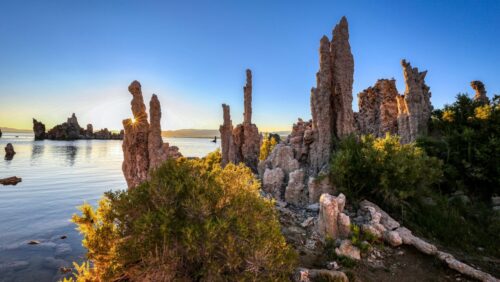
“To save California’s celebrated yet very parched Mono Lake, the city of Los Angeles needs to stop taking water from the basin, or at least sharply curtail its draws. That’s the takeaway from a new, state-commissioned report on how to revive the depleted saltwater body, widely known for its extraordinary tufa towers and curious alkali shores. But that’s not the only takeaway. Even if Los Angeles is to halt pumping from the remote eastern Sierra watershed — and the city has no intention of doing so — the report says Mono Lake will still struggle to rise to healthy heights, due to the drying effects of climate change. Evaporation, according to the report, will increasingly siphon water from the basin, exacerbating the low lake levels that have raised water salinity, thrown a wrench into the food web that includes countless migratory birds and caused dust storms to rise furiously from the exposed lakebed. … ” Read more from the San Francisco Chronicle.
UCLA report shows LADWP diversions must change for Mono Lake to rise
“On March 17, the State Water Board will hear why Mono Lake has not risen to the elevation needed to protect Mono Lake in the presentation of a new report from the UCLA Center for Climate Science. “The UCLA report confirms ongoing LADWP water diversions are the cause of the dangerously low level of Mono Lake. The chronically low lake level is putting nesting and migratory birds, air quality, and the lake’s renowned scenic and cultural resources at risk.” said Geoffrey McQuilkin, Mono Lake Committee Executive Director. The new report states, “If the existing export criteria continues, meeting D-1631 water level objectives will be unlikely.” The report was commissioned by the board to take the next steps to ensure Mono Lake’s rise. “UCLA-MLM simulations demonstrate that alternative export approaches can increase the likelihood of Mono Lake being above 6,391 ft, as compared to the existing exports outlined in D-1631.” … ” Continue reading from the Mono Lake Committee.
LADWP Statement on Mono Lake Study Presentation at California State Water Board Meeting
“LADWP appreciates the effort by the UCLA Center for Climate Science to attempt to develop a climate modeling to inform long-term water planning in the Mono Basin. At this stage, however, this model has not undergone the rigorous independent scientific and peer review that is a standard requirement in the model development process and is therefore not reliable. By contrast, LADWP’s hydrologic model for the Mono Basin, eSTREAM, has undergone years of rigorous scientific vetting and was developed collaboratively with stakeholders – representing the high standard any model used for policy purposes should meet. The State Water Resources Control Board has recognized eSTREAM as the authoritative model for Mono Basin and incorporated its use in LADWP’s amended water rights licenses. … ” Read more from the LA DWP.
Crazy or genius? A nuclear-powered solution to the West’s water crisis
“In the middle of the desert sits a sign: “Caution docks may be slippery.” They are not. In fact, there’s not a drop of water to be seen at Antelope Point Marina, which once sat near the shore of Lake Powell, the nation’s second-largest reservoir. The sparkling Colorado River now laps at the Glen Canyon walls about 180 feet below, completely invisible from a dock that once floated atop the water. … Now, a public lands access group has proposed an eye-poppingly ambitious plan to build eight massive desalination plants off the California coastline, turning ocean water into fresh for farming, and reducing demand on the ailing Colorado River. To meet the energy demand, the plants might have to be powered with nuclear reactors. … Although desalination plants are widely used in the Middle East, they consume huge amounts of electricity to generate a relatively small amount of water. No country has ever tried something on this scale before. The Colorado River basin ‒ and the seven states that depend on the river for water ‒ is facing significant shortfalls this summer following an unusually hot and dry winter. The plan’s authors at the Idaho-based BlueRibbon Coalition say their $40 billion proposal offers a viable long-term solution at a time when President Donald Trump is slashing environment-based regulatory delays and encouraging the country to think big. … ” ” Read more from the USA Today. | Read via Yahoo News.
Lawmaker: Bond to pay for updates for state’s water
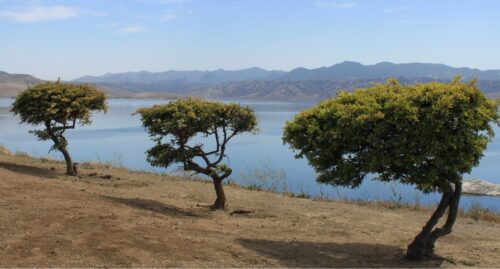 “The legislator who wrote a law modernizing California’s water infrastructure says there’s no concrete estimate for the cost to respond to worsening drought conditions. In a press conference held Friday morning at the San Luis Reservoir in western Merced County, Sen. Anna Caballero, D-Merced County, author of last year’s successful Senate Bill 72, said there is no way to know the cost of developing 9 million acre-feet of water by 2040. Her bill, which Gov. Gavin Newsom signed into law in October, is being implemented and requires the California Department of Water Resources to formulate long-term water supply goals. “Frankly, we don’t know what the cost will be to meet that goal,” Caballero said, answering a question from The Center Square at the end of the press conference. “It’s speculative to say it’s a certain amount. Will it be expensive? Yes.” Caballero added she’s proposing a bond that could pay for implementing much-needed updates to the state’s water plan. … ” Read more from the Center Square.
SEE ALSO: Sen. Anna Caballero unveils California Water Plan at San Luis Reservoir, from KMPH
California environmentalists, water contractors join forces in support of water bill
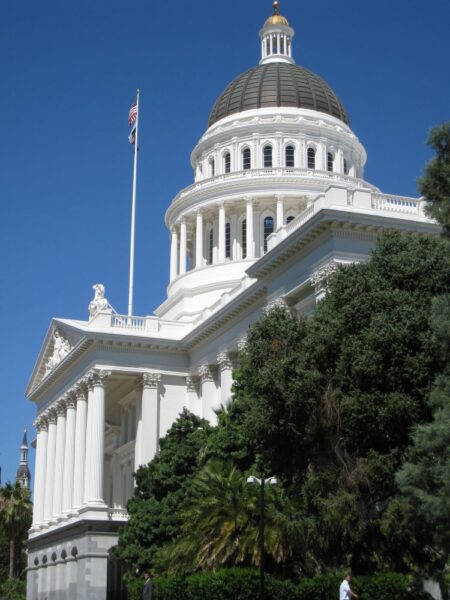 “A coalition of California lawmakers and stakeholders often at odds declared Tuesday that water, instead of being for fighting, was for friendship. The group of legislators, water district managers and environmentalists pushed for passage of Senate Bill 872. The bill would take $300 million annually from the state’s greenhouse gas reduction fund for water projects. Half of the dollars would go toward capital improvements for projects affected by subsidence, and the other half would pay for levee repairs. The legislation has drawn people usually fighting over water to the same side of the negotiating table. One reason is that, absent the improvements, millions of Californians will pay more for water as the infrastructure fails and the resource becomes scarcer, they said. “You don’t see this every day,” said state Senator Jerry McNerney, a Pleasanton Democrat and the bill’s author. “We’re on the same page on this. There’s an urgency on this.” … ” Read more from the Couthouse News Service.
Trump administration cuts key California drought-monitoring program
“As California has endured increasingly severe droughts, a long-running federal research program has used planes to survey, and help explain, the growing toll on the landscape: how many trees have died, what areas are being hit hardest and where wildfire risk is greatest. The state Aerial Detection Survey, run by the U.S. Forest Service, however, has become a casualty of the Trump administration, which has sought to aggressively slash spending, sometimes running afoul of federal courts, which have deemed many of its cuts illegal. The research flights, which for decades crisscrossed California’s forests to assess their health, ground to a halt last year because of funding and staffing reductions, federal officials say. The program’s recently released annual report shows that less than a quarter of the area typically flown was covered in 2025, leaving researchers, land managers and fire agencies with an incomplete picture of forest conditions — and questions about when and if the surveys will return. … ” Read more from the San Francisco Chronicle.
In commentary this week …
Are we entering the next California drought? It will be like none other
Opinion columnist Tom Philp writes, “If California is entering its next historic drought, the weather cycle would begin precisely like this, with a stretch of summer-like weather before it is even officially spring. A meager Sierra snowpack hovering at less than 50% of average is on track to melt away under a scorching sun and all but disappear in the coming days to near record-low levels. Temperatures in Southern California this week are reaching into the triple digits. In Redding, peak heat is more than 20 degrees above average. In terms of whether this becomes a drought, “this could be that marker of year one,” said Michael Anderson, the state climatologist with the California Department of Water Resources. … ” Read more from the Sacramento Bee.
California manages water and land separately. It’s time to tie them
Juan Altamirano, senior director of California Government Affairs at the Trust for Public Land, and Moisés Moreno-Rivera, its senior program manager, write, “Water touches nearly every aspect of life in California, underpinning healthy communities, economies, farms and ecosystems. Unfortunately, a cascade of growing threats, including severe droughts, depleted groundwater, and outdated water infrastructure puts this vital resource at risk. Solutions have traditionally focused on water itself—how it is stored, moved, and manage. But water’s true resilience depends on how land and water function together. And we can do better. From city streets to working farms and mountain meadows, land use determines how water moves across landscapes, whether it runs off quickly, becomes polluted, gets naturally filtered, or is reused. … ” Continue reading at the Sacramento Bee.
Heat wave melts excuses for California’s failure to expand water storage
The California Post editorial board writes, “This week’s heat wave is about to melt what’s left of California’s snowcap. That could mean water shortages — not because of climate change, but because we failed to build more water storage when we had the chance. Barely two months ago, the Golden State was officially free of drought — from the Tijuana River to the Oregon border — for the first time in 25 years. We also had plenty of rainfall recently, with Southern California enduring its wettest Christmas on record. But aside from a few heavy snowstorms — one of which produced deadly avalanches — there hasn’t been enough snow on the Sierra Nevada. … ” Read more from the California (New York) Post.
NOAA forecast this decades ago. We have to adapt to survive it.
Craig N. McLean, the former assistant administrator of National Oceanic and Atmospheric Administration Research, writes”This time last year, the administration of President Donald Trump tried to decimate one of the nation’s premier scientific institutions, the National Oceanic and Atmospheric Administration. With a Department of Government Efficiency-led wrecking ball, it caused personnel losses equaling more than 27,000 years of experience. Looking back, anyone who cares about this agency still mourns the unnecessary departure of deep experience and too many experts. We feel for those who were lost and those who remain – they are hurting. There’s a very shallow number of people available to get things done, and they are making Herculean efforts across the board to fill the void recklessly created by DOGE. Despite these losses, NOAA continues to provide daily weather forecasts and warnings plus climate and fisheries outlooks, among other valuable and free public services. … ” Read more from USA Today.
Conservation easements that strengthen Western ag
Dan Keppen, Executive adviser ,Family Farm Alliance, writes, “In recent months, federal leaders have increasingly framed American agriculture not only as an economic engine, but as a pillar of national security. For farmers and ranchers across the West, that recognition reflects a long-standing reality: the ability to reliably produce food, fiber, and energy crops at home supports economic stability, geopolitical resilience, and the vitality of rural communities. Conservation investments — when thoughtfully structured — can play a decisive role in advancing that mission. Western agriculture operates in conditions that demand constant innovation. Limited precipitation, recurring drought, aging irrigation systems, and growing competition for water require producers to maximize every drop. Conservation funding that supports irrigation modernization, soil health improvements, watershed restoration, or voluntary habitat work can translate directly into more dependable production. These are practical tools that help producers remain viable, sustain local employment, and maintain the productive capacity the nation depends upon. … ” Read more from the Western Farm Press.
Why the Colorado River’s future could reshape water in the San Joaquin Valley
The Water Blueprint for the San Joaquin Valley writes, “The Colorado River is hundreds of miles from the San Joaquin Valley. Not a single drop of it flows to Valley farms or communities. So when federal negotiations over the river’s future make headlines, it’s easy to see it as someone else’s problem. But California’s water system doesn’t respect those boundaries — and decisions made in the Colorado River Basin can directly reshape what’s available here. The upcoming federal decision on post-2026 operating rules for the Colorado River could have significant ripple effects across California, especially for the farms, communities, and ecosystems in the San Joaquin Valley. The Colorado River supplies roughly one-third of Southern California’s water for more than 19 million people. If that supply is reduced — whether by drought, new federal rules, or litigation among Basin states — Southern California won’t simply go thirsty. It will turn to other sources to make up the difference. Chief among them: Northern California water delivered through the State Water Project and Central Valley Project. … ” Read more from the Water Blueprint for the San Joaquin Valley.
In regional water news this week …
Yuba County farmers may lean on groundwater after New Colgate powerhouse rupture
“Yuba County growers may have to tap into groundwater supplies to irrigate their orchards and fields this summer because of the pipeline rupture at New Colgate Powerhouse. The Yuba Water Agency, which operates New Bullards Bar Dam and controls the release of water from its reservoir, has adjusted its water conveyance plans for the spring and summer due to the incident and the mercurial, moderate rainy season. “We will have the water available for our irrigators,” said Willie Whittlesey, Yuba Water general manager, at an agency meeting Tuesday. “There will be some irrigation pumping required, not because of hydrology, but because of the conveyance impacts we’ve had related to the Colgate penstock incident.” … ” Read more from the Sacramento Bee.
San Francisco Baykeeper challenges unlawful sand mining leases for SF Bay
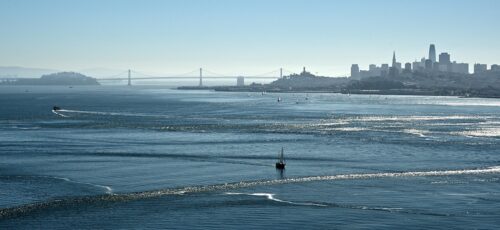 “On March 12, 2026, San Francisco Baykeeper filed a lawsuit in California Superior Court for the County of Alameda against the State Lands Commission for authorizing harmful sand mining leases in San Francisco Bay. Baykeeper is represented in the litigation by Robert “Perl” Perlmutter of Shute, Mihaly & Weinberger and by in-house Baykeeper attorneys. The case asserts that the State Lands Commission’s approval of ten-year sand mining leases violates both the California Environmental Quality Act and the agency’s public trust obligations. The leases benefit two for-profit companies, Martin Marietta and Lind Marine, which turn the Bay’s dwindling sand into concrete and asphalt. The Bay’s sandy floor is important habitat for countless Bay fish and wildlife, including Dungeness Crab and White Sturgeon. Sand is also necessary in the ecosystem to fortify shorelines and beaches, which are already experiencing erosion and worsening sea level rise. Alarmingly, new research has determined that much of the Bay’s sand is ancient and irreplaceable. … ” Continue reading from SF Baykeeper.
Pipeline remains stalled as Kings County ag titans continue court battle
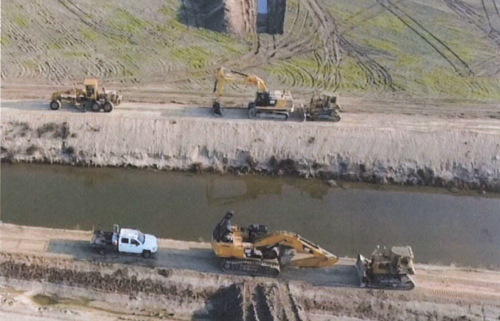 “A massive pipeline that could move water from north of Lemoore south to Stratford – and beyond – in Kings County is still stuck in its tracks as the region’s largest growers continue to duke it out in court. The pipeline, owned by Sandridge Partners, which is controlled by John Vidovich, began construction in late 2021. The 48-inch line piqued a great deal of speculation and generated both headlines and lawsuits after area farmers first noticed it being built. But it was stopped cold at a canal owned by the Tulare Lake Canal Company in early 2022. That canal company is controlled by the J. G. Boswell Company, which parked heavy equipment on the canal banks that stymied further trenching. … ” Read more from SJV Water.
State staff give thumbs down to “good guy” exemptions for Tulare County groundwater agencies
“A host of groundwater agencies in southern Tulare County were disappointed Thursday after Water Resources Control Board staff recommended none of them receive a so-called “good guy” exemption from onerous reporting and fee sanctions for lacking an adequate groundwater plan. Eight groundwater sustainability agencies (GSAs) in the Tule subbasin, which covers southern Tulare County’s flatlands, had applied for an exemption after the Water Board placed the subbasin on probation in fall 2024. A Water Board staff report released Thursday, however, recommends none of the eight be granted an exemption. The issue will come before the Water Board at its April 21 meeting. Subsidence, again, was the main problem with staff noting: “The Tule Subbasin is located within the largest and most significant region of subsidence in the state.” … ” Read more from SJV Water.
SEE ALSO: Staff reports posted regarding Tule Subbasin Exclusions from Reporting and Fees in advance of April 21, 2026 Action Item, from the State Water Board
New report on L.A. post-fire beach contamination finds something unexpected: good news
“Researchers investigating the long-term effects of the 2025 firestorms on L.A.’s beaches have found that rarest of things: good news. In the year following the Palisades and Eaton fires, levels of harmful metals like lead in coastal sand and seawater have remained far below California’s limits for safe drinking water and the U.S. Environmental Protection Agency’s safety thresholds for aquatic life. “We’re not seeing any evidence for harm in the ecosystem or harm for human health,” said Noelle Held, a University of Southern California marine biogeochemist and principal investigator for the CLEAN Waters project, which is measuring post-fire water quality. … ” Read more from the LA Times. | Read via AOL News.
Can Long Beach curb trash flowing down the L.A. River?
“California storms do a lot of good. They replenish the state’s water supply by filling its reservoirs and lower the risk of wildfires. But the rainwater runoff also comes with problems, most notably downstream on the Los Angeles River. Carried along it are heavy pollutants and debris that often skirt the river’s trash blockade and wash directly onto shore, creating a toxic crust that’s unsavory for beachgoers. For years, a solution has largely escaped the city. Hopefully, one might still be floating downstream. The Long Beach City Council on Tuesday is expected to enter into an agreement with Los Angeles County and Ocean Cleanup, an international conservation group, to forge a plan for stewarding a new trash collection system at the mouth of the river. … ” Read more from the Long Beach Post.
‘A blaring alarm’ issued for Colorado River as heat wave melts snow early
“The Colorado River system’s immediate outlook got even worse this week when federal forecasters downgraded the expected inflows into Lake Powell to just 27 percent of average. At the beginning of the month, that number was 36 percent of average. This year has brought the third lowest mid-March projection on record, with only 1.75 million acre-feet expected to flow into the Lake Powell between April and July, said Cody Moser, a hydrologist with the Colorado Basin River Forecast Center in Salt Lake City. Previously, forecasters predicted that number would be closer to 2.3 million acre-feet. Below-average precipitation paired with an unusual heat wave caused the shift in the numbers, Moser said. “In what we call a normal year, it’s valid to target April-through-July volume for your forecast,” Moser said. “But in a year like this, when we’ve been extremely warm and dry and we’ve got this heat wave coming, it’s just shifting everything earlier.” … ” Read more from the Las Vegas Review-Journal.
Low snowpack and early melt threaten spring runoff on the Colorado River, raising concerns for Lake Powell
“April 1 is an important date for water management in the Western United States. It typically marks the point at which snowpack has peaked for the year, meaning that water managers and users have a pretty good idea of what will be available come spring. However, as April approaches, snowpack is at record lows in much of the Rocky Mountains. Across the entire Upper Colorado River Basin, the snow-water equivalent, or the amount of water stored in snowpack, is 62% of normal for this time of year. Utah and Colorado are both seeing their lowest snowpacks on record, at 57% snow-water equivalent and 59% snow-water equivalent, respectively. “A feature of this winter that we will see increasingly more and more of are these really warm temperatures during winter, and some of our snow drought really being attributed to warm temperatures rather than lack of precipitation,” said Seth Arens, a hydrologist with the Western Water Assessment. … ” Read more from Aspen Public Radio.
Announcements, notices, and funding opportunities …

