
Several news sources featured in the Daily Digest may limit the number of articles you can access without a subscription. However, gift articles and open-access links are provided when available. For more open access California water news articles, explore the main page at MavensNotebook.com.
On the calendar today …
- PUBLIC MEETING: Draft 2026 Report of the Statewide Advisory Committee on Cooling Water Intake Structures from 1pm to 3pm. The Statewide Advisory Committee on Cooling Water Intake Structures (SACCWIS) will hold a public meeting to consider approving the Draft 2026 Report of the SACCWIS (Draft SACCWIS Report) and the recommendations contained therein. Click here for the meeting notice.
In California water news today …
Western heat wave shatters March records, to expand with more extremes
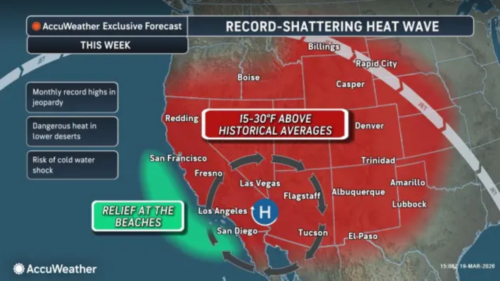 “Dozens of record-high temperatures, including all-time March records, have already been set in the western United States during this week’s heat wave, with the heat set to intensify and expand before it starts to loosen its grip. Temperatures will climb to levels more typical of late May and June across a broad area of the western and central United States through this weekend and, in some areas, into next week. Widespread highs will reach the 80s and 90s F, with multiple desert locations climbing past 100 degrees. These temperatures are 15–30 degrees above the historical average for the latter half of March. Heat-sensitive individuals may face an elevated risk of health problems due to the early-season surge in warmth. Some households may not yet have switched their climate control systems from heating to cooling, which could be especially dangerous as the record-breaking heat persists. … ” Read more from AccuWeather.
SEE ALSO: Maps and charts show how this Western U.S. heat wave is a historic weather moment, from the San Francisco Chronicle
Record heat, melting snow: What does it mean for California’s reservoirs?
“A record-baking heat wave is scalding California, with major consequences for the state’s most important reservoir: its snowpack. Providing about a third of the state’s water supply, the Sierra Nevada snowpack is a vital source of spring and summer runoff that refills reservoirs when the state needs the water most. But a warm wet storm followed February’s snow, and now, March temperatures are shattering records — prompting warnings of rapid snowmelt and swift rivers. Historically, the snowpack is at its deepest in April. But climate change is shifting runoff earlier, leaving less water trickling down the mountains in warmer months for homes, farms, fish, hydropower and forests. “In an ideal world, you’d have your reservoir full right now, and this additional huge snowpack reservoir that we know will help replenish and provide more water supply,” said Levi Johnson, operations manager for the Central Valley Project, the massive federal water system that funnels northern California river water to the Central Valley and parts of the Bay Area. This year, he said, “we’re not going to have that.” … ” Read more from Cal Matters.
Northern California drought could return by summer, forecasters warn
“Northern California recently emerged from drought. It may not last. Federal forecasters warned Thursday that dry conditions are likely to redevelop across the region by early summer — a sharp reversal after a winter that erased drought conditions statewide. A new three-month outlook released Thursday by the National Oceanic and Atmospheric Administration’s Climate Prediction Center showed drought conditions were likely to develop across a broad stretch of Northern California, including the Sacramento Valley and areas just north of the Bay Area, by late June. … ” Read more from the San Francisco Chronicle.
Why unprecedented March heat wave has experts worried about what comes next
“The most destructive wildfires in Southern California history. The region’s wettest holiday season. The hottest March heat wave on record. In the last 15 months, the Southland has seen a trio of extreme weather events, and UC climate scientist Daniel Swain says there’s one clear through line connecting them all. “All of the superlative extremes we’ve seen in recent years — from extreme heat to extreme dryness to extreme wetness, and even the severe wildfires — they all have clear links to climate change,” he said. The ongoing heat wave shattering dozens of temperature records in Southern California is no exception, Swain said. Climate change warms the atmosphere, raising baseline temperatures and making heat-trapping weather patterns more intense and longer-lasting. As a result, we see more frequent and more severe heat waves. … ” Read more from the LA Times.
Temperatures are soaring in the Western united states. Climate change is to blame, says a new report.
“A historic heatwave is sweeping across western North America. Wednesday, 18 March was the hottest March day in recorded history in dozens of cities across the West, including Phoenix, Palm Springs, and Las Vegas. Temperatures are expected to peak today, with a forecast of 42.2°C (108°F) in Palm Springs and 41.1°C (106°F) in Phoenix. The Bay Area saw its first-ever March heat advisory on Monday. Cities as far east as Texas and as far north as Montana could also see March temperature records, according to The Weather Channel meteorologist Jonathan Erdman. … ” Read more from EOS.
Why the ridge keeps coming back: The structural shift behind western heat domes
Deirdre Des Jardins writes, “In Part 1, I described the diabatic engine behind March 2026’s record-shattering western heat dome: upstream precipitation in the Pacific Northwest released latent heat that amplified an extraordinary ridge over the interior West. That post explained the mechanism. This one asks a different question: why does the ridges keep forming? The March 2026 heat dome was not a bolt from the blue. It was the most extreme pulse in a winter-long pattern that locked the western United States into warmth and the East into cold for months. That warm-West/cool-East dipole has become a recurring feature of North American winters over the past decade, and a growing body of research suggests it reflects something deeper than internal variability. The leading mode of winter atmospheric circulation over North America appears to have shifted, driven by greenhouse-gas forced changes in the jet stream and the atmospheric waveguide. The atmosphere has been restructured in a way that favors extreme ridges over the West. … ” Read more from California Water Research.
El Nino on its way and expected to stay for the winter
“The Northwest will have a drier and warmer than average spring and early summer, a trend likely to persist through the end of the year, the National Weather Service predicts. An El Nino will create the conditions for above-average temperatures and below-average precipitation in April, May and June in Oregon, Washington, Idaho and Northern California, the service’s Climate Prediction Center said March 19. The El Nino isn’t here yet, but likely will emerge soon, according to the climate center. There is an 82% chance it still will be in place when winter comes. The odds it will be a strong El Nino are 33%. … ” Read more from Capital Press.
Tribes and environmental groups criticize Legislative Analyst’s Office report on updated Bay-Delta Plan
 “A new report from the California Legislative Analyst’s Office is drawing strong criticism from a broad coalition of environmental organizations and Tribes, arguing that the report on the State Water Resources Control Board’s proposed update to the water quality control plan for the San Francisco Bay-Sacramento-San Joaquin Delta (“Bay-Delta Plan”) falls short of providing lawmakers with a fair and complete assessment of options. Coalition members argue the report assumes approval of the voluntary agreements (VAs) and fails to serve as a balanced, neutral evaluation of the regulatory alternative that is grounded in enforceable water quality standards. The coalition also raised concerns about the lack of enforceability within the VA framework, warning that it could allow water agencies to self-report compliance with minimal oversight. This approach poses serious risks to an already fragile ecosystem, while failing to protect Tribal Beneficial Uses or address harmful algal blooms. Coalition leaders further criticized the report’s framing of “environmental flows,” arguing that the term is a misnomer for unimpaired flows and that flows necessary for ecosystem health should be established through enforceable regulatory standards, not negotiated or purchased by water users. … ” Read more from Restore the Delta.
Federal funds to raise Shasta Dam reignite local opposition
“The Department of the Interior announced yesterday a $40 million allocation for the pre-construction and planning of the Shasta Dam enlargement. The money comes from the One Big Beautiful Bill Act signed in July last year. The project aims to raise the dam structure by 18.5 feet. This would increase the reservoir’s water storage capacity by approximately 634,000 acre-feet. Officials from the Bureau of Reclamation argue the expansion will bolster water security for the Central Valley Project, which currently holds 41% of its total storage in the reservoir. However, environmental advocates and tribal groups strongly oppose the expansion. Ron Stork, representing the advocacy group Friends of the River, said that the project has conflicted with state law since 1989, when the McCloud River was added to California’s list of protected rivers. Stork empasized that raising the reservoir by 20.5 feet would inundate upstream portions of the protected McCloud River and swallow key remaining cultural sites belonging to the Winnemem Wintu tribe. … ” Read more from KOBI.
Huffman blasts $40 million in taxpayer funds for illegal Shasta Dam raise
“Today, Ranking Member Jared Huffman (D-Calif.) issued the following statement after the Department of the Interior announced $40 million in taxpayer funds for planning and preconstruction activities to raise Shasta Dam. “The proposal to raise Shasta Dam is a stubbornly unlawful, wasteful, and destructive boondoggle that refuses to die, and it is past time we bury it for good. It is illegal under California law. Raising Shasta Dam has been blocked by state courts, opposed by California’s Attorney General, and killed in Congress before. Republicans keep resurrecting this zombie project for one and only one reason: because the Westlands Water District — one of the most politically powerful players in Western water — wants it. And the Republican budget bill threw out the longstanding rule that water districts have to help pay for projects they benefit from, meaning taxpayers will end up getting stuck with a nearly $2 billion bill if the project moves forward. So much for fiscal responsibility. … ” Continue reading from Congressman Huffman.
Groups sue to stop Trump’s dangerous fish-killing water grab in California
“Conservation groups this month sued the Trump Administration for pumping excessive amounts of water out of the Sacramento-San Joaquin River Delta in a way that harms imperiled fish species. The lawsuit alleged that the U.S. Bureau of Reclamation violated the Endangered Species Act by exceeding regulations intended to limit the Central Valley Project’s impacts on Central Valley Steelhead, North American Green Sturgeon, and Chinook Salmon, according to a press statement from a coalition of environmental groups. “The Delta is the irreplaceable home of iconic and endangered California fish, like salmon and steelhead, and we can’t let Trump’s reckless pumping destroy it,” said Harrison Beck, a staff attorney at the Center for Biological Diversity. “If the Trump Administration continues to pump as much water as it can out of the Delta ecosystem, we may lose these native fish forever. We can’t allow mass extinction when it’s entirely avoidable.” … ” Read more from the Daily Kos.
These animals can cause big trouble. Why are states unleashing them by the millions?
“When animals that aren’t native to an area harm the environment, we usually label them as invasive and consider them bad. State wildlife agencies spend tens of millions of dollars a year trying to eliminate them. That makes this fact peculiar: Those same agencies also regularly and purposefully release nonnative fish into the environment that, in many cases, damage local ecosystems. The reason for this apparent contradiction is that anglers everywhere want something nice to catch. Many US streams, ponds, and lakes no longer support healthy native fish populations, or never did. Without flooding them with brown trout, rainbow trout, largemouth bass, and a whole host of other nonnative species, there wouldn’t be much to fish. … ” Read more from Vox.
Why some regions are winning the fight against groundwater depletion
“For half the world’s population, the water in their drinking glasses comes from below them. Groundwater also supplies 40% of global irrigation projects. Alarmingly, more than a third of the planet’s aquifers, or groundwater basins, are dropping. Declining water tables leave entire regions vulnerable to drought, land subsidence or seawater intrusion while damaging ecosystems and reducing water access. Properly securing this resource is a matter of social, humanitarian and environmental security. Fortunately, there have been some success stories. UC Santa Barbara professor Scott Jasechko dove into the details of 67 cases of aquifer recovery in a study published in Science. He found that most successful initiatives incorporated multiple intervention categories, and over 80% involved sourcing an alternative water supply. The paper provides many insights on the strategies that communities and resource managers can use to address declining groundwater resources. “The cases in this review are a reminder that groundwater depletion is not inevitable,” said Jasechko, a professor at the Bren School of Environmental Science & Management. “They highlight how humans have solved this problem in different places around the globe.” … ” Read more from The Current.
A new high-tech network is tracking how California’s wildlife is changing
“As climate change and land use changes accelerate, a collaboration of state agencies, researchers and conservation groups is working to better track how California’s ecosystems are changing over time. Gary Bucciarelli, a professor at the University of California, Davis, and chair of California Sentinel Sites for Nature, said the effort comes at a critical moment. “In simple terms, Mother Nature needs a checkup,” Bucciarelli said, noting that wildlife patterns across the state are already shifting. The Sentinel Sites initiative is tied to California’s “30×30” goal, an effort to conserve 30% of the state’s lands by 2030. … ” Read more from Jefferson Public Radio.
“Pocket parks” promise climate resiliency on a small scale. Are they working?
“If you see someone scrutinizing the trash at your local park, it could be urban ecologist Monica Palta. Fear not, you’re just witnessing science in action. “It’s basically trash archeology in a way,” Palta said. A discarded burger wrapper can be a clue to understanding the ways people engage with their neighborhood nature. Is this a place where people have picnics? Maybe birthday parties? “Not all uses are going to leave remnants behind, but it’s a broader way of trying to figure out what’s happening in the park,” she said. Studying people’s relationship with their local environment is Palta’s job as a UC Cooperative Extension specialist of urban water quality, health and justice with UC Agriculture and Natural Resources. By cataloguing uses and benefits of neighborhood green space, her research helps urban planners design parks that best serve their surrounding community. … ” Read more from California Agriculture.
Foresters, prescribed-fire experts swap knowledge to reduce wildfire impacts
“Fresh out of high school, Marcus Hampshire, a member of the United Auburn Indian Community, was invited by his uncle to participate in a cultural burn — the controlled use of fire by Indigenous peoples to manage the land. He was hooked. “From then on, I always had a torch in my hand or I was dragging fire with a tool,” said Hampshire, who is part of the Fire Leadership for Intertribal Conservation Knowledge-keeping Eco-cultural Revitalization (F.L.I.C.K.E.R.) Crew. “I really enjoy being able to see how fire works on the landscape.” Providing the public a chance to see beneficial fire in action was one objective of the second Forester Prescribed Fire Training Exchange (FTREX), held Oct. 26 to Nov. 1, 2025, in and around the UC Berkeley Blodgett Forest Research Station. … ” Read more from California Agriculture.
California water leaders release recommendations for strengthening Proposition 4 implementation
“The California Water Data Consortium released Strengthening California’s Climate Bond Outcomes with Water Data Infrastructure, a new report on data and information systems-focused strategies and approaches to maximize Proposition 4’s success. The report reflects insights from over 100 water leaders convened last June—representing state agencies, local water managers, nonprofits, academic institutions, and more. While California has dedicated $3.8 billion from Proposition 4 for water resilience, many agencies and communities lack the data infrastructure, governance systems, and coordination mechanisms to help implement investments as effectively as possible and learn from outcomes. … ” Read more from the California Water Data Consortium.
Congressman Valadao works to improve forest management and wildfire prevention
“Today, Congressman David Valadao (CA-22) introduced the Long-Term Good Neighbor Authority Act alongside Congressman Jimmy Panetta (CA-19). This bipartisan bill extends the Good Neighbor Authority program from 10 years to 20 years to allow the U.S. Forest Service and Bureau of Land Management to partner with state, tribal, and local partners to address wildfire risk and improve forest health. “California is no stranger to devastating wildfires, and we need every tool available to better manage our forests and reduce this growing threat,” said Congressman Valadao. “By strengthening long-term collaboration between federal, state, tribal, and local partners, the Long-Term Good Neighbor Authority Act will take a more proactive approach to forest management and wildfire prevention. I’m proud to work alongside Rep. Panetta on this bipartisan effort to better protect our communities.” … ” Read more from Congressman Valadao.
California files lawsuit challenging EPA’s rescission of endangerment finding
“In response to President Donald Trump’s illegal attempt to overrule science and abandon an entire category of federal climate protections, California Attorney General Rob Bonta, alongside California Governor Gavin Newsom and the California Air Resources Board (CARB), today co-led a coalition of 25 attorneys general, the Governor of Pennsylvania,10 cities and counties in filing a petition challenging the U.S. Environmental Protection Agency’s (EPA) rescission of the Endangerment Finding in the U.S. Court of Appeals for the D.C. Circuit. The Endangerment Finding is EPA’s formal acknowledgement that greenhouse gas emissions from motor vehicles contribute to air pollution that drives climate change and endangers public health and welfare; it has served as the legal basis under the Clean Air Act for limiting climate pollution from vehicles. … ” Read more from Attorney General Rob Bonta.
SEE ALSO: 24 States Sue the E.P.A. for Renouncing Its Power to Fight Climate Change, from the New York Times
In commentary today …
Are we entering the next California drought? It will be like none other
Opinion columnist Tom Philp writes, “If California is entering its next historic drought, the weather cycle would begin precisely like this, with a stretch of summer-like weather before it is even officially spring. A meager Sierra snowpack hovering at less than 50% of average is on track to melt away under a scorching sun and all but disappear in the coming days to near record-low levels. Temperatures in Southern California this week are reaching into the triple digits. In Redding, peak heat is more than 20 degrees above average. In terms of whether this becomes a drought, “this could be that marker of year one,” said Michael Anderson, the state climatologist with the California Department of Water Resources. … ” Read more from the Sacramento Bee.
Conservation easements that strengthen Western ag
Dan Keppen, Executive adviser ,Family Farm Alliance, writes, “In recent months, federal leaders have increasingly framed American agriculture not only as an economic engine, but as a pillar of national security. For farmers and ranchers across the West, that recognition reflects a long-standing reality: the ability to reliably produce food, fiber, and energy crops at home supports economic stability, geopolitical resilience, and the vitality of rural communities. Conservation investments — when thoughtfully structured — can play a decisive role in advancing that mission. Western agriculture operates in conditions that demand constant innovation. Limited precipitation, recurring drought, aging irrigation systems, and growing competition for water require producers to maximize every drop. Conservation funding that supports irrigation modernization, soil health improvements, watershed restoration, or voluntary habitat work can translate directly into more dependable production. These are practical tools that help producers remain viable, sustain local employment, and maintain the productive capacity the nation depends upon. … ” Read more from the Western Farm Press.
In regional water news and commentary today …
NORTH COAST
Arcata: Massive waterline replacement project will mean service disruptions
“The Steel Waterline Replacement Project is continuing in Arcata and may cause disruptions to water usage for residents. McCullough Construction, Inc (MCI) has made significant progress on the City of Arcata Steel Waterline Replacement Project and work is beginning in central Arcata. The city recognizes that water shutoffs affect the day-to-day life, business and livelihoods of our community members and is committed to minimizing disruptions. Advance notice of the planned construction activities and scheduled water shutoffs that may directly affect residents and businesses will be provided. These disruptions are necessary to facilitate the replacement of the city’s aging water infrastructure, particularly targeting remaining sections of steel waterlines. … ” Read more from the Mad River Union.
State Assemblymember Chris Rogers to host town hall Saturday in Potter Valley
“Assemblymember Chris Rogers, D-Santa Rosa, will host a town hall at Potter Valley Jr/Sr. High School on Saturday. During the town hall, he will provide a legislative update, share work he has been doing throughout the 2nd District and take questions from constituents on a first-come, first-served basis. The meeting comes as Potter Valley faces ongoing uncertainty around the future of the Potter Valley Project, a key water system for local agriculture and the regional economy. Rogers has been involved in broader discussions about balancing water supply needs with environmental restoration. … ” Read more from the Mendocino Voice.
SIERRA NEVADA
Portola to receive 7 free water tanks
“The City of Portola will soon receive seven new 2,500-gallon tanks for storing water in case of drought or emergency. The tanks will be delivered and installed by the California Department of Water Resources at no cost to the city. In a presentation during the Portola City Council meeting March 11, City Manager Ryan Bonk suggested the council approve participation in the tank program. The Plumas County Office of Emergency Services had alerted him to the opportunity. DWR developed the program with funding from the California Budget Act of 2022, and it is implemented under the Small Community Drought Relief Program. The department will provide the tanks and cover the costs of tank delivery, installation, eventual decommissioning and grant administration. In a follow-up email to The Plumas Sun, Bonk clarified that no funds will change hands: DWR will purchase and deliver the tanks to the city. … ” Read more from the Plumas Sun.
Protecting wetlands in the Lake Tahoe basin with fences
“Taylor Creek may be only one of the 63 waterways feeding into Lake Tahoe, but it’s a particularly special location for plants, animals, and humans alike. The National Forest Foundation, in partnership with the Lake Tahoe Basin Management Unit (LTBMU), recently completed building a rustic-looking fence along the outlet of Taylor Creek to better protect one of the last remaining natural wetland resources in the Lake Tahoe Basin (Basin). The Taylor and Tallac Creek Wetland were home to the Basin’s most significant invasion of Eurasian Watermilfoil. This invasive plant species pulls nutrients up from soil and sediment into the water, where they can contribute to hazardous algae bloom. With support from the Tahoe Fund, LTBMU began the Taylor and Tallac Ecosystem Restoration Project in 2018. This project aims to combat the prolific invasive species and promote the health and ecological benefits provided by the wetland. … ” Read more from the National Forest Foundation.
Will Tahoe-area resorts cut ski season even shorter? What to know as temps climb
“As temperatures rise across California, some Lake Tahoe-area resorts are cutting their losses and ending ski season early. Many resorts in the Sierra Nevada had to push their opening days back due to abnormally warm and dry weather, The Sacramento Bee previously reported. Weather played a role in Homewood Mountain Resort’s decision to close for skiing and snowboarding on Tuesday, March 17, nearly a week earlier than previously planned. “Mother Nature always gets the final word in the mountains, and this season she’s calling it a little early,” Homewood representatives wrote in an Instagram post on Tuesday. … ” Read more from the Sacramento Bee.
$100M Yuba River ‘fishway’ advances amid powerhouse clean-up, angler concerns
“Yuba Water Agency directors moved forward with the construction of a $100 million-plus project on the lower Yuba River intended to forge passage for fish to swim freely around a small dam. But anglers who revere the 10-mile stretch of protected water upstream of that site still fear the consequences of creating a path for all species, including predators, to reach the fishery that currently only trout and salmon can access. Water agency directors on Tuesday chose Sacramento firm Teichert Construction to oversee the project, and approved about $1.4 million for the company to finish designs and begin pre-construction, which officials have said may begin by the end of this year. … ” Read more from the Sacramento Bee.
SACRAMENTO VALLEY
Redding’s March heat wave could shatter 112-year record
“The 90-degree weather hitting Redding and the rest of the Sacramento Valley could shatter century-old heat records for March. Expect temperatures to soar daily through Friday, March 20; rising roughly 30 degrees hotter than historic averages for the month, according to the National Weather Service. Redding’s afternoon temperatures usually hover around 65 degrees in mid-March. “This is weather we usually see the first week of May in Redding,” said Dakari Anderson with the weather service’s Sacramento branch. Here’s what forecasters say could be Northern California’s 2026 historic March heat wave. … ” Read more from the Redding Record Searchlight.
West Sacramento water rates will soon go up — by a lot. Here’s how much and why
“West Sacramento residents’ water and sewer utility fees will increase and for some could nearly double under new rates approved unanimously this week by the city council and which will go into effect starting next month. The city has not raised prices since 2021 after a rate study was conducted nearly 10 years ago, according to city officials. However, the pipes, pumps and other machinery — inherited from Yolo County after the city incorporated in 1987 — require replacement, said Rebecca Scott, the director of public works operations and maintenance director. … ” Read more from the Sacramento Bee.
NAPA/SONOMA
Sonoma County family’s logging plan for Jenner forestland riles coastal community, environmentalists
“For several generations, the Berry family has logged the forest on their sprawling coastal property near the mouth of the Russian River to feed a sawmill they continue to operate a few miles upstream. But the family’s latest plan for 1,099 acres of forest they own overlooking the river near its outlet at Jenner has riled this small community, raising concerns about the long-term impacts on drinking water and imperiled salmon runs that have yet to recover from a century of destructive commercial logging. Bruce Berry, proprietor of Berry’s Mill and Lumberyard in Cazadero, is seeking state approval to thin his family’s forestland, which borders the river’s north bank, with the protected Jenner Headlands Preserve to the west. … ” Read more from the Santa Rosa Press Democrat.
North Bay heatwave shatters records; relief still days away, forecasters say
“A stretch of unusually intense mid-March heat shattered records across the North Bay this week and meteorologists say those waiting for a reprieve will have to hang on a little longer. Temperatures across Sonoma and Napa counties surged well above the seasonal averages this week, breaking multiple daily records in the process. In some places, temperatures reached the mid-90s, according to National Weather Service Meteorologist Karleisa Rogacheski. Santa Rosa reached 88 degrees Wednesday, March 18, breaking the past record of 77 set in 2001. In northern Sonoma County, Cloverdale hit 90 degrees and Lake Sonoma recorded a high of 91 degrees, the weather service reported. Over to the east, Napa County shattered a century-old record. … ” Read more from the Santa Rosa Press Democrat.
The nuances of tapping North Bay sediment supplies
“Any admirer of the Petaluma River will tell you it isn’t really a river. Indeed, the word doesn’t do justice to this 13-mile waterway that works in both directions, wending a serpentine course from the northwestern corner of the San Pablo Bay to the heart of downtown Petaluma and back again. Technically a slough with significant freshwater flows during the rainy season, it drains a 146-square-mile watershed yet runs brown with fine bay sediment all year long. This confluence of creek and bay, fresh and saline, seasonal and tidal occurs across a vast expanse recognized as the second-largest remaining brackish tidal marsh on the West Coast, trailing only Suisun Marsh. But not all is well on the Petaluma Marsh. Its original 16,000 acres have fragmented into a patchwork of small marshes totaling about 6,800 acres. Human and natural needs sometimes clash, particularly around wetlands, and nowhere is that more true than at Petaluma’s most beloved public open space. … ” Read more from Knee Deep Times.
BAY AREA
Bay Area heat wave finale: Friday could be the hottest day yet
“Spring arrives at 7:46 a.m. on Friday. Our reward? Perhaps the hottest day of a record-breaking heat wave. It’s a grand finale of sorts, with temperatures this weekend expected to drop as much as 15 degrees from the peak. What a week it’s been. Since Monday, the region has broken or tied more than 30 daily high temperature records. Salinas broke its all-time March record Tuesday, then broke it again Wednesday. Redwood City has broken its daily record for four days running. In Napa, a mark that had stood since 1914 fell Wednesday. But on Thursday, the Bay Area offered up one of its classic microclimate curveballs. A shallow marine layer, maybe a few hundred feet thick, kept San Francisco and selected bayside locations cooler than forecast into the afternoon. Once it finally dissipated, temperatures were off to the races. San Francisco reached 86 degrees, breaking its daily record set in 2010. … ” Read more from the San Francisco Chronicle.
When summer heat arrives in March
“The Bay Area is baking this week. Cue our modern human adaptations to summer: On go the shorts—and the A/C, if we have it. But how are our wild neighbors faring? A high-pressure system is sitting over much of the West Coast, creating a heat dome: sinking air warms as it compresses and acts like a lid, trapping heat near the surface. The resulting heat wave is by many measures extraordinary, with record temperatures 20–30 degrees above average. Winter is over, and suddenly. A temperature jolt like this can disrupt the harmonious change of season. If flowers bloom before insects emerge, for example, that could in turn make life harder for the birds that eat those very insects. Such phenological mismatches—a desynchronizing of seasonal biological timing—could stress native flora and fauna. But it might not be so bad in some parts of the San Francisco Bay Area. An absence of drought conditions and a strong maritime layer are likely buffering the region from the most extreme negative effects—though some experts still say they are concerned. … ” Read more from Bay Nature.
Marin Municipal Water District orders plan to address Nicasio flooding
“The Marin Municipal Water District is pursuing a long-term management plan to address flood concerns in Nicasio, fulfilling a requirement set by the regional water quality board. The utility secured an emergency permit late last year to remove accumulated woody debris from the district-owned portions of Nicasio Creek. The effort, which was requested by Nicasio residents because of flood risks, allowed water to flow more freely to the reservoir, officials said. As a condition of approval of that permit, the San Francisco Bay Regional Water Quality Control Board said the district must develop a long-term maintenance plan for the area to minimize the risk of flooding. Residents say they are inundated each year and that the problem is getting worse. … ” Read more from the Marin Independent Journal.
Hundreds protest proposed cuts to San Francisco Environment Department
“Dozens of climate action organizations and hundreds of activists gathered at noon on Wednesday, February 25 on the front steps of San Francisco City Hall to rally against layoffs and program cuts to the city’s Environment Department proposed by Mayor Daniel Lurie’s office. San Francisco is facing a $400 million budget shortfall for fiscal year 2026-2027 and a combined deficit of nearly $900 million over the next two years. That situation has forced the mayor’s budget team to introduce sweeping reductions across city departments, with Lurie only pledging to leave “core” services like public safety and transportation untouched. The result could be devastating to the city’s ability to reach its climate goals, including its main target of net zero emissions by 2040, advocates and Environment Department staff warn. Lurie has proposed laying off about eight employees (7.8 to be exact, because of part-time and hourly workers) from SFE and cutting direct General Fund support for the department from more than $3 million to less than $600,000. … ” Read more from the Knee Deep Times.
San Francisco is sinking at a rapid pace, NASA data shows
“NASA is out with a dire warning about San Francisco. The city is sinking at a rate so fast, it could put human life at risk. Scientists used satellite data to study vertical land motion from 2015 to 2023. Findings revealed that regional studies substantially underestimate sea level rise. NASA projects more than double the expected rise by 2050. … ” Read more from KGO.
SEE ALSO: NASA warns San Francisco sinking faster than expected, from the SJV Sun
Mountain View’s shoreline gets serious SLR attention
“The first question any local asks when they hear about a shoreline construction project is always the same, no matter which corner of the Bay Area they hail from: “How long will the trail be closed?” Almost everyone who enjoys the outdoors is familiar with a specific stretch of the 350-mile-long Bay Trail, whether to jog, walk the dog, or commute to work at the tech campuses of Google, Microsoft, and Intuit on the Mountain View shoreline, for example. Which is why the closure of a portion of the Bay Trail for seven months to raise its elevation and buffer the surrounding properties from sea level rise was one of the biggest challenges for a $20 million project completed this February (detours were provided through Shoreline Park). “If you walk on that levee trail today, you’d never know there’s a flood protection project out there,” says Raymond Wong, a City of Mountain View engineer who collaborated on the project. “Instead of a typical sea wall, the entire thing is buried and converted back to nature on the surface.” … ” Read more from Knee Deep Times.
Plants facilitate transition to higher water
“This winter, crews with the nonprofit Save The Bay weeded more than two dozen acres of land near Bedwell Bayfront Park in Menlo Park. The workers were maintaining a “habitat transition zone,” sometimes called an “ecotone” or a “horizontal levee.” It’s an area where ecosystems meet and meld. In Menlo Park, it’s where rehabilitated tidal marshes merge with the land. These transition zones, built from packed dirt and rocks and vegetated by organizations like Save The Bay, provide a natural buffer against erosion, as well as habitat for local wildlife. “The ideal situation is that we get the right amount of native plant material out onto the slope during the right time of year, and we only have to do like three to five years of weeding and maintenance,” says Save The Bay’s Habitat Restoration Director Jessie Olson. … ” Read more from the Knee Deep Times.
CENTRAL COAST
Moss Landing battery fire update: Residents, supes left with more questions than answers
“Residents and lawmakers were expecting to get some answers Tuesday at the Monterey County Board of Supervisors meeting about the consequences of a lithium-ion fueled Battery Energy Storage System fire that ripped through a Moss Landing facility in January 2025, but they left with only questions. Questions were left unanswered about why scientists hired by the company, Vistra Corp., failed to investigate hundreds of large, black chunks of sediment that were seen deposited in the surrounding area in the days after the fire. Or why the company waited until May to start analyzing impacts, four months after the fire. Questions remained about why the state’s Department of Toxic Substances Control decided to test soil samples up to 6 inches deep for health impacts, instead of focusing on surface samples, where concentrations of chemical residue might be higher. And questions were repeated about what, exactly, the immediate impacts were of the fire on the environment and human and animal health. … ” Read more from Local News Matters.
SAN JOAQUIN VALLEY
$200 million for Friant-Kern Canal
“Local lawmakers, including Republican Congressman David Valadao, referenced funding that was set aside in what’s know as the One Big Beautiful Bill for water infrastructure. On Tuesday that funding was awarded. The Department of the Interior announced $889 million in investments for what it described as critical water infrastructure projects across the West made possible by President Donald Trump’s One Big Beautiful Bill Act. Included was $200 million for the continued repairs of the Friant-Kern Canal. … ” Read more from the Porterville Recorder.
State staff give thumbs down to “good guy” exemptions for Tulare County groundwater agencies
“A host of groundwater agencies in southern Tulare County were disappointed Thursday after Water Resources Control Board staff recommended none of them receive a so-called “good guy” exemption from onerous reporting and fee sanctions for lacking an adequate groundwater plan. Eight groundwater sustainability agencies (GSAs) in the Tule subbasin, which covers southern Tulare County’s flatlands, had applied for an exemption after the Water Board placed the subbasin on probation in fall 2024. A Water Board staff report released Thursday, however, recommends none of the eight be granted an exemption. The issue will come before the Water Board at its April 21 meeting. Subsidence, again, was the main problem with staff noting: “The Tule Subbasin is located within the largest and most significant region of subsidence in the state.” … ” Read more from SJV Water.
SEE ALSO: Staff reports posted regarding Tule Subbasin Exclusions from Reporting and Fees in advance of April 21, 2026 Action Item, from the State Water Board
Farmers invited to free SGMA workshop in Tulare County
“A workshop aiming to help farmers find economical ways to remain in business through crop alternatives, farm management and land repurposing will be held March 31 from 7:45 a.m. to 1 p.m. The event will take place at the Tulare County Co-op Extension building, 4437 S Laspina St. The workshop is a collaboration between the Tule Land and Water Conservation Trust and the University of California’s Division of Agriculture and Natural Resources. … ” Read more from SJV Water.
Tulare County water agencies to spend $80,000 on PR campaign aimed at state funding to help farmers
“Everyone likes a “feel good” story and farmers in part of Tulare County are hoping their stories make legislators feel good enough to fork over more public funding to help them comply with the state’s groundwater laws. The boards of the Lower Tule and Pixley groundwater sustainability agencies voted March 10 and 12, respectively, to spend another $30,000 – on top of $50,000 already spent – for a Sacramento public relations firm to continue a campaign launched in October showing how farmers have worked to reduce pumping in the critically overdrafted region. The goal is to become a sort of happy “earworm” for legislators as they ponder how to spend Proposition 4 funding and to avoid cuts in the Governor’s budget revise coming up in May, according to Eric Limas, manager of both Lower Tule and Pixley GSAs and water districts. “We want to really hammer this over the next couple of months while that’s happening,” Limas said at the Pixley GSA meeting. … ” Read more from SJV Water.
SOUTHERN CALIFORNIA
New report on L.A. post-fire beach contamination finds something unexpected: good news
“Researchers investigating the long-term effects of the 2025 firestorms on L.A.’s beaches have found that rarest of things: good news. In the year following the Palisades and Eaton fires, levels of harmful metals like lead in coastal sand and seawater have remained far below California’s limits for safe drinking water and the U.S. Environmental Protection Agency’s safety thresholds for aquatic life. “We’re not seeing any evidence for harm in the ecosystem or harm for human health,” said Noelle Held, a University of Southern California marine biogeochemist and principal investigator for the CLEAN Waters project, which is measuring post-fire water quality. … ” Read more from the LA Times. | Read via AOL News.
SAN DIEGO
Cheaper water ahead? San Diego County Water Authority inks landmark water deal with Riverside County.
“The San Diego County Water Authority has inked its first deal to sell excess water to other communities in Southern California, a landmark overhaul of the water authority’s business model that’s long been promised by top officials. The water authority’s new agreement to sell water to the Western Municipal Water District in Riverside County will bring in $100 million in new revenue for the San Diego region’s financially strapped water system over the next five years. That influx of cash could temper future rate hikes for many county residents. But it’s too early to say what impact the deal might have. “This is going to be groundbreaking for them as much as it is for us,” Water Authority General Manager Dan Denham said of the deal. … ” Read more from the San Diego Union-Tribune.
SEE ALSO: Riverside Water Sale Is Done; Deal with Feds Doesn’t Actually Exist, from Voice of San Diego
Along the Colorado River …
Why Colorado River negotiations stalled, and how they could resume with the possibility of agreement
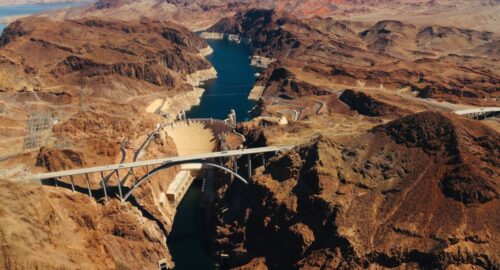 “The seven U.S. states that make up the Colorado River basin are struggling to agree on how best to manage the river’s water as its supply dwindles due to climate change and a period of prolonged drought. Their negotiations, which are not open to the public, missed a Feb. 14, 2026, deadline the federal government had established, after which federal officials said they would impose their own plan. The federal government has not yet done so, but the prospect of such an action is not good news for the nearly 40 million people who depend on the Colorado River for water, energy, agriculture and recreation, nor for the estimated US$1.4 trillion in economic activity the river supports. We have led or participated in complex water management discussions from the river’s headwaters in Colorado to its delta in Mexico and elsewhere in the arid Southwest and around the world. Even on less contentious issues, the keys to success involve learning together, understanding one another’s interests, working through conflict and developing inclusive solutions for diverse participants. And that works best with an outside facilitator. … ” Read moire from The Conversation.
Low snowpack and early melt threaten spring runoff on the Colorado River, raising concerns for Lake Powell
“April 1 is an important date for water management in the Western United States. It typically marks the point at which snowpack has peaked for the year, meaning that water managers and users have a pretty good idea of what will be available come spring. However, as April approaches, snowpack is at record lows in much of the Rocky Mountains. Across the entire Upper Colorado River Basin, the snow-water equivalent, or the amount of water stored in snowpack, is 62% of normal for this time of year. Utah and Colorado are both seeing their lowest snowpacks on record, at 57% snow-water equivalent and 59% snow-water equivalent, respectively. “A feature of this winter that we will see increasingly more and more of are these really warm temperatures during winter, and some of our snow drought really being attributed to warm temperatures rather than lack of precipitation,” said Seth Arens, a hydrologist with the Western Water Assessment. … ” Read more from Aspen Public Radio.
Upper Basin states test methods to fill Powell pool
“With a Lake Powell conservation pool nearly guaranteed for the future of Colorado River management, the four Upper Basin states are exploring and refining the ways they could fill it. Conservation by those states (Colorado, New Mexico, Utah and Wyoming) could be one of the keys to reaching a deal among the seven states that share the Colorado River and an important part of the framework for managing the drought-stricken river after this year. The water saved by the Upper Basin states could be stored in Lake Powell as a means of maintaining higher water levels and as an insurance policy against drastic cuts. This type of pool isn’t yet being used in Lake Powell; it would have to be established by an agreement among the seven states. An agreement in the 2019 Drought Contingency Plan allowed for a 500,000 acre-foot Upper Basin storage pool in Lake Powell, but so far, the states have not utilized this and the agreement expires this year. … ” Read more from Aspen Journalism.
Colorado River crisis: How record spring heat impacts Western water sharing
“Our record-breaking spring heatwave is doing more than just spiking air conditioning bills early; it’s raising concerns for the future of the West’s most vital water source—the Colorado River. There are a lot of unknowns when it comes to the future of the Colorado River water, including how the seven basin states will share the water after 2026 and how these above-average spring temperatures will affect what’s left to share. Unseasonably high temperatures can trigger an early snowpack melt, and that directly impacts how the Colorado River water system functions. “What happens when we have extreme heat, even now in the early spring, is that the snow melts faster,” said Sarah Porter, director of the Kyl Center for Water Policy at ASU. “A lot of that snowmelt evaporates into the air instead of basically making its way kind of percolating through the ground to the river.” … ” Read more from Fox 10.
Colorado River flows drop to crisis levels
“New forecasts released in mid-March 2026 show the Colorado River entering another difficult year, with far less water expected to reach key reservoirs that supply millions across the West. According to reporting by Ryan Spencer in Summit Daily News on March 13, 2026, federal forecasters now expect only about 2.3 million acre-feet of water to flow into Lake Powell during the spring runoff season. That amount is roughly one-third of normal. Spencer reports that hydrologist Cody Moser with the National Oceanic and Atmospheric Administration’s Colorado River Basin Forecast Center warned that conditions may worsen in the near term. “I anticipate this water supply forecast trending lower, at least during the next two weeks,” he said during a water briefing. If those projections hold, the inflow to Lake Powell would rank among the lowest recorded in more than six decades. … ” Read more from Western Water.
Hobbs seeks business support in D.C. as Colorado River cuts loom
“Gov. Katie Hobbs pressed the U.S. Chamber of Commerce and national business leaders in Washington this week to back Arizona’s bid for more Colorado River water as federal officials weigh cuts that could squeeze supplies and drive up rates. Hobbs warned that Arizona is especially vulnerable because, among the seven states that rely on the river, it holds the lowest priority under long-standing water rights agreements. She argued that federal plans being considered would place a disproportionate burden on Arizona compared with other states in the basin. “I firmly believe Arizona has the most to offer in advancing national priorities of AI, national defense, and technological advancement,” Hobbs said. … ” Read more from Arizona Family.
Las Vegas serves as case study for groundwater recovery, study says
“Groundwater depletion is a growing concern for regions that need to provide water for growing cities and thirsty agriculture in a drying climate, but Las Vegas offers a case study for how intervention can help stabilize a major source of portable water. New research published in Science Magazine Thursday documents dozens of cases of “groundwater recovery” across the globe — where groundwater levels rose after a prolonged period of depletion. Las Vegas stood out as a rare case of groundwater levels recovering significantly after intervention through artificial recharge, which involves direct injection of treated unused Colorado River water into the local groundwater aquifer. Since 1987, the Las Vegas Valley Water District (LVVWD) and its partners have stored more than 360,000 acre-feet of treated water, or roughly 117 billion gallons, in the local underground aquifer — a major shift after decades of intensive groundwater use that caused once free flowing artesian wells in the valley to run dry. … ” Read more from the Nevada Current.
In national water news today …
Trump admin details enviro agency exodus
“Thousands of energy and environmental agency staffers left their jobs under a Trump administration program aimed at slashing the size of the federal workforce. More than 10,700 employees resigned from EPA and the Interior and Energy departments under the administration’s “deferred resignation program” that offered workers incentives to leave their jobs, according to the most recent data published by the Office of Personnel Management. The latest figures — including information about staff departures through the end of January — offer the clearest picture yet of the extent of the Trump administration’s workforce reductions across energy and environmental agencies. … ” Read more from E&E News.
The planet is overheating, but you might not know it from the news
“Scientists are pretty sure that Earth is hotter than at any time in the last 125,000 years, but the news media is moving on, trying to keep on top of a fire hose of pressing news—from the daily chaos of the Trump administration to the breaking developments in the war on Iran. The shift in attention started during the COVID-19 pandemic and, despite a temporary rebound, has gathered pace in recent years: Since its peak in 2021, global news coverage of climate change has dropped 38 percent, according to data from the University of Colorado Boulder’s Media and Climate Change Observatory. Many journalists have been busy digging through 3 million pages of the Epstein files rather than the latest scientific report, though you can still find news about some of the biggest recent findings, including that estimates of sea level rise have been dramatically underestimated and that global warming has accelerated “significantly” over the past decade. … ” Read more from Inside Climate News.

