
A wrap-up of posts published on Maven’s Notebook this week …
Note to readers: Sign up for weekly email service and you will receive notification of this post on Friday mornings. Readers on daily email service can add weekly email service by updating their subscription preferences. Click here to sign up!
In California water news this week …
Rain, snow returning to California. Here’s when a flurry of storms could hit
 “Northern California’s three-week dry spell looks like it will end with a bang. Confidence is growing that the second half of December will feature a flurry of storms from the Bay Area to the Sierra Nevada. It’s too early to say just how much rain and snow will fall, but the atmosphere is expected to transition to a pattern that favors Northern California for significant precipitation through the end of 2025. A windier pattern will also wipe away the relentless tule fog that has gripped the Central Valley for weeks and knock out the temperature inversions that have kept the valleys cool and the mountains warm. … ” Read more from the San Francisco Chronicle.
SEE ALSO: Atmospheric Rivers affecting the Pacific Northwest and California into late December, from NOAA’s Climate Prediction Center
Snow drought current conditions and impacts in the West
 “Snow cover across the West was the lowest December 7 snow cover amount in the MODIS satellite record (since 2001), at 90,646 square miles. Water Year 2026 (October 1, 2025–September 30, 2026) precipitation to date is near or above median for many parts of the West. However, much warmer-than-normal temperatures caused precipitation to fall as rain instead of snow across many basins, leading to snow drought despite wetter-than-normal conditions across most of the West. Nearly every major river basin in the West experienced a November among the top 5 warmest on record. Snow drought is most severe across much of the Sierra Nevada in California, the Cascade Range in Washington and Oregon, the Blue Mountains of Oregon, and the Great Basin in Nevada, with snow water equivalent (SWE) in most of these basins at less than 50% of median. … ” Read more from NIDIS.
Is a rapid reversal from La Niña to El Niño brewing in the Pacific?
“The Pacific Ocean remains officially locked in a La Niña phase, but the mechanisms keeping it there are beginning to sputter. On Thursday, the Climate Prediction Center left a “La Niña Advisory” in place, confirming that cool sea surface temperatures continue in the equatorial Pacific. But it won’t last much longer. The agency expects the La Niña phase to fade by February. “There is high confidence that we currently are at or near the peak of this weak La Niña, so we expect that ocean temperatures in the eastern equatorial Pacific will rise and bring us to ENSO-neutral within a couple of months,” said Nat Johnson, a meteorologist at the NOAA Geophysical Fluid Dynamics Laboratory. … ” Read more from the San Francisco Chronicle (gift article).
New federal plan for Delta water pumping conflicts with California requirements
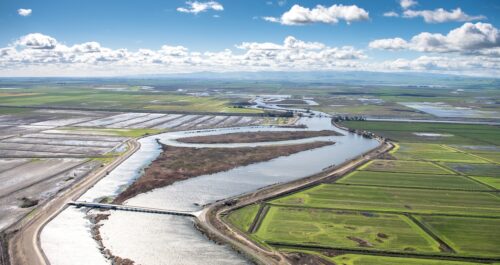 “The Bureau of Reclamation on Thursday updated the long-term operations plan for the Central Valley Project to allow increased exports from the Sacramento-San Joaquin Delta, a move that conflicts with California’s own requirements, potentially shifts more of the water burden onto the state and threatens the Delta’s ecosystem and water quality. The decision follows a January executive order from President Donald Trump directing agencies to boost water deliveries and echoes earlier efforts during his first term to loosen pumping restrictions in the Delta. “The Trump administration is putting politics over people — catering to big donors instead of doing what’s right for Californians,” Tara Gallegos, a spokesperson for Gov. Gavin Newsom’s office told The Sacramento Bee. … ” Read more from the Sacramento Bee (gift article).
NASEM reviews science behind Central Valley Project and State Water Project operations
 “Managing the delicate balance between reliable water delivery and environmental stewardship in California requires rigorous scientific backing. At the request of the US Bureau of Reclamation (USBR), the National Academies of Sciences, Engineering, and Medicine (NASEM) recently conducted a comprehensive review of the scientific activities supporting the long-term operations of the Central Valley Project (CVP). An 18-member committee led this work, and the report underwent independent peer review before its release. Issued in November 2025, this report serves as the inaugural product in a planned series of biennial reviews designed to solve complex problems and inform public policy. The committee’s charge was specific: assess the science informing three high-stakes actions managed by the USBR and the California Department of Water Resources (CDWR). These actions are central to daily operations and are critical for both water customers and the protection of six species listed under the Endangered Species Act. Because of their impact, these areas remain subjects of significant controversy. … ” Read more from Maven’s Notebook.
Pine Flat Dam upgrade proposed to boost water storage in San Joaquin Valley
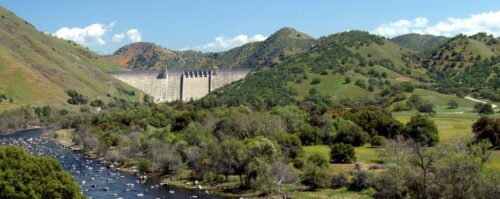
“State leaders are considering an “infrastructure upgrade” for the Pine Flat Dam in the San Joaquin Valley, aiming to address urgent water storage and protection needs. Congressman Vince Fong is spearheading a proposal to raise the dam’s spillway by 12 feet, which would increase its water capacity by over 100,000 acre-feet. “Water is critical to growing our food and so water storage is essential for us to have a stable water supply,” Fong said. … ” Read more from KMPH.
The biggest threat to the Delta you’ve (probably) never heard of
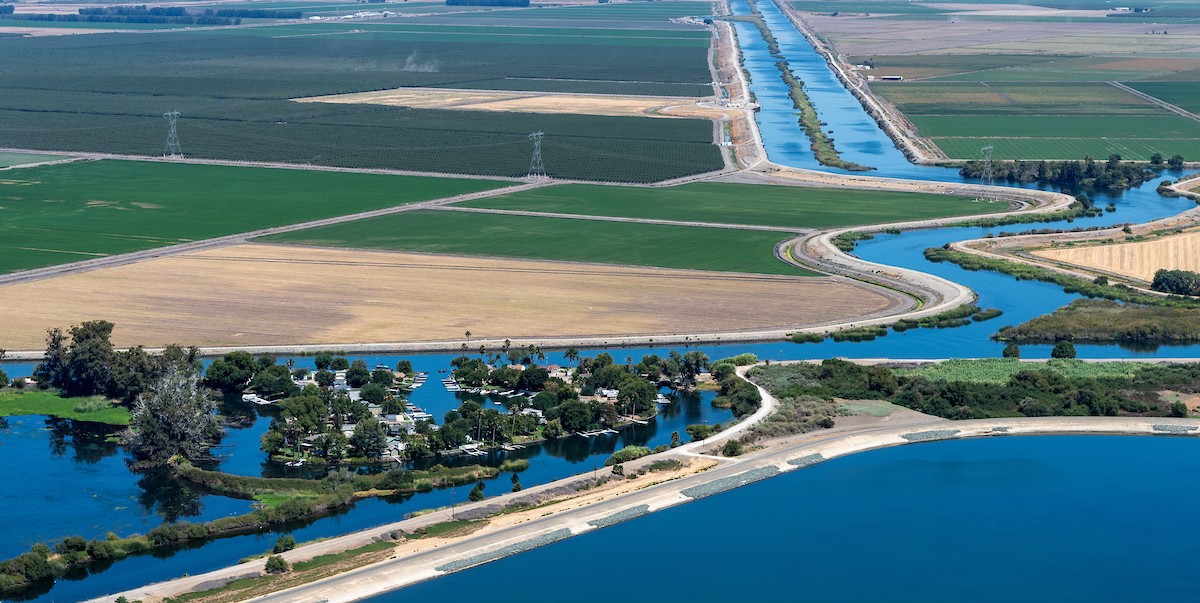
“In 1962, when Mary Hildebrand was 10 years old, her family moved to their farm between the communities of Vernalis and Mossdale in the southern tip of California’s Sacramento-San Joaquin Delta. The 140-acre farm sits on the banks of the San Joaquin River, which squiggles north through the flat expanse of the South Delta toward its confluence with the Sacramento River. … “It was wild and wonderful,” says Hildebrand, who still lives in her family home. She and her sister spent summers swimming and sailing in the slough that connected to the San Joaquin River mainstem, and often spied weasels, muskrats, meadowlarks and other wildlife. Today Hildebrand rarely sees wildlife apart from the raccoons and coyotes that thrive even in heavily degraded ecosystems. Invasive plants like water hyacinth and Egeria densa infest nearby sloughs and channels. Her farm, which she worked with her mom and dad and now leases to a neighbor, is also at risk. In wet years, Hildebrand worries that the water bordering her land will rise and inundate the fields. In dry years, she worries that the water will drop below the pumps that irrigate the rows of sweet corn and lima beans. In both types of water extremes, the culprit is the same: build up of sediment that chokes South Delta channels. Silt and sandbars diminish channel capacity, causing floods and blocking water from reaching irrigation pumps. … ” Read the full story by Robin Meadows at Maven’s Notebook.
California’s salmon may be rebounding after three wet winters
“Earlier this year, our senior fellow Jeff Mount and UC Davis’s Carson Jeffres explained that three “wettish” years in a row offered a crucial opportunity for salmon to recover from the 2020–22 drought. We sat down with them this month to get an update. Q: So, catch us up. How did things pan out? A: Jeff: Before Carson gives his assessment, I should stress how unusual these past three years have been. If you look at the parts of the state that produce most of our salmon—the Sacramento River and North Coast hydrologic regions—you had three consecutive average- to above-average years of precipitation. The last time that happened was in the late 1990s, more than 25 years ago. And before that, it happened in the early ‘80s. Usually, a dry year or multiple dry years separate wet years in California. … ” Read more from the PPIC.
NOAA’s denial of endangered status for salmon sparks talk of legal challenge
“Federal fisheries officials on Monday rejected a bid to designate West Coast Chinook salmon as threatened or endangered under the Endangered Species Act. In response, one of the conservation groups that petitioned for the listing, the Center for Biological Diversity, says it is considering a legal challenge. “The major species protections could have benefited not just the salmon, but other wildlife that feeds on them,” Jeff Miller, a senior conservation advocate at the Center for Biological Diversity said, adding orcas, river otters, bald eagles, and bears as some of the examples. “Unfortunately, the decision by the Fisheries Service really only benefits the logging industry and dam operators.” … ” Read more from the Sacramento Bee (gift article).
With a target on their bellies, can California’s sturgeon survive?
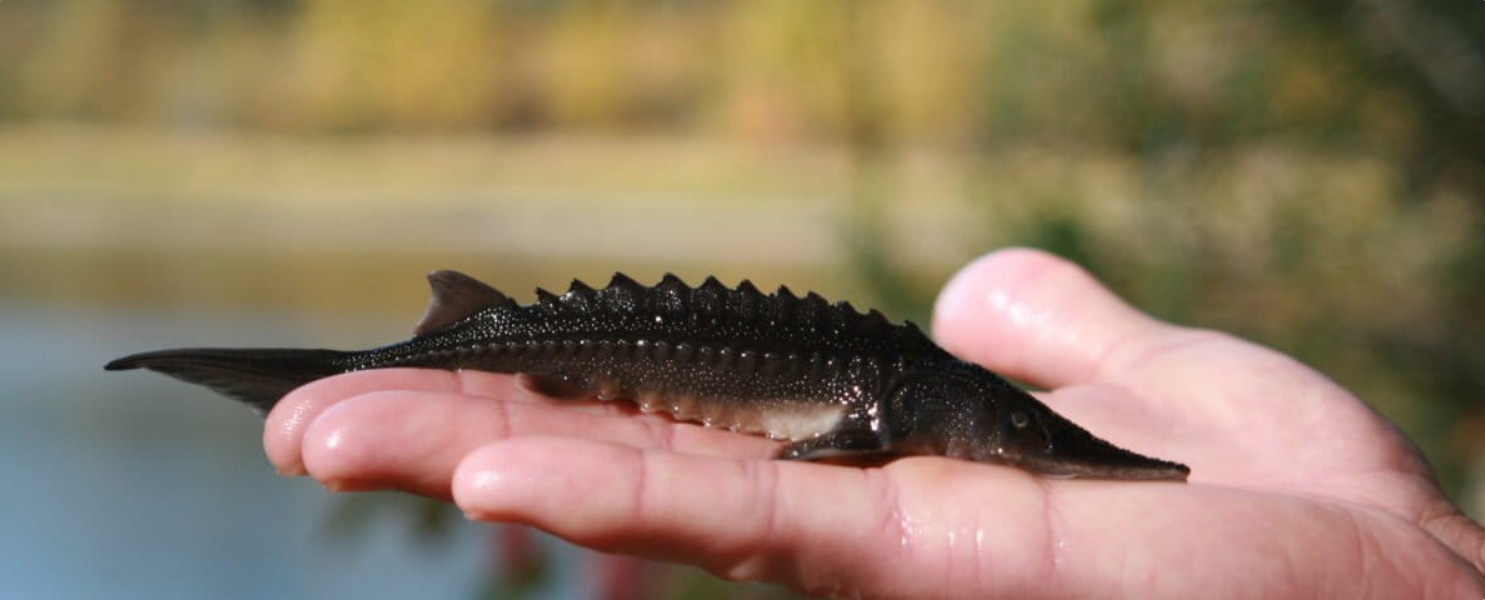
“In California, and worldwide, poachers target sturgeon for their eggs, which become a coveted delicacy when processed into caviar. Caviar from California’s white sturgeon (Acipenser transmontanus) is highly prized: It’s been compared to that from the critically endangered beluga sturgeon (Huso huso) from Eurasia, which is the world’s most expensive. California protects both of its sturgeon species, white and green sturgeon. Keeping, killing or selling wild sturgeon or their eggs is prohibited; the state banned commercial sturgeon fishing 71 years ago, in 1954. Globally, sturgeon populations are dropping, with 85% of species at risk of extinction. “Sturgeon are one of the most highly threatened groups of species on Earth,” says Monika Böhm, freshwater conservation coordinator at Indianapolis Zoo’s Global Center for Species Survival. “All species are threatened, although in some parts of the world [like Europe and Asia], it’s worse than others.” … ” Read the full story from Mongabay.
California cities pay a lot for water; some agricultural districts get it for free
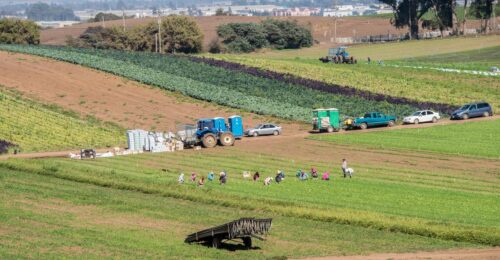 “California cities pay far more for water on average than districts that supply farms — with some urban water agencies shelling out more than $2,500 per acre-foot of surface water, and some irrigation districts paying nothing, according to new research. A report published today by researchers with the UCLA Institute of the Environment and Sustainability and advocates with the Natural Resources Defense Council shines a light on vast disparities in the price of water across California, Arizona and Nevada. … The research team spent a year scouring state and federal contracts, financial reports and agency records to assemble a dataset of water purchases, transfers and contracts to acquire water from rivers and reservoirs. They compared vastly different water suppliers with different needs and geographies, purchasing water from delivery systems built at different times and paid for under different contracts. Their overarching conclusion: One of the West’s most valuable resources has no consistent valuation – and sometimes costs nothing at all. … ” Read more from Cal Matters.
Good news for tiered rates: Court upholds LADWP’s budget-based tiered water rates
“On December 8, 2025, the California Court of Appeal issued its decision in Dreher v. City of Los Angeles Department of Water and Power, affirming Los Angeles Department of Water and Power’s (LADWP) budget-based tiered water rates for single-dwelling unit customers. The Court rejected Patz v. City of San Diego’s strict interpretation of Proposition 218 in several key respects, finding: (1) agencies may base tiered rates on source-of-supply costs even when supplies are commingled; (2) tier breakpoints do not require cost-based justification; and (3) agencies may rely on peak pumping and storage costs to support higher rates in upper tiers. The Court also held that while a low-income subsidy adjustment violates Proposition 218, refunds are not presumed. Instead, a claimant must satisfy statutory prerequisites, including paying under protest and submission of an administrative claim. … ” Read more from Best Best & Krieger.
Companies are racing to fuel and cool AI
 “If you haven’t noticed, data centers have been sprouting up all over. And they’re mighty thirsty. Inside these secured, windowless compounds, where servers hum and data never sleeps, AI systems guzzle millions of gallons of water (a single large data center can consume as much water as a town of 10,000 people, or even more) just to stay cool. In this new reality, no sector has escaped the lure of advanced tech: Faster processing! Smarter analytics! More data than ever! But every leap forward comes at a cost. For AI, it shows up on the utility bill: electricity to run the servers, and, in more and more cases, vast amounts of water to keep them from overheating. In a region like Sacramento, where the grid strains under demand and droughts loom, some critics, including Assemblymember Diane Papan, a Democrat from San Mateo, see data centers as hulking, water-hogging threats to local communities. … ” Read more from Comstock’s.
Why are meadows important to the climate?
“When most people think of solutions to environmental degradation, meadows are not usually the first thing that comes to mind. But research by Ben Sullivan, a soil ecologist in the University of Nevada, Reno’s College of Agriculture, Biotechnology & Natural Resources, has brought new attention to the power of meadows in defending the environment, restoring watersheds and supporting ecosystems. His work may offer an opportunity to address the pressing climate issues we face today. “I love all meadows, no matter what meadow I happen to be standing in, regardless of condition or location or surroundings” said Sullivan, who also conducts research as part of the University’s Experiment Station “Their magic lies not only in their thriving flora and fauna, but in their significance to protecting surrounding ecosystems and the people who rely on them.” … ” Read more from UNR.
In commentary this week …
DAN WALTERS: Trump sides with agriculture again in California’s neverending water wars
“From the onset of his foray into presidential politics a decade ago, Donald Trump has been obsessed with managing California’s water, often interjecting himself into decades-long conflicts over how the precious commodity should be divvied up. During his first stint as president, Trump was heavily influenced by the Westlands Water District, a huge agricultural water agency in the San Joaquin Valley that sought more irrigation water for itself and other farm interests. That relationship led to an extremely controversial contract that guaranteed Westlands as much as 1 million acre-feet of water each year from the federal Central Valley Project, solidifying the district’s supply situation. Lacking water rights, Westlands had historically depended on temporary contracts to meet members’ demands. The new contract angered environmental groups because it threatened to reduce flows through the Sacramento-San Joaquin Delta for wildlife habitat. The groups sued and won rulings against the contract in trial and appellate courts. After Trump moved back into the White House in January, he immediately picked up where he left off, issuing an order to federal water officials to maximize deliveries in California. … ” Read more from Cal Matters.
EDWARD RING: Will advocates for more water supply projects find unity?
“There’s only one way to restore reliable water allocations to farmers, avoid turning our cities into rationed “xeriscaped” heat islands, and cope with whatever the climate ultimately delivers. That’s to build more infrastructure to safely and sustainably produce millions of acre feet of new fresh water every year. There are many practical ways to accomplish this. Some are controversial. Others, less so. But chances are slim that any of them will happen anytime soon unless advocates for more water are unified. The single biggest variable in water supply projects and management priorities is the Sacramento-San Joaquin Delta. A new organization, The Great Valley Farm Water Partnership, joins together farmers from the delta and the San Joaquin Valley to “foster mutually beneficial water and environmental solutions through collaboration and expert guidance.” They have identified seven priority issues … ” Continue reading from Edward Ring.
To save salmon runs and fishing jobs California needs new water rules
Vance Staplin, executive director of the Golden State Salmon Association, and Barbara Barrigan-Parrilla, executive director of Restore the Delta, writes, “Today, Chinook salmon are spawning in the Sacramento, American and other Central Valley rivers. After three years of disastrous populations and closed commercial salmon seasons, this fall brings hope for a better future. It’s time for decision-makers to take bold action to save California’s largest salmon runs and the fishing jobs that depend on them. That starts with California’s State Water Resources Control Board, which is setting new water diversion rules to protect salmon, the Bay-Delta and Valley rivers for the first time in three decades. The number of wild Sacramento River Fall run Chinook — the cornerstone of California salmon fishing — has crashed by 95% over 20 years. The loss of fishing seasons has devastated California’s salmon fishing industry. When salmon runs are healthy, they generate $1.4 billion per year and 23,000 jobs. Coastal fishing families and ports are struggling, as are Central Valley fishing-related businesses. … ” Read more from the Sacramento Bee (gift article).
California’s water partnerships are effective and in danger
Letitia Grenier, director and a senior fellow at the PPIC Water Policy Center, and Jeffrey Mount, a senior fellow at the PPIC Water Policy Center, writes, “In a year of profound shifts at the federal level, uncertainty has been the name of the game across the United States. Nowhere is that truer than in the California water world. Over many decades, the state has forged a symbiotic relationship with federal agencies to manage its notoriously complex — and aging — water system. The state has worked with an alphabet soup of federal agencies to manage some of the worst floods and droughts the state has ever seen. Research and technical expertise undergird all water-related activity in California, whether you’re a farmer applying water to your crops, a utility providing clean drinking water to your customers or a municipality trying to protect your community from floods. Fortunately the state is blessed with top-notch water experts, hailing from state and federal agencies, universities, consulting firms and nongovernmental organizations. They’re responsible for many of the tools the state uses to manage its water. Any California water action relies on decades of applied research and experienced people to implement it. Changes at the federal level have put this tight state-federal partnership in doubt. … ” Read more from Cal Matters.
Why California needs a unified groundwater strategy
Emma Manetta, Dani Del Rosal, Sarah Lummus, and Amira Zhanat, all students at Georgetown University studying environmental and public policy issues, write, “Groundwater rise is one of California’s most overlooked climate emergencies. The water rising beneath our feet is quietly colliding with a century of industrial contamination, and the state is not prepared. California representatives must take groundwater rise seriously because the consequences for public health and infrastructure will be too severe to ignore. Federal legislation provides the funding and programming necessary to identify the communities most vulnerable to the impacts of groundwater rise. Across California, regulators maintain extensive records on contaminated bodies of water and hazardous remediation sites, especially in the Bay Area, Los Angeles Basin, and San Diego. Current policy allows polluted sites to be closed once they are deemed stable and pose minimal risk. But groundwater levels are climbing, and contamination that was once submerged is now at risk of being mobilized. … ” Read more from Capitol Weekly.
C-WIN: Follow the Money: The Central Valley Project
“If the State Water Project is a travesty, its federal analogue – the Central Valley project – is an outrage. To be sure, the two projects have much in common. Both are stunningly expensive public works that divert water from Northern California to Southern California. Both benefit the few, the wealthy and the powerful at the expense of ratepayers, taxpayers, fishermen, and underserved and tribal communities. Both wreak immense environmental harm. But viewed as a matter of scale, the inequities and deficits of the CVP trump those of the SWP. A part of Franklin D. Roosevelt’s New Deal initiative, the CVP was launched following decades of acrimonious dispute over California’s water distribution and policies. Getting the CVP built required the federal government to ignore tribal water rights claims and offer sweetheart deals to powerful interests that controlled water on both the Sacramento and San Joaquin Rivers. … ” Continue reading from C-WIN.
NRDC: Rethinking the price of water in the West
Isabel Friedman, Senior Advocacy Associate for NRDC, writes, “Americans have long romanticized the settlement and land grabs of the West through stories of cowboys riding through a rugged land. In old Western films, dust clouds would swirl behind their horses’ hooves as they beat down on the tough, arid land. These romanticized stories and the decisions that precipitated in Washington, D.C., ignored the long history of the people who already lived on this land, putting a first-come, first-serve sign on the land and natural resources of the region. Settlers in the 19th and early 20th century laid claim to parcels of land and the rivers that flowed through them. To them, the federal government doled out water free of charge, relying on these resources to drive the rapid development of the West. … Today, just as it was 100 years ago, substantial volumes of water in the Colorado River Basin are sold or diverted at little to no cost. California’s Central Valley Project, another massive federal water resource that was first envisioned in 1921, still allocates water under similarly antiquated pricing systems that allow water to be diverted for next to nothing, incentivizing inefficiency and overuse. … ” Read more from the NRDC.
In regional water news this week …
First Upper Klamath chinook poached
“The good news? With removal of four dams on the Klamath River completed in 2024, thousands of Chinook have wasted little time making their way back into Southern Oregon waters. The not-so-good news? So too have poachers. Or at least two, anyway. Details come from the Oregon State Police Fish and Wildlife Division’s October newsletter, where troopers reported on what’s believed to be the first criminal case of unlawful take of salmon on the Beaver State side of the Klamath Basin since the sea-going fish lost access to the area in the early 1910s. Troopers say a witness phoned in a report about a man who was fishing on and had illegally kept a Chinook from Spencer Creek, which is about 15 miles west of Klamath Falls and had been closed to fishing at the end of September to protect spawning salmon. While the man was gone when a trooper arrived, witnesses provided a license plate, and the vehicle was subsequently spotted and stopped on Highway 66 by the officer. … ” Read more from NW Sports.
Yurok Tribe welcomes back salmon, native plants, and Indigenous sovereignty to a former lumber mill site in Northern California
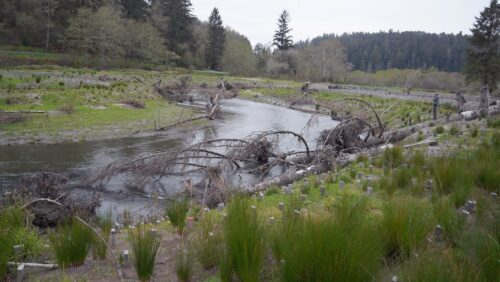 “Bright-yellow excavators, swathes of ocher fabric, and sculptural piles of large logs lie scattered across the floodplain of Prairie Creek, just off US Highway 101 in the northernmost reaches of California’s Humboldt County. A noisome lumber mill once spewed smoke here as it processed the region’s last unprotected ancient coast redwoods, while cattle grazed near a faded green barn. But before it became a mill site and ranch in 1954, and before goldminers and homesteaders seized it from the Yurok Tribe in the 1850s, this land was the site of ‘O Rew, one of more than 70 Yurok villages that once hugged the Pacific coast and embraced the banks of the Klamath River. Now the ‘O Rew Redwoods Gateway & Prairie Creek Restoration Project, set against the majestic backdrop of surviving old-growth redwood forest, is transforming “Orick Mill Site A” back into the salmon stronghold and seat of Indigenous sovereignty it once was. ‘O Rew is also writing an important chapter in America’s land-back story, whose keynote is “Indian lands in Indian hands.” … ” Read more from Earth Island Journal.
Palo Alto begins horizontal levee construction project
“Palo Alto is about to get a first-of-a-kind solution to a major problem. A horizontal levee is being built in the Palo Alto Baylands to restore habitat and improve the quality of the water flowing into the Bay – all meant to address the climate crisis. Save The Bay volunteers spent Wednesday planting native species in a patch of dirt in the Palo Alto Baylands. These volunteers say they recognize this project could be a game changer for the environment. The City of Palo Alto has constructed an underground horizontal levee here. “This is an innovative way to improve water quality to the bay to protect our infrastructure and create a habitat for species in this area,” said Caitlin Sweeney, director of San Francisco Estuary Partnership. … ” Read more from NBC Bay Area.
Bringing life back to the Van Buskirk Wetland
“When the city of Stockton, California, closed the Van Buskirk Municipal Golf Course in 2019, local leaders were presented with a prime opportunity. The community of South Stockton, an underserved neighborhood, needed more green space and outdoor recreational opportunities. It also faced the looming threat of catastrophic flooding due to climate change and the aging flood infrastructure along the San Joaquin River. Now, with 192 green acres available, the city could potentially solve both problems if it worked toward a creative, nature-based solution. When the Yachicumne Yokuts and Miwok Tribes were the primary stewards of this portion of California’s Central Valley, the area had been freshwater wetlands that were naturally designed to flood. When settlers arrived in the mid-1800s, the wetlands were rapidly replaced with agricultural fields, and the river was hemmed in by levees built to protect farms and crops from flooding. Over time, Stockton grew into an urban and diverse community of more than 320,000 people. … ” Read more from American Rivers.
Proposed pumping allocations by two Kings County groundwater agencies ignite flurry of responses
“Incompatible pumping allocations being considered by two groundwater agencies in north Kings County have prompted a blizzard of responses, and even some accusations, from farmers and multiple entities. The South Fork Kings Groundwater Sustainability Agency (GSA) and Mid-Kings River GSA each had draft pumping allocation policies out for public comment. The GSA boards will likely discuss the policies further at their Dec. 16 and 18 meetings. The allocation amounts differ significantly, with Mid-Kings proposing to allow its farmers to pump a base amount of 1.43 acre feet per acre of land, which is more than double South Fork’s proposed base allocation of .66 of an acre foot per acre of land. That discrepancy initiated opposition from South Fork farmers, including Doug Freitas who said the lopsided allocation would essentially give Mid-Kings farmers the benefit of South Kings’ groundwater. … ” Read more from SJV Water.
The science of snowmaking: How Southern California resorts bring snow to the slopes during warm winters
“When Mother Nature doesn’t deliver, it’s up to technology — and a dedicated crew willing to work in freezing cold weather while the rest of the world sleeps — to bring winter to the slopes. There has been an unseasonably warm start to this winter, with local ski resorts cranking on their snowmaking machines to blanket slopes for enthusiasts eagerly awaiting the start of the ski and snowboard season. It’s nothing new for resort operators in Southern California; winters can be fickle and unpredictable for the mountain towns wedged between desert landscape and the Pacific Ocean. Some seasons, the mountains are a winter wonderland blanketed in deep snow, while other years, the season doesn’t get started until after the holidays. And some winters, snow hardly shows up at all. … ” Read more from the LA Daily News (gift article).
San Diego officials say Tijuana River pollution is a state of emergency
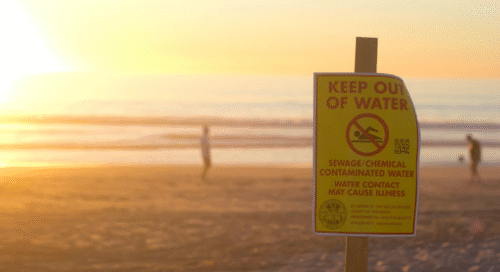 “California public officials, scientists and coastal advocates rang the alarm over the continued pollution of the Tijuana River into the Pacific Ocean and nearby communities on the Mexican border, describing the situation as one of the worst public health and environmental disasters in the country and around the world. “Since 2018, over 200 billion gallons of sewage have crossed our border,” Paloma Aguirre, who serves on the San Diego County Board of Supervisors, told an audience at a California Senate Environmental Quality Committee hearing in San Diego. “That is a gigantic amount of sewage you don’t hear about anywhere in our nation. It is the biggest public health and environmental crisis in the western hemisphere.” She said the situation has been compared to the public water crisis in Flint, Michigan, a national scandal that exposed failures in the government and left that city’s residents without safe drinking water for years. … ” Read more from the Courthouse News Service.
Climate change is stealing rain and snow from the Colorado River, new report says
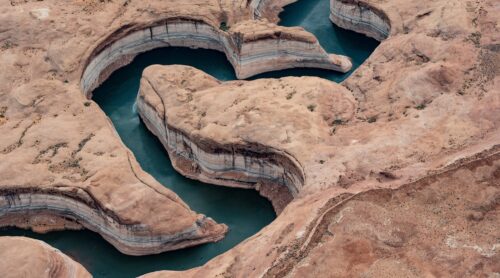
“Climate change is stealing rain and snow from the Colorado River, and it might be the basin’s new permanent condition, according to a report released this week. Leading scientists from around the Colorado River Basin, which spans parts of Colorado, six other Western states and Mexico, released Tuesday a collection of essays on the future water supply for 40 million people. In many ways, it’s bleak. Rainfall is low, river flows are down, reservoir storage is on the brink of depletion and groundwater is struggling, according to several authors in the Colorado River Research Group. “We still don’t have a crystal ball, but the future is pretty dark,” Brad Udall, a member of the research group and a Colorado-based climate scientist, told The Colorado Sun. … ” Read more from the Colorado Sun.
Announcements, notices, and funding opportunities …

