Visit the Water Shelf main page
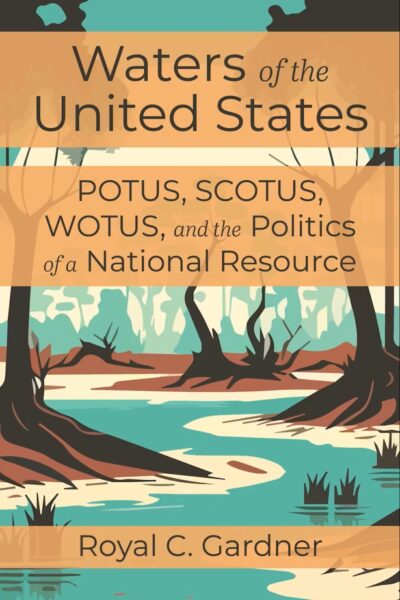 With the big-ticket dramas of the Colorado River and who can and can’t turn on spigots in state and regional water supplies, we sometimes lose track of the ongoing legal tug-of-war revolving around the statutory and foundational definition of “waters of the United States.” Recently, the U.S. Supreme Court waded into these waters with their Sackett decision, and the U.S. Environmental Protection Agency has picked up the baton by proposing yet another rule for determining what water bodies fall under the Clean Water Act.
Fortunately, Royal Gardner, in his authoritative and engaging book, Waters of the United States: POTUS, SCOTUS, WOTUS, and the Politics of a National Resource (Island Press, 2024), provides both a comprehensive historical review and a critical assessment of the shifting, soggy ground falling under this important term. In the below interview, Gardner discusses his past “playful romp” through the Clean Water Act, his wonderful experience with Island Press, and how avoiding AI and dodging alligators feeds his writing process.
Who do you consider to be the intended audience of Waters of the United States? Another way of asking this might be, who do you most want to read Waters of the United States?
One of my intended audiences is folks who know what the acronym WOTUS means. Although many people are familiar with POTUS (President of the United States) and SCOTUS (Supreme Court of the United States), fewer are familiar with WOTUS — or “waters of the United States,” a statutory term that is at the heart of the federal Clean Water Act. But anyone who works on legal and policy issues related to the Clean Water Act understands the importance of how WOTUS is defined. This bucket includes state and federal regulators, wetland consultants, stream and wetland mitigation bankers, and environmental advocates.
I hope, however, that the book reaches a broader audience, including students of environmental law, environmental policy, and environmental science (and adjacent fields) — anyone who might be concerned about the direction of the country with respect to environmental matters and is searching for resources to inform them about how best to engage effectively. For example, after the Supreme Court issued its decision in Sackett v. EPA, I wrote a brief piece for Nature. I was contacted by a Ph.D. student in Engineering and Public Policy. She and her husband, an environmental consultant, wanted advice about how to get involved with wetland protection efforts at the state level. I hope that the book, by explaining how WOTUS and our approaches to water quality protection have evolved (or devolved), will be a resource for them and others who have a similar desire to make specific policy improvements.
Was there a particular book or books that inspired you to write, or inspired you while you were writing, Waters of the United States?
Waters of the United States builds on my first book, Lawyers, Swamps, and Money: U.S. Wetland Law, Policy, and Politics, which has been described as a playful romp through the Clean Water Act section 404 program. A book that inspired me to write Lawyers, Swamps, and Money was Wetlands Explained: Wetland Science, Policy, and Politics by William M. Lewis, Jr. He did an excellent job of explaining, to a general audience, what wetlands are and why they should be protected. The material is presented in an entertaining and even humorous manner (which is no mean feat when one is writing about hydric soils). I try to do the same when explaining legal issues.
One of the inspirations for Waters of the United States came from a quote in a 2017 Washington Post article that stuck with me. The piece focused on the role of WOTUS in moving Iowa to Trump in the 2016 election. A farmer stated that nothing galled her more than the Obama WOTUS regulation issued in 2015, which felt like the government’s hands on her throat. How did a relatively obscure (but important!) statutory term come to evoke such strong emotions? Perhaps because it implicates fundamental issues related to our system of governance: What is the proper balance between the feds and the states on water quality matters? How do we best protect the environment while respecting private property rights? What is the relationship between the branches of government when creating and implementing the law — ultimately, which branch gets to say what the “law” is?
What would you say is the thesis or central argument for Waters of the United States?
In 2023, the U.S. Supreme Court made one of its most devastating rulings in environmental history in Sackett v. EPA. By narrowing the legal definition of WOTUS, the court gutted the heart of the Clean Water Act. The decision was the latest in a long series of battles over WOTUS, and which rivers, streams, lakes, ponds, wetlands, and perhaps even farm fields were to be protected by the Clean Water Act. The book not only examines how bodies of water are legally defined (and therefore protected), but who gets to decide on these definitions. It provides what I hope is an interesting look at the ongoing power struggle between the president and federal agencies, the courts, the states, and Congress over water quality.
News about WOTUS continues to develop, as the USEPA recently released a new draft regulation that redefines WOTUS to comply with the U.S. Supreme Court’s Sackett ruling. How can your book help readers understand the ongoing conflict related to this regulation?
The book tells us how we got here. The latest proposed Trump WOTUS rule needs to be understood in context. The book traces the history of federal involvement with water issues, from its initial focus on navigation to a broader concern about water quality. It takes a deep dive into how administrations from Ford to Trump have defined WOTUS and explains the significance of the Sackett decision. To fully appreciate what has happened and how to respond, one needs to understand the historical, legal, and political context surrounding the federal government’s efforts to protect water quality.
What book(s) would you like to see next to Waters of the United States on the water shelf? Are there specific books that you think would pair well with Waters of the United States, that you see Waters of the United States in dialogue with, either reinforcing, challenging, or playing off each other’s arguments?
I’d love to see my book paired with Undammed: Freeing Rivers and Bringing Communities to Life by Tara Lohan and The Swine Republic: Struggles with the Truth about Agriculture and Water Quality by Chris Jones. Undammed offers concrete examples (so to speak) of environmental restoration, while The Swine Republic reminds us of the challenges in confronting the power of agricultural interests.
And I’d be honored to have my book on the shelf with Mike Grunwald’s classic The Swamp: The Everglades, Florida, and the Politics of Paradise and his recent publication We Are Eating the Earth, along with James Salzman’s Drinking Water: A History.
What was the process like for getting Waters of the United States published? What is your advice for anyone writing about water?
I had a great experience with Island Press, which had published Lawyers, Swamps, and Money back in 2011. In the fall of 2021, I reached out to my editor Emily Turner with an outline of what became Waters of the United States to see if Island Press would be interested in the idea. Fortunately, it was, and that support helped me secure a sabbatical from my teaching responsibilities to focus on writing (and a few other projects).
I began writing in August 2022, overlooking a lovely saltwater marsh in Misquamicut, Rhode Island. Sackett had been set for oral argument in October 2022, and when it came down in May 2023, it provided me the penultimate chapter. I emphasize “penultimate,” because editors (quite rightly) recommend that one does not end a book like this on a completely negative note. Thus, the last chapter, entitled “Navigating the Legal Shoals,” examines different response actions, both offense and defense, at the federal, state, tribal, and local levels.
I formally submitted my proposal to Island Press in October 2023 and had a contract the following month. I delivered the completed manuscript in February 2024 and received the page proofs in June 2024. Waters of the United States hit the shelves in December 2024, just in time to make the perfect holiday gift for WOTUS geeks.
In terms of advice, I have one piece that applies to writing generally and one that is more specific to aquatically inclined authors. First, for the love of god, do not use generative AI to write. Relying on it for research is fine, but do not deprive yourself of the benefits of composing text. Writing is learning. I learn about a subject by writing about it. And I take joy in the act of writing — coming up with a particular turn of phrase, connecting the seemingly unrelated, and explaining complicated subjects in an accessible fashion. Why delegate that to a machine?
Second, as you write, take time to physically visit your subject. One of my favorite places in the world is a cypress dome in Big Cypress National Preserve in the Western Everglades. I love to take my law students there to wade through the hip-deep waters of the cathedral-like swamp. Not only is it invigorating to emerge unscathed from an alligator-populated wetland, but the quiet beauty of the place always reminds me of the value of protecting our aquatic resources.