By Lisa McEwen, SJV Water
The settlement of a disputed land annexation could mean greater communication and a chance for innovative projects in a groundwater-strapped part of southeastern Tulare County.
Or it could open the gates to groundwater sales for profit leaving the aquifer a husk of its former state.
Time will tell as the Alpaugh Irrigation District and neighboring Atwell Island Water District forge ahead with a settlement agreement that ends a lawsuit over Atwell’s annexation last year of more than 13,000 acres of land.
“I’m not saying it’s not going to be scary,” said Mike Battles, Alpaugh Irrigation District general manager.
But without more communication and cooperation among districts, he feared there would be very little farming left in the Tule subbasin, which covers the southern half of Tulare County’s flatlands.
Need to know
It was fear, though, that prompted the lawsuit by Alpaugh in the first place.
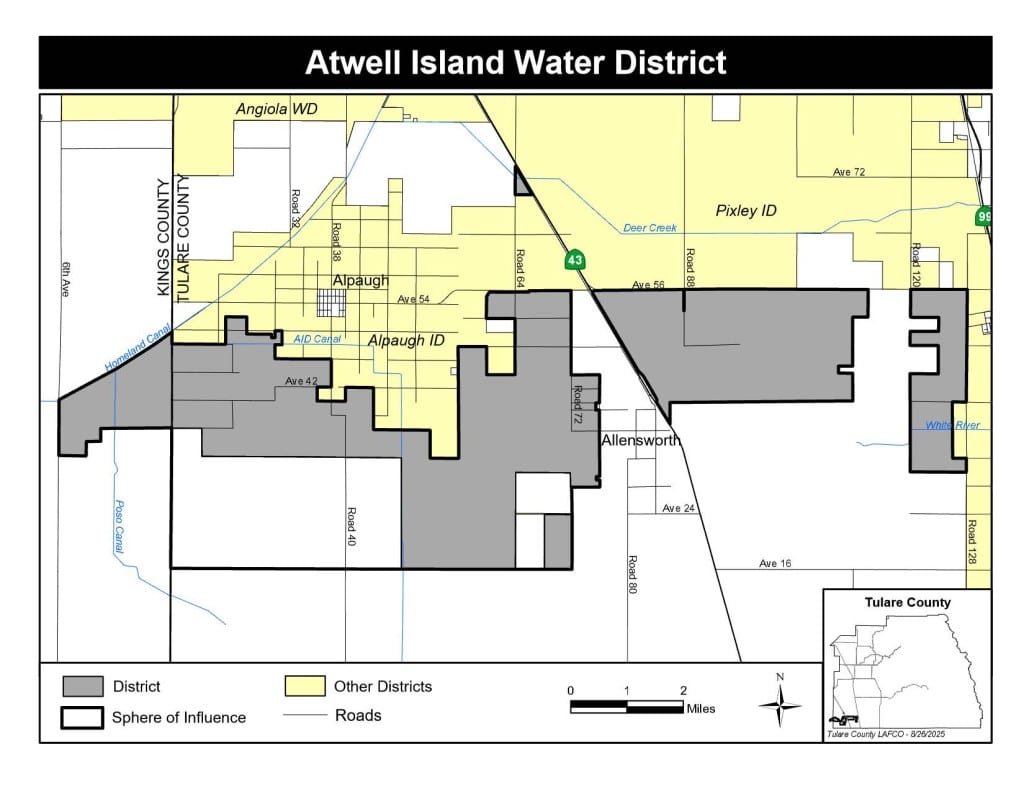
The district feared Atwell was engineering an end-run on its ability to move water through Deer Creek and White River. So, Alpaugh sued Atwell and Tulare County Local Agency Formation Commission (LAFCo) for approving the annexation.
The settlement acknowledges Alpaugh’s historical use of Deer Creek and White River, which it uses to move water through its 10,000-acre service area, including storing flood water in its 4,000-acre-foot holding basins. And it requires Atwell to coordinate and communicate in advance with Alpaugh.
“I’ll just say that we were concerned that there wasn’t an explanation of anything,” Battles said. “We just need to know what is going on.”
Settling was also a business decision, he added.
“We have spent quite a bit of money in attorney’s fees over the time this has been going on,” he said. “We kind of thought it was only gonna get worse, and we didn’t know what our chances were at the end of this thing. So, we sat down and started communicating more.”
Vocal opposition
Local newspaper columnist Trudy Wischemann also spoke out against the annexation last year, and was dismayed by the settlement. She has been a vocal opponent of water districts increasing their power and influence through annexing new lands.
Water districts allocate votes based on acreage owned. That allows Atwell’s larger landowners, including John Vidovich, who controls Sandridge Partners LP for example, to hold more sway over smaller growers.
She scoffs at the idea that Atwell Island will be a good neighbor to Alpaugh ID, especially since no CEQA review is required for any projects.
“The substitution of this settlement agreement and whatever cooperative arrangement they will derive regarding Deer Creek and White River is a great minimization, a reduction of the public interest issues to private ones,” she wrote in an email.
Her concern is that large farmers, such as Vidovich, could export native groundwater out of the area. She referenced a 2018 article by Mark Arax in which Vidovich admitted to such exports. He has since denied he is moving groundwater out of the region.
“The thing about groundwater pumping, which we see in the Tule and Tulare Lake subbasins, is that it goes on without remorse, emptying and collapsing aquifers out of sight,” Wischemann stated. “Once the groundwater is gone, it’s gone, and no amount of legal recourse can bring it back. Even the most outrageous judges will throw up their hands – what restitution can be made to restore a whole region when its water is gone?”
Always time
Battles is more optimistic about the future.
The settlement also stipulates that Atwell will provide Alpaugh with at least 30 days notice of any approval of projects or action involving the annexed land, including water conveyance, pumping, pipelines, canals or other water infrastructure.
“If they come up with something, there may be opportunities for a joint venture there,” Battles said. “That’s something that you can’t always be afraid of. There’s always time, if you don’t agree with something, to argue about it.”
Such communication and coordination is sorely lacking in the Tule subbasin, Battles said.
He was referring to the region’s probationary status, handed down by the state Water Resources Control Board in 2024. Under probation, farmers must pay $20 per acre foot, and $300 per well. They must also report their groundwater extractions.
The subbasin faces a state-mandated pumping plan that could take effect next year if water managers can’t write an adequate groundwater management plan. Pumping fees also would increase to $35 an acre foot.
Offering a lifeline
Atwell Island Water District nearly tripled in size last year when it annexed more than 13,000 acres of “white lands” in an effort to bring more acres into its service area. White lands are outside of water district boundaries and rely almost entirely on groundwater.
White lands have become pariahs as water districts struggle to comply with the Sustainable Groundwater Management Act, which mandates that aquifers reach balance by 2040. Because they don’t buy surface supplies through water districts, white land farmers face almost certain extinction as groundwater agencies restrict pumping below what they need to continue farming.
If they are annexed into districts, the hope is they can participate in water purchases to continue farming.
Other Tulare County water districts have also annexed white lands. Those include Ducor, Hope, St. Johns and Consolidated.
Battles took the reins of Alpaugh ID in April from manager Bruce Howarth, who retired just before the lawsuits were filed.
At a LAFCo hearing in January 2025, Howarth protested the annexation, citing a lack of notification, fear of groundwater exports and violation of the California Environmental Quality Act (CEQA) with any potential water storage projects.
Atwell Island manager Alan Becker said the district initiated the annexation to bring its management over a larger area. Becker said no projects are planned on the annexed lands, which brings the district to 21,000 acres.
“The annexation is a measure to increase flexibility and ensure Atwell Island is prepared to explore any opportunities that become available in the future,” he wrote in an email.
Atwell Island has a sub-contract for 50 acre feet of water through the Cross Valley Canal in Kern County.