

UC Santa Cruz researchers use passive resin samplers to track chemical cues, extending predictive lead time for harmful algal blooms in Monterey Bay by up to seven weeks.
By Mike Peña, UC Santa Cruz
Key takeaways
- UC Santa Cruz researchers adapted a new technique to measure chemical “alarm cues” from marine predators and forecast toxic algal blooms up to seven weeks in advance.
- This monitoring approach could be integrated into existing programs, providing coastal managers and shellfish growers with more than a month of extra warning time.
- The results contribute a new, top-down perspective on harmful algal bloom monitoring to help protect marine wildlife from fatal neurotoxin poisoning and prevent costly emergency shutdowns of California’s coastal fisheries.
A team of marine scientists led by researchers at the University of California, Santa Cruz, has unlocked a novel approach to predicting harmful algal blooms (HABs), fundamentally shifting how oceanographers track these hazardous marine events.
In a study publishing this week in the Proceedings of the National Academy of Sciences (PNAS), the researchers demonstrated that passively measuring chemical “alarm cues” produced by microscopic ocean predators—a group of polar lipids known as copepodamides—allows scientists to forecast toxic algal blooms up to seven weeks in advance. This “top-down” biological monitoring technique extends predictive lead time by more than a month compared to conventional toxin-tracking methods, giving coastal agencies and shellfish fisheries critical advance warning before toxins reach dangerous levels.
For decades, ocean-forecast models have focused almost exclusively on “bottom-up” physical and environmental drivers, such as ocean currents, water temperature, and nutrient upwelling, according to the study’s senior author, Distinguished Ocean Sciences Professor Raphael Kudela.
“By capturing the chemical signals of biological predators, we’ve opened up a vital top-down window into ecosystem dynamics,” Kudela said. “By ‘listening’ to chemical interactions between marine grazers and algae, we can add a new and reliable monitoring technique to our early-warning toolbox.”
Decoding chemical cues in Monterey Bay
Harmful algal blooms in the California Current System are primarily driven by Pseudo-nitzschia, a genus of microscopic marine diatoms capable of producing the potent neurotoxin domoic acid. When tiny herbivorous crustaceans called copepods graze on phytoplankton, they release trace chemical compounds known as copepodamides. These lipids act as an aquatic “predator scent,” or alarm signal. Diatoms like Pseudo-nitzschia detect these grazer cues and respond by activating defensive mechanisms, including a dramatic increase in domoic-acid production to potentially deter grazers.
“Globally, researchers are continuing to find new instances of predator-induced toxin production in different species of harmful algae,” said Aubrey Trapp, the study’s corresponding author. Trapp finished her Ph.D. dissertation in Kudela’s lab and is now a postdoctoral scholar at Northwest Indian College in Bellingham, Wash.
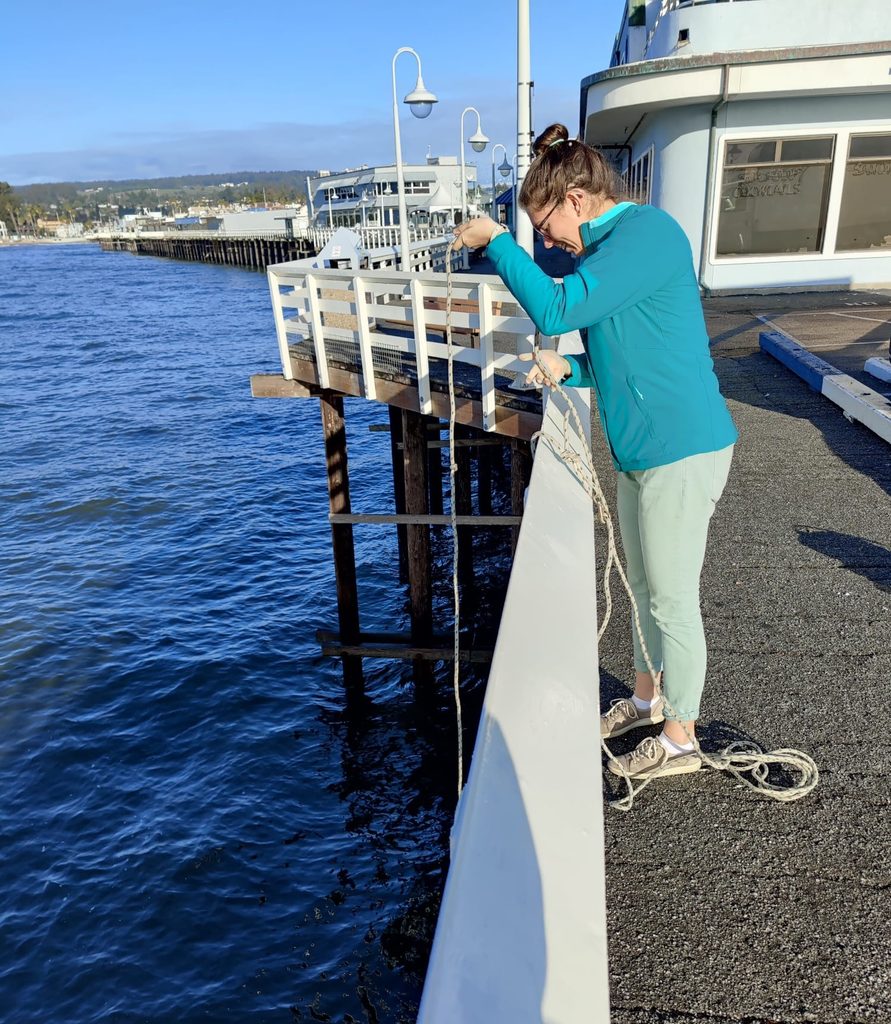
In marine environments, ambient copepodamides are dilute and degrade rapidly, making them historically difficult to measure in open seawater. To overcome this challenge, the research team adapted “Solid-Phase Adsorption Toxin Tracking” (SPATT)—a passive sampling technology that uses porous resin beads suspended in mesh rings to continuously absorb dissolved compounds directly from ocean water over days or weeks.
Over a 28-month monitoring campaign at the Santa Cruz Municipal Wharf—a recognized hotspot in Monterey Bay for toxic bloom activity—the team showed that SPATT samplers reliably captured copepodamide concentrations, which correlated directly with zooplankton net counts. Subsequent lab experiments at UC Santa Cruz confirmed that exposing local Pacific strains of Pseudo-nitzschia to copepodamides triggered a tenfold surge in cellular toxin production.
Gaining weeks of lead time for bloom prediction
Current public-health monitoring relies on measuring toxin levels in seawater or shellfish tissue, which often provides coastal managers with only days to a week of notice before harvesting closures must be enforced.
By building statistical prediction models using the Monterey Bay dataset, the researchers found that monitoring copepodamide cues with SPATT resins predicted blooms of Pseudo-nitzschia diatoms six weeks in advance with high statistical accuracy. For predicting domoic-acid contamination in sentinel mussels above safety thresholds, copepodamide tracking provided a seven-week predictive lead time.
In contrast, conventional models tracking domoic acid directly achieved peak predictive accuracy at only one week of lead time.
Crucially, the copepodamide detection technique significantly reduced false-negative rates. In seafood-safety management, false negatives—failing to detect contamination before toxic shellfish enter the market or food supply—represent the most hazardous outcome. The new copepodamide models could successfully alert managers to 22% of high-toxin events seven weeks in advance, compared to just 14% of events alerted one week in advance by standard toxin tracking.
Protecting California’s marine wildlife and coastal economies
Developing early-warning systems for domoic acid is vital because the neurotoxin creates harmful ripple effects across marine food webs and coastal human communities.
When Pseudo-nitzschia blooms surge, domoic acid bioaccumulates up the food chain: accumulating first in filter-feeding shellfish, anchovies, and sardines, and subsequently poisoning higher-level predators. In marine mammals and seabirds, domoic acid poisoning causes severe neurological damage, disorientation, seizures, and death.
Over the past two decades, toxic blooms in Monterey Bay and along the Pacific coast have caused widespread strandings and mortalities among California sea lions, sea otters, brown pelicans, and humpback whales.
When toxin levels exceed federal safety thresholds—20 micrograms of domoic acid per gram of tissue—regulatory agencies must implement immediate harvesting bans to prevent Amnesic Shellfish Poisoning in humans. These emergency shutdowns frequently force extended closures of high-value commercial and recreational fisheries, including Dungeness crab, rock crab, razor clam, sardine, and anchovy fisheries.
Unpredicted fishery closures cost California coastal communities tens of millions of dollars in lost revenue, disrupt tribal subsistence harvests, and harm local tourism economies dependent on coastal recreation.
A pioneer in harmful algal bloom research
Kudela, an internationally recognized expert in marine ecology and bloom forecasting, has spent decades at the forefront of marine-toxin research and observing innovation. The Kudela Lab at UC Santa Cruz has pioneered major coastal-observing initiatives, including the California Harmful Algae Risk Mapping (C-HARM) system, which combines satellite oceanography, numerical circulation models, and field data to generate routine hazard maps for the California Current. His research bridges high-resolution chemical oceanography, cellular biology, and predictive modeling to safeguard public and ocean health.

Kudela said this study is a major leap forward because SPATT passive samplers are already deployed routinely by monitoring networks along the Pacific coast and globally. “By simply analyzing those existing resin samplers for grazer chemical signals alongside target toxins, coastal agencies can plug top-down information directly into our current warning networks without needing expensive new infrastructure,” he said. “Looking ahead, our goal is to adapt this passive sampling technology for deployment on autonomous underwater vehicles and gliders that would deliver real-time, high-resolution predictive risk maps across the entire California Current System.”
The study, a collaboration among UC Santa Cruz, Northwest Indian College, and Lund University, was funded by several grants from the National Oceanic and Atmospheric Administration.

